The Missing Link: Why Most AI Initiatives Never Reach the Shop Floor - And How Leaders Close the Gap
PHYSICAL AI · INDUSTRIAL AI · JUNE 2026 · ENERGY DOMINANCE - WEEK 25 · PART II
The Pilot Graveyard in Manufacturing: Why 80%+ of AI Projects Fail to Scale from Data-Center Hype to Real Shop-Floor Impact, and the Proven Bridges That Turn Experiments into Production Reality.
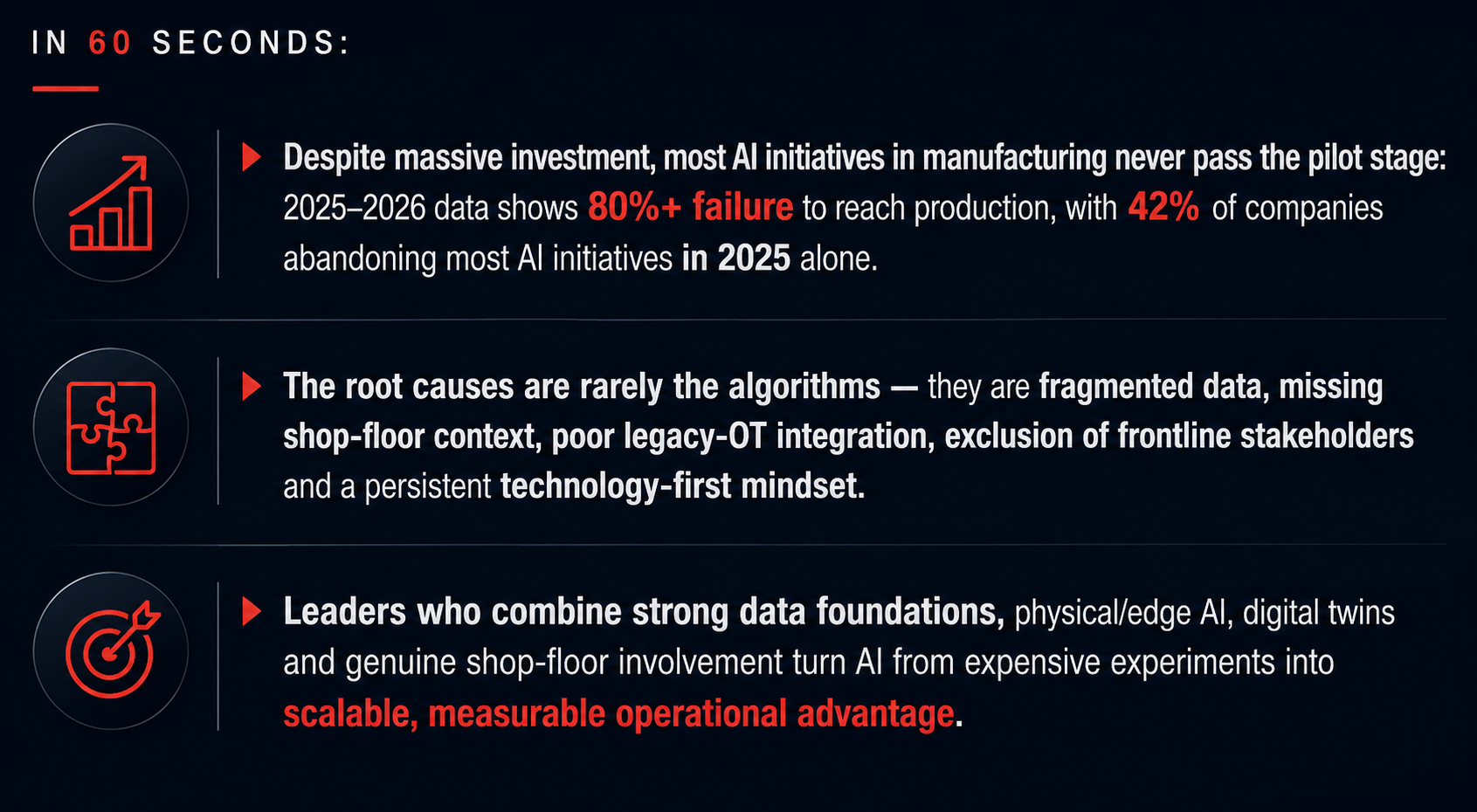
Part I argued that the future of AI value lives on the factory floor, not in the cloud. There is just one problem: most of it never gets there. For every triumphant pilot showcased at a trade fair, a quiet graveyard fills with experiments that worked in the lab and died on contact with a real production line.
Efficiency Before Fuel is brutal here: an AI initiative that never reaches the shop floor burns budget, attention and credibility while producing zero operational return. The waste is not in the silicon, it is in the gap between ambition and deployment.
This is Part II of Week 25. That gap is a decision, not a destiny, and the leaders who close it are building bridges that everyone else assumed were someone else's job.
Executive Summary
1. The Scale of the Problem: The Pilot Graveyard in Manufacturing
Industry surveys and studies from 2025–2026 paint a sobering picture. RAND research indicates over 80% of AI projects fail to reach meaningful production deployment, roughly double the rate of traditional IT projects. Gartner notes that only about 48% of AI projects make it into production, taking on average 8 months from prototype to deployment.
S&P Global's 2025 executive survey found that 42% of organizations abandoned most of their AI initiatives in 2025 (up sharply from 17% the previous year), while 46% of proof-of-concepts were scrapped before delivering value. In manufacturing specifically, many promising pilots stall because they were developed in isolation from the messy realities of brownfield factories.
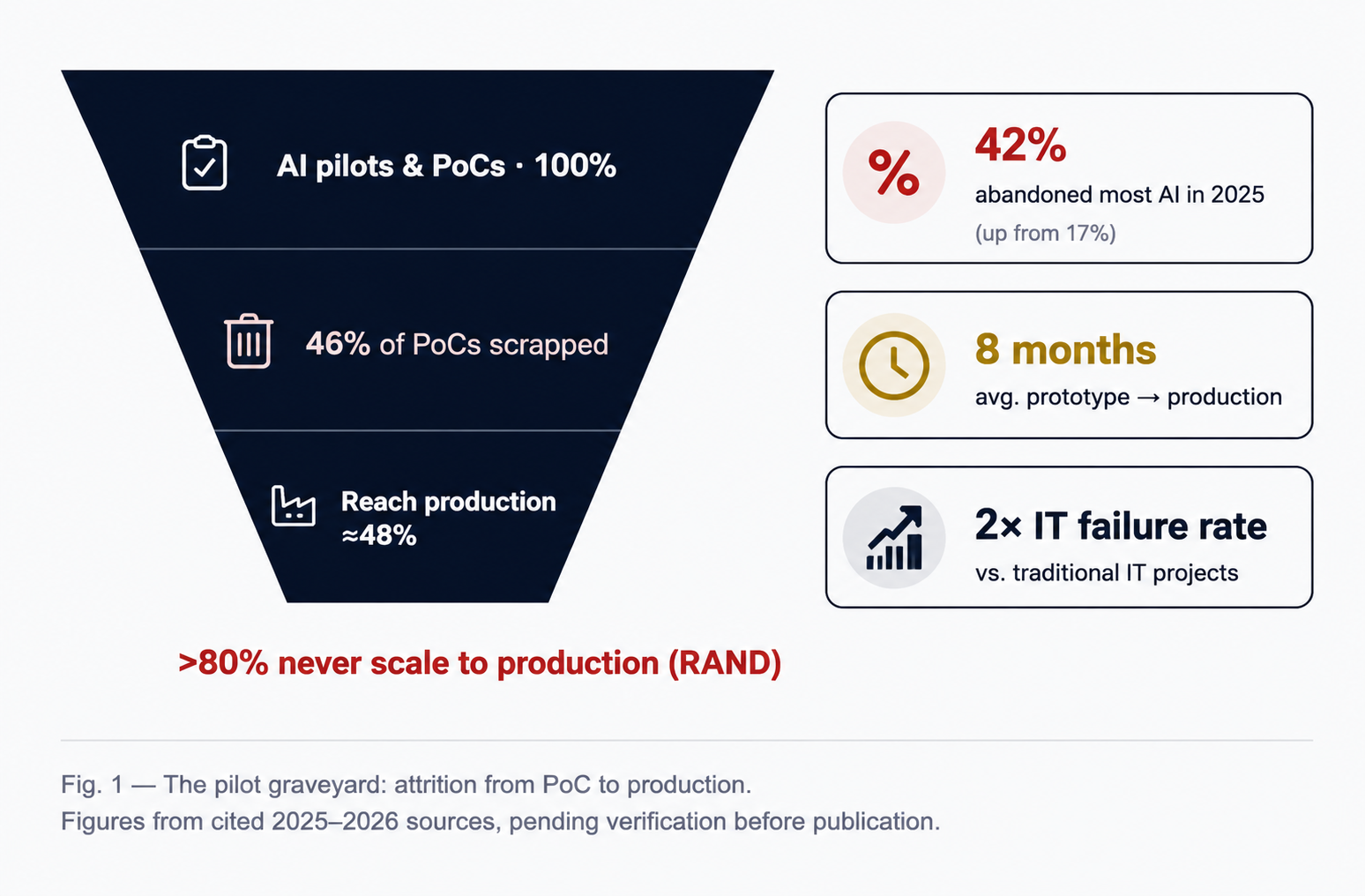
👉 Key Insight: The failure is systemic and organizational far more often than it is technical.
2. The Real Missing Links – Why AI Stalls Before It Reaches the Shop Floor
The primary barriers are well documented across 2025–2026 sources:
▸Data and context gaps: fragmented, poor-quality or inaccessible data from legacy machines; lack of operational/shop-floor insight when use cases are defined.
▸Integration and infrastructure issues: difficulty connecting AI to existing ERP/MES/SCADA/OT systems in brownfield environments.
▸People and change management: frontline operators and OT teams often excluded from design and rollout; skills gaps and resistance.
▸Misaligned approach: technology-first or hype-driven projects instead of starting with clear, measurable shop-floor problems and defined ownership.
▸Governance and expectations: unrealistic ROI timelines, missing risk/safety frameworks for physical systems, and lack of cross-functional accountability.
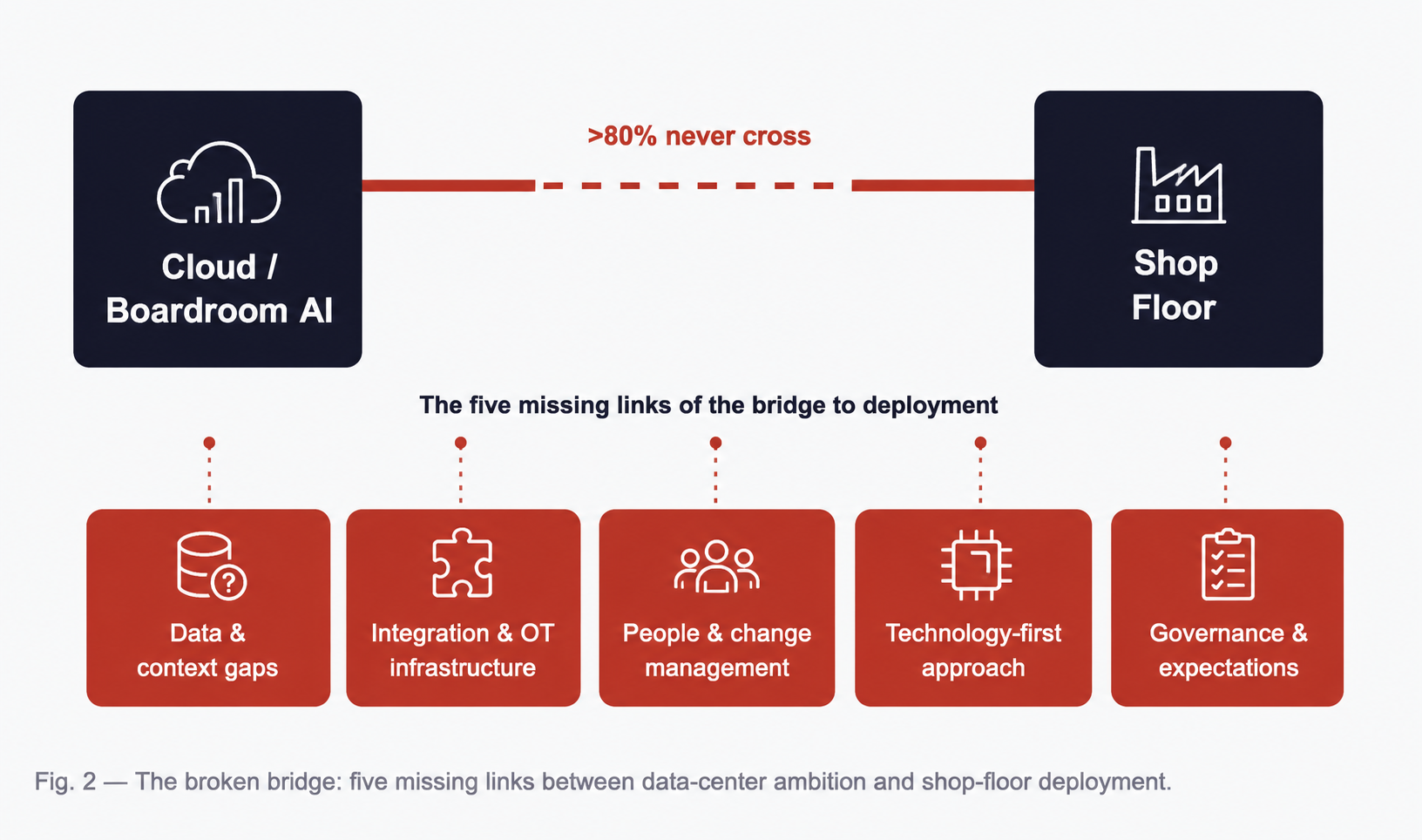
👉 Key Insight: Most AI initiatives are built for the data center or the boardroom, not for the noisy, variable, safety-critical reality of the shop floor.
3. How Leading Organizations Are Closing the Gap in 2026
Successful deployments share common patterns. They start with high-ROI, well-defined shop-floor problems (predictive maintenance, real-time quality inspection, flexible assembly) and involve operators early. They build proper data foundations and use digital twins + simulation (e.g. NVIDIA Omniverse) for safe sim-to-real transfer. They adopt hybrid edge + physical AI architectures that integrate with legacy systems rather than rip-and-replace. They leverage strong industrial partnerships (Siemens + NVIDIA Industrial AI Operating System, Universal Robots + ecosystem players, specialized edge AI/sensor companies). And they treat change management and frontline leadership as core workstreams, not afterthoughts.
Early 2026 examples include scaled predictive maintenance reducing unplanned downtime significantly, vision-based inspection paying for itself quickly through scrap/rework reduction, and pilot-to-production humanoid/cobot deployments in automotive and electronics.
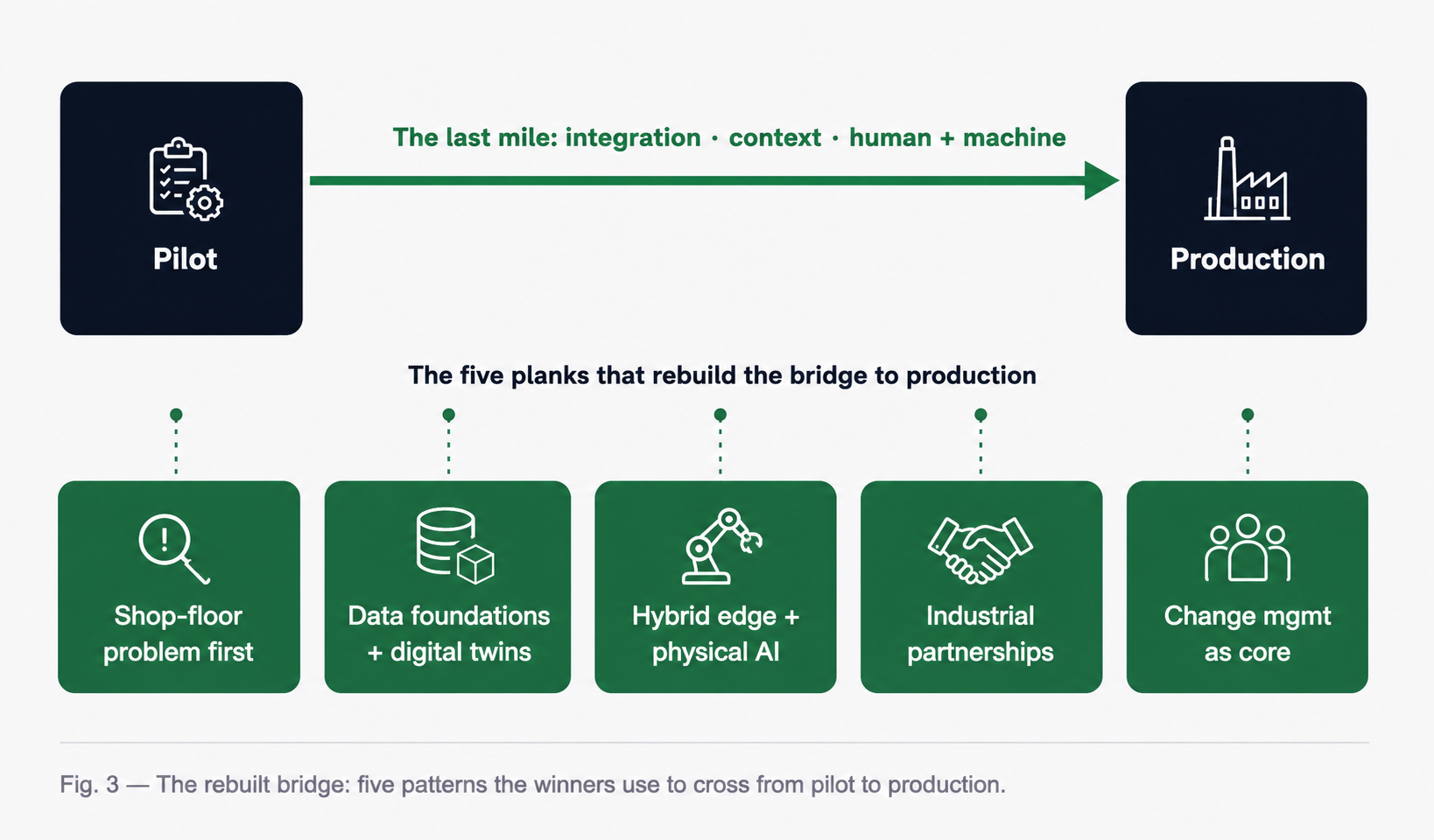
👉 Key Insight: The winners are not those with the most advanced models, they are those who master the last mile of integration, context, and human + machine collaboration on the factory floor.
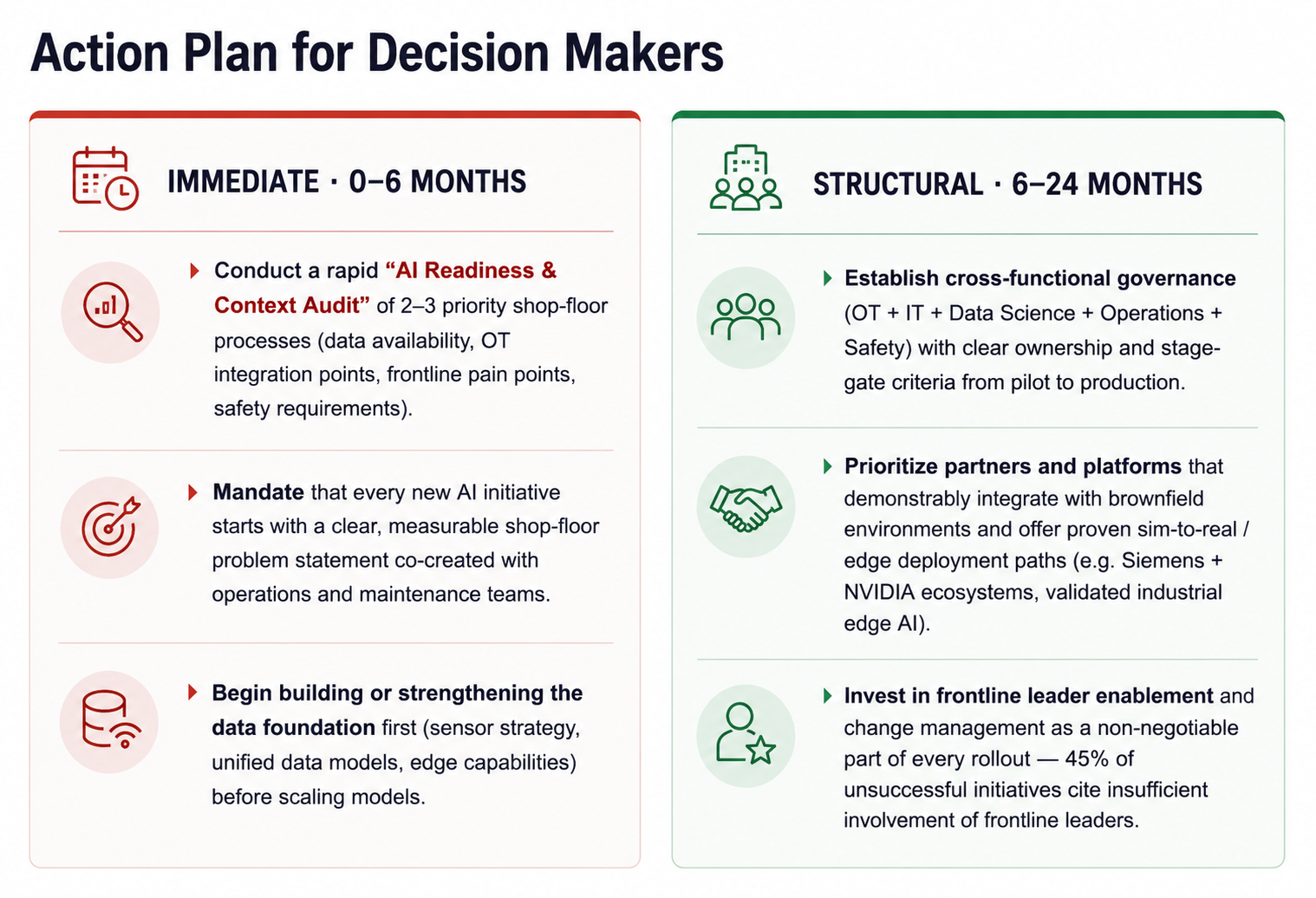
Action Plan for Decision Makers
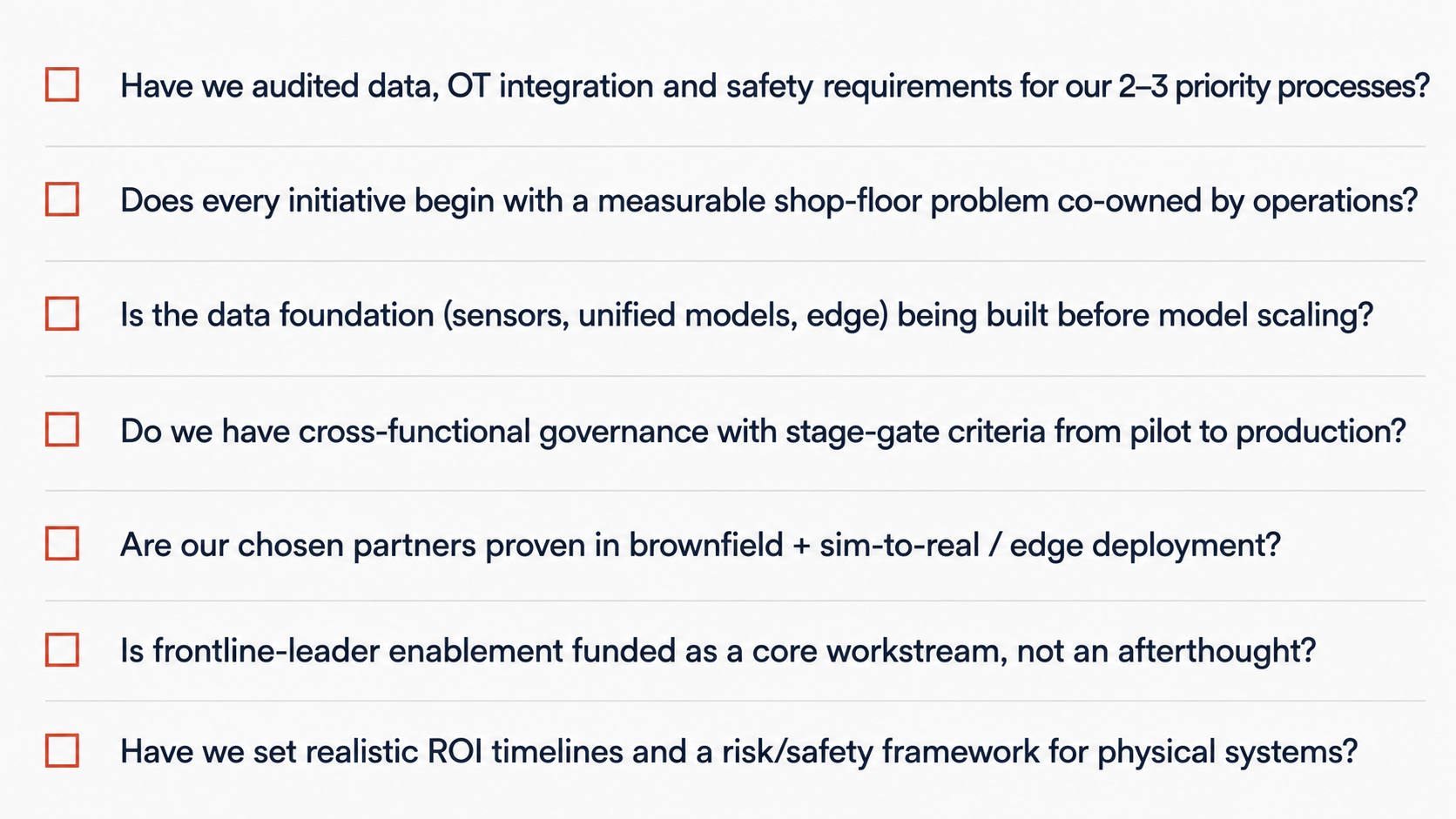
Decision Checklist
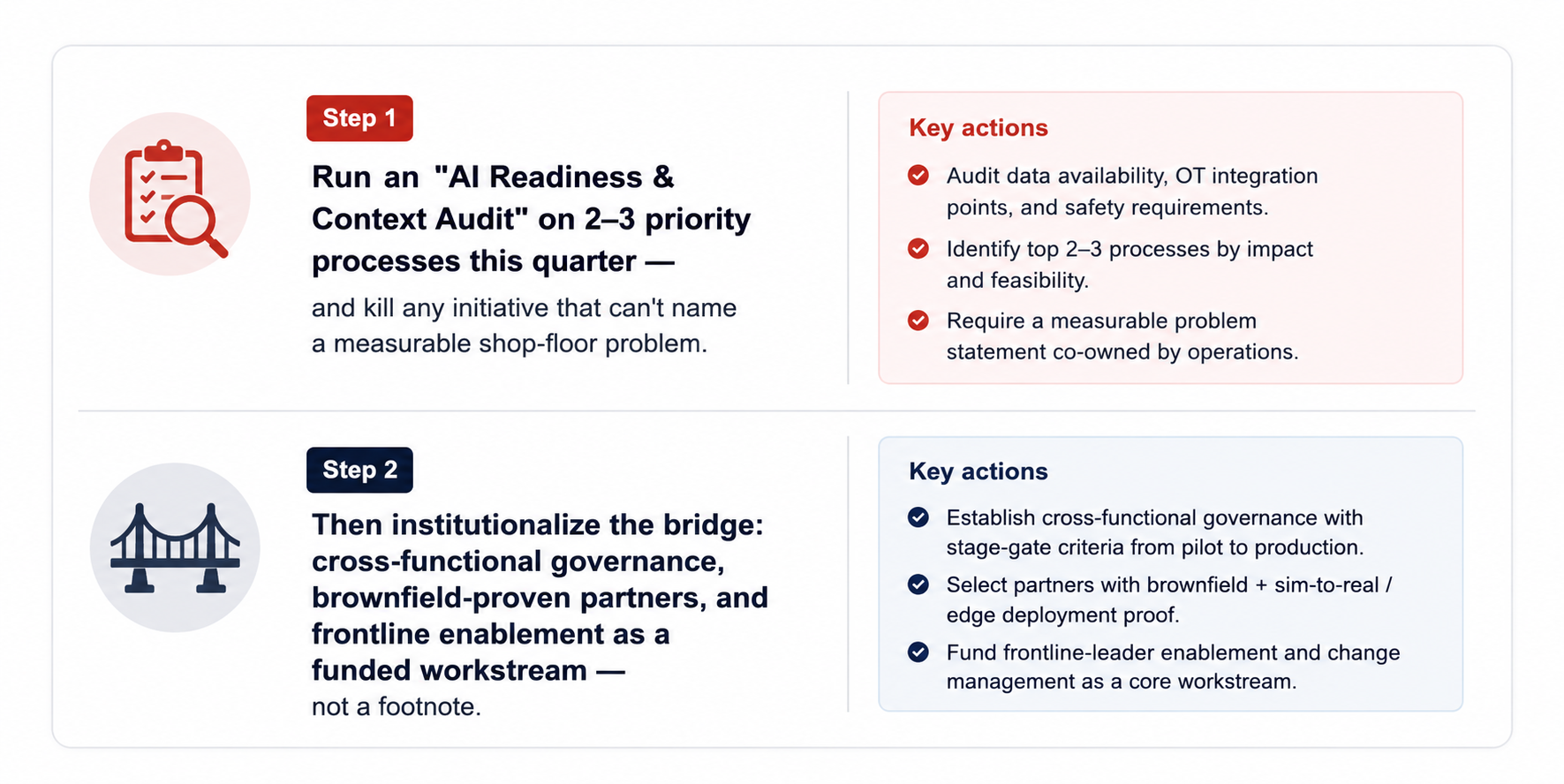
Final Thought
The pilot graveyard is not filled with bad algorithms. It is filled with good ideas that no one designed a path for. Every missing link, the unintegrated OT system, the operator never consulted, the ROI timeline no one questioned, was a decision made by omission. Ownership as Design means the opposite: deciding, deliberately, who owns the last mile, what counts as production, and how the bridge gets built before the pilot ever starts. The technology was never the hard part.
Systems don't fail. Decisions do.
Take the Next Step
Subscribe to the Weekly Punch for weekly strategic clarity, direct to your inbox.
References
RAND Corporation (2025/2026) Research on AI Project Failure.
Gartner (2025) AI Project Production Rates & GenAI Abandonment.
S&P Global Market Intelligence (2025) Executive Survey on AI Initiative Abandonment.
Informatica (2025) CDO Insights Survey: Data Quality as Top Barrier.
Wirtek, vStorm, Tulip.co & Invisible AI (2025–2026) Manufacturing-Specific AI Stall-Point Analyses.
Capgemini Research Institute (2026) Physical AI Report.
Siemens & NVIDIA (2026) Industrial AI Operating System & Factory Deployments (CES & 2026 updates).
World Economic Forum & Deloitte (2025–2026) Physical AI in Manufacturing.
Hannover Messe (2026) Industry Case Examples; automotive & electronics deployments.
Note: This article reflects my personalviews based on industry experience and publicly available information. It does not constitute professional, legal, or investment advice and does not represent the views of my employer. AI-generated visuals, concept and content by the author.
