When Machines Start Making Decisions: The Shift from Generative AI to Autonomous Operations

PHYSICAL AI | AUTONOMOUS OPERATIONS | JUNE 2026
From Powerful Digital Co-Pilots to Closed-Loop Agentic Systems | How Physical AI and Autonomous Decision-Making Are Turning Insights into Self-Optimizing Factory Operations in 2026
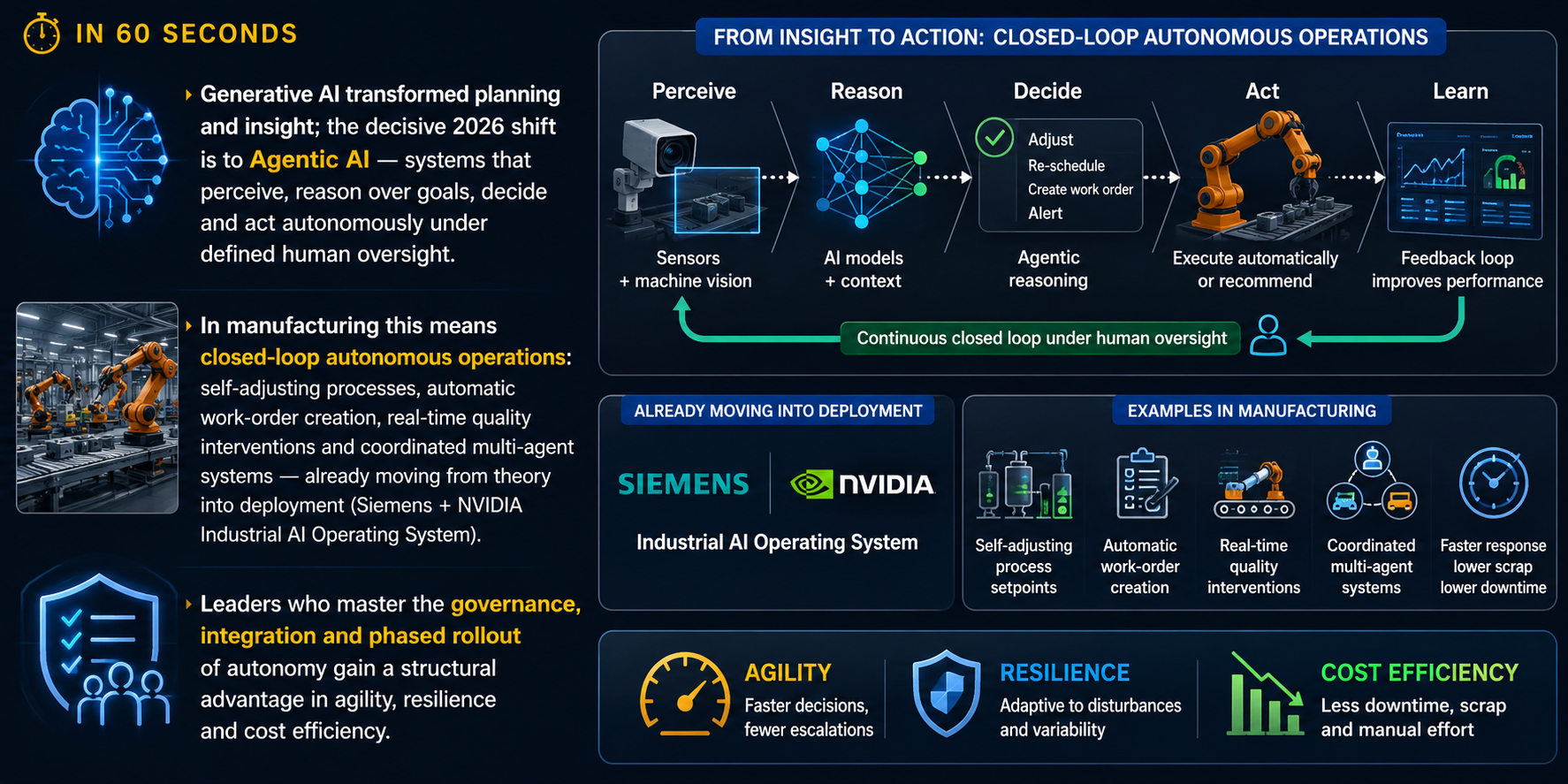
This is Part I of Week 26, the next evolutionary step beyond Generative AI and Physical AI deployment: the rise of Agentic AI and autonomous operations, where machines don't just analyze or recommend, they perceive, decide and act with increasing independence on the shop floor.
For three years, the conversation about AI on the factory floor has been about better answers, better forecasts, better simulations, better dashboards. But a recommendation no one acts on is just expensive intuition. In 2026 the frontier moves from advice to action: machines that don't wait to be told.
This is the logic of Efficiency Before Fuel applied to intelligence itself. Before adding more compute, more headcount or more capacity, you first compress the distance between knowing and doing. Agentic AI is that compression, and Part I maps the shift before Part II turns to what it demands of leadership.
Executive Summary
1. From Generative AI to Agentic AI: The Critical Leap in Industrial Contexts
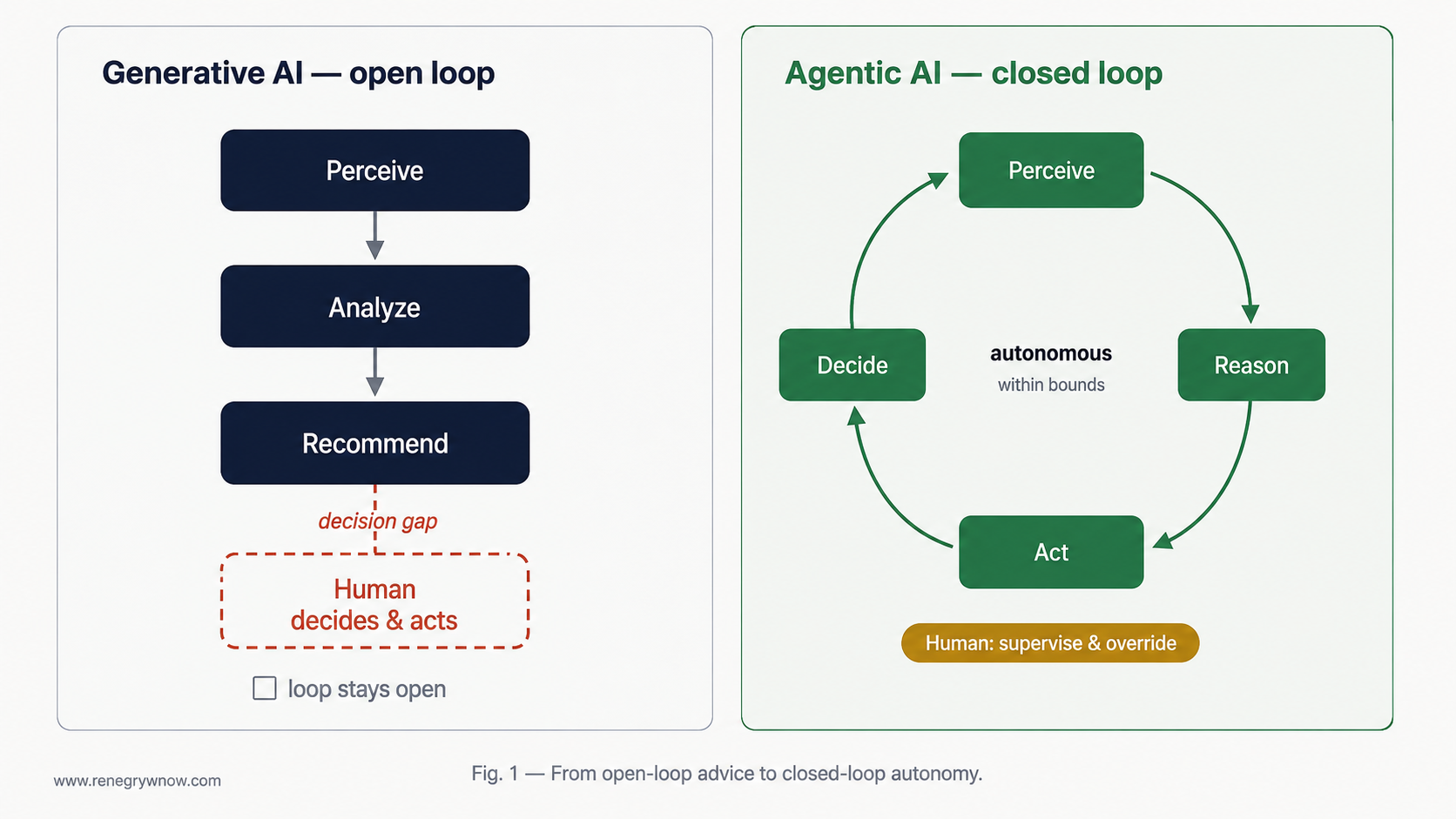
Ask most plants what their AI does today and the honest answer is: it tells people things. It forecasts demand, simulates a line change, flags an anomaly. Useful, but every one of those outputs still waits at the same bottleneck: a human deciding whether to act.
Generative AI is built to produce, content, simulations, recommendations, and then stop. Agentic AI is built to pursue. It holds a goal, reasons over changing conditions, plans a sequence of steps, and executes them by writing into the systems that actually run the floor: PLCs, robots, edge controllers. That last capability, safe, bounded write-access to OT, is what turns analysis into a closed loop.
Concretely: a quality agent that detects drift in tolerance doesn't just raise an alarm on a dashboard. Within its authorized envelope it can nudge a machine parameter back into spec, or trigger a controlled stop and open a work order, in the seconds before scrap accumulates, not the minutes after someone notices the alert.
2. What Autonomous Operations Look Like on the Shop Floor in 2026
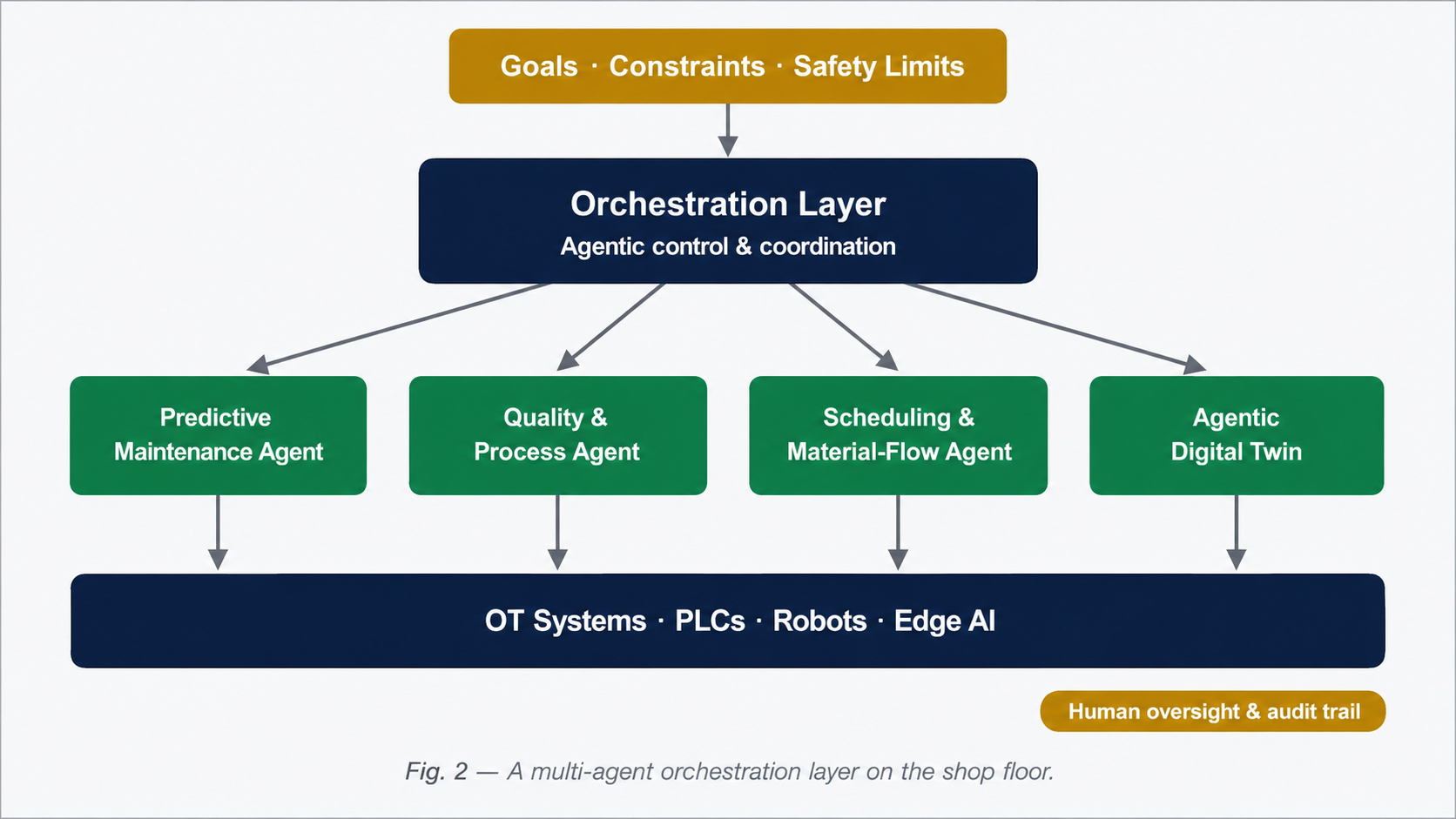
"Autonomous operations" sounds like an empty factory. In 2026 it looks like something far more specific: narrow, well-instrumented agents owning particular jobs.
Predictive-maintenance agents detect anomalies, diagnose root cause, and create and prioritize work orders, in some cases initiating the intervention themselves. Quality and process agentsread live sensor and vision data and adjust parameters on the fly, coordinating with upstream and downstream steps. Multi-agent systems orchestrate scheduling, material flow and exception handling across cells with minimal human intervention. And agentic digital twins don't just simulate, they propose and validate an optimization before it ever touches the physical line.
The enabling layer is arriving fast. The Siemens–NVIDIA "Industrial AI Operating System," announced at CES 2026, targets the first AI-driven adaptive manufacturing sites this year, with Erlangen cited as an early blueprint. Maturing edge-AI hardware and robust simulation-to-real frameworks are what let these agents run reliably outside the lab.
3. Quantified Impact and Early Proof Points
The strategic question isn't whether agentic AI works in a demo. It's how fast it's actually spreading, and what it pays back.
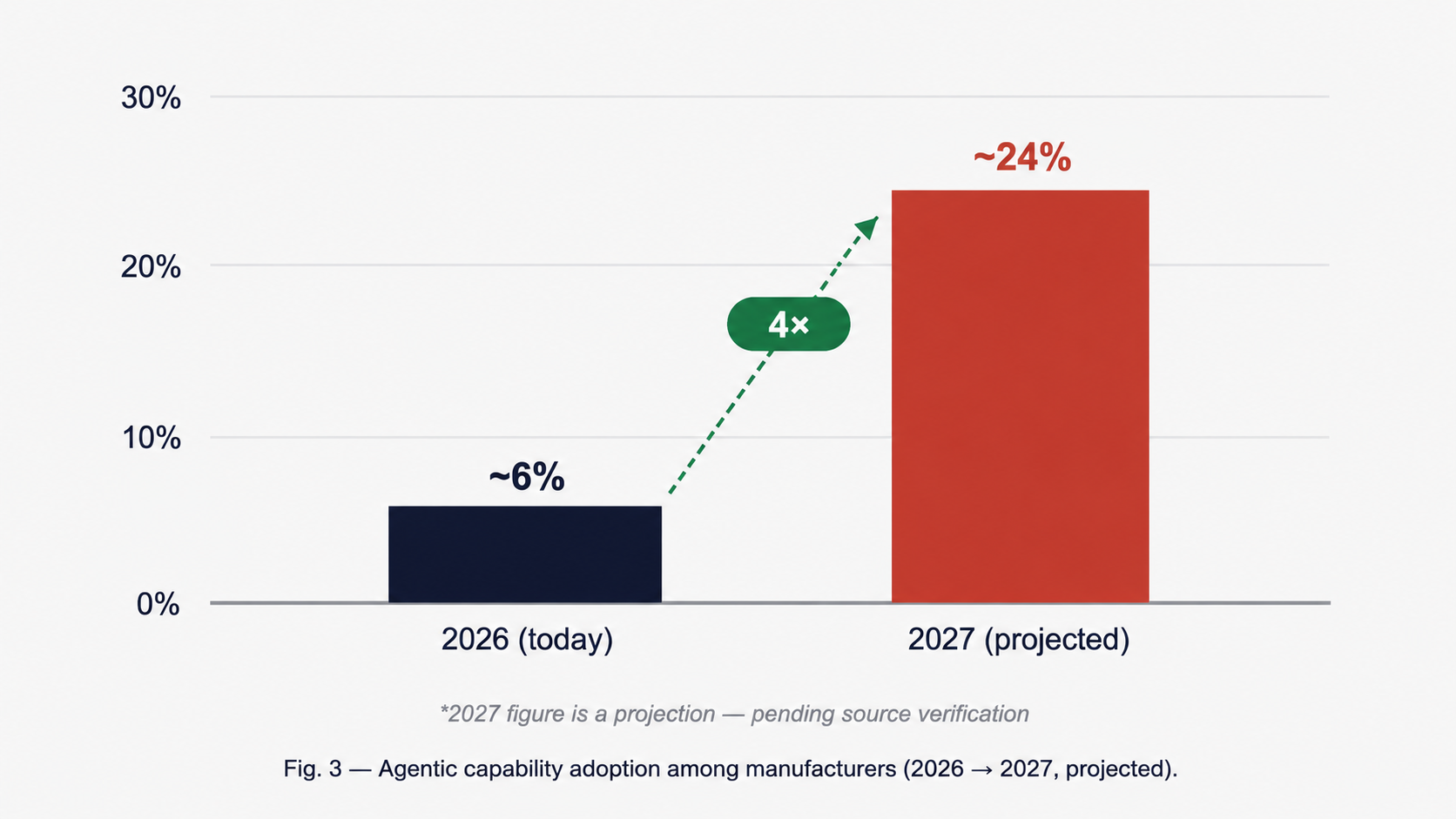
Today only about 6% of manufacturers use advanced agentic capabilities, but adoption is projected to roughly quadruple by 2027 (Deloitte / Manufacturing Leadership Council). Early systems in predictive maintenance and quality are already showing meaningful cuts in unplanned downtime and scrap, driven by faster automated closed-loop responses, while multi-agent coordination begins to dissolve long-standing data and process silos.
Underneath it, the combination of edge AI, unified namespaces and agentic frameworks is enabling 24/7 semi-autonomous operation in defined segments, without surrendering traceability or safety compliance.
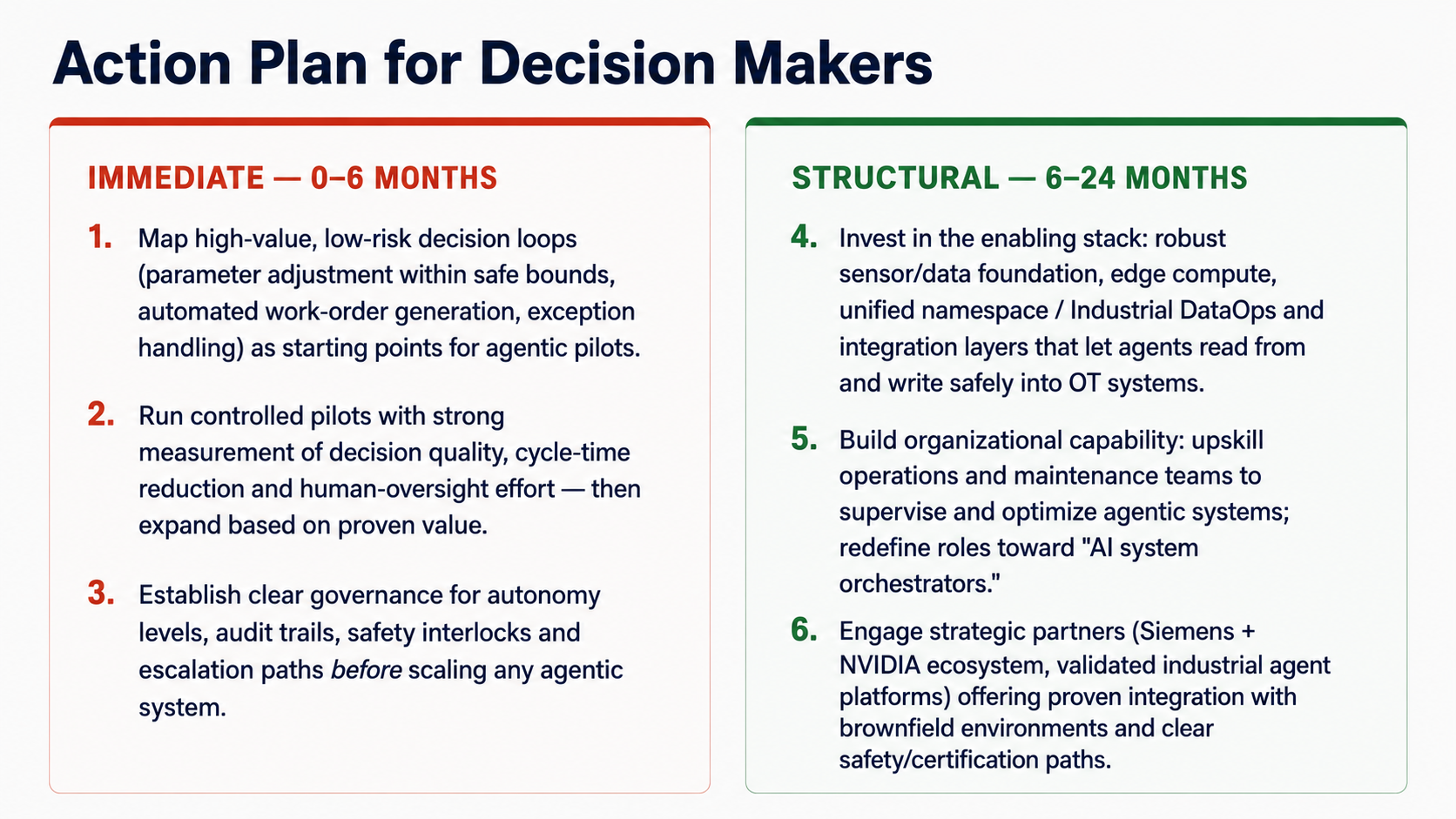
Action Plan for Decision Makers
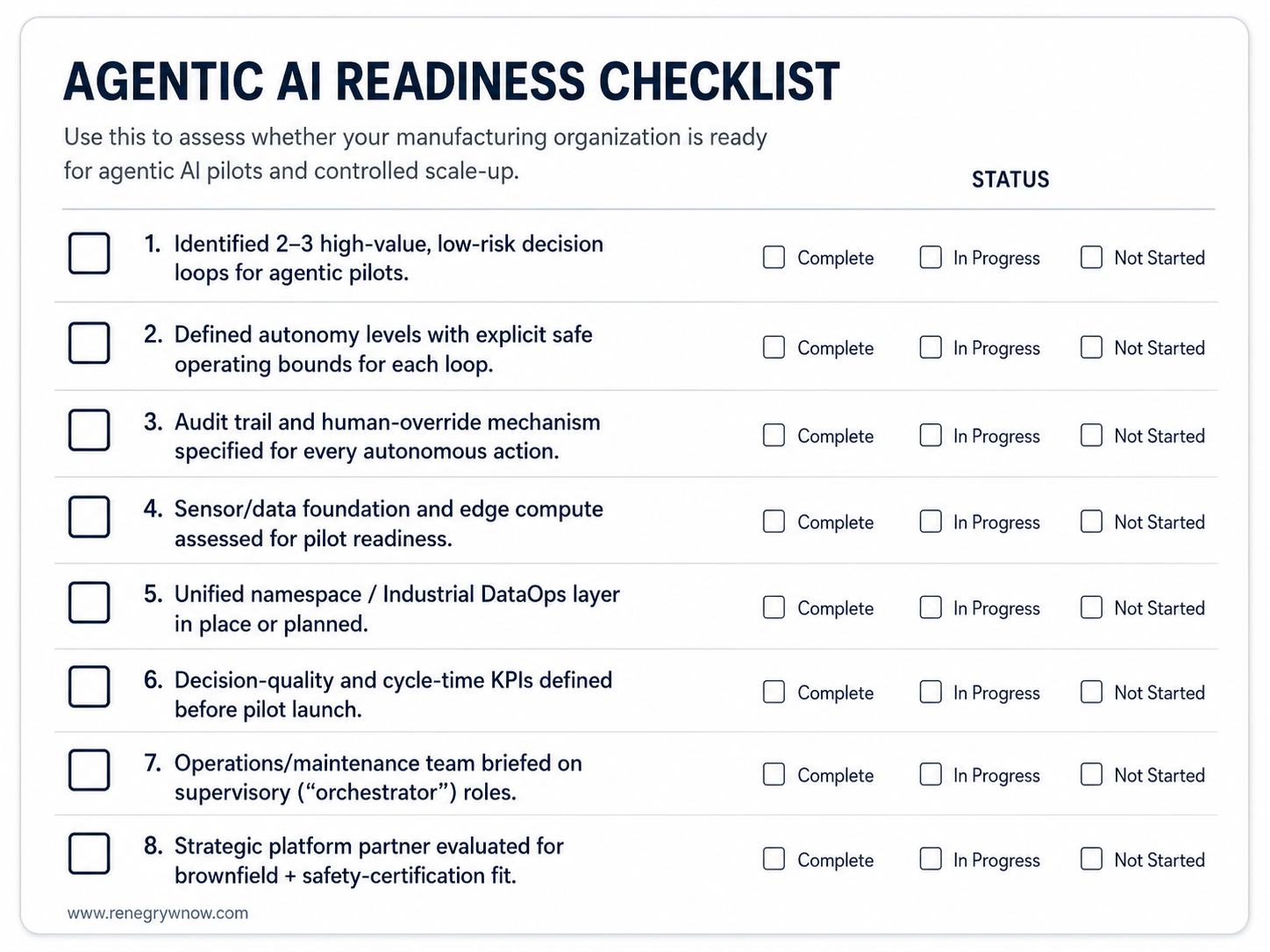
Readiness Checklist
Final Thought
The factories that pull ahead in 2026 won't be the ones with the most data or the largest models. They'll be the ones that handed well-bounded decisions to systems that can act on them faster than any human shift can, while keeping people firmly in command of the boundaries.
Autonomy is not abdication. It is design: deciding in advance which loops a machine may close on its own, and which always return to a person. That choice, not the technology, is what separates resilient operations from fragile ones. Part II turns from the what to the how: the governance and integration architecture that makes this safe at scale.
Because when an autonomous line stops, or fails to stop, the post-mortem never points to the sensor. Systems don't fail. Decisions do.
If your operations team is debating where autonomy belongs, and where it doesn't, Part II is built for exactly that conversation. Read it next.
And if you're scoping your first agentic pilot, let's map your highest-value, lowest-risk decision loop together. Reach out to start the assessment.
Take the Next Step
Subscribe to the Weekly Punch for weekly strategic clarity, direct to your inbox.
References
Capgemini Research Institute (2025) Physical AI and Autonomous Industrial Systems. Capgemini.
Deloitte (2025) From Vision to Value: A Road Map for Enterprise Transformation in Manufacturing with Agentic AI. Deloitte Insights.
Gartner (2026) Manufacturing Predicts 2026: Digital Twins, AI Agents, and the Race to Autonomous Operations. Gartner Research.
Hannover Messe (2026) Real-World Agentic Pilot References, Automotive, Electronics and Process Industries. Hannover Messe 2026.
IIoT World (2026) AI Manufacturing Day 2026: Agentic AI in Smart Factories. IIoT World.
Kanerika (2025) Agentic AI Use Cases in Manufacturing. Kanerika Analysis.
Manufacturing Leadership Council (2025) Agentic AI Adoption Outlook. MLC.
Siemens & NVIDIA (2026) Industrial AI Operating System and AI-Driven Adaptive Factories (CES 2026 announcement; Erlangen blueprint). Siemens / NVIDIA.
World Economic Forum (2025) Physical AI and the Future of Autonomous Operations. WEF.
Disclaimer: This article is provided for general information and strategic-orientation purposes only and does not constitute professional, legal, financial or engineering advice. Market figures and adoption projections cited are subject to source verification and reflect forward-looking estimates that may change. Readers should validate all data against primary sources before making decisions.
Ownership as Design.
© 2026 René Grywnow, DBA | Energy Dominance Series · Week 26, Part I.
Note: This article reflects my personalviews based on industry experience and publicly available information. It does not constitute professional, legal, or investment advice and does not represent the views of my employer. AI-generated visuals, concept and content by the author.
