Who Is Responsible When AI Gets It Wrong on the Factory Floor?
Physical | AI | Accountability | Governance | Manufacturing | Week 30 · Part I
PHYSICAL AI | ACCOUNTABILITY | JULY 2026
The Accountability Gap in Physical and Agentic AI “Why Traditional Responsibility Models Break Down”, When Machines Make Autonomous Decisions, and What Manufacturers Must Do About It
For two years, this series has traced a single idea across ships, supply chains, and now factories: “Efficiency Before Fuel” the deepest inefficiency in any complex system was never the fuel, the material, or the machine. It was the decision behind it.
On the factory floor, that idea is about to meet its hardest test. AI Agents are no longer just recommending what to do, they are doing it: adjusting parameters, rerouting production, shutting down lines. And when one of those decisions turns out to be wrong, the question that follows is no longer academic. It has a euro figure, a safety officer, and sometimes a courtroom attached to it: who, exactly, is responsible?
Executive Summary
IN 60 SECONDS:
Autonomous AI Agents increasingly make shop-floor decisions no single human directly controls, when something breaks, the responsibility chain spans developer, integrator and operator, and is often unclear.
The EU AI Act's high-risk obligations, originally due 2 August 2026, have been postponed to 2 December 2027 under the newly agreed "Digital Omnibus", but transparency duties still apply from August 2026, and the hardest physical-outcome questions remain contractual, not regulatory.
Manufacturers that define accountability before deployment, not after an incident, scale Physical AI faster and with measurably less operational fear.
1. Why Traditional Responsibility Models Fail in the Age of Shop-Floor AI
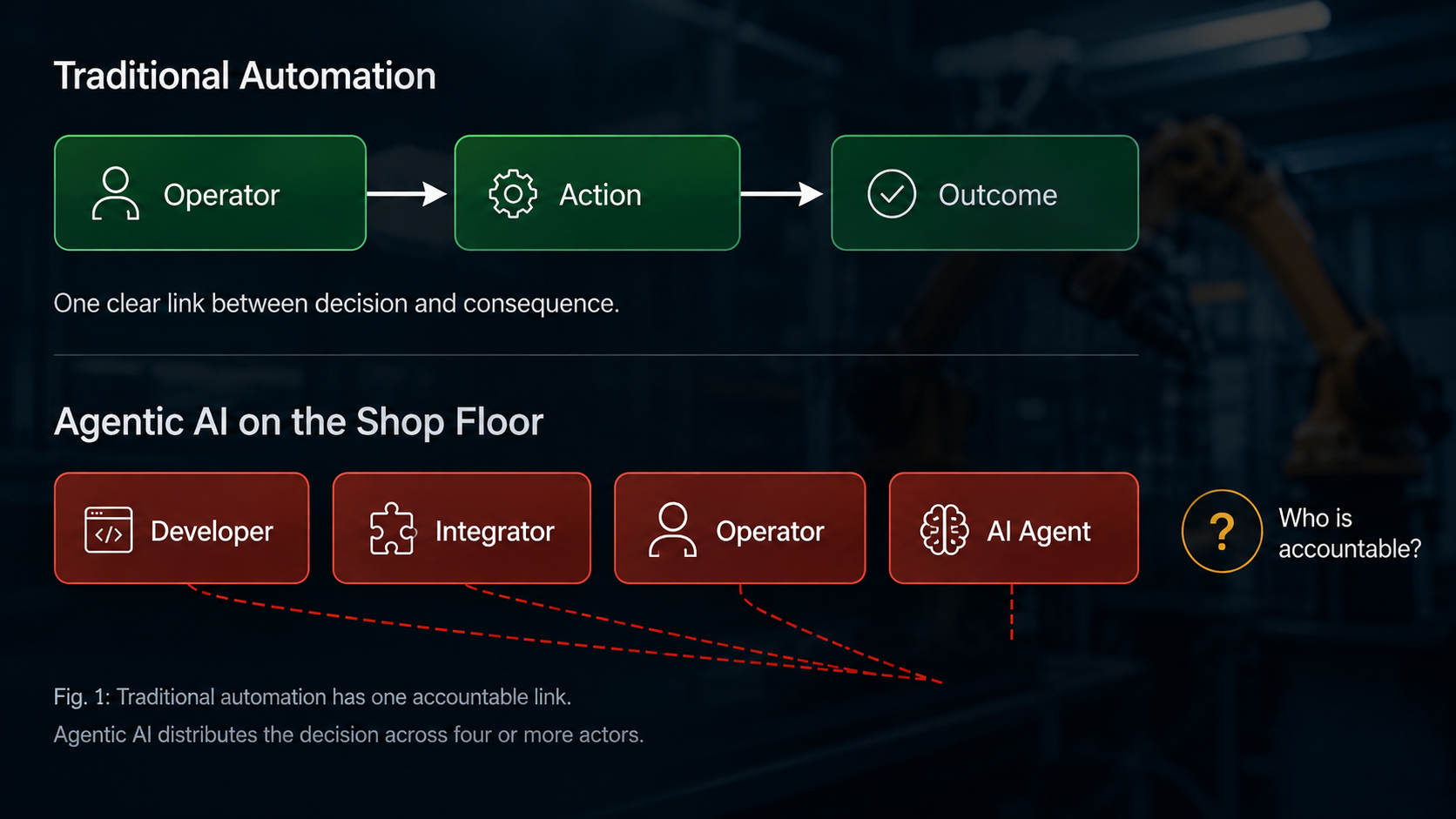
In conventional automation, a wrong outcome has a name, the operator who set the parameter, the supervisor who approved the run. That certainty is disappearing.
With learning or adaptive AI Agents, the decision chain becomes far more complex. The model was trained on certain data by a developer. It was deployed and configured by an integrator. It is supervised, or not, by operations. And it is operating under real-time shop-floor conditions that may differ meaningfully from the conditions it was trained on. When something goes wrong, it is frequently unclear whether the root cause sits in data quality, model behavior, integration choices, human oversight, or a genuinely unforeseen edge case. In conventional automation, that chain had one or two links. In agentic AI, it can have five.
This is not a theoretical gap. Capgemini's 2026 global survey of senior executives found that while a large majority of organizations are already engaging with physical AI, in pilots or full deployment, only a small fraction have reached large-scale deployment, with integration, safety and governance challenges cited among the reasons pilots stall before they scale (Capgemini Research Institute, 2026). Ambiguous accountability sits squarely inside that governance gap: it is one of the quiet reasons pilots stay pilots.
👉 Key Insight
Ambiguous accountability is one of the biggest hidden barriers to scaling Physical AI beyond controlled pilots.
2. The New Accountability Landscape in Industrial Environments
Ask five people in a plant who is accountable for an AI Agent's decision, and you will often get five different answers, because right now, all five are partly right.
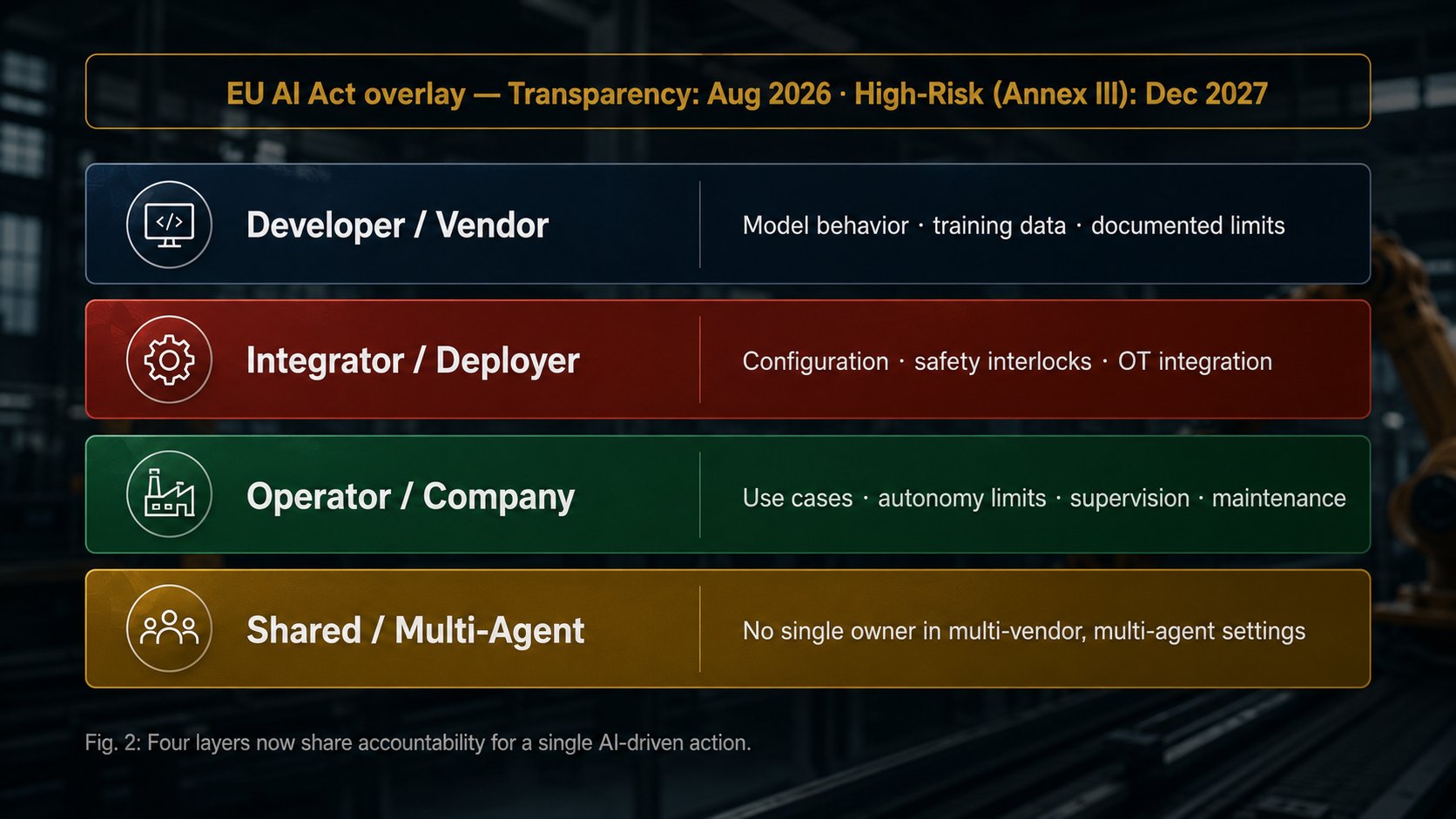
Four dimensions now share the load. Developer / Vendor responsibility covers model behavior, training data quality, and documented limitations. Integrator / Deployer responsibility covers proper configuration, safety interlocks, and integration with existing OT systems. Operator / Company responsibility covers defining use cases, setting autonomy boundaries, providing adequate supervision, and maintaining the system. And increasingly, there is shared accountability in multi-vendor, multi-agent environments, where no single dimension can honestly claim full ownership of an outcome.
Regulation is catching up, but on a longer runway than most boardrooms assumed a year ago. The EU AI Act entered into force on 1 August 2024, with obligations phasing in over three years (European Commission, 2026). Its transparency duties, including disclosure obligations under Article 50, remain on track to apply from 2 August 2026. But under the political agreement on the "Digital Omnibus" reached on 7 May 2026 and formally adopted by the Council and Parliament in June 2026, the Act's high-risk obligations for standalone systems under Annex III have been pushed back roughly sixteen months, to 2 December 2027 (Travers Smith, 2026). High-risk AI embedded as a safety component of regulated products, including much shop-floor machinery, is being folded into the EU Machinery Regulation instead, with delegated acts due by 2 August 2028. For manufacturers, the practical takeaway is not "less pressure", it is "more preparation time before enforcement, and no change at all to who a court or a customer holds responsible when an agent gets it wrong today."
👉 Key Insight
Effective accountability is not about assigning blame after an incident, it is about designing clear roles, technical safeguards and governance processes upfront.
3. Practical Lessons from Early Deployments
The organizations furthest along with agentic AI on the shop floor did not solve accountability with more automation. They solved it with paperwork, training, and a permission structure most competitors have not written yet.
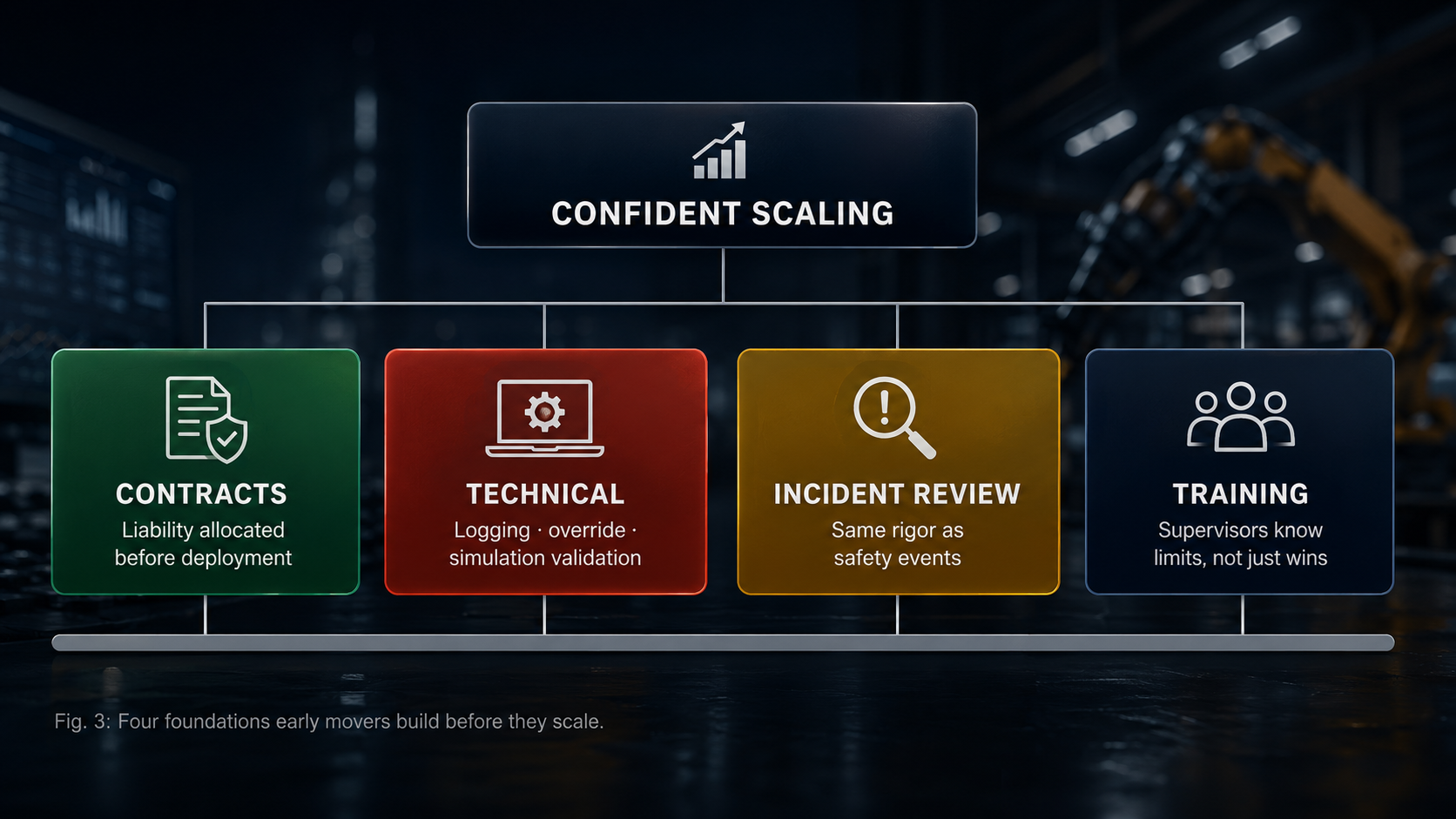
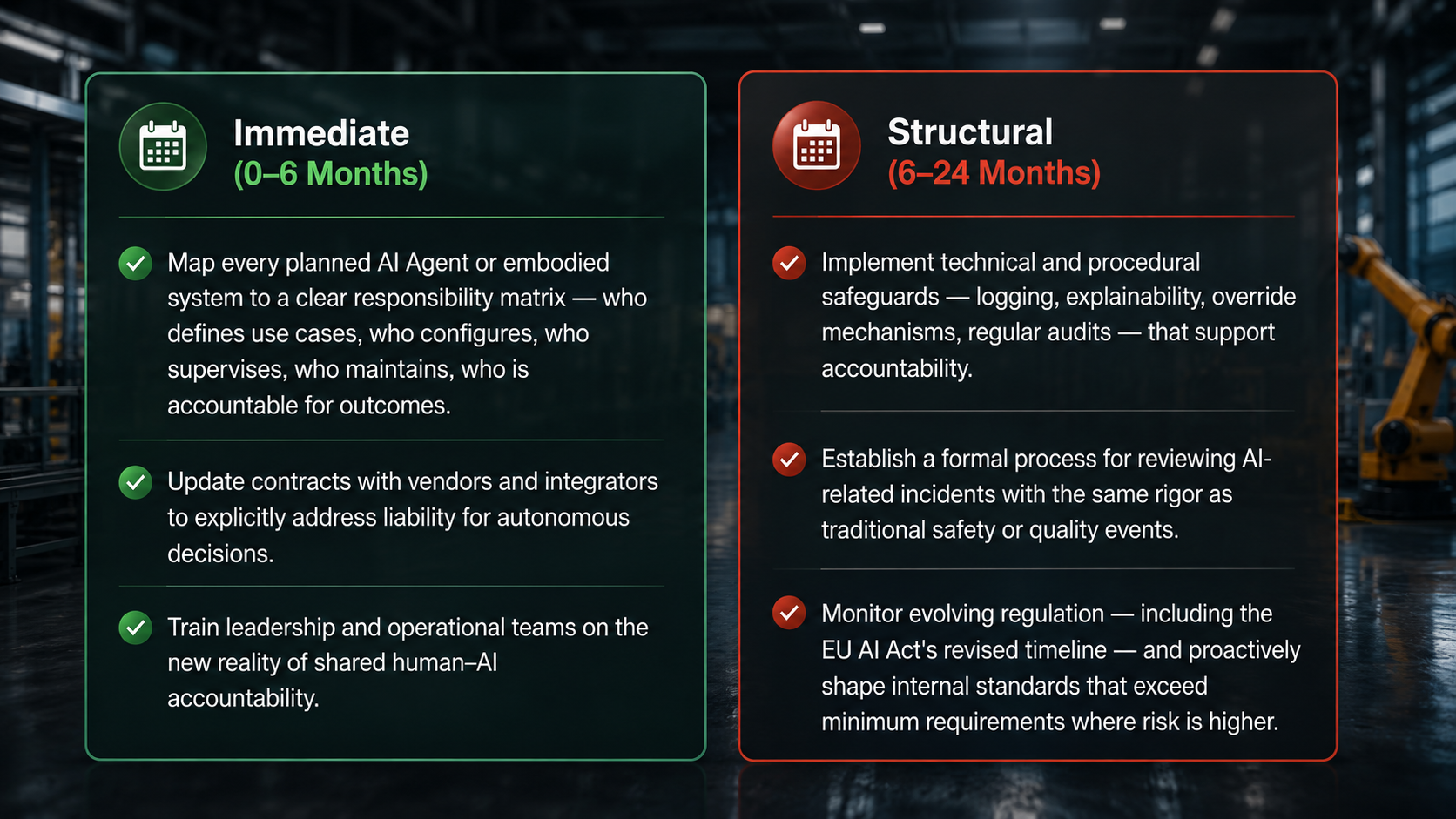
Four practices recur among early movers: they explicitly allocate responsibility in contracts and internal policy beforedeployment, not after an incident. They implement technical measures — detailed logging, human-in-the-loop options for critical decisions, and simulation validation before any change touches the physical line. They create cross-functional incident review processes that treat AI-related events with the same rigor as traditional safety incidents. And they invest in training so supervisors understand both the capabilities and the limitations of the systems they oversee.
Simulation validation is no longer aspirational — it is already operating at scale. Siemens and NVIDIA's expanded Industrial AI partnership lets organizations recreate every machine, conveyor and operator path in a factory with physics-level accuracy, so AI agents can simulate and refine changes before anything touches the physical line. Siemens has reported that this approach identified up to 90% of potential issues before physical modification in an early deployment, alongside a 20% increase in throughput (Siemens, 2026). Whatever the final, audited numbers turn out to be once fully verified, the underlying lesson holds: the accountability question gets easier to answer when the agent's proposed action was validated in a digital twin before it ever reached the shop floor.
👉 Key Insight
Clarity on responsibility actually accelerates adoption because it reduces fear and builds confidence among operations and leadership teams.
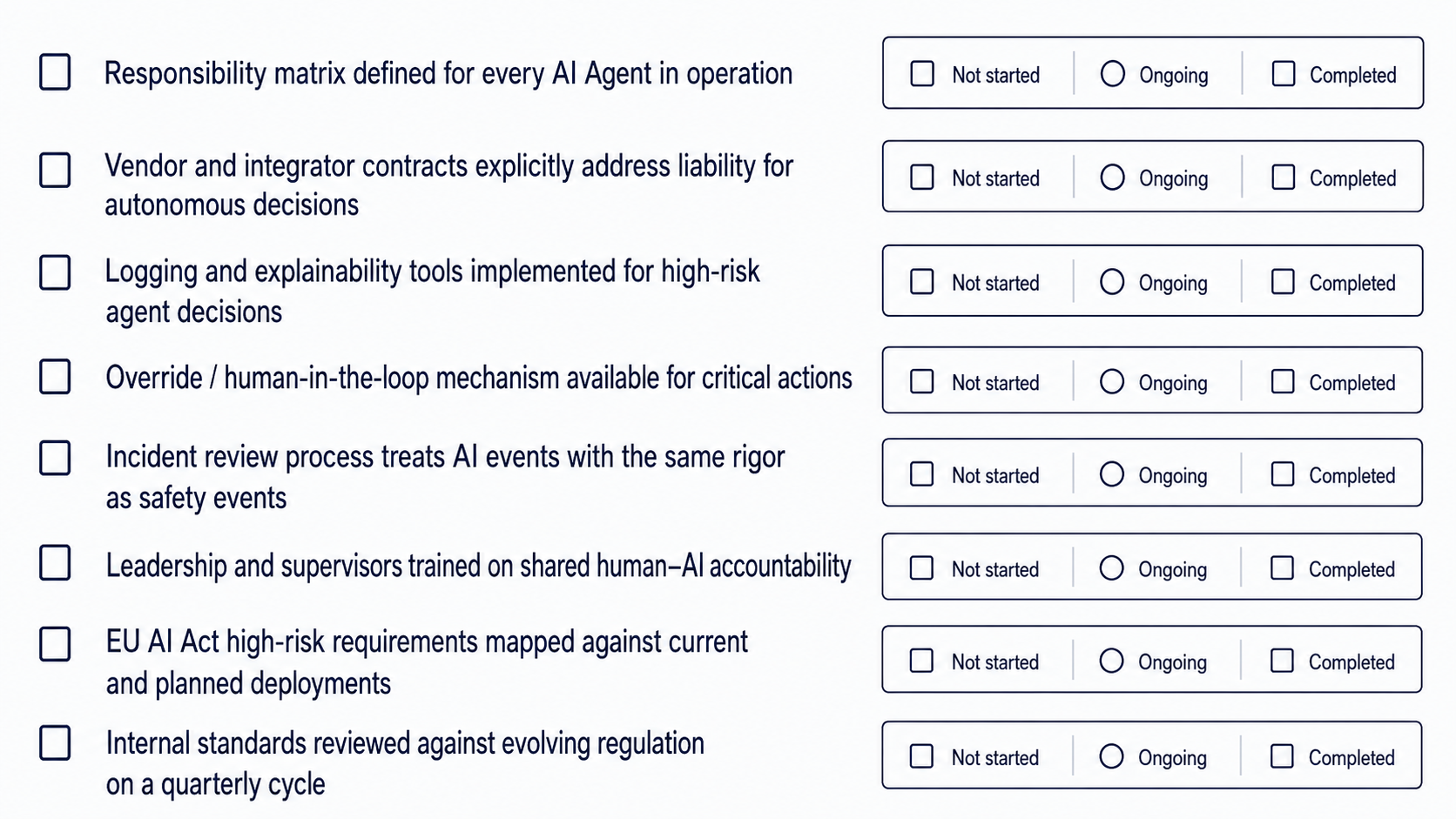
Action Plan for Decision Makers
Checklist
Final Thought
Accountability for a single AI Agent is hard enough. Part II of this Week 30 pair goes further, into the reality most factories actually live in: many agents, many vendors, and decades of legacy equipment all interacting at once.
The efficiency this series has chased since its first article was never about fuel. It was always about the decision behind it, and increasingly, about who owns that decision when the one making it is no longer human.
Systems don't fail.
Decisions do.
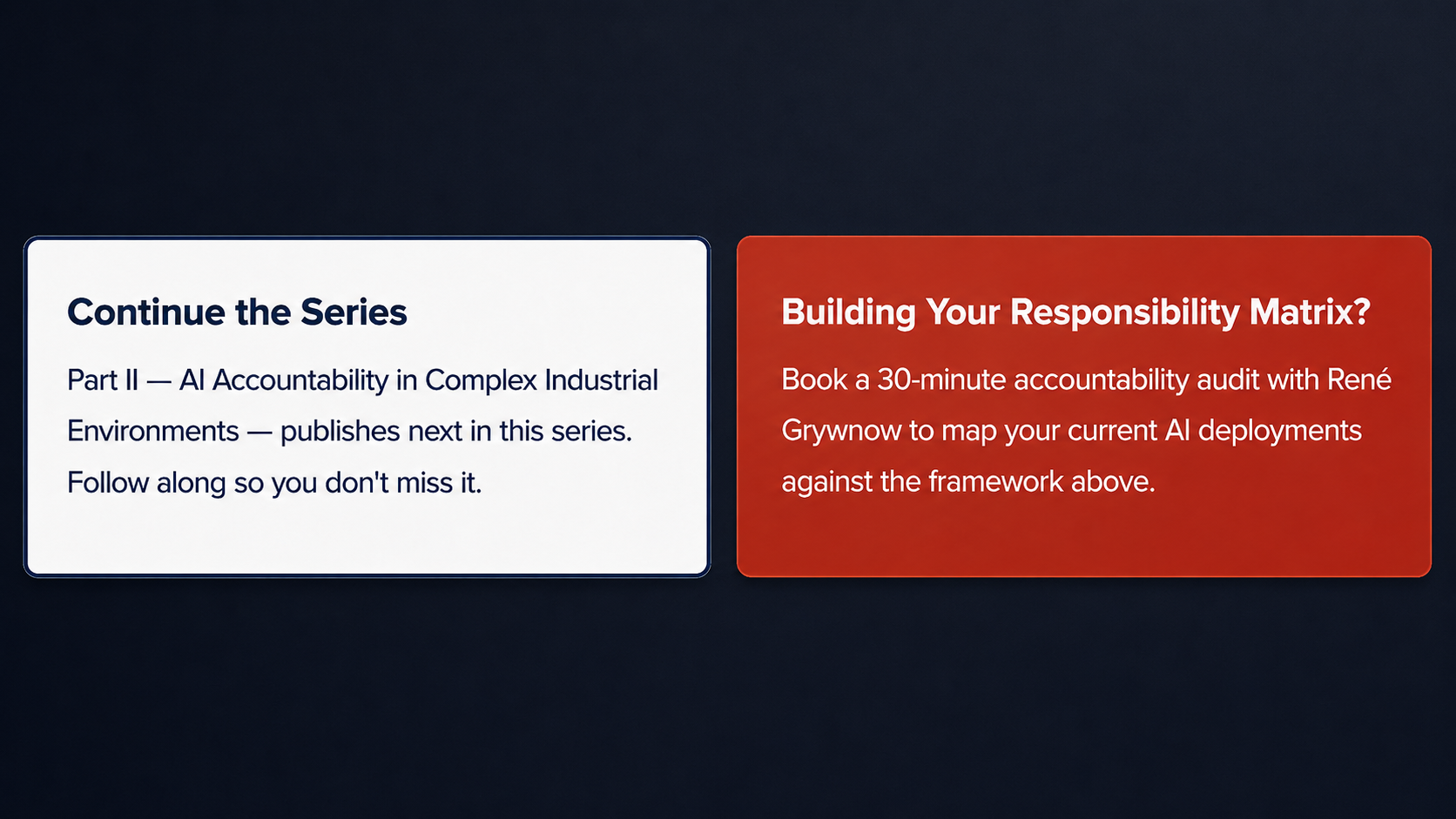
Continue the Series
Take the Next Step
Subscribe to the Weekly Punch for weekly strategic clarity, direct to your inbox.
References
Capgemini Research Institute (2026) Physical AI: Taking Human-Robot Collaboration to the Next Level. Paris: Capgemini Research Institute.
European Commission (2026) AI Act — Shaping Europe's Digital Future. Brussels: European Commission, Directorate-General for Communications Networks, Content and Technology.
NVIDIA Newsroom (2026) Siemens and NVIDIA Expand Partnership to Build the Industrial AI Operating System. Santa Clara: NVIDIA Corporation.
Siemens AG (2026) Siemens Unveils Technologies to Accelerate the Industrial AI Revolution at CES 2026. Munich: Siemens AG.
Travers Smith (2026) EU Agrees to Delay Key AI Act Compliance Deadlines. London: Travers Smith LLP.
Disclaimer: This article synthesizes publicly available reporting and regulatory guidance current as of publication. Quantitative figures are attributed to their original sources and, where marked as reported results, reflect the issuing organization's own disclosures rather than independently audited data. Regulatory deadlines are subject to further change as EU implementing acts and technical standards are finalized. Readers should verify current requirements against primary EU sources and confirm all figures before relying on them for compliance or investment decisions. Verification Gate: flagged for pre-publication source check.
Note: This article reflects my personalviews based on industry experience and publicly available information. It does not constitute professional, legal, or investment advice and does not represent the views of my employer. AI-generated visuals, concept and content by the author.
