Why GDPR and Current Rules Are Not Enough for Physical AI Systems

PHYSICAL AI | REGULATION & GOVERNANCE | JULY 2026
ENERGY DOMINANCE · WEEK 29 · PART II
The Limitations of Traditional Data Protection Regulation When AI Makes Physical Decisions.
And What Forward-Looking Governance Must Address in Embodied and Agentic Systems
This is Part II of Week 29, examining why classic data protection rules like GDPR, while important, fall short when AI systems move from the digital to the physical world and start making decisions with direct real-world consequences.
Part I made the case that governance is the missing layer. Here is where that gap becomes concrete, and legal. A data breach costs money and trust. A robot that misjudges a moving pallet costs a machine, a shift, and potentially a person. Our regulatory instincts were trained on the first kind of harm. Physical AI produces the second.
The thread of this series, “Efficiency Before Fuel” applies to compliance as sharply as to energy. The reflex is to stack more legal review onto the same framework and hope it holds. But a framework designed for data processing does not become a safety framework by being applied harder. The right layer first, then the speed follows, defensibly.
Executive Summary
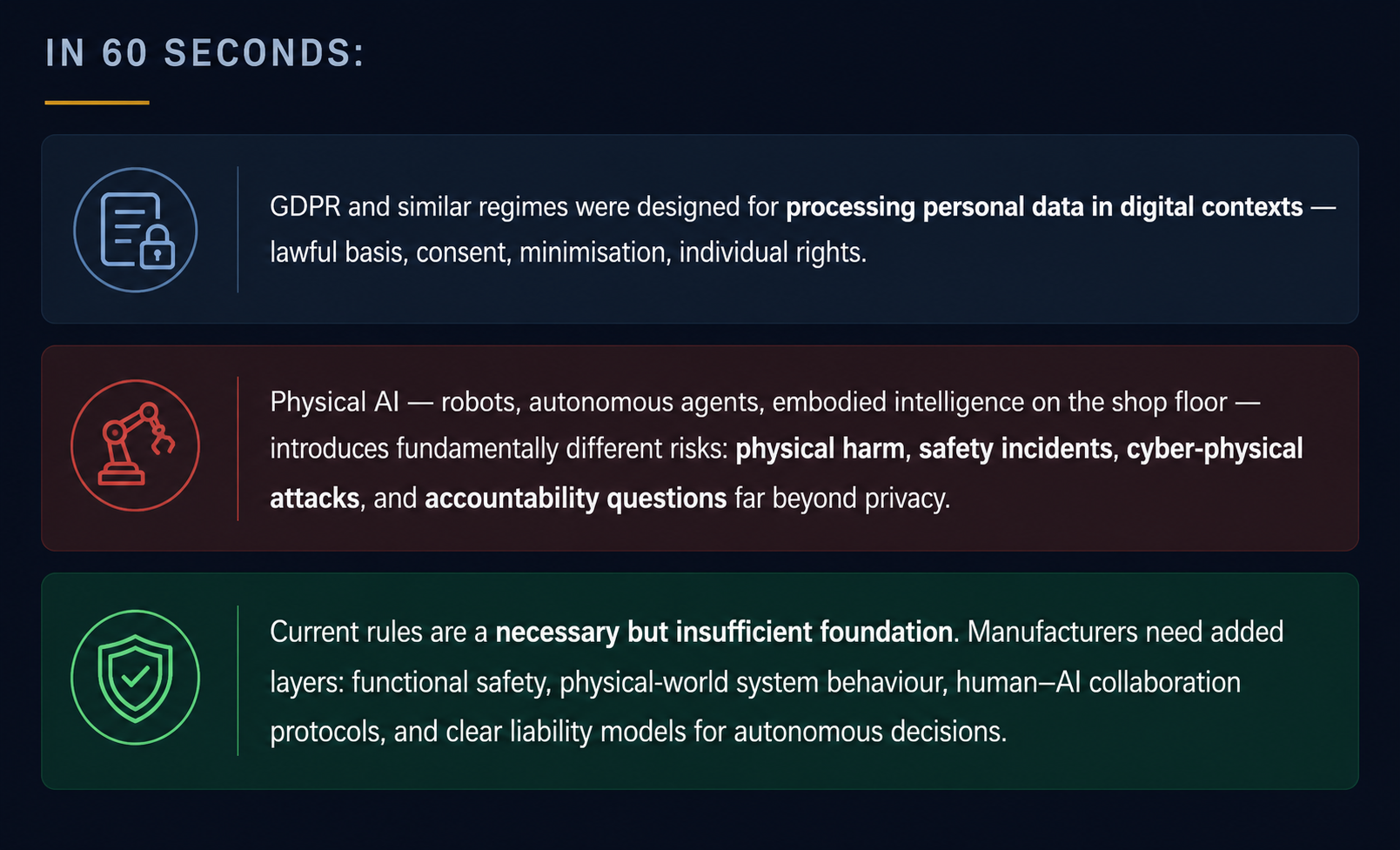
1. The Gap Between Data Protection and Physical-World AI
The hook: GDPR asks whether you were allowed to process the data. It never asks whether the robot should have moved.
The mechanism: GDPR focuses on lawful processing, consent, data minimisation, and the rights of individuals regarding personal data. Physical AI systems collect and act on sensor data from machines, environments and sometimes people, in ways that directly shape physical outcomes: robot movement, machine adjustment, safety stops.
The evidence: A wrong decision by an agent can cause material damage, production stoppages, or in extreme cases injury. These are risks that data protection rules, however well enforced, simply do not address, because they were never written to.
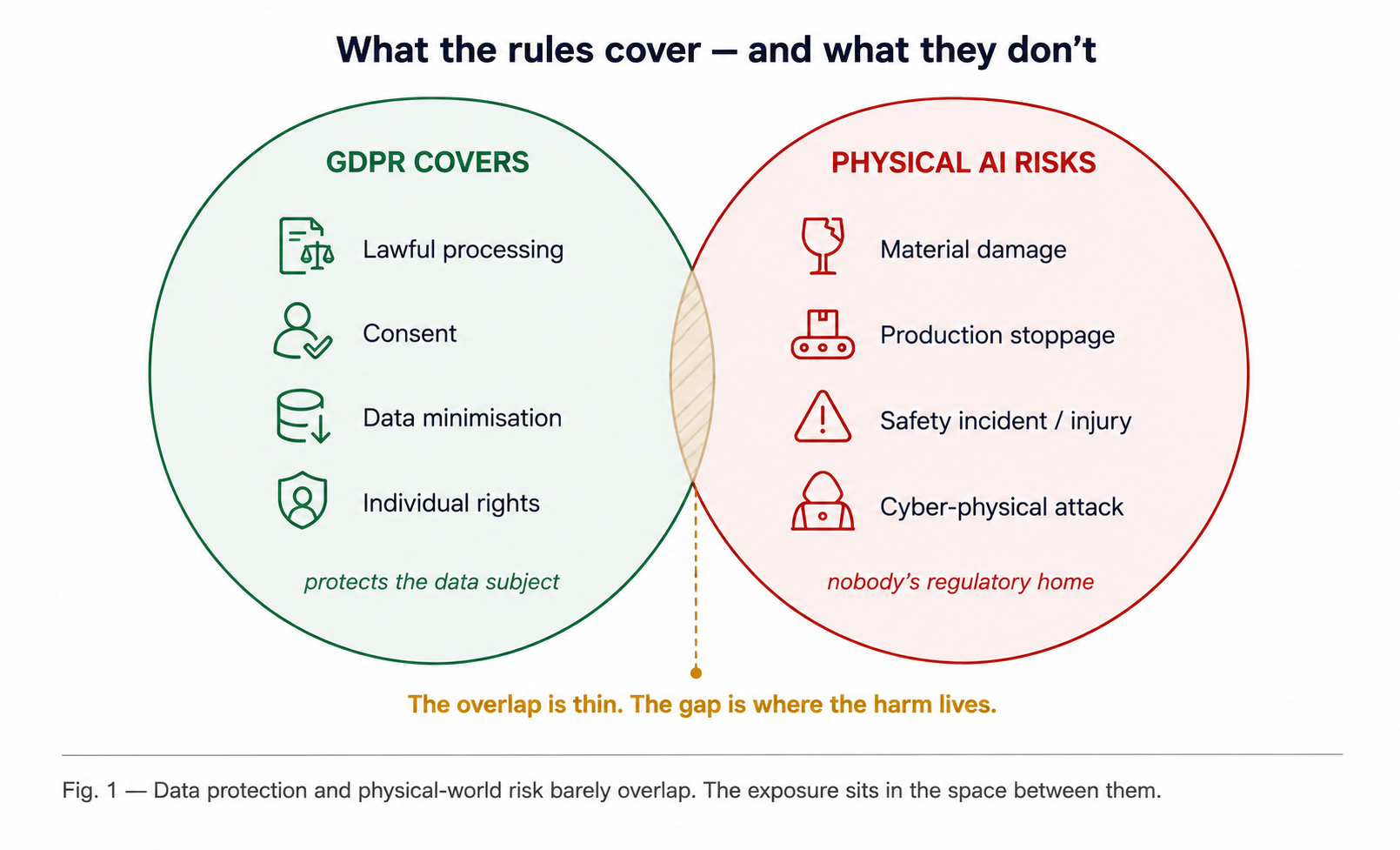
👉 Key Insight: GDPR protects data subjects. Physical AI governance must also protect physical assets, processes and people from the consequences of autonomous actions.
2. Specific Shortcomings for Embodied and Agentic Systems
The hook: Five gaps, and none of them close by trying harder at compliance. They close only by adding a layer that does not currently exist in most organisations.
The mechanism: Where current frameworks come up short for embodied and agentic systems:
Physical consequences & safety: rules for data processing do not inherently cover functional safety or real-time decision reliability.
Accountability & liability: when an agent acts autonomously, it is often unclear who bears responsibility: developer, operator, deployer, or user.
Cyber-physical risks: attacks that manipulate sensor data or agent behaviour have immediate physical effects that traditional cybersecurity and data-protection frameworks do not fully cover.
Explainability & auditability in dynamic environments: agents adapt to real-time conditions; tracing decisions across complex, multi-agent systems is technically and legally hard.
Cross-border & supply-chain complexity: European manufacturers operate in global value chains where jurisdictions differ in what they expect of autonomous systems.
The evidence: The common structure across all five: they are questions about behaviour and consequence, not about data. A regime built to govern data cannot answer them, no matter how rigorously it is applied.
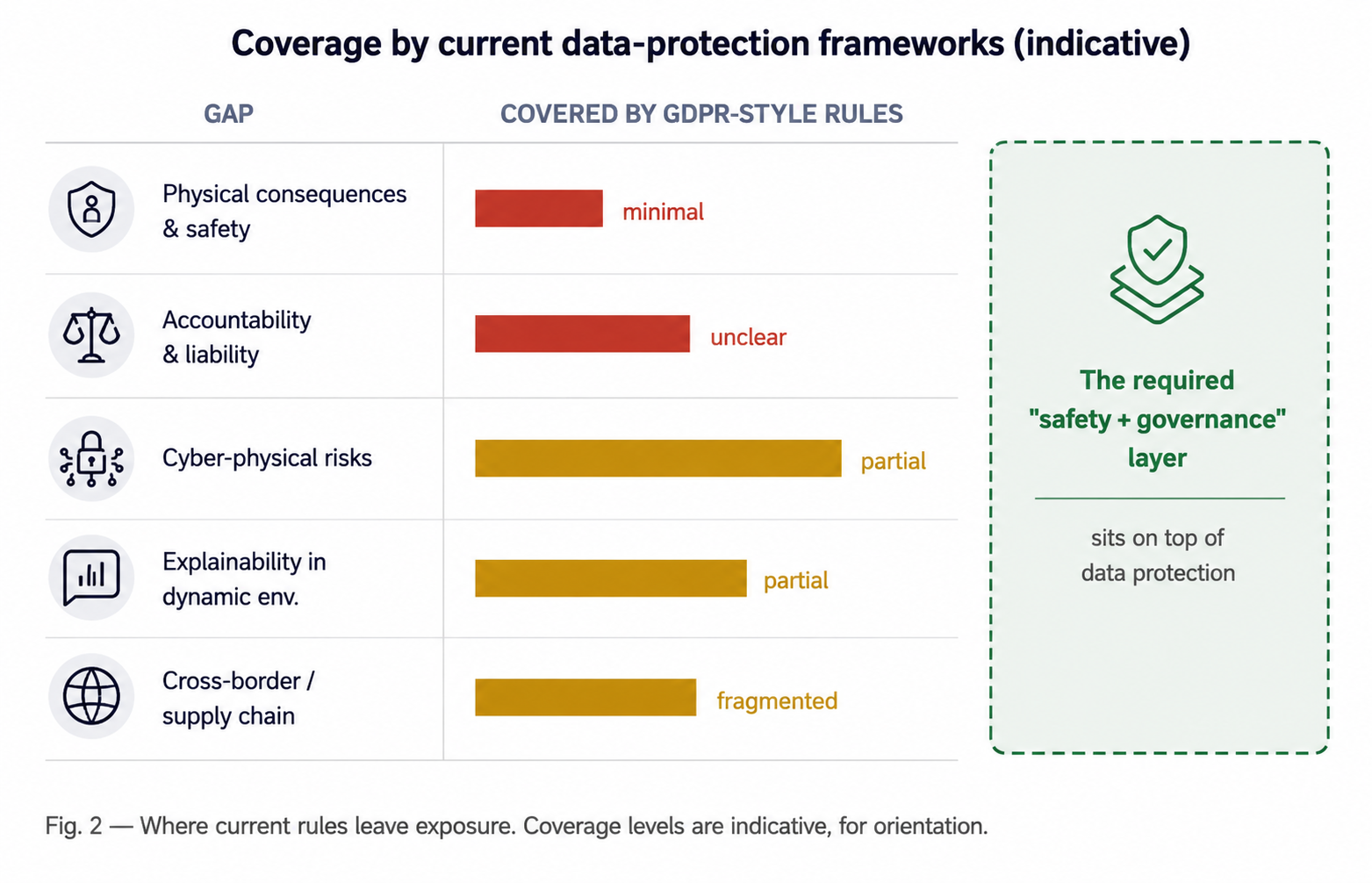
👉 Key Insight: Physical AI requires a "safety + governance" layer on top of data protection, combining functional safety standards with AI-specific risk management.
3. What Forward-Looking Governance Must Include
The hook: The organisations getting this right are not treating regulation as a wall to comply with. They are treating it as a foundation to build on — and, increasingly, to help shape.
The mechanism: Leading organisations build on GDPR as a baseline, then add:
Functional safety & risk assessment frameworks: tailored specifically to learning and adaptive systems.
Clear liability allocation models: differentiated by autonomy level.
Technical requirements: monitoring, logging, and human override as engineering obligations.
Ethics & human-rights impact assessments: extended to consider physical-world effects.
Regulator & industry-body collaboration: shaping future rules, e.g. EU AI Act implementation for high-risk industrial applications.
The evidence: Compliance with today's rules is table stakes, it earns nothing but the right to operate. The advantage accrues to organisations whose governance actively enables responsible scaling of Physical AI while others are still waiting for the regulator to tell them what to do.
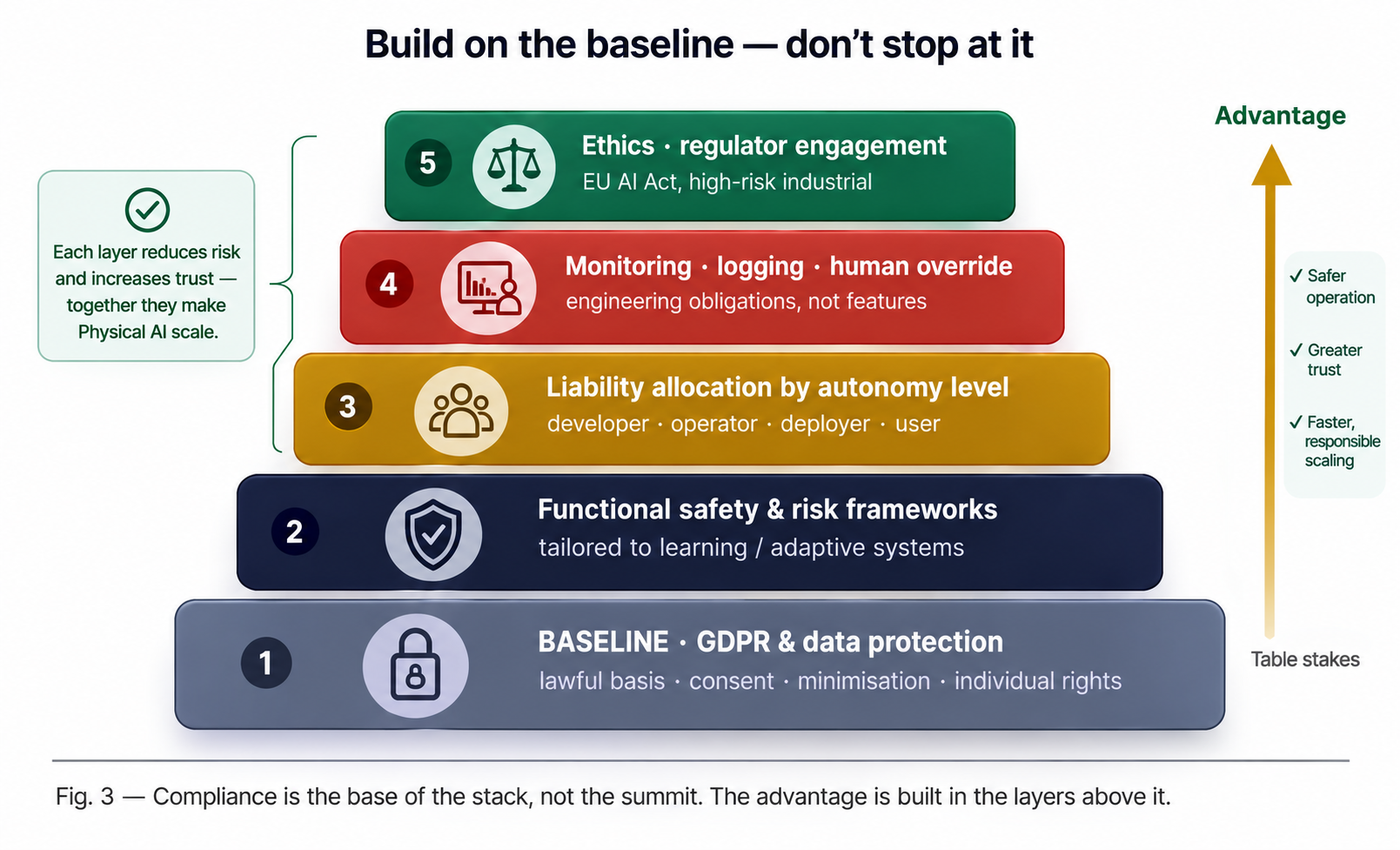
👉 Key Insight: Compliance with current rules is table stakes. Competitive advantage comes from governance that enables responsible scaling of Physical AI.
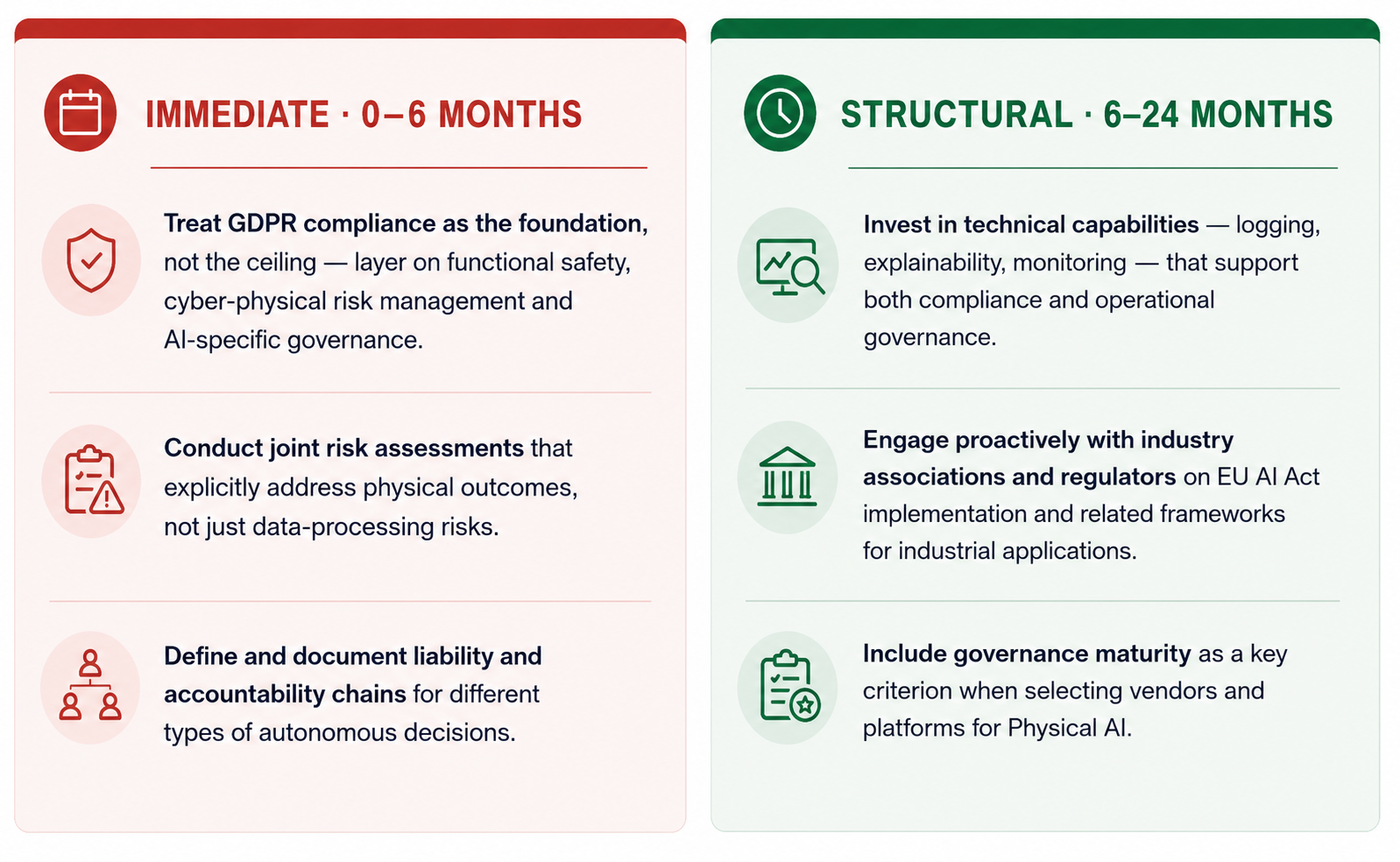
Action Plan for Decision Makers
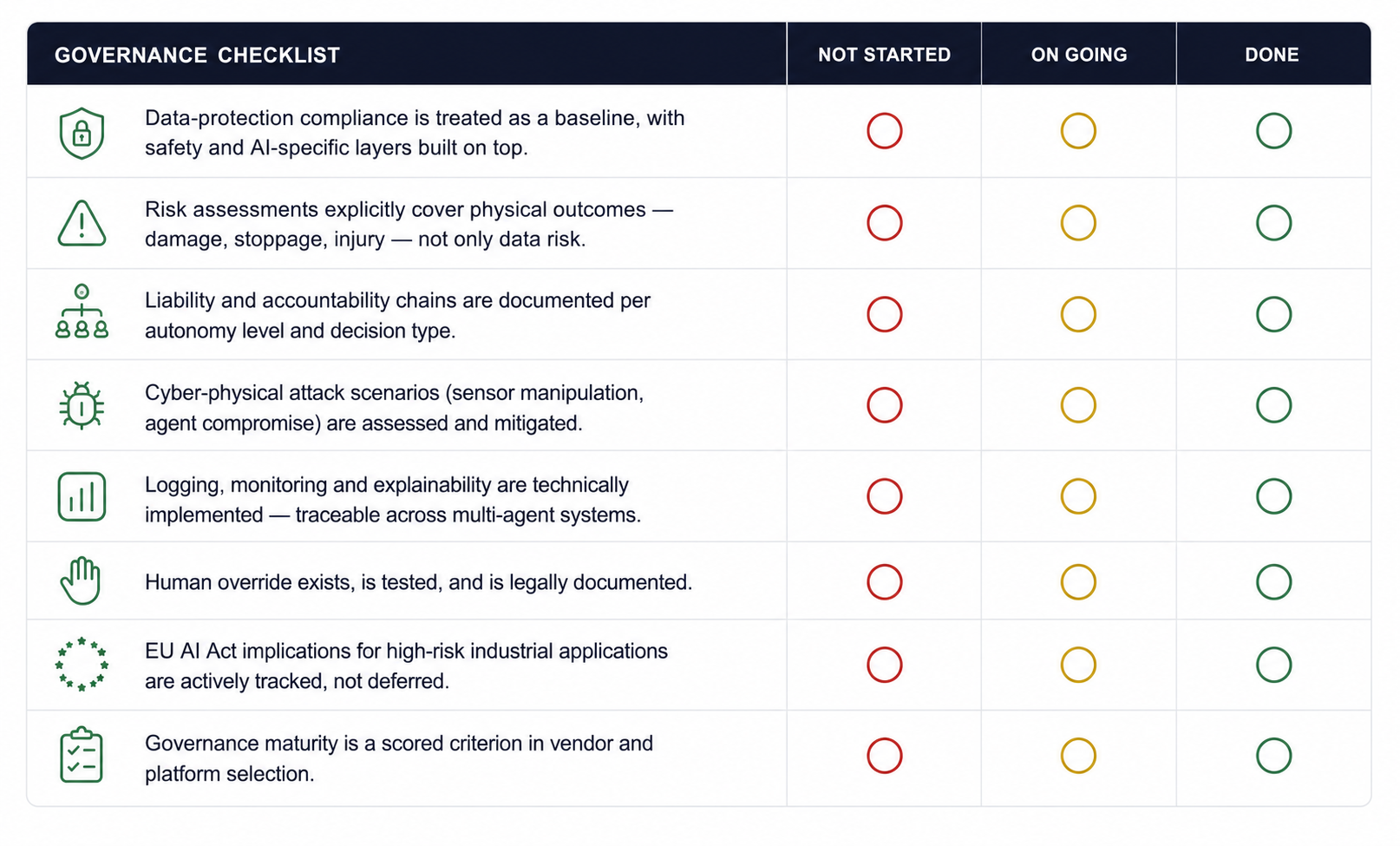
Readiness Checklist
Final Thought
Week 29 began with the layer nobody drew on the architecture diagram. It ends with the reason that omission is no longer merely operational: when AI acts physically, the missing layer is where liability lives. Our regulatory reflexes were trained on breaches of data. Physical AI breaches machines, schedules, and, at the edge, people. Those need a different answer, and it is not a stricter reading of an old rule.
Waiting for the regulator to specify the answer is the slowest possible strategy, and the least defensible. European manufacturers already possess the functional-safety discipline this requires; it needs extending to adaptive systems, not inventing.
Efficiency before fuel: build the right layer, and compliance stops being a brake and becomes a differentiator.
Systems don't fail. Decisions do.
If your agent damaged a machine tomorrow, which framework covers it?
First: Ask Legal and Safety that question together, about one system already running. If the answer is "GDPR", or a silence, you have found your gap.
Then: Put the safety-plus-governance layer on the roadmap now, and track the EU AI Act's industrial implications rather than waiting to be told. Share this with the colleague who believes data-protection sign-off means the AI is cleared.
Take the Next Step
Subscribe to the Weekly Punch for weekly strategic clarity, direct to your inbox.
References
European Union (2025–2026) EU AI Act developments and industry guidance.
Capgemini Research Institute (2026) Governance needs for Physical AI. Capgemini.
Siemens & NVIDIA (2026) Discussions on responsible Industrial AI.
Functional safety standards bodies (2025–2026) Guidance relevant to adaptive and autonomous systems.
Manufacturing case studies (2026) Cyber-physical risk management.
Disclaimer: This article is informational and does not constitute legal advice. All regulatory descriptions are indicative and based on published third-party analyses and guidance current at time of writing; readers should obtain qualified legal counsel and conduct their own verification before making governance, compliance, operational or capital-allocation decisions. The author maintains no commercial relationship with the organisations named.
Note: This article reflects my personalviews based on industry experience and publicly available information. It does not constitute professional, legal, or investment advice and does not represent the views of my employer. AI-generated visuals, concept and content by the author.
