Physical AI |Complex Systems | Governance | Manufacturing | Week 30 · Part II
PHYSICAL AI | COMPLEX SYSTEMS GOVERNANCE | JULY 2026
Navigating Multi-Agent Systems, Legacy Integration and Human–AI Collaboration. How Manufacturers Can Build Robust Accountability in Increasingly Autonomous Factories
Part I of this pairing asked a deceptively simple question: who is responsible when an AI Agent gets it wrong? The honest answer, in most real factories, is: it depends on which agent, which system, which vendor, and which decade the machine next to it was built in.
This series has always argued “Efficiency Before Fuel”, that the real cost sits in decisions, not inputs. Multiply that by dozens of interacting agents, legacy PLCs, and three different vendor contracts, and the decision layer stops being a line item. It becomes the entire risk surface.
Executive Summary
IN 60 SECONDS:
Modern factories are rarely greenfield: AI Agents must coexist with legacy control systems, multiple vendors and decades of accumulated human expertise, and accountability now emerges from how these components interact, not from any single one.
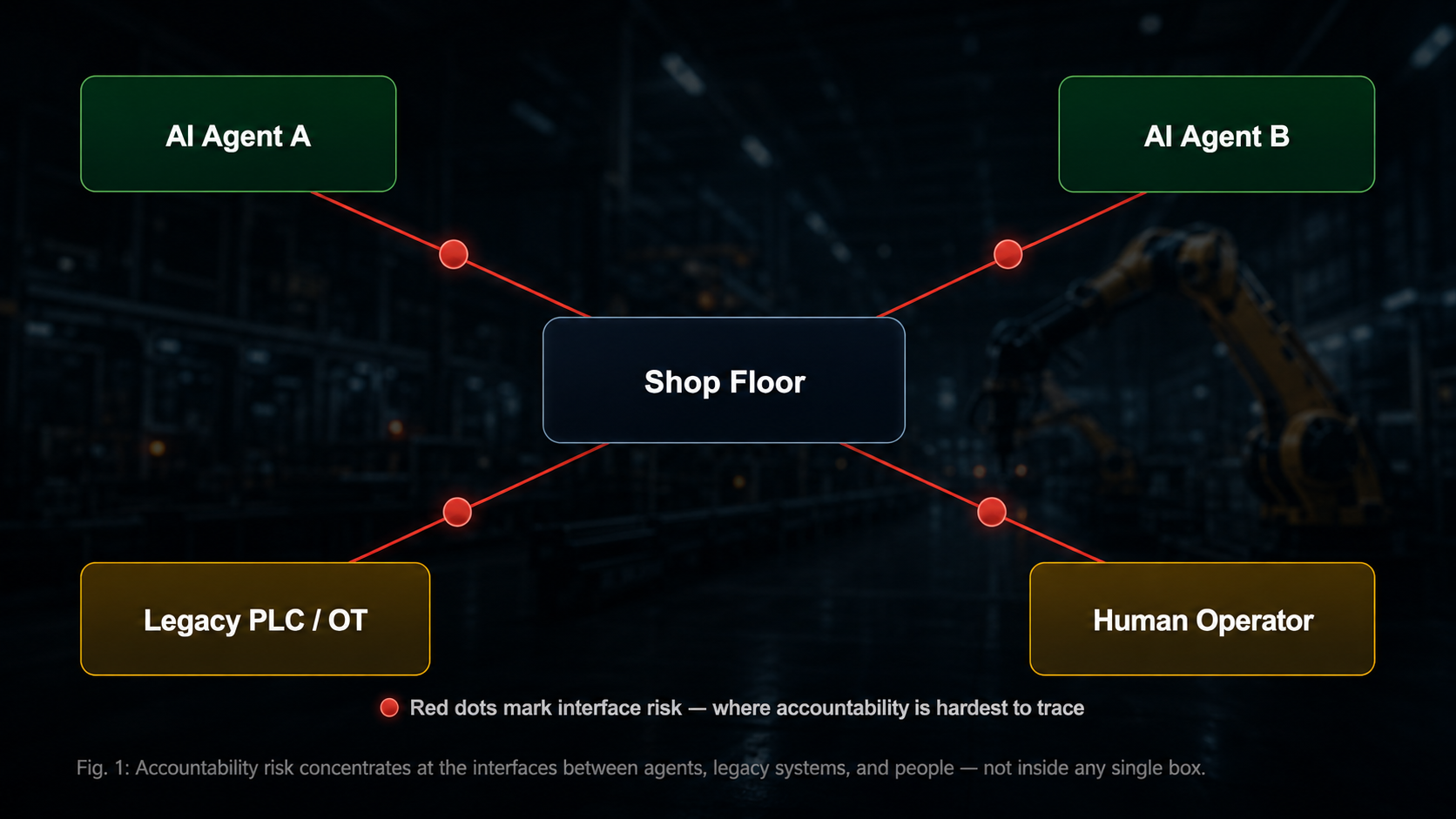
The biggest accountability risks sit at the interfaces: between agents, between agents and legacy equipment, and between machines and human operators, not inside any one well-documented system.
Companies that build accountability into the technical, organizational, cultural and contractual layers from the concept phase reach production faster than those treating AI as plug-and-play.
1. The Complexity Challenge: Multi-Agent, Multi-Vendor and Legacy Environments
No AI Agent on a real factory floor acts alone, it acts inside a conversation with machines that were designed before anyone imagined it would exist.
In a typical factory, AI Agents interact with other agents, legacy control systems, human operators, and external data sources. A decision made by one agent can trigger actions in another system, or be shaped by noisy sensor data coming off decades-old equipment. This interconnectedness makes root-cause analysis, and therefore accountability, significantly harder than in simpler, self-contained digital applications.
This is precisely why simulation has become the industry's preferred way to de-risk interface complexity before it reaches the physical line. Siemens' Digital Twin Composer, built on NVIDIA Omniverse libraries and computer vision, lets organizations recreate every machine, conveyor, pallet route and operator path with physics-level accuracy, allowing AI agents to simulate, test and refine system changes before anything is touched in reality (Siemens, 2026). And the stakes for getting this right are not abstract: as MIT CSAIL's Daniela Rus has observed, even a very small physical failure rate can be catastrophic in safety-critical settings, because unlike a language model's wrong sentence, a robot's wrong action cannot be quietly retracted (as reported in Humanoids Daily, 2026). In a multi-agent, multi-vendor plant, the interfaces are exactly where that small failure rate tends to live.
👉 Key Insight
In complex industrial settings, the biggest accountability risks often arise at the interfaces between systems and between humans and machines.
2. Building Robust Accountability in Practice
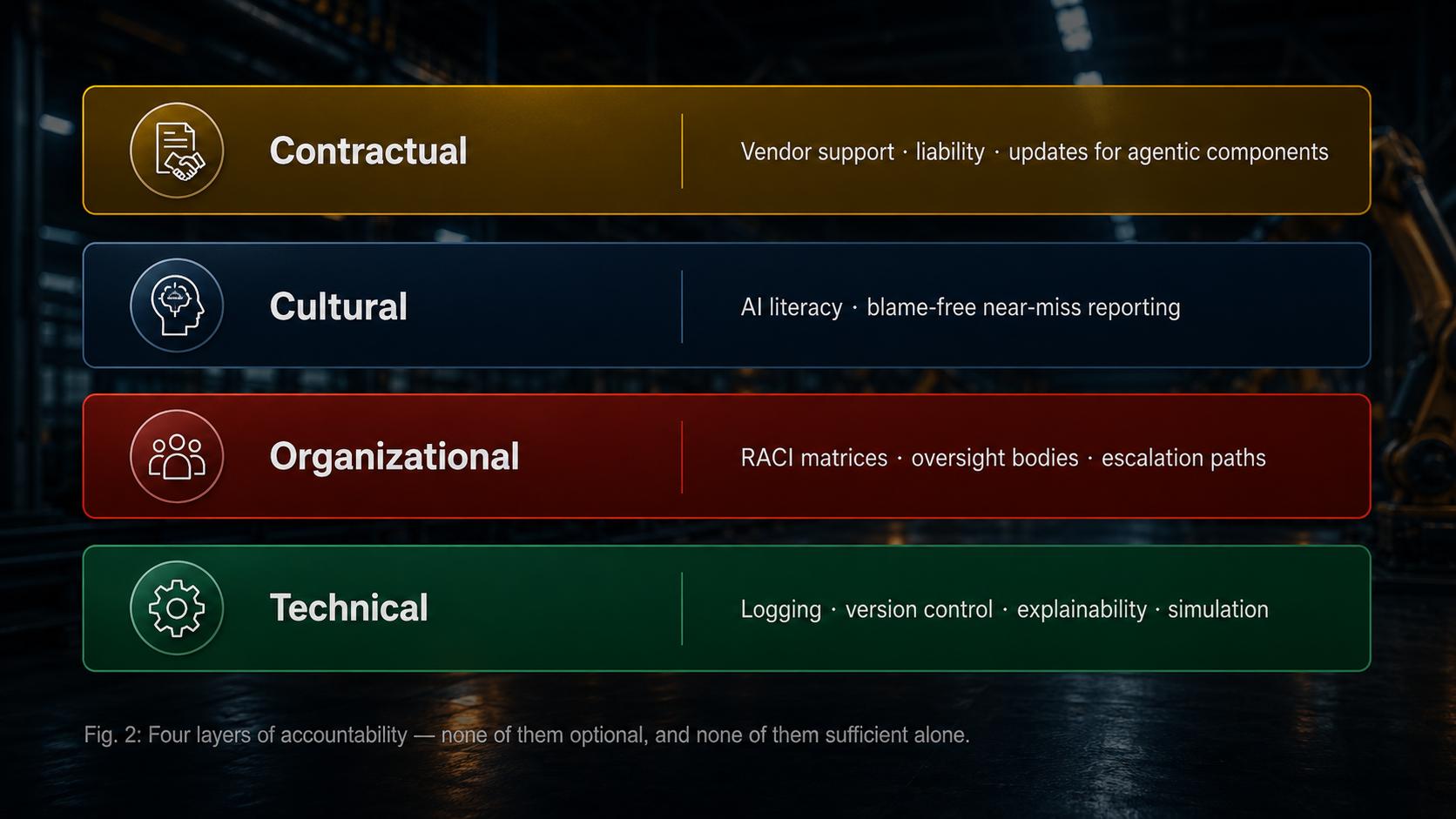
Robust accountability in a complex factory isn't a policy document. It's four separate systems that have to agree with each other.
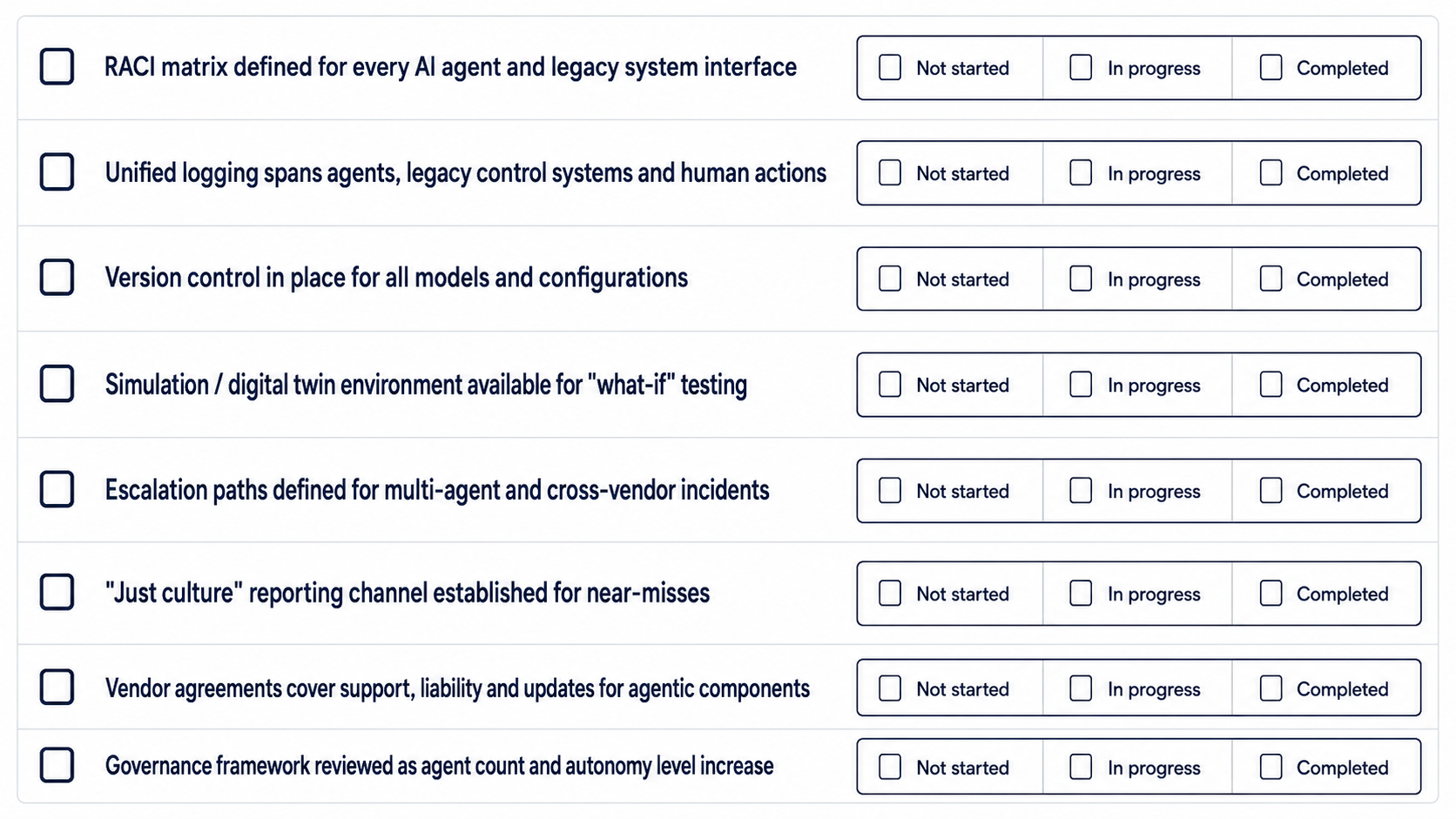
The technical layer covers comprehensive logging, version control of models and configurations, explainability tools, and simulation environments for "what-if" analysis. The organizational layer covers clear RACI matrices for AI systems, cross-functional oversight bodies, and defined escalation paths. The cultural layer covers training that builds AI literacy across operations and maintenance teams, and encourages reporting of near-misses without blame. And the contractual layer covers detailed agreements with vendors that define support, liability and update responsibilities for agentic components.
Leading industrial players are treating internal deployment as the proving ground for exactly this kind of layered discipline. Siemens has said it will first deploy its expanding portfolio of AI-powered copilots and agentic tools within its own operations before scaling them to customers, using internal adoption as the proof point (Siemens, 2026). That sequencing matters for accountability specifically: an organizational and cultural layer that has already absorbed near-misses internally is a very different starting point than a vendor asking a customer to be the first real-world test.
👉 Key Insight
Accountability in complex environments is a socio-technical challenge that must be addressed at the intersection of technology, processes and people.
3. Lessons from Early Complex Deployments
The gap between a physical AI pilot and a physical AI product is where most accountability frameworks quietly fail.
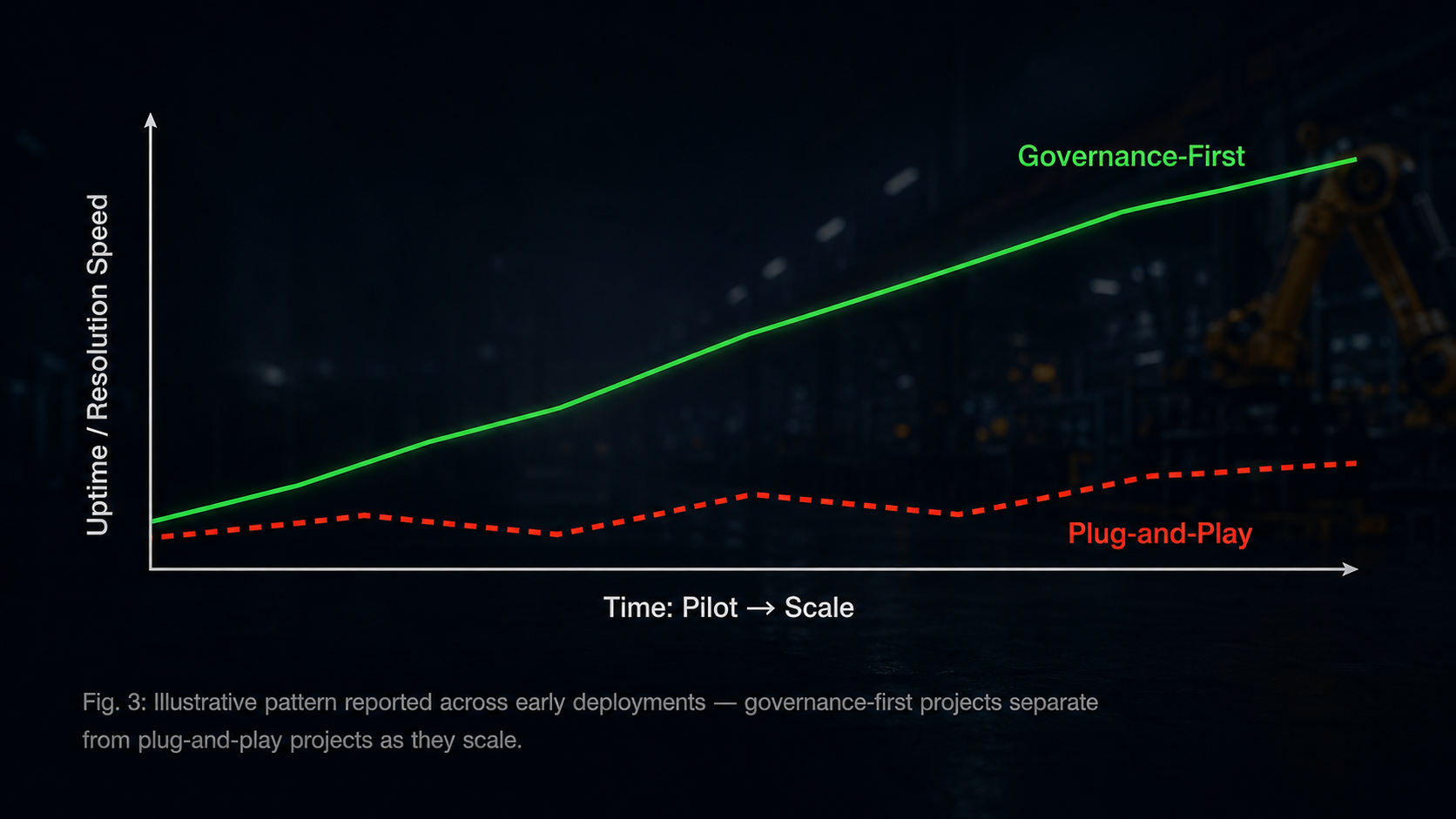
Early large-scale attempts in 2025–2026 show a consistent pattern: projects with strong upfront governance and continuous monitoring achieve higher uptime and faster resolution of issues. Projects that treated AI as "plug-and-play" instead frequently encounter integration surprises, unclear blame during incidents, and slower scaling. European manufacturers in particular benefit from aligning new AI accountability frameworks with existing functional safety and quality management systems rather than building a parallel structure from scratch.
The scale of what is now at stake makes the governance-first case sharper. Capgemini's 2026 global survey of 1,678 senior executives found that although roughly two-thirds of organizations now rank physical AI as a high priority for the next three to five years, only a small fraction have reached large-scale deployment, and reshoring and reindustrialization are cited by over four in ten executives as a growing driver of investment (Capgemini Research Institute, 2026). Siemens and NVIDIA's own approach, building one fully governed, AI-driven site at their Erlangen Electronics Factory as a repeatable blueprint, rather than deploying agents plant-by-plant without a common architecture, is a direct illustration of the governance-first pattern the data points toward (NVIDIA Newsroom, 2026).
👉 Key Insight
The organizations that treat accountability as a design feature rather than a post-deployment fix are the ones successfully moving from pilot to production at scale.
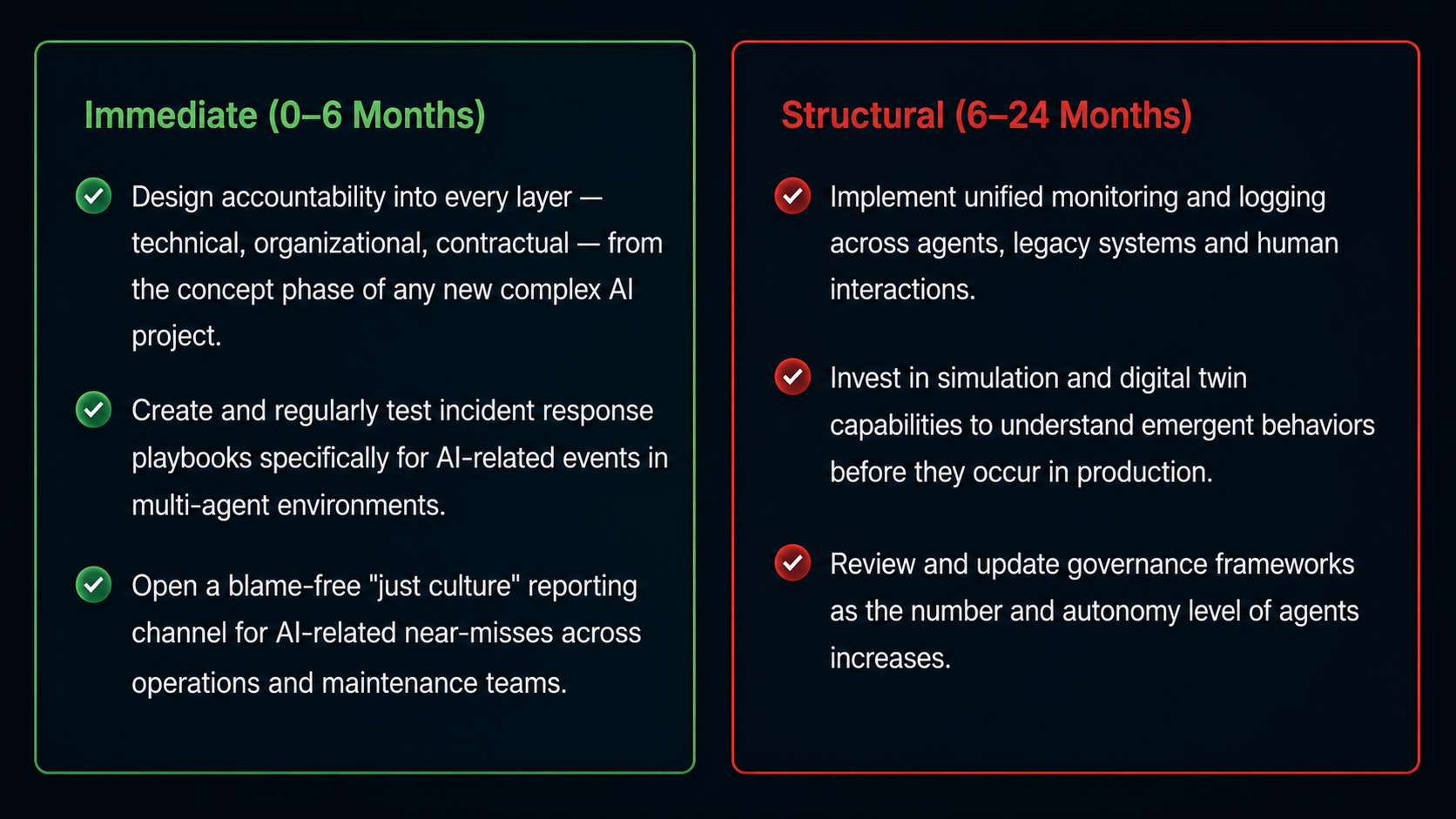
Action Plan for Decision Makers
Checklist
Final Thought
Part I of this pair asked who is responsible. Part II answers where that responsibility actually breaks, not inside any single agent, but in the gaps between agents, vendors and machines that were never designed to talk to each other.
Efficiency Before Fuel has meant the same thing in every article of this series: the system that wins is not the one with the most advanced technology, but the one whose decisions, human and now machine, are owned, designed and accounted for.
Systems don't fail. Decisions do.
Take the Next Step
Subscribe to the Weekly Punch for weekly strategic clarity, direct to your inbox.
References
Capgemini Research Institute (2026) Physical AI: Taking Human-Robot Collaboration to the Next Level. Paris: Capgemini Research Institute.
Humanoids Daily (2026) Beyond the Screen: Capgemini 2026 Report Signals the Shift to Physical AI. [Online news article].
NVIDIA Newsroom (2026) Siemens and NVIDIA Expand Partnership to Build the Industrial AI Operating System. Santa Clara: NVIDIA Corporation.
Siemens AG (2026) Siemens Unveils Technologies to Accelerate the Industrial AI Revolution at CES 2026. Munich: Siemens AG.
Siemens AG (2026) Siemens and NVIDIA Expand Partnership to Build the Industrial AI Operating System. Munich: Siemens AG.
Disclaimer: This article synthesizes publicly available reporting current as of publication. Quantitative figures are attributed to their original sources and, where marked as reported results, reflect the issuing organization's own disclosures rather than independently audited data. The uptime/resolution comparison in Figure 3 is an illustrative pattern drawn from qualitative reporting on early deployments, not a plotted dataset, and should be treated as directional. Readers should verify all figures before relying on them for compliance or investment decisions. Verification Gate: flagged for pre-publication source check.
Ownership as Design.
Note: This article reflects my personalviews based on industry experience and publicly available information. It does not constitute professional, legal, or investment advice and does not represent the views of my employer. AI-generated visuals, concept and content by the author.
