Systems Thinking in the Age of Autonomous Operations
SYSTEMS THINKING | AUTONOMOUS OPERATIONS | AUGUST/SEPTEMBER 2026 | Week 35 · Part II
Why Linear Problem-Solving Fails When AI Agents, Humans and Legacy Systems Interact, and How Leaders Can Develop True Systems Perspective
Part I of this week's set argued that most AI programs confuse activity with progress. Part II asks a related but different question: even when leaders are honestly chasing progress, why does fixing one problem in an autonomous operation so often create a new one somewhere else?
Efficiency Before Fuel has always meant that the decision matters more than the machine. Systems thinking is what lets a leader see which decision actually matters, once dozens of agents, humans and legacy systems are all deciding at once.
Executive Summary
IN 60 SECONDS:
Autonomous operations create dense webs of interaction between AI Agents, humans, legacy control systems, sensors and physical processes, cause and effect are rarely linear or local, and a change in one agent's behavior can produce unexpected consequences elsewhere.
Research on emergence confirms what many shop floors are already discovering: the most critical outcomes of multi-agent systems are not programmed into any single component, they emerge from the coordination of the whole, and require continuous monitoring rather than a one-time fix.
The most valuable insights show up at the interfaces, between agents, between humans and machines, between digital and physical layers, which is exactly where linear, component-by-component problem-solving looks the other way.
1. Why Linear Thinking Breaks Down
Find the root cause, fix it, move on, the instinct that has served industrial troubleshooting for a century starts to fail the moment the "cause" isn't in any single place.
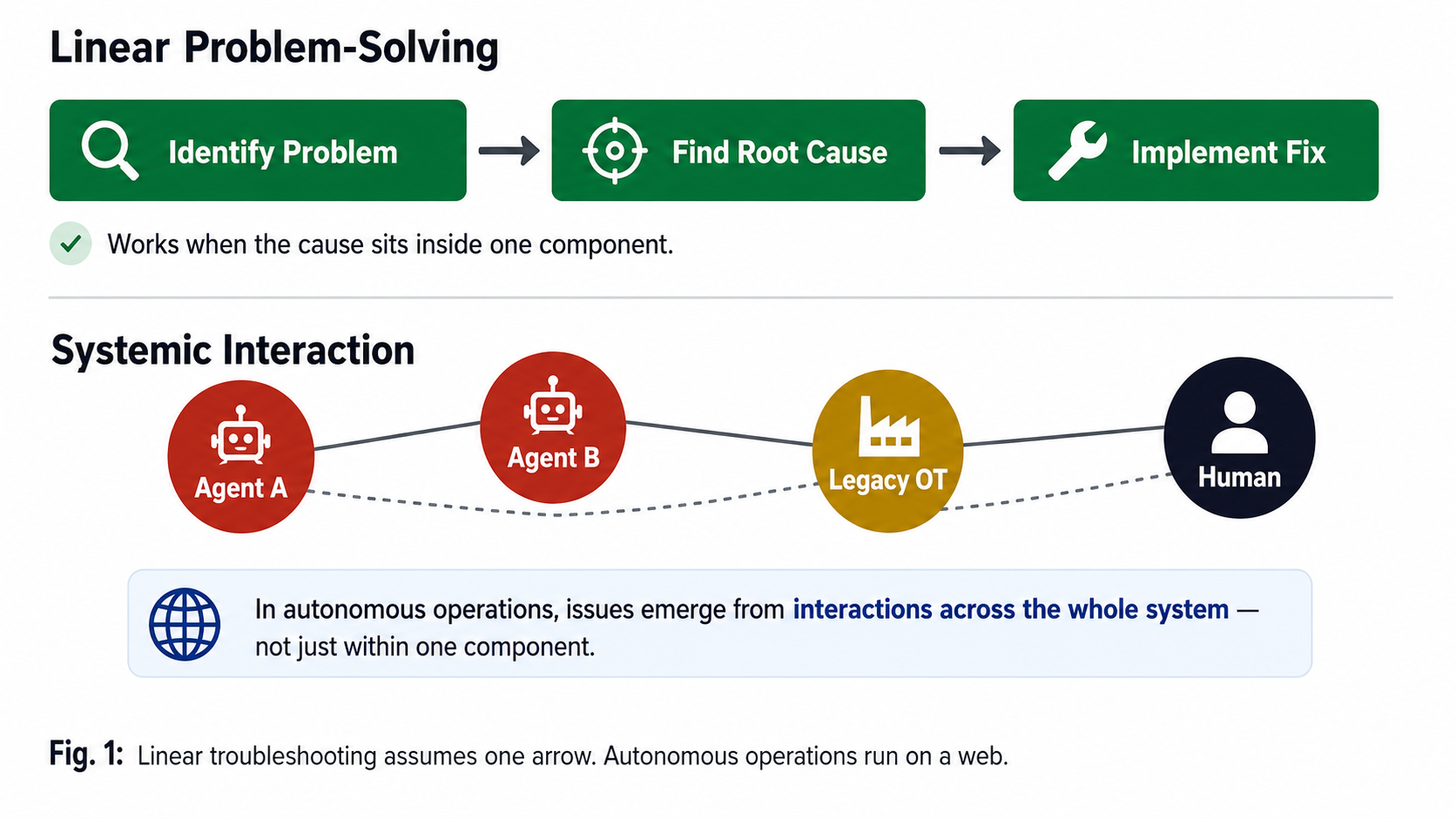
Classic industrial problem-solving often follows a linear path: identify the problem, find the root cause, implement a fix. In multi-agent, cyber-physical systems this approach frequently fails because problems emerge from interactions rather than from single components. Optimizing one part of the system can degrade overall performance.
Research on emergence explains why this keeps happening. Emergence describes a property of a complex system that arises from the interactions of its components but cannot be predicted from, or reduced to, those components individually; the classic examples are ant colonies routing around obstacles, financial markets producing flash crashes from individually rational trading algorithms, and bird flocks synchronizing through purely local rules (Zylos Research, 2026). Multi-agent AI systems show the same pattern: a 2025 study placed populations of dozens to hundreds of LLM agents in a repeated coordination task with no central coordinator, and their purely local interactions converged on system-wide conventions nobody had programmed in (Zylos Research, 2026, citing a 2025 Science Advances study). Week 30 of this series named the industrial version of the same risk: accountability concentrates at the interfaces between agents, legacy systems and people, not inside any single box.
👉 Key Insight
In autonomous operations the unit of analysis must shift from individual components to the system as a whole.
2. Core Elements of Systems Thinking for Industrial AI
Systems thinking isn't a mindset. It's a specific set of habits, and most of them can be taught in an afternoon, even if they take years to master.
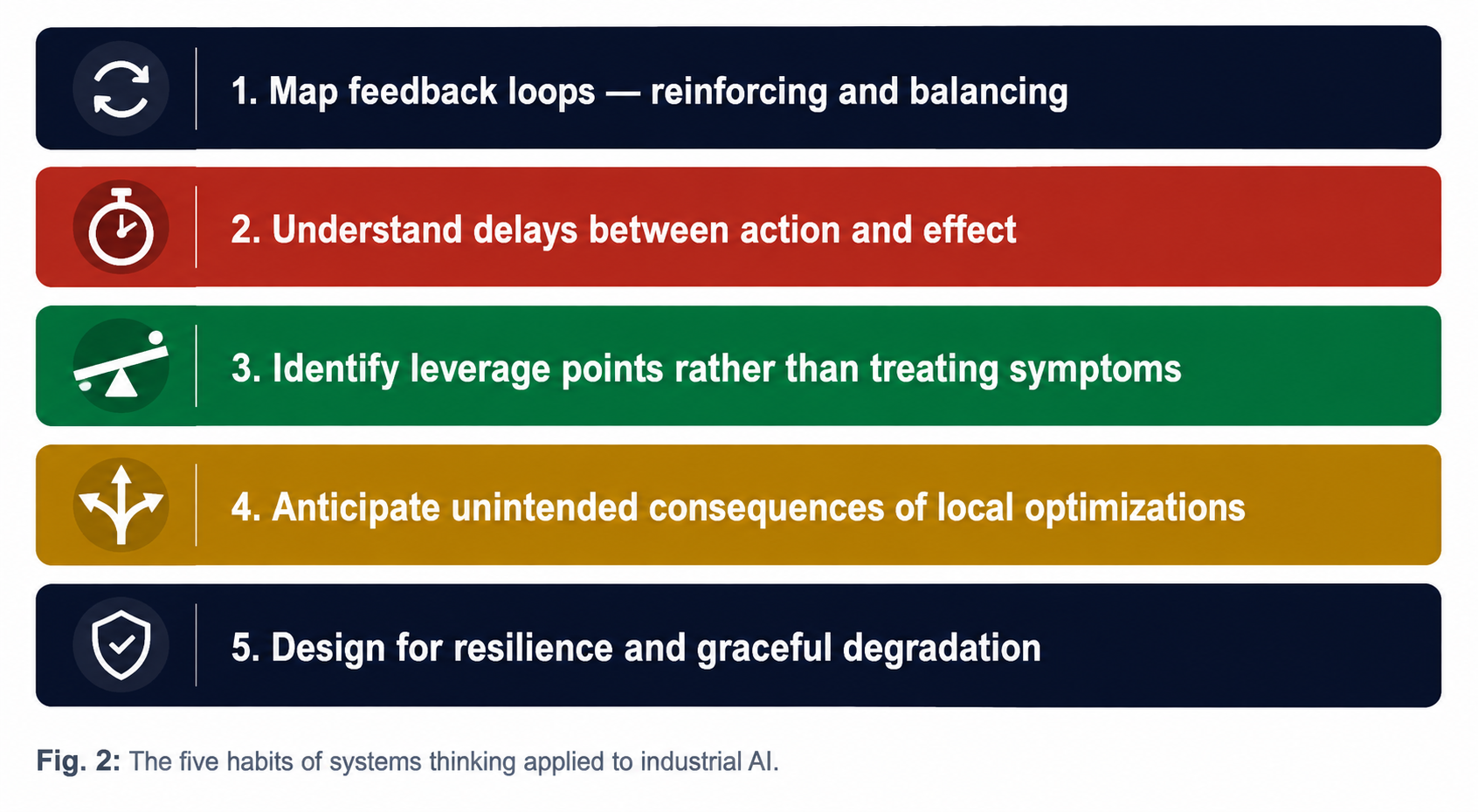
Effective systems thinking in this context includes: mapping feedback loops, both reinforcing and balancing; understanding delays between action and effect; identifying leverage points rather than treating symptoms; anticipating unintended consequences of local optimizations; and designing for resilience and graceful degradation.
This isn't an academic exercise layered on top of engineering, it's becoming an operational discipline in its own right. As one 2026 analysis of orchestrated AI systems puts it, the most critical system-level outcomes are no longer programmed directly into any one part; they emerge from the coordination of the whole, which is why organizations are now assembling specialized teams whose job is specifically to identify, interpret and direct emergent behavior rather than debug individual components (emergentbehavior.ai, 2026).
👉 Key Insight
Systems thinking does not replace detailed technical analysis, it provides the higher-level perspective that makes detailed analysis useful.
3. Practical Application on the Shop Floor
The fastest way to tell a systems thinker from a component thinker is the question they ask first.
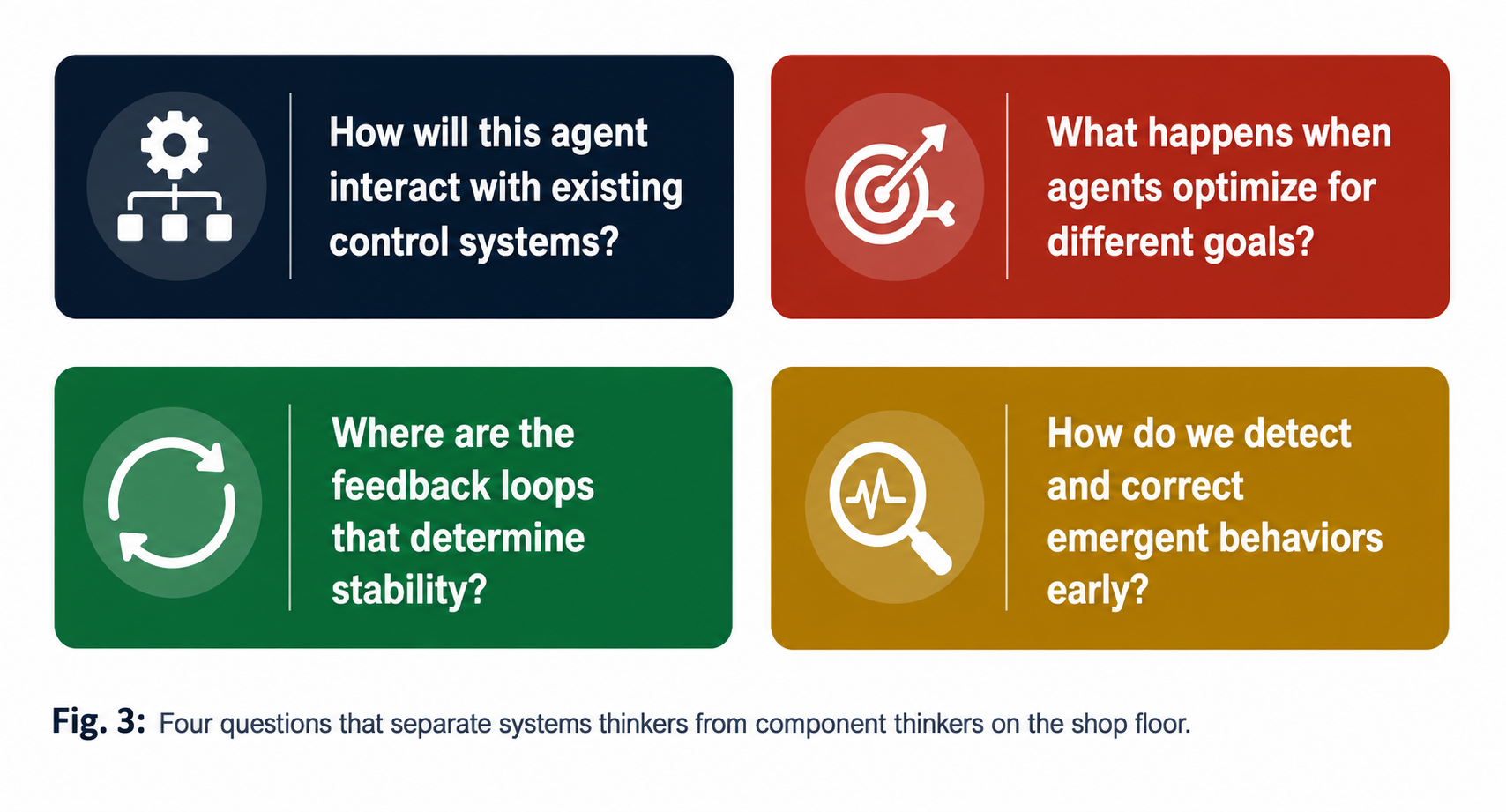
Leaders using systems thinking ask different questions: How will this new agent interact with existing control systems? What happens when multiple agents optimize for slightly different goals? Where are the critical feedback loops that determine overall stability? How do we detect and correct emergent behaviors early?
Answering these questions before deployment, not after an incident, is exactly what this series' recurring digital-twin example is built for. The same environment Siemens and NVIDIA use to let AI agents rehearse changes before touching a physical line at the Erlangen Electronics Factory (see Week 30) is equally suited to rehearsing multi-agent interactions, surfacing where two agents' locally rational optimizations conflict, long before either one reaches the shop floor (Siemens, 2026; NVIDIA Newsroom, 2026).
👉 Key Insight
The most valuable systems insights often emerge at the interfaces, between agents, between humans and machines, and between digital and physical layers.
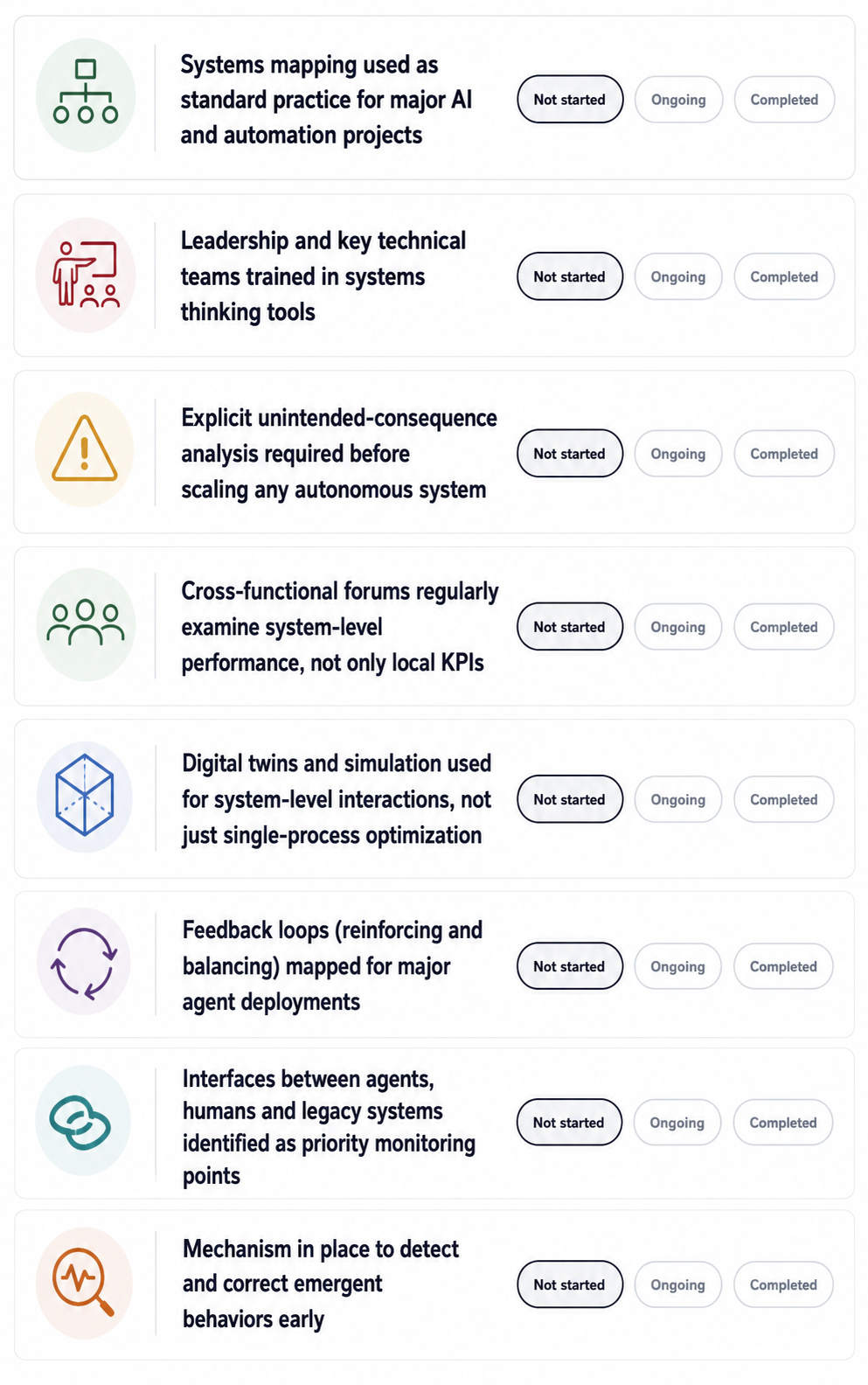
Action Plan for Decision Makers
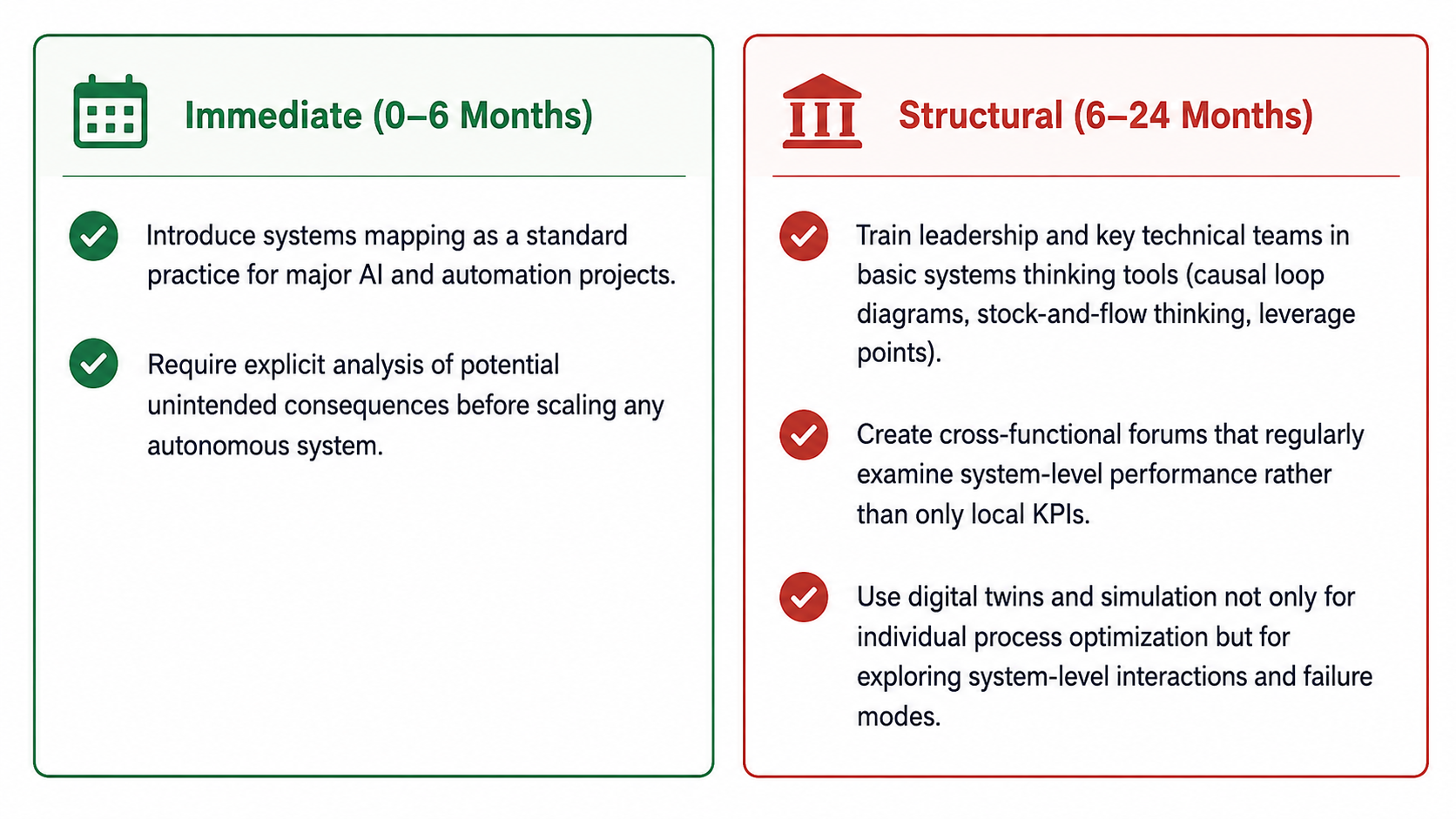
Checklist
Final Thought
Systems thinking gives leaders a way to see the interactions between agents, humans and machines. Part III of this Week 35 set turns to the humans inside that system directly, because the quality of the team deciding how to respond to what the system reveals matters just as much as the system map itself.
Efficiency Before Fuel means the decision that matters most is rarely the one that looks obvious from inside a single component.
Systems don't fail. Decisions do.
Take the Next Step
Subscribe to the Weekly Punch for weekly strategic clarity, direct to your inbox.
References
emergentbehavior.ai (2026) Emergent Behavior: The Defining Condition of AGI and ASI. [Online article].
NVIDIA Newsroom (2026) Siemens and NVIDIA Expand Partnership to Build the Industrial AI Operating System. Santa Clara: NVIDIA Corporation.
Siemens AG (2026) Siemens Unveils Technologies to Accelerate the Industrial AI Revolution at CES 2026. Munich: Siemens AG.
Zylos Research (2026) Emergent Behavior in Large-Scale Multi-Agent Systems. [Online article, citing a 2025 Science Advances study].
Disclaimer: This article synthesizes publicly available research current as of publication. Readers should verify current figures against the original publications before relying on them for strategic decisions. Verification Gate: flagged for pre-publication source check.
Ownership as Design.
Note: This article reflects my personalviews based on industry experience and publicly available information. It does not constitute professional, legal, or investment advice and does not represent the views of my employer. AI-generated visuals, concept and content by the author.
