Why Most Organizations Confuse AI Activity with Real Progress
INDUSTRIAL AI | STRATEGY & PROGRESS | AUGUST/SEPTEMBER 2026 | Week 35 · Part I
The Activity Trap in Industrial AI: Why Pilots, Dashboards and Proof-of-Concepts Rarely Translate into Sustainable Operational Advantage
Week 34 closed with a framework for turning vague AI ambition into explicit strategic choices. Week 35 opens with the trap that framework exists to prevent: mistaking the resulting activity for the progress it was supposed to produce.
Efficiency Before Fuel has always meant the decision is the expensive part, and so is the discipline of admitting a pilot isn't working. A portfolio of scattered proof-of-concepts feels like momentum. It usually isn't.
Executive Summary
IN 60 SECONDS:
AI activity has exploded across manufacturing, more pilots, dashboards, proof-of-concepts, but the impact on uptime, energy intensity, quality or flexibility often remains limited, because activity is easy to report and progress is not.
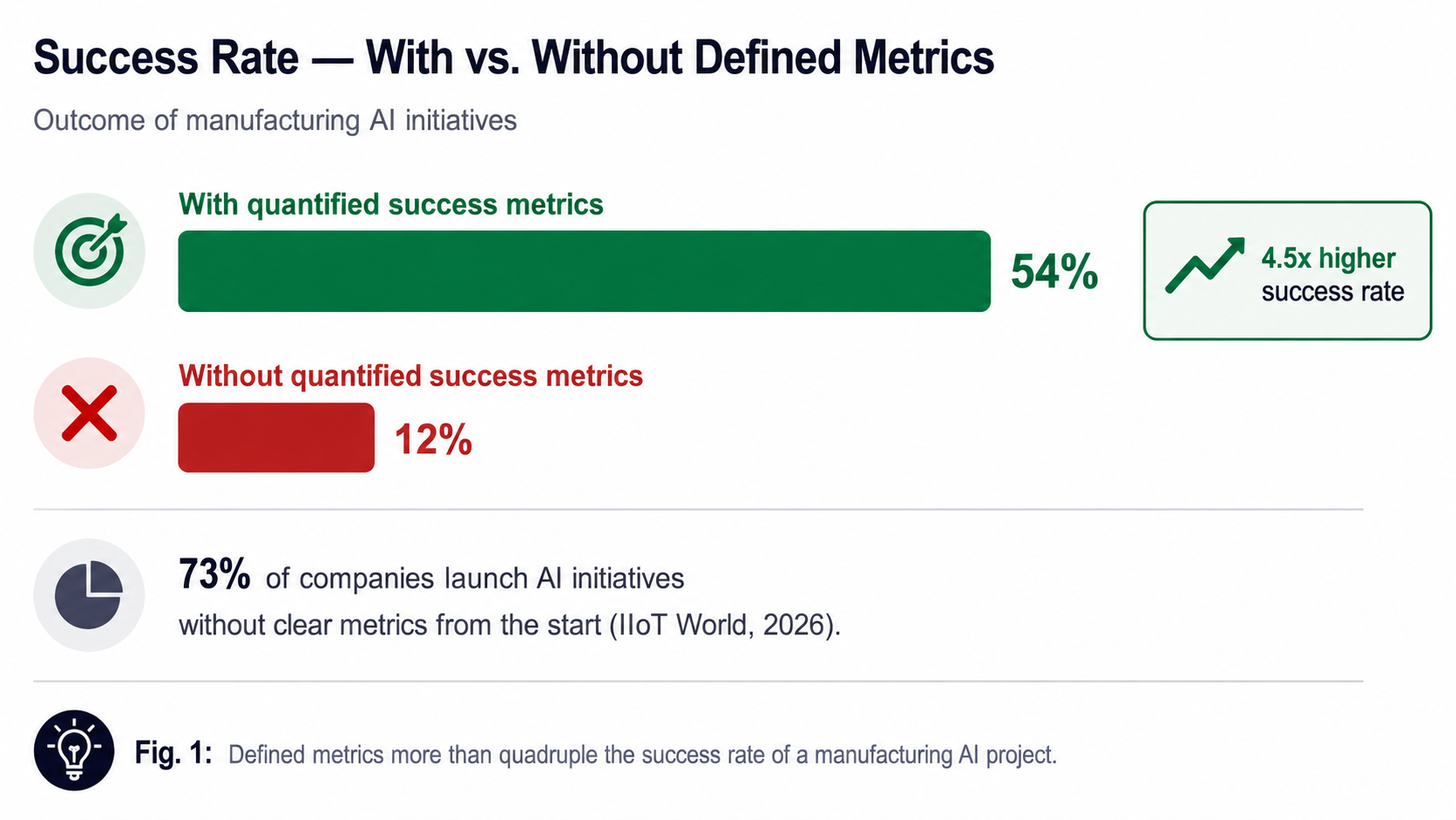
Manufacturing's own numbers show the gap: AI projects fail at a rate of 76.4%, and 84% of those failures trace back to leadership decisions, most commonly, launching without defined success metrics, rather than technical limitations.
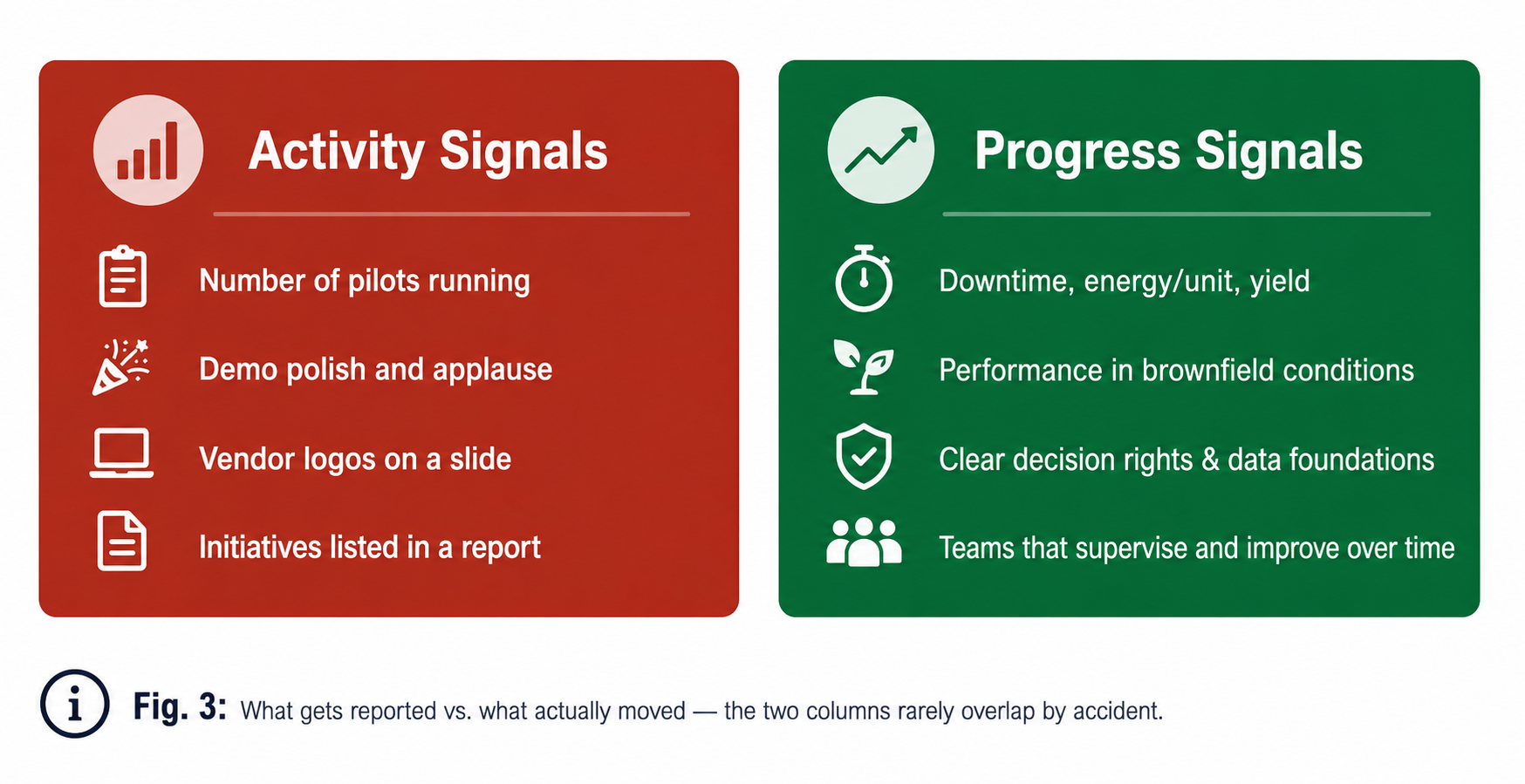
Real progress shows up in operational outcomes (downtime, energy per unit, yield) and organizational capability (decision rights, data foundations, supervision skill), not in the number of initiatives running at any given time.
1. The Activity Trap in Industrial AI
A dashboard full of green metrics and a CFO's spreadsheet full of red questions can both be true at the same time. That gap is where AI programs go to die.
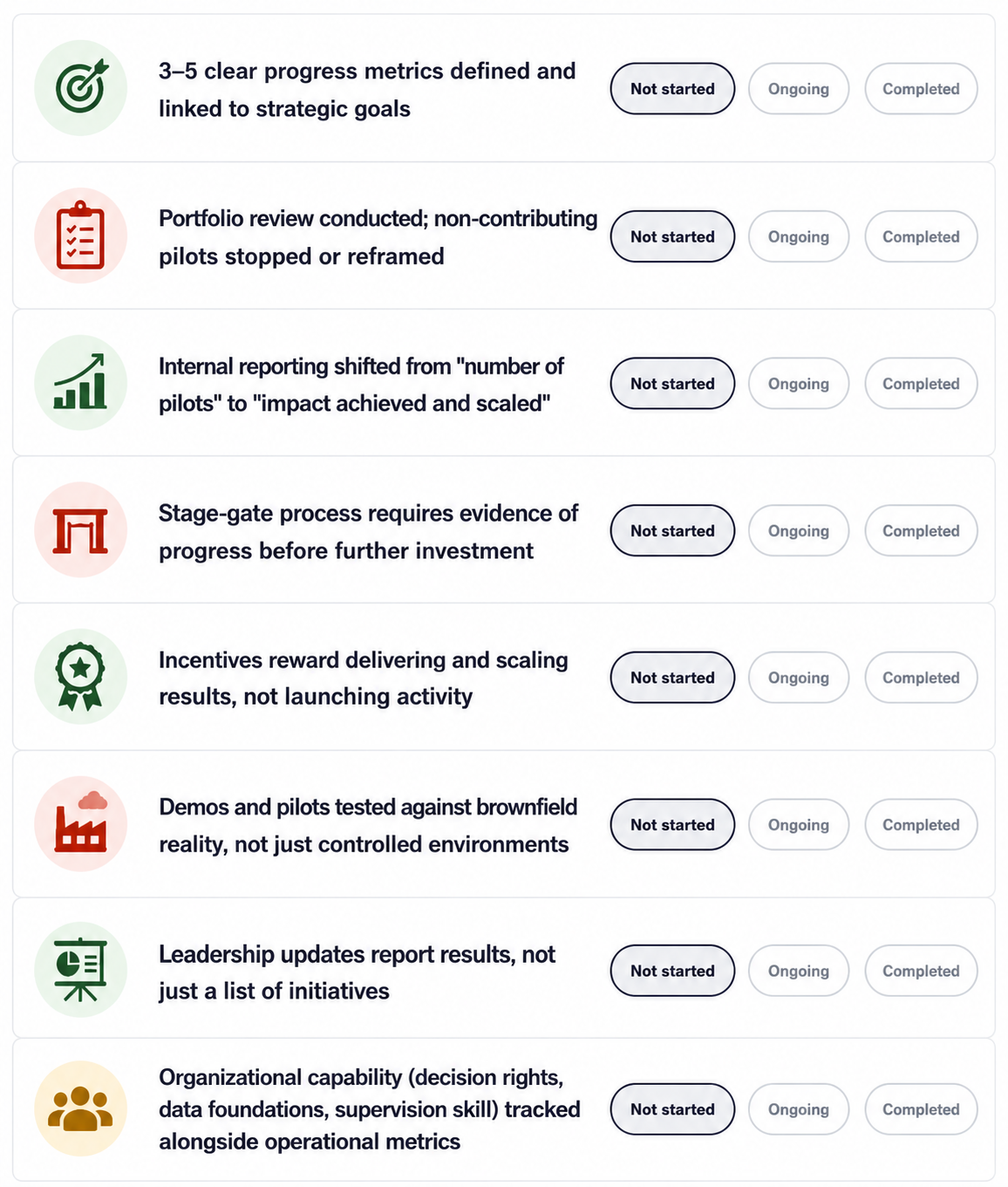
Typical signs of the activity trap include:
A growing portfolio of pilots that never move beyond controlled environments
Impressive demos that do not survive contact with brownfield reality
Metrics focused on number of AI projects rather than business outcomes
Leadership updates that list initiatives instead of results
The scale is now well documented. Manufacturing AI projects fail at a rate of 76.4%, and 84% of those failures trace back to leadership decisions rather than technical limitations, chief among them, launching without success metrics defined upfront (IIoT World, 2026, citing Folio3 AI and Labor411). The correlation is stark: projects with quantified success metrics achieve a 54% success rate; projects without them achieve 12%, yet 73% of companies launching AI initiatives still lack clear metrics from the start (IIoT World, 2026). One recent analysis calls the underlying pattern "AI theatre": pilots, demos and showcases that create the appearance of progress without changing a single board-level number (Green Everest, 2026).
👉 Key Insight
Activity creates the illusion of momentum. Progress creates actual competitive advantage.
2. Why the Confusion Persists
Nobody builds a dashboard to lie. They build it to answer the question that's actually easy to answer.
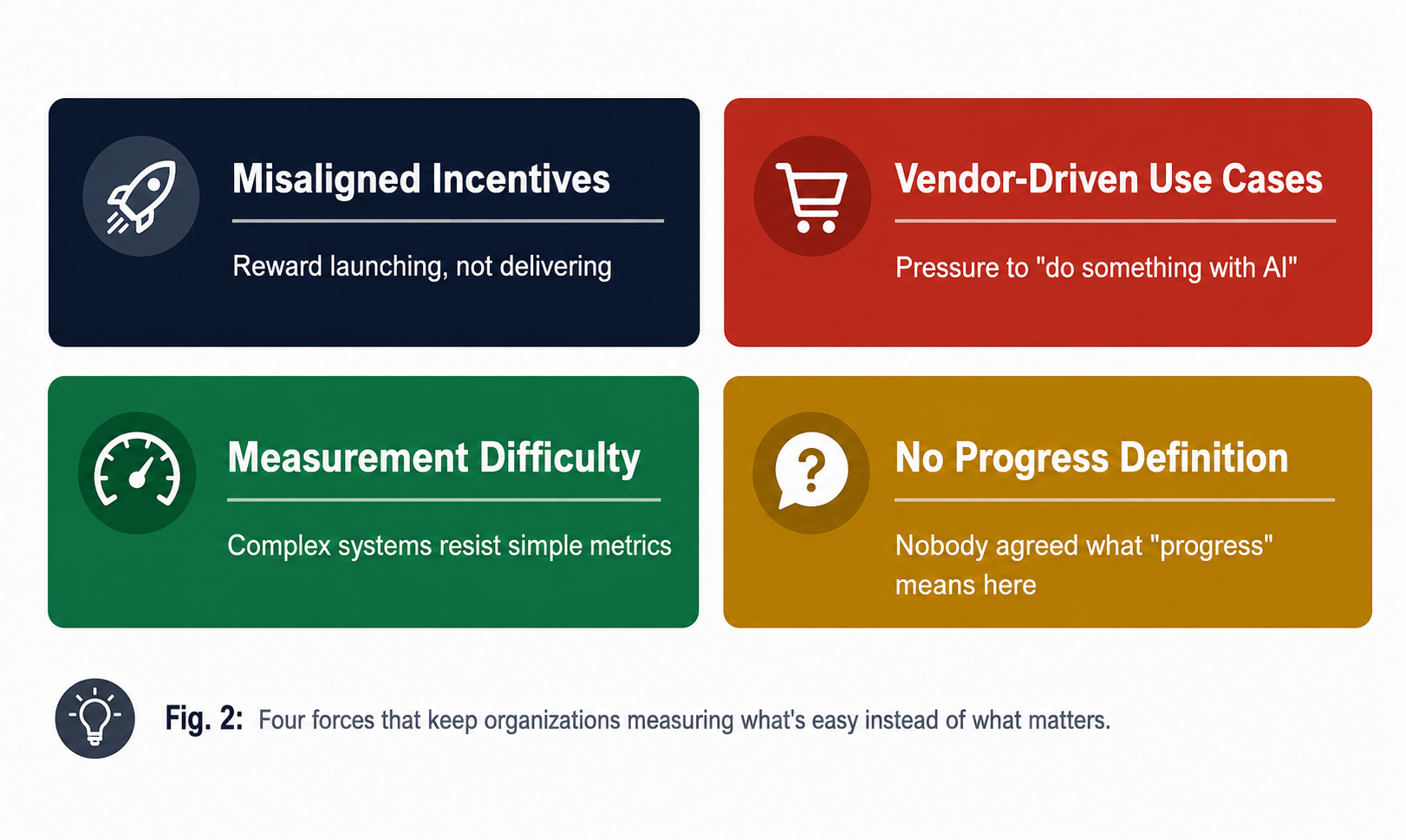
Several forces reinforce the trap: pressure to "do something with AI," vendor-driven use-case lists, internal incentives that reward launching projects more than delivering results, and the genuine difficulty of measuring impact in complex industrial systems. In addition, many organizations lack a clear definition of what "progress" actually looks like in their specific context.
Recent analysis of the pattern, drawing on McKinsey research, traces it to three structural root causes: misaligned incentives that reward AI activity, pilots launched, models trained, rather than outcomes; technical debt that blocks AI systems from accessing the production data they'd need to prove value; and organizational structures that isolate AI teams from the business decision-makers who could tell them what actually matters (Crosley, 2026, citing McKinsey, 2026). A parallel diagnosis calls this "metrics theater": tracking what's easy to measure, model accuracy, deployment velocity, user satisfaction, while ignoring what drives business value, such as decision speed or workflow transformation. McKinsey's own research found that tracking defined KPIs is the single strongest predictor of whether AI delivers bottom-line impact, yet fewer than one in five organizations actually do it (A.Team, 2026, citing McKinsey, 2026).
👉 Key Insight
Without an explicit definition of progress, organizations default to measuring what is easy – activity.
3. What Real Progress Looks Like
Real progress doesn't need a showcase. It shows up on its own, in numbers nobody had to explain.
Real progress in Physical and Agentic AI is visible in operational metrics: reduced unplanned downtime, lower energy per unit, higher first-pass yield, faster response to variability, and scalable processes that no longer depend on heroic individual effort. It is also visible in organizational capability: clearer decision rights, stronger data foundations and teams that can supervise and improve AI systems over time.
The financial signal behind this is significant. Grant Thornton's 2026 AI Impact Survey found that organizations with fully integrated AI are nearly four times more likely to report revenue growth than those still piloting, 58% versus 15%, and concluded that without strong governance, piloting and scaling produce activity, not outcomes (Grant Thornton, 2026). That governance discipline is exactly what separates a portfolio of demos from a portfolio of results.
👉 Key Insight
Progress is measured in outcomes and capabilities, not in the number of ongoing initiatives.
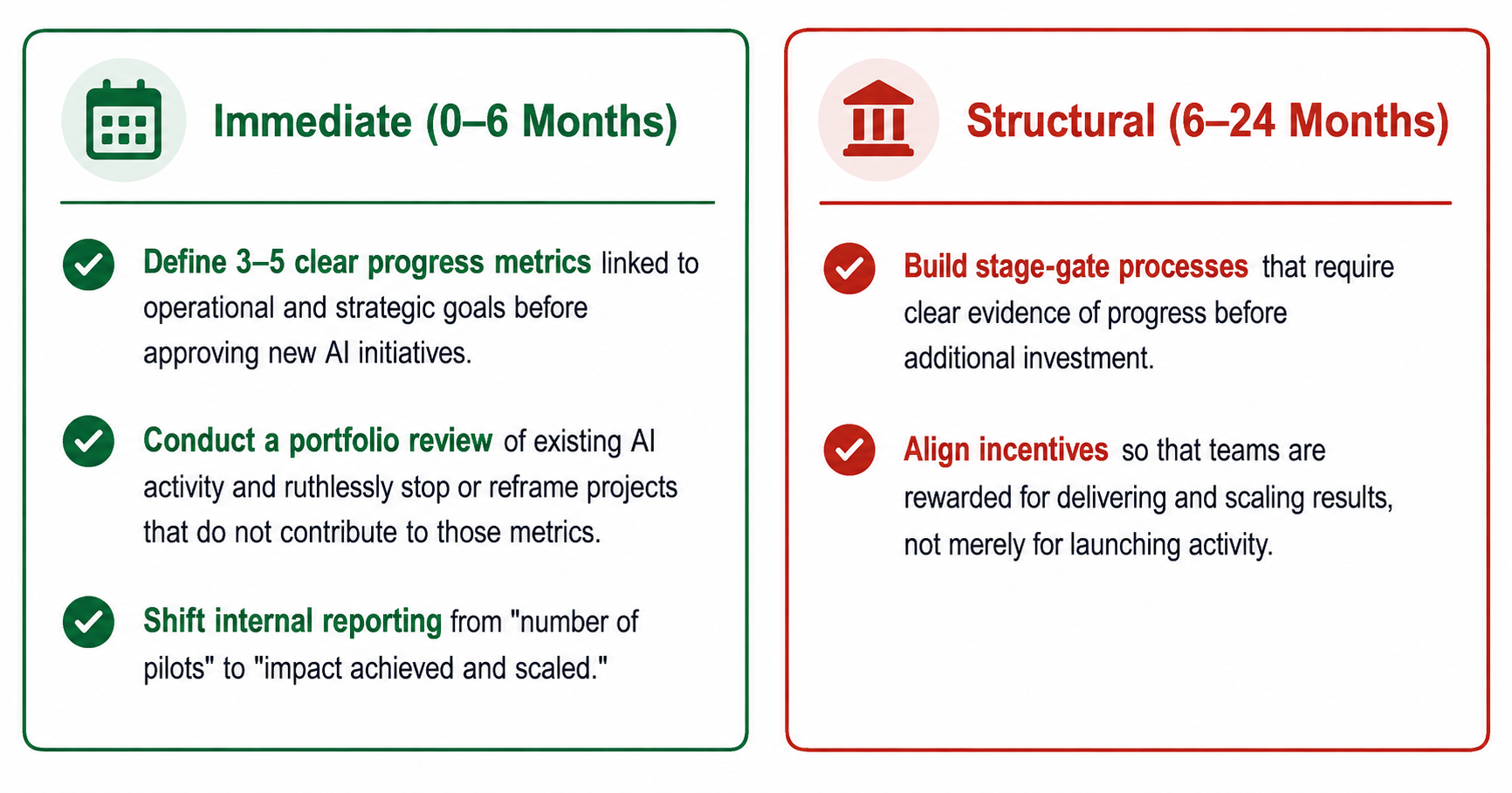
Action Plan for Decision Makers
Checklist
Final Thought
Real progress in a single pilot is hard enough to measure. Part II of this Week 35 set goes further, into why progress at the system level requires a different way of thinking altogether, once AI Agents, humans and legacy systems start interacting.
Efficiency Before Fuel means the organization that wins isn't the one with the fullest pilot portfolio. It's the one that can tell the difference between motion and movement.
Systems don't fail. Decisions do.
Take the Next Step
Subscribe to the Weekly Punch for weekly strategic clarity, direct to your inbox.
References
A.Team (2026) How to Measure AI ROI (Beyond Metrics Theater). [Online article, citing McKinsey, 2026].
Crosley, B. (2026) AI Theater: Why Only 23% of Companies Create Real Value. [Online article, citing McKinsey, 2026].
Grant Thornton (2026) 2026 AI Impact Survey Report. [Online report].
Green Everest (2026) AI Theatre Is Over: How Value Pools Turn Pilots into Progress. [Online article].
IIoT World (2026) Agentic AI in Manufacturing: ROI vs. Reality. [Online article, citing Folio3 AI and Labor411].
Disclaimer: This article synthesizes publicly available industry research current as of publication. Readers should verify current figures against the original publications before relying on them for strategic decisions. Verification Gate: flagged for pre-publication source check.
Ownership as Design.
Note: This article reflects my personalviews based on industry experience and publicly available information. It does not constitute professional, legal, or investment advice and does not represent the views of my employer. AI-generated visuals, concept and content by the author.
