Strategic Dependency vs. Sovereignty: Why Supply Chains and Grids Are Becoming Political
GEOPOLITICS | ENERGY & SUPPLY CHAINS | SEPTEMBER 2026 | Week 37 · Part II
Chips, Cloud, Energy Imports and Grid Access Are No Longer Neutral Inputs, They Are Strategic Exposure
Part I of this week's pair mapped Europe's infrastructure gap: the megawatts and the years it takes to connect them. Part II asks the question underneath that one, who actually controls the inputs infrastructure itself depends on, and what happens to a company's plans when that control sits somewhere else.
Efficiency Before Energy only works if the energy is actually available to be efficient with. Sovereignty, in this sense, isn't a government word anymore. It's a supply-chain word.
Executive Summary
IN 60 SECONDS:
Sovereignty used to be a government word. It is now an operating reality for companies: AI systems depend on chips, cloud capacity, specialized equipment and electricity, and Europe is exposed on several of these critical inputs.
Brussels itself now treats this as strategic, not administrative: the European Technological Sovereignty Package, published 3 June 2026, bundles a Chips Act 2.0, a Cloud and AI Development Act, an Open Source Strategy and a Strategic Roadmap for Digitalisation and AI in Energy into a single response.
Leaders who treat this as "geopolitics out there" will discover it as a plant-level constraint. The choice is not autarky versus dependence — it is optionality under political and physical constraint.
1. Dependency Has a Shop-Floor Face
Sovereignty sounds like a summit topic. It shows up as a delayed transformer.
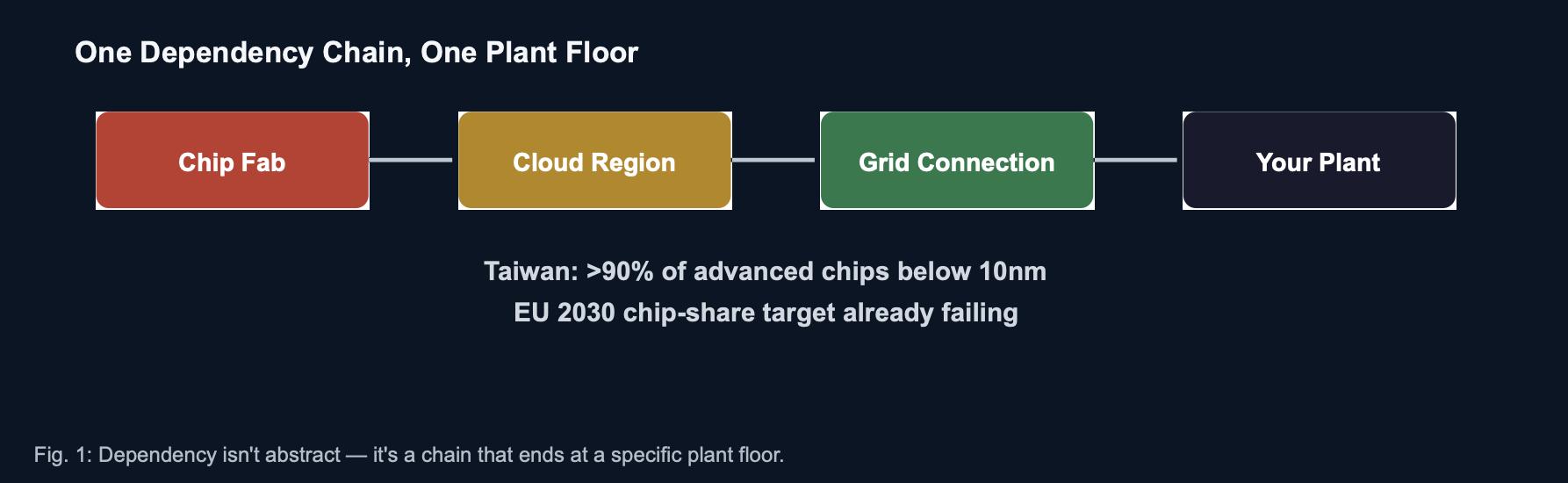
Strategic dependency is not abstract. It looks like a delayed transformer, a queued grid connection, a cloud region with limited capacity, or a single-source component for robotics and edge systems. When those inputs tighten, AI roadmaps slip and energy projects stall.
Semiconductors show the exposure most starkly. Taiwan produces more than 90% of the world's advanced chips below 10 nanometres, precisely the class of chip that Physical AI and edge inference depend on, and the EU's original 2023 Chips Act target of growing Europe's global market share from under 10% to 20% by 2030 has effectively failed, with Intel among the manufacturers cancelling planned European capacity (innobu, 2026). The European Commission's response is the clearest sign yet that this has moved from procurement risk to policy priority: its Technological Sovereignty Package, published 3 June 2026, gives Brussels emergency powers to prioritize chip production during supply crises, including the ability to override existing commercial contracts during a formally declared crisis stage (Freshfields, 2026).
👉 Key Insight
Sovereignty is the ability to operate when an external supplier, route or permit does not cooperate.
2. Why Grids and Supply Chains Are Now Political
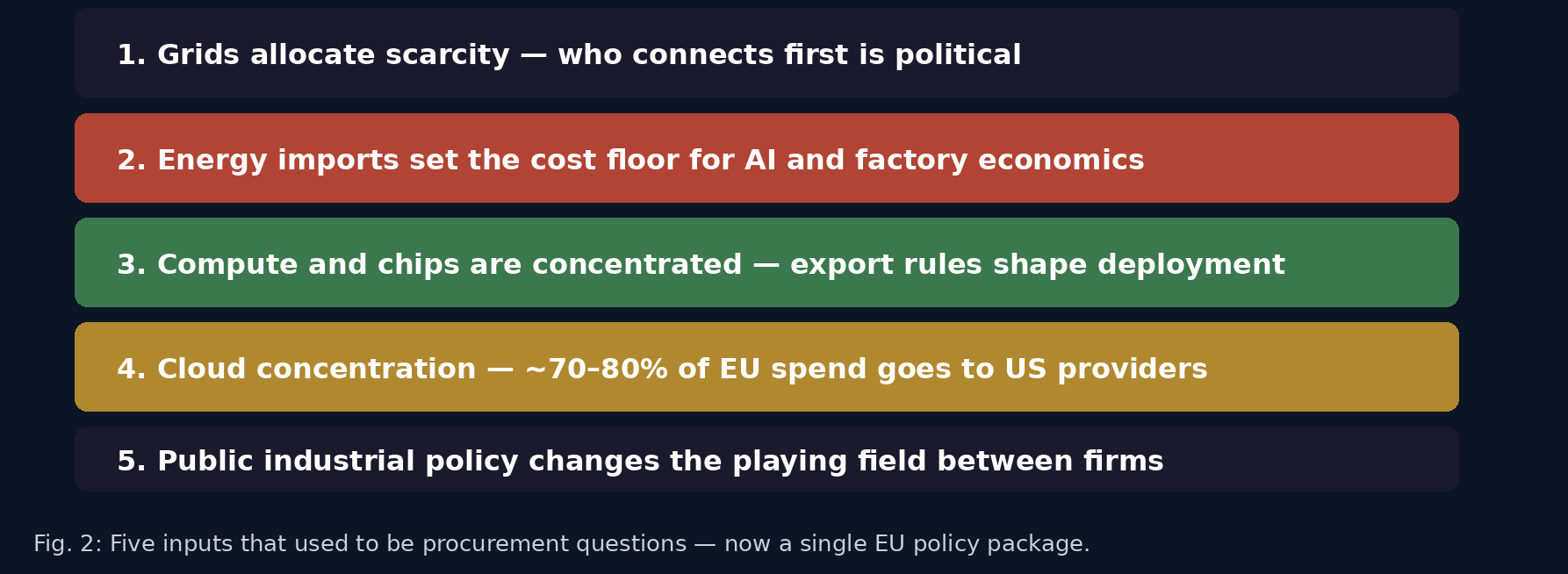
Five inputs used to be procurement line items. In June 2026, Brussels made all five a single policy package.
Grids allocate scarcity: who gets connected first is a political and regulatory choice with industrial consequences. Energy imports set the cost floor: exposure to gas and interconnectors feeds through to AI and factory economics. Compute and chips are concentrated: access, export rules and vendor lock-in shape what can be deployed. Cloud concentration creates operational and data-residency exposure even when the application is "European." Public industrial policy, gigafactories, sovereignty packages, grid rules, changes the playing field between locations and firms.
The scale of the cloud dependency alone explains why this became political: American companies account for roughly 70–80% of professional cloud expenditure in the EU (Cloud Security Alliance, 2026; innobu, 2026). The European Commission's 3 June 2026 Technological Sovereignty Package addresses that concentration directly through the Cloud and AI Development Act, which will bar cloud providers that fail to meet EU sovereignty criteria from sensitive government contracts and define a four-tier sovereignty framework for public-sector and critical-sector workloads (TechPolicy.Press, 2026; Digital Watch Observatory, 2026). Gartner projects European sovereign cloud infrastructure spending will nearly double from $6.9 billion in 2025 to $12.6 billion in 2026, en route to $23.1 billion by 2027 (Cloud Security Alliance, 2026), a structural shift in procurement, not a passing preference.
👉 Key Insight
Each of these five points was, until recently, a procurement question. Brussels' own June 2026 package is the clearest sign they have become a policy question instead.
3. The Leadership Choice: Reduce Exposure Without Waiting for Perfect Autonomy
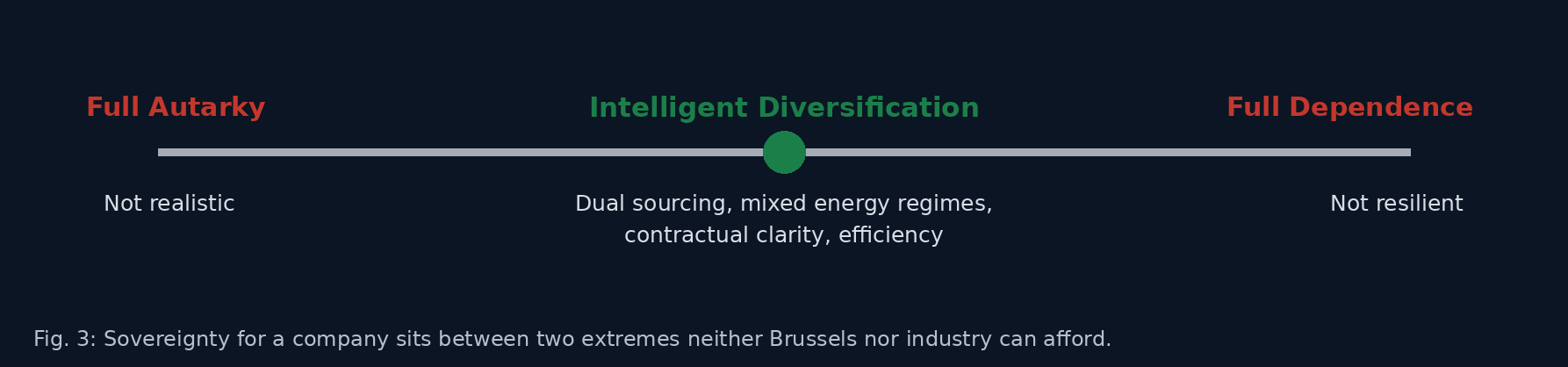
Full autarky is not a realistic corporate strategy. Intelligent diversification is.
Dual sourcing where possible, location portfolios that mix energy regimes, contractual clarity on compute and energy, and efficiency that reduces dependence on scarce new capacity, none of this requires waiting for the EU to finish building its own semiconductor or cloud base.
Independent analysis of the EU's own package makes the same point from the policy side: full EU cloud and AI autonomy is unlikely within the next five years, given the domestic data-centre expansion, energy availability and advanced semiconductor capacity that remain structural constraints even after the June 2026 package (BISI, 2026). If Brussels itself is planning for exposure to persist for years, companies waiting for sovereignty to arrive before adjusting their own sourcing and location strategy are planning on the wrong timeline.
👉 Key Insight
Sovereignty for a company is not isolation. It is optionality under political and physical constraint.
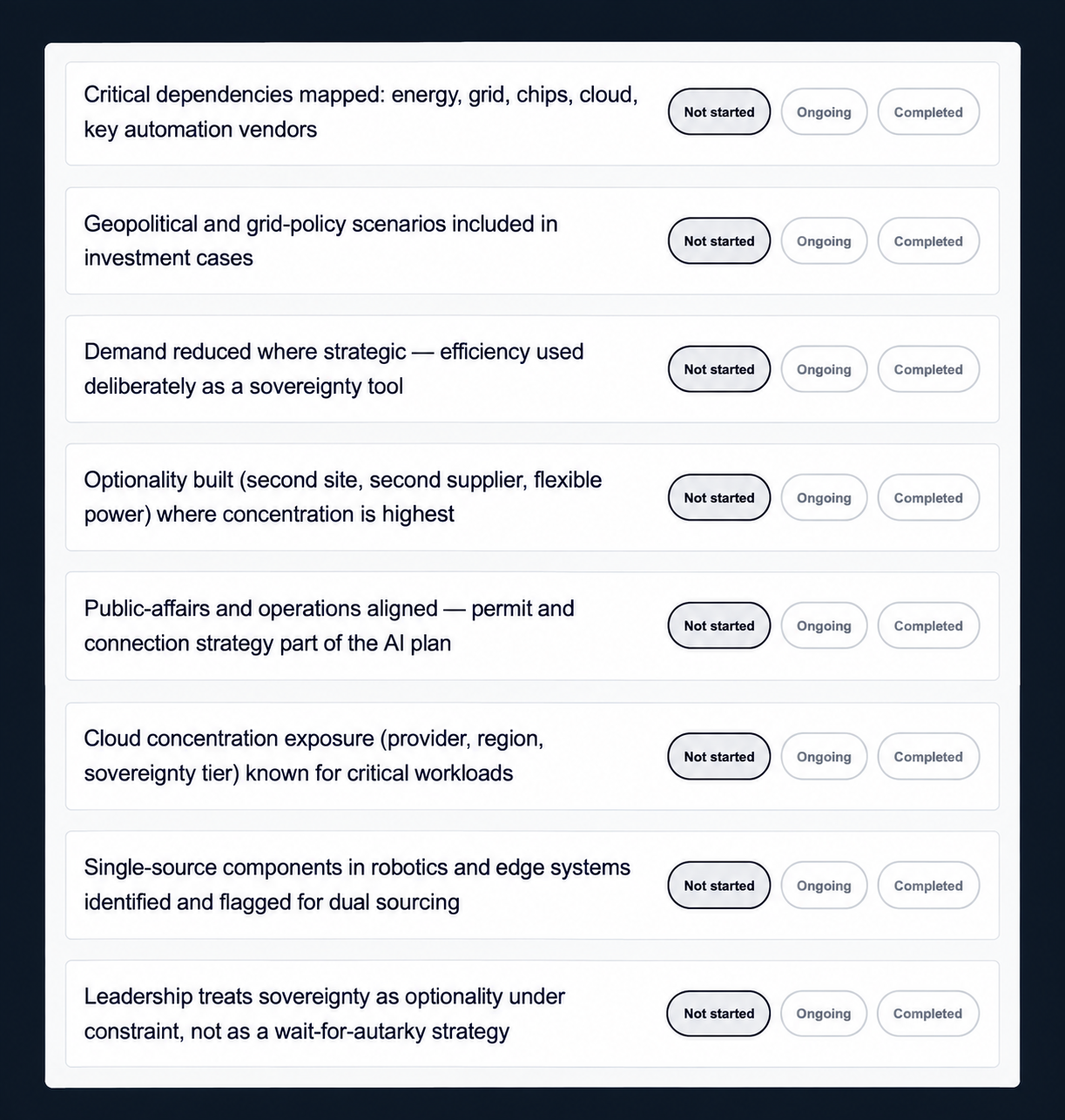
Action Plan for Decision Makers
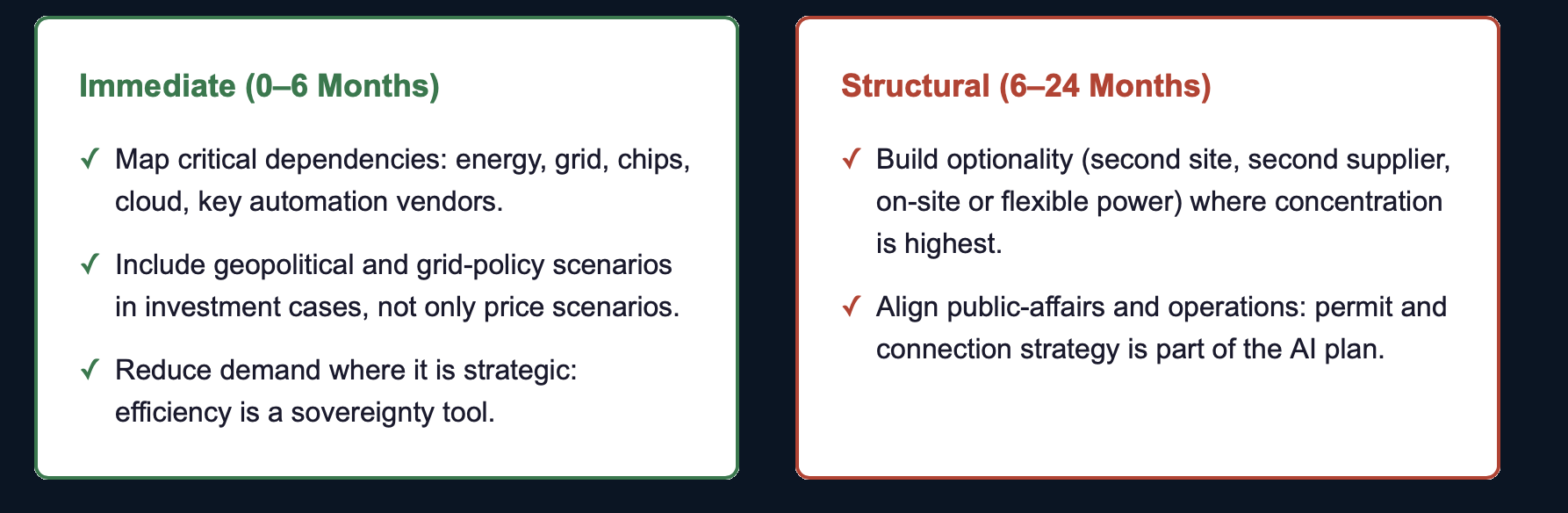
Checklist
Final Thought
Part I of this pair showed why the grid itself is a competitiveness problem. Part II shows why the things that feed the grid, and the compute sitting behind it, are exposed the same way. Neither problem waits for a policy package to finish before it shows up on a plant floor.
Efficiency Before Energy applies here too: the input you don't need is the one no supplier, permit or grid operator can ever hold hostage.
Systems don't fail. Decisions do.
Take the Next Step
Subscribe to the Weekly Punch for weekly strategic clarity, direct to your inbox.
References
BISI (2026) EU Cloud and AI Development Act: Sovereignty, AI and US Tech Dependence. London: Bloomsbury Intelligence and Security Institute.
Cloud Security Alliance (2026) EU Tech Sovereignty: Cloud Concentration Risk and the Compliance Cascade. [Online research briefing].
Digital Watch Observatory (2026) The EU's Tech Sovereignty Package and the Future of European Digital Power. [Online article].
Freshfields (2026) Shifting Away from Dependency: The EU's Tech Sovereignty Package. [Online legal briefing].
innobu (2026) EU Tech Sovereignty Package 2026: Chips Act 2.0, CAIDA and What European Companies Need to Know. [Online article].
TechPolicy.Press (2026) EU Unveils Sweeping Tech Sovereignty Push, Balancing Autonomy with Openness. [Online article].
Disclaimer: This article synthesizes publicly available policy and market research current as of publication. Readers should verify current figures and legislative status against the original publications before relying on them for strategic decisions. Verification Gate:flagged for pre-publication source check.
Ownership as Design.
Note: This article reflects my personalviews based on industry experience and publicly available information. It does not constitute professional, legal, or investment advice and does not represent the views of my employer. AI-generated visuals, concept and content by the author.
