Europe's Competitiveness Crisis in the AI Era: Energy and Infrastructure as Deciding Factors
EUROPE | ENERGY & INFRASTRUCTURE | SEPTEMBER 2026 | Week 37 · Part I
The AI Race Is No Longer Won by Models Alone, It Is Won by Power, Grids and the Speed to Connect
Week 36 argued that energy is now a leadership job inside the factory. Week 37 zooms out to the level where that job gets decided before any single plant does: European competitiveness itself.
Efficiency Before Energy is not a slogan Brussels would recognize, but it is exactly the discipline the data says Europe is missing. The continent doesn't have an AI-ambition problem. It has a megawatt-and-decade problem.
Executive Summary
IN 60 SECONDS:
Europe wants to compete in AI. The binding constraints are physical: electricity prices remain structurally higher than in the US and China, and grid congestion and connection queues slow data centers, factories and electrified industry.
The numbers are no longer abstract: EU industrial electricity prices average roughly twice US levels and nearly 50% above China's, and new grid connections can take up to a decade in some markets — while over 2,500 GW of projects sit stalled in connection queues worldwide.
Decision Makers who treat AI as a software agenda and energy as a utility agenda will misread the race. Competitiveness now sits at the intersection of energy, grids and industrial AI.
1. The Race Has Shifted from Algorithms to Infrastructure
Foundation models still matter. What increasingly decides location and scale is something no roadmap slide shows: whether the power actually gets there.
What increasingly decides location and scale is the ability to power, connect and operate compute and Physical AI at industrial speed. Europe generates clean energy in several regions, but struggles to move it to where demand is growing. Connection waits measured in years are a competitiveness problem, not an engineering footnote.
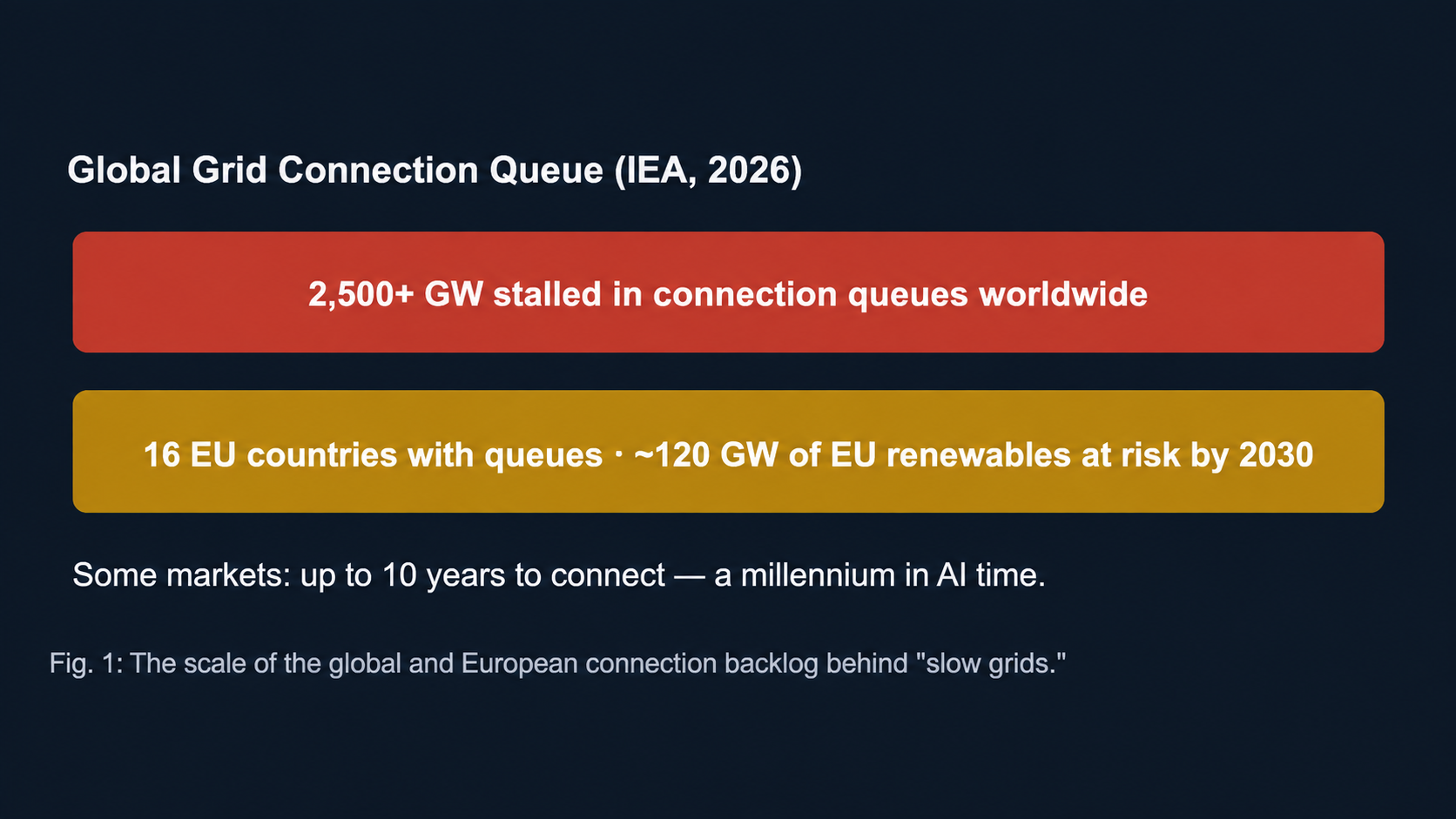
The IEA's Electricity 2026 report puts a number on that footnote: more than 2,500 gigawatts' worth of projects, renewables, storage, and large loads such as data centres, remain stalled in grid connection queues worldwide, with grid investment having lagged well behind investment in generation capacity (IEA, 2026). Inside the EU specifically, connection queues are present in at least 16 member states as of mid-2026, putting roughly 120 GW of mature renewable projects, including 1.5 million household installations, at risk of missing timely grid access by 2030 (European Commission, 2026, citing EMBER, 2026). In some markets, new connections can take up to ten years, a millennium in a field where advances are measured in days (OilPrice.com, 2026).
👉 Key Insight
In the AI era, infrastructure speed is strategy. Slow grids produce slow industry.
2. Where Europe Loses Ground
Four gaps, and none of them show up in a model benchmark.
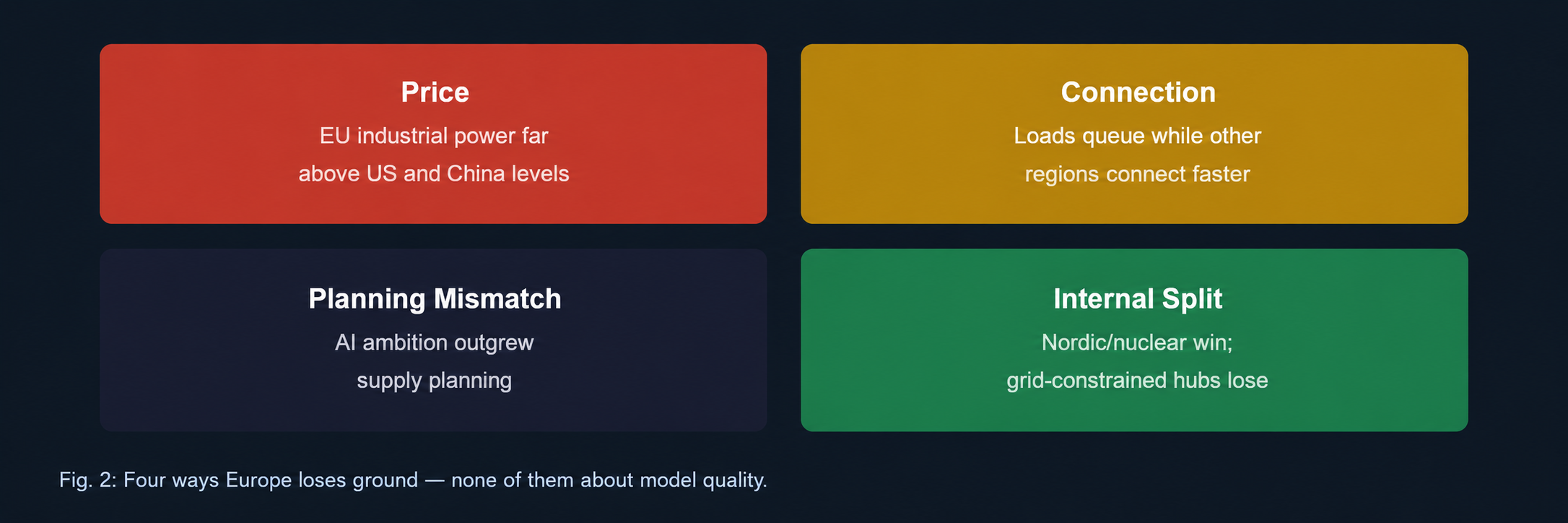
Price: European industrial power remains far above US and Chinese levels, raising the operating cost of data centers and energy-intensive AI-enabled production. Connection: proposed loads wait in queues while other regions connect faster. Planning mismatch: AI and data-center ambitions have grown faster than coordinated energy-supply planning. Internal split: Nordic and nuclear-strong locations look relatively attractive; grid-constrained hubs face rising cost and delay.
The price gap is not close. EU electricity prices for energy-intensive industries averaged over twice US levels and nearly 50% above China's in 2025, the highest among the markets the IEA analyzed, roughly double the US and India, 65% above Australia and 25% above Japan, with the average EU wholesale price up about 10% year over year to roughly $95/MWh (IEA, 2026). The internal split is just as real: securing data-centre capacity across Europe's five largest hubs, Frankfurt, London, Amsterdam, Paris and Dublin, is set to rise a further 12% in 2026 on supply constraints alone (CBRE, 2026, cited in CNBC, 2026), while France's nuclear-heavy grid offers industrial rates around €85–105/MWh and, under the Plan France 2030 programme, grid connections in 18–30 months for qualifying AI facilities, versus the standard three-to-five-year queue elsewhere (techplustrends.com, 2026).
👉 Key Insight
None of these four gaps is a European weakness in AI itself. They are gaps in the physical layer underneath it — and physical layers don't close on a policy timeline.
3. What This Means for Industrial Decision Makers
A Physical AI roadmap that ignores the grid is not an ambitious roadmap. It is an incomplete one.
Plant and portfolio choices now include power availability, power quality, connection timelines and energy intensity of AI deployments. Efficiency, on-site generation, flexible load and location strategy become competitive tools, not sustainability extras.
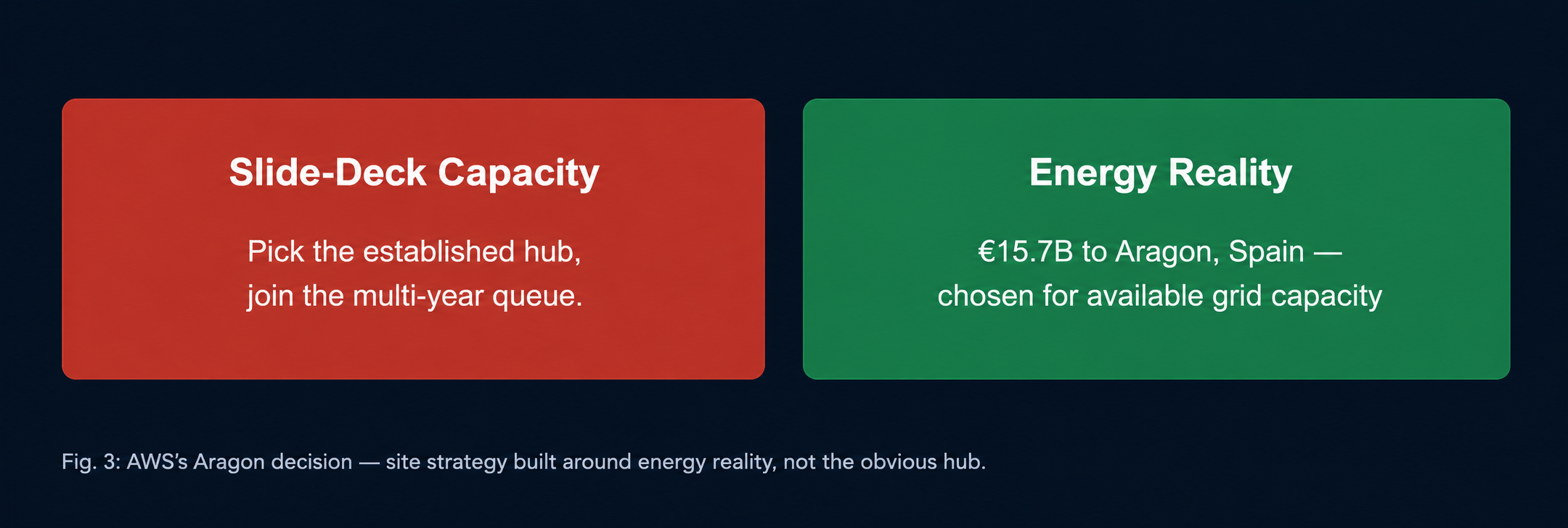
The companies acting on this today are not waiting for policy reform, they are engineering around the constraint. AWS committed €15.7 billion to a data-centre campus in Aragon, Spain, a secondary market selected specifically because it had available grid capacity, rather than joining the multi-year queue in the established FLAP-D hubs (Avanza Energy, 2026). That is site strategy as a competitiveness decision, made against energy reality rather than slide-deck capacity.
👉 Key Insight
The companies that win in Europe will be those that design AI and operations around energy reality – not around slide-deck capacity.
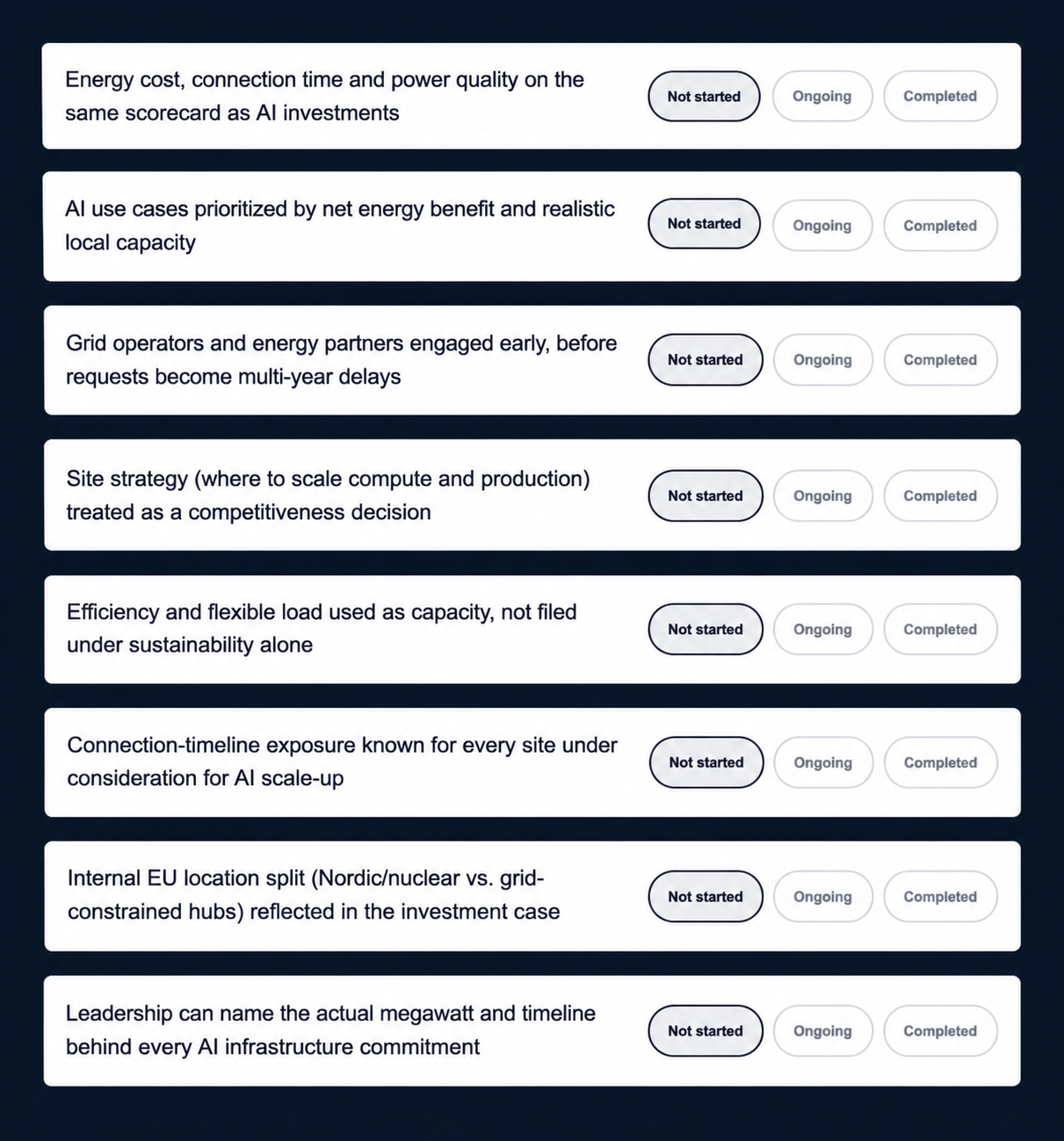
Action Plan for Decision Makers
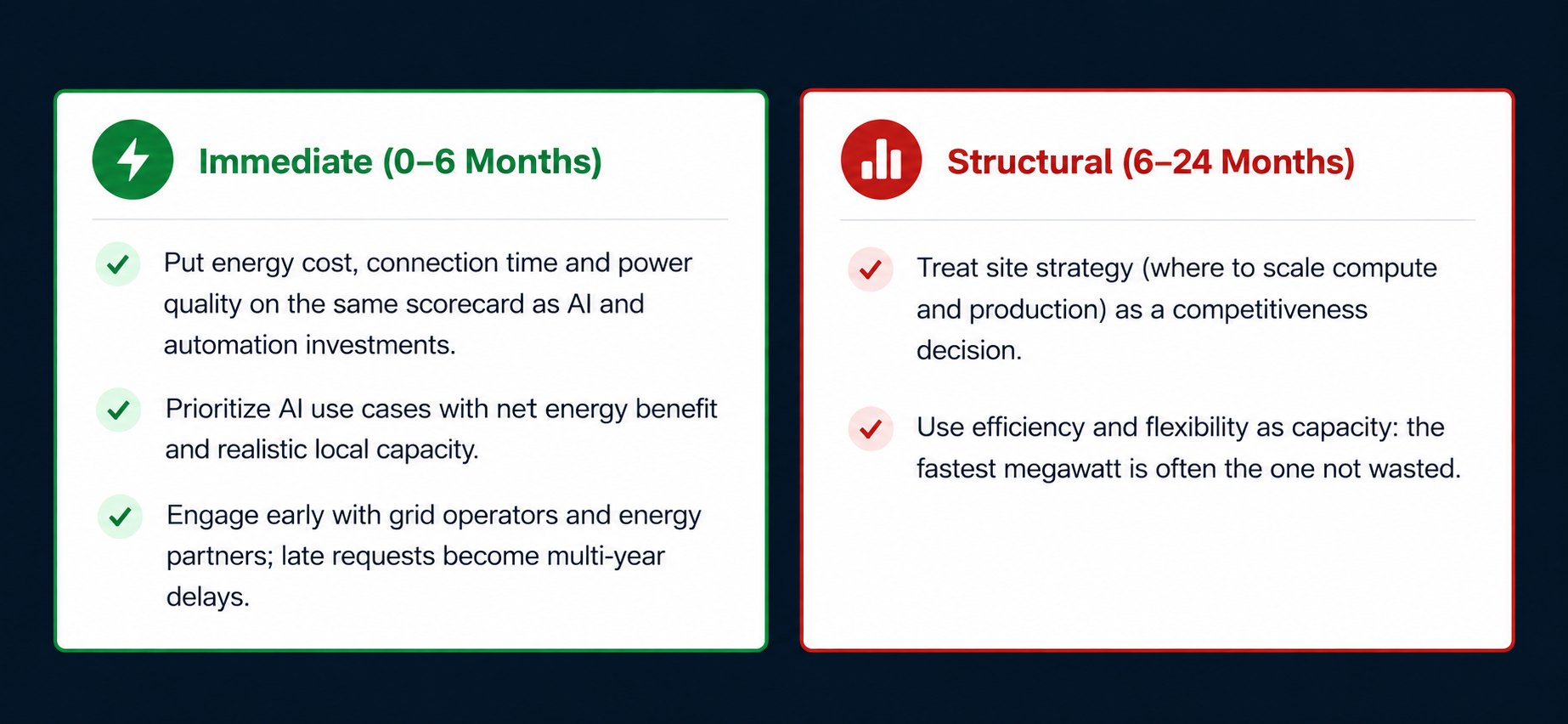
Checklist
Final Thought
Infrastructure speed is one half of Europe's constraint. Part II of this Week 37 pair asks about the other half: who controls the inputs, chips, cloud, energy imports, grid access, that infrastructure actually depends on.
Efficiency Before Energy means the megawatt you don't need is faster than the one you're still waiting to connect.
Systems don't fail. Decisions do.
Take the Next Step
Subscribe to the Weekly Punch for weekly strategic clarity, direct to your inbox.
References
Avanza Energy (2026) The $176 Billion Detour: How Europe's Data Centers Built Three Regulatory Workarounds When the Grid Said No. [Online article].
CNBC (2026) Why Europe's Electricity Prices Threaten Its AI Ambitions. [Online article, citing CBRE, 2026].
European Commission (2026) European Grids. Brussels: European Commission, Directorate-General for Energy [citing EMBER, 2026].
IEA (2026) Electricity 2026. Paris: International Energy Agency.
OilPrice.com (2026) Europe Is Losing the AI Race as Energy Costs Soar. [Online article].
techplustrends.com (2026) AI Data Center Energy Cost Europe: 2026 Market & Cost Guide. [Online article].
Disclaimer: This article synthesizes publicly available energy-market and policy research current as of publication. Readers should verify current figures against the original publications before relying on them for site-selection or investment decisions. Verification Gate: flagged for pre-publication source check.
Ownership as Design.
Note: This article reflects my personalviews based on industry experience and publicly available information. It does not constitute professional, legal, or investment advice and does not represent the views of my employer. AI-generated visuals, concept and content by the author.
