Accelerate Transformation: Leadership Lessons from Monica Monsch

LEADERSHIP | TRANSFORMATION | SEPTEMBER 2026 | Week 37 · Part III
Five Accelerators That Turn Change from a Program into Visible Progress | Applied to Modern Leadership in Organizations
Every few weeks, this series pauses the technology conversation to borrow a proven leadership book and apply it directly to organizations scaling Physical AI. This time it's Monica Monsch's Transformation beschleunigen, and her argument that transformation doesn't fail from a lack of strategy. It fails because the pieces that make strategy real never work together.
Efficiency Before Energy is about deciding what actually matters before committing resources. Monsch's book makes the same case for organizational change: direction before initiatives, always.
Executive Summary
IN 60 SECONDS:
Monsch starts from a familiar problem: organizations debate initiatives while the environment moves faster than their decision cycle. Transformation, she argues, cannot be reduced to projects.
Leaders must win the people affected by change, work with the emotions that change always produces, and still create speed. The book offers five Transformationsbeschleuniger: clear direction, integration of emotion and psychological safety, trust-building communication, leadership that enables responsibility, and implementation strength that makes progress visible.
For Decision Makers this is a practical leadership system — not a slogan stack.
1. Why Transformation Stalls, and What Monsch Puts in Front
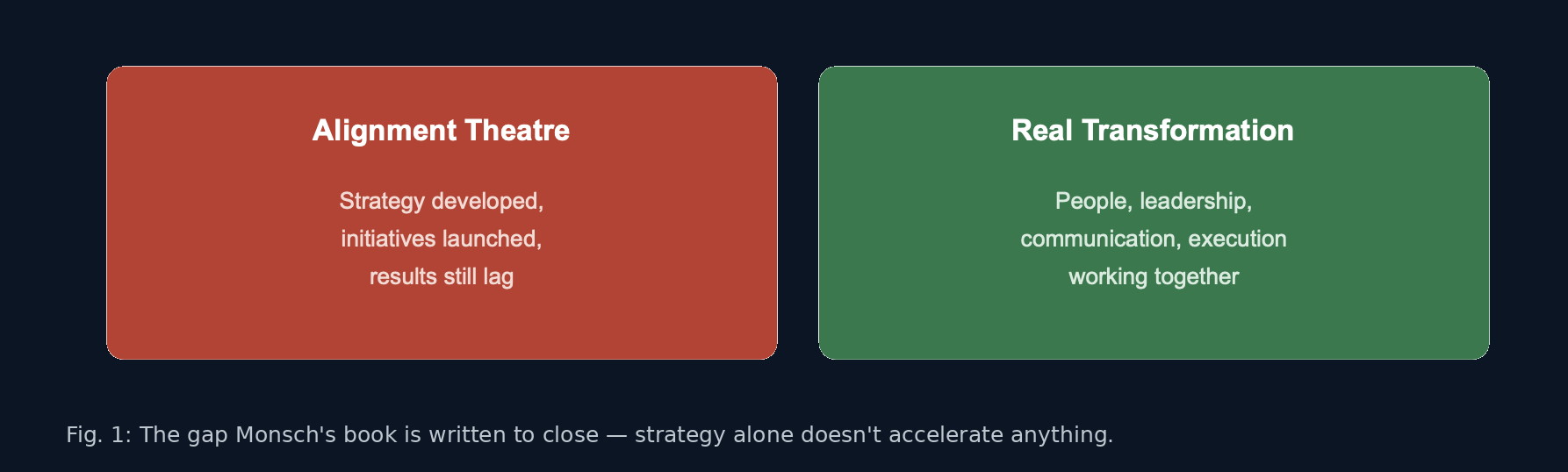
Change produces emotion. Meetings produce alignment theatre. The world does not wait for the next steering committee.
Monsch's claim is that speed and humanity are not opposites. Transformation accelerates when people know where they are going, feel safe enough to act, hear communication they can trust, are allowed to take responsibility, and see progress in the real work, not only in slide status.
The book, published by Versus Verlag in 2026, opens from exactly this diagnosis: strategies get developed, initiatives get launched, projects get planned, and results still lag expectations, because the decisive factors don't work together (Versus Verlag, 2026). Transformation, in Monsch's framing, is more than a strategy project. It emerges where people, leadership, communication and execution meet and it is the quality of those interfaces, not the quality of the strategy document, that decides whether friction slows things down or progress becomes possible (Versus Verlag, 2026).
👉 Key Insight
Transformation is not faster because leaders push harder. It is faster because orientation, safety, communication, empowerment and visible execution work together.
2. The Five Accelerators, with One Leadership Example
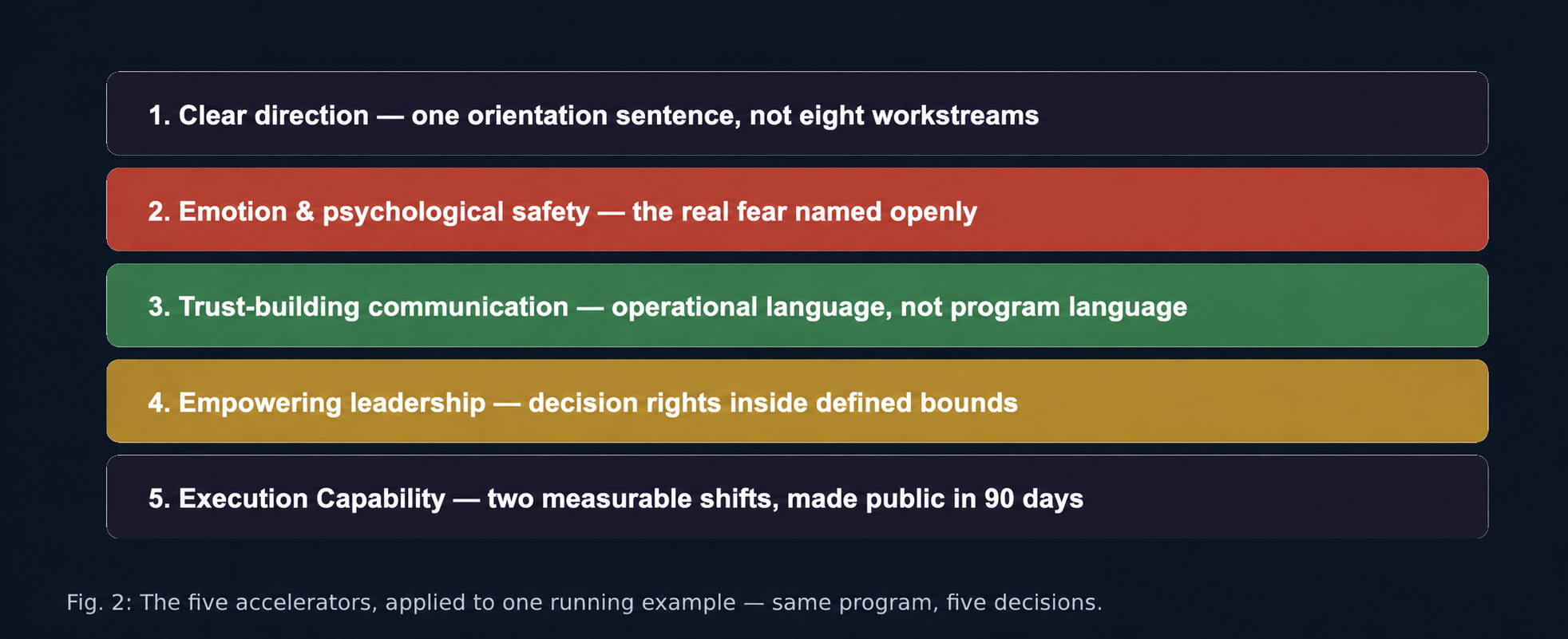
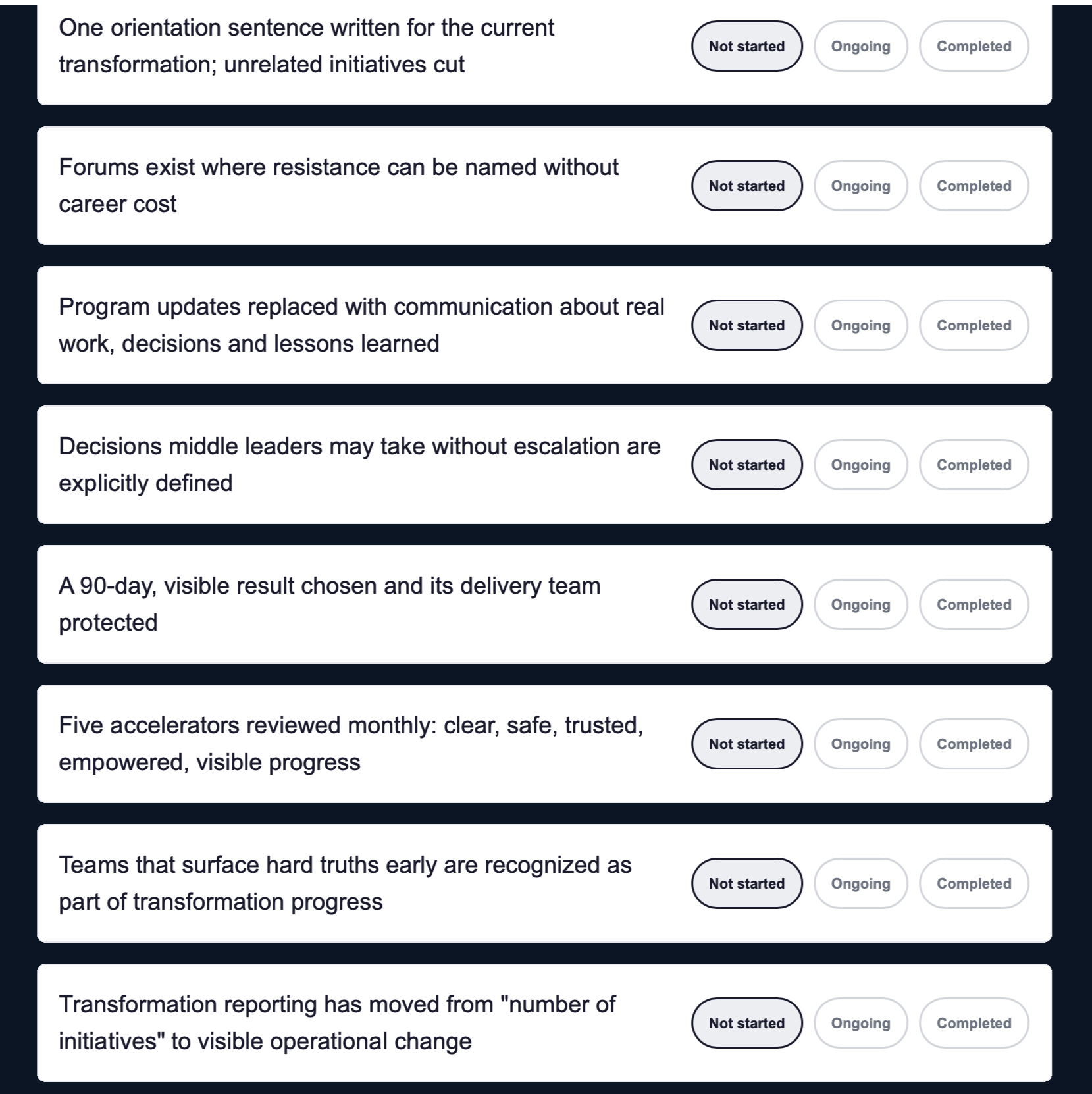
A mid-sized industrial organization launched "digital operations" with eight workstreams, a monthly steering deck and little change in daily work. Using Monsch's five accelerators, the leadership team reset.
1. Clear direction
They replaced the initiative list with one orientation: "In 12 months, supervisors run the line with fewer surprises and clearer decisions." Everything that did not serve that sentence was stopped or parked.
2. Emotion and psychological safety
They named the real fear, loss of competence and control, in open sessions. Challenge of plans was invited. Psychological safety was treated as a speed condition, not a soft extra.
3. Communication that builds trust
Updates moved from program language to operational language: what changes on Monday, what does not, what was learned. Trust rose when communication matched shop-floor reality.
4. Leadership as responsibility and empowerment
Middle managers received decision rights inside defined bounds instead of collecting topics for the next committee. Empowerment was specified, not announced.
5. Ability to execute: visible progress
They chose two measurable shifts in 90 days and made them public inside the company. Progress became visible work, not a status color on a slide.
The program did not get bigger. It got faster because the five accelerators removed delay that looked like governance.
👉 Key Insight
The running example never got a bigger budget. It got a faster program, because the five accelerators removed delay that had been disguising itself as governance.
3. What This Changes for Leaders and Organizations
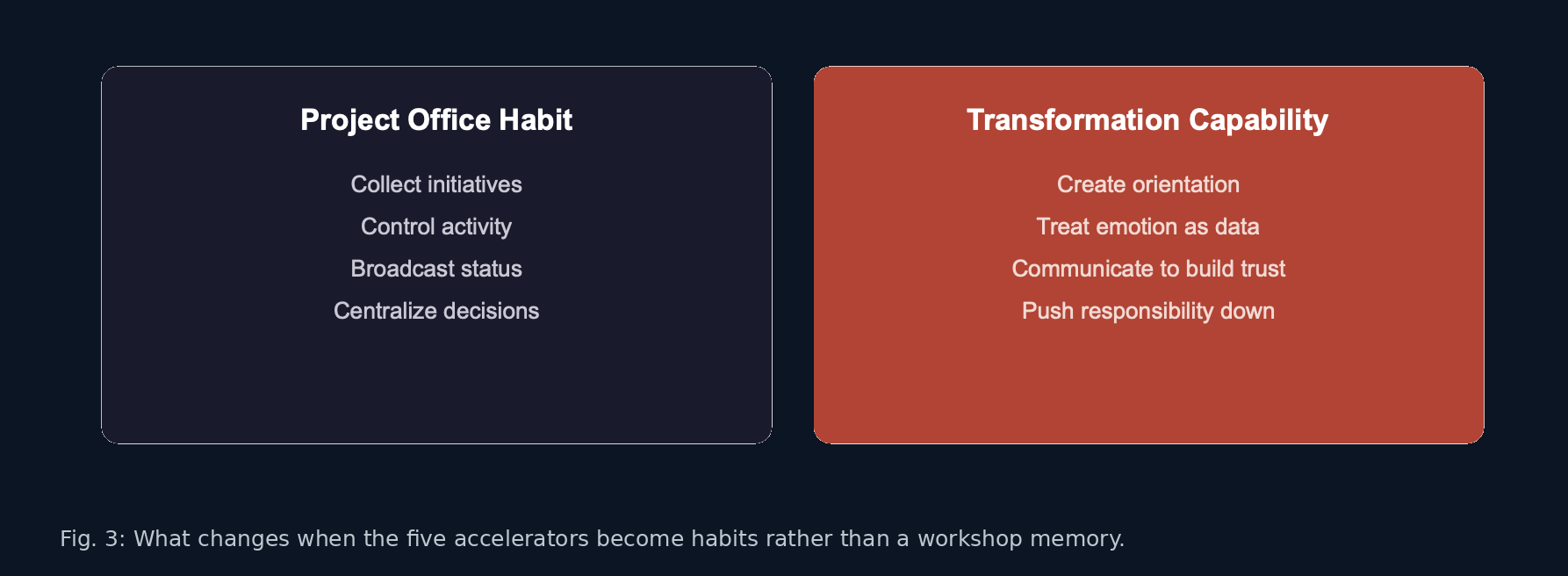
None of this is a new department. It's a different set of habits inside the one leadership already has.
Leaders stop collecting initiatives and start creating orientation. They treat emotion as data, not noise. They communicate to build trust rather than to broadcast activity. They push responsibility down with clear bounds. They insist that transformation shows up in operations. Organizations that do this develop transformation as a capability, not as a temporary project office.
Readers of the book describe this same shift in their own words: it explains transformation management in a way that puts the people experiencing and carrying the change at the center, rather than treating them as an afterthought to the plan (LinkedIn commentary on Monsch, 2026, cited via Versus Verlag community, 2026). That is not a coincidence, it is the accelerators working as designed.
👉 Key Insight
Monsch's accelerators are a leadership operating system: direction, human reality, trust, empowerment, visible execution.
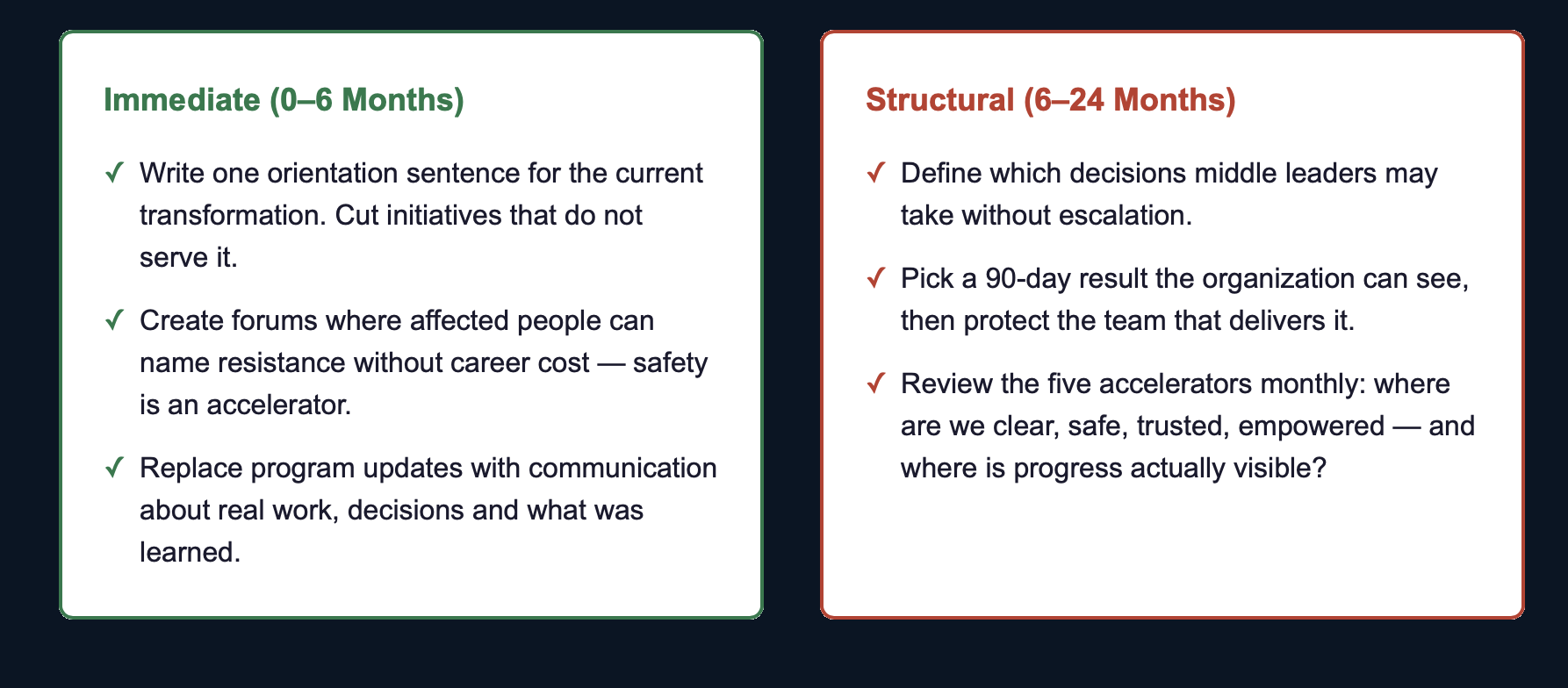
Action Plan for Decision Makers
Checklist
Final Thought
Five accelerators, one running example, and not a single new department. Monsch's argument holds up because it doesn't ask leaders to do more, it asks them to make direction, safety, trust, empowerment and visible execution work as one system instead of five separate initiatives competing for attention.
Efficiency Before Energy. Ownership as Design. A transformation that can't show its progress in the real work isn't accelerating, it's just busy.
Systems don't fail. Decisions do.

Take the Next Step
Subscribe to the Weekly Punch for weekly strategic clarity, direct to your inbox.
References
Monsch, M. (2026) Transformation beschleunigen: Strategisch. Menschlich. Umsetzungsstark. Zurich: Versus Verlag.
Versus Verlag (2026) Transformation beschleunigen — Titelanzeige. [Publisher page].
Disclaimer: This article applies Monica Monsch's five-accelerator framework (Versus Verlag, 2026) and publicly available commentary current as of publication. The running example in Section 2 is an illustrative composite, not a verified named case study. Verification Gate: flagged for pre-publication source check.
Ownership as Design.
Note: This article reflects my personalviews based on industry experience and publicly available information. It does not constitute professional, legal, or investment advice and does not represent the views of my employer. AI-generated visuals, concept and content by the author.
