Photonic Computing and Data Centers: Why Energy Could Finally Become the Constraint
DATA CENTERS | PHOTONIC COMPUTING | JUNE 2026
ENERGY DOMINANCE · WEEK 24 · PART I
Can Photonic Computing Solve the Data Center Energy Crisis? Lessons from q.ant and Beyond
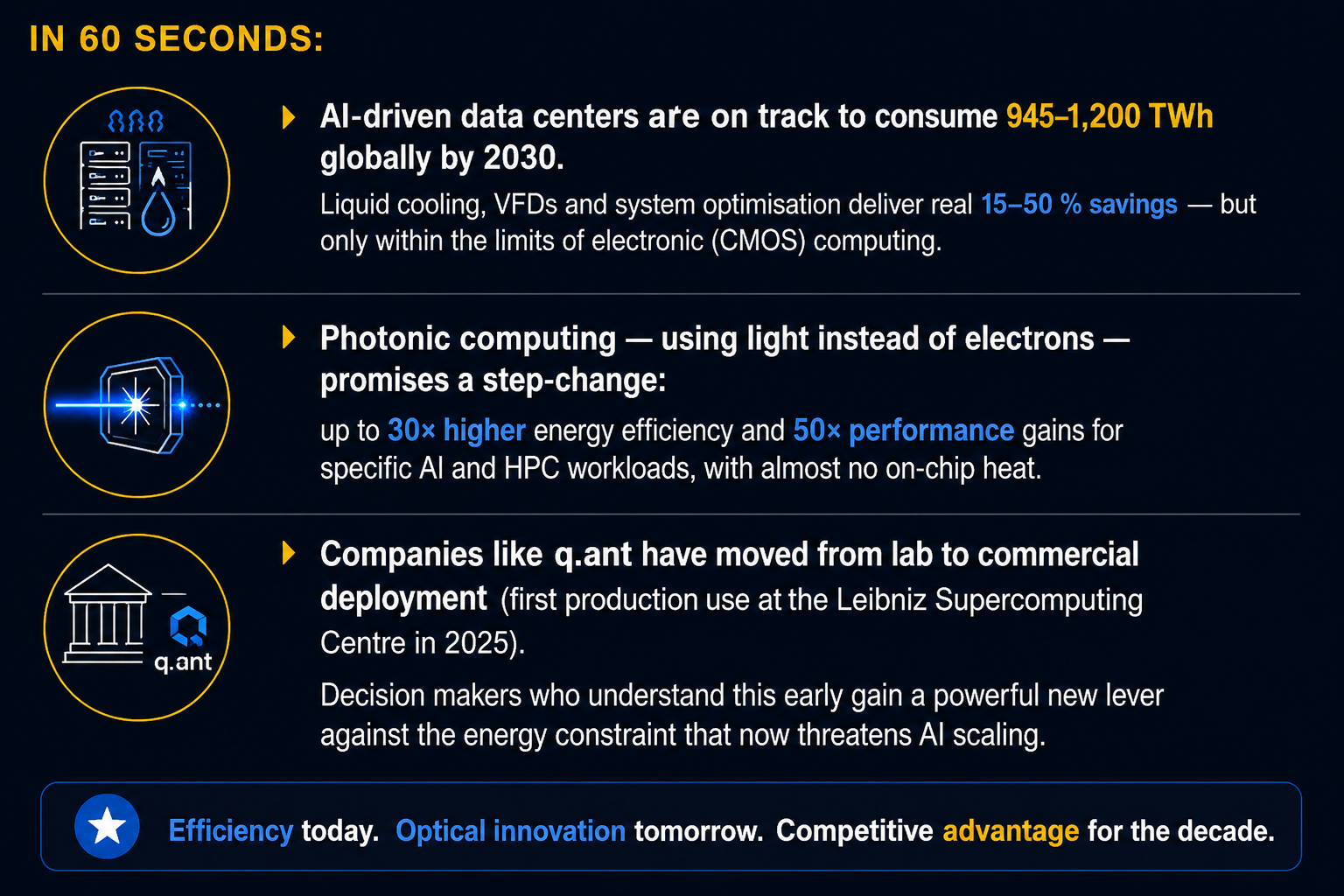
For three years the industry has been winning the wrong battle. We have squeezed liquid cooling, variable-frequency drives and system optimisation for every last percent, and it has worked, delivering 15–50 % savings in the right facilities. Yet demand keeps doubling. The uncomfortable truth is that every one of those wins still happens inside the same physics: electrons pushed through silicon, generating heat, resistance and an auxiliary load that never goes away.
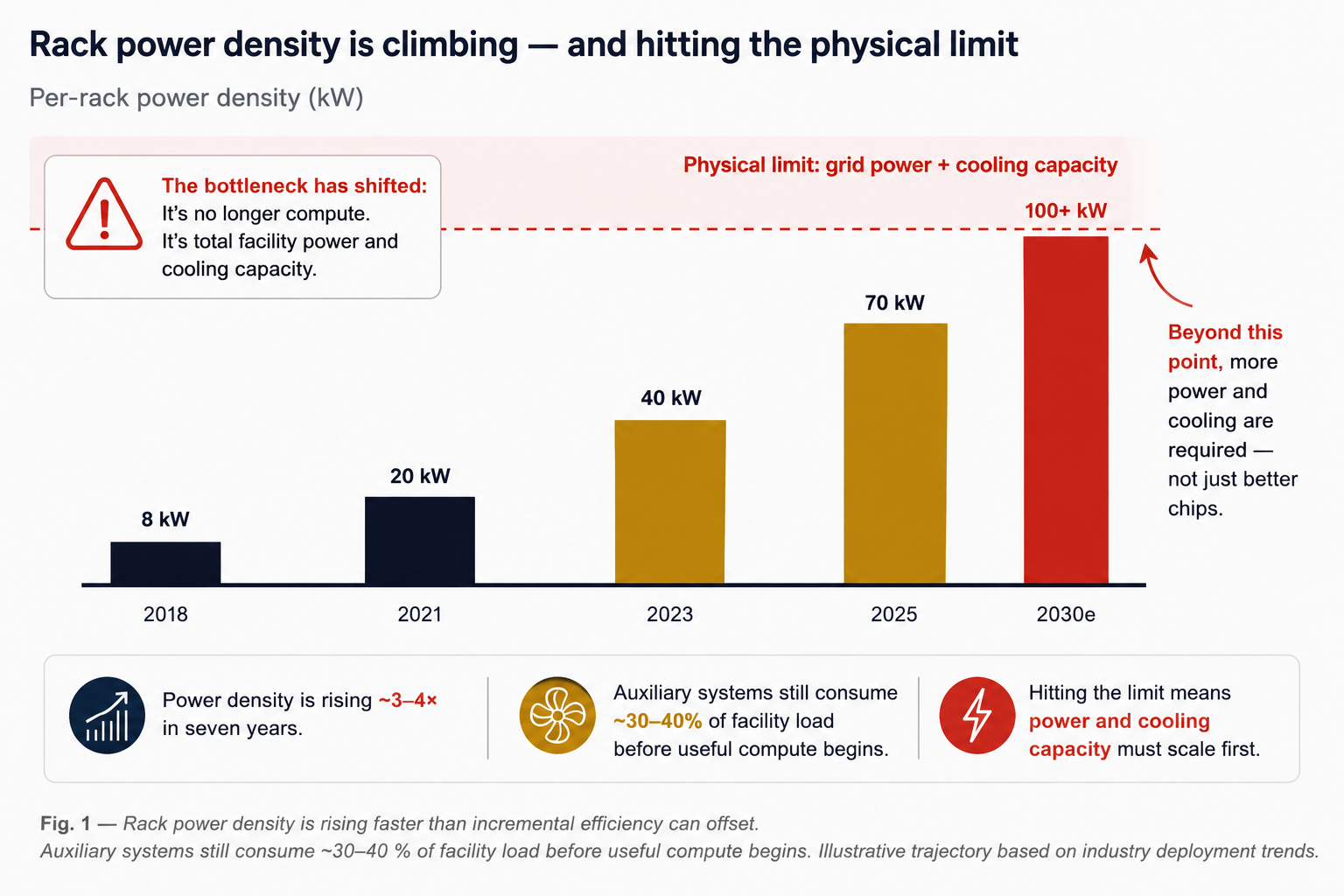
There is a hard ceiling to optimisation, and the most advanced operators are already pressing against it. When a single rack approaches 100 kW, the constraint is no longer cost, it is whether the grid and the cooling plant can physically keep up. Systems don't fail. Decisions do. And the decision now facing every board is whether to keep optimising a paradigm that is running out of room, or to start understanding the architectures that change the rules entirely.
This is Part I of Week 24, the shift from incremental efficiency gains to a fundamentally different way of computing. One that uses light instead of electrons, and that has just moved out of the laboratory and into a live supercomputing centre.
Executive Summary
1. The Persistent Energy Wall in Electronic Computing
The efficiency story is real, and it is nearly over. Every gain we celebrate in GPUs, cooling and power delivery is a refinement of the same underlying machine, and that machine has a physics problem that no amount of refinement removes.
Computation in CMOS chips means moving electrons through resistive silicon. Resistance produces heat; heat demands cooling; cooling, power conversion and distribution form an auxiliary load that consumes roughly 30–40 % of total facility energy before a single useful calculation is counted. As rack densities climb toward 100+ kW, both the power available at the meter and the cooling infrastructure on the floor become hard physical limits rather than budget lines.
The most efficient operators have already harvested the easy 15–50 %. What remains is asymptotic: each additional percentage point costs more capital and yields less, while compute demand keeps growing 17–33 % per year. Optimisation curves flatten; demand curves do not. That gap is the wall.
👉 Key Insight: Incremental efficiency is no longer enough. The next leap requires changing the physics of computation itself.
2. How Photonic Computing Changes the Game
If electrons are the problem, light is the answer the industry has quietly been engineering.Photonic processors do not push electrons through resistive material, they compute directly with photons, and photons do not generate the same resistive heat.
Using platforms such as thin-film lithium niobate (TFLN), photonic chips perform the heavy linear-algebra operations at the core of AI inference and complex simulation as interactions of light in waveguides. The result is almost no on-chip heat, minimal cooling demand, and massive native parallelism, many operations carried simultaneously on different wavelengths of light.
q.ant's Native Processing Server (NPS) is deployed not as a GPU replacement but as a PCIe co-processor that sits alongside GPUs. For suitable workloads it has demonstrated up to 30× lower energy consumption and 50× higher performance per application, offloading exactly the operations that cost the most energy on electronic silicon.
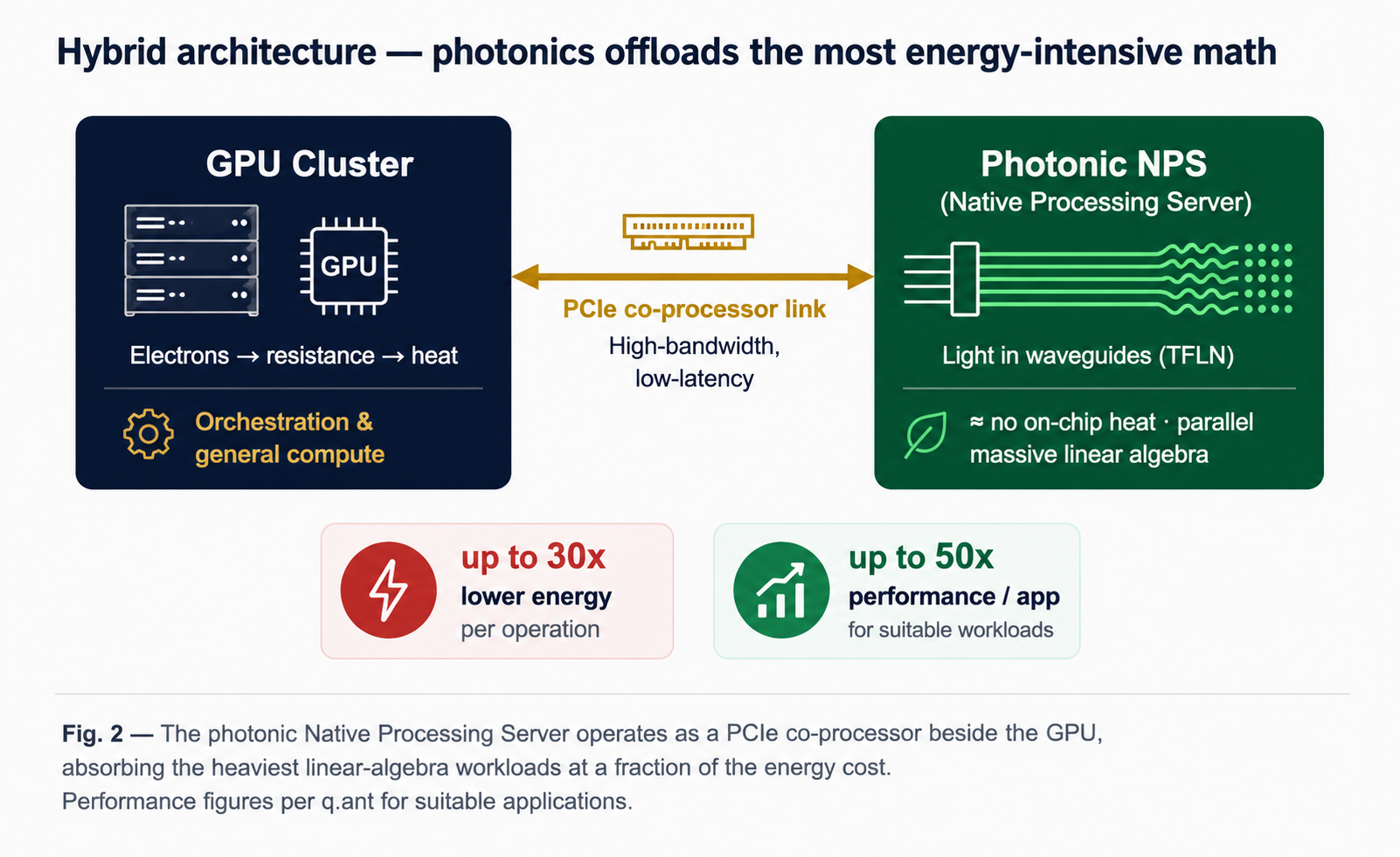
👉 Key Insight: Photonics does not replace GPUs, it acts as a highly efficient co-processor, dramatically reducing the energy cost of the most demanding mathematical operations.
3. Quantified Scenarios: The Potential Impact on Data Centers
The strategic question is not whether photonics works, it is how far and how fast you lean into it. Three trajectories illustrate the range, and the gap between them is measured in grid capacity, cooling cost and competitive headroom.
Photonic adoption is workload-specific: the more of your suitable inference and HPC tasks you offload to a photonic co-processor, the lower your energy intensity per accelerated operation, and the more compute you can host within a fixed power envelope.
The scenarios below trace the path from an electronics-only status quo to aggressive integration at q.ant-scale, where targeted segments could see 50–90 % lower power per application and a genuine route to sustainable scaling.
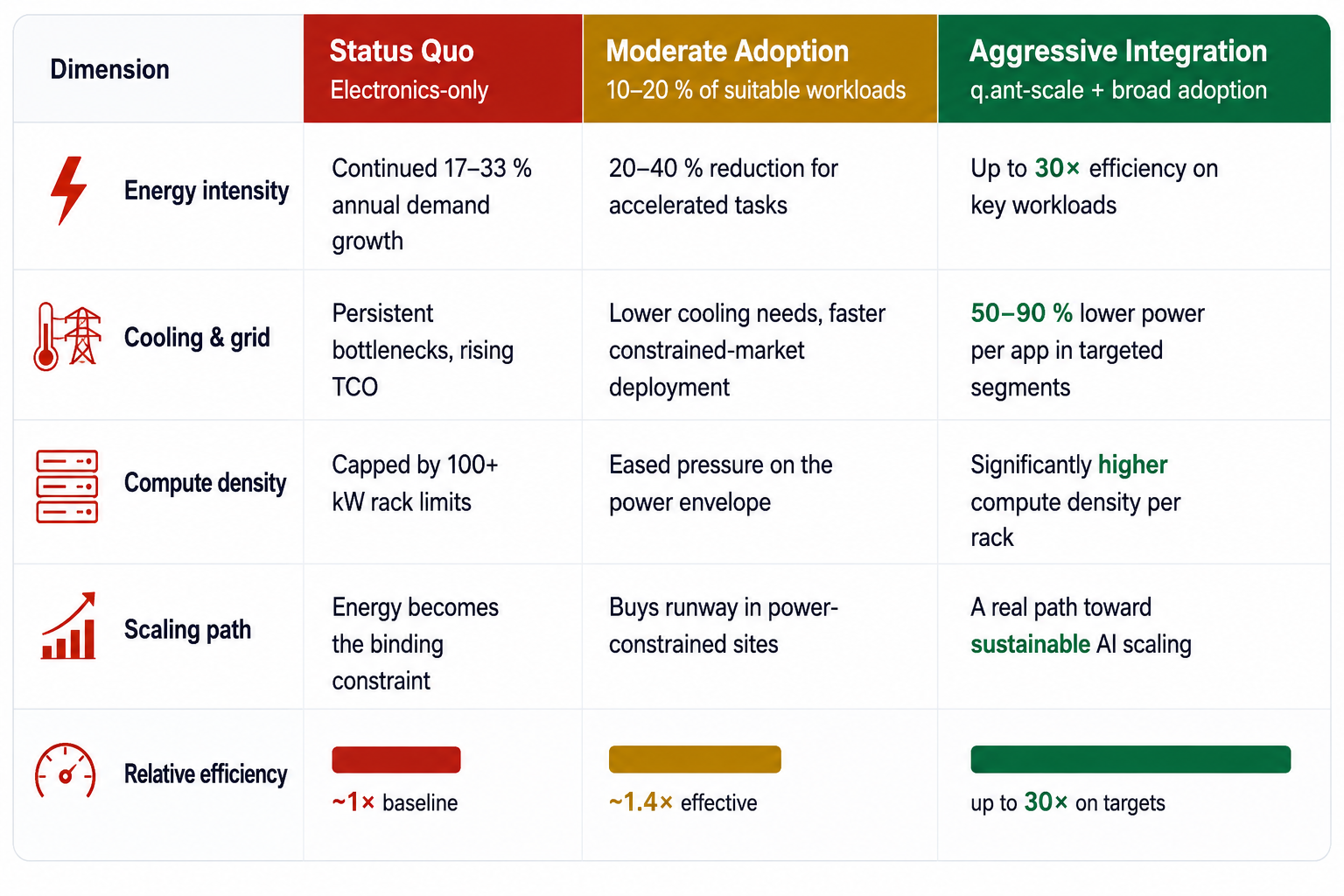
👉 Key Insight: The decisive variable is not the technology's ceiling but the share of suitable workloads you choose to move , adoption strategy, not physics, separates the three futures.
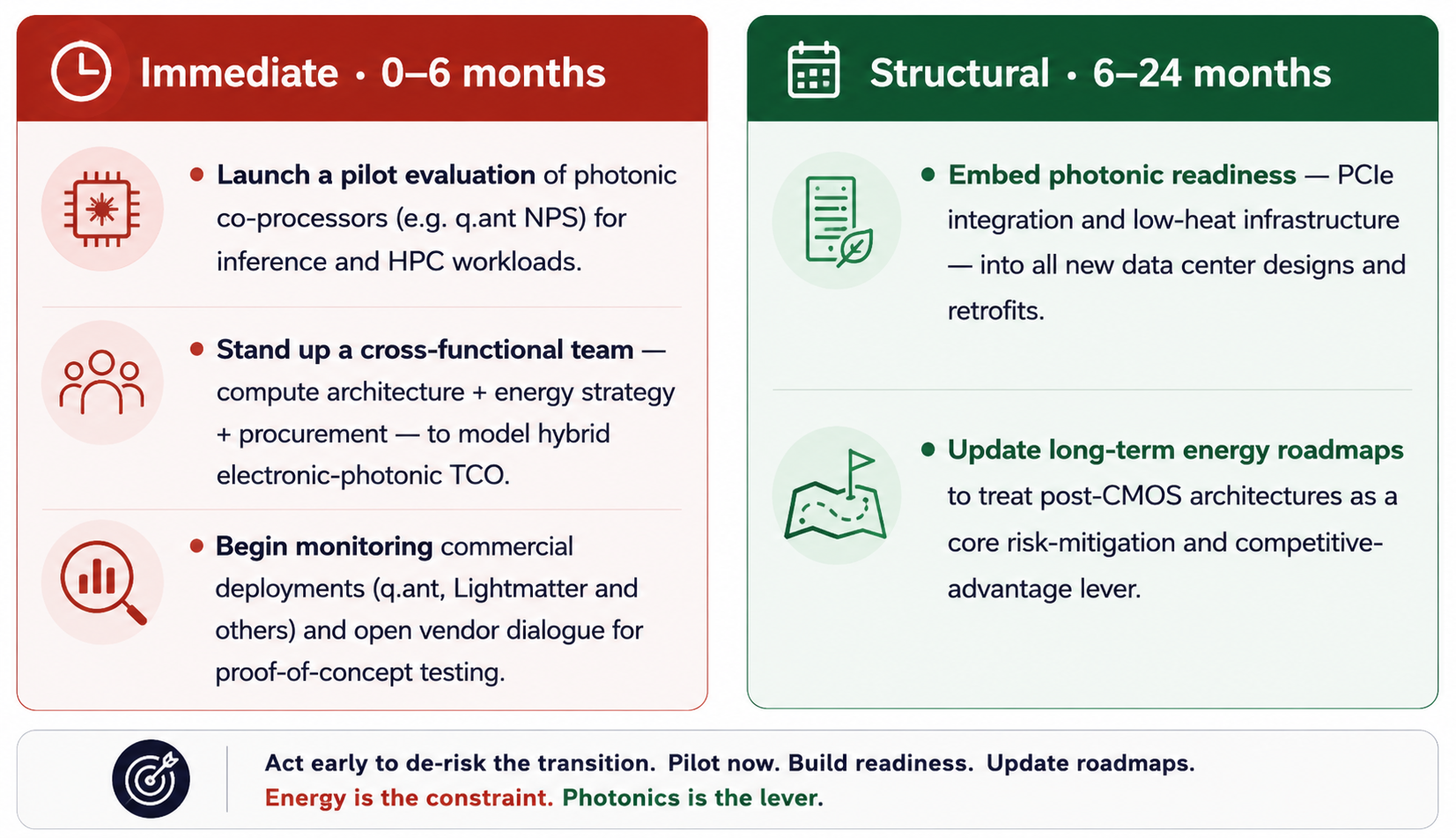
Action Plan for Decision Makers
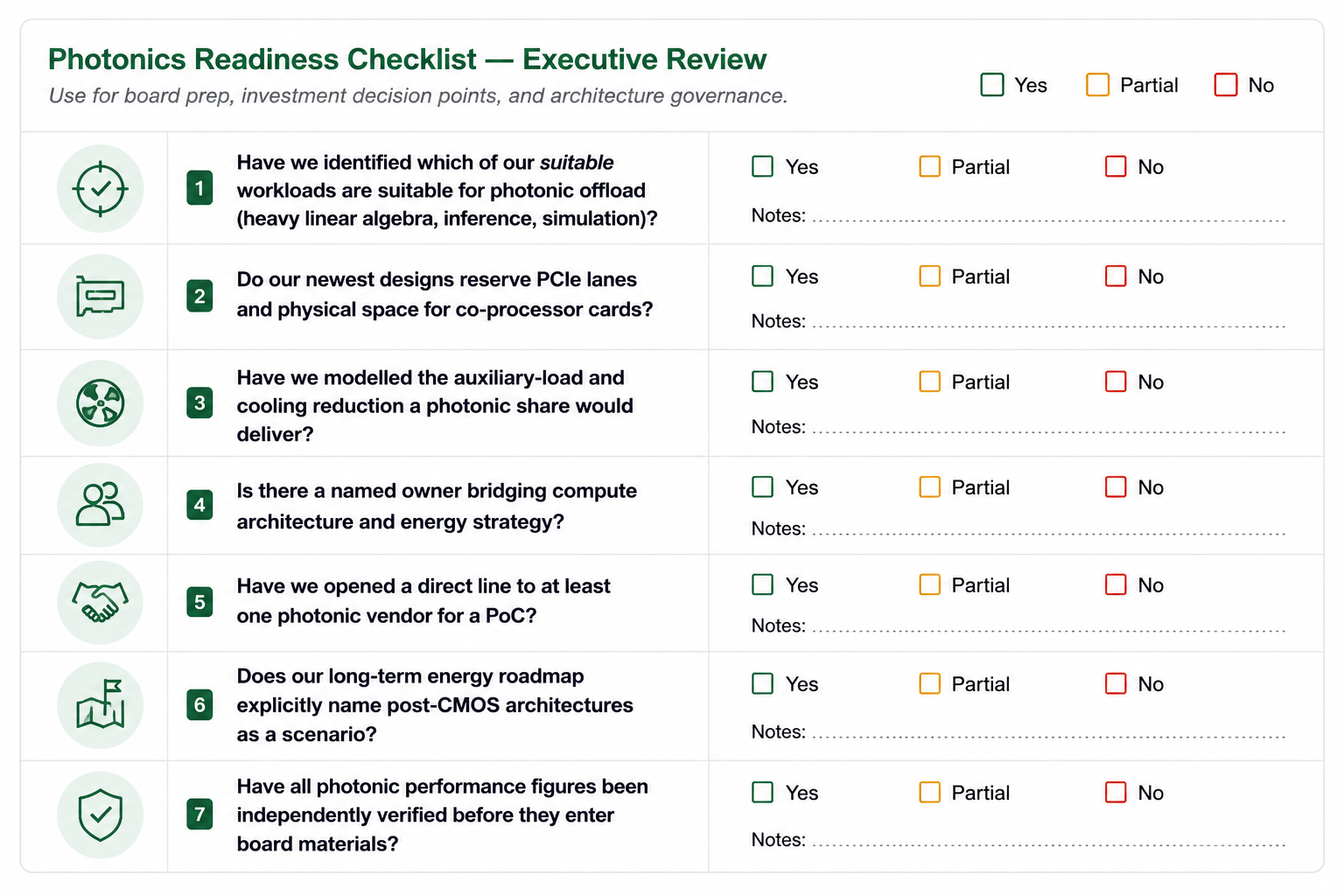
Photonic-Readiness Checklist
Final Thought
The principle that has carried this work from the engine rooms of ships to the data halls of AI has always been the same: Efficiency Before Fuel. For years that meant wringing more out of the system we had. We are now at the point where the system itself is the limit, and efficiency before fuel starts to mean choosing a different machine.
Photonics will not arrive as a single dramatic switch-off of the old world. It will arrive as a co-processor in a slot, quietly absorbing the most expensive operations, one workload at a time. The operators who win will not be the ones who waited for certainty. They will be the ones who treated ownership as design, building the readiness in before the constraint forced their hand.
Energy is about to stop being a line item and start being the constraint. The only question is whether your architecture is ready to route around it.
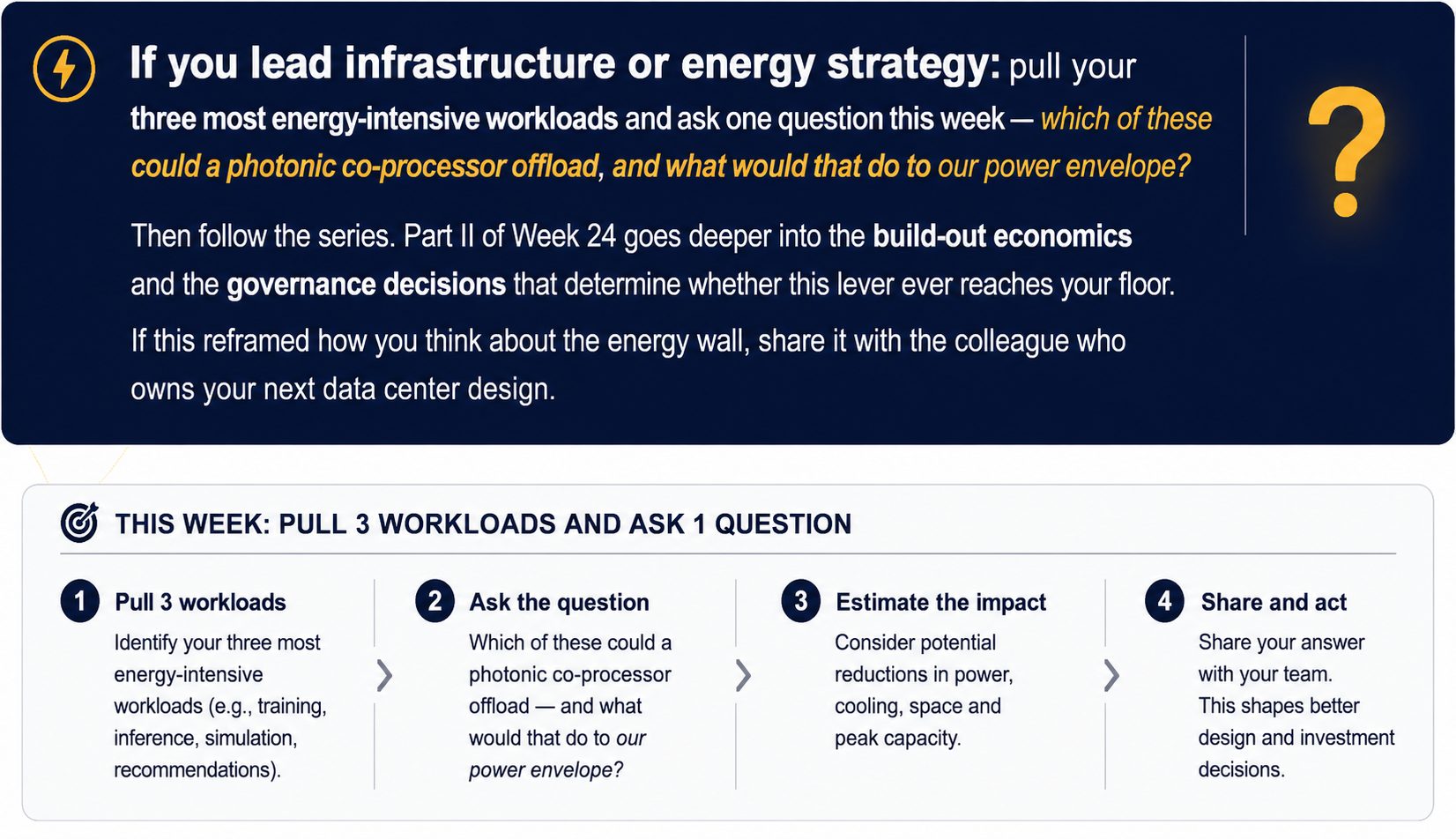
Take the Next Step
Subscribe to the Weekly Punch for weekly strategic clarity, direct to your inbox.
References
HPCwire (2025) Q.ANT Photonic Computing Shines at ISC 2025. June 2025.
International Energy Agency (2025) Energy and AI. Paris: IEA.
International Energy Agency (2025/2026) Data Centre Electricity Consumption Reports. Paris: IEA.
McKinsey & Company (2025) The Cost of Compute: AI and the Power Sector (AI Power Reports). McKinsey Global Institute.
Communications Physics / Nature Portfolio (2025) Selected studies on integrated photonic computing and thin-film lithium niobate devices.
Q.ANT GmbH (2025–2026) Official Publications and Press Releases. Stuttgart: Q.ANT.
Note: This article reflects my personalviews based on industry experience and publicly available information. It does not constitute professional, legal, or investment advice and does not represent the views of my employer. AI-generated visuals, concept and content by the author.
