The Next Bottleneck After GPUs? Power, Cooling, and Photonic Infrastructure
DATA CENTERS | PHOTONIC COMPUTING | JUNE 2026
ENERGY DOMINANCE · WEEK 24 · PART II
Beyond GPUs: How Photonic Systems Could Reshape AI Infrastructure and Break the Energy Wall
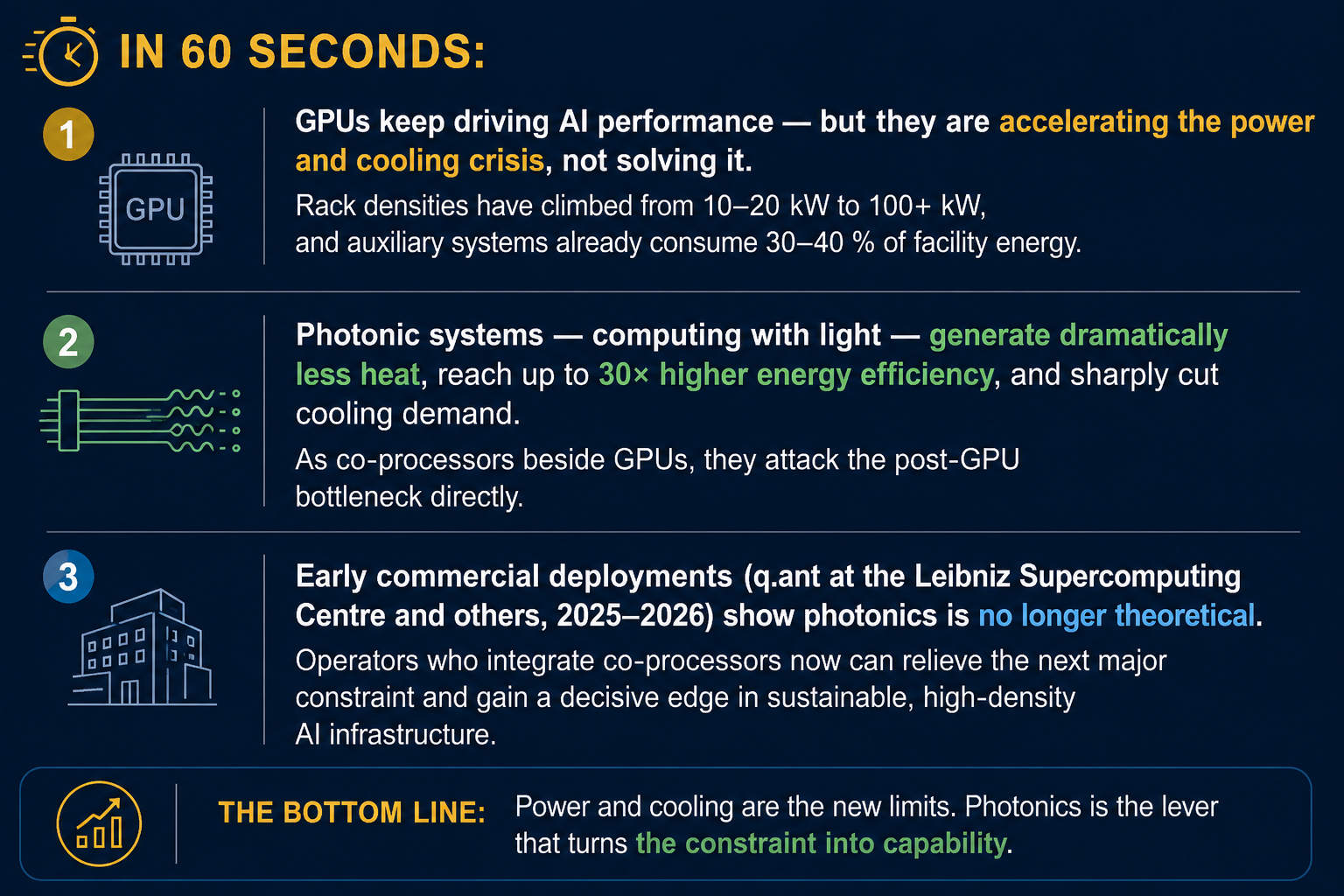
For a decade the question that drove every AI build was simple: can we compute fast enough? The answer turned out to be yes, and that success quietly inverted the problem. The GPUs arrived. The performance arrived. What did not arrive at the same pace was the power to feed them and the cooling to keep them alive.
Part I introduced photonic computing as a different way to do the math. This is Part II, and the question is no longer about the chip, it is about the building, the busbar and the substation. A single rack that once drew 10–20 kW now approaches 100+ kW, and the binding constraint has migrated from compute to thermodynamics. Systems don't fail. Decisions do. The decision now is whether your infrastructure is being designed around the abundant resource or the scarce one.
Because the next bottleneck after GPUs is not a faster GPU. It is whether you can power and cool what you have already committed to build.
Executive Summary
1. Why Power and Cooling Are Becoming the Post-GPU Bottleneck
We won the compute race and discovered the prize was a thermodynamics problem. The GPU era made raw performance abundant. In doing so it relocated the constraint from the silicon to the infrastructure around it.
GPU-heavy clusters have pushed rack densities from 10–20 kW to 100+ kW. At that density, power delivery and thermal management, not compute throughput, become the primary constraints. Auxiliary systems (cooling, power conversion, distribution) already consume 30–40 % of total facility energy before useful work begins, and traditional electronic architectures are hitting physical limits on both heat dissipation and grid interconnection.
The bottleneck has visibly moved up the stack: from the chip, to the rack, to the building, to the substation. Projects are increasingly gated not by GPU availability but by megawatts at the fence and tonnes of heat to reject.
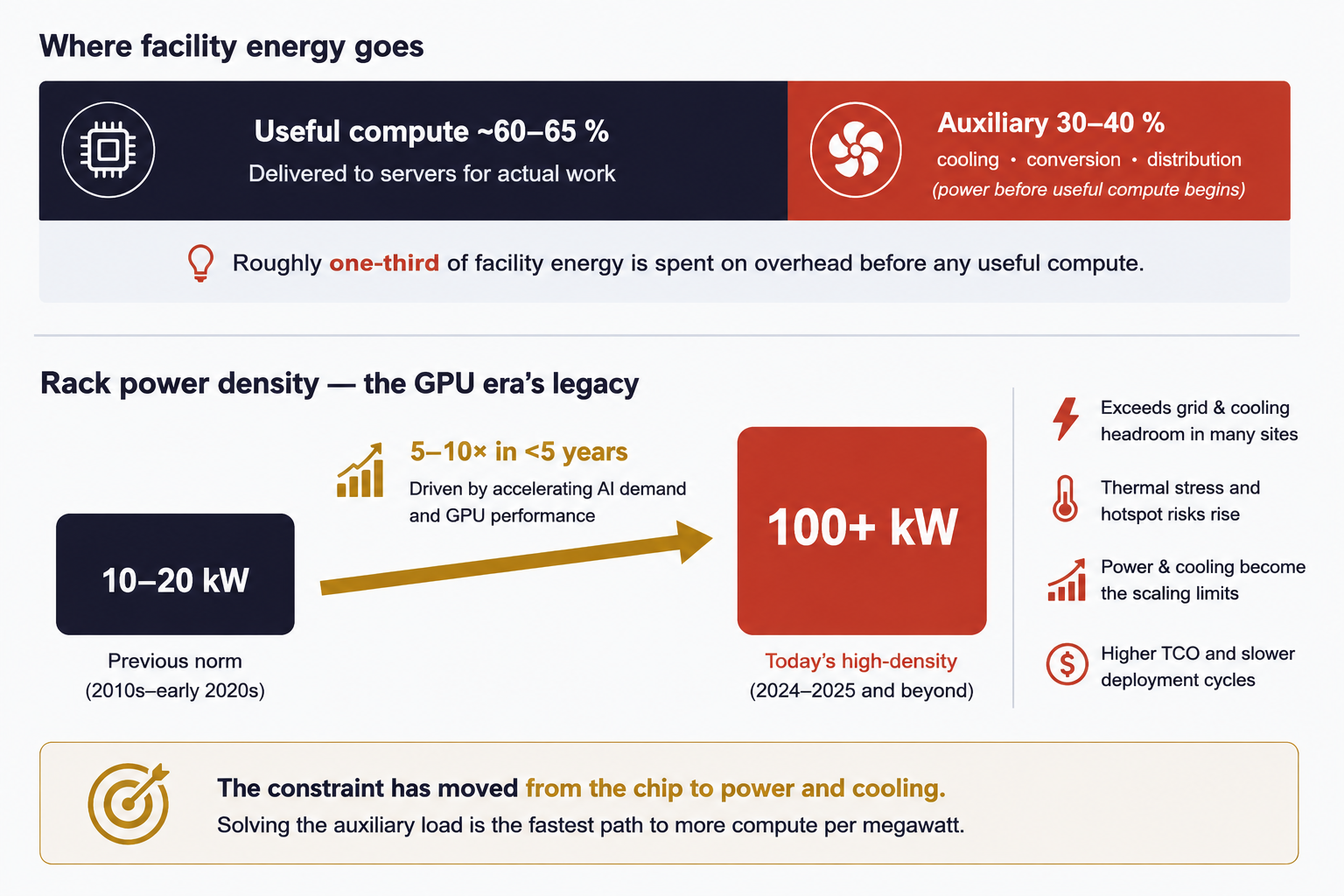
👉 Key Insight: The next ceiling in AI scaling is not compute performance, it is the energy and thermal cost of moving and processing electrons at massive scale.
2. How Photonic Systems Address the Core Constraints
If the constraint is heat and power, the answer is not a faster electron, it is a different carrier. Photonics attacks the bottleneck at its physical root rather than managing its symptoms downstream.
Photonic processors, for example q.ant's Native Processing Server on thin-film lithium niobate, compute with light, generating almost no on-chip heat and requiring minimal or even passive cooling. Deployed as co-processors alongside GPUs, they handle complex mathematical operations at up to 30× lower energy and 50× higher performance per workload for suitable AI inference and HPC tasks.
The effect compounds across the three post-GPU constraints at once: lower facility power draw, eased cooling infrastructure, and much higher compute density per rack, because the heaviest math no longer arrives as heat to be removed.
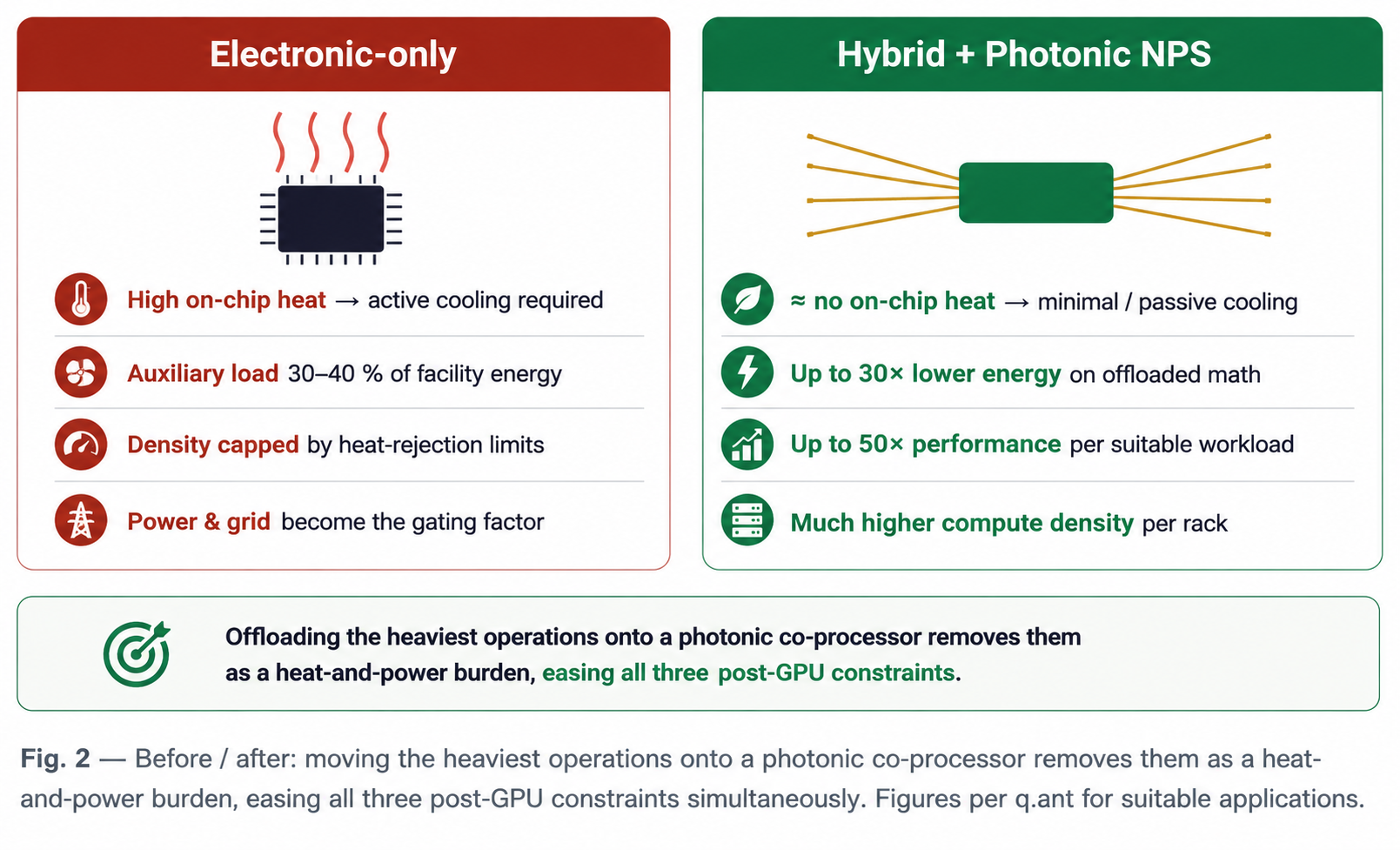
👉 Key Insight: Photonics does not replace GPUs, it complements them by slashing the energy and thermal penalty of the most demanding operations, directly attacking the post-GPU bottlenecks.
3. Quantified Scenarios: The Infrastructure Impact
The infrastructure question is not "if", it is how much of the build you redesign around it.Three trajectories show what that choice does to power, cooling and the density you can physically host.
The larger the share of suitable workloads moved to photonic co-processors, the lower the energy intensity and cooling demand per accelerated task, and the more compute fits inside a fixed power envelope.
The scenarios run from a GPU-only continuation, through hybrid adoption, to a photonic-led infrastructure shift that opens a realistic path to sustainable multi-GW AI campuses.
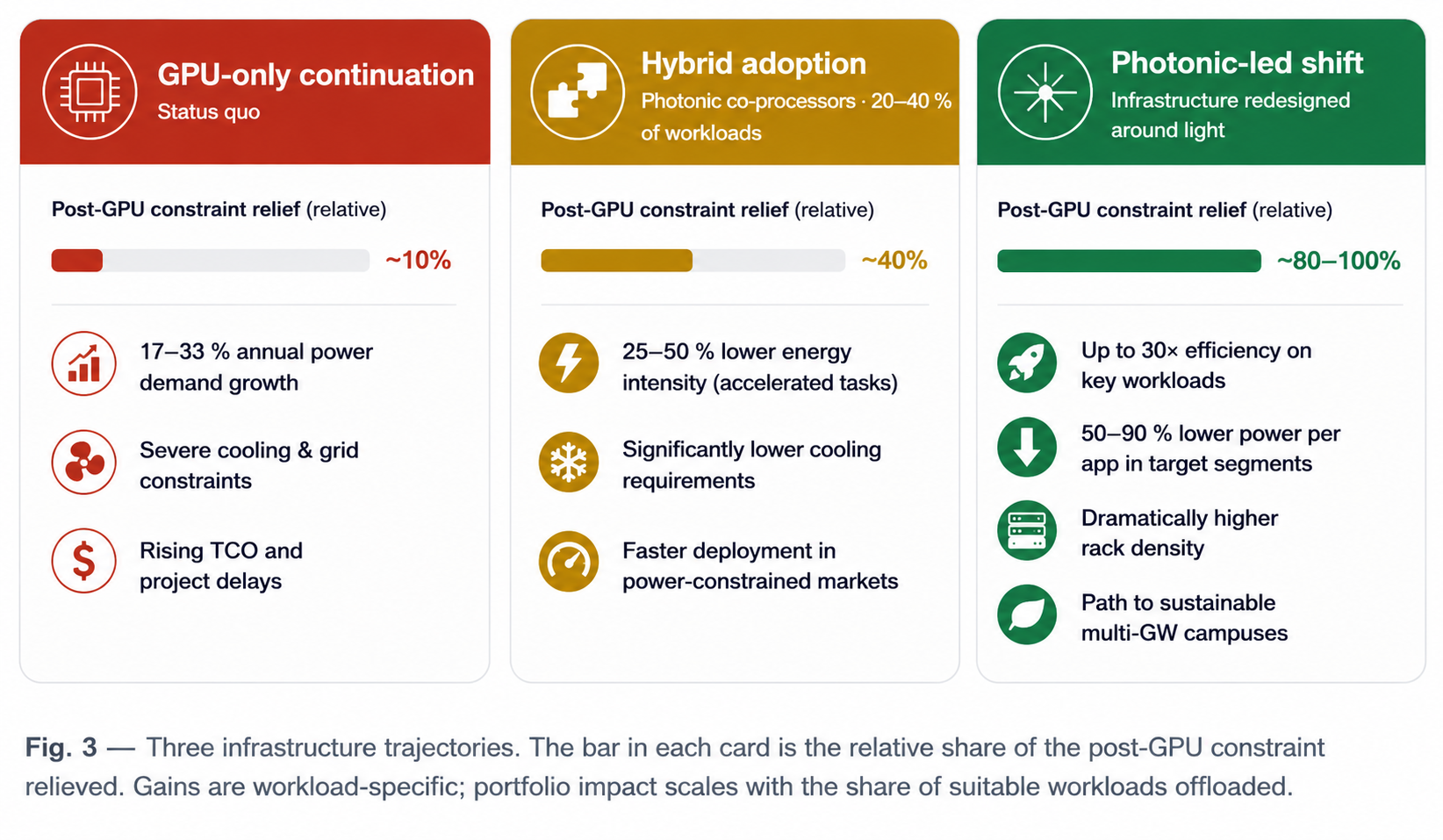
👉 Key Insight: Photonic efficiency only becomes infrastructure relief when it is designed in, the gain is captured at the rack and the substation, not in a procurement line item.
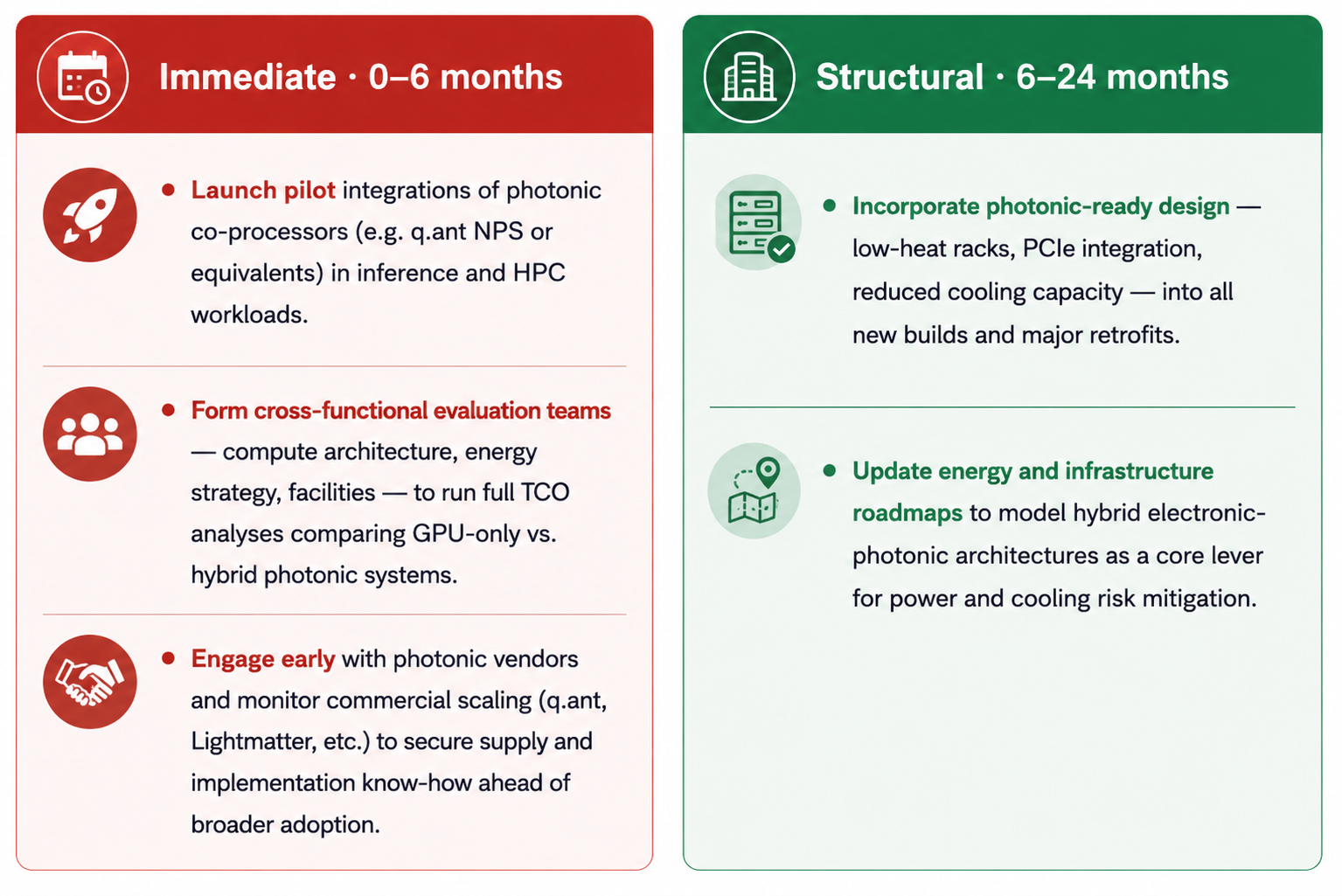
Action Plan for Decision Makers
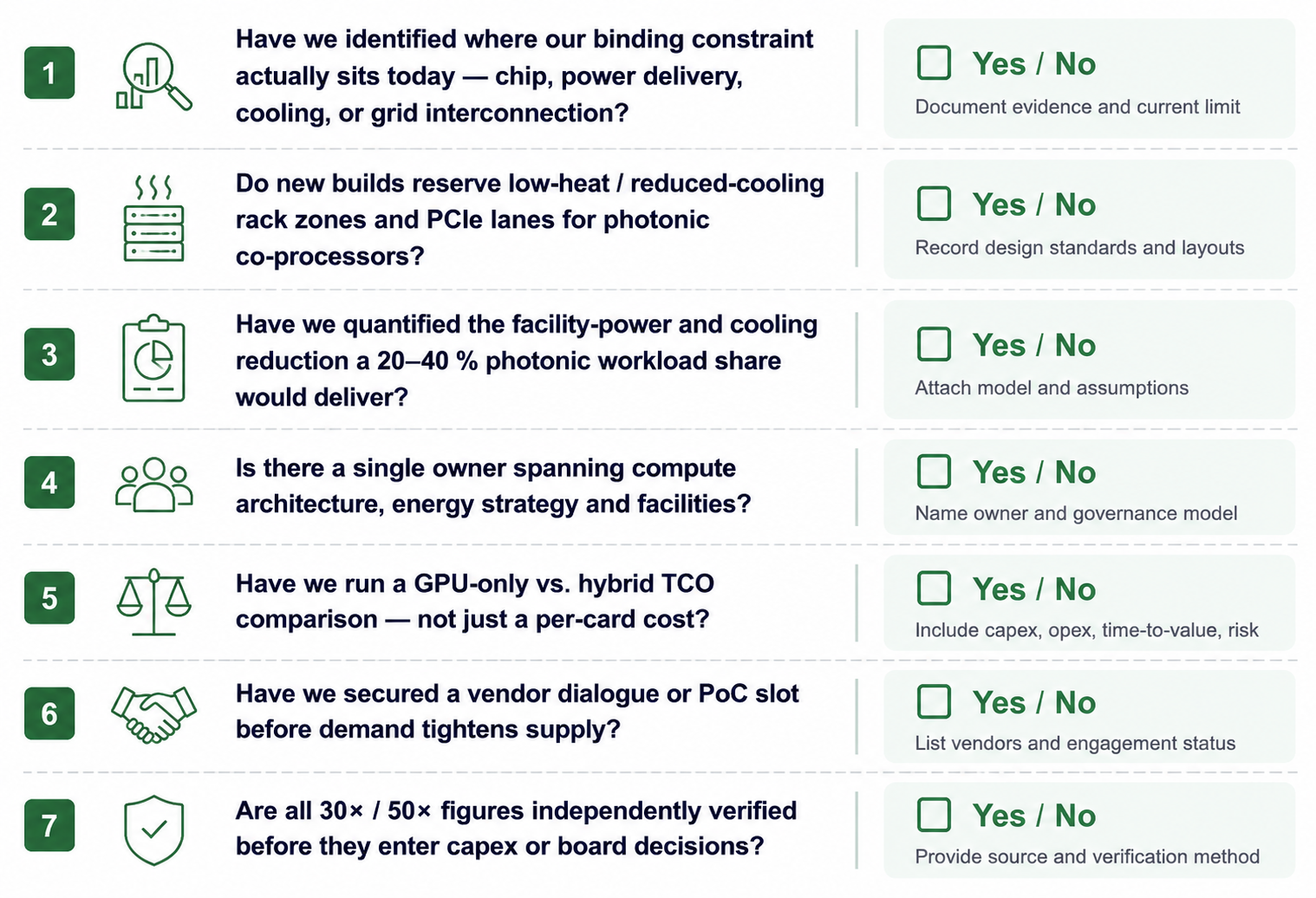
Post-GPU Infrastructure Readiness Checklist
Final Thought
The GPU race made compute abundant and power scarce. That is the quiet inversion of the last decade, and it changes what good infrastructure design even means. Efficiency Before Fuel was never about saving a few kilowatts, it was about refusing to scale the cost of the scarce resource faster than the value it creates.
Photonics will not arrive as a forklift upgrade. It arrives as a co-processor in a slot and a cooling loop you no longer have to build, quietly removing the heaviest operations as heat before they ever reach the chiller. The campuses that scale into the multi-GW era will be the ones that treated ownership as design: that reserved the space, the lanes and the roadmap for the scarce resource, not the abundant one.
The next bottleneck after GPUs is already here. The only decision left is whether your next build is designed to route around it, or to run straight into it.
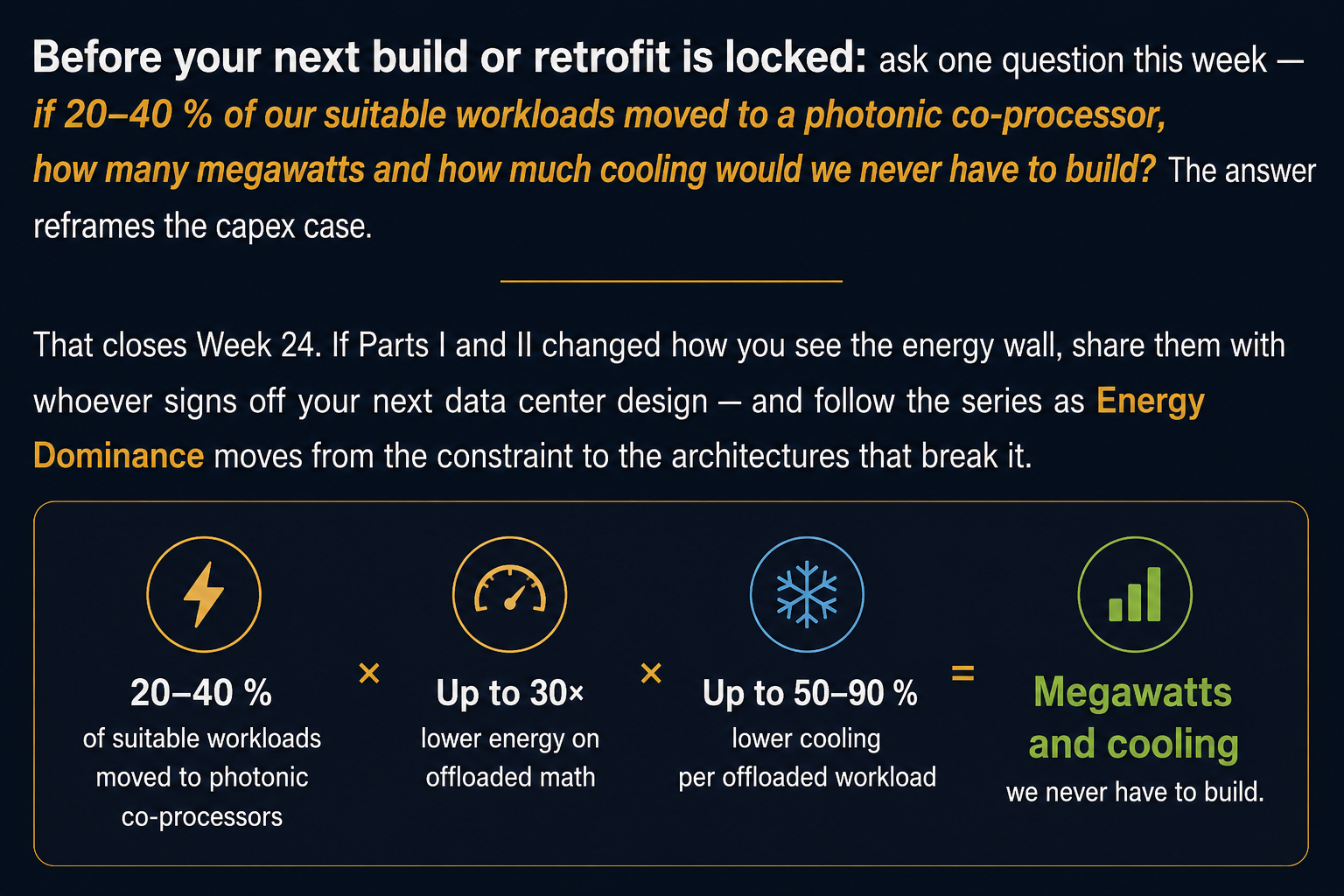
Take the Next Step
Subscribe to the Weekly Punch for weekly strategic clarity, direct to your inbox.
References
HPCwire (2025) Q.ANT Photonic Computing Shines at ISC 2025. June 2025.
International Energy Agency (2025) Energy and AI. Paris: IEA.
International Energy Agency (2025/2026) Data Centre Electricity Consumption Reports. Paris: IEA.
McKinsey & Company (2025) The Cost of Compute: AI and the Power Sector (AI Power Reports). McKinsey Global Institute.
Communications Physics / Nature Portfolio (2025) Selected studies on integrated photonic computing and thin-film lithium niobate devices.
Q.ANT GmbH (2025–2026) Official Publications and Press Releases. Stuttgart: Q.ANT.
Note: This article reflects my personalviews based on industry experience and publicly available information. It does not constitute professional, legal, or investment advice and does not represent the views of my employer. AI-generated visuals, concept and content by the author.
