The Second Load: Why Robotics Will Hit the Grid After Data Centers
ENERGY | ROBOTICS | SEPTEMBER 2026 | Week 38 · Part I
AI Compute Was the First Shock to Electricity Systems. The Robot Fleet Is the Next One — Distributed, Harder to See, and Still Largely Unmodelled
Week 37 measured the megawatts and the years it takes to connect them, data centers colliding with Europe's already-constrained grid. Week 38 adds the load nobody modelled into that same system: the robot fleet already running today, quietly, on ordinary factory feeders.
Efficiency Before Energy assumed the first constraint was compute. The second one is standing on the shop floor right now, and most electrical models don't have a line item for it yet.
Executive Summary
IN 60 SECONDS:
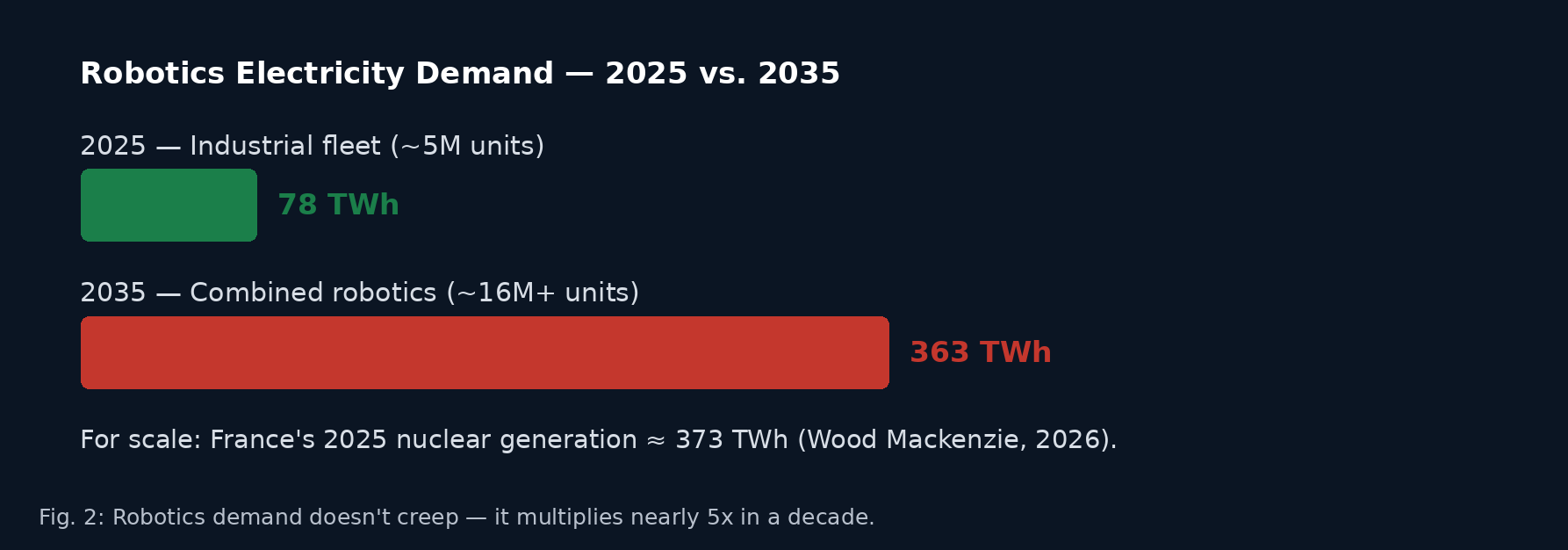
Energy planners have mobilized around data centers. That was necessary. It is not sufficient: today's industrial robot fleet of roughly 5 million units already consumes about 78 TWh a year, some 20–25% of global data-center demand and almost twice London's electricity use.
If the fleet grows toward 16 million units by 2035, combined robotics demand could reach roughly 363 TWh, approaching France's entire 2025 nuclear output. Most of that load is industrial robots, not humanoids, and it sits on existing factory feeders rather than dedicated substations.
Decision Makers who treat robotics as a labor project and energy as a data-center project will miss the second load until connection queues and peak demand make it visible.
1. Data Centers Were Visible. Robotics Is Not — Yet
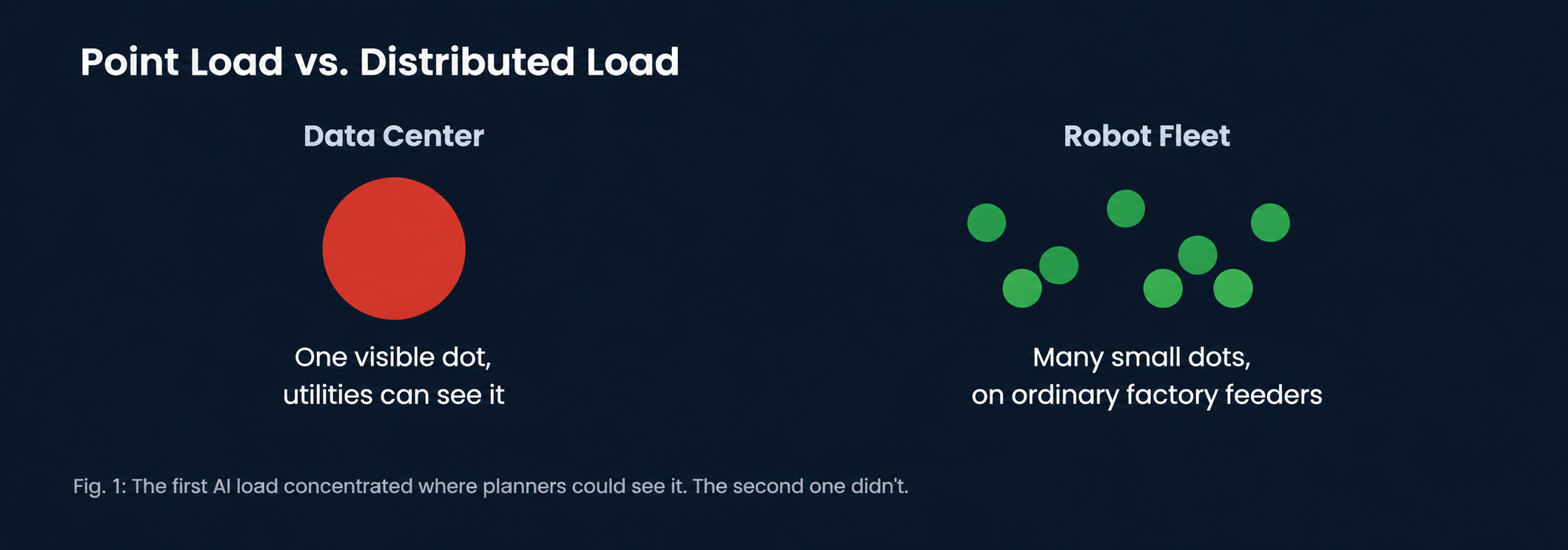
A data center is a single, unmistakable dot on a grid map. A robot fleet is a thousand small dots nobody put on the map at all.
A data center is a point load. Utilities, regulators and boards can see the megawatts. A robot fleet is many smaller loads: arms, AMRs, cobots, charging docks, vision PCs and cooling. Individually modest. In aggregate, material. Industrial robotics also tends to sit on existing factory feeders rather than on dedicated substations with public IRPs attached.
Wood Mackenzie's Robert Liew, Director of Integrated Energy Research, puts the warning plainly: "Power constraints are becoming a real brake on robotic adoption, and that matters because labour markets in developed economies are running short of alternatives. Industrial robots already draw 78 TWh a year globally, and that is before humanoid robots reach any real scale" (Wood Mackenzie, 2026). That last clause is the one most electrical models miss — the visible load is not the whole load.
👉 Key Insight
The first AI load concentrated in a few clusters. The second AI load spreads into every automated building.
2. The Numbers That Change Planning
Four numbers, and none of them were in most 2024 capacity plans.
Current industrial fleet: ~5 million units, ~78 TWh/year. 2035 combined robotics demand: ~363 TWh in Wood Mackenzie's projection — industrial robots contributing ~357 TWh of that, humanoids still a smaller slice at ~6 TWh on this horizon. Installations have risen from ~200,000 a year in 2015 to ~500,000 in 2025, with a path toward 1 million-plus annual units by 2032. Warehouse and logistics density is already high enough that a single large facility with thousands of robots is a step-change on the local feeder — on top of HVAC and process load.
Robotics can also save energy when it cuts scrap, idle running and poor scheduling — but that net effect only appears if leaders measure both the new draw and the avoided waste. Left unmeasured, the 363 TWh projection stands on its own: a load that would approach France's roughly 373 TWh of 2025 nuclear generation, arriving inside a decade in which the fleet itself more than triples (Wood Mackenzie, 2026).
👉 Key Insight
None of these four numbers describe a future technology. They describe a fleet that is already running, the only thing that changes by 2035 is how many capacity plans still don't include it.
3. Why This Hits Europe and Brownfield Sites Harder
A grid that is already the constraint doesn't get a grace period for the load nobody modelled.
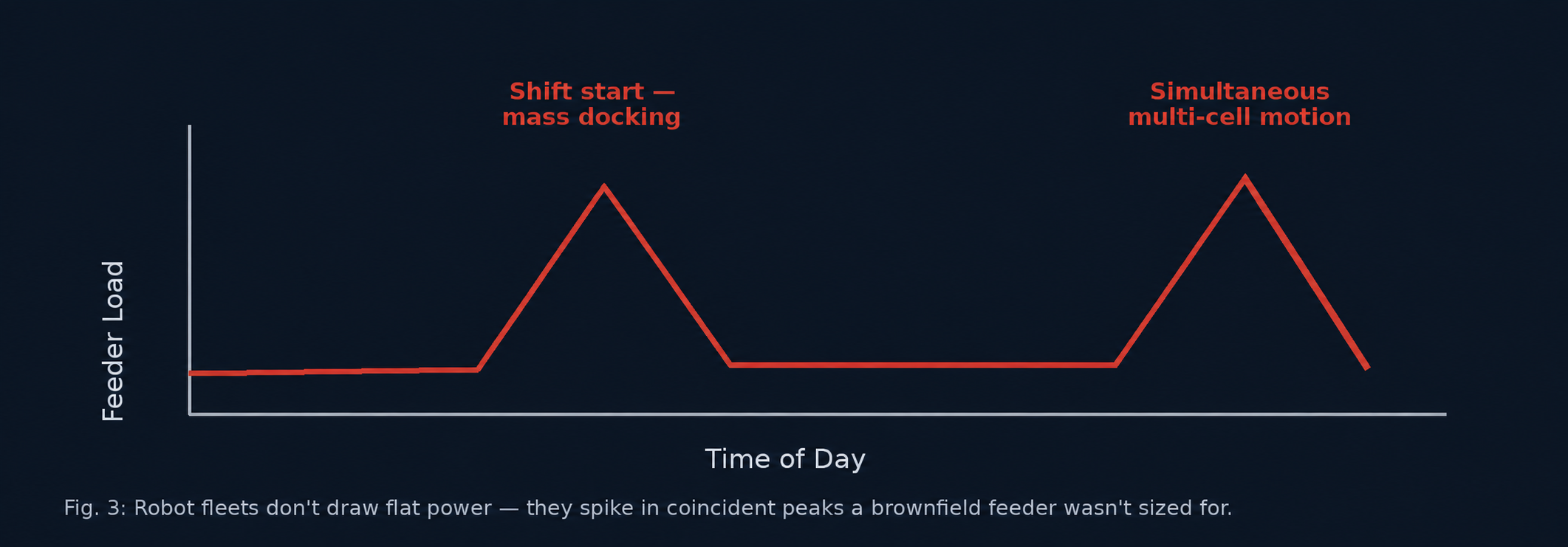
European plants already face high power prices and slow connections. Adding robot cells, charging and edge inference on a constrained feeder is not "just automation." It is a new coincident load at shift start, at docking peaks and during simultaneous motion. Data-center queues taught the lesson at campus scale. Robotics will teach it at plant scale.
Week 37 of this series already put numbers on the European half of this problem: industrial electricity prices running roughly twice US levels, and grid connections that can take up to a decade in constrained markets. Robotics doesn't wait for that queue to clear, it adds a distributed, shift-synchronized load directly onto feeders that are already the tightest part of the system, in the plants least able to absorb a surprise.
👉 Key Insight
If the grid is the bottleneck of the AI revolution, robotics is how that bottleneck enters the factory gate.
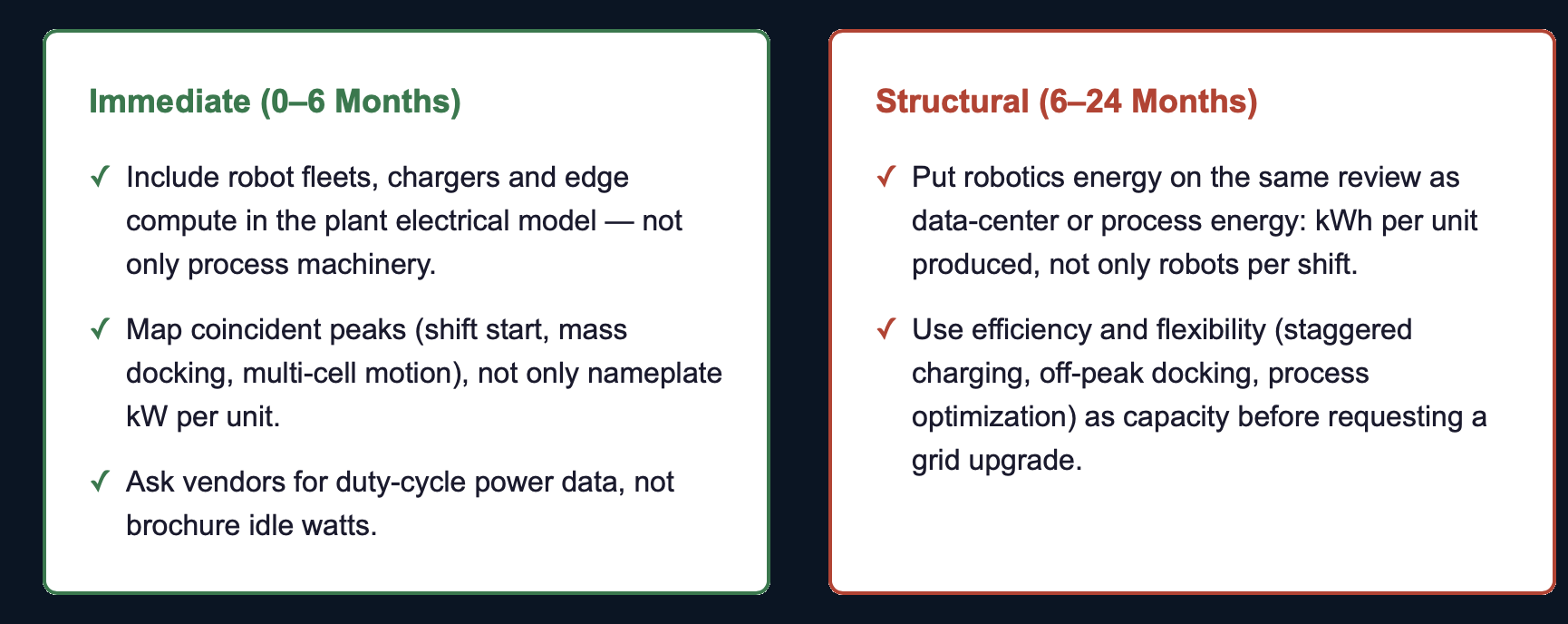
Action Plan for Decision Makers
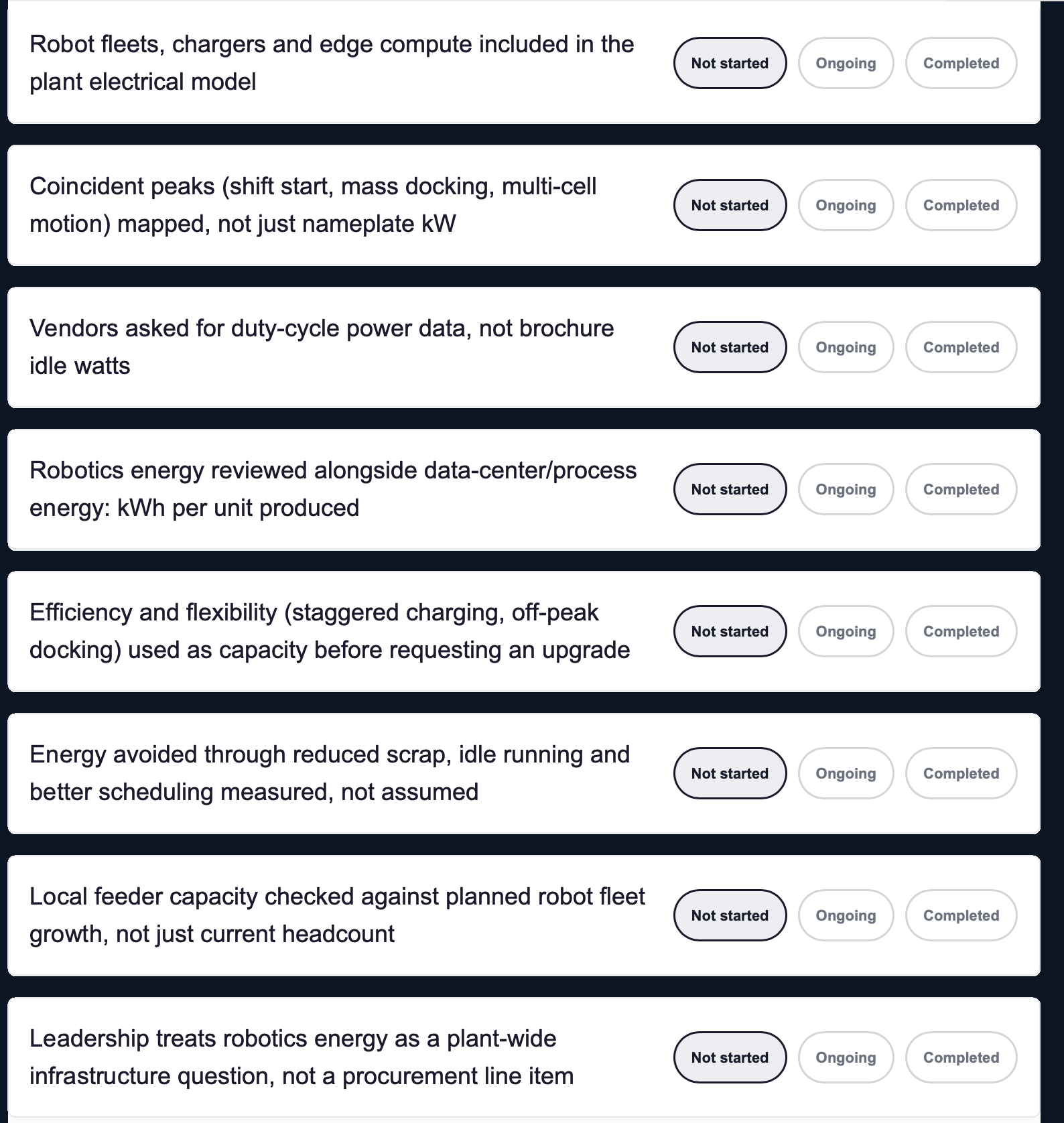
Checklist
Final Thought
Part I counted the fleet. Part II opens a single robot and asks where all those watts actually go — because "cheap labour" and "mobile energy system" are not the same purchase order.
Efficiency Before Energy means counting the load before it shows up as a surprise on the feeder — not after.
Systems don't fail. Decisions do.

Take the Next Step
Subscribe to the Weekly Punch for weekly strategic clarity, direct to your inbox.
References
gasworld (2026) Robotics Next in Line to Face Electricity Scrutiny. [Online article, citing Wood Mackenzie, 2026].
Intelligent CIO (2026) Robotics Power Demand Set to Surge as Embodied AI Scales Globally. [Online article, citing Wood Mackenzie, 2026].
SolarQuarter (2026) Robotics Industry's Power Demand Could Reach 363 TWh by 2035, Nearing France's Nuclear Generation.[Online article, citing Wood Mackenzie, 2026].
Wood Mackenzie (2026) Embodied AI: How Robotics Are Accelerating Global Power Demand. Edinburgh: Wood Mackenzie.
Disclaimer: This article synthesizes publicly available industry and energy research current as of publication. Readers should verify current figures against the original publications before relying on them for capacity-planning decisions. Verification Gate: flagged for pre-publication source check.
Ownership as Design.
Note: This article reflects my personalviews based on industry experience and publicly available information. It does not constitute professional, legal, or investment advice and does not represent the views of my employer. AI-generated visuals, concept and content by the author.
