Humanoids Are Not Cheap Labour. They Are Mobile Energy Systems

PHYSICAL AI | ENERGY | SEPTEMBER 2026 | Week 38 · Part II
A Walking Robot Is a Battery, a Charger, a Thermal Load and a Compute Node — Labour Cost Is the Wrong First Equation
Part I counted the fleet-wide load. Part II opens a single humanoid and asks where the watts actually go, because "cheap labour" and "mobile energy system" are not the same purchase order.
Efficiency Before Energy applies at the scale of one machine just as much as it does at the scale of a grid. A robot that can't finish its shift on one charge isn't a labour bargain. It's an unsolved energy budget wearing a humanoid chassis.
Executive Summary
IN 60 SECONDS:
The labour story is simple: a humanoid costs less per hour than a person in high-wage markets. The energy story is harder and more honest — current platforms typically carry about 1–4 kWh on board and last a few hours before they must dock.
Actuators take most of the power; onboard AI takes a non-trivial share. Every extra inference cycle is a minute of motion lost, and at fleet scale, charging becomes a distribution problem: many units docking at shift change look like a row of small EV chargers inside the building.
Leaders who buy humanoids as "cheap labour" without an energy and charging architecture will get short cycles, hidden peaks and disappointing utilization.
1. The Wrong Frame: Headcount Replacement
A robot that works two hours and queues for a charger is not an eight-hour worker at a discount. It's a two-hour worker with a very specific power cord.
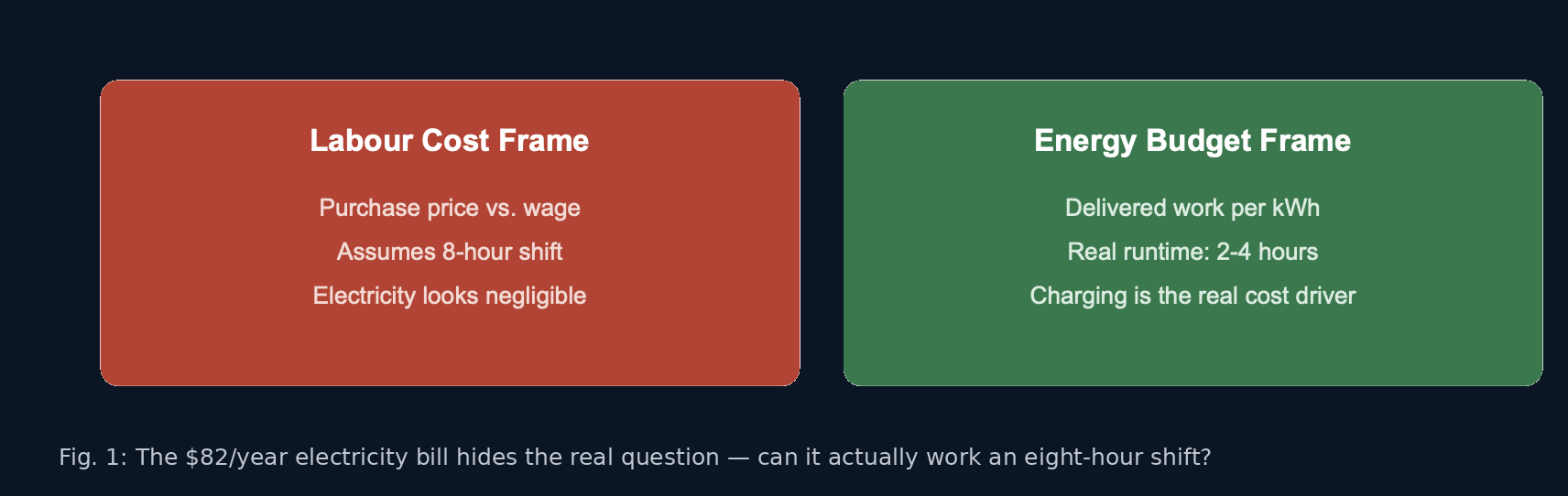
Labour cost is one input. Utilization is the output that matters. Battery swaps, thermal limits and compute load cut the useful day. The economic unit is delivered work per kWh and per charged hour, not purchase price versus wage.
Wood Mackenzie's own cost math shows why the labour frame is seductive and incomplete at the same time. A Unitree G1, priced around $16,000, would cost roughly $82 a year in electricity running eight hours a day at a global average industrial tariff of $0.14/kWh (Wood Mackenzie, 2026). That number looks like a rounding error next to a wage bill, right up until "eight hours a day" turns out to require a charging architecture, spare packs and a duty cycle the pilot never budgeted for.
👉 Key Insight
A humanoid is not a person at a discount. It is a mobile machine with an energy budget.
2. What the Hardware Actually Consumes
Every published spec sheet says "all-day operation." Every real-world deployment says otherwise.
Typical published envelopes in 2025–2026: pack size often ~1–3 kWh, some platforms ~2.3–4 kWh. Mixed-task draw commonly ~400–600 W; walking alone can sit near ~500 W, with actuators as the dominant share. Onboard compute can take on the order of 10–16% of operating power on advanced platforms. Runtime under real load is often 1–8 hours, not a full double shift, unless packs are swapped. Charging and warehouse-class mobile robots already show 1–7 kW charge rates per unit; thousands of docks change the building load shape.
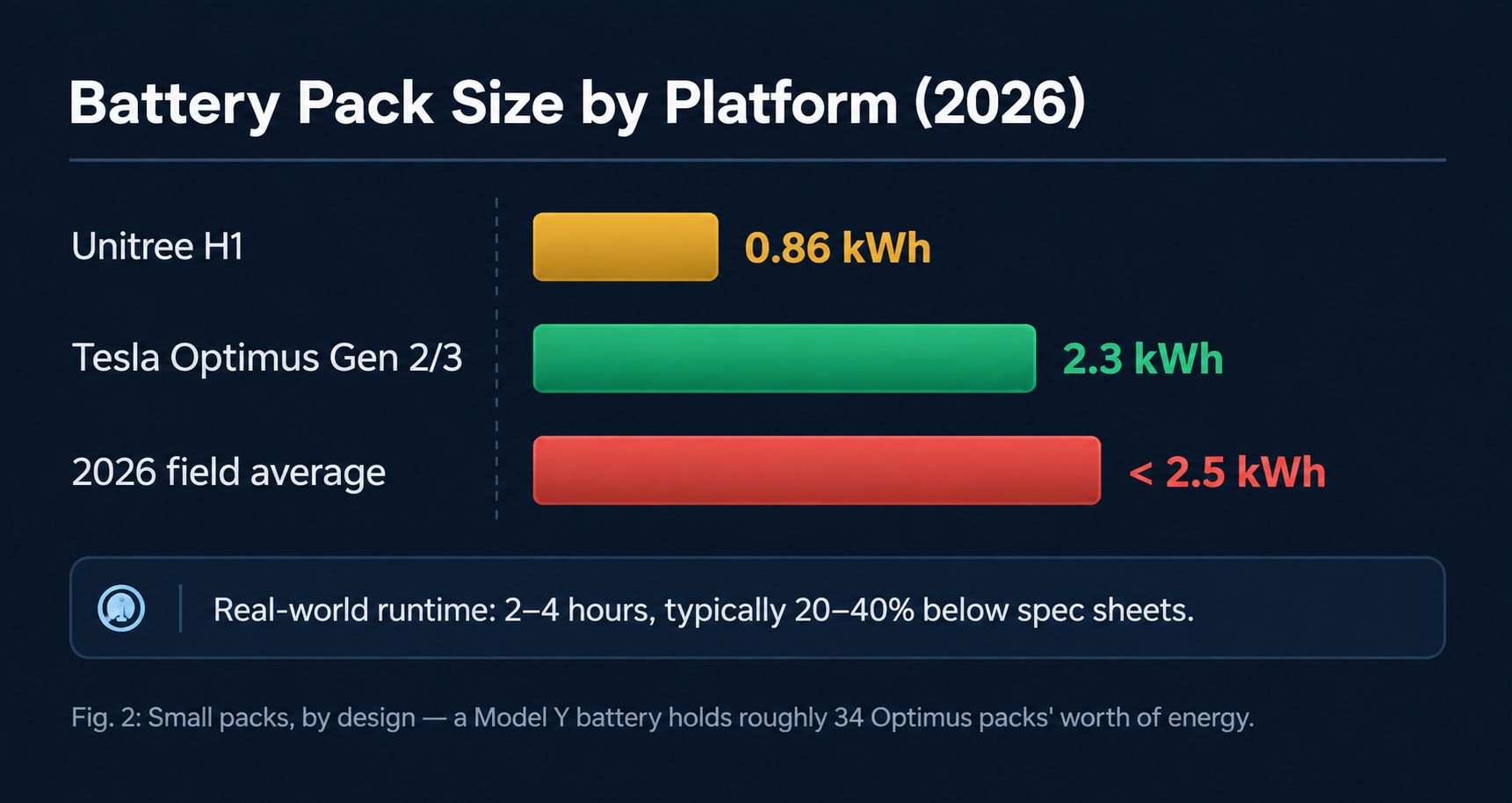
Platform-level numbers make the pattern concrete. The average humanoid shipping in 2026 carries under 2.5 kWh, Tesla's Optimus runs a 2.3 kWh pack marketed for roughly eight hours of light-duty work but typically delivers 3–6 hours under real mixed-task load, drawing on the order of 250–500 W and higher during lifting; Unitree's H1 carries a smaller 0.864 kWh pack good for under four hours even static (Technologies.org, 2026; optimusk.blog, 2026). Runtime across the field clusters between two and four hours, and real-world figures typically run 20–40% below manufacturer-stated numbers (RobotsPoint, 2026). RethinkX-style scaling exercises use ~10 kWh per robot-day as a planning midpoint. Whether or not that exact figure holds, the direction is clear: endurance is an energy problem before it is a software problem.
👉 Key Insight
Every one of these numbers describes the same ceiling from a different angle: a 1–4 kWh pack cannot fund both an eight-hour shift and a full onboard AI stack. Something gives, usually the shift.
3. Why Energy Architecture Decides ROI
In a data center a wasted joule is an invoice line. In a humanoid a wasted joule is a robot standing still.
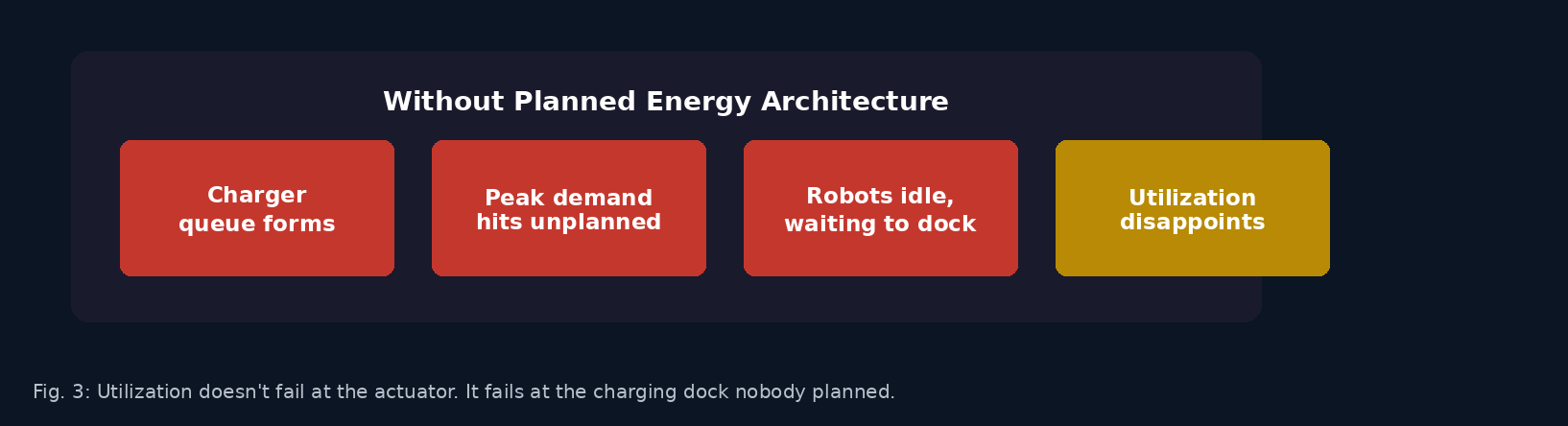
Without planned docks, spare packs, staggered shifts and thermal headroom, utilization collapses. Without efficient locomotion and edge models, the battery is spent on waste motion and waste inference. The constraint is not whether the robot can do the task. It is whether it can do the task for a full economic cycle without breaking the building's power system.
The industry is already racing to close this gap, which is itself evidence of how real the constraint is: the humanoid battery market alone is projected to grow from roughly $14 million in 2025 to about $622 million by 2032 — a 72% CAGR driven specifically by shift-length runtime becoming the subsystem that decides whether a humanoid is a genuine workforce tool or an expensive demonstration unit (MarketsandMarkets, 2026). Tesla and Figure AI are already treating charging as core infrastructure rather than an accessory: Tesla has filed a patent for an upright charging station that powers down and supports Optimus during charging, while Figure's Figure 03 charges through induction coils built into its feet, delivering roughly 2 kW without any plug-in step (Next Humanoid, 2026).
👉 Key Insight
The constraint is not whether the robot can do the task. It is whether it can do the task for a full economic cycle without breaking the building's power system.
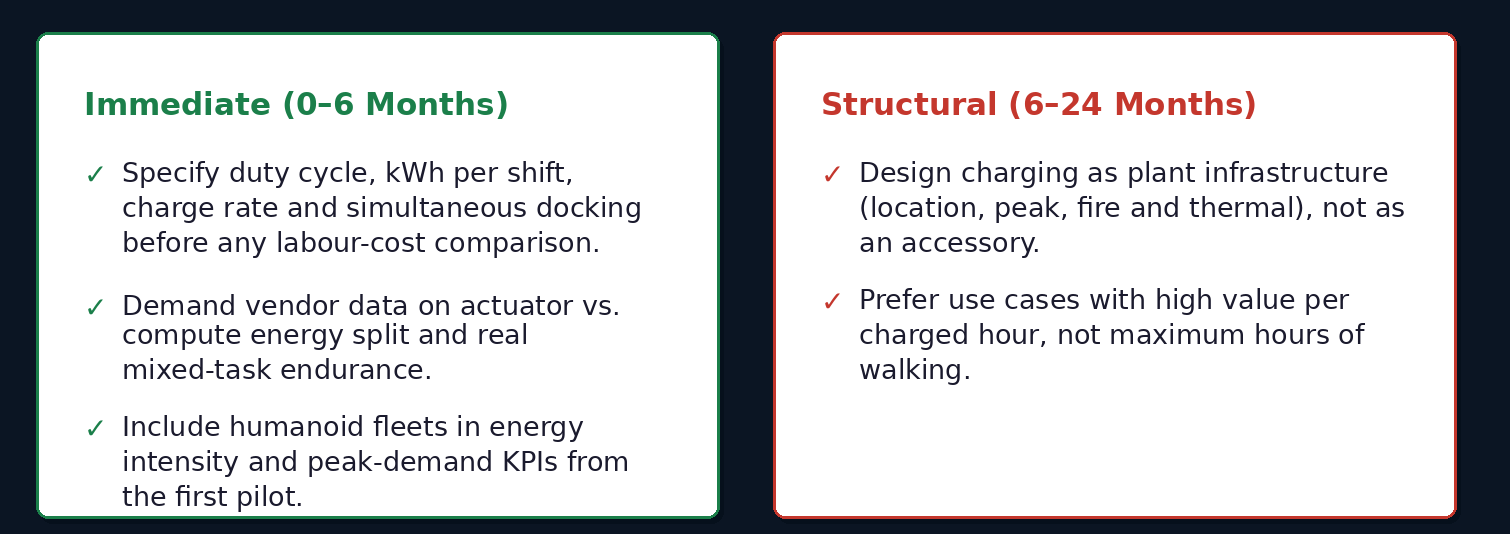
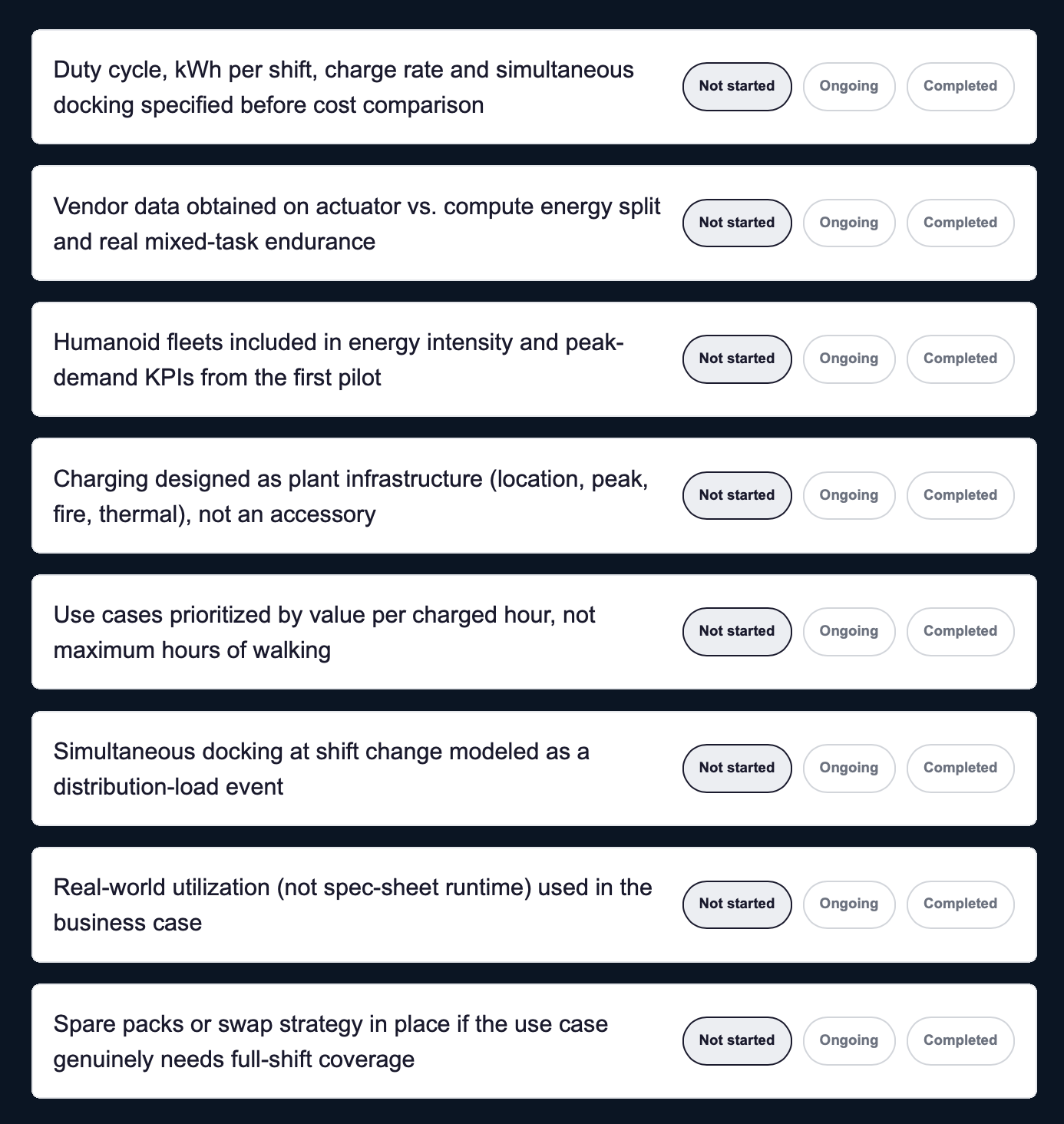
Action Plan for Decision Makers
Checklist
Final Thought
Robotics is the second load, and the individual robot is where that load actually lives — in a battery, a charger and a joule budget shared with intelligence itself. Get the energy architecture right, and the labour case takes care of itself. Get it wrong, and utilization fails before the robot ever does.
Efficiency Before Energy. Ownership as Design.
Systems don't fail. Decisions do.

Take the Next Step
Subscribe to the Weekly Punch for weekly strategic clarity, direct to your inbox.
References
MarketsandMarkets (2026) Humanoid Robot Battery Market to Reach USD 622 Million by 2032, Growing at 72% CAGR. [Online press release].
Next Humanoid (2026) Battery Technology and the 24/7 Robot Challenge. [Online article].
optimusk.blog (2026) Tesla Optimus Battery Life & Runtime 2026: kWh & Hours. [Online article].
RobotsPoint (2026) How Long Does a Humanoid Robot Run on a Single Charge? [Online article].
Technologies.org (2026) The Humanoid Robot Bottleneck Is the Battery: Why Two Kilowatt-Hours Caps the Whole Industry. [Online article].
Wood Mackenzie (2026) Embodied AI: How Robotics Are Accelerating Global Power Demand. Edinburgh: Wood Mackenzie.
Disclaimer: This article synthesizes publicly available industry research current as of publication. Manufacturer-stated specifications may differ from real-world duty-cycle performance. Readers should verify current figures against the original publications before relying on them for procurement decisions. Verification Gate: flagged for pre-publication source check.
Ownership as Design.
Note: This article reflects my personalviews based on industry experience and publicly available information. It does not constitute professional, legal, or investment advice and does not represent the views of my employer. AI-generated visuals, concept and content by the author.
