Playing to Win with Physical AI: How Leaders Apply the Lafley/Martin Strategy Cascade to Real Factory Decisions
Leadership | Strategy | Physical AI | Manufacturing | Week 34 · Part III
From Vague AI Ambition to Clear Strategic Choices, Using the Playing to Win Framework to Turn Physical AI Investments into Competitive Advantage
Week 33 argued that judgment, not information, is the scarce resource in AI-rich organizations. Part I of this week's set showed what happens when leaders lack that judgment, AI exposes them. Part II put a price on the paralysis that follows. Part III offers something the first two didn't: a concrete framework for building the judgment and the decisiveness both pieces were describing.
Efficiency Before Fuel has always meant the decision is the expensive part. A.G. Lafley and Roger Martin spent a career proving that the highest-leverage decision of all is deciding what you are actually trying to win, before you spend a single euro on the technology to get there.
Executive Summary
IN 60 SECONDS:
Many manufacturing organizations still approach Physical AI with a technology-first mindset, "we need AI because everyone else is doing it", producing scattered pilots, unclear priorities and limited impact.
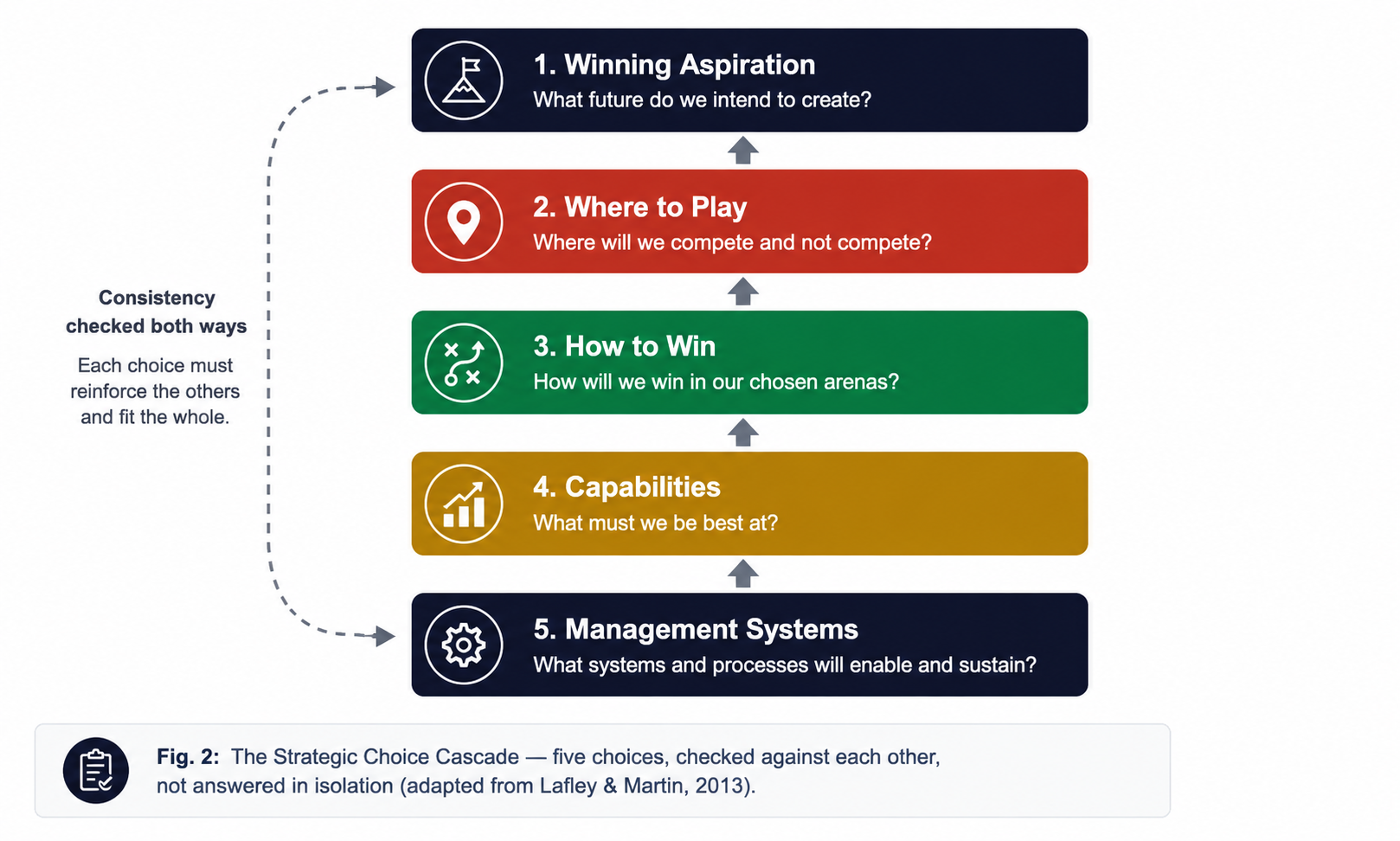
Lafley and Martin's Playing to Win offers a proven antidote: a cascade of five interconnected choices, Winning Aspiration, Where to Play, How to Win, Capabilities and Management Systems, that forces leaders to make explicit strategic decisions rather than default ones.
Applied deliberately to Physical AI, the cascade turns technological possibility into focused competitive advantage, creating clarity, aligning resources, and avoiding the common trap of activity without strategy.
1. Why Most AI Initiatives Lack Strategic Clarity
Ask ten manufacturing leaders why they're investing in AI, and eight will say some version of "because everyone else is doing it." That is not a strategy. It is peer pressure with a budget line.
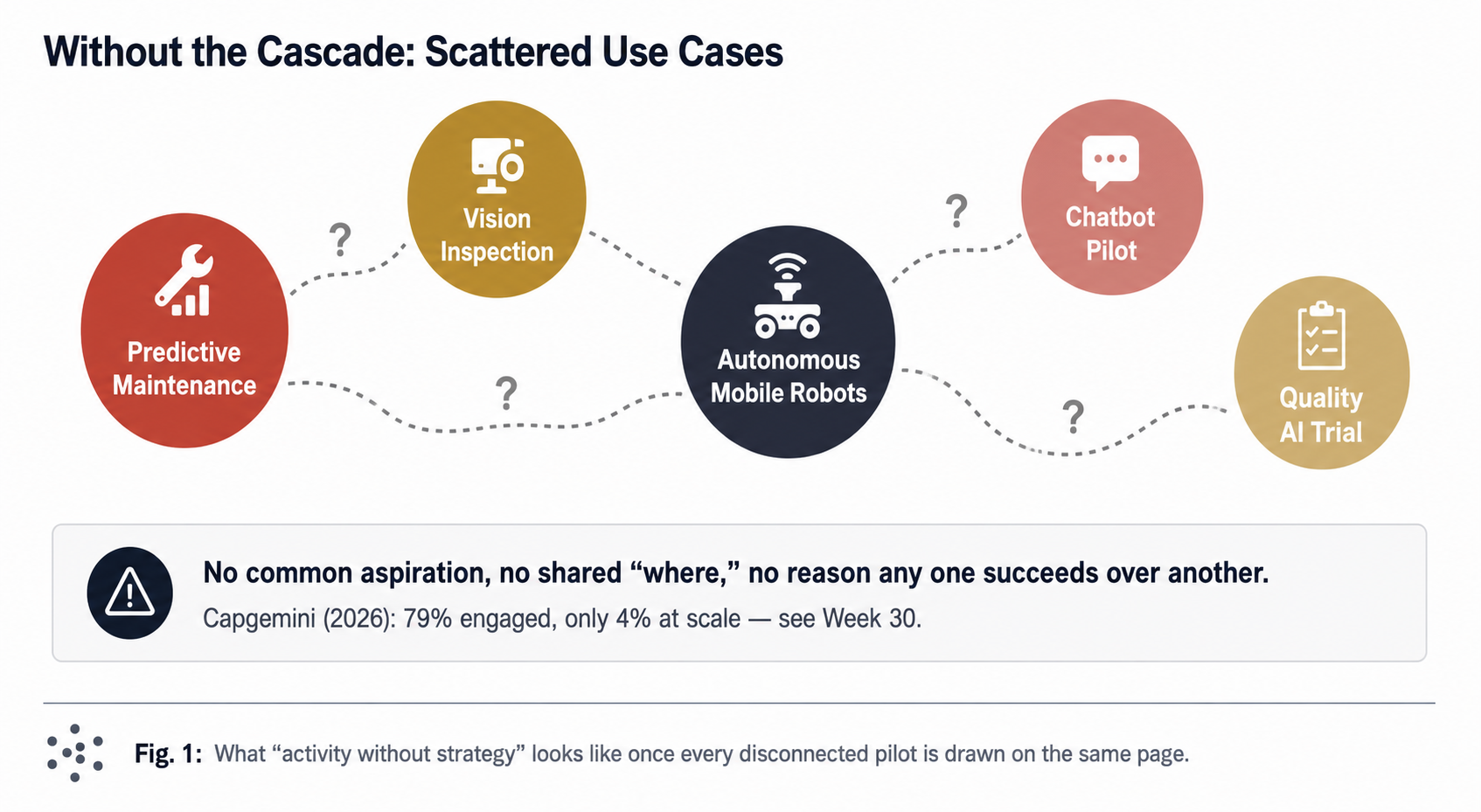
Without a clear strategy cascade, AI projects often become collections of disconnected use cases. Leaders invest in predictive maintenance here, vision inspection there, and autonomous mobile robots elsewhere, without answering the fundamental questions of what winning looks like and where the organization will compete. The Playing to Win framework starts with the opposite approach: strategy is a set of integrated choices that define how the organization will win.
This series has already put a number on that gap. Capgemini's 2026 global survey found that while 79% of business leaders are already engaging with physical AI, only 4% have reached large-scale deployment (Capgemini Research Institute, 2026, see Week 30). A field of scattered, disconnected pilots is exactly what "activity without strategy" looks like once you count it.
👉 Key Insight
Technology without strategic choices produces activity. Strategic choices without technology produce irrelevance. The combination creates advantage.
2. Applying the Five Choices to Physical AI, Practical Examples
Five questions, asked in order, do more strategic work than a hundred-slide AI roadmap deck.
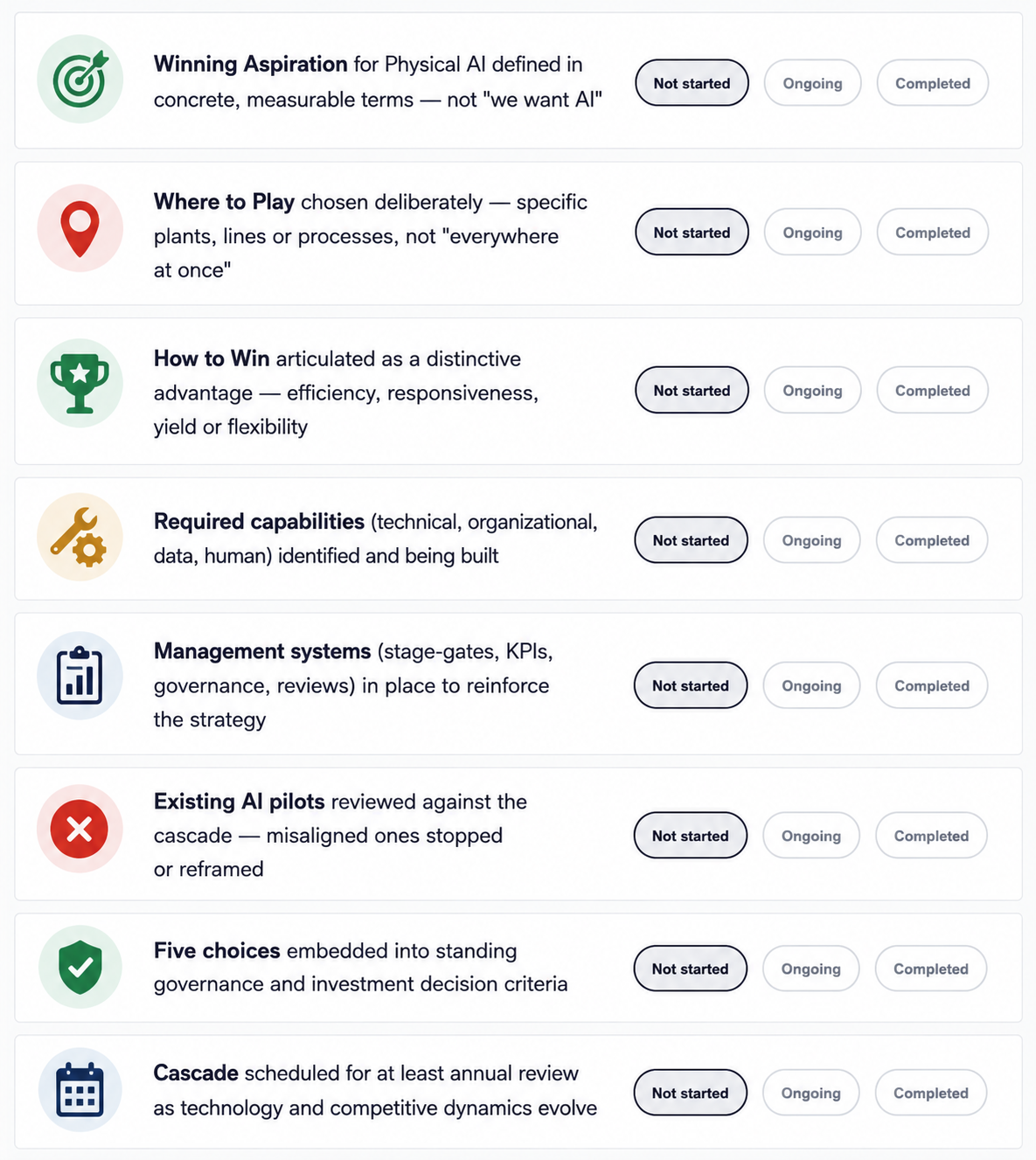
1. Winning Aspiration
Instead of "We want to implement AI," leaders define a clear aspiration such as: "We will become the most reliable high-mix producer in our segment by reducing unplanned downtime by 40% and energy intensity by 15% within three years."
Practical example: A European automotive supplier redefined its aspiration around "zero surprise downtime" rather than "AI adoption." This single choice immediately prioritized predictive and agentic maintenance use cases over lower-impact experiments.
2. Where to Play
Leaders decide which plants, product lines, processes or customer segments will be the primary arenas for Physical AI. Trying to transform everything at once dilutes impact.
Practical example: A machinery manufacturer chose to focus first on its highest-volume, highest-energy-cost production lines rather than spreading resources across all sites. This concentration created visible results that built internal credibility for broader rollout.
3. How to Win
This is the critical choice of the distinctive advantage. In Physical AI terms it often means: superior energy efficiency, faster response to variability, higher first-pass yield, or greater flexibility in high-mix environments.
Practical example: One process manufacturer decided its "How to Win" would be real-time adaptive process control enabled by edge AI and agentic systems. Every subsequent investment had to demonstrably support this advantage.
4. Capabilities
What specific capabilities, technical, organizational, data, human, must the organization build or acquire?
Practical example: Successful companies deliberately develop "AI supervision" skills among experienced operators and create cross-functional teams that combine process expertise with data and safety competence, rather than relying solely on external data scientists.
5. Management Systems
Which processes, metrics, governance structures and decision routines will reinforce the strategy?
Practical example: Leading organizations introduce stage-gate processes for AI pilots, clear autonomy boundaries, energy-linked KPIs and regular strategy reviews that check whether AI investments still serve the original winning aspiration.
👉 Key Insight
Each of the five choices is deliberately concrete here, a plant, a KPI, a named capability, because vague strategy and vague AI produce exactly the same result: motion without direction.
3. Why the Framework Works Particularly Well for Physical AI
Physical AI investments are capital-intensive, touch safety and operational systems, and create lasting organizational change, which is exactly why vague strategy is more dangerous here than almost anywhere else in the business.
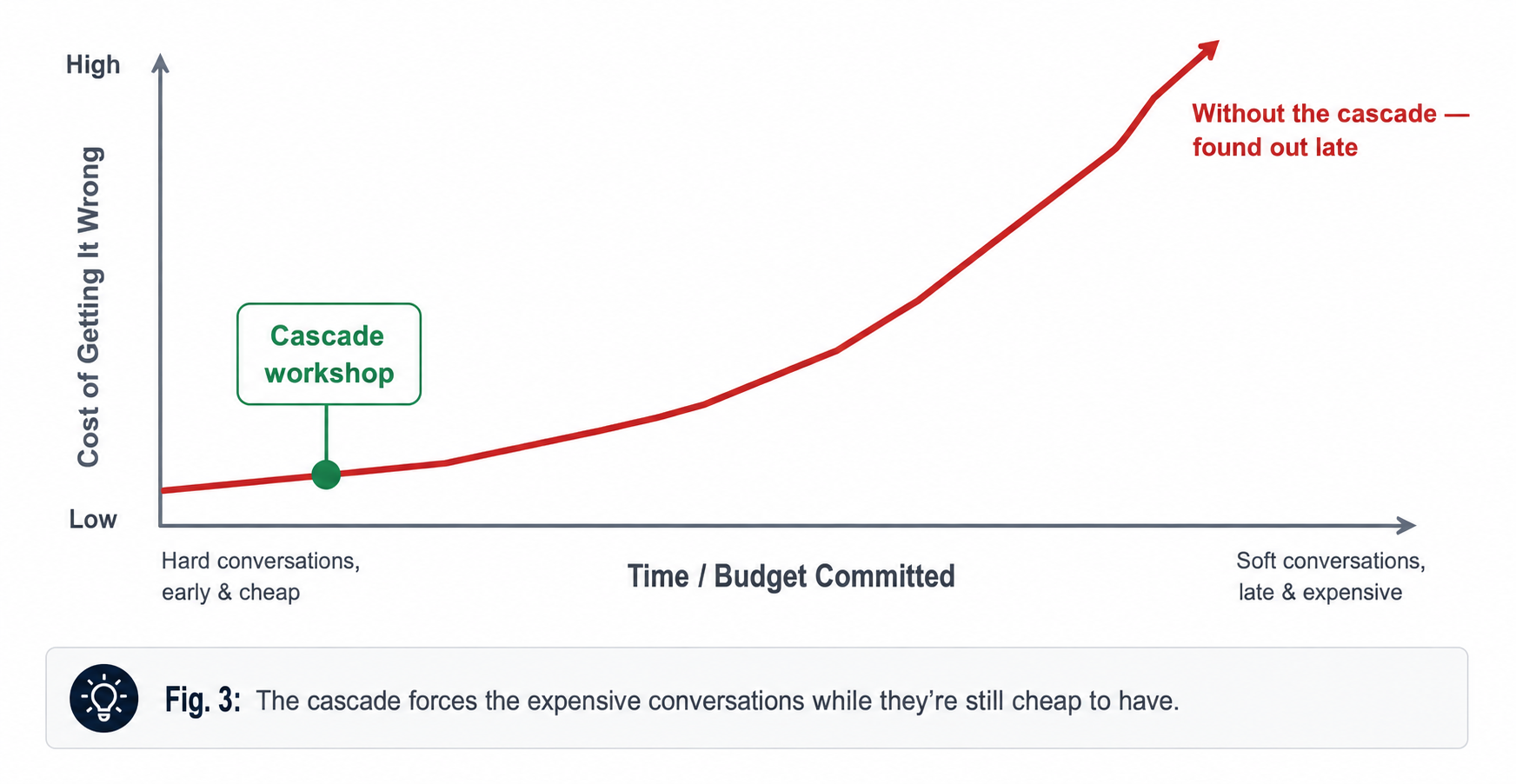
The Playing to Win cascade forces the hard conversations early, before large budgets are committed. It also provides a common language that bridges technology teams, operations and senior leadership, three groups that too often evaluate the same AI investment against three different definitions of success.
Week 30 of this series already showed what disciplined "Where to Play" and "Management Systems" choices look like in practice: rather than deploying agents plant-by-plant without a common architecture, Siemens and NVIDIA built one fully governed, AI-driven site at the Erlangen Electronics Factory as a repeatable blueprint (Siemens, 2026; NVIDIA Newsroom, 2026). That is the cascade at work, concentration instead of dilution, one coherent management system instead of five uncoordinated ones. It also echoes the distinction this series drew in Week 33 and Week 34 Part I between organizations that treat AI as a catalyst for reinvention and those that treat it as a technology experiment (Deloitte, 2026): the cascade is, in effect, a structured way to force that choice.
👉 Key Insight
The power of the framework lies in the integration of the five choices. Changing one choice requires checking the consistency of the others, preventing fragmented AI roadmaps.
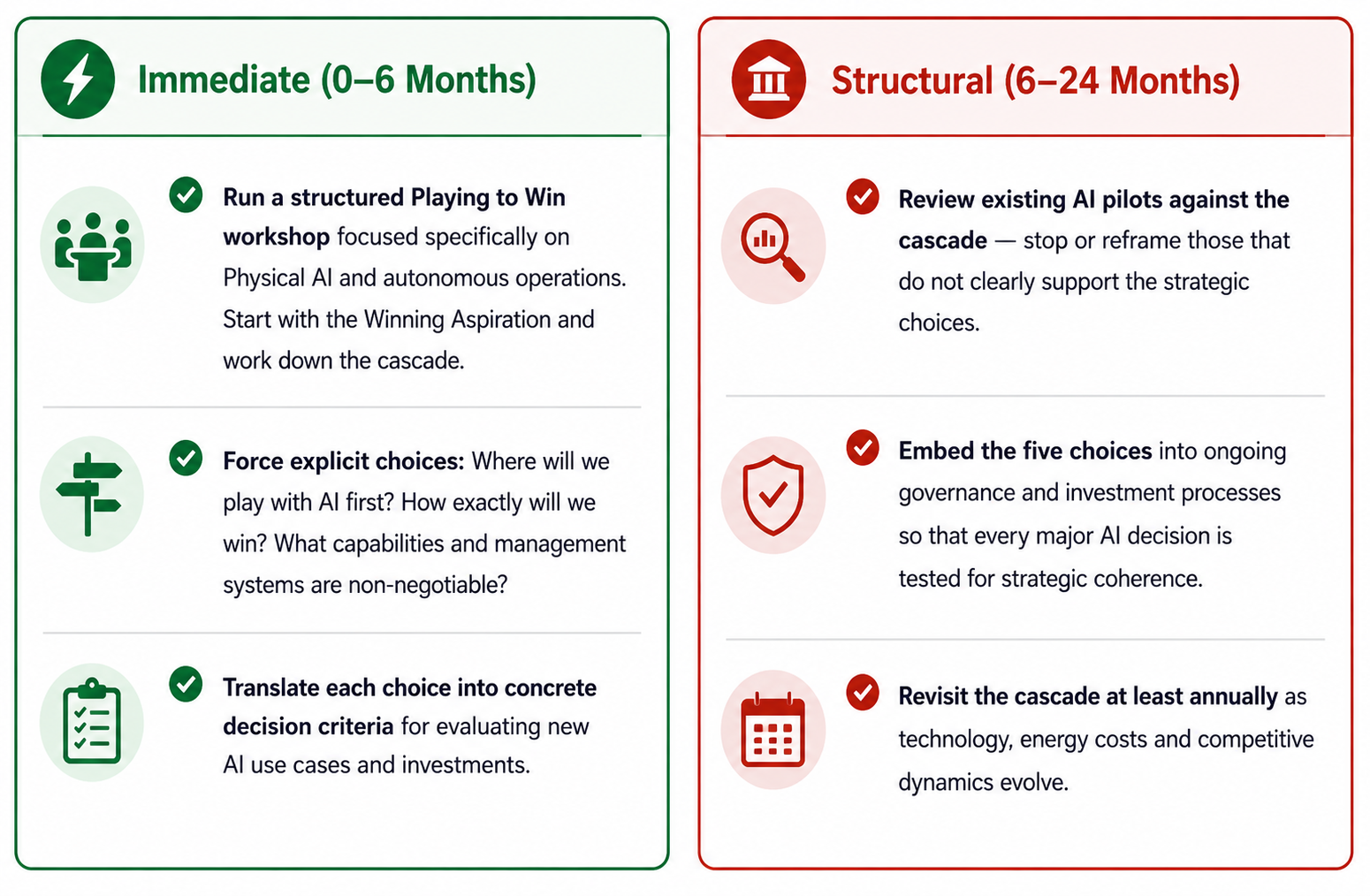
Action Plan for Decision Makers
Checklist
Final Thought
This Week 34 trilogy started with a diagnosis, AI exposes weak leadership, moved to a price tag, the cost of the decisions that never get made, and ends with a tool. The Strategic Choice Cascade doesn't remove uncertainty or guarantee good judgment. It does something almost as valuable: it makes vague ambition impossible to hide behind.
Efficiency Before Fuel. Ownership as Design. Five choices, made explicitly and revisited honestly, are how both actually get built.
Systems don't fail. Decisions do.
Take the Next Step
Subscribe to the Weekly Punch for weekly strategic clarity, direct to your inbox.
References
Capgemini Research Institute (2026) Physical AI: Taking Human-Robot Collaboration to the Next Level. Paris: Capgemini Research Institute.
Deloitte (2026) The Future of Human-Led, AI-Powered Leadership. [Forbes BrandVoice].
Lafley, A.G. and Martin, R.L. (2013) Playing to Win: How Strategy Really Works. Boston, MA: Harvard Business Review Press.
NVIDIA Newsroom (2026) Siemens and NVIDIA Expand Partnership to Build the Industrial AI Operating System. Santa Clara: NVIDIA Corporation.
Siemens AG (2026) Siemens Unveils Technologies to Accelerate the Industrial AI Revolution at CES 2026. Munich: Siemens AG.
Disclaimer: This article synthesizes the Playing to Win framework (Lafley & Martin, 2013) and publicly available industry research current as of publication. The practical examples in Section 2 are illustrative composites, not verified named case studies. Readers should verify current figures against the original publications before relying on them for strategic decisions. Verification Gate: flagged for pre-publication source check.
Ownership as Design.
Note: This article reflects my personalviews based on industry experience and publicly available information. It does not constitute professional, legal, or investment advice and does not represent the views of my employer. AI-generated visuals, concept and content by the author.
