The Cost of Delayed Decisions in High-Complexity Industrial Environments
Decision | Velocity | Industrial Leadership | Manufacturing | Week 34 · Part II
LEADERSHIP | DECISION VELOCITY | AUGUST 2026
Why the Slowness Tax Is Usually Larger Than the Cost of Being Wrong, and How to Build an Organization That Decides Fast
Part I of this pair argued that AI exposes weak leadership. Part II puts a number on one of the clearest ways that exposure shows up: the decision that never gets made, and what it actually costs a high-complexity industrial organization to keep waiting.
Efficiency Before Fuel has always meant the decision is the expensive part. This week's pair just gives that idea two different price tags: one for deciding badly, and a usually larger one for not deciding at all.
Executive Summary
IN 60 SECONDS:
Slow decision-making is a measurable, not just a cultural, cost: West Monroe's 2026 survey of over 1,200 leaders at companies with $250M+ in revenue found that nearly three in four estimate their organization loses up to 5% of annual revenue to delayed decisions and execution, and leadership behavior, not technology, is the biggest driver.
High-complexity industrial environments have a structural bias toward "analysis paralysis": the cost of a wrong decision is visible and attributable, while the cost of delay is diffuse — so incentive structures routinely reward demanding more data over committing to a reversible call.
Organizations that build real decision architecture, matching deliberation intensity to reversibility, and making delay costs as visible as mistake costs, convert AI-era decisiveness into a compounding advantage rather than one more source of organizational friction.
1. Why Delay Costs More Than Being Wrong
Executives fear the decision that turns out wrong. They should fear the decision that never gets made.
Most operational decisions inside a complex industrial environment are reversible, a parameter can be adjusted back, a maintenance call can be revised ,yet they routinely get deliberated as if they were bet-the-company calls. The cost of delay almost always exceeds the cost of a fixable mistake, while genuinely irreversible decisions, a major acquisition, exiting a market, a bet-the-company product pivot, deserve the heavier deliberation they get instead applied indiscriminately across the board.
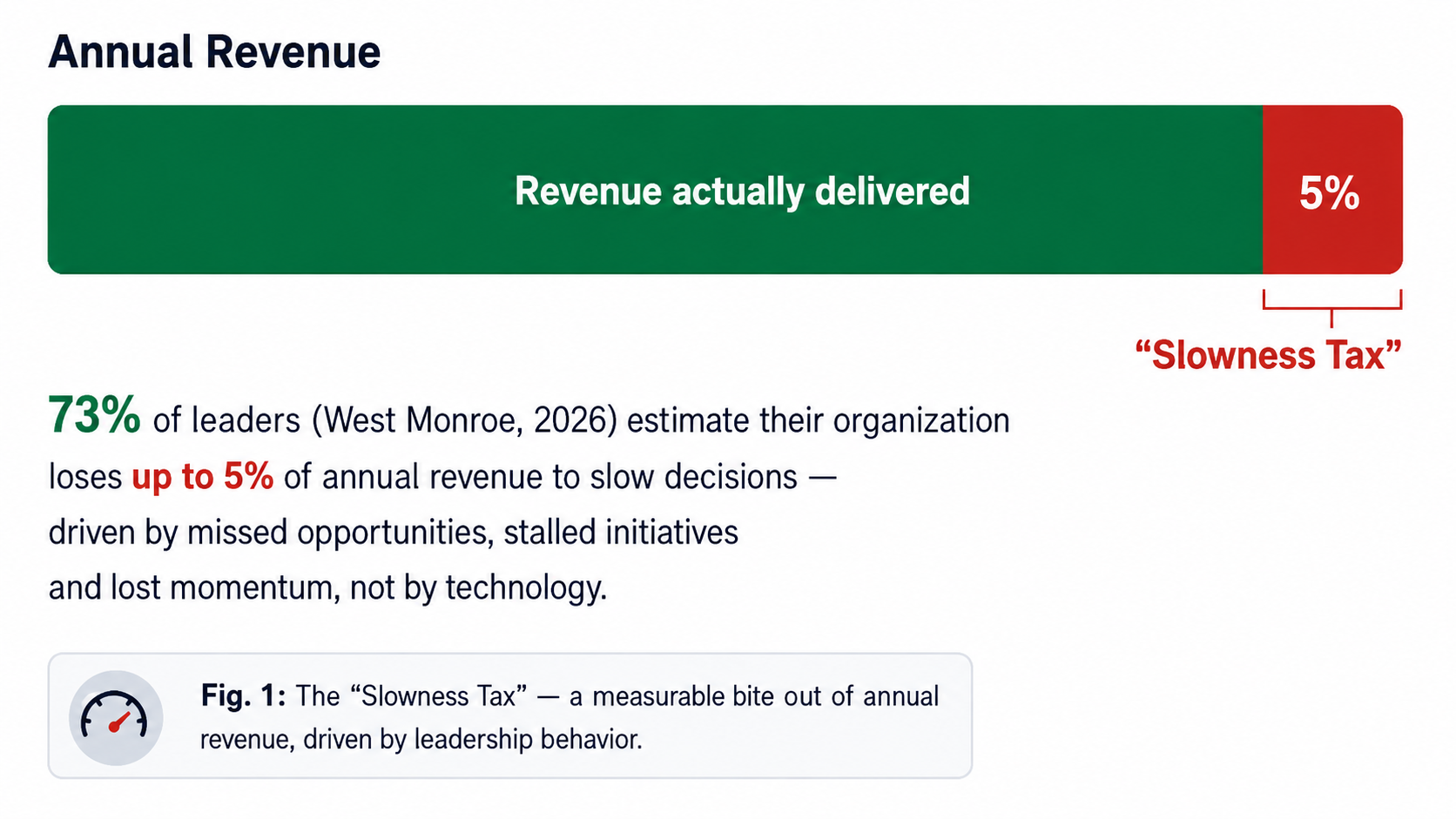
The number behind that mismatch is larger than most organizations assume. West Monroe's 2026 "Speed Wins" study, based on responses from more than 1,200 leaders, 214 C-suite executives and 1,000 managers at U.S. companies with at least $250 million in annual revenue, found that nearly three in four leaders (73%) estimate their organization loses up to 5% of annual revenue simply because decisions and execution move too slowly, a cost the study calls the "Slowness Tax" (West Monroe, 2026). Leadership behavior, not technology, is the biggest contributor, and AI productivity gains are largely absorbed by process friction before they ever reduce that tax at the enterprise level (West Monroe, 2026).
👉 Key Insight
The mistake gets a post-mortem. The delay gets a shrug. In high-complexity environments, the delay is usually the more expensive one.
2. The Decision Velocity Matrix — and Where High-Complexity Environments Get Stuck
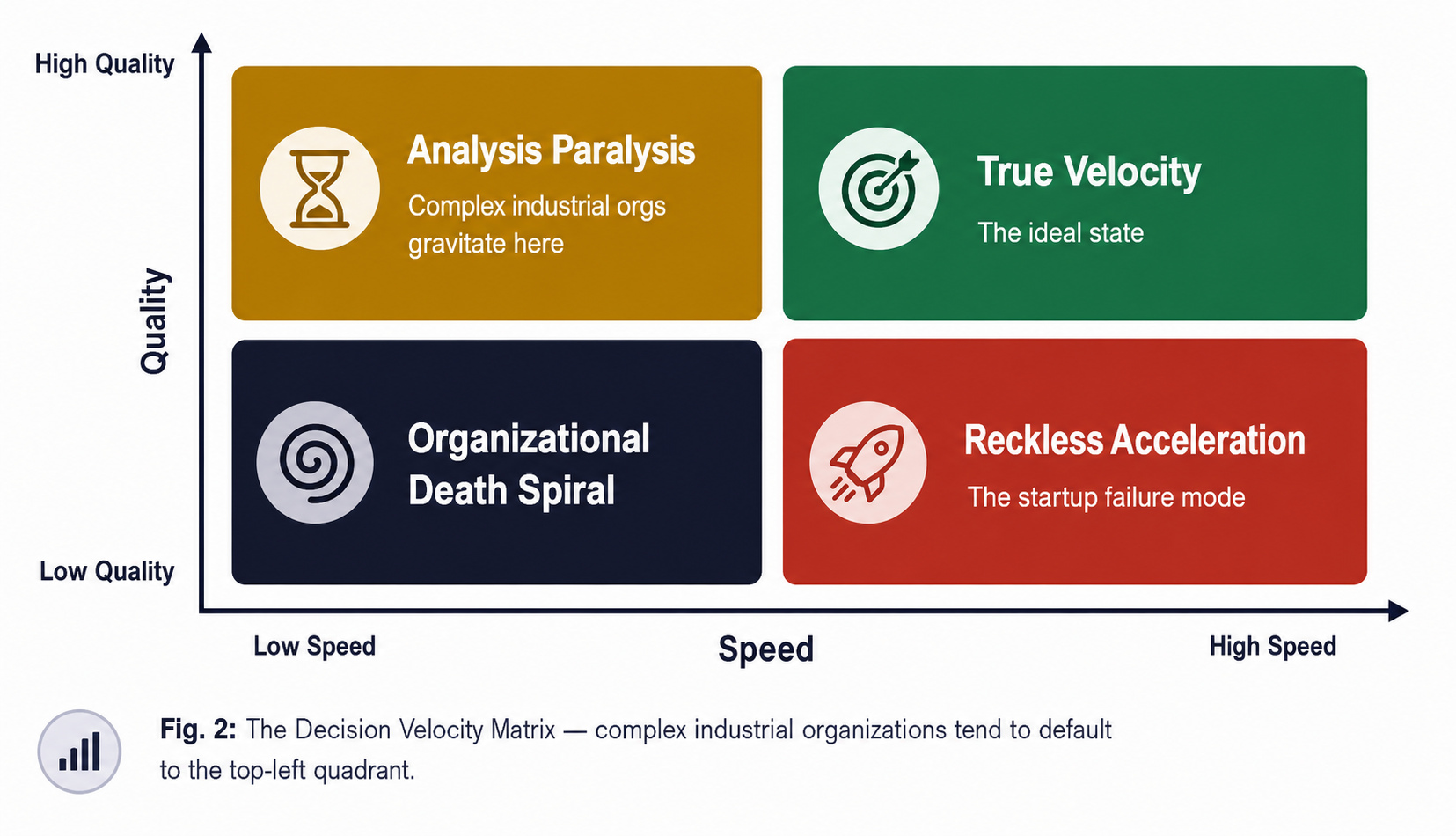
Speed without quality is reckless. Quality without speed has a name too, most industrial organizations just don't like using it: analysis paralysis.
A useful way to see the trap is a simple two-by-two: High Speed with High Quality is true velocity, the ideal state. High Speed with Low Quality is reckless acceleration. Low Speed with High Quality is analysis paralysis, the characteristic enterprise failure mode. And Low Speed with Low Quality is an organizational death spiral (Turning Data Into Wisdom, 2026). High-complexity industrial environments, multiple interacting systems, safety constraints, regulatory overlays, have a structural bias toward the analysis-paralysis quadrant, because the cost of a wrong decision is concentrated and attributable, while the cost of delay is diffuse and gets absorbed into "normal" operating friction.
That bias is reinforced by an incentive asymmetry most organizations never make explicit: the person who makes a decision bears the risk of being wrong, while the person who delays, escalates or demands more data bears very little risk at all (ACG Strategic Insights, 2026). Part I of this pair named the leadership-level version of this same pattern: an inability to make trade-off decisions, delaying under the guise of "gathering more information" rather than actually choosing.
👉 Key Insight
In volatile, high-complexity environments, the cost of delay routinely exceeds the cost of being wrong, yet almost no incentive structure is built to notice that.
3. Practical Lessons: Building an Organization That Decides Fast
The fastest-deciding organizations in 2026 didn't get faster models. They got clearer decision rights.
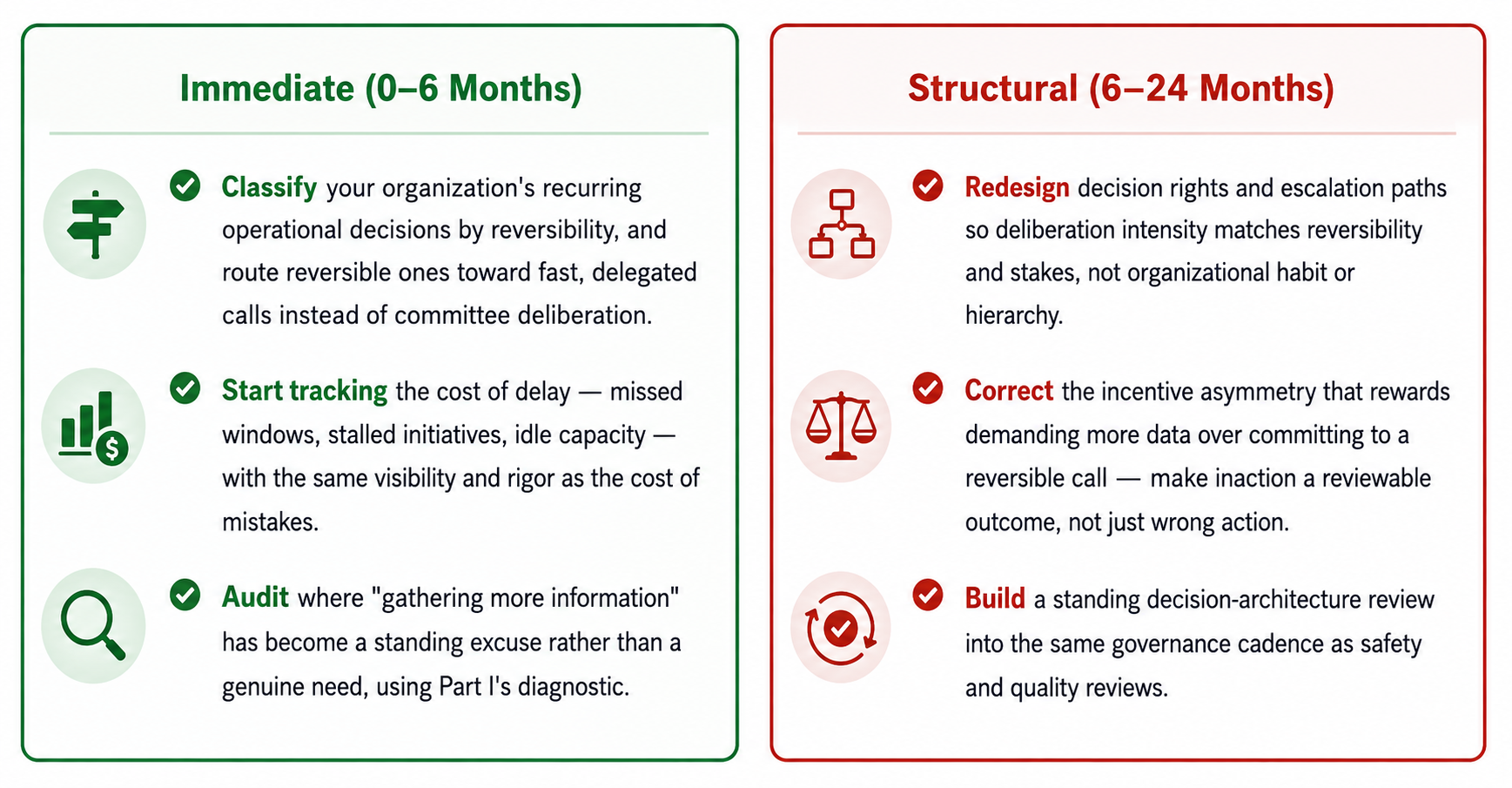
Three moves recur among organizations that close the gap: they match deliberation intensity to reversibility, so reversible decisions get fast, delegated calls while genuinely irreversible ones get real scrutiny; they make the cost of delay visible in the same reporting cycle as the cost of mistakes, so both show up on the same page instead of one hiding inside "normal" friction; and they correct the incentive asymmetry that currently rewards demanding more data over committing to a call, by making inaction itself a reviewable outcome.
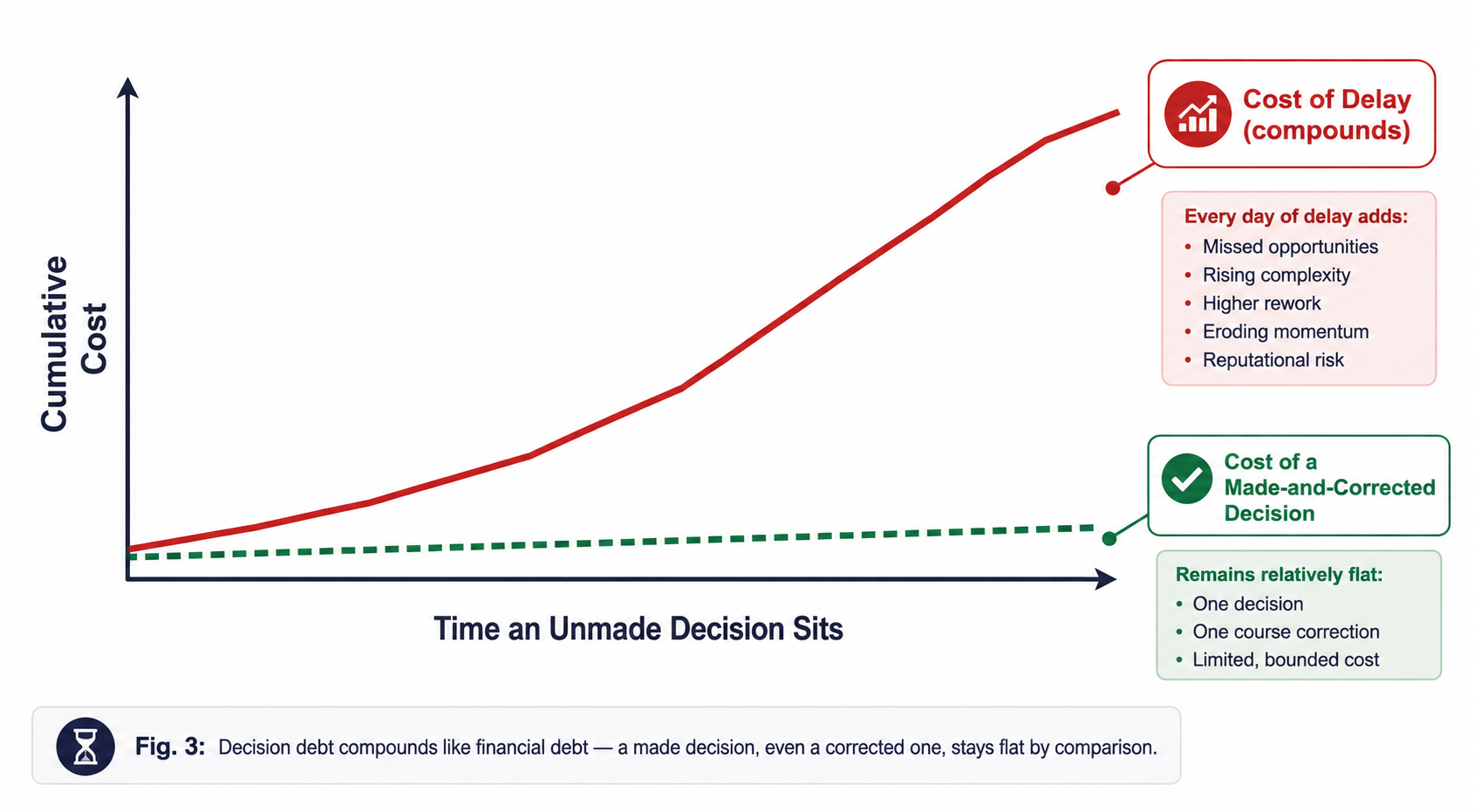
The payoff compounds rather than staying flat. IBM's 2026 CEO Study frames the underlying logic bluntly: AI "rewards decisiveness and penalizes hesitation," and found that CEOs remaking their organizations with an AI-first mindset had already scaled 10% more AI initiatives than peers, with the most future-focused group scaling 23% more (IBM, 2026, cited in Grow to Your Fullest, 2026). Read alongside Part I of this pair, the logic closes a loop: an organization that has already removed "gathering more information" as a leadership excuse is, almost by definition, one that has started paying down its decision debt.
👉 Key Insight
Decision debt compounds like financial debt. The fix isn't more courage in the moment, it's decision architecture that makes fast the default for anything reversible.
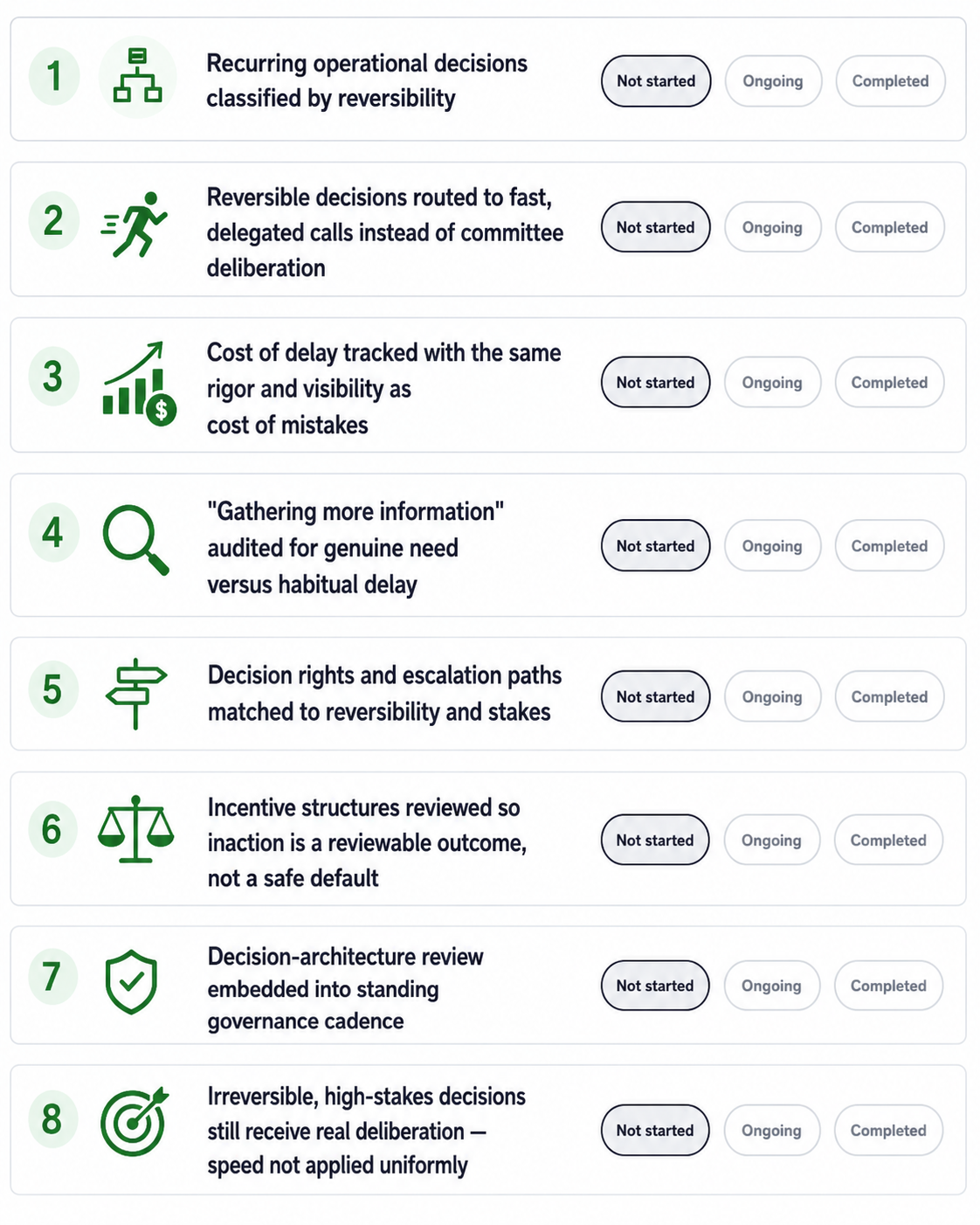
Action Plan for Decision Makers
Checklist
Final Thought
Part I asked what AI exposes about leadership. Part II shows that one of the most expensive things it exposes is silence — the decision quietly deferred, month after month, until the market or the machine decides without you.
Efficiency Before Fuel. Ownership as Design. Neither one survives an organization that mistakes delay for diligence.
Systems don't fail. Decisions do.
Take the Next Step
Subscribe to the Weekly Punch for weekly strategic clarity, direct to your inbox.
References
ACG Strategic Insights (2026) The Real Cost of Slow Decisions and the Decision Architecture Behind It. [Online article].
Grow to Your Fullest (2026) Decision Velocity: Essential Leadership Insight. [Online article, citing IBM 2026 CEO Study].
Murphy, M. (2026) Why Slow Executive Decisions Can Cost More Than Wrong Ones. Forbes.
Turning Data Into Wisdom (2026) 10 Leadership Moves That Kill Decision Velocity. [Online article].
West Monroe (2026) Slow Decisions Cost Companies Revenue. [Press release, "Speed Wins" study].
Disclaimer: This article synthesizes publicly available research current as of publication. No detailed section brief was supplied for this week; body sections, framing and evidence selection were originated by the writer from the two given titles. Readers should verify current figures against the original publications before relying on them for strategic or investment decisions. Verification Gate: flagged for pre-publication source check.
Ownership as Design.
Note: This article reflects my personalviews based on industry experience and publicly available information. It does not constitute professional, legal, or investment advice and does not represent the views of my employer. AI-generated visuals, concept and content by the author.
