Physical AI in European Factories: Between Hype, Energy Constraints and Reality
PHYSICAL AI | EUROPEAN MANUFACTURING | JUNE 2026
Why Europe's Combination of High Energy Costs, Strict Regulation and Brownfield Reality Makes Physical AI Both More Urgent and Significantly Harder to Scale, and What Pragmatic Leaders Are Actually Doing in 2026
This is Part II of Week 26, the European reality check after the broader vision of autonomous operations in Part I: the specific tension between technological hype, acute energy and regulatory constraints, and what is realistically achievable on European shop floors today.
Part I sketched the global vision: machines that perceive, decide and act on their own. Cross the Atlantic, or rather, land in a 40-year-old plant in the Ruhr or Lombardy, and the vision meets a harder equation. Here, every kilowatt has a price, every robot a safety dossier, and every legacy line a reason it can't simply be ripped out.
This is where Efficiency Before Fuel stops being a slogan and becomes a survival constraint. In Europe you cannot buy your way out with cheap energy or a greenfield rebuild. Physical AI only earns its place if it lowers energy intensity rather than adding to it. The leaders winning in 2026 aren't chasing the loudest demo, they're solving the most expensive process.
Executive Summary
1. The European Context: Energy Costs, Regulation and Brownfield Reality
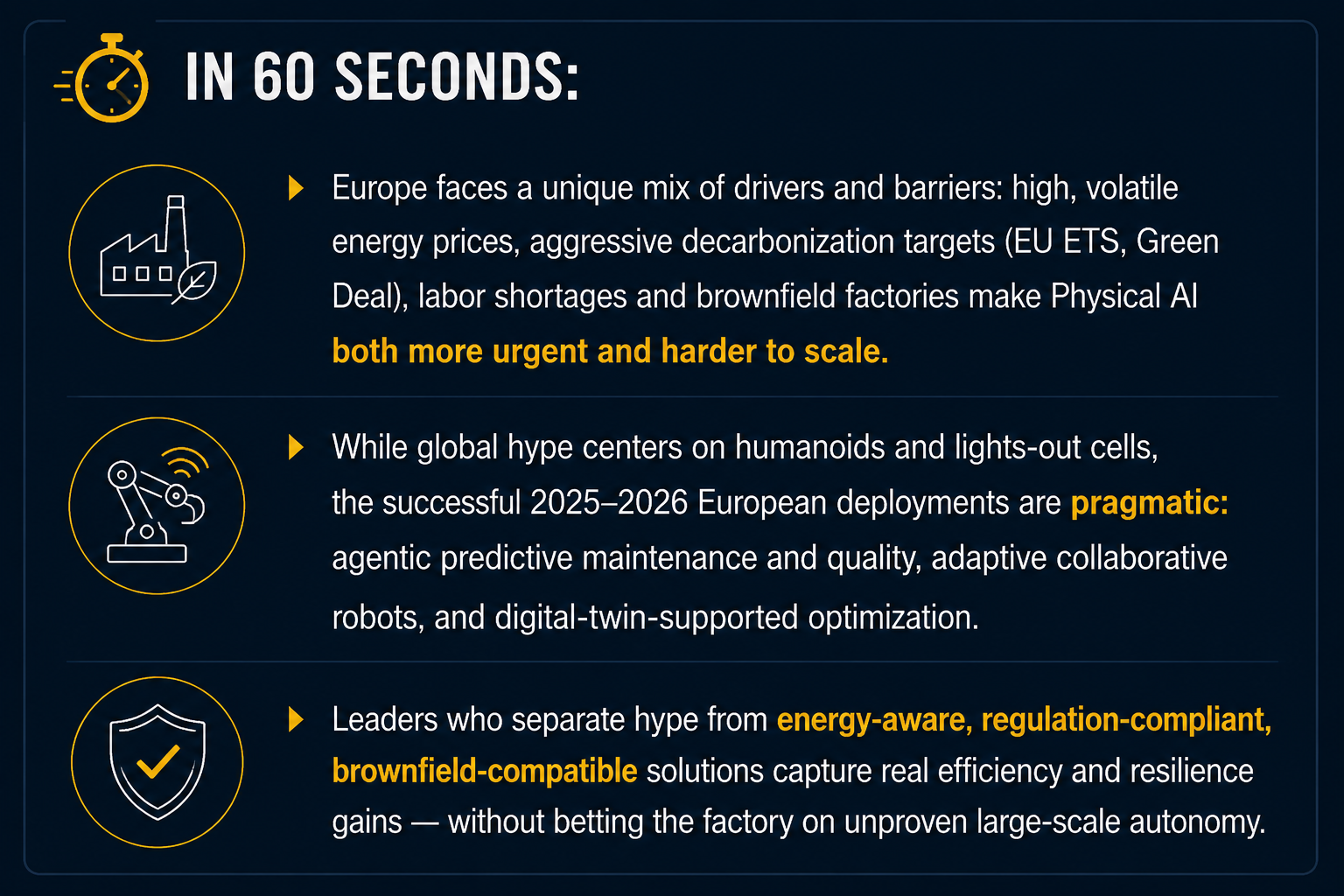
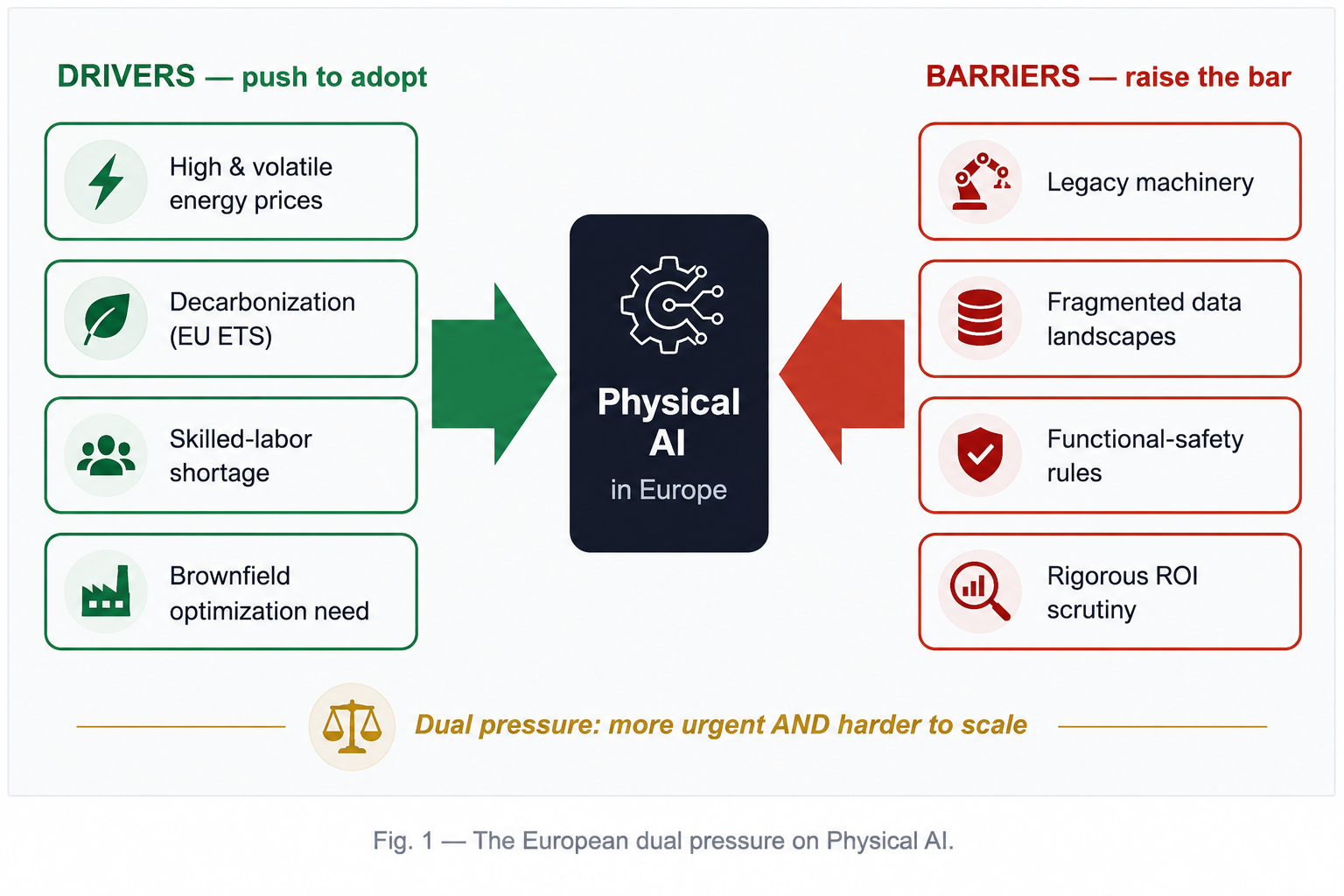
Strip away the keynote optimism and Europe's factories face a harder equation than the demos suggest. European manufacturers operate under significantly higher and more volatile energy prices than many global competitors, combined with tightening carbon pricing and reporting obligations.
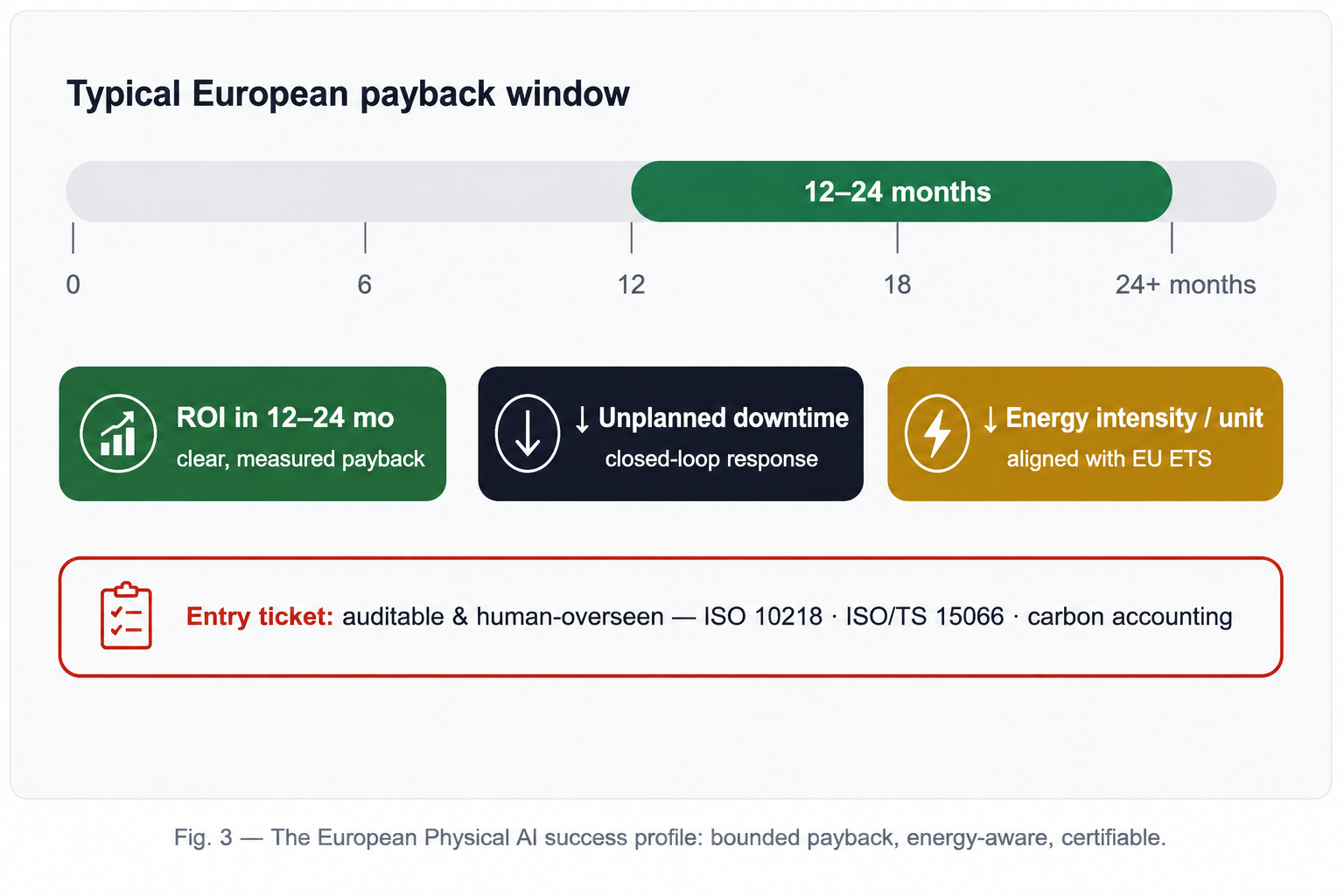
At the same time, most plants are brownfield environments: legacy machinery, fragmented data landscapes and strict functional-safety requirements. The result is a dual pressure. Physical AI is urgently needed to reduce energy intensity, improve flexibility and compensate for labor shortages, yet integration is more complex, and ROI timelines are scrutinized more rigorously than in greenfield markets.
That tension is the defining feature of the European market. It is not a reason to wait; it is the reason to be precise about where Physical AI is deployed and what it must prove.
2. Hype vs. Realer Umsetzung: What Actually Works on European Shop Floors in 2026
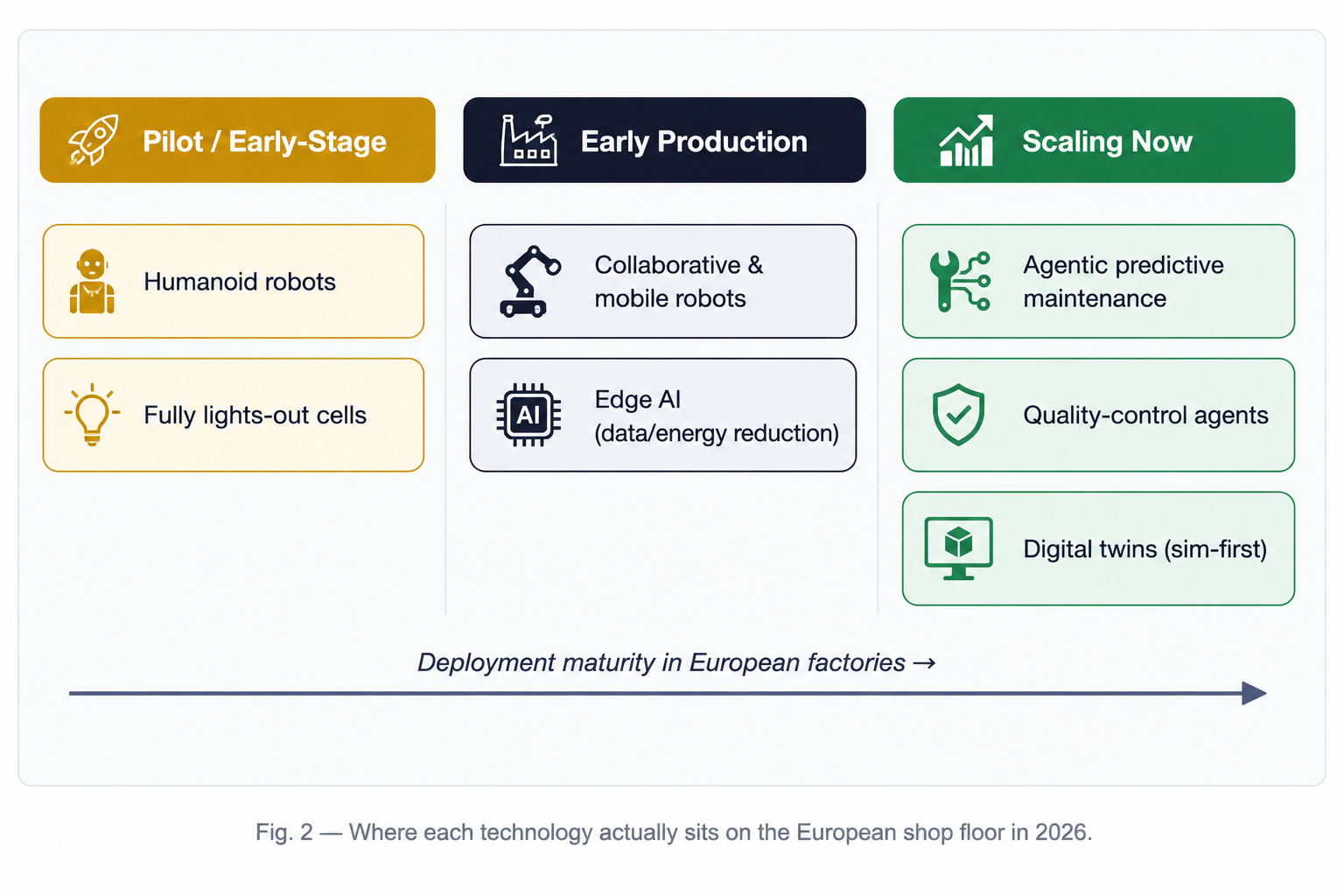
Much of the public discourse fixates on humanoid robots and fully lights-out factories. In practice, leading European deployments look far more grounded, and far more specific.
They prioritize agentic AI for closed-loop predictive maintenance and quality control that triggers actions automatically within defined safety envelopes; collaborative and mobile robotswith real-time sensor fusion for high-mix, low-volume production; digital twins and simulation-first approaches (e.g. the Siemens + NVIDIA Industrial AI Operating System) that de-risk integration before any physical rollout; and pragmatic edge AI that cuts data-transfer volumes and the energy cost that comes with them.
Large-scale humanoid deployments remain mostly in pilot or very early production. Meanwhile, targeted, well-integrated Physical AI is already delivering measurable results across automotive, electronics and machinery.
3. Quantified European Perspective and Early Proof Points
Energy and cost pressure remain the top drivers. Physical AI in predictive maintenance and process optimization shows clear potential to cut both unplanned downtime and energy intensity per unit produced, the two metrics European boards watch most closely.
The Siemens + NVIDIA partnership, expanded at CES 2026, targets the first AI-driven adaptive manufacturing sites in Europe from 2026, with the Erlangen electronics factory as blueprint, combining domain expertise, digital twins and edge AI. Broader signals point the same way: while overall Physical AI adoption in Europe is still early, pragmatic use cases in quality inspection, intralogistics and condition-based maintenance are scaling faster than general-purpose autonomy.
Regulation shapes the design space. Functional safety (ISO 10218, ISO/TS 15066), cyber-resilience and carbon-accounting requirements favor solutions with strong auditability and human oversight over fully black-box autonomy. In Europe, "explainable and certifiable" is not a nice-to-have, it is the entry ticket.
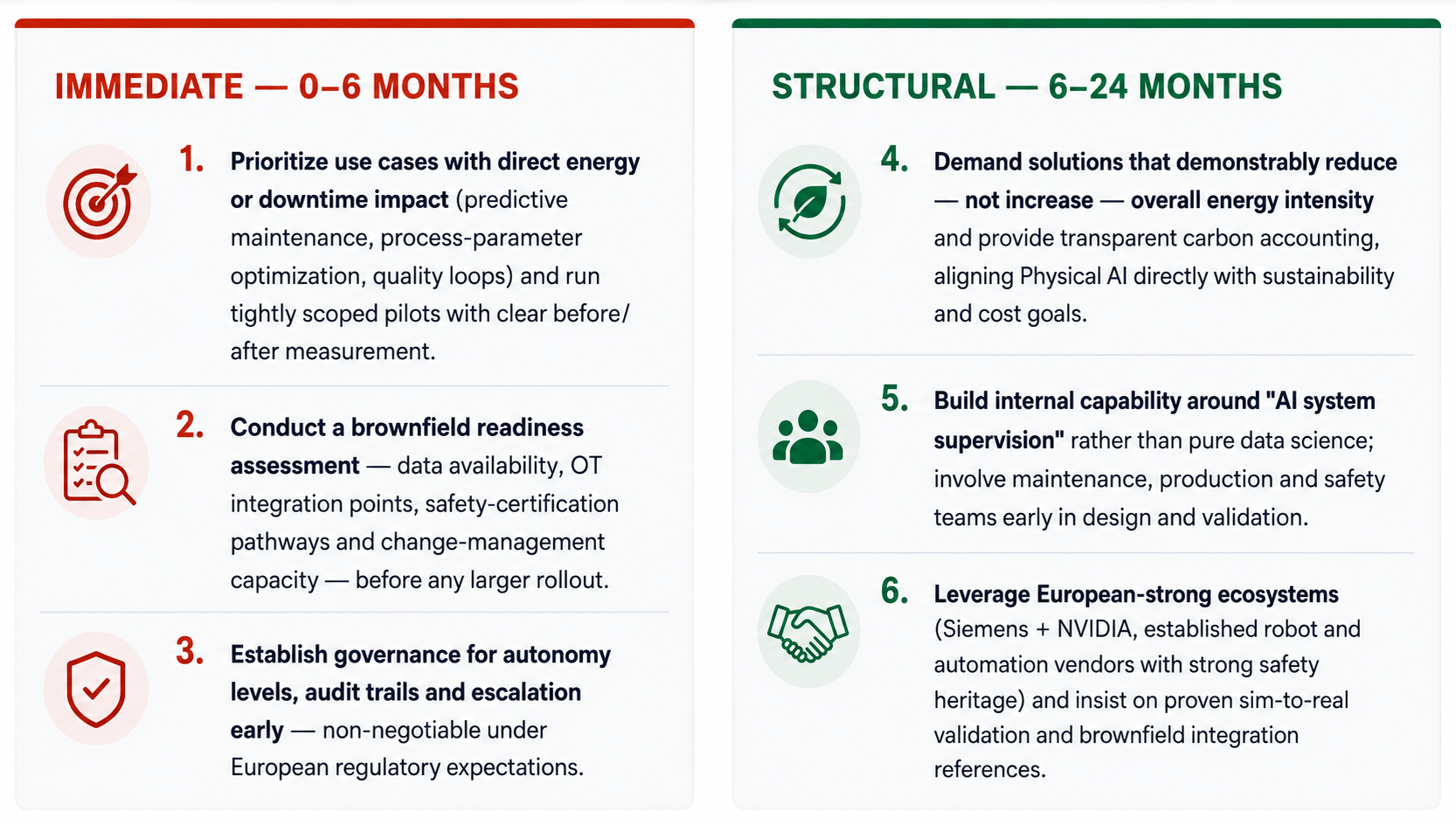
Action Plan for Decision Makers (European Context)
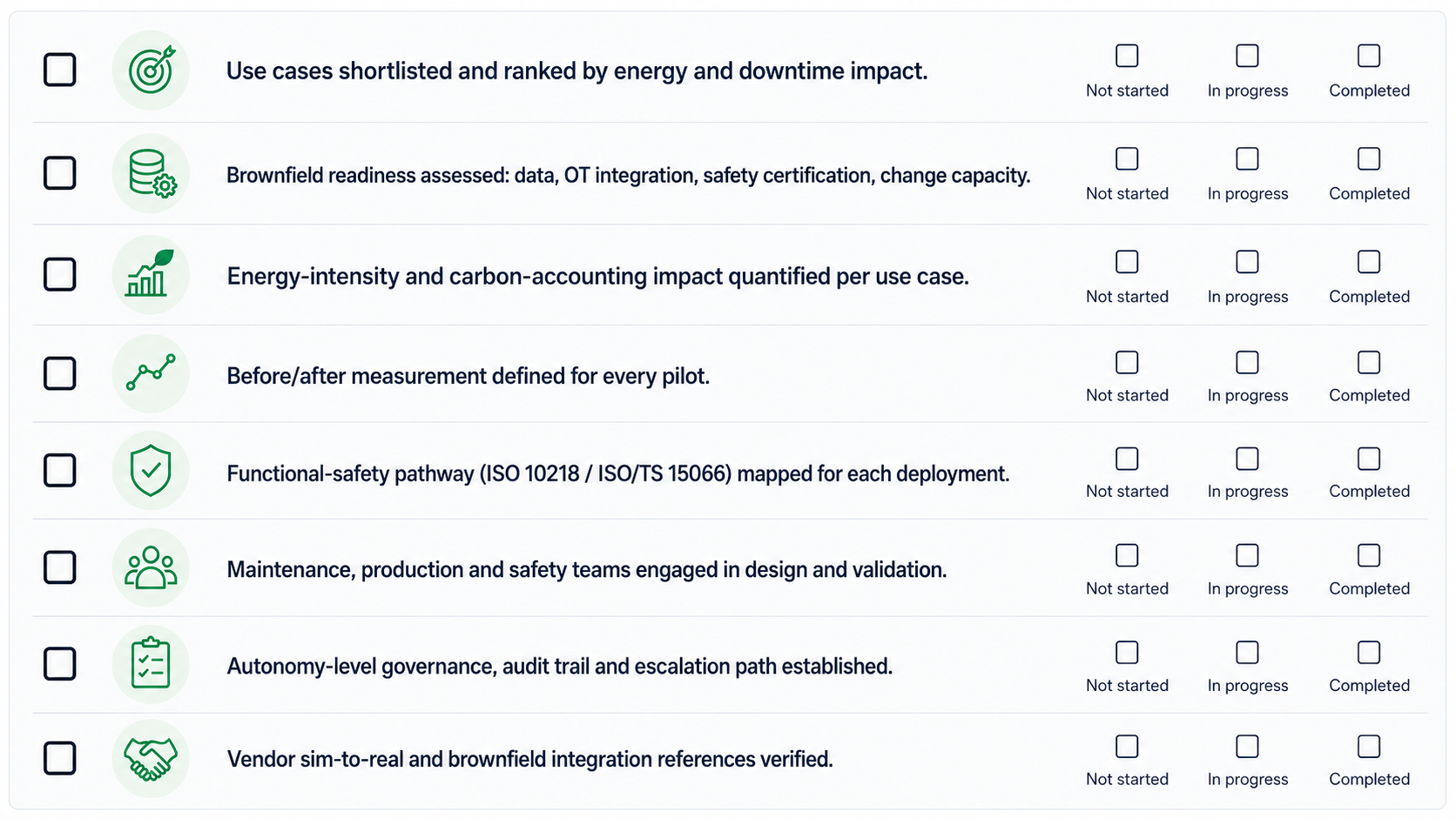
Readiness Checklist
Final Thought
Europe will not win the Physical AI race by deploying the most advanced robot. It will win, or lose, on the quality of a few unglamorous decisions: which process to automate first, which energy-intensive bottleneck to attack, which autonomy to grant and which to withhold under the weight of regulation and a 40-year-old plant.
The constraints that look like disadvantages, high energy prices, strict safety regimes, brownfield complexity, are exactly what force the discipline that makes deployments pay back. The hype rewards ambition. The European floor rewards judgment. Part I asked what autonomous operations could be; Part II is the reminder that on this continent, capability without a sound deployment decision is just a stranded asset.
Systems don't fail. Decisions do.
If you read Part I and asked "but what works here?", this is the grounded answer. Start with the process, not the form factor.
Ready to act? Let's run a brownfield readiness assessment on your highest-energy, highest-downtime process and size the 12–24-month case together. Reach out to begin.
Take the Next Step
Subscribe to the Weekly Punch for weekly strategic clarity, direct to your inbox.
References
Capgemini Research Institute (2026) Physical AI Report. Capgemini.
Deloitte (2026) Physical AI and Manufacturing Transformation in Europe. Deloitte Insights.
Hannover Messe (2026) Showcases and Case Examples — Energy-Efficiency and Brownfield Integration. Hannover Messe 2026.
IIoT World (2026) The Agentic AI Reality in European Smart Factories. IIoT World.
ISO (2011) ISO 10218 — Robots and Robotic Devices: Safety Requirements for Industrial Robots. International Organization for Standardization.
ISO (2016) ISO/TS 15066 — Robots and Robotic Devices: Collaborative Robots. International Organization for Standardization.
Siemens & NVIDIA (2026) Industrial AI Operating System and First European AI-Driven Adaptive Factories (CES 2026; Erlangen blueprint). Siemens / NVIDIA.
World Economic Forum (2026) Physical AI and Manufacturing Transformation. WEF.
Disclaimer: This article is provided for general information and strategic-orientation purposes only and does not constitute professional, legal, financial or engineering advice. Market figures, ROI ranges and adoption projections cited are subject to source verification and reflect forward-looking estimates that may change. Standards references are indicative; readers should validate all data and compliance requirements against primary sources before making decisions.
Ownership as Design.
© 2026 René Grywnow, DBA — Energy Dominance Series · Week 26, Part II.
Note: This article reflects my personalviews based on industry experience and publicly available information. It does not constitute professional, legal, or investment advice and does not represent the views of my employer. AI-generated visuals, concept and content by the author.
