Why Industrial AI Is Fundamentally Different from ChatGPT | Lessons for Manufacturers
INDUSTRIAL AIMANUFACTURING STRATEGYJUNE/JULY 2026
ENERGY DOMINANCE · WEEK 27 · PART I
Beyond the Chatbot Illusion: The Unique Demands of Safety-Critical, Real-Time, Physical-World Intelligence — and What Manufacturers Must Understand Before Scaling AI on the Shop Floor
This is Part I of Week 27 — the essential reality check that separates consumer-grade Generative AI hype from the hard requirements of Industrial and Physical AI in real manufacturing environments.
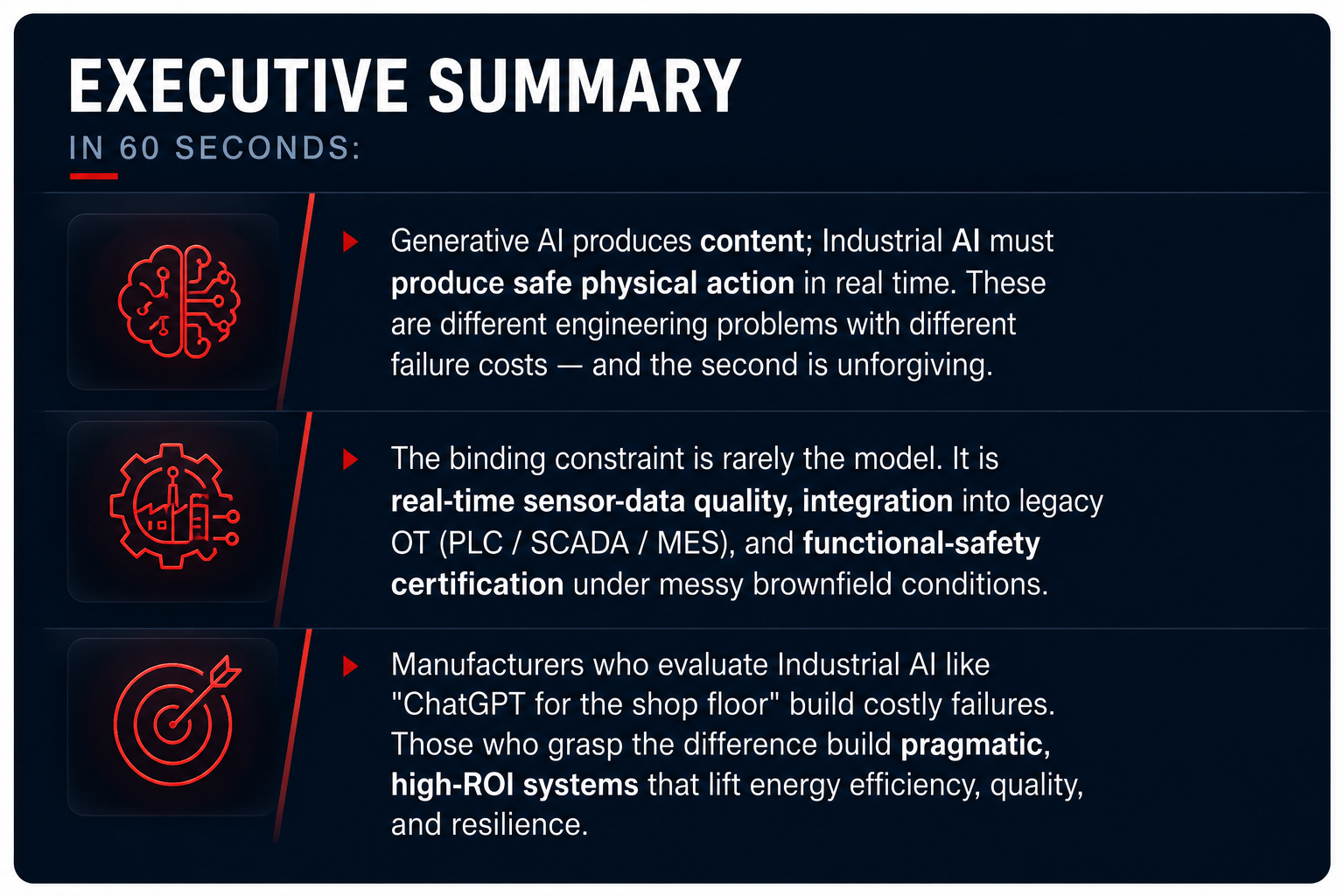
Ask ChatGPT for the wrong word and you lose nothing. Ask an AI to adjust a press, coordinate a robot, or decide whether a line keeps running, and a wrong millisecond can cost a hand, a batch, or a shipment. That is the chasm boards keep underestimating. The expectations created by chatbots are real — but they were set in a frictionless digital world. The shop floor is neither frictionless nor forgiving.
The thread running through this series — Efficiency Before Fuel — applies directly here. In Industrial AI, the scarce resource is almost never the model. It is clean, real-time, contextual data; safe integration into decades-old automation; and disciplined governance of autonomy. Pour more "fuel" (bigger models) onto a plant that lacks that foundation and you simply burn capital faster. Efficiency — in data, integration, and decision architecture — comes first.
Executive Summary
1. Purpose and Output: From Content Generation to Physical Action
The hook: A chatbot's job ends when the text appears on screen. An Industrial AI's job has barely begun at that point, because its output has to move metal, draw current, and keep a worker safe.
The mechanism: Generative AI (like ChatGPT) is optimised for creativity, summarisation, and human interaction. Its products are text, images, code, and recommendations, artefacts a human then judges and acts upon. Industrial AI must drive or directly support physical outcomes: adjusting machine parameters in real time, triggering maintenance, stopping a line safely, or coordinating robots. The output is not content. It is action with real-world consequences, energy consumed, product quality, worker safety, uptime.
The evidence: Across 2026 deployments showcased at Hannover Messe and CES, the systems delivering measurable value are closed-loop, they don't just describe a problem, they act on it within defined safety limits. The "chat interface to the factory" demos, by contrast, remain largely analytics dressed as autonomy.
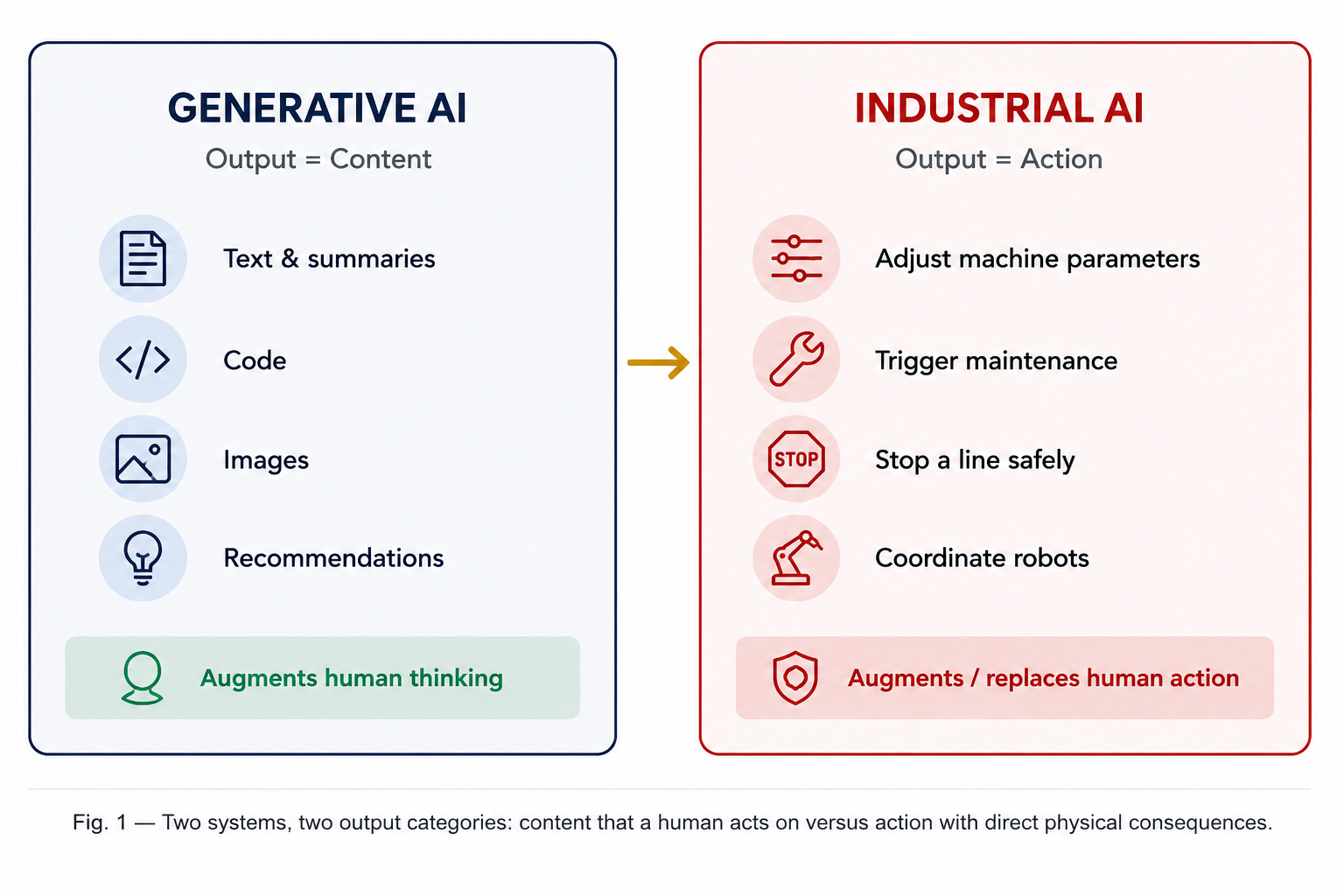
👉 Key Insight: Generative AI augments human thinking. Industrial AI must augment or replace human action in safety-critical, time-sensitive environments.
2. Data Requirements and Environment: Clean Digital vs. Messy Physical Reality
The hook: ChatGPT was raised on a near-infinite, well-edited library. Industrial AI is raised on whatever a 15-year-old sensor on a vibrating machine happens to report, when it reports at all.
The mechanism: Large language models were trained on vast internet text corpora and perform best in well-defined digital domains. Industrial AI depends on high-quality, real-time sensor data from machines, frequently in brownfield environments with incomplete, noisy, or legacy data. It must hold up against vibration, dust, temperature swings, and electromagnetic interference while still delivering consistent results.
The evidence: A hallucination in ChatGPT is, at worst, annoying. The same statistical error in a closed-loop quality or control system can scrap a batch, damage a tool, or endanger an operator. That is why the hardest part of most industrial pilots is not model selection, it is getting trustworthy, contextualised data out of the plant in the first place.
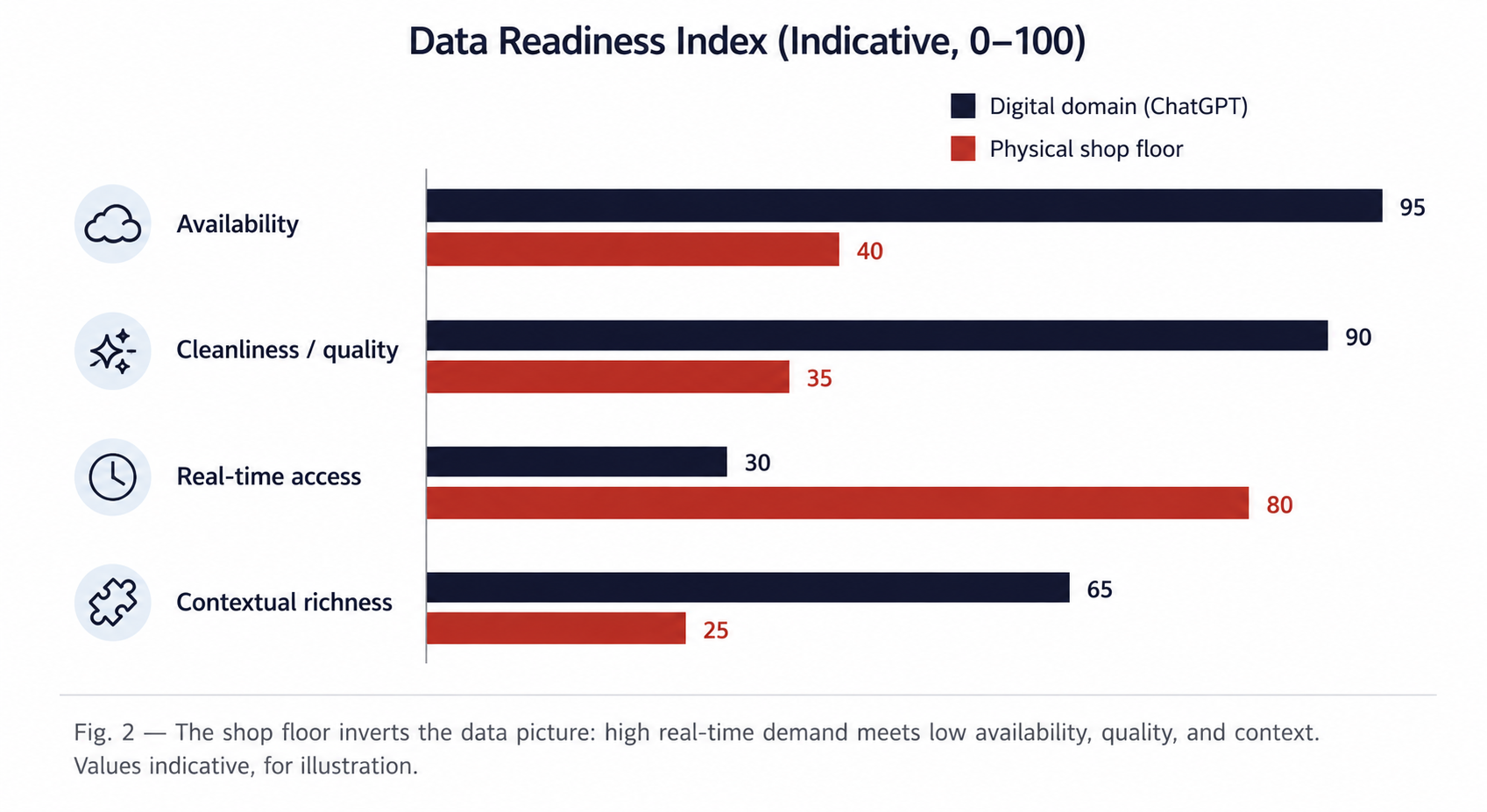
👉 Key Insight: The biggest bottleneck for Industrial AI is rarely the model, it is the availability, quality, and contextual richness of physical-world data.
3. Performance, Safety and Integration Demands
The hook: "Mostly correct, in a few seconds" is a perfectly good chatbot. On a safety-rated control loop, it is a recall, a fine, or an injury waiting to happen.
The mechanism: Four demands separate Industrial AI from anything in the consumer world:
· Latency & determinism: ChatGPT can take seconds; many industrial decisions must happen in milliseconds, with guaranteed timing.
· Reliability & safety: Functional-safety certification (ISO 13849, IEC 61508), full auditability, and predictable behaviour under all conditions. "Mostly correct" is not acceptable.
· Integration: The system must read from and write safely into PLCs, SCADA, and MES, not merely call a cloud API.
· Energy & edge reality: Many deployments run at the edge under strict power and thermal limits, tying directly back to the energy themes of this series.
The evidence: The reference architectures emerging in 2026, the Siemens + NVIDIA industrial AI operating-system blueprints among them, treat the model as one component inside a certified, deterministic, edge-capable stack, not as the system itself.
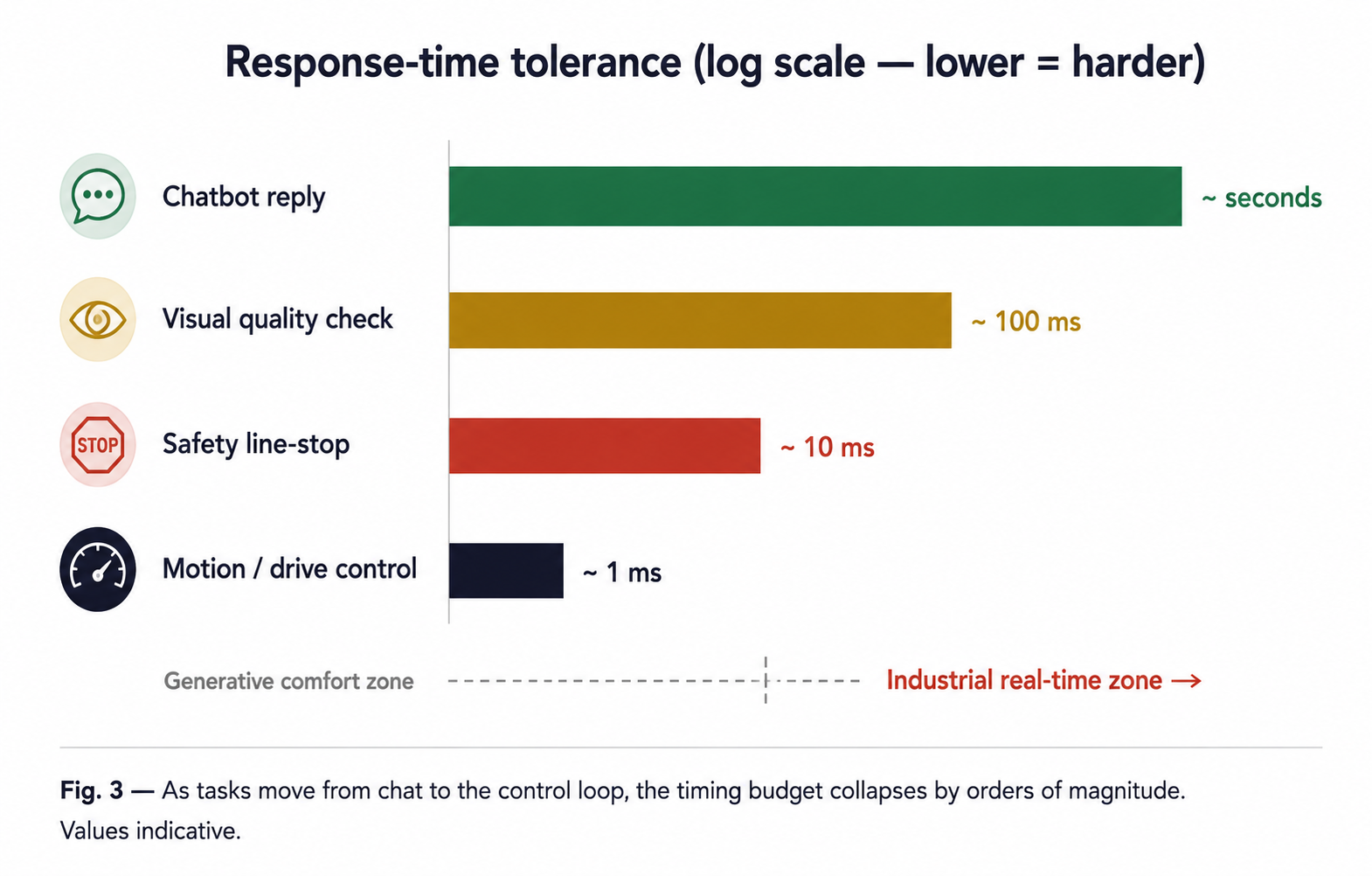
👉 Key Insight: Industrial AI is not a standalone application. It is a deeply embedded, cyber-physical system that must coexist with decades-old automation infrastructure.
Action Plan for Decision Makers
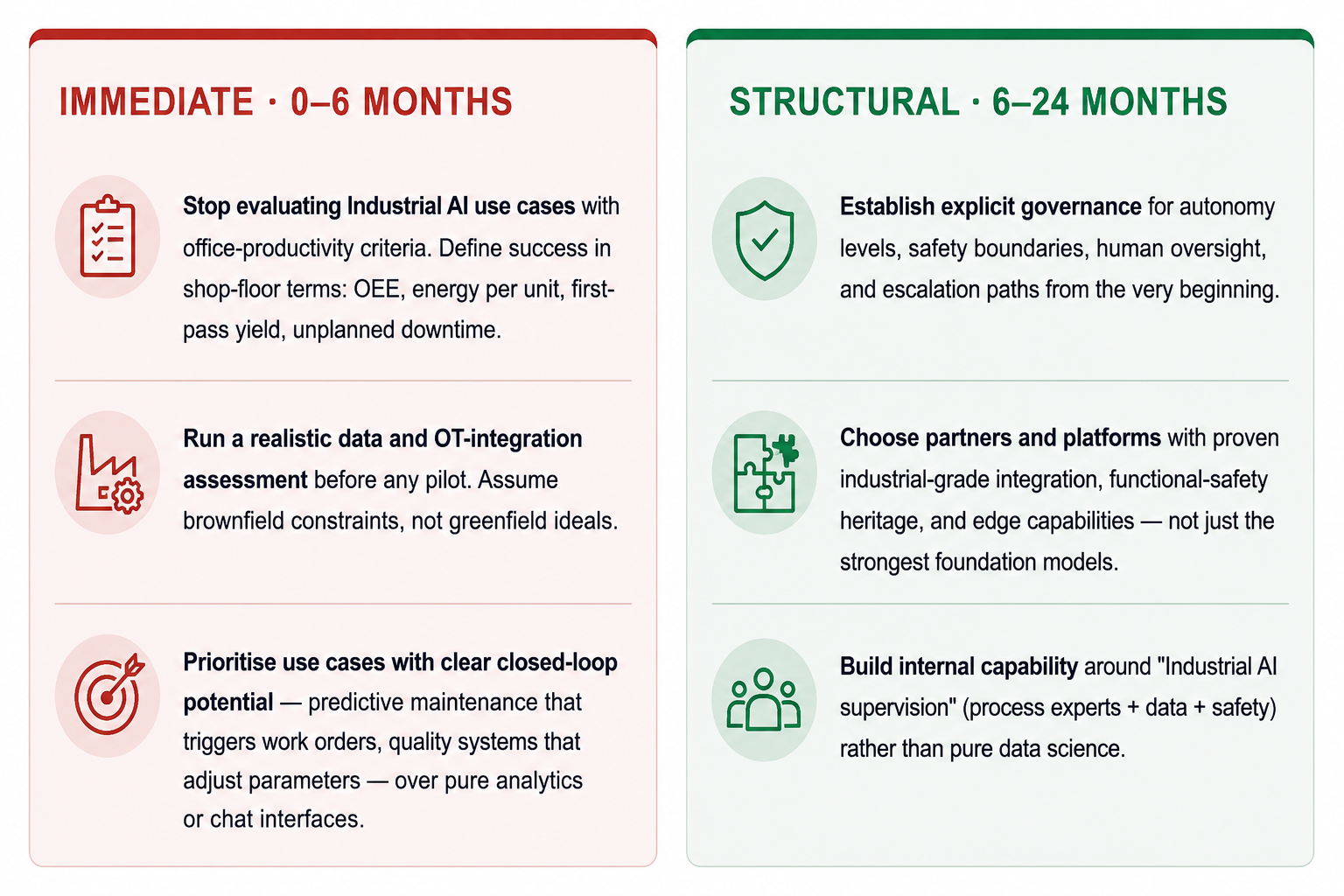
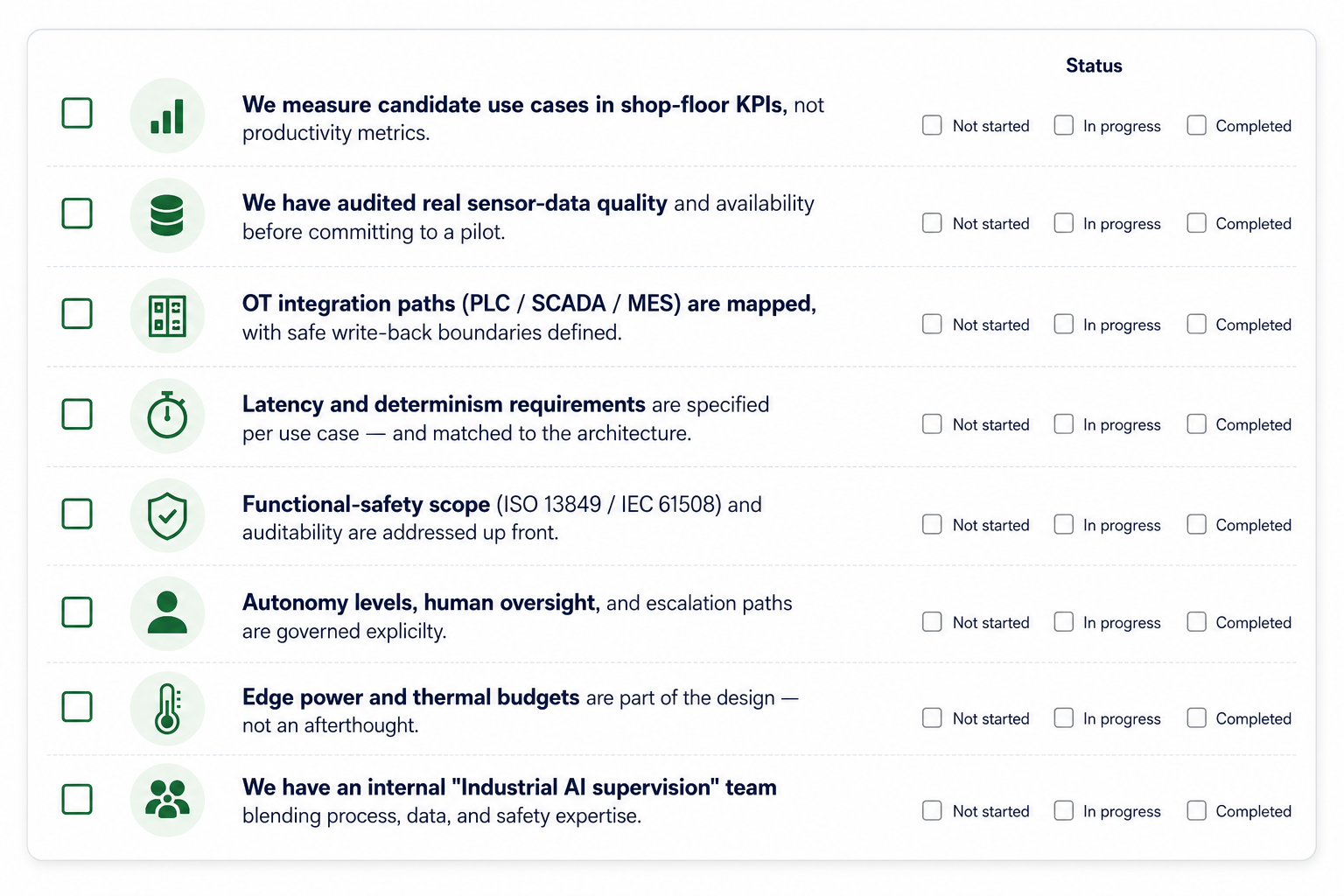
Readiness Checklist
Final Thought
The chatbot wave proved that AI can think alongside us. The industrial wave will be won by those who understand that thinking and acting safely in the physical world are not the same discipline. Part II turns to where this gets concrete, the manufacturers already separating real deployment from demo-ware, and what their early results reveal.
The temptation is to buy a bigger model and call it a strategy. But on the shop floor, capability without data, integration, and governance is just expensive risk. Efficiency before fuel, in data, in integration, in decision architecture, is what turns Industrial AI from a pilot into a moat.
Systems don't fail. Decisions do.
Where does your Industrial AI strategy actually stand?
First: Take one AI use case you are considering and run it through the Readiness Checklist above. If it fails on data, integration, or safety, that is your real roadmap, not the model.
Then: Follow Part II of Week 27,The Role of Energy Infrastructure in Scaling Physical AI. Because Physical AI will not scale on intelligence alone. It will scale where power, grid capacity, cooling, and efficiency can support it.
Take the Next Step
Subscribe to the Weekly Punch for weekly strategic clarity, direct to your inbox.
References
Capgemini Research Institute (2026) Physical AI Report. Capgemini.
Siemens & NVIDIA (2026) Industrial AI Operating System — announcements and factory blueprints, CES 2026.
Gartner (2026) Manufacturing AI adoption realities. Gartner Research.
Deloitte (2026) AI in manufacturing — adoption and operating-model analyses. Deloitte Insights.
IIoT World (2026) Agentic / Industrial AI vs. Generative AI in manufacturing, industry analyses.
Hannover Messe (2026) Brownfield deployment case studies, automotive and machinery sectors, conference proceedings.
Functional-safety standards referenced: ISO 13849; IEC 61508.
Disclaimer: All performance ranges, comparisons and indices are indicative and based on published third-party analyses; they do not constitute investment, financial or management advice. Readers are encouraged to conduct their own verification before making governance, operational or capital-allocation decisions. The author maintains no commercial relationship with the organisations named.
© 2026 René Grywnow · Energy Dominance Series · Week 27 · Part I | Ownership as Design.
Note: This article reflects my personalviews based on industry experience and publicly available information. It does not constitute professional, legal, or investment advice and does not represent the views of my employer. AI-generated visuals, concept and content by the author.
