Physical AI in Brownfield Plants: Why Europe Cannot Copy Chinese Greenfield Robotics

EUROPE | PHYSICAL AI | SEPTEMBER 2026 | Week 40 · Part I
Two Different Industrial Machines — Europe's Installed Base Is an Asset Only If Leadership Treats It as a System to Improve
Week 39 went inside a single robot's path and found more than 20% of its energy sitting in a bad trajectory nobody had rechecked since sign-off. Week 40 pulls back from the arm to the fleet, and from the fleet to the continent, because the same physics of waste and constraint that governs one machine's motion governs an entire region's installed base, and the numbers published this quarter make the gap impossible to ignore.
Efficiency Before Energy was never a call to buy more robots faster than the competition. For Europe, it is the only strategy left that fits the facts: it is not winning the installation race, and pretending otherwise wastes the one advantage it still has.
Executive Summary
IN 60 SECONDS:
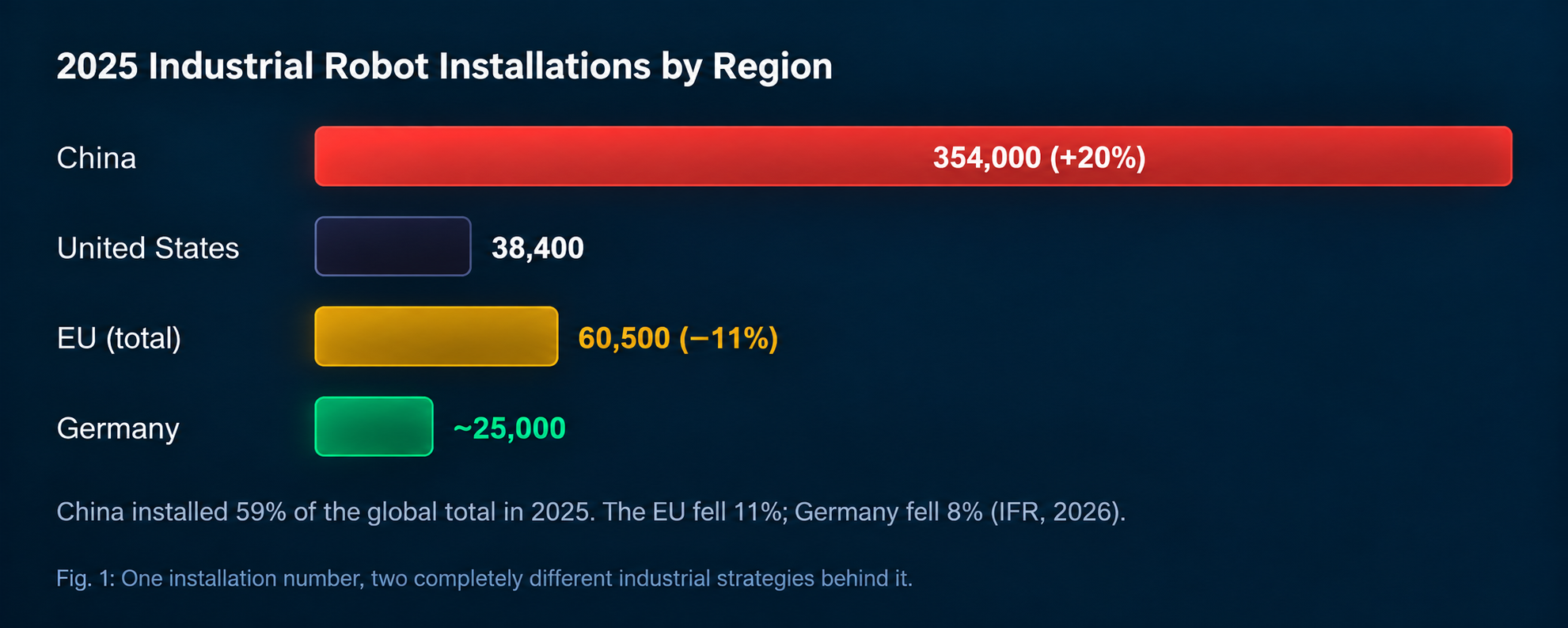
Global industrial robot installations reached a record 603,000 units in 2025, up 11% year-on-year — but China alone installed 354,000 of them (59% of the world total), up 20%, almost entirely into new, purpose-built greenfield capacity.
The EU installed just 60,500 units, down 11%; Germany, 41% of that EU total, installed roughly 25,000, down 8%. The US overtook Japan into second place globally with 38,400 installations; Japan fell 19% to 36,200.
Europe is not losing the greenfield capacity race — it was never going to win that one outright. The real risk is losing a different race: turning its existing, decades-old installed base into a Physical AI asset before it becomes a competitive liability.
1. Two Different Industrial Machines
Ask what "robotics leadership" means in Shenzhen versus Stuttgart and the honest answer is that the two regions are not running the same race.
China's 2025 installation surge is overwhelmingly greenfield: new factories, built from an empty site, with layout, power distribution, safety systems and workforce structure designed around robotics from the first drawing. There is no legacy floor plan to argue with, no thirty-year-old safety fence to relocate, no existing labor agreement written before automation was on the table. Capacity gets added the way a spreadsheet models it, as a clean-sheet build.
Europe's installed base is almost the opposite case. Most of its manufacturing capacity sits in plants built decades ago, with power infrastructure, aisle widths, safety zoning and workforce agreements shaped by a pre-robotic or lightly automated era. Every new robot has to fit inside constraints nobody designed for it. The International Federation of Robotics' 2026 World Robotics report puts hard numbers on the resulting gap: global installations of 603,000 units in 2025 (+11%); China at 354,000 (59% share, +20% year-on-year); the EU at 60,500 (−11%); Germany at roughly 25,000 (−8%, still 41% of the EU total); the US in second place globally at 38,400, overtaking Japan; Japan down 19% to 36,200; South Korea at 30,000; India at 10,500 (+15%); and a global operational robot stock of 5 million units, up 9% (IFR, 2026).
👉 Key Insight
Greenfield robotics is a capacity race. Brownfield robotics is a constraint race.
2. Why "Do What China Does" Fails in European Plants
Benchmarking European automation against China's install rate is not ambitious. It is a category error, one that gets expensive the moment it becomes a capital plan.
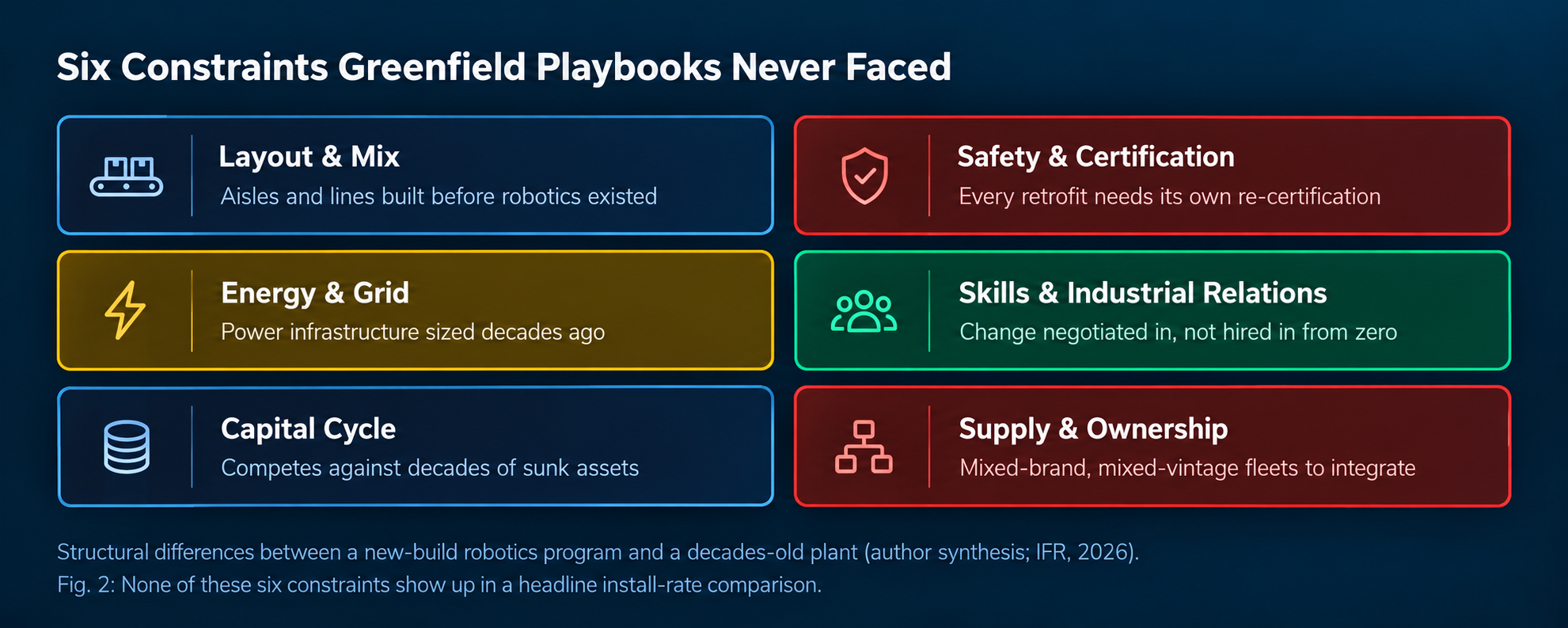
Six structural differences separate a new-build robotics program from a decades-old plant, and none of them show up in an install-rate comparison: Layout & mix, brownfield aisles, mixed product lines and fixed column grids were never drawn with a robot's reach envelope in mind. Safety & certification, every retrofit into an occupied, running line needs its own re-certification; a greenfield cell is certified once, from a blank sheet. Energy & grid, brownfield power infrastructure was sized for the load profile of the 1990s or 2000s, not for a fleet of high-torque arms and mobile robots added on top. Skills & industrial relations, greenfield sites hire and structure a workforce around automation from day one; brownfield sites negotiate change into an existing workforce and existing agreements. Capital cycle, a greenfield build is one clean-sheet capex event; brownfield automation competes, line by line, against decades of sunk assets still earning their keep. Supply & ownership, brownfield fleets are mixed-brand, mixed-vintage and often multi-vendor, which greenfield single-integrator builds simply avoid.
The volume data confirms how uneven the playing field already is. Roughly 7,000 humanoid robots were sold globally in 2025 across some 174 different manufacturers, more than half of them China-based, while European automotive makers, the historic anchor customer for industrial robotics, cut new robot orders by roughly 25% amid the sector's broader capex pullback (IFR, 2026; The Next Web, 2026). Fewer orders, more constraints, and a widening supplier base that skews further East every quarter, that is the environment any "just automate faster" plan actually has to survive in.
👉 Key Insight
A brownfield plant that copies a greenfield deployment plan doesn't get China's speed. It gets a stalled retrofit and a shelved robot.
3. What Brownfield Physical AI Actually Looks Like
Europe already has a working example of brownfield done right. This series named it in Week 30, and it is worth returning to now that the installation numbers make the stakes explicit.
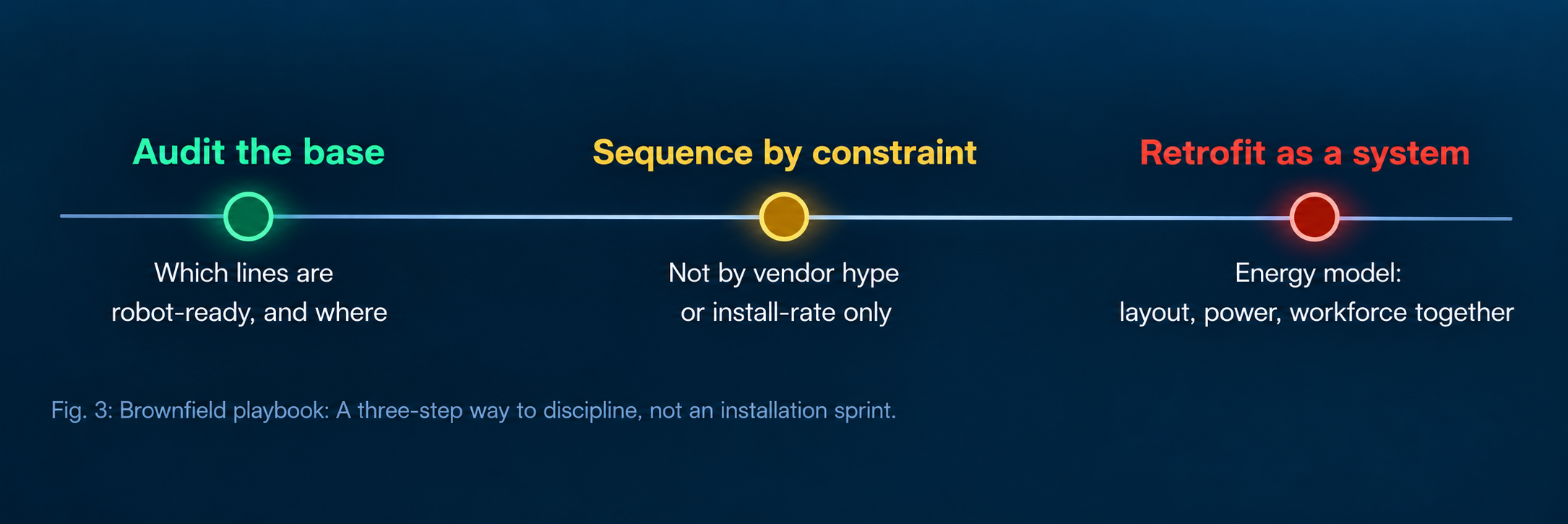
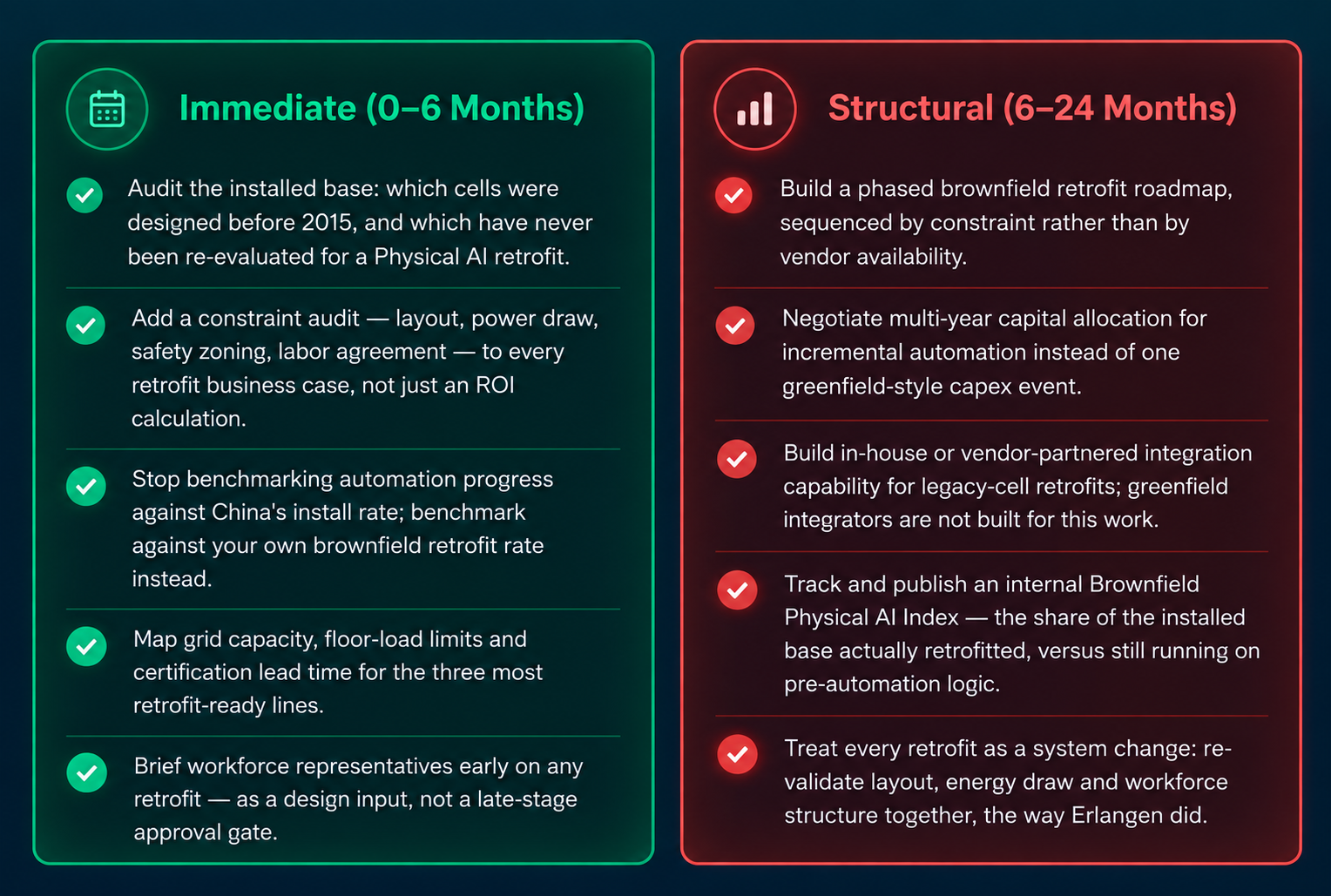
The Siemens–NVIDIA Physical AI retrofit of the Electronics Factory in Erlangen was not a clean-sheet build. It was a decades-old, running production site, upgraded in place: sensing and digital-twin capability layered onto existing lines, automation sequenced by where the constraint actually was rather than where a vendor's brochure suggested it should be, and the workforce brought into the redesign rather than displaced by it. Nothing about that program required Europe to out-install China. It required leadership to treat an existing asset as a system worth improving.
That is the model the installation numbers now make unavoidable. Europe cannot manufacture a greenfield installation rate it does not have the empty sites, the capital cycle, or the workforce structure to support. What it can do is take the 5-million-unit global operational stock the IFR already counts, a meaningful share of it sitting in European plants, and treat retrofitting that base as the strategy, not as a consolation prize for losing the capacity race.
👉 Key Insight
Europe's installed base is an asset only if leadership treats it as the system to improve – not as a museum to replace.
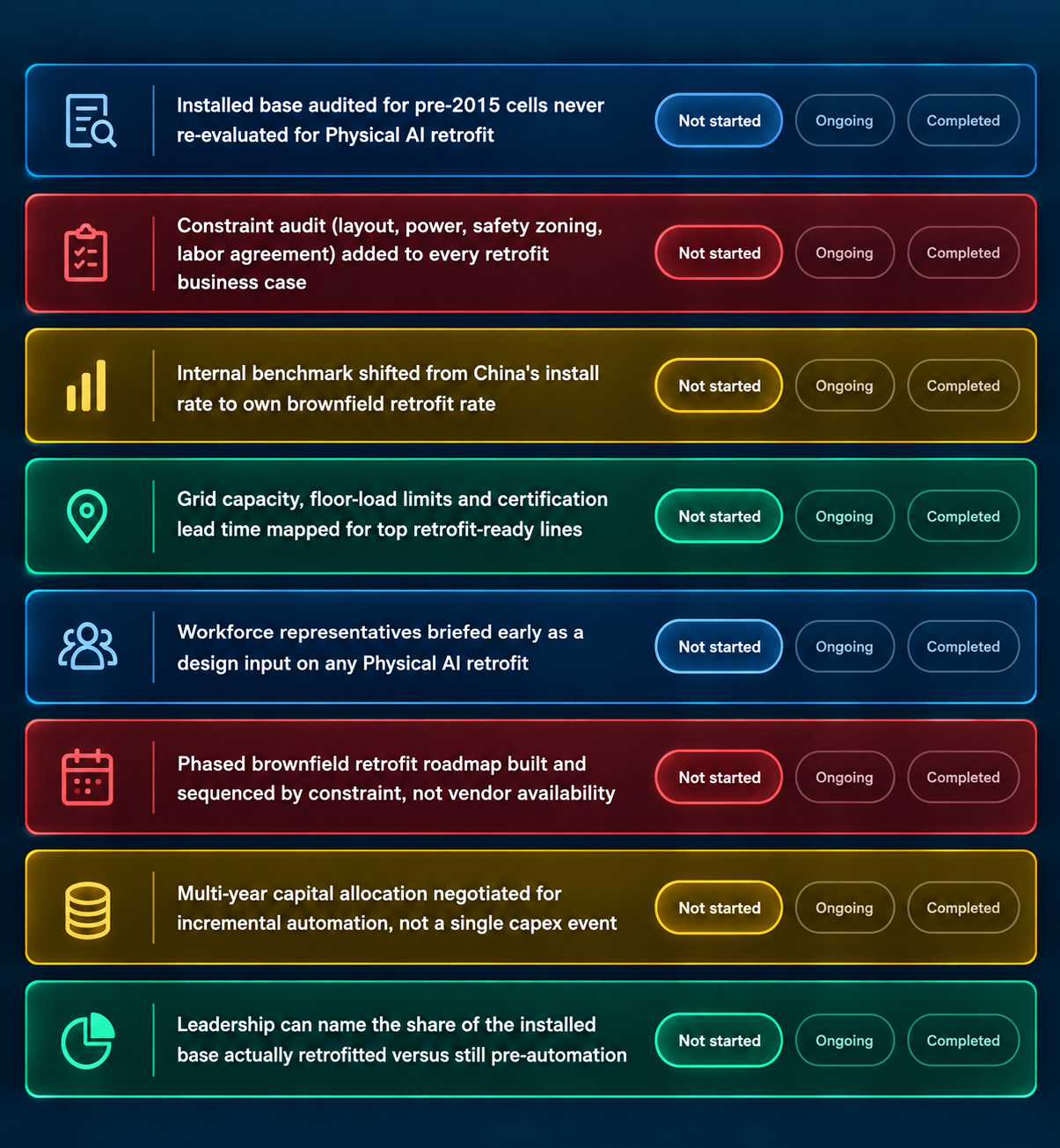
Action Plan for Decision Makers
Checklist
Final Thought
A brownfield production line is at least a line someone can walk. Part II of this Week 40 set goes to the other end of the same installed-base problem: hundreds of kilometres of grid and infrastructure line nobody can walk fast enough to inspect by hand.
Efficiency Before Energy means Europe's fastest path to competitiveness is not outbuilding China's install rate. It is making every robot, cell and kilometre of asset already on the books earn its keep.
Systems don't fail. Decisions do.
Take the Next Step
Subscribe to the Weekly Punch for weekly strategic clarity, direct to your inbox.
References
International Federation of Robotics (2026) World Robotics 2026 — Industrial Robots. Frankfurt: IFR.
bne IntelliNews (2026) China Dominates Global Robot Installations as Europe's Automation Race Stalls.
The Next Web (2026) Robot Installations Hit a Record High in 2025 — But Europe Is Falling Behind.
Tech Times (2026) Global Robot Deployments Jump 11% Amid China's Growing Dominance.
daily.dev (2026) IFR World Robotics 2026: The Numbers Behind the Robotics Race.
Disclaimer: This article synthesizes publicly available industry reporting current as of publication. Installation figures are provisional IFR World Robotics 2026 estimates and may be revised; readers should verify current figures against the original IFR report before relying on them for strategic decisions. Verification Gate: flagged for pre-publication source check.
Ownership as Design.
Note: This article reflects my personalviews based on industry experience and publicly available information. It does not constitute professional, legal, or investment advice and does not represent the views of my employer. AI-generated visuals, concept and content by the author.
