Inspection Drones, Grid Robots, and the New Maintenance Stack
GRID INFRASTRUCTURE | PHYSICAL AI | SEPTEMBER 2026 | Week 40 · Part II
The Line Nobody Can Walk Fast Enough Is Now Inspected From 200 Miles Away — and That Changes What "Maintenance" Means
Part I of Week 40 stayed inside the plant fence, where Physical AI has to fit into decades-old layouts, safety zoning and workforce agreements. Part II walks out the gate, onto hundreds of kilometres of transmission line, substation fencing and pipeline that no brownfield-versus-greenfield debate ever fully covers, because most of it was never a "plant" in the first place. It is simply too much infrastructure for too few people to walk.
That constraint is what is quietly being re-engineered right now, one drone-in-a-box and one grid robot at a time.
Executive Summary
IN 60 SECONDS:
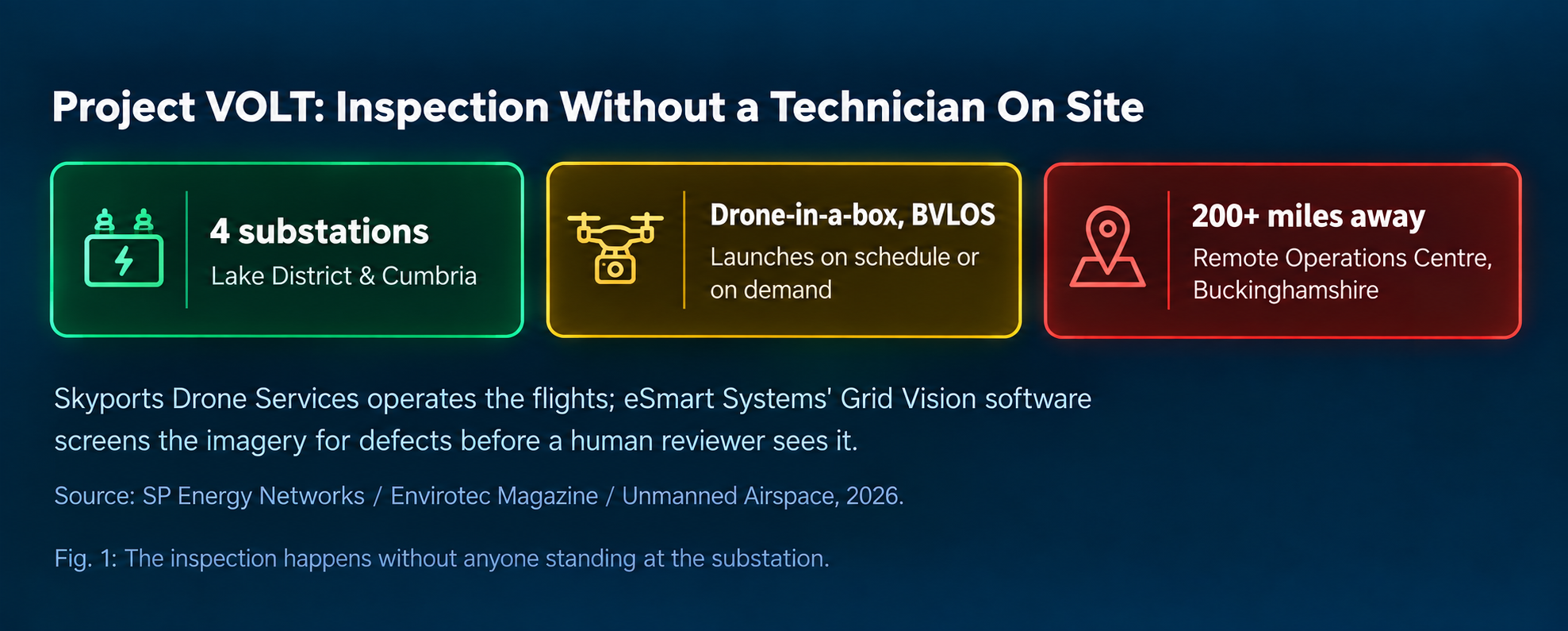
SP Energy Networks' Project VOLT now runs drone-in-a-box units at four substations across the Lake District and Cumbria, flown beyond visual line of sight from a Remote Operations Centre more than 200 miles away in Buckinghamshire.
The drones fly automatically, capture imagery of towers and lines that would otherwise need a technician on foot or in a helicopter, and feed it into AI-based defect-detection software that flags what a human reviewer should look at first.
This is not a faster inspection tool bolted onto the old maintenance process. It is a new maintenance stack — sensing, autonomy, AI triage and a remote human — replacing the assumption that someone has to be physically present to know the condition of the asset.
1. The Constraint Part I Didn't Cover
A brownfield factory at least has a floor someone can walk end to end in an afternoon. A transmission network does not.
Grid operators, pipeline owners and rail networks manage assets spread across hundreds or thousands of kilometres, much of it in terrain that is slow, expensive or dangerous to reach on foot: hillsides, waterways, remote towers, live high-voltage equipment. The traditional answer has been scheduled patrols, helicopter flights and reactive callouts after a fault — an inspection cadence set by how many people and vehicles are available, not by how often the asset actually needs checking.
SP Energy Networks' Project VOLT, run through its SP Electricity North West licence area, is a direct answer to that mismatch. Drone-in-a-box installations — permanently stationed at the substation, ready to launch on schedule or on demand — now operate at four sites across the Lake District and Cumbria. The flights run beyond visual line of sight (BVLOS), controlled from a Remote Operations Centre operated by Skyports Drone Services more than 200 miles away in Buckinghamshire. Nobody has to be at the substation, or even in the same region, for the inspection to happen (Envirotec Magazine, 2026; Unmanned Airspace, 2026; ScottishPower, 2026).
👉 Key Insight
The constraint was never really "too many kilometres." It was too many kilometres per available pair of eyes. Project VOLT changes the denominator.
2. From a Flying Camera to a Maintenance Stack
A drone that takes photographs is a better camera. A drone whose photographs feed straight into defect-detection software is a different maintenance system entirely.
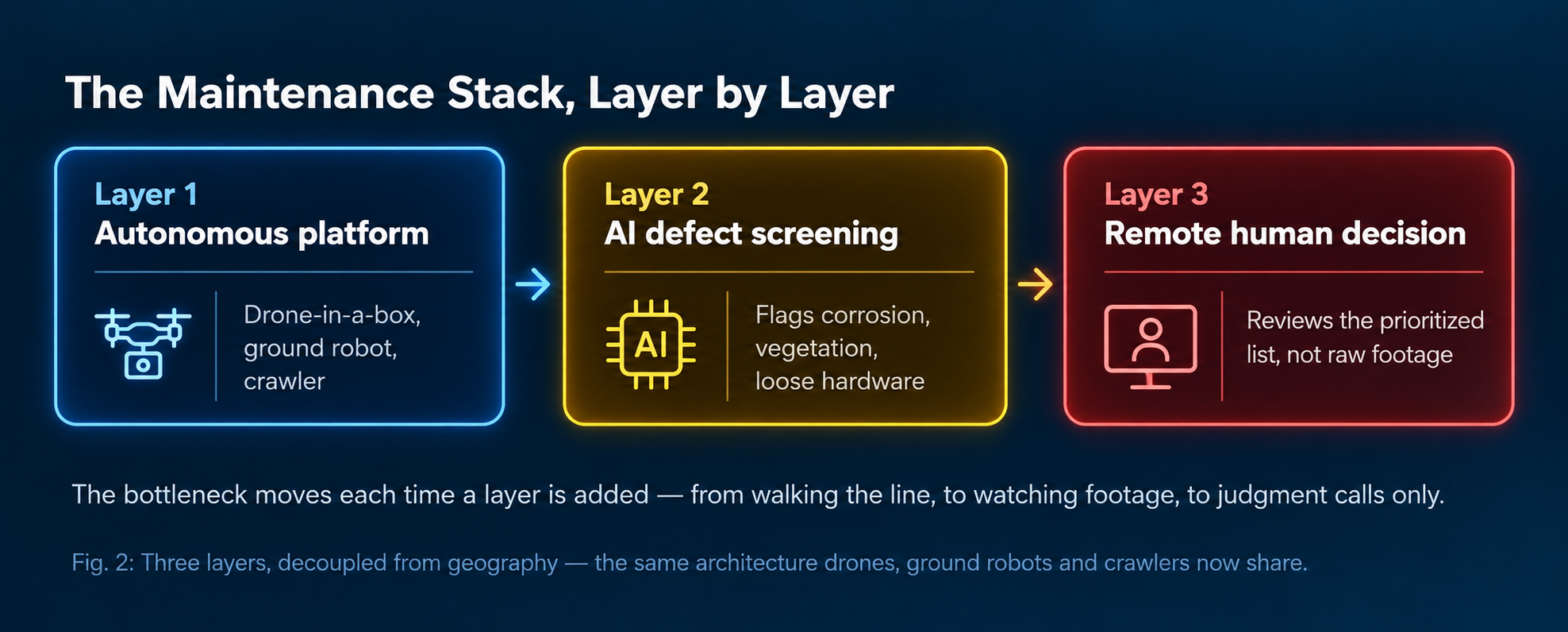
The distinction matters because it determines what leadership is actually buying. A camera drone still requires a trained person to review every image, which caps how much ground the technology can cover, the bottleneck just moves from walking the line to watching the footage. Project VOLT instead routes its imagery through eSmart Systems' Grid Vision AI software, which screens for corrosion, vegetation encroachment, loose hardware and other defects automatically, and surfaces a prioritized list for the human reviewer at the Remote Operations Centre. The technician's time is spent on judgment calls, not on scanning thousands of routine images for the handful that matter (eSmart Systems / SP Energy Networks, 2026).
That is the actual shape of the "new maintenance stack": autonomous platform (the drone or ground robot), automatic defect-screening (the AI layer), and a remote human decision-maker, in that order, and increasingly decoupled from geography. The same architecture is showing up beyond drones, in ground-based grid-inspection robots and pipeline crawlers now being trialed by utilities across Europe and North America, all built around the same principle: the machine covers the distance and does the first pass; the person makes the call.
👉 Key Insight
Buying a drone is not the strategy. Buying the AI-screening layer that decides what the drone's footage is worth looking at is.
3. What Leadership Has to Decide Now
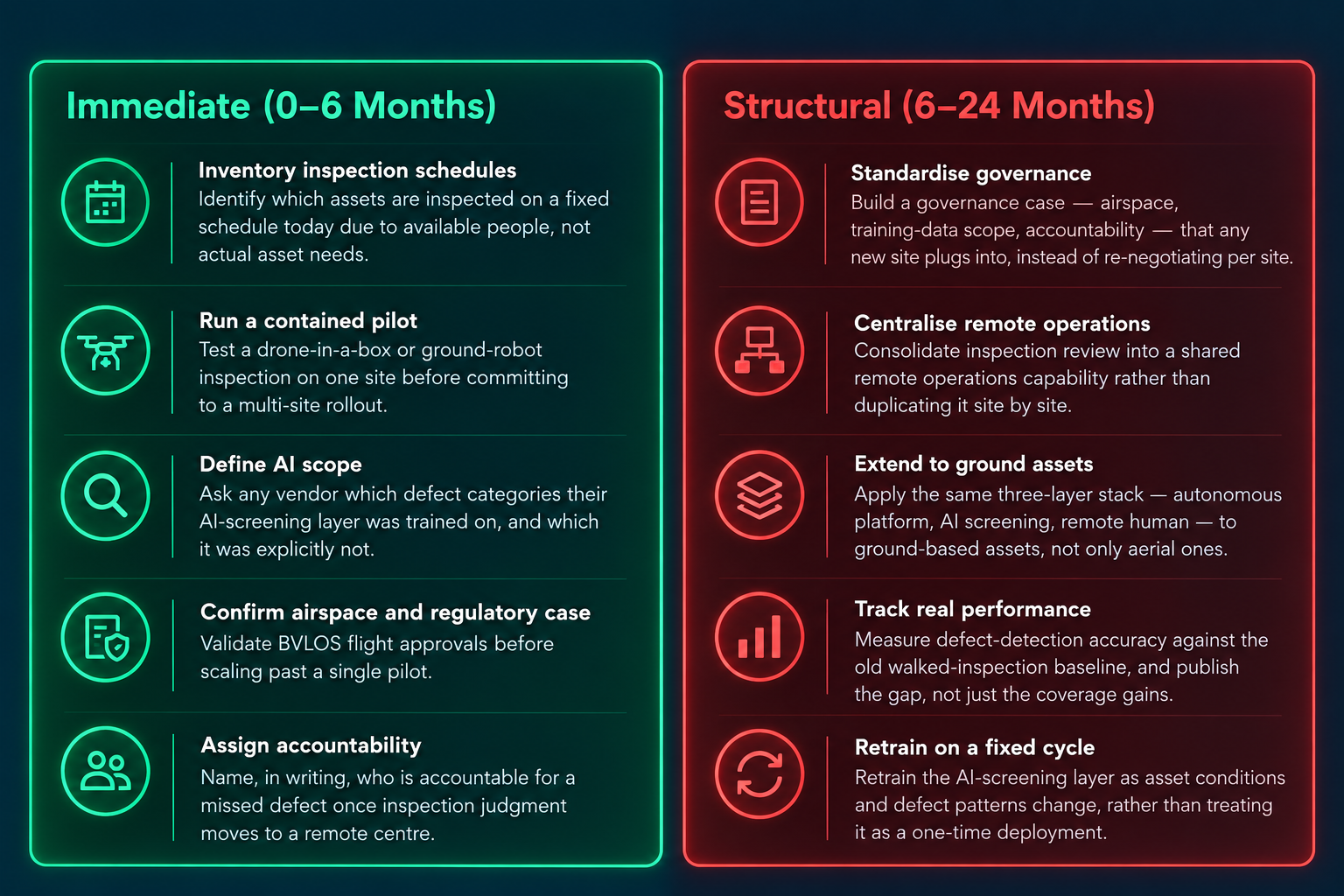
Project VOLT is a pilot at four substations, not a national rollout — which is exactly the point at which leadership decisions matter most, before the pattern hardens into next year's default.
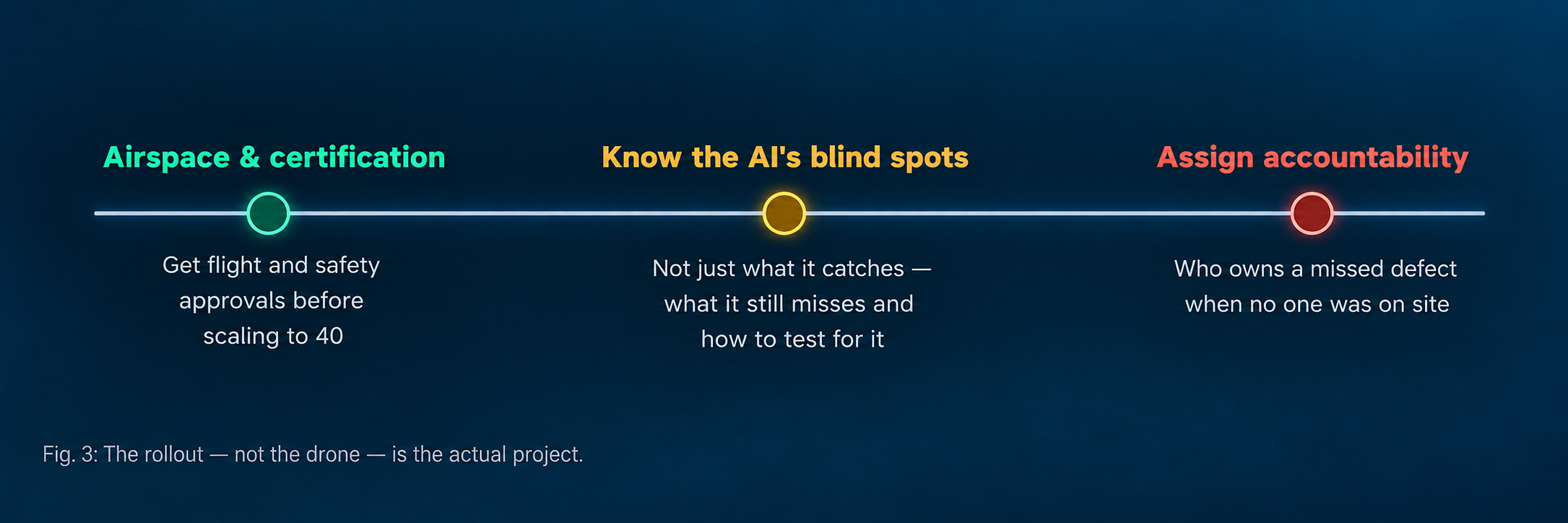
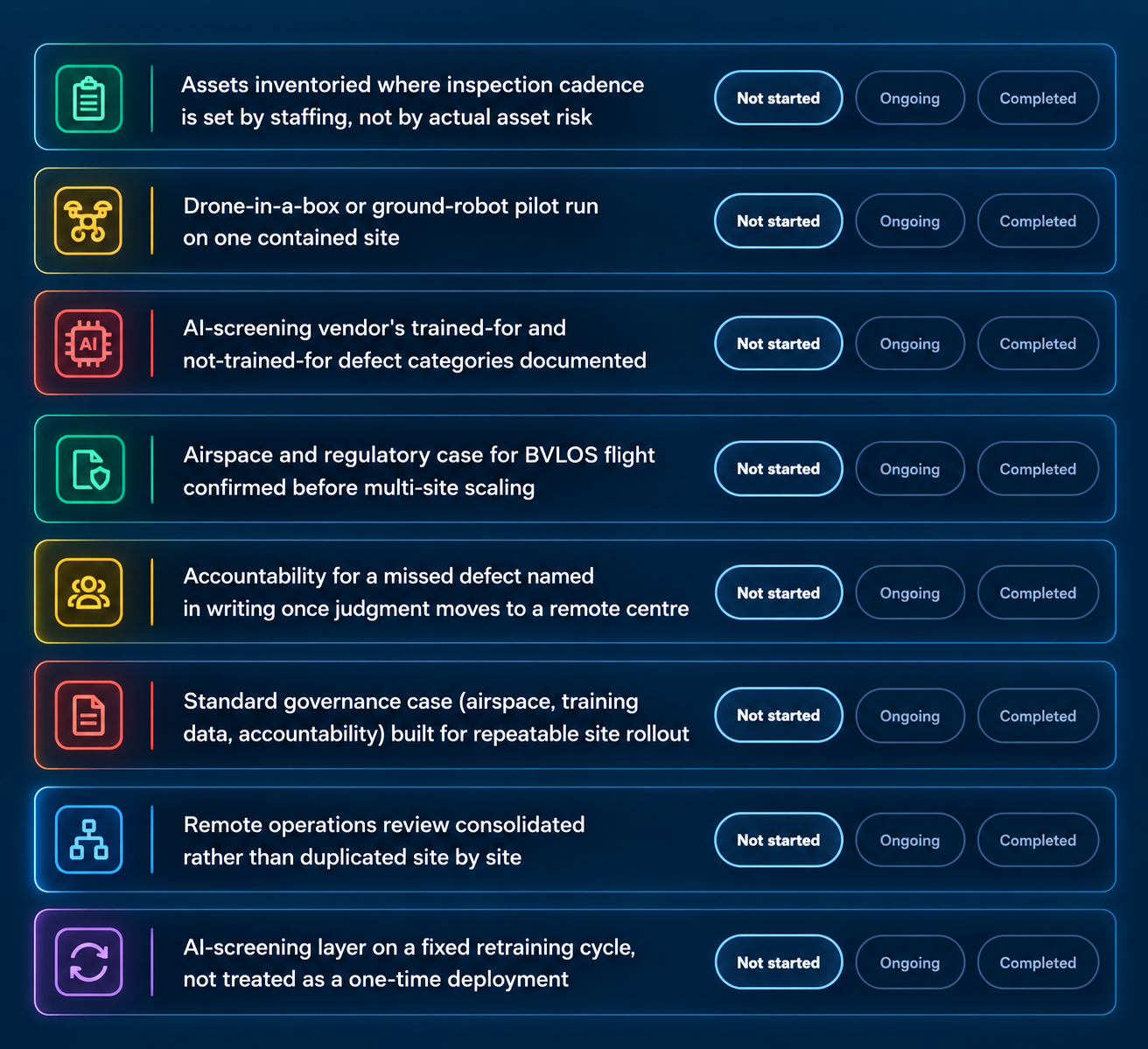
Three decisions sit ahead of every organization running comparable infrastructure. First, BVLOS flight and a remote operations centre are regulatory and airspace decisions as much as technical ones; getting the certification and safety case right at four sites is the template for scaling to forty, and getting it wrong once can freeze the whole programme. Second, an AI-screening layer is only as good as the defect categories it was trained to see — leadership has to know explicitly what the system is not looking for, not just what it catches. Third, moving inspection judgment to a Remote Operations Centre changes who is accountable for the call: the site no longer has the last set of eyes, so the operating model needs a clear answer for who owns a missed defect.
None of this is a reason to slow down. Project VOLT already demonstrates that the model works at real substations, with real airspace, and a real 200-mile gap between the asset and the reviewer. It is a reason to treat the rollout itself, governance, training-data scope, and accountability, as the actual project, with the drone as only its most visible part.
👉 Key Insight
A pilot that works at four substations is not evidence the model is finished. It is evidence the model is ready to be governed properly before it scales.
Action Plan for Decision Makers
Checklist
Final Thought
Part I asked what leadership does with a factory floor it can already walk. Part II asked what leadership does with hundreds of kilometres it never could. Part III closes Week 40 by asking what kind of command structure can actually run either one at scale, a question McChrystal's Task Force answered the hard way, in a very different kind of network.
Efficiency Before Energy means the cheapest inspection is the one that finds the fault before it becomes an outage, not the one flown fastest.
Systems don't fail. Decisions do.
Take the Next Step
Subscribe to the Weekly Punch for weekly strategic clarity, direct to your inbox.
References
SP Energy Networks / ScottishPower (2026) Project VOLT: Drone Innovation Taking Flight Across the North West.
Envirotec Magazine (2026) Drone-in-a-Box Technology Deployed for Substation Inspection in the Lake District.
Unmanned Airspace (2026) BVLOS Drone Inspections Go Live for UK Electricity Network, Remotely Piloted 200 Miles Away.
eSmart Systems (2026) Grid Vision: AI-Based Defect Detection for Utility Infrastructure Inspection.
Disclaimer: This article synthesizes publicly available reporting on Project VOLT current as of publication. Operational details may evolve as the pilot scales; readers should verify current figures against SP Energy Networks' own publications before relying on them for planning decisions. Verification Gate: flagged for pre-publication source check.
Ownership as Design.
Note: This article reflects my personalviews based on industry experience and publicly available information. It does not constitute professional, legal, or investment advice and does not represent the views of my employer. AI-generated visuals, concept and content by the author.
