Digital Twins That Cut kWh, Not Just Cycle Time
DIGITAL TWINS | ENERGY | SEPTEMBER 2026 | Week 39 · Part II
A Twin That Only Makes the Cell Faster Is Incomplete. The Useful Twin Predicts Energy, Peaks and Trade-Offs Before Steel Moves
Part I showed that the same robot, same task, can burn more than 20% extra energy depending only on where it's placed and how it's programmed. Part II asks why the tool built specifically to test placements and paths before they're built, the digital twin, so rarely gets asked to look at energy at all.
Efficiency Before Energy means testing the joule cost before the concrete is poured, not after the shutdown weekend proves the layout was wrong.
Executive Summary
IN 60 SECONDS:
A digital twin of a robot cell can test thousands of placements and speed profiles before a weekend shutdown. That is only valuable if energy is in the objective function.
Recent work embeds energy models in twins, validates them with controller data plus external meters, and then searches for layouts and trajectories that cut kWh while holding the task fixed. Pick-and-place twins with adaptive policies report roughly 14% energy reduction under changing payload.
Broader manufacturing twins used for energy scheduling show double-digit cuts in consumption or peak demand when energy is an explicit goal. Decision Makers should stop accepting twins that report only takt.
1. Cycle Time Is the Default Objective — and the Wrong Monopoly
A twin that finds a fast, collision-free path did exactly what it was told to do. Nobody told it energy was a variable.
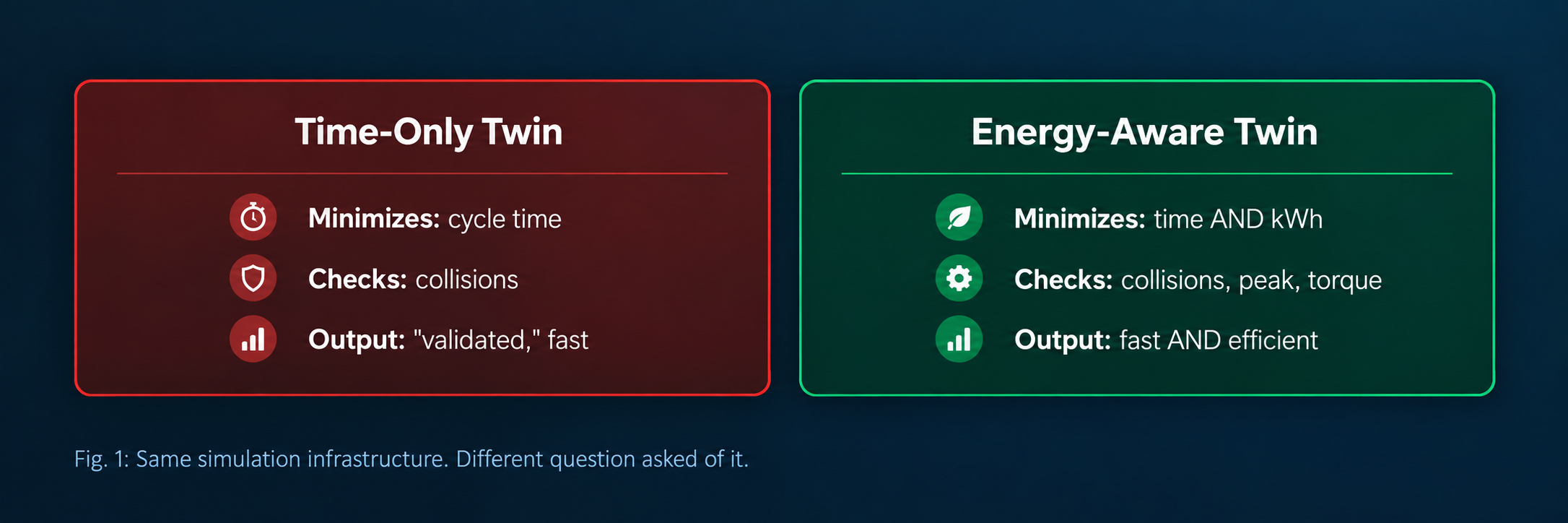
Offline tools (RobotStudio, Process Simulate, brand equivalents) are good at collision-free, time-feasible motion. Energy is often an add-on or ignored. The plant then "validates" a fast cell that sits on a high-torque posture and a coincident peak with the rest of the line. The twin did its job as specified. The specification was incomplete.
The workspace-placement research this series cited in Part I shows what changes once energy is added to the objective: researchers used a digital twin to systematically evaluate thousands of candidate positions of a fixed trajectory inside ABB RobotStudio, then validated the winning and losing configurations on a real ABB IRB 1600, the same twin infrastructure most plants already own, pointed at a question most plants never ask it (MDPI AI, 2026).
👉 Key Insight
What the twin is asked to minimize is a leadership choice. Time-only twins produce time-only factories.
2. What Energy-Aware Twins Already Deliver
Not a research promise. A short list of deployed methods, each with a measured number attached.
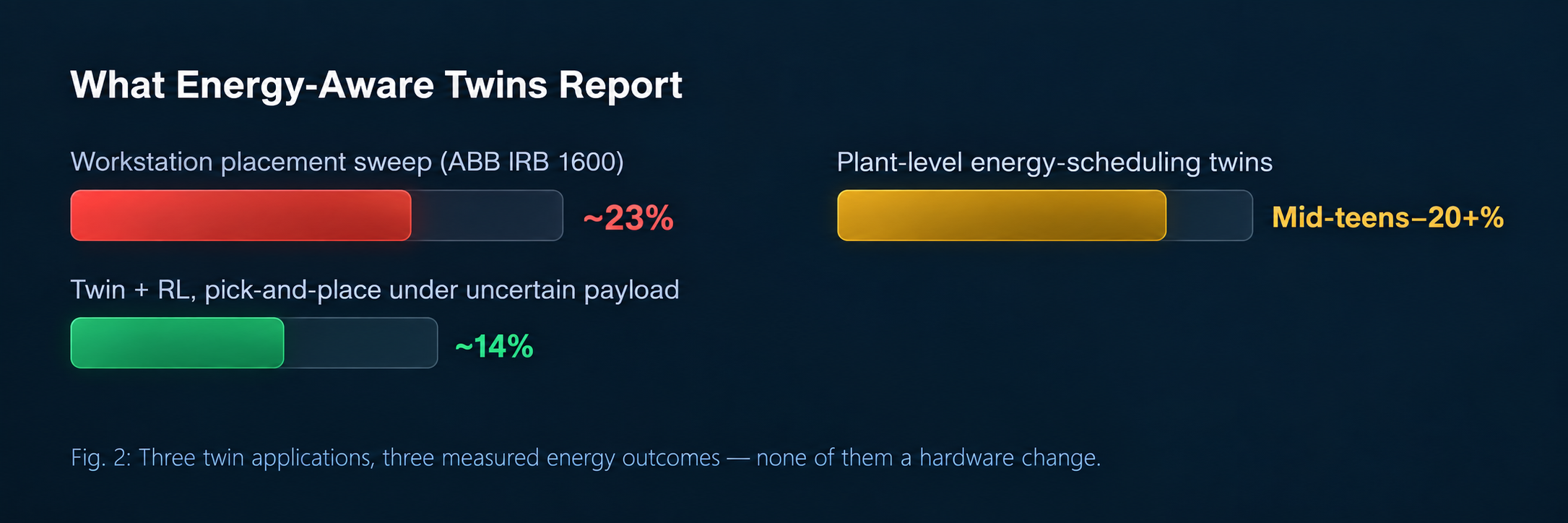
Workstation twins that sweep placement of a fixed trajectory and rank candidates by simulated then measured energy find the same task using ~23% different kWh depending only on placement. Digital-twin plus reinforcement-learning on pick-and-place with uncertain payload reports roughly 14% energy reduction while adapting motion to load. Model-based energy analysis inside a twin architecture for linear Cartesian moves shows consumption varying sharply with speed profile and pattern. Plant-level twins, used in EU energy-management and flexibility projects to shift loads, cut peaks and align production with on-site generation, report savings in energy cost and peak in the mid-teens to high-twenties in published manufacturing cases when energy is in the loop.
The pick-and-place figure comes from a specific, named methodology: a digital twin captures real-time payload data and feeds it to a linear-decay proximal policy optimization (LD-PPO) reinforcement-learning algorithm, which continuously re-optimizes the robot's motion as the payload itself changes, precisely the scenario where a fixed, pre-programmed path wastes the most energy (ScienceDirect, 2025). The pattern across every method here is consistent: the twin is useful when it compares options on kWh, not when it only animates the path already chosen.
👉 Key Insight
Every method here reused equipment the plant already owns. The only thing that changed was the question the simulation was asked to answer.
3. How to Specify the Twin So It Changes the Bill
A twin nobody validated against a real meter isn't a prediction. It's a nicely rendered guess.
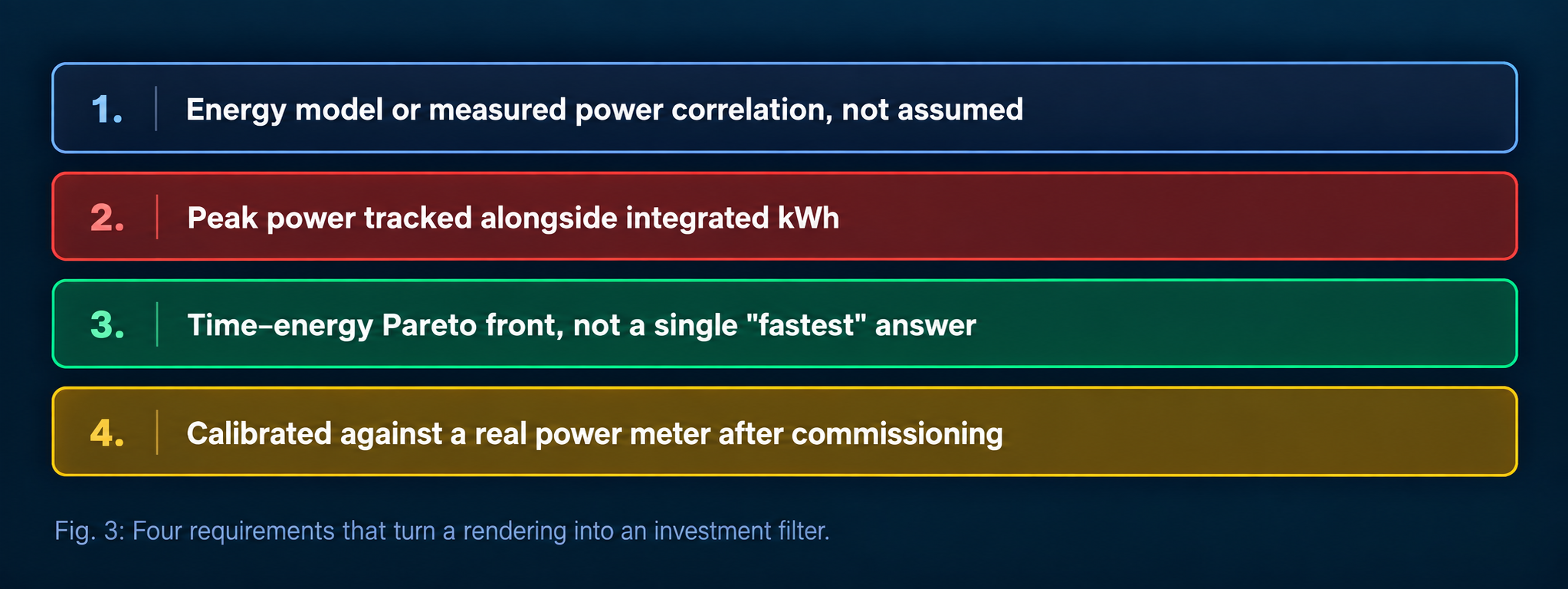
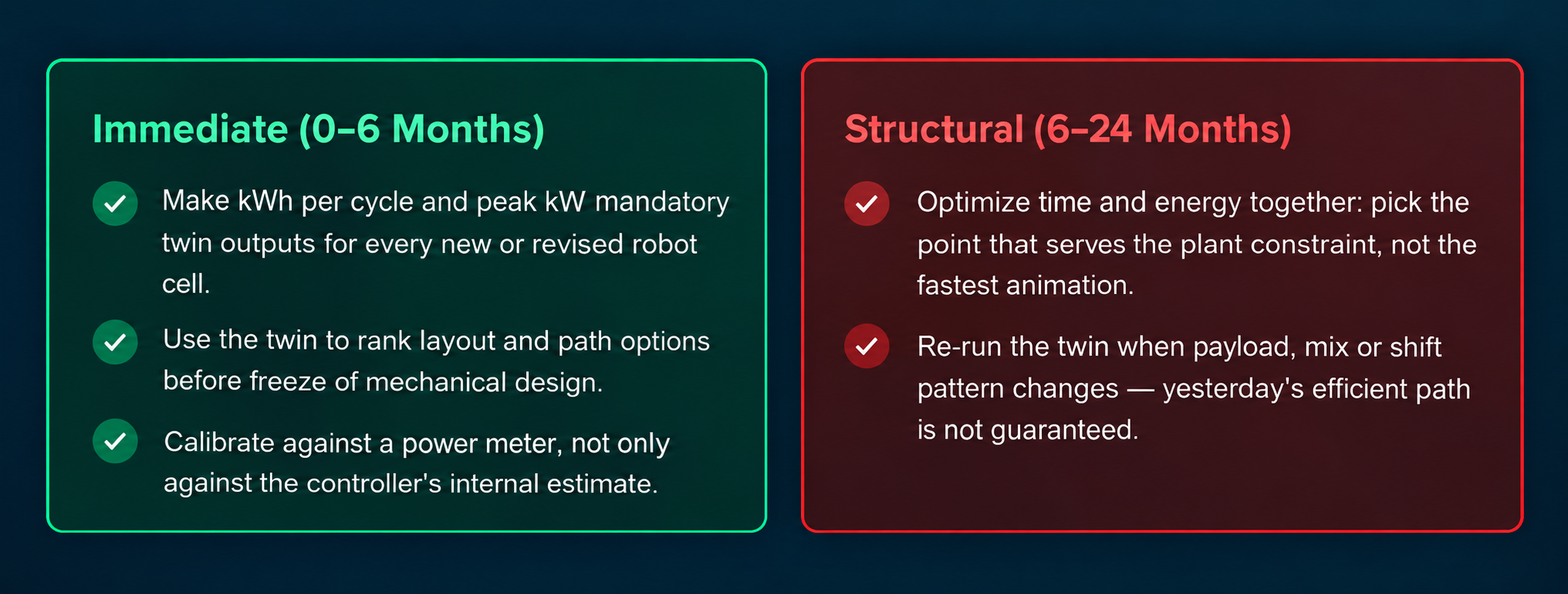
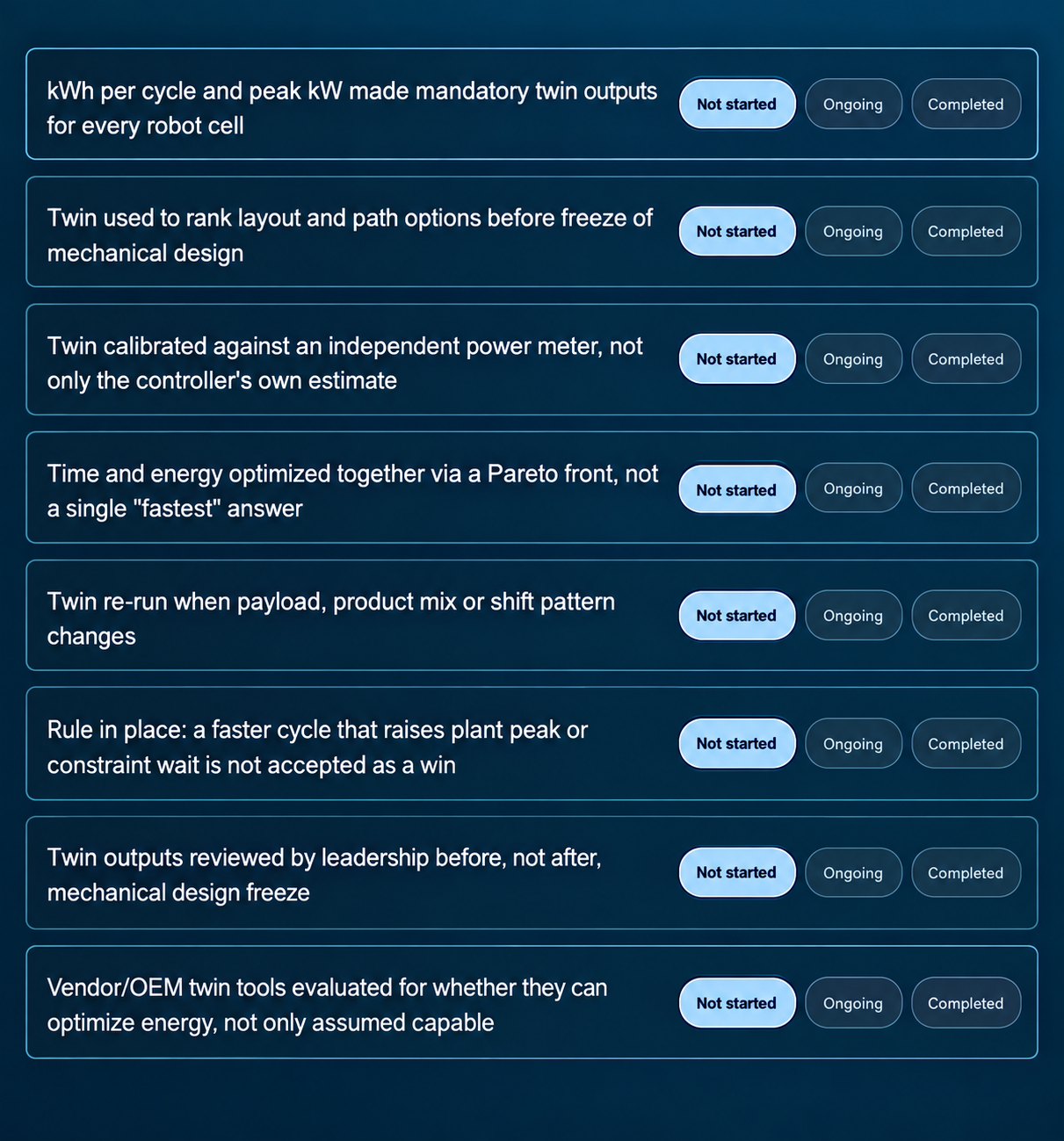
Require: an energy model (or measured power correlation), peak power as well as integrated kWh, a time–energy Pareto front, and a rule that a faster cycle which raises plant peak or constraint wait is not a win. Connect the twin to real meter data after commissioning or it remains a slideshow.
The workspace-placement study modeled exactly this discipline: a dual acquisition system combining the robot controller's own estimate with an independent external power meter, used to validate the simulation against physical reality rather than trusting the controller's internal number alone (MDPI AI, 2026). That second, independent measurement is the difference between a twin that informs a decision and a twin that simply confirms what the vendor's simulator already assumed.
👉 Key Insight
An unverified twin is a hypothesis. An energy-verified twin is an investment filter.
Action Plan for Decision Makers
Checklist
Final Thought
Motion waste and twin design are the same problem seen from two ends: one is what happens when nobody asks the energy question, the other is the tool that could have caught it before the cell was ever welded to the floor.
Efficiency Before Energy. Ownership as Design.
Systems don't fail. Decisions do.
Take the Next Step
Subscribe to the Weekly Punch for weekly strategic clarity, direct to your inbox.
References
MDPI AI (2026) Automatic Optimization of Industrial Robotic Workstations for Sustainable Energy Consumption. AI, 7(1), 17. https://doi.org/10.3390/ai7010017
ScienceDirect (2025) Digital Twin-Based Energy Efficiency Optimization of Robotic Pick-and-Place Process Under Uncertain Payload.[Journal article].
Disclaimer: This article synthesizes publicly available research current as of publication. Reported savings vary by method, robot model and baseline; readers should verify current figures against the original publications before relying on them for engineering decisions. Verification Gate: flagged for pre-publication source check.
Ownership as Design.
Note: This article reflects my personalviews based on industry experience and publicly available information. It does not constitute professional, legal, or investment advice and does not represent the views of my employer. AI-generated visuals, concept and content by the author.
