Motion Waste: Why Most Industrial Robots Still Burn Energy on Bad Paths
ROBOTICS | ENERGY EFFICIENCY | SEPTEMBER 2026 | Week 39 · Part I
Same Task, Same Robot, Very Different kWh ,Path, Placement and Acceleration Decide More Than the Hardware Brochure
Week 38 counted the fleet-wide load and opened a single humanoid's battery. Week 39 goes one level deeper: into the trajectory itself, where the same robot can burn more than 20% extra energy for the exact same job, depending on nothing more than where someone parked it in the workspace.
Efficiency Before Energy was never only about how much power a plant draws. It's about whether the joules already being spent are buying anything. Most of the time, on the factory floor, they aren't.
Executive Summary
IN 60 SECONDS:
Most industrial robots do the job. Fewer do it on an energy-aware path. Energy follows mass, acceleration, joint torque and unnecessary travel, not only seconds per cycle.
Studies on the same trajectory in different workspace positions show energy differences above 20%. Trajectory and joint-level optimization regularly reports mid-teens to much larger savings versus default motion.
The robot is rarely the constraint. The path is. Decision Makers who buy new arms to "save energy" while leaving teach-pendant paths untouched are treating hardware as strategy.
1. Where the Energy Actually Goes
Ask an engineer where a robot's energy goes and most point at the motor spec sheet. Ask where it's actually spent and the answer is: on the detour nobody noticed.
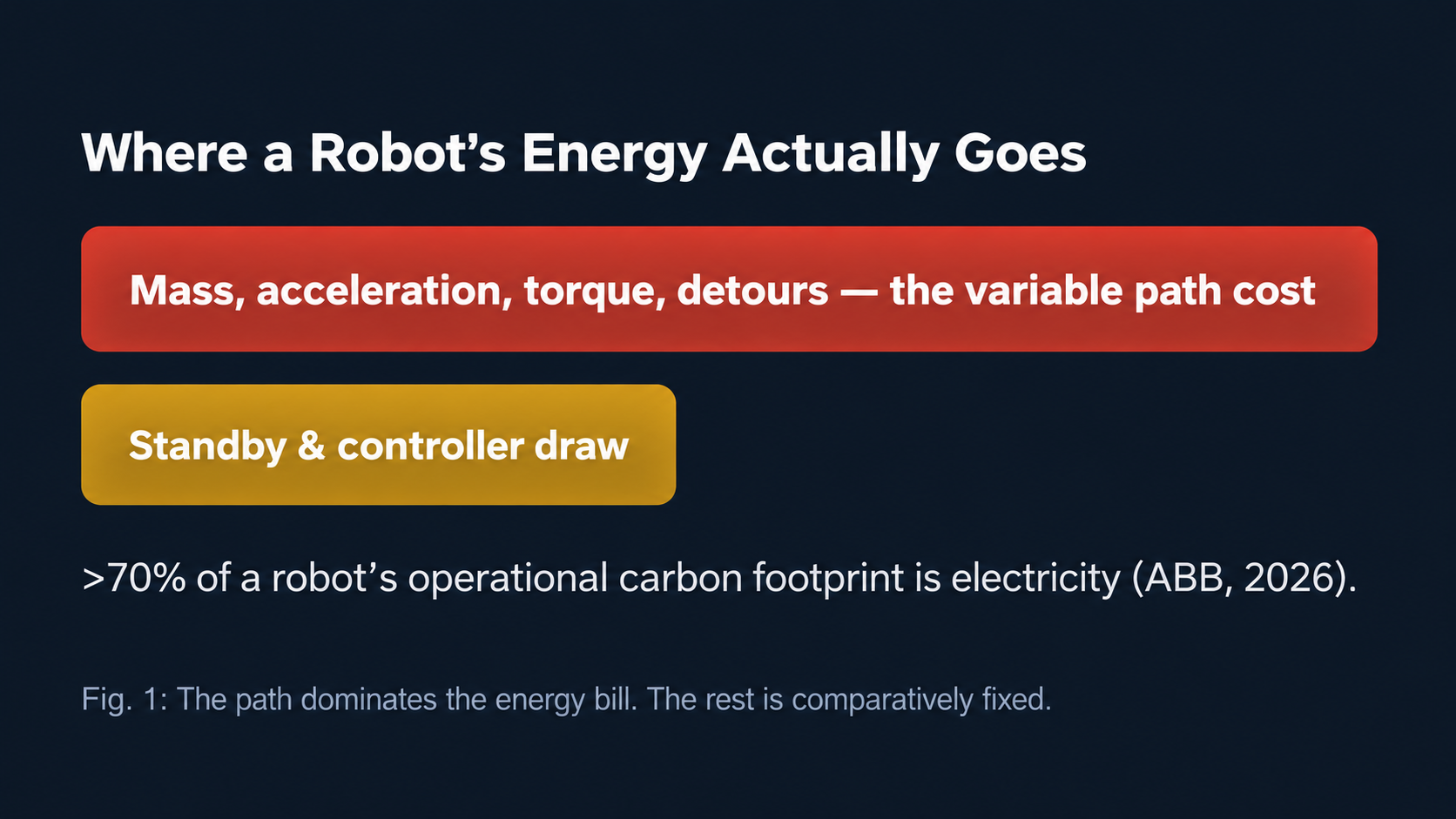
A six-axis arm spends most of its electricity on moving mass through poorly chosen joint space: overshoot, sharp acceleration, long detours around singularities, high-torque postures and motion that could have been shorter or smoother. Standby and controller draw matter, but the variable waste is in the path. Faster is not always more expensive, a badly blended slow path can cost more than a smooth faster one, but "as fast as possible everywhere" is a reliable way to burn energy at non-constraints.
ABB's own internal analysis puts a number on how much this matters at the fleet level: more than 70% of its customer robots' total carbon footprint comes from electricity used during the operational phase, not from manufacturing or disposal, which is exactly why the company is now leading a global effort to standardize how robot energy consumption gets measured in the first place (IFR/ABB, 2026). If the operational phase is where the footprint lives, the path is where the operational phase lives.
👉 Key Insight
Cycle time is a programming default. Energy is a physical consequence of that default.
2. What the Evidence Shows
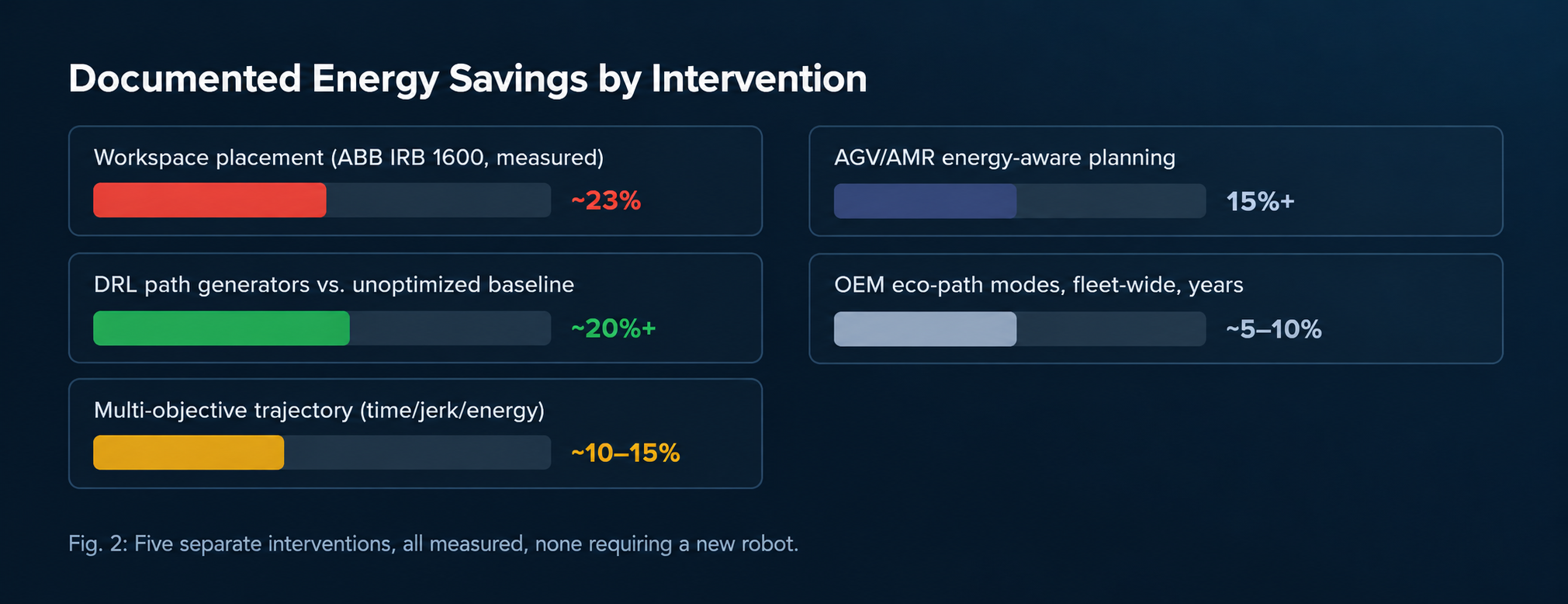
Five different research angles. One consistent number range: real, measurable, double-digit savings that never touched the hardware.
Same standardized trajectory, different placement in the workspace: measured ~23% energy difference on an ABB IRB 1600 in a 2026 digital-twin-plus-power-meter study. Multi-objective trajectory work (time, jerk, energy) reports savings in the ~10–15% range versus conventional weighting. Deep-learning and DRL path generators report on the order of 20%+ reductions versus unoptimized industrial baselines. AGV/AMR path work shows energy cuts above 15% versus conventional planners, documented in simulation. OEM practice, lighter structures, controller efficiency and eco-path modes, adds a further ~5–10% fleet energy over years.
The workspace-placement study is worth naming precisely: researchers combined pre-simulation filtering, large-scale energy simulation in ABB RobotStudio, and dual measurement from the robot's own controller plus an external power meter, then validated on a real ABB IRB 1600–10/1.2, confirming a 23.4% difference in total energy consumption between two workspace configurations for the identical task: 2.85 kWh versus 3.52 kWh for the same cycle count (MDPI AI, 2026). Nobody touched the robot. They moved where it stood.
👉 Key Insight
Every one of these numbers was produced by leaving the hardware exactly as it was. The savings all came from where the robot stood, how it moved, or what it was asked to minimize.
3. Why Plants Still Run Bad Paths
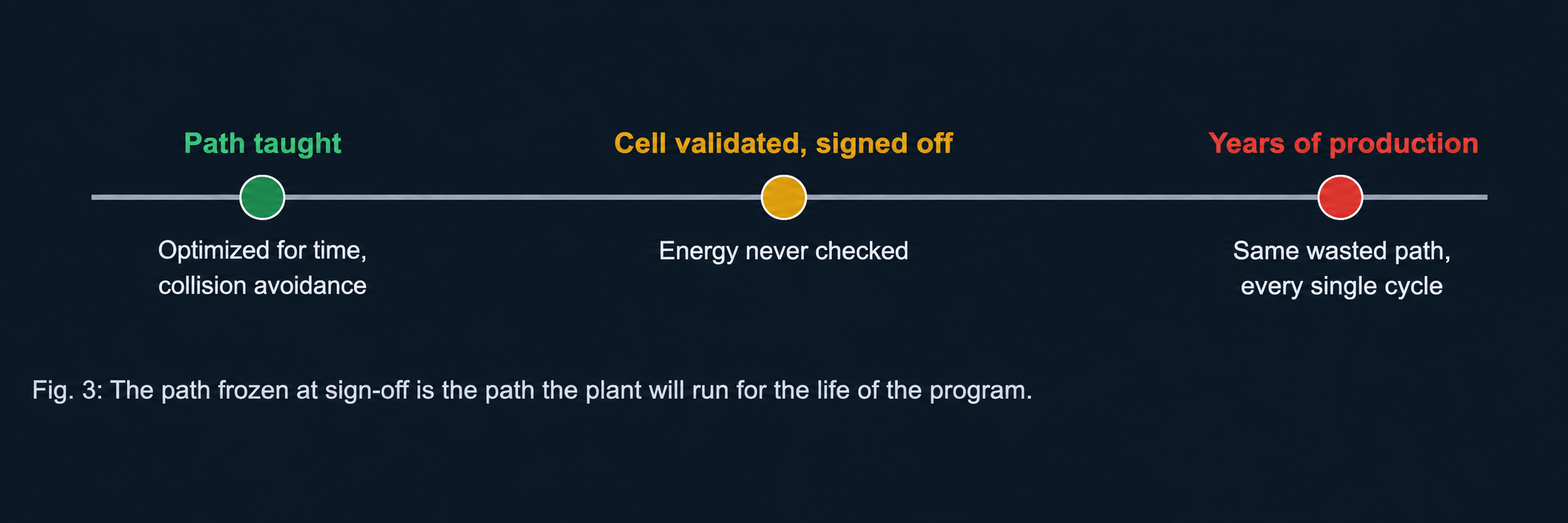
A path gets taught once, validated once, and then runs unchanged for the rest of the program's life, kWh included.
Paths are taught to avoid collisions and hit takt. Energy is rarely a teach-pendant field. Offline simulation often optimizes time. Once a cell is validated, nobody reopens the motion for kWh. The result is locked-in motion waste for the life of the program.
This is the same failure mode this series named from a different angle in Week 38: a resource that looks "done" and "efficient" on its own terms can still be quietly wrong for the system as a whole. A validated path is exactly that, validated against collision and cycle time, never against energy, and never revisited once the sign-off is filed.
👉 Key Insight
Motion waste is a management system problem. The robot will execute whatever path leadership accepts as "done."
Action Plan for Decision Makers
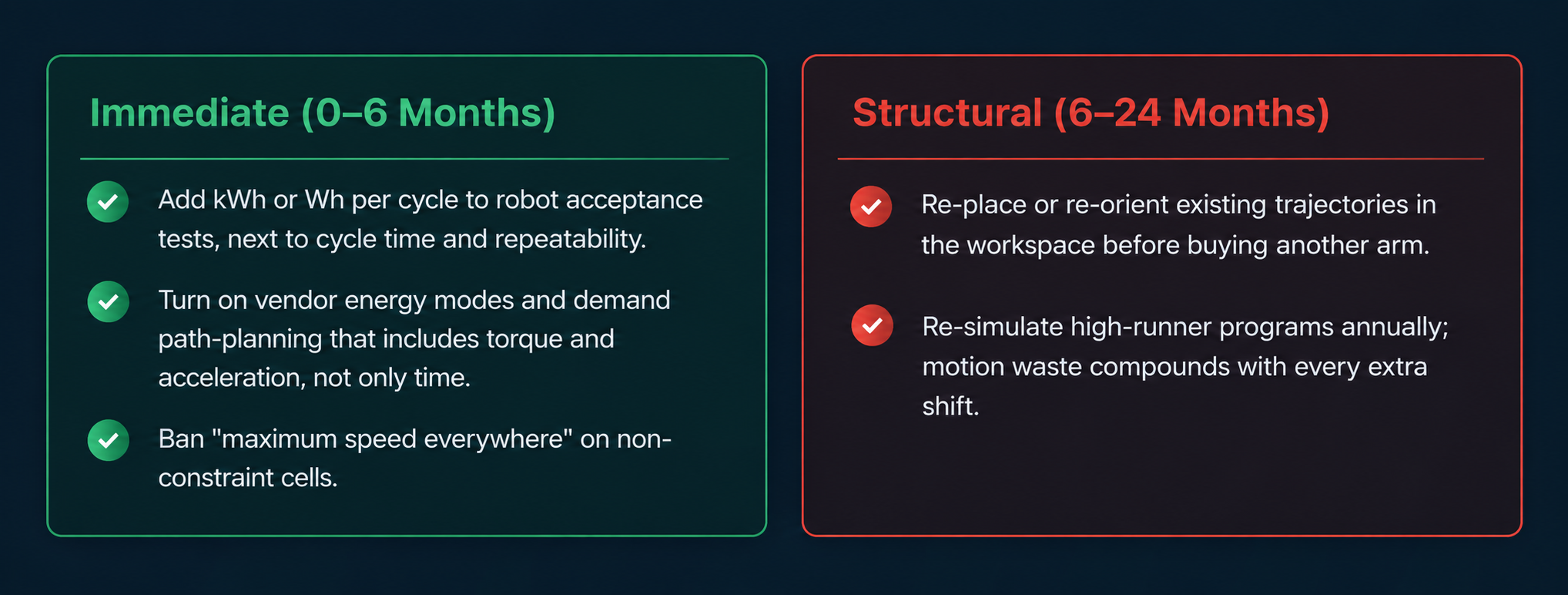
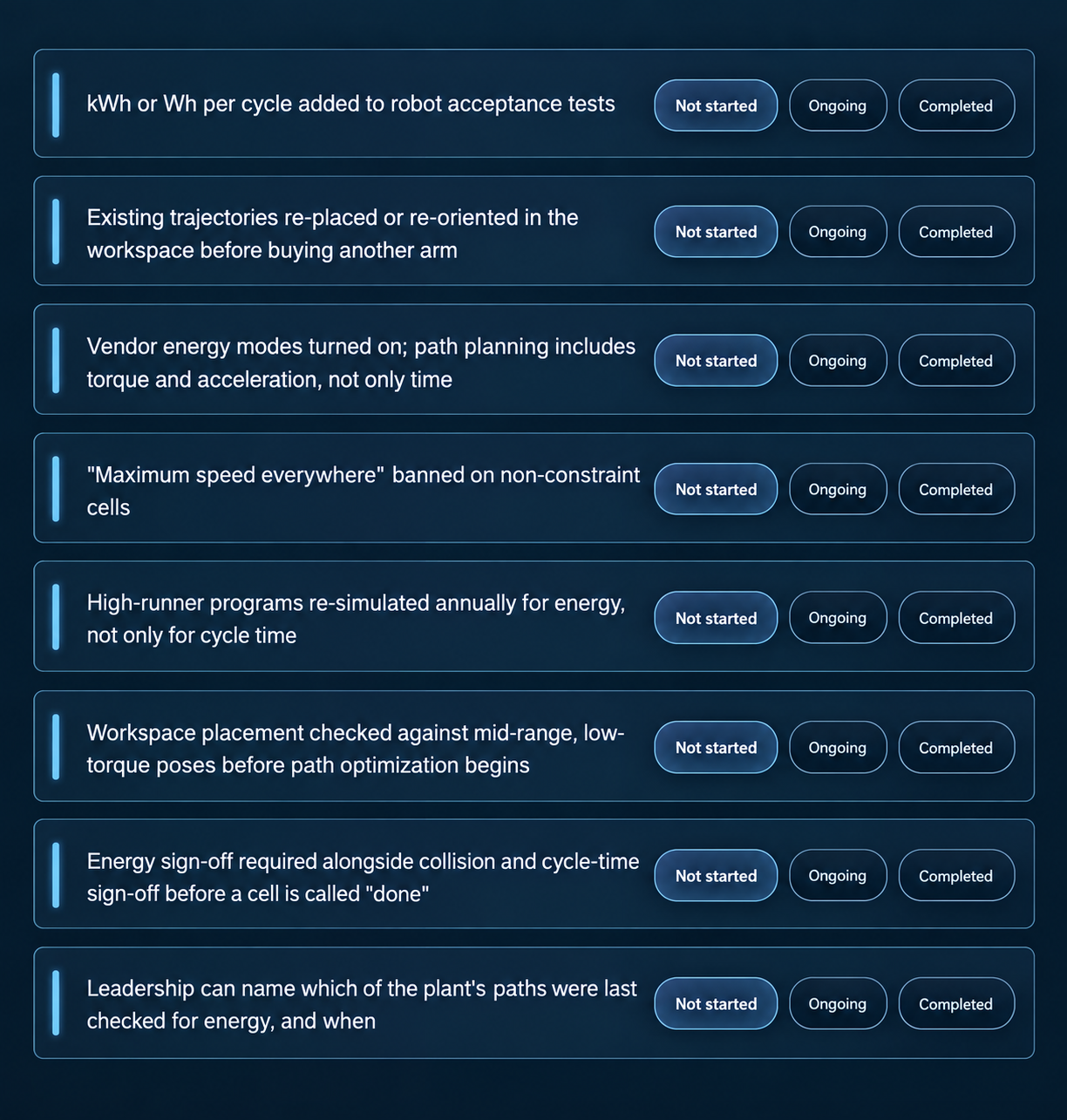
Checklist
Final Thought
Motion waste is invisible until someone measures it, which is exactly what a properly specified digital twin is for. Part II of this Week 39 set asks why so many robotics twins already exist on the factory floor and still can't answer the one question that matters: how many kWh does this path actually cost?
Efficiency Before Energy means the cheapest kWh is the one the robot never needed to spend in the first place.
Systems don't fail. Decisions do.
Take the Next Step
Subscribe to the Weekly Punch for weekly strategic clarity, direct to your inbox.
References
IFR / ABB Robotics (2026) ABB Robotics Leads Global Effort to Standardize Measurement of Industrial Robots' Energy Consumption.Frankfurt: International Federation of Robotics.
MDPI AI (2026) Automatic Optimization of Industrial Robotic Workstations for Sustainable Energy Consumption. AI, 7(1), 17. https://doi.org/10.3390/ai7010017
MDPI Machines (2025) A Scoping Review of Energy Consumption in Industrial Robotics. Machines, 13(7), 542.
Disclaimer: This article synthesizes publicly available research current as of publication. Reported savings vary by robot model, task and baseline; readers should verify current figures against the original publications before relying on them for engineering decisions. Verification Gate: flagged for pre-publication source check.
Ownership as Design.
Note: This article reflects my personalviews based on industry experience and publicly available information. It does not constitute professional, legal, or investment advice and does not represent the views of my employer. AI-generated visuals, concept and content by the author.
