Leading in the Missing Middle: What Human + Machine Demands of Modern Leadership
LEADERSHIP | HUMAN + MACHINE | SEPTEMBER 2026 | Week 36 · Part III
From Managing People and Projects to Designing Human - Machine Systems - Practical Leadership Lessons from Daugherty & Wilson for Organizations Scaling Physical AI
Part I of this week's set named the human advantage. Part II named the leadership discipline energy now demands. Part III gives both a name inside a single job description, because Daugherty and Wilson were writing about exactly this before most organizations had a Physical AI budget line to argue over.
Ownership as Design is, it turns out, close to a one-line summary of what this book asks of leaders: stop assigning tasks to people, and start designing the system people and machines run inside.
Executive Summary
IN 60 SECONDS:
Human + Machine is often read as a book about jobs and technology. For leaders it is a book about a changed job description: when machines enter real operations, leaders no longer only assign tasks to people, they design systems in which people and machines work together in the "missing middle."
That requires reimagining processes, building fusion skills, and setting explicit norms for when machines may act, the MELDS framework Daugherty and Wilson built from cases spanning manufacturing, healthcare and consumer goods.
Organizations that keep leading as if AI were an IT workstream get activity. Organizations that lead as designers of human–machine work get progress.
1. The Leadership Shift the Book Requires
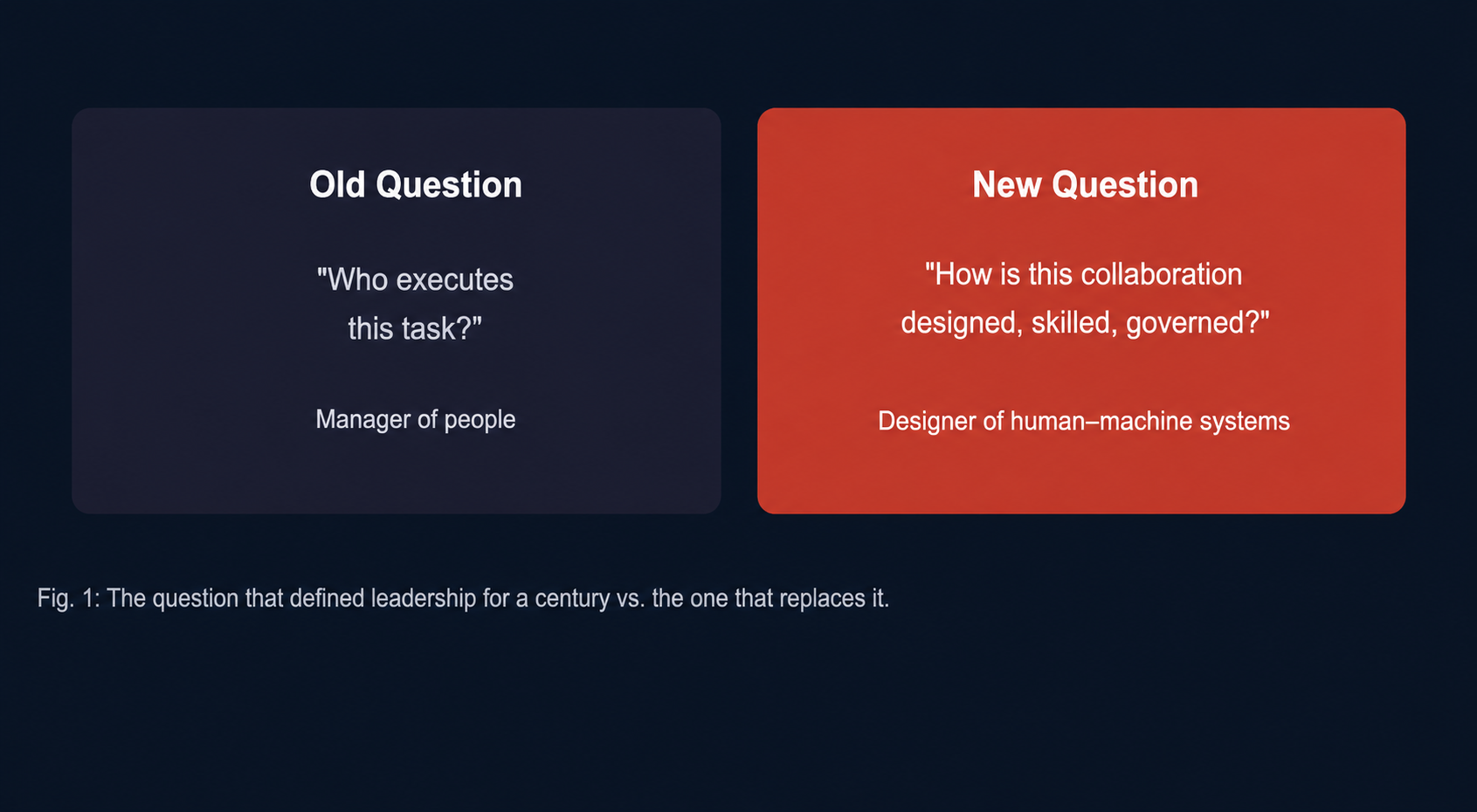
"Who executes this task?" was a complete leadership question for a hundred years. It stopped being one the day the answer became "a person and a machine, together."
Value, in Daugherty and Wilson's argument, sits where humans and machines must work together. If the work is hybrid, leadership must become hybrid-aware: less "Who executes this task?" and more "How is this collaboration designed, skilled and governed?"
The book's own framing puts weight behind that shift: AI systems, in this current era of business process transformation, are not replacing workers wholesale, they are amplifying human skills and collaborating with people to achieve productivity gains that were previously impossible, in what the authors call the "missing middle" (Daugherty and Wilson, 2018). Their MELDS framework, Mindset, Experimentation, Leadership, Data, Skills, turns that idea into five leadership disciplines, and its fifth pillar, fusion skills, later expanded into eight specific skills the authors argue every AI-era workforce needs (UXmatters, 2019, reviewing Daugherty and Wilson, 2018).
👉 Key Insight
The modern leader is not only a manager of people. The leader is a designer of human–machine systems.
2. Four Leadership Practices, with One Running Example
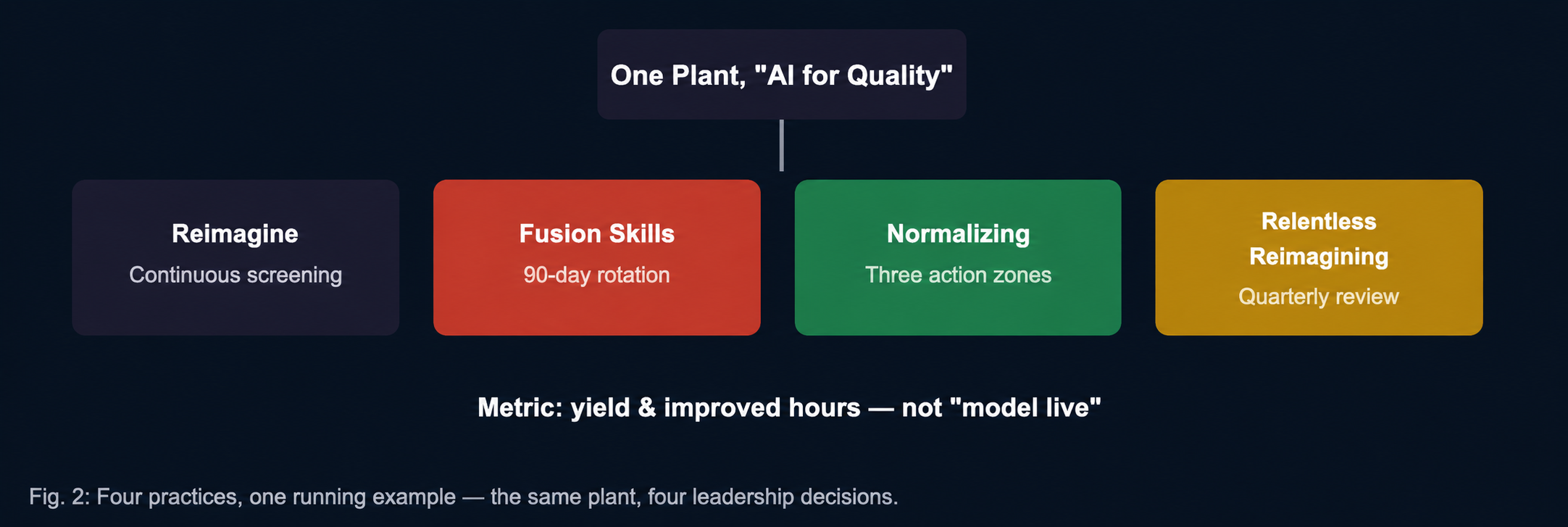
One plant. One quality problem. Four decisions that turned a dashboard project into a leadership case study.
1. Reimagine the process, do not automate the old flow
A plant wanted "AI for quality." The first plan was a dashboard on the existing inspection routine. Leadership stopped that and redesigned the work: the system does continuous screening; the supervisor owns exceptions and improvement; time saved is moved into root-cause work. The metric became yield and improved hours, not "model live."
2. Build fusion skills as an organizational capability
The same team ran a 90-day rotation: shift leaders learned to interrogate recommendations; technical profiles learned line constraints. Every model update needed a short shop-floor review. Reciprocal apprenticing became a leadership rule, not a workshop idea.
3. Responsible normalizing
Leadership wrote three zones: the system may act inside a safe band; it may only recommend in a second band; it must stop and escalate in a third. Supervisors were assessed on the quality of overrides. "Normal" human–machine behavior was set by leaders, not left to vendor defaults.
4. Relentless reimagining as a management system
Quarterly the team asks: What work moved into the missing middle? Which skills are still weak? Which process should we redesign next because the technology now allows it? That replaces the habit of adding another pilot.
👉 Key Insight
The running example never changes projects. It changes what leadership pays attention to, yield and improved hours instead of "model live," shop-floor review instead of vendor defaults.
3. What Changes for Leaders and Organizations
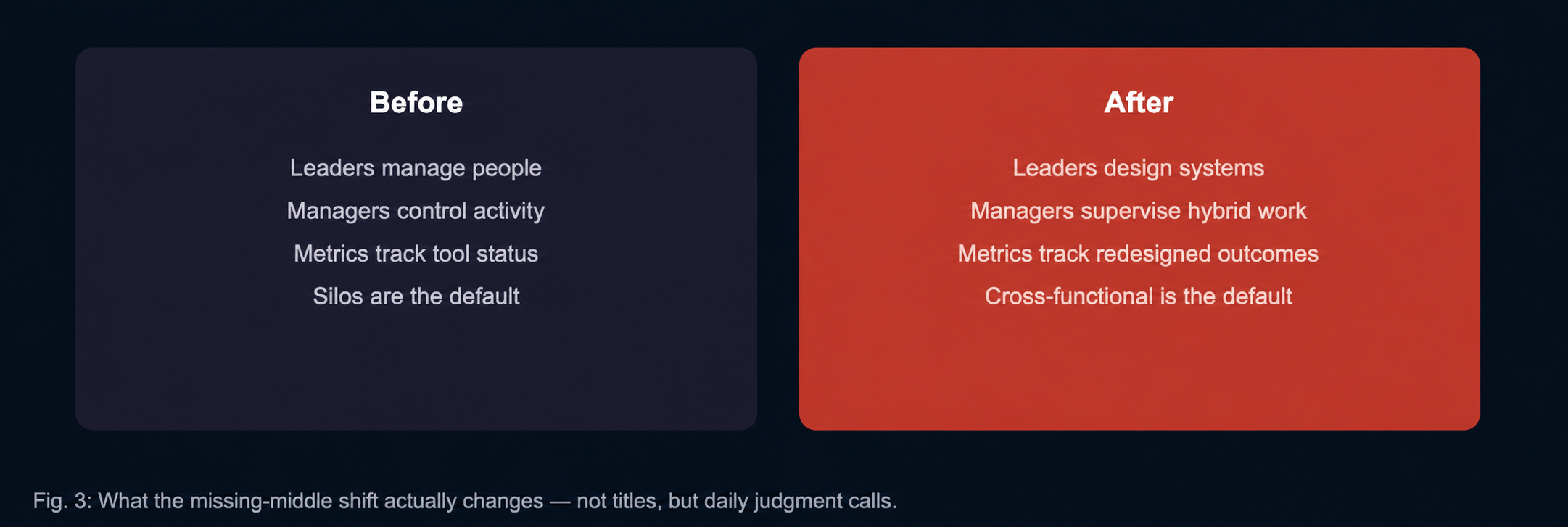
None of this shows up as a new org chart box. It shows up as a different answer to the same old questions.
Leaders become system designers and judges of last resort. Middle managers supervise hybrid work instead of only controlling activity. Cross-functional teams become the default. Metrics shift from tool status to redesigned outcomes and collaboration quality. Culture expects challenge of both human and machine decisions.
This is the same shift this series named from a different angle in Week 35: teams that create psychological safety to challenge AI recommendations outperform teams that suppress dissent, and the difference shows up long before an incident forces it into the open. Daugherty and Wilson's contribution is to put that expectation into the leader's own job description, not just the team's culture statement.
👉 Key Insight
After Human + Machine, leadership is the discipline of keeping humans where they create unique value – and building the organization that makes that value scalable.
Action Plan for Decision Makers
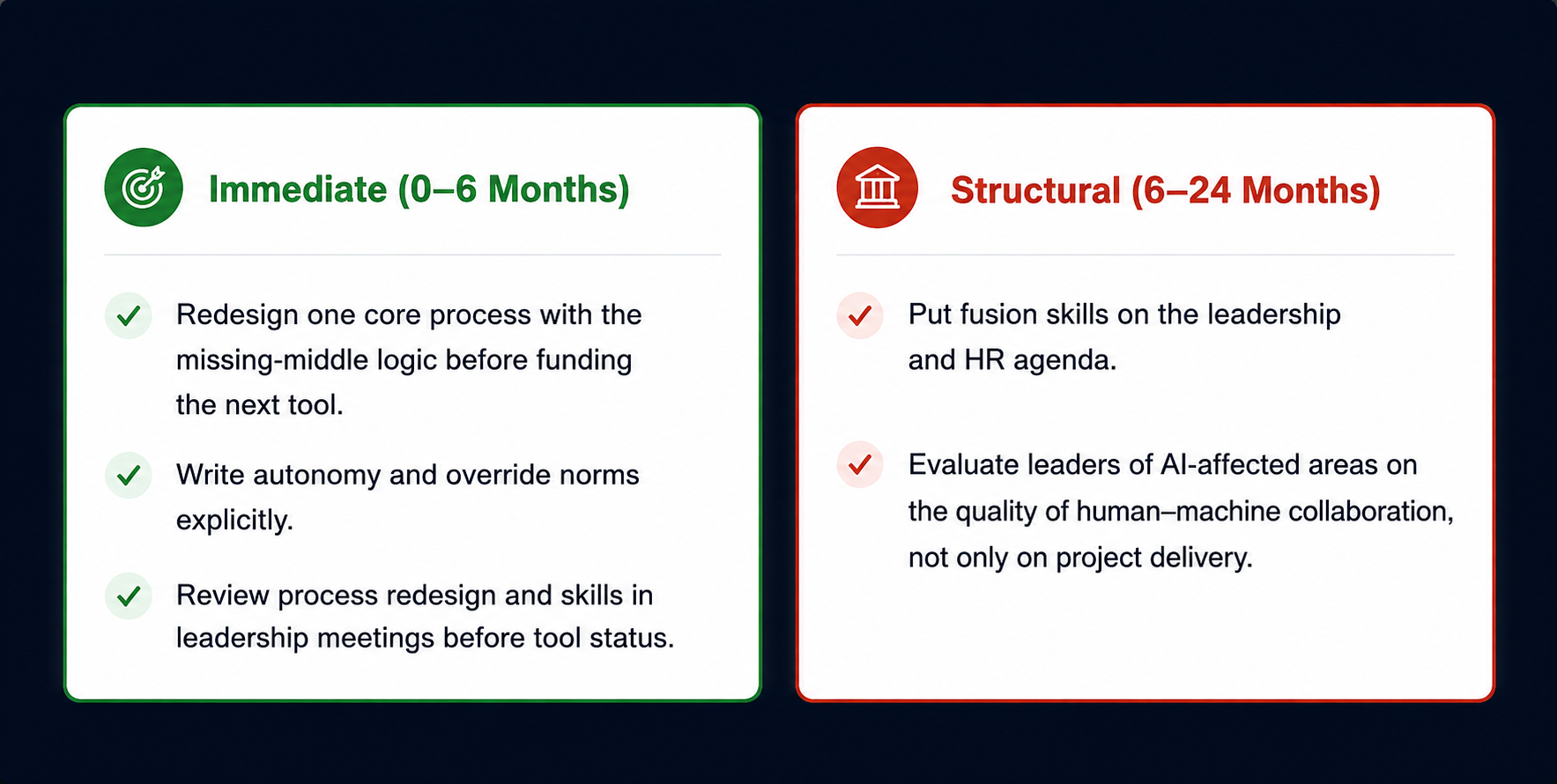
Checklist
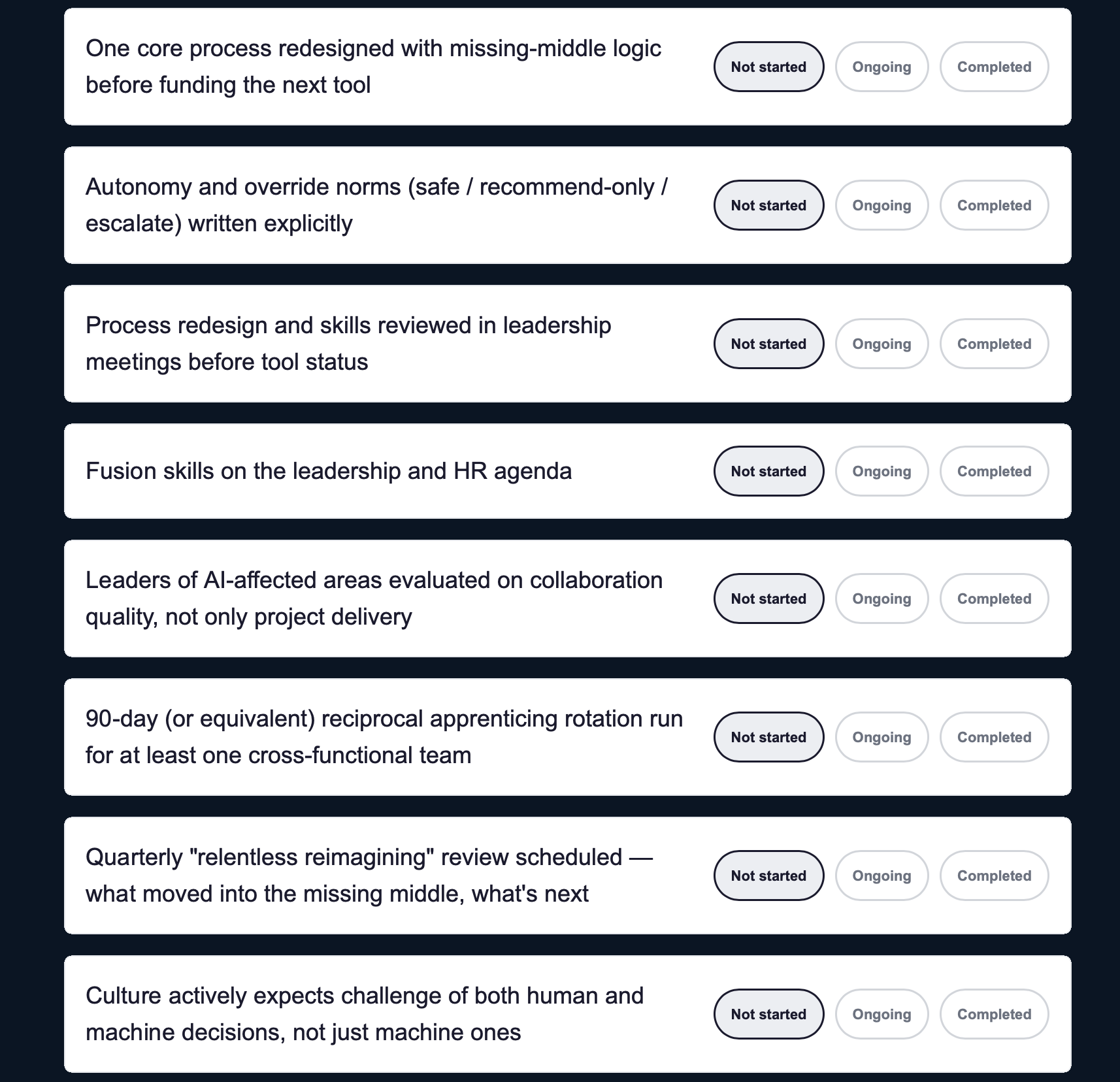
Final Thought
This Week 36 set made one argument from three directions: on the shop floor, in the energy ledger, and in the leadership job itself, the same principle holds. AI doesn't remove the need for judgment. It relocates it, to the override, to the trade-off, to the redesigned process. Leaders who chase the technology and skip the redesign get activity. Leaders who design the missing middle get progress.
Efficiency Before Fuel. Ownership as Design.
Systems don't fail. Decisions do.
Take the Next Step
Subscribe to the Weekly Punch for weekly strategic clarity, direct to your inbox.
References
Daugherty, P.R. and Wilson, H.J. (2018) Human + Machine: Reimagining Work in the Age of AI. Boston, MA: Harvard Business Review Press.
UXmatters (2019) Book Review: Human + Machine. [Online article, reviewing Daugherty and Wilson, 2018].
Disclaimer: This article applies the Human + Machine framework (Daugherty & Wilson, 2018) and publicly available commentary current as of publication. The running example in Section 2 is an illustrative composite, not a verified named case study. Verification Gate: flagged for pre-publication source check.
Ownership as Design.
Note: This article reflects my personalviews based on industry experience and publicly available information. It does not constitute professional, legal, or investment advice and does not represent the views of my employer. AI-generated visuals, concept and content by the author.
