Leadership Lessons from the Energy-AI Convergence
LEADERSHIP | ENERGY & AI | SEPTEMBER 2026 | Week 36 · Part II
When Energy Constraints Meet Autonomous Systems, Leadership Becomes the Binding Constraint, Not Technology
Part I of this week's pair argued that human judgment is the scarce asset inside an AI-driven factory. Part II asks about the constraint outside it: how much of that factory can even run once energy, not silicon, becomes the binding limit.
Efficiency Before Fuel gave this series its name for a reason. The fuel was always going to come back into the conversation, the only question was whether leadership would still be treating it as someone else's department when it did.
Executive Summary
IN 60 SECONDS:
Energy limits how far Physical AI can scale. Physical AI, used well, can reduce energy intensity, waste and inefficient running states, but if energy stays in facilities and AI stays in IT, both agendas underperform.
The scale is no longer abstract: global data-centre electricity demand grew 17% in 2025, AI-focused demand surged 50%, and manufacturers are already reporting higher costs and longer interconnection timelines as they compete with data centres for grid capacity.
The leadership lesson from the convergence is simple: one agenda, shared metrics, clear choices, and judgment when recommendations conflict with safety, quality or cost.
1. Why the Convergence Changes the Leadership Job
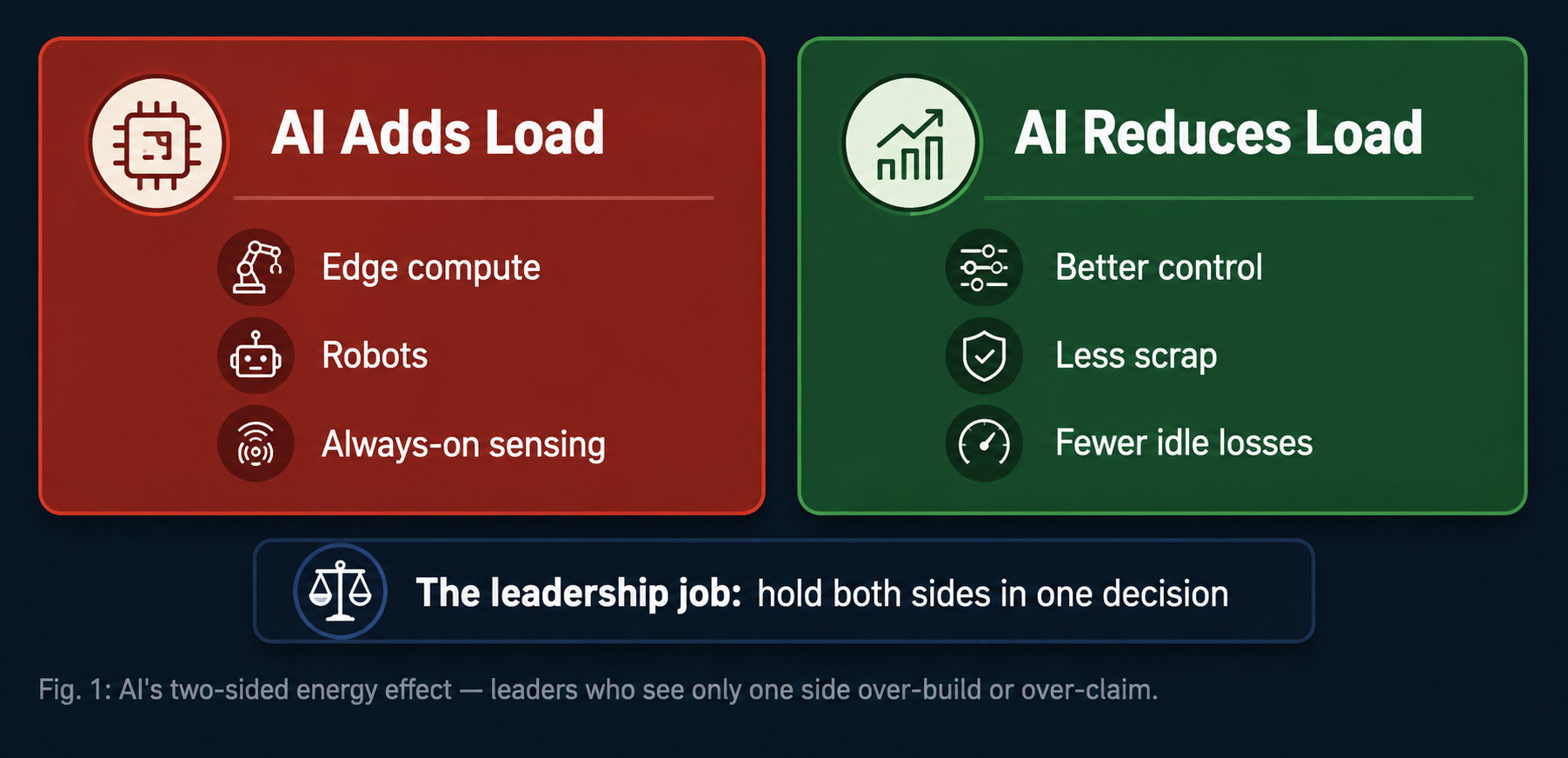
AI adds load. AI reduces load. Most leadership teams still only see one half of that sentence.
AI deployments add load, edge compute, robots, always-on sensing, and can reduce load, better control, less scrap, fewer idle losses. Leaders who see only one side will either over-build infrastructure or over-claim savings. The job is to hold both sides in one decision.
The scale behind that job has stopped being abstract. The IEA's 2026 analysis found that global data-centre electricity demand grew 17% in 2025, in line with prior projections, while electricity consumption from AI-focused data centres surged 50%, and the largest technology companies' data-centre capital expenditure, which exceeded USD 400 billion in 2025, is expected to jump by a further 75% in 2026 (IEA, 2026). That buildout is not staying inside the technology sector: Stanford's Emerging Technology Review 2026 finds that the growth of AI infrastructure, data centres and manufacturing reshoring together has created an energy supply problem existing grids cannot absorb, and that factories competing for grid capacity in regions with new data-centre construction are already facing higher costs and longer interconnection timelines (IIoT World, 2026, citing Stanford Emerging Technology Review 2026).
👉 Key Insight
Energy is no longer a downstream cost of AI. It is a design constraint and a performance target at the same time.
2. Five Leadership Lessons
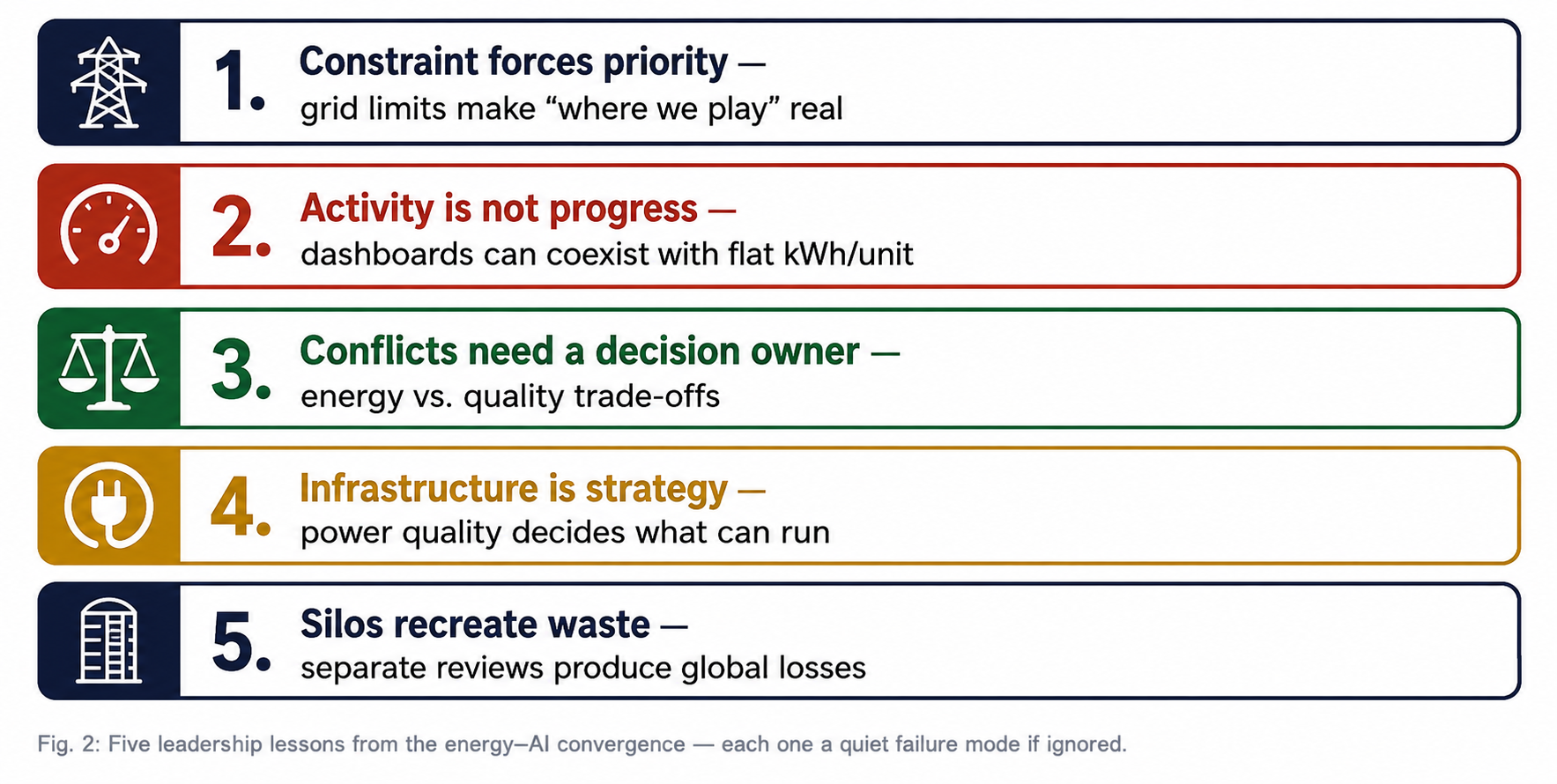
None of these five lessons fails loudly. They fail quietly, as a slide that says "aligned" while the P&L and the kWh meter tell two different stories.
Constraint forces priority. Grid limits and energy prices make "where we play first" a real choice, not a slogan. Activity is not progress. Energy dashboards plus AI pilots can coexist with flat kWh per unit. Conflicts need a decision owner. An agent may recommend an energy-saving setpoint that raises quality risk. Someone must be accountable for the trade-off. Infrastructure is strategy. Power quality, peak demand and on-site capacity decide which autonomous systems can actually run. Silos recreate waste. Separate energy and AI reviews produce local optima and global losses.
The "infrastructure is strategy" lesson has teeth already. Industrial robots typically draw power directly from the local grid without any low-carbon sourcing mandate, and analysts now warn that if humanoid robot deployment reaches the scale some markets are projecting, power demand from robots alone could rival a mid-sized country's entire electricity generation (Rigzone, 2026, citing Wood Mackenzie). At the same time, the constraint on AI expansion broadly has shifted since 2025 from chip availability to grid access, a single AI facility's 100–300 MW demand is now a utility-level load that local distribution networks were never designed to handle (enkiai.com, 2026). Both dynamics land on the same factory floor.
👉 Key Insight
Each of these five lessons fails the same way: quietly, as a slide that says "aligned" while the P&L and the kWh meter tell two different stories.
3. Practical Pattern
The pattern that works isn't a new dashboard. It's fewer dashboards, in the same room.
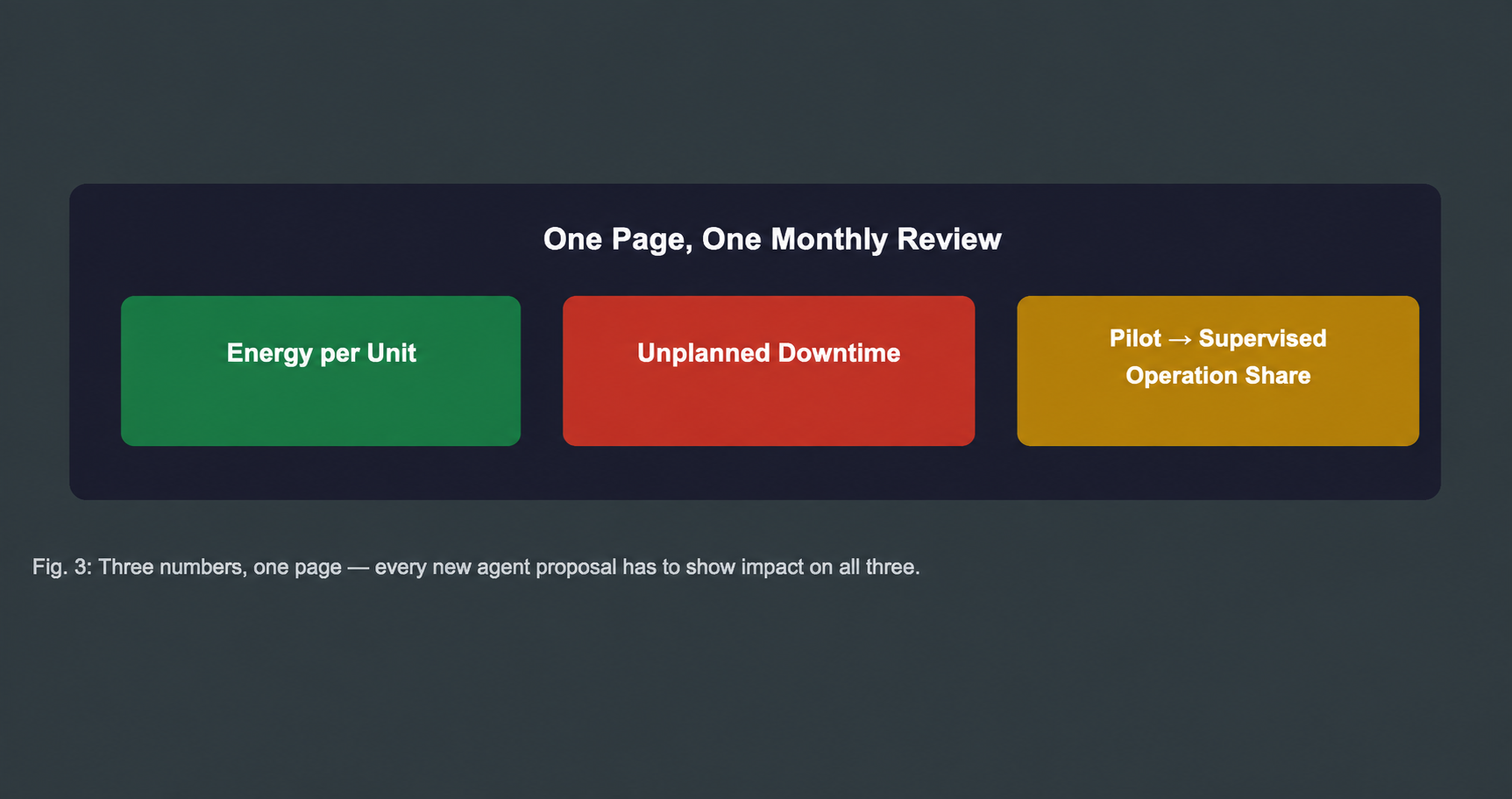
A leadership team puts three numbers on the same page: energy per unit, unplanned downtime, and share of AI use cases that have moved from pilot to supervised operation. New agent proposals must show expected impact on all three. Energy and operations sit in the same monthly review. That single change cuts projects that look digital but add load without operational return.
This is the energy-specific version of a pattern this series has already named: Week 35 argued that energy dashboards plus AI pilots can coexist with flat kWh per unit for exactly the same reason a portfolio of pilots can coexist with flat operational impact, activity gets reported because it is easy to report, and progress does not show up until someone insists on measuring it on the same page as everything else.
👉 Key Insight
What leadership reviews together, the organization starts to manage together.
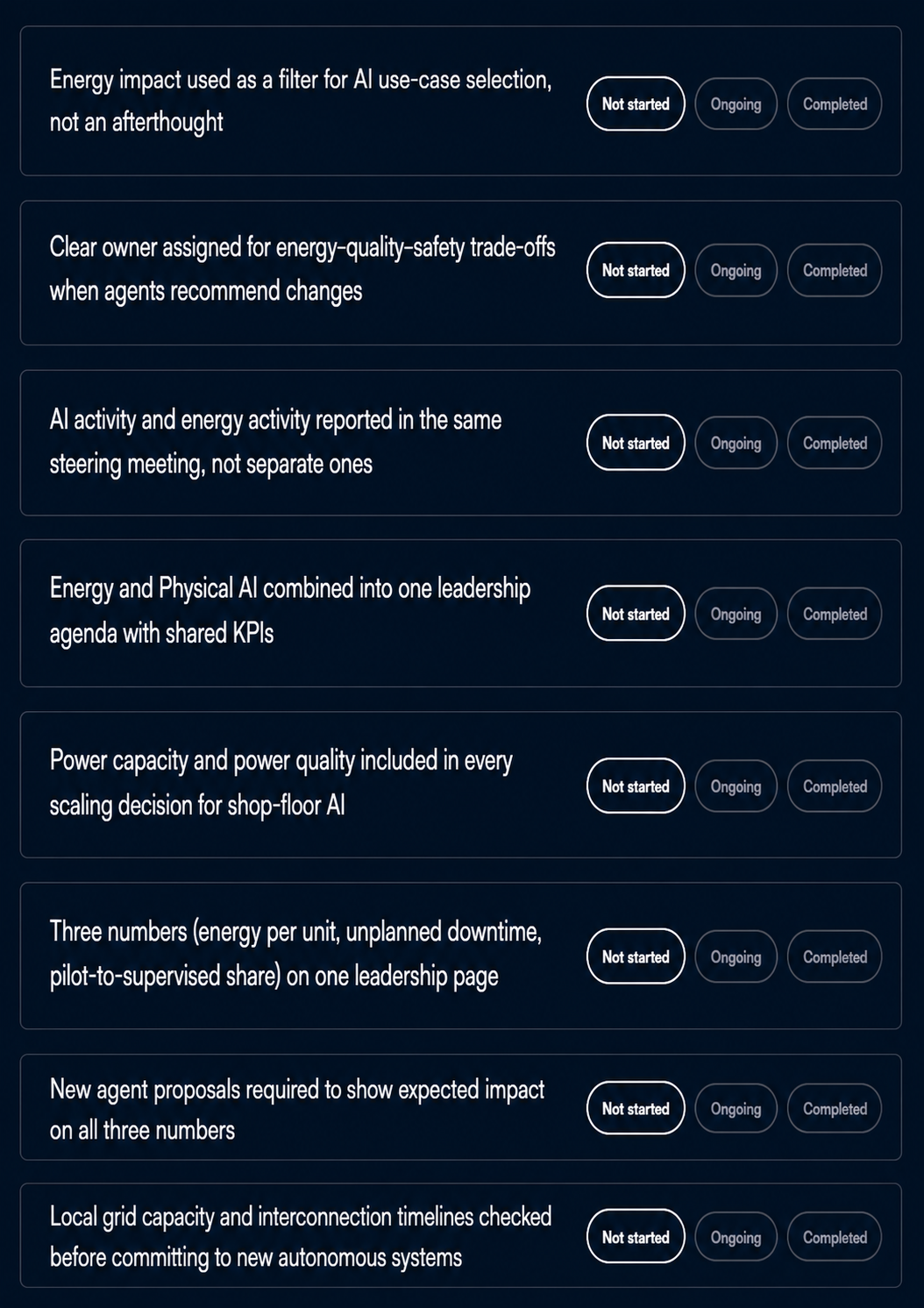
Action Plan for Decision Makers
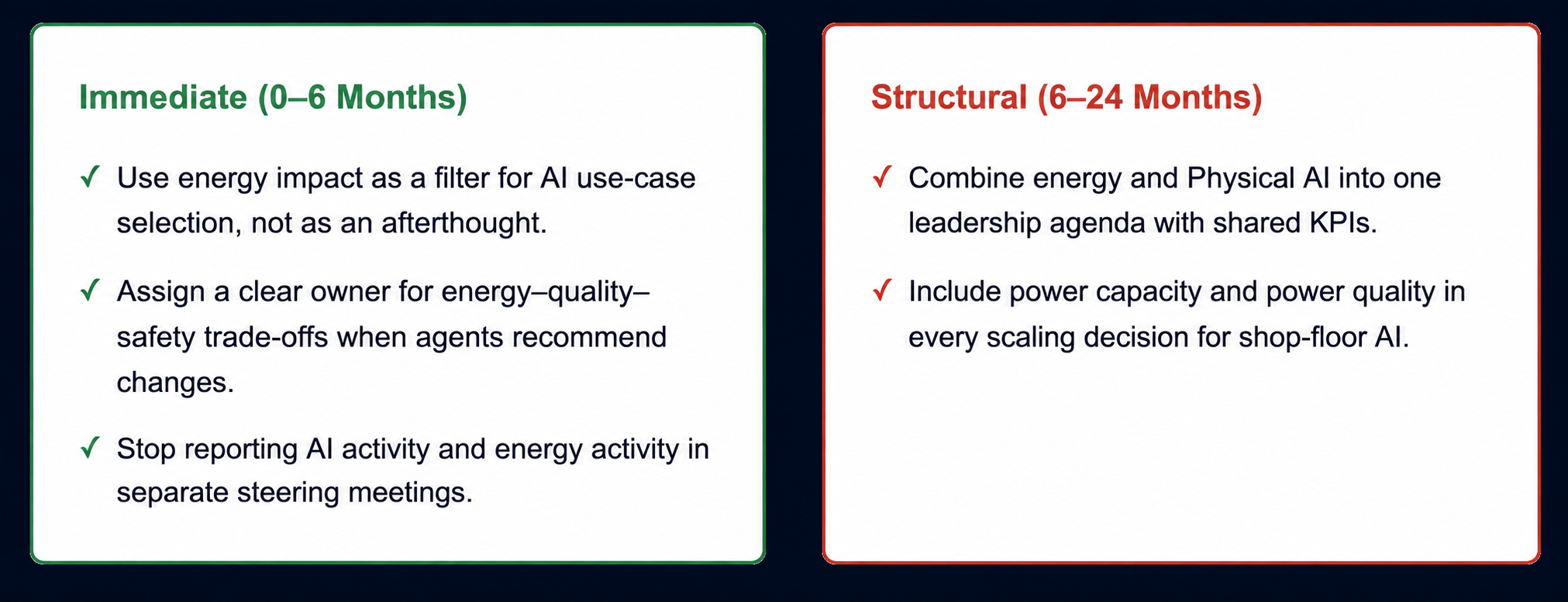
Checklist
Final Thought
Energy discipline and human judgment come down to the same leadership habit: refusing to let two true numbers sit in two separate meetings. Part III of this Week 36 set names that habit properly, not as a leadership style, but as a system-design job.
Efficiency Before Fuel was never a metaphor for this series. It was always the constraint underneath every other one.
Systems don't fail. Decisions do.
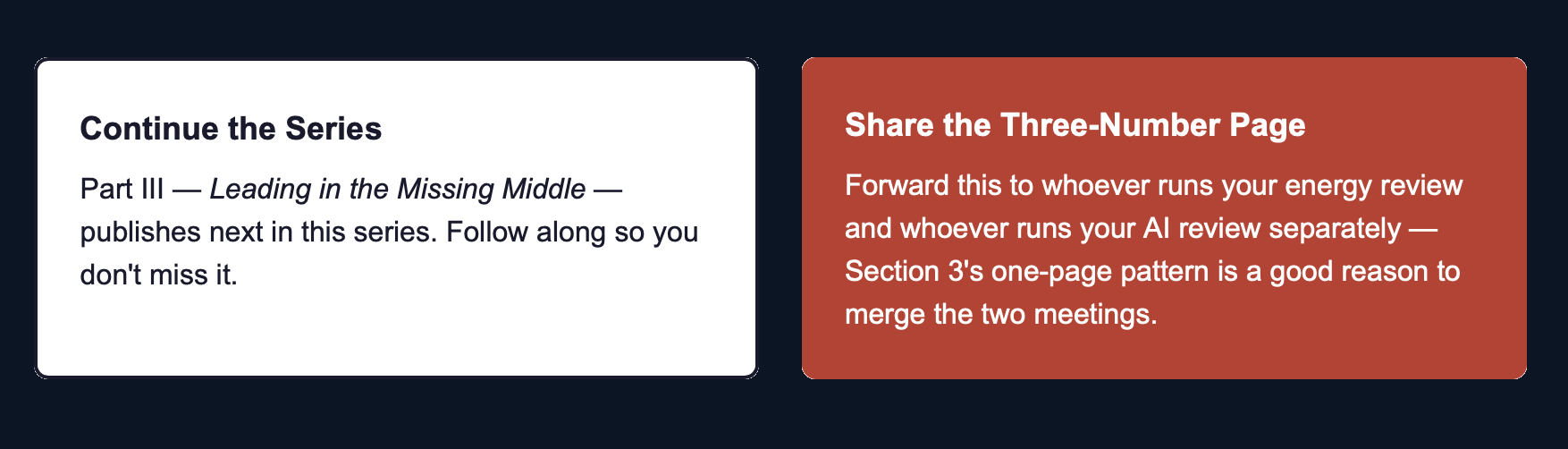
Take the Next Step
Subscribe to the Weekly Punch for weekly strategic clarity, direct to your inbox.
References
enkiai.com (2026) AI's Power Grid Bottleneck: The 2026 Crisis Revealed. [Online article].
IEA (2026) Key Questions on Energy and AI. Paris: International Energy Agency.
IIoT World (2026) 5 Technologies Reshaping Manufacturing in 2026. [Online article, citing the Stanford Emerging Technology Review 2026].
Rigzone (2026) Power Constraints Becoming Brake on Robotic Adoption. [Online article, citing Wood Mackenzie].
Disclaimer: This article synthesizes publicly available industry and energy-sector research current as of publication. Readers should verify current figures against the original publications before relying on them for strategic decisions. Verification Gate: flagged for pre-publication source check.
Ownership as Design.
Note: This article reflects my personalviews based on industry experience and publicly available information. It does not constitute professional, legal, or investment advice and does not represent the views of my employer. AI-generated visuals, concept and content by the author.
