The Leadership Risks of Autonomous Systems and How to Mitigate Them

AI Governance | Leadership Risk | Board Oversight | Manufacturing | Week 32 · Part II
AI GOVERNANCE | LEADERSHIP RISK | JULY 2026
What Boards and Executives Are Now Personally Accountable For,
and the Five Questions That Close Most of the Gap
Part I of this week's pair asked why pilots stall before production. Part II asks what happens once they don't, once an autonomous system is making real decisions, and something goes wrong at a level the board, not the plant, has to answer for.
Ownership as Design has always meant that responsibility is built in, not bolted on after an incident. For boards overseeing autonomous systems in 2026, that design choice is no longer optional, it is the difference between a governance record and a liability exposure.
Executive Summary
IN 60 SECONDS:
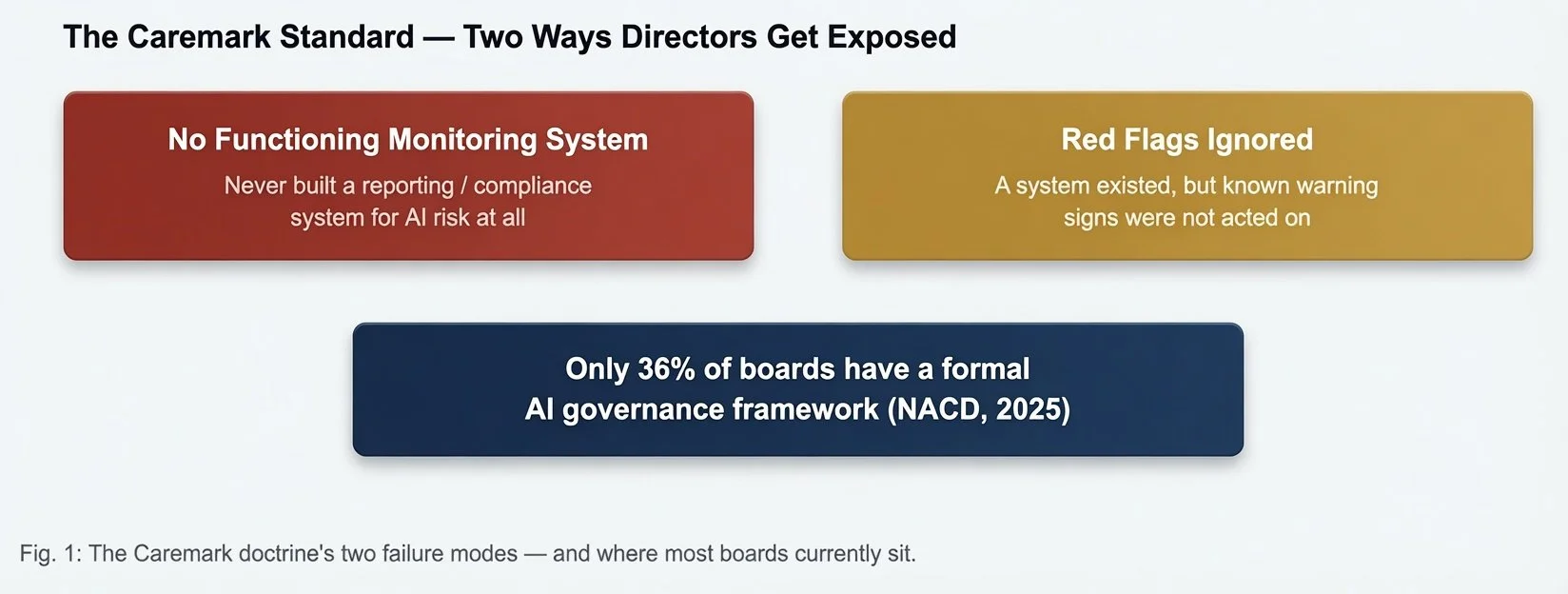
Autonomous AI systems raise the bar on an old legal standard, not a new one: under the Caremark doctrine, directors can be liable for failing to implement a functioning oversight system or for consciously ignoring red flags, and only 36% of boards currently have a formal AI governance framework.
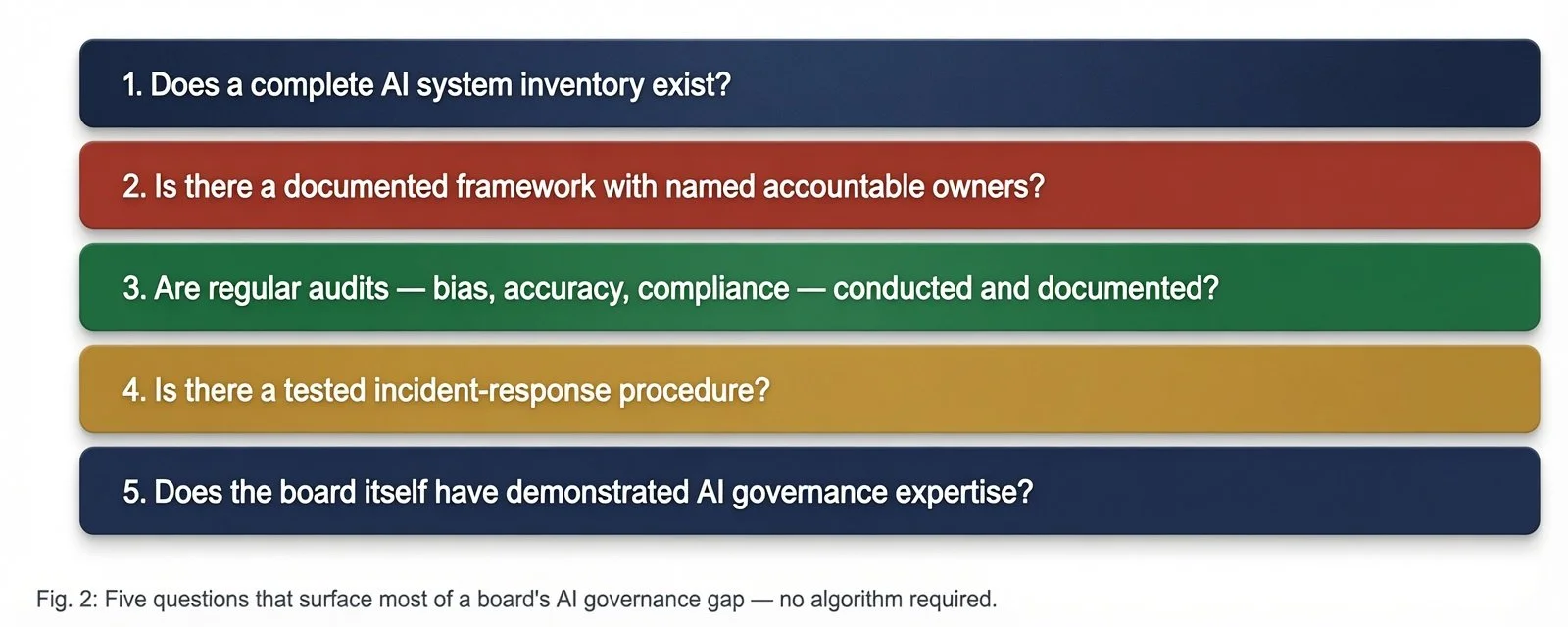
Five plain-language questions, is there a system inventory, a documented framework with named owners, regular audits, a tested incident-response procedure, and board-level AI expertise, close most of the governance gap without requiring anyone to understand the underlying model.
Boards should resist the instinct to supervise agents directly. Their job is to hold management accountable for the governance frameworks and oversight mechanisms the agents operate inside, calibrated to how much impact each system can have.
1. Why Autonomous Systems Raise the Bar on Fiduciary Duty
Boards have overseen technology risk for decades. Autonomous AI changes what "oversight" even means, not the underlying legal duty, but how hard it now is to satisfy.
Unlike traditional technology investments that operate within established risk frameworks, AI systems create autonomous decision-making capabilities that can expose organizations to regulatory violations, financial liability and reputational damage without direct human oversight (Relyance AI, 2025). The urgency is compounded by agentic AI specifically: systems that make autonomous decisions with limited human intervention are arriving roughly two to three years ahead of the risk-management structures organizations typically build to oversee them (Agility at Scale, 2026).
The legal standard underneath this is not new. Under Delaware's Caremark doctrine, board members can be liable to shareholders if they fail to implement a functioning system for reporting or compliance, or if they consciously ignore red flags within an existing system (WilmerHale, 2026). What has changed is exposure: the NACD's 2025 Board Practices and Oversight Survey found that only 36% of boards have implemented a formal AI governance framework, and just 6% have established AI-related management reporting metrics (WilmerHale, 2026), precisely the gap a Caremark-style claim is built to exploit. Under the EU AI Act itself, penalties fall on organizations rather than individual directors, but directors can still face personal liability under existing corporate governance law for inadequate oversight, a pattern that mirrors how cybersecurity governance liability developed before it (The Thinking Company, 2026).
👉 Key Insight
The law hasn't created a new duty for AI. It has started applying an old duty, the duty to monitor, to a class of systems that can now act faster than any monitoring meeting can convene.
2. The Five Questions That Close Most of the Gap
You don't need to understand the algorithm to close most of your governance gap. You need to ask the same questions you already ask about financial risk, cybersecurity and regulatory compliance.
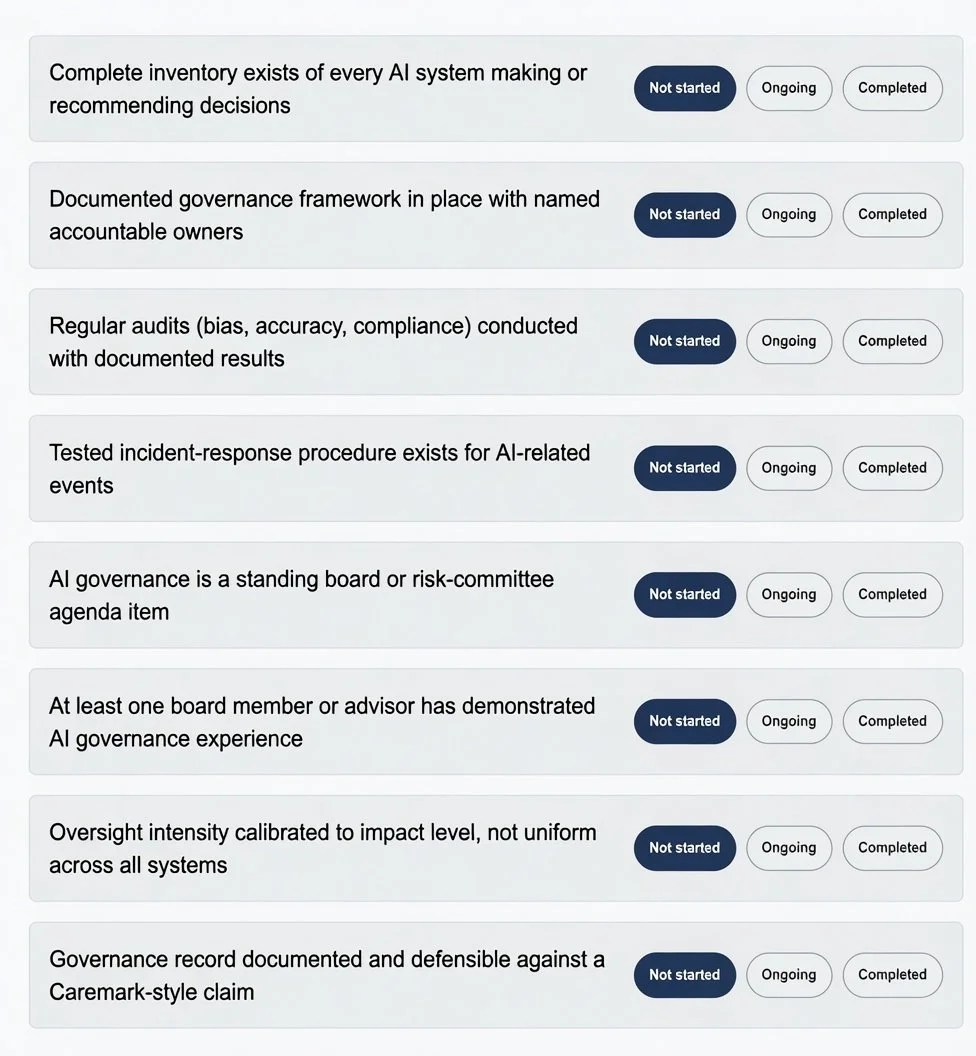
Four tests do most of the work: does a complete AI system inventory exist; is there a documented governance framework with named accountable owners; are regular audits, bias, accuracy, compliance, conducted with documented results; and is there a tested incident-response procedure (The Thinking Company, 2026). A fifth belongs alongside them for boards specifically: does at least one director bring demonstrated AI governance experience to the table. NACD data associates this fifth factor with a measurable edge, boards with at least one AI-governance-experienced member are 2.8 times more effective at identifying AI risks early (The Thinking Company, 2026).
None of these five questions requires technical fluency. Asking whether a framework exists, whether someone is accountable, whether it is audited, whether incidents get reported, and whether the board itself has the expertise to ask better questions next year, that alone surfaces the great majority of governance gaps, without anyone opening a model card.
👉 Key Insight
Ask whether a framework exists, whether someone is accountable, whether it's audited, and whether incidents get reported, and you will find most of your governance gap without opening a single model card.
3. What Boards Should Not Do: Lessons from Early Agentic AI Governance
The instinct to "get closer" to the technology is usually the wrong instinct for a board.
As autonomous systems begin acting without human intervention, boards must resist the urge to intervene operationally and instead hold management accountable for the governance frameworks, controls and oversight mechanisms that surround these systems (Directors & Boards, 2026). Two examples make the distance concrete: a financial-services firm deploying an AI agent that autonomously reviews client portfolios, identifies rebalancing opportunities and drafts trade recommendations before a human advisor arrives at the office; and a manufacturing company using AI agents that independently negotiate procurement terms with suppliers, compare bids, flag risks and execute purchase orders within pre-approved parameters (Directors & Boards, 2026). In neither case is the board's job to review the trade recommendation or the purchase order. It is to make sure the parameters, audits and escalation paths around that agent were designed responsibly.
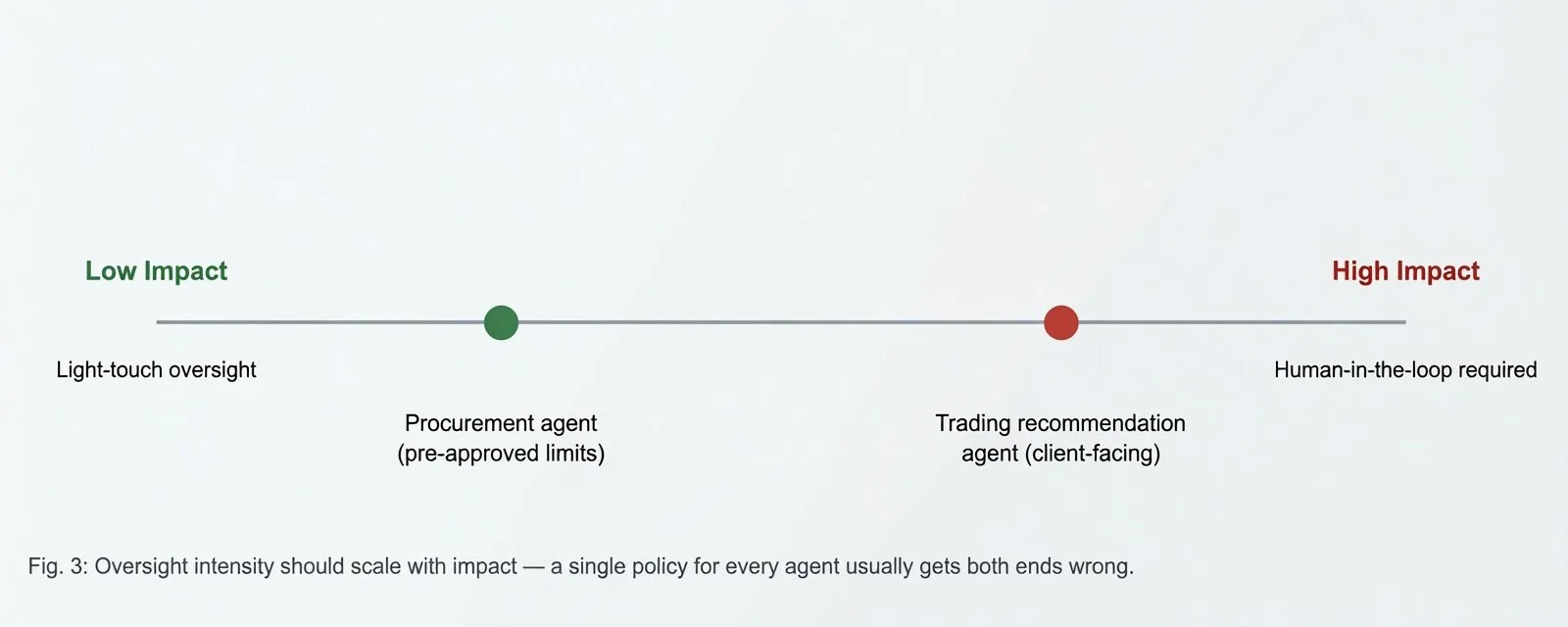
How much oversight any given agent needs is not uniform. The emerging consensus, echoed in graduated-autonomy approaches such as Singapore's regulatory framework, is that oversight intensity should scale with the potential impact of the agent's actions, even though translating that principle into enforceable, board-usable standards remains a work in progress (Chen, 2026). A procurement agent negotiating within pre-approved limits and a trading agent drafting client-facing recommendations do not warrant the same oversight architecture, and boards that apply one policy to both are usually over-governing the low-risk system and under-governing the high-risk one.
👉 Key Insight
The board's job is not to supervise the agent. It's to make sure someone, with the right expertise, is accountable for the framework the agent operates inside.
Action Plan for Decision Makers
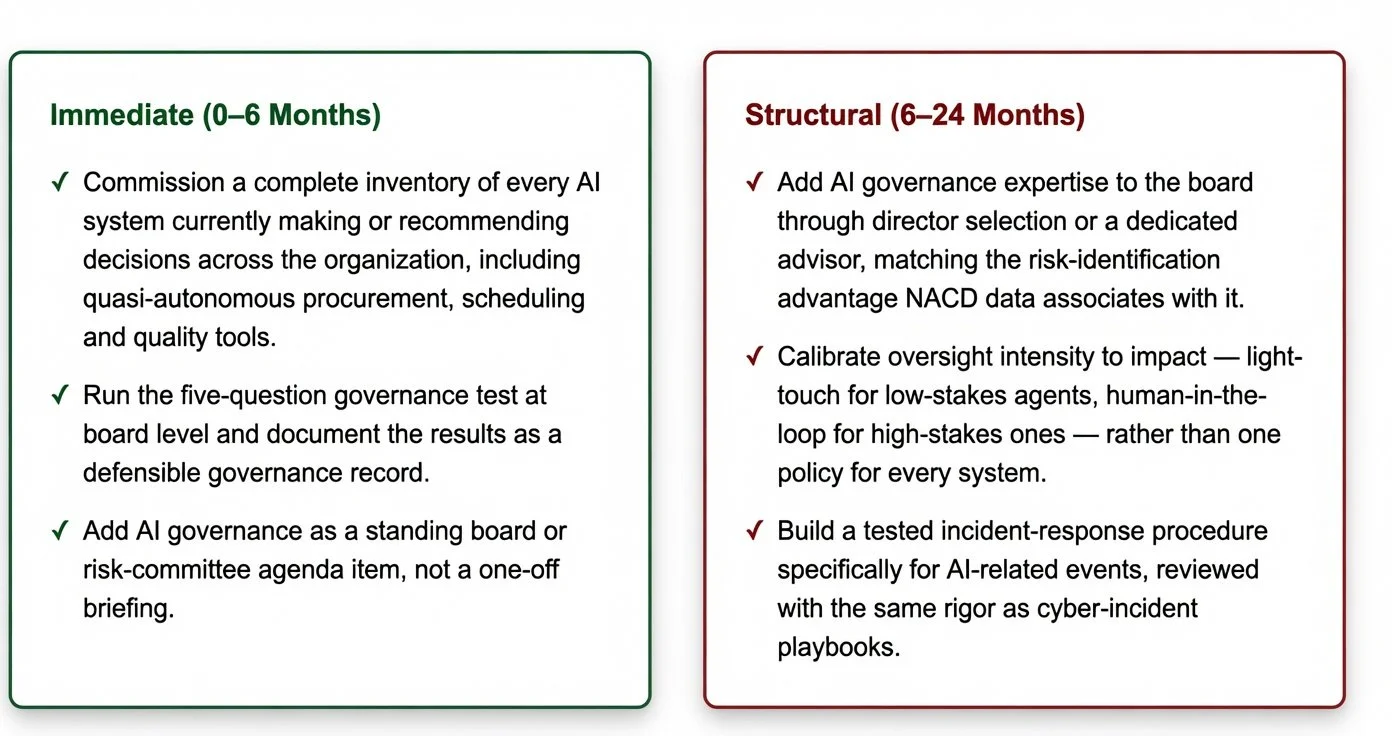
Checklist
Final Thought
Part I of this pair asked what it takes to trust an AI system enough to put it into production. Part II shows why that trust has to be documented, not just felt, because the moment an autonomous system acts, the question of who was accountable for the framework around it stops being rhetorical.
Ownership as Design means the governance record exists before anyone needs it. Efficiency Before Fuel means that record is worth more than any single model's accuracy score.
Systems don't fail. Decisions do.
Take the Next Step
Subscribe to the Weekly Punch for weekly strategic clarity, direct to your inbox.
References
Agility at Scale (2026) Board Oversight of AI Governance: A Director's Guide. [Online article].
Chen, H-Y. (2026) AI Governance and Regulation 2026: A Complete Guide to Global Frameworks. [Online article].
Directors & Boards (2026) Agentic AI and Corporate Governance. [Online article].
Relyance AI (2025) Board-Level AI Risk: Data Journeys for Directors. [Online briefing].
The Thinking Company (2026) AI Governance for Board Members, 2026 Guide. [Online guide].
WilmerHale (2026) Managing Legal Risk in the Age of Artificial Intelligence: What Key Stakeholders Need to Know Today. [Client alert].
Disclaimer: This article synthesizes publicly available governance research and legal commentary current as of publication. No detailed section brief was supplied for this week; body sections, framing and evidence selection were originated by the writer from the two given titles. This article discusses general governance and liability trends and is not legal advice; boards should consult qualified counsel on their specific Caremark and jurisdictional exposure. Verification Gate: flagged for pre-publication source check.
Ownership as Design.
Note: This article reflects my personalviews based on industry experience and publicly available information. It does not constitute professional, legal, or investment advice and does not represent the views of my employer. AI-generated visuals, concept and content by the author.
