The New Leadership Skill: Decision-Making Under AI-Induced Uncertainty
Leadership |AI | Decision-Making | Judgment | Manufacturing | Week 33 · Part I
LEADERSHIP | AI DECISION-MAKING | AUGUST 2026
Why Traditional Decision Frameworks Break Down When AI Systems Generate More Options, Faster Feedback and New Forms of Ambiguity, and What Leaders Must Learn Instead
Week 32 closed this series' run through governance with a hard question for boards: who is accountable when an autonomous system acts? Week 33 asks the question underneath that one, even with the right framework in place, how does a human leader actually decide, in the moment, whether to trust what the system just told them?
Efficiency Before Fuel has never been about the machine. It's about the decision. And the decision that matters most right now isn't made by the AI Agent, it's made by the person deciding whether to believe it.
Executive Summary
IN 60 SECONDS:
AI is inverting the classic leadership problem: 60% of executives now regularly use AI to support their decisions, and Gartner projects that by 2027 half of all business decisions will be augmented or automated by AI agents, yet the underlying uncertainty hasn't disappeared, it has changed shape.
The new leadership skill isn't "using AI better." It's developing calibrated judgment: knowing when to trust, challenge, override or escalate a probabilistic recommendation under incomplete certainty.
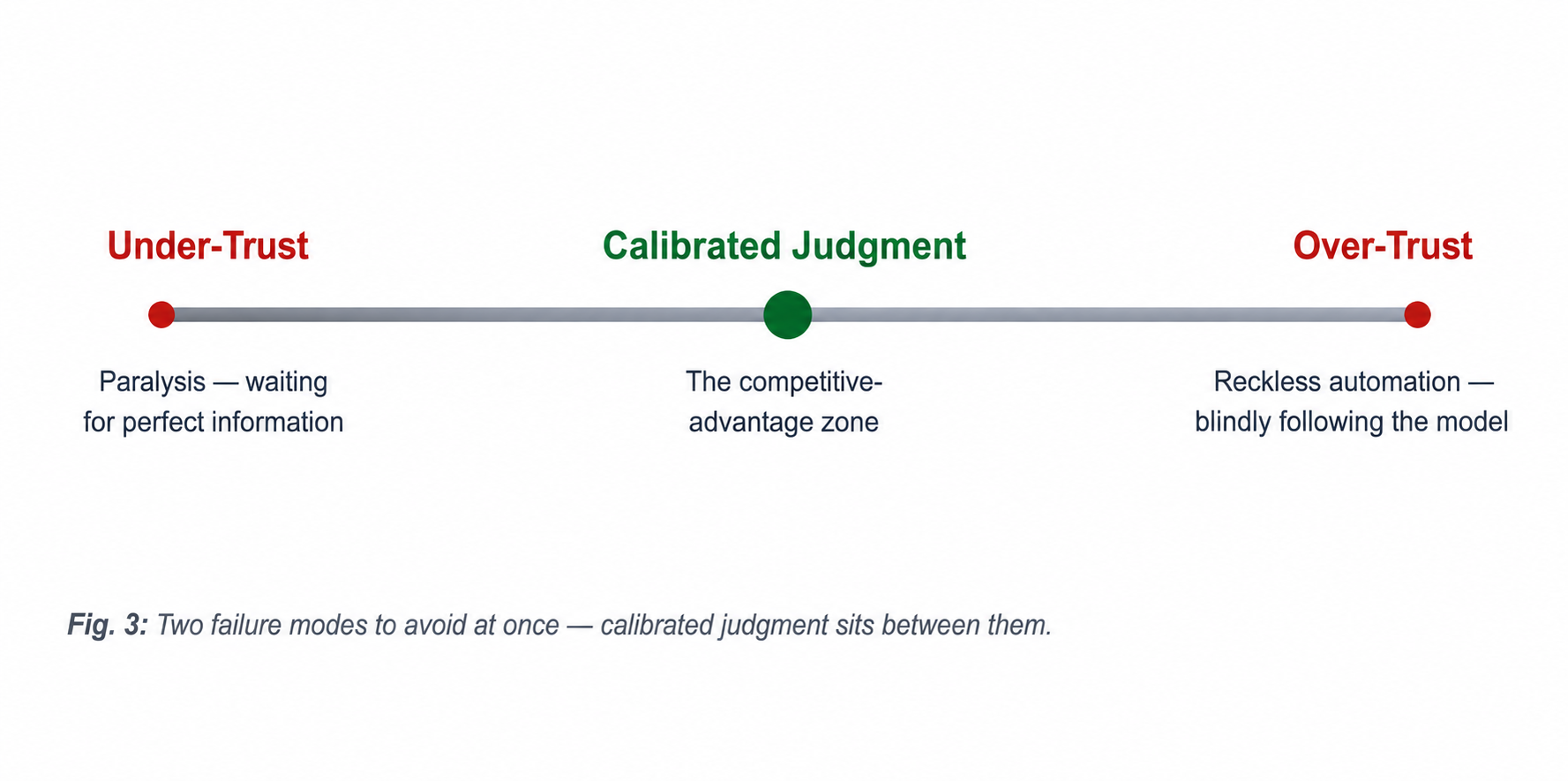
Leaders who develop this capability avoid both failure modes at once, the paralysis of waiting for perfect information and the reckless automation of blindly following the model.
1. How AI Changes the Nature of Uncertainty
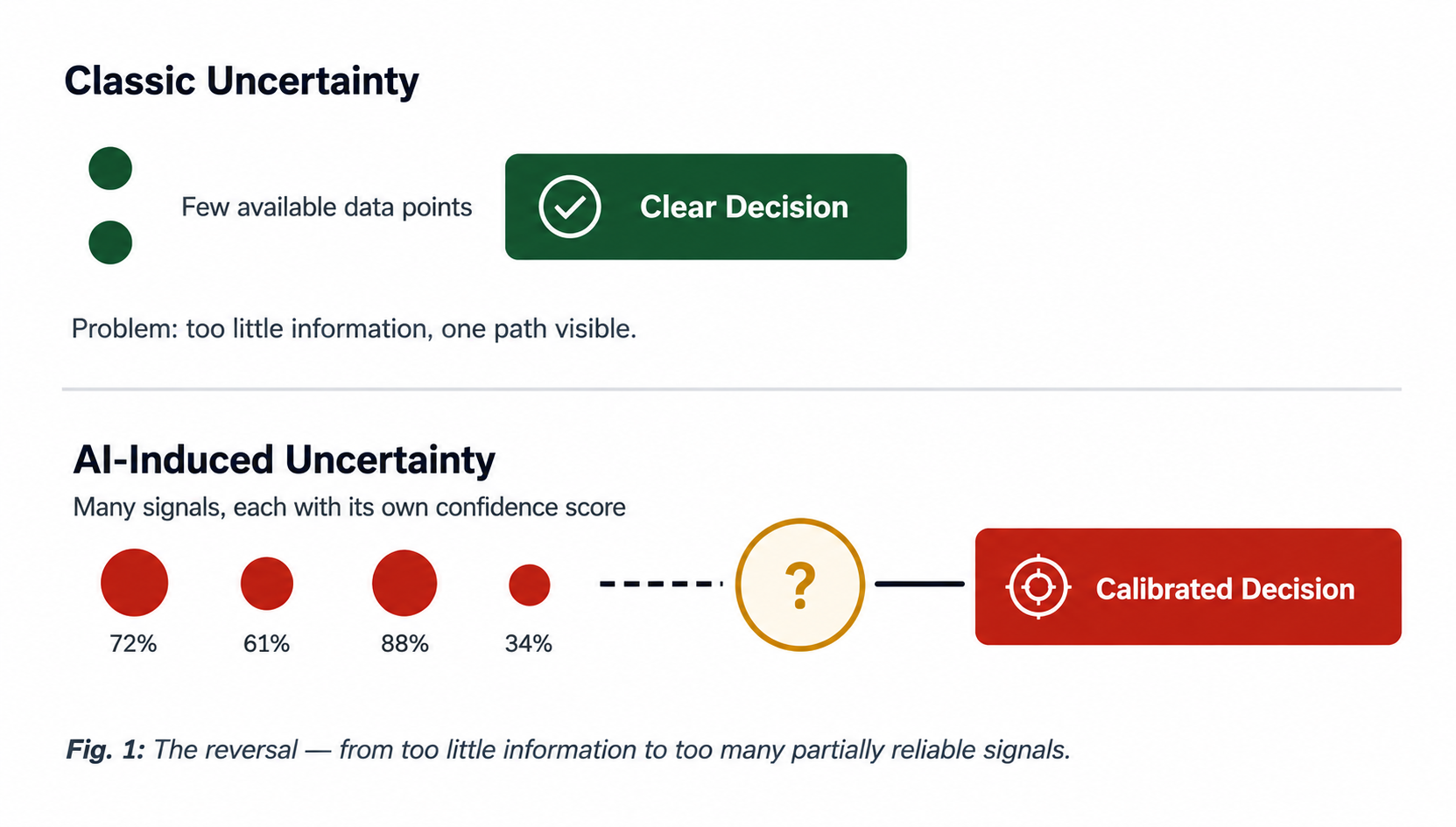
Leaders used to lose sleep over not having enough information. Now they lose sleep over having too much of it, delivered with confidence scores they were never trained to read.
Classic uncertainty in industrial environments was often information scarcity. AI reverses this: leaders now face information abundance combined with new ambiguities around model confidence, data drift, edge cases and multi-agent interactions. Decisions must frequently be made with probabilistic rather than binary outputs, and the cost of both over-trusting and under-trusting AI can be high.
The scale of the reversal is already visible in the data. Deloitte's 2026 Global Human Capital Trends survey, conducted with Oxford Economics across more than 9,000 business and HR leaders in 89 countries, found that 60% of executives now regularly use AI to support their decisions, and cites Gartner's projection that by 2027 half of all business decisions will be augmented or automated by AI agents (Deloitte, 2026). The same research points to the cost of getting the trust calibration wrong: citing a widely referenced Oracle study, it notes that 85% of business leaders regret or question decisions they made in the past, and 72% say the sheer volume of data, and their lack of trust in it, has stopped them from making a decision at all (Deloitte, 2026, citing Oracle, 2023).
👉 Key Insight
AI does not eliminate uncertainty, it transforms it. The new challenge is managing decision quality when information is plentiful but reliability is partial.
2. The Core Elements of Decision-Making Under AI-Induced Uncertainty
The skill nobody put on a leadership competency framework two years ago is now the one separating winners from watchers.
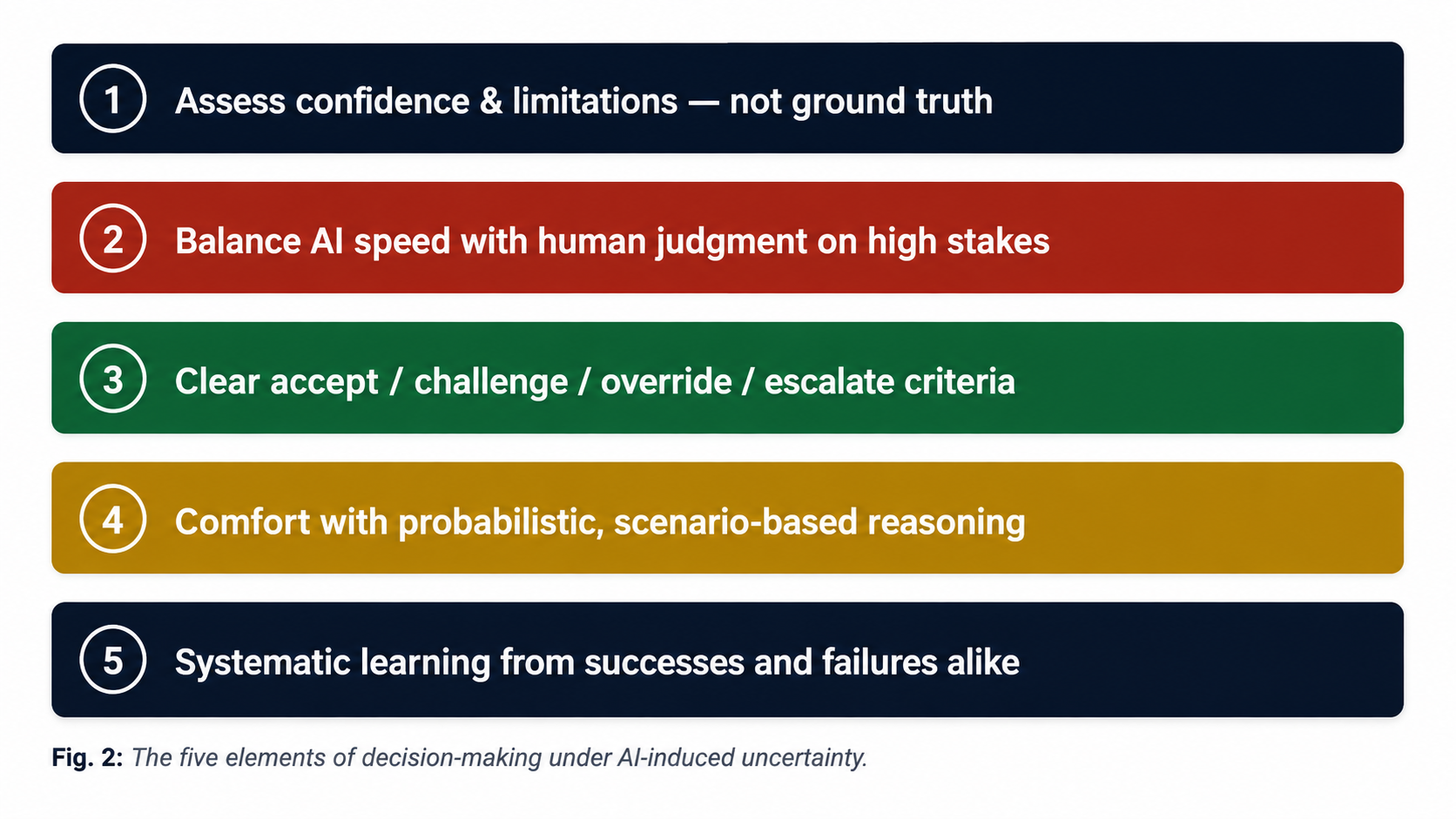
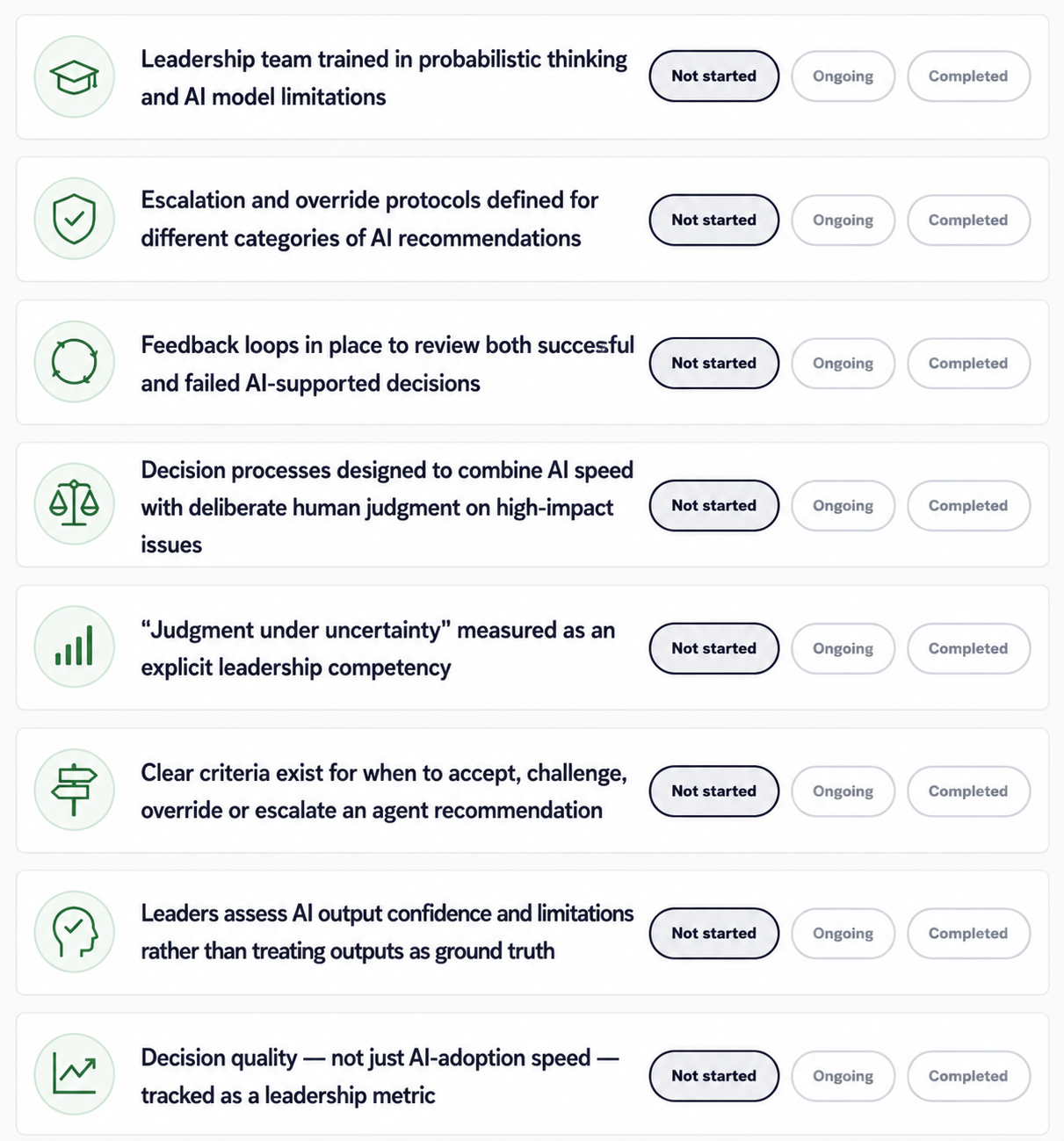
Effective leaders in AI-rich environments develop five capabilities: the ability to assess the confidence and limitations of AI outputs rather than treating them as ground truth; structured approaches to balancing the speed of AI recommendations with the need for human judgment on high-stakes issues; clear criteria for when to accept, challenge, override or escalate agent decisions; comfort with probabilistic thinking and scenario-based reasoning instead of seeking absolute certainty; and mechanisms to learn systematically from both successful and failed AI-supported decisions.
Deloitte frames the distinction in blunt terms: as 2026 unfolds, watchers continue to treat AI as a technology experiment, while winners understand it as a catalyst for reinvention, reimagining how work gets done and using AI to amplify human judgment at scale rather than replace it (Deloitte, 2026). Independent research from early 2026 across Deloitte, EHL and the International Leadership Association points to why this distinction is so hard to close in practice: leadership governance maturity is lagging the pace at which AI is being embedded into decisions, with many organizations acting on AI outputs without clear visibility into how those outputs were generated, and without explicit discipline about where human judgment must remain in the loop (PositivEnergy Consulting, 2026).
👉 Key Insight
The scarce resource is no longer information – it is calibrated judgment under conditions of partial knowledge.
3. Practical Implications for Industrial Leaders
On the shop floor, this isn't philosophy. It's the three seconds before a supervisor approves an agent's parameter change.
In manufacturing and operational settings this skill shows up in real time: deciding whether to accept an agent's parameter adjustment, whether a predictive-maintenance recommendation justifies stopping a line, or how to weigh conflicting signals from multiple AI systems. Leaders who develop this capability reduce both paralysis, waiting for perfect information ,and reckless automation, blindly following the model.
The discipline transfers from an adjacent domain worth borrowing from: engineering leaders working with AI-assisted coding report the same pattern, velocity looks better on paper while systems quietly grow more fragile, because nobody wrote down when to trust generated output, when to escalate, and when speed is worth the risk; left undocumented, the default always drifts toward speed (Forbes Councils / Aburto, 2026). The same undocumented-default risk applies directly to an agent's parameter change or a predictive-maintenance alert, and the fix is the same one used across this series: simulate and validate before the agent's proposed action ever reaches a physical line, the same digital-twin discipline this series covered when Siemens and NVIDIA built it into their Industrial AI Operating System (see Week 30).
👉 Key Insight
Decision quality under AI uncertainty becomes a measurable competitive advantage – especially in high-stakes, safety-critical environments.
Action Plan for Decision Makers
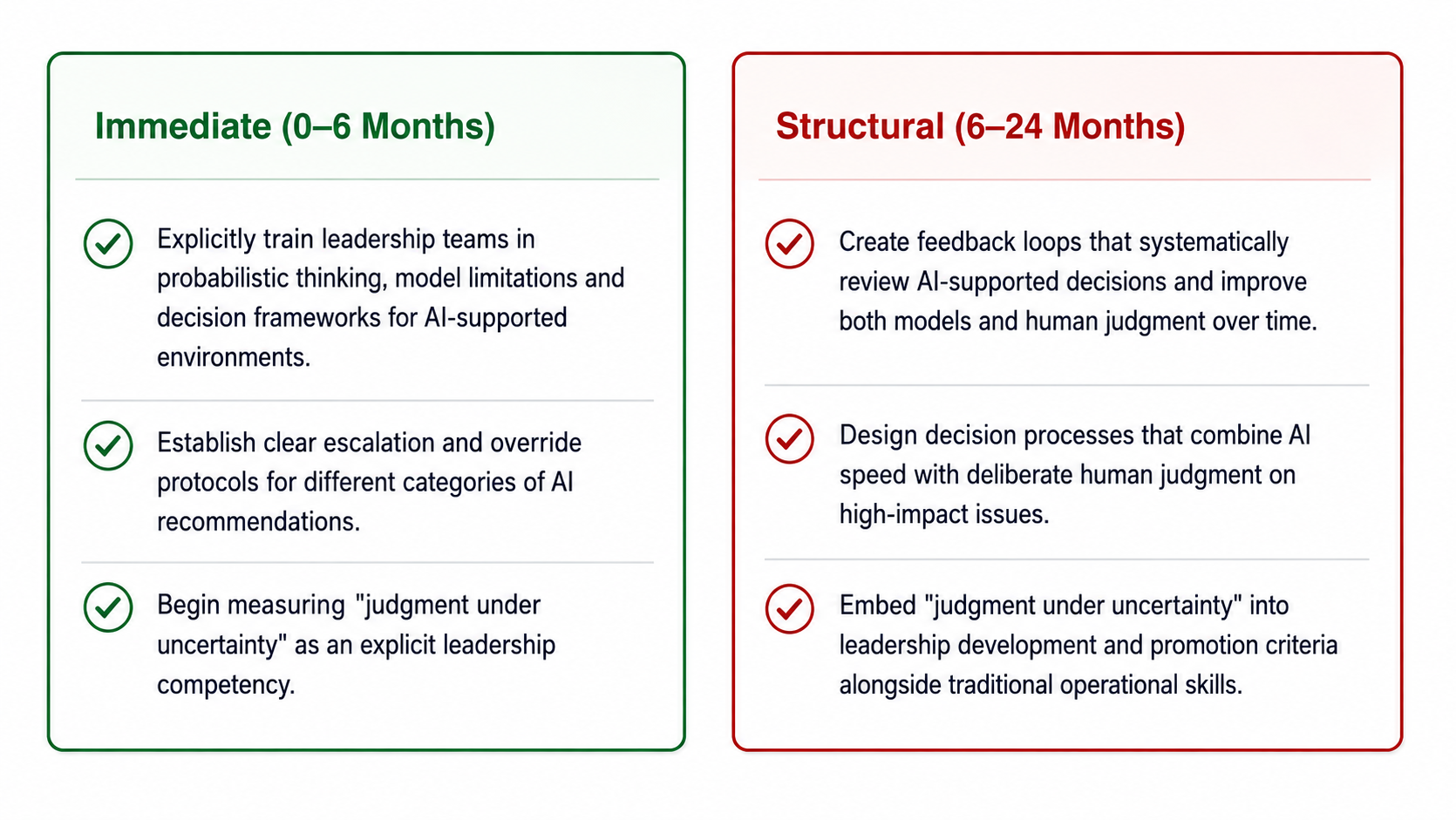
Checklist
Final Thought
Naming the skill is the easy part. Part II of this Week 33 pair goes after the harder question: why has judgment become the scarcest resource in the organization — scarcer, now, than the information it's supposed to interpret?
Efficiency Before Fuel means the organization that wins isn't the one with the most AI-generated options. It's the one whose people know which option to trust.
Systems don't fail. Decisions do.
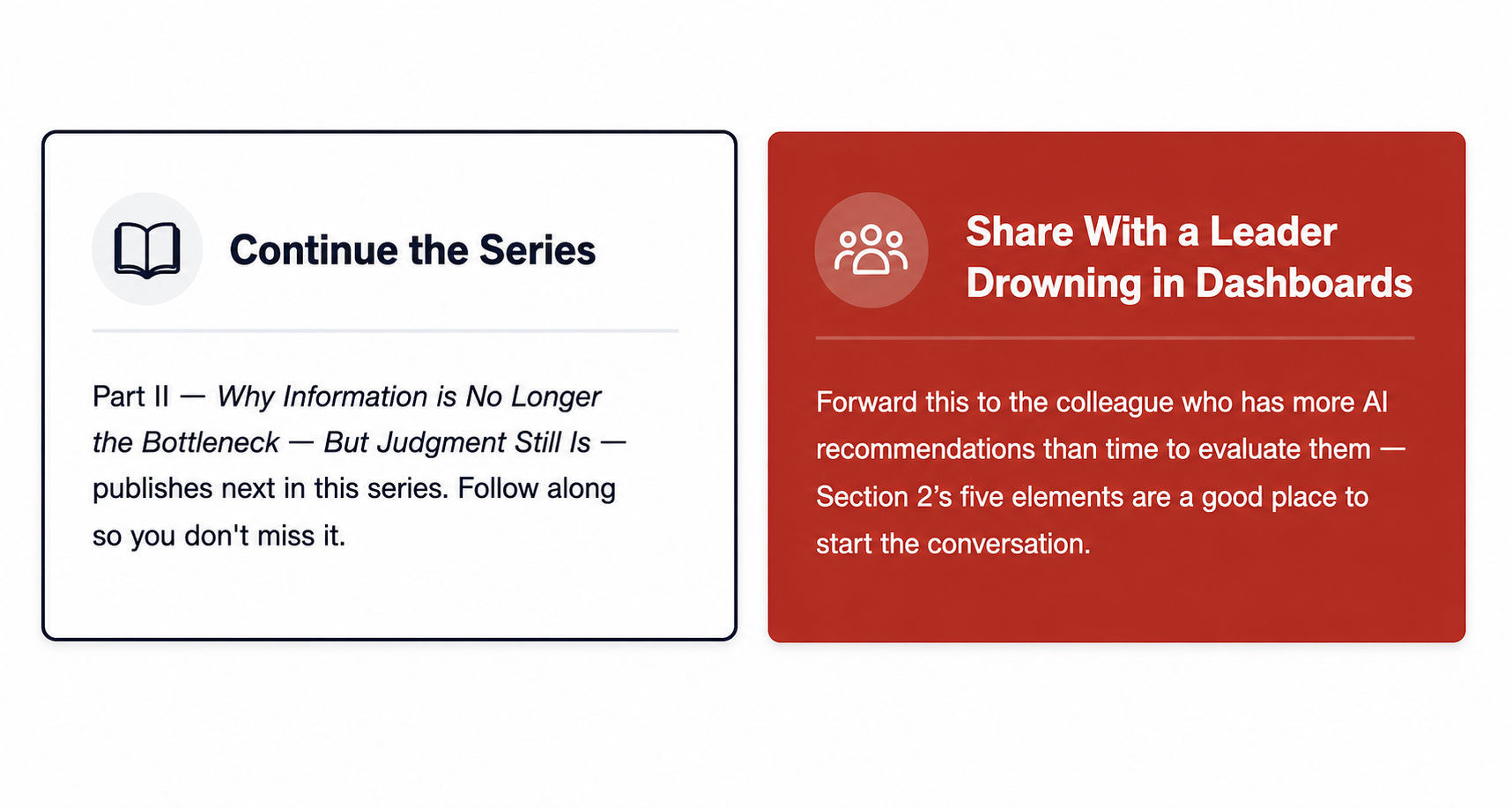
Take the Next Step
Subscribe to the Weekly Punch for weekly strategic clarity, direct to your inbox.
References
Deloitte (2026) Decision-Making with AI. Deloitte Insights, 2026 Global Human Capital Trends [citing Gartner, 2026 and Oracle, 2023].
Deloitte (2026) The Future of Human-Led, AI-Powered Leadership. [Forbes BrandVoice].
Forbes Councils / Aburto, L. (2026) Software Engineering in the Age of AI: From Capacity to Judgment. [Online article].
PositivEnergy Consulting (2026) The Judgment Imperative: Leadership in the AI Era. [Online article].
Disclaimer: This article synthesizes publicly available research current as of publication. Quantitative figures are attributed to their original sources; where a figure is reported by a secondary source citing a further original study (e.g. Gartner, Oracle), both are named. Readers should verify current figures against the original publications before relying on them for strategic decisions. Verification Gate:flagged for pre-publication source check.
Note: This article reflects my personalviews based on industry experience and publicly available information. It does not constitute professional, legal, or investment advice and does not represent the views of my employer. AI-generated visuals, concept and content by the author.
