Building Trust in Industrial AI: From Pilot to Production
Physical AI | TrustScale-Up | Manufacturing | Week 32 · Part I
PHYSICAL AI | TRUST & ADOPTION | JULY 2026
Why Most Manufacturing AI Pilots Never Scale, and What Separates the Ones That Do
Week 31 spent two long articles on what regulation requires. Week 32 asks a quieter question underneath all of it: even where the rules are clear, why do most industrial AI pilots never make it to the shop floor at scale?
The honest answer has less to do with the model and more to do with trust. Efficiency Before Fuel has always meant that the decision matters more than the machine, and nowhere is that clearer than in the gap between a pilot that works and a production system the organization actually believes.
Executive Summary
IN 60 SECONDS:
Industry research puts the scale of the problem in stark terms: RAND Corporation research found 80.3% of enterprise AI projects fail to deliver promised business value, and Gartner's 2026 survey found only 28% of AI use cases fully meet ROI expectations, pilots are not the hard part.
Trust is not a UX feature added at the end. It requires transparency about what a system does and doesn't do, demonstrated reliability on tasks people actually care about, and training that builds the judgment to know when to override a model's output.
Manufacturers that scale successfully assign clear ownership, involve finance before benefits are claimed, and build AI into the governance structures that already protect production, rather than treating scale as a bigger version of the pilot.
1. The Pilot-to-Production Gap Nobody Budgets For
A pilot can show that AI produces an answer. Production begins the moment the organization has to trust that answer, act on it consistently, and stay accountable for the result.
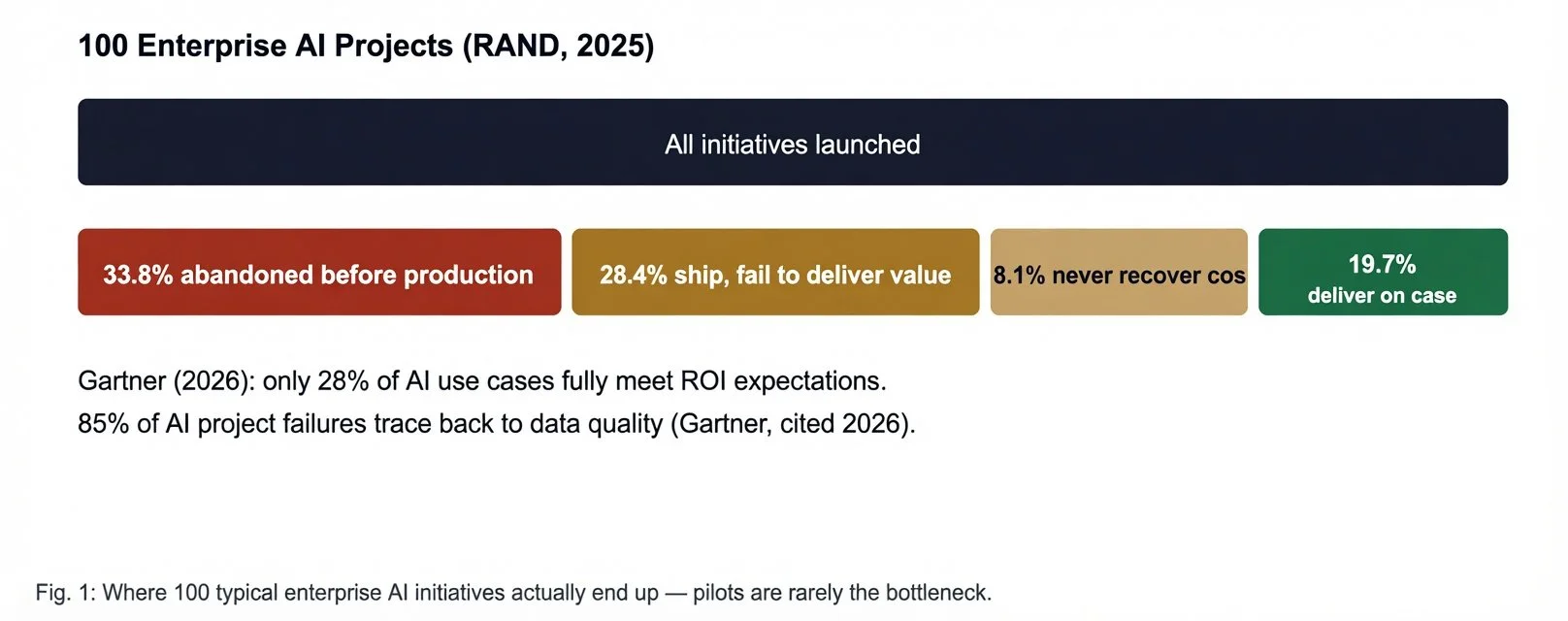
That gap is larger than most steering committees assume. RAND Corporation research, reported by industry analysts, found that 80.3% of enterprise AI projects fail to deliver promised business value, 33.8% are abandoned before reaching production, 28.4% reach production but fail to deliver expected value, and 18.1% run but never recover their investment, leaving only 19.7% that deliver on the original business case (AI Assembly Lines, 2026). Gartner's April 2026 survey of infrastructure and operations leaders found a similarly narrow success rate: only 28% of AI use cases fully succeed and meet ROI expectations (AI Assembly Lines, 2026).
The proximate cause is usually data. Gartner projects that through 2026 organizations will abandon 60% of AI projects unsupported by AI-ready data, and finds that 85% of AI projects fail because of poor data quality overall (AI Assembly Lines, 2026), because pilots are typically evaluated on a curated, manually cleaned dataset that simply does not exist once the same model has to run at production volume, across every plant's own equipment and local practice.
👉 Key Insight
A pilot proves AI can produce an answer. Production begins when the organization trusts that answer enough to act on it consistently — and stay accountable for the result.
2. What Trust Actually Requires; Not Just Better Models
Trust is not a UX feature bolted on after technical delivery. It is what technical delivery is for.
User trust in AI outputs is earned, not assumed: through transparency about what the system does and does not do, through demonstrated reliability on the tasks users actually care about, and through training that builds the judgment to know when to act on a model's output and when to override it (Digital Divide Data, 2026). Skip any of the three, and a technically accurate model still fails to translate into adopted, trusted behavior on the floor.
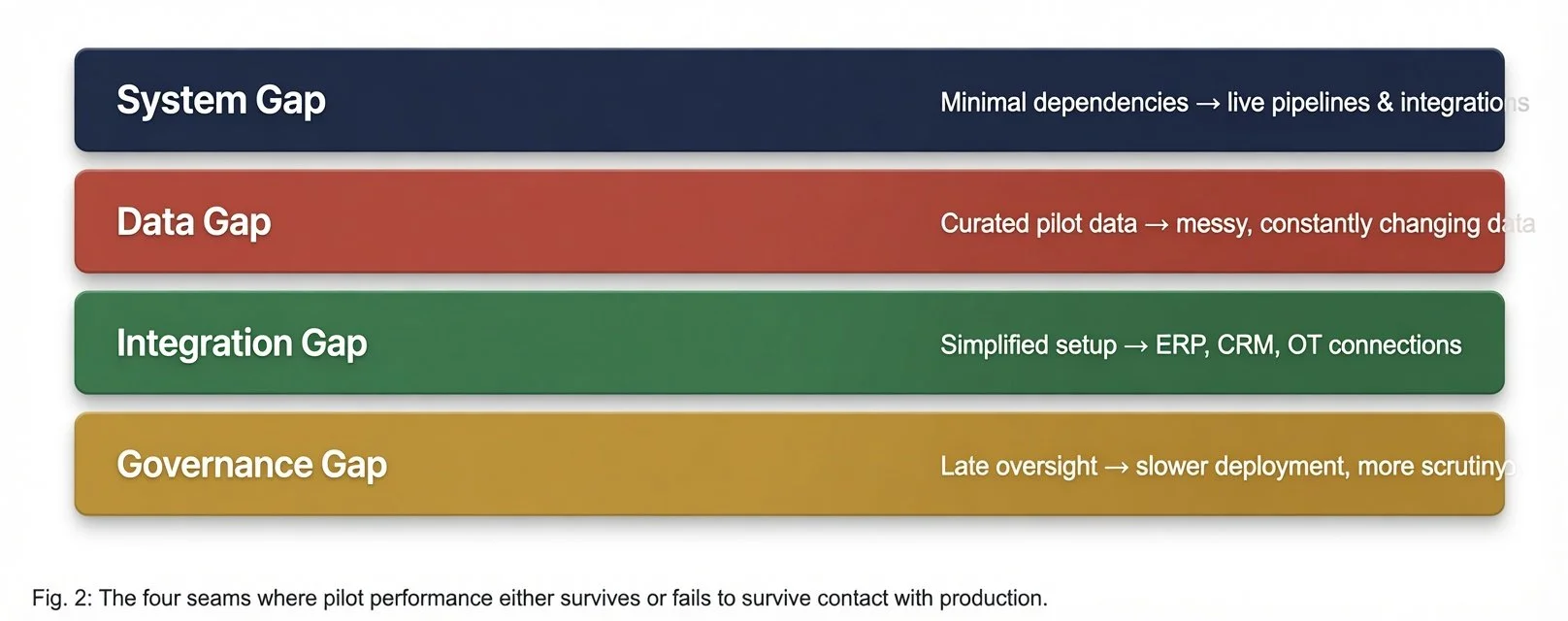
The same shift from pilot to production tends to break along four predictable seams: a system gap, where a model that ran with minimal dependencies now depends on live data pipelines and integrations; a data gap, where curated pilot data gives way to messy, constantly changing production data; an integration gap, where simplified pilot setups now have to connect into ERPs, CRMs and OT systems; and a governance gap, where oversight introduced late slows deployment and increases scrutiny of every hallucination or exposure (Ema, 2026). Each of these seams is exactly where trust either survives contact with production or doesn't.
👉 Key Insight
Trust and safety work that makes model behavior interpretable and auditable is not a soft add-on after technical delivery — it is what technical delivery is for.
3. Practical Lessons: What Separates Scaled Deployments from Stalled Pilots
Manufacturers who scale successfully rarely have better AI than the ones who stall. They have better ownership.
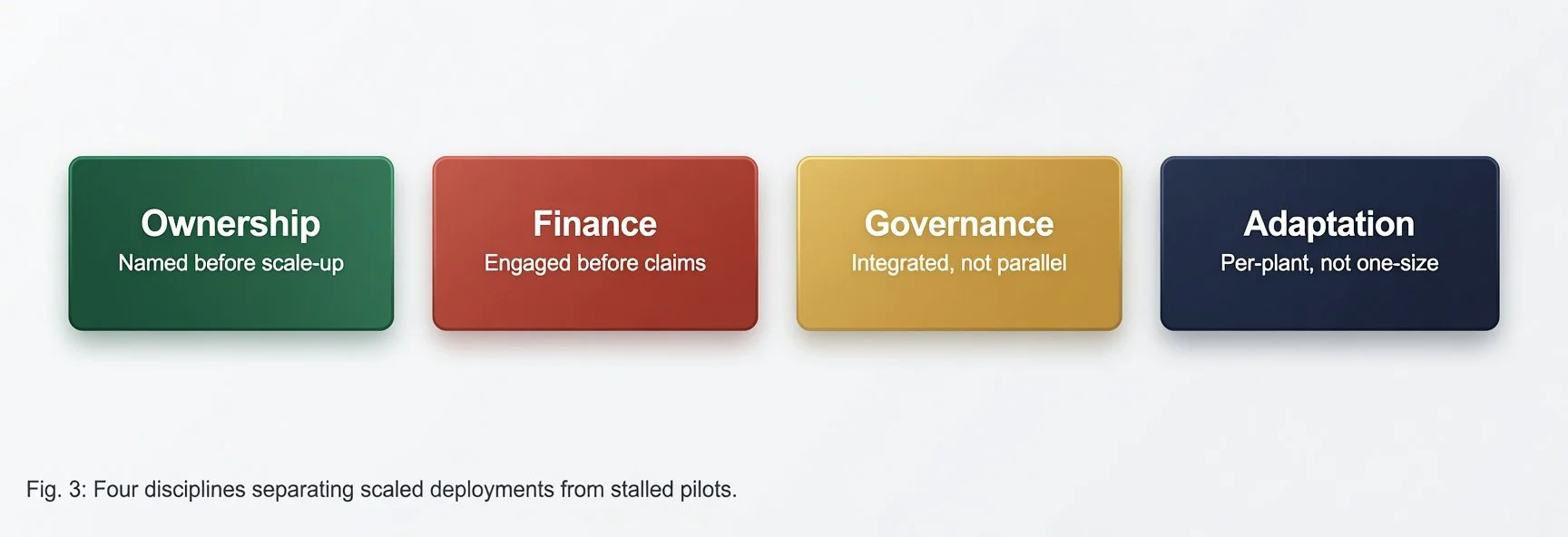
The organizations closing the gap are assigning clear ownership before scale-up begins, involving finance before benefits are claimed rather than after, and building AI into the governance structures that already protect production, safety and quality, instead of running a parallel track that has to be reconciled later. They are also accepting, up front, that scale requires adaptation: the system has to work with the reality of each plant, not the assumptions of the first successful trial (Manufacturing Today, 2026).
Week 30's Siemens example is a useful illustration of the same discipline in practice: rather than deploying agents plant-by-plant without a common architecture, Siemens and NVIDIA built one fully governed, AI-driven site at the Erlangen Electronics Factory as a repeatable blueprint, treating governance and ownership as the thing being scaled, not just the technology.
👉 Key Insight
Scale doesn't test whether the technology works. It tests whether the organization can make the result part of how it operates.
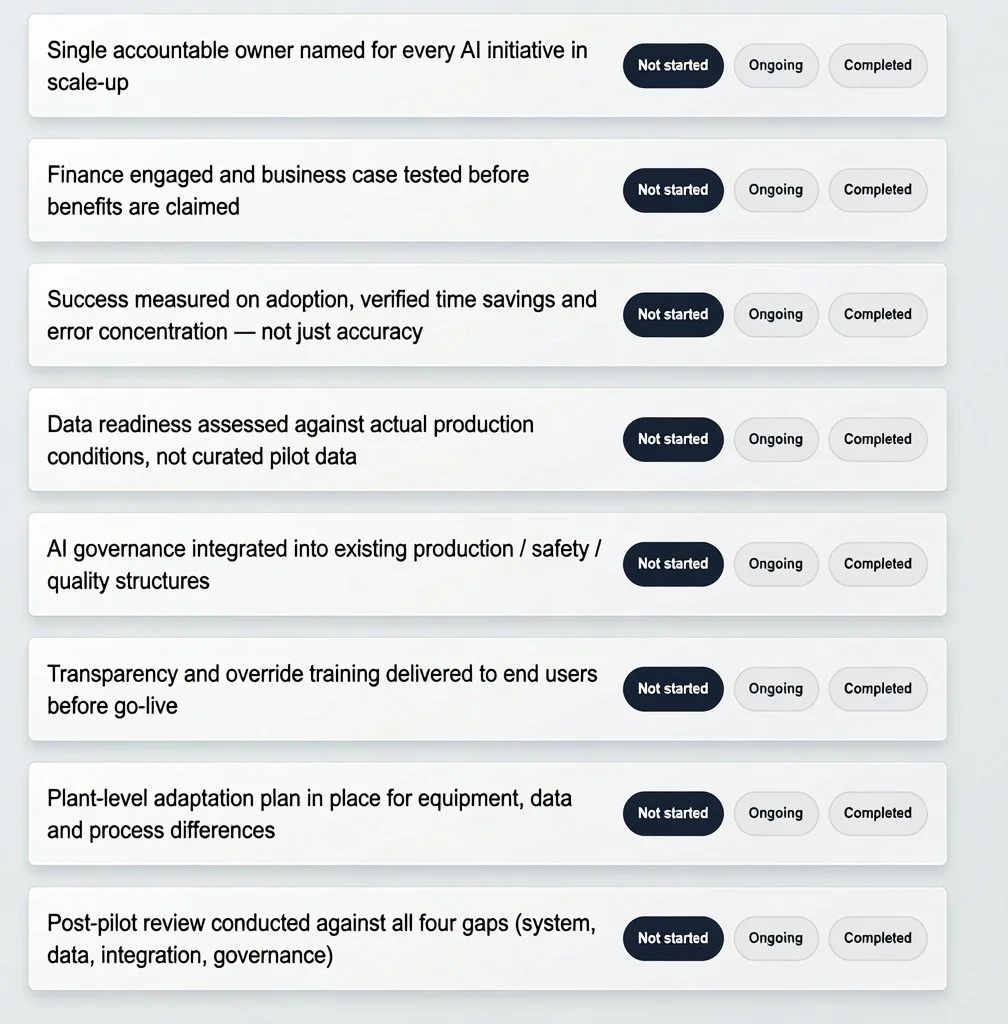
Action Plan for Decision Makers
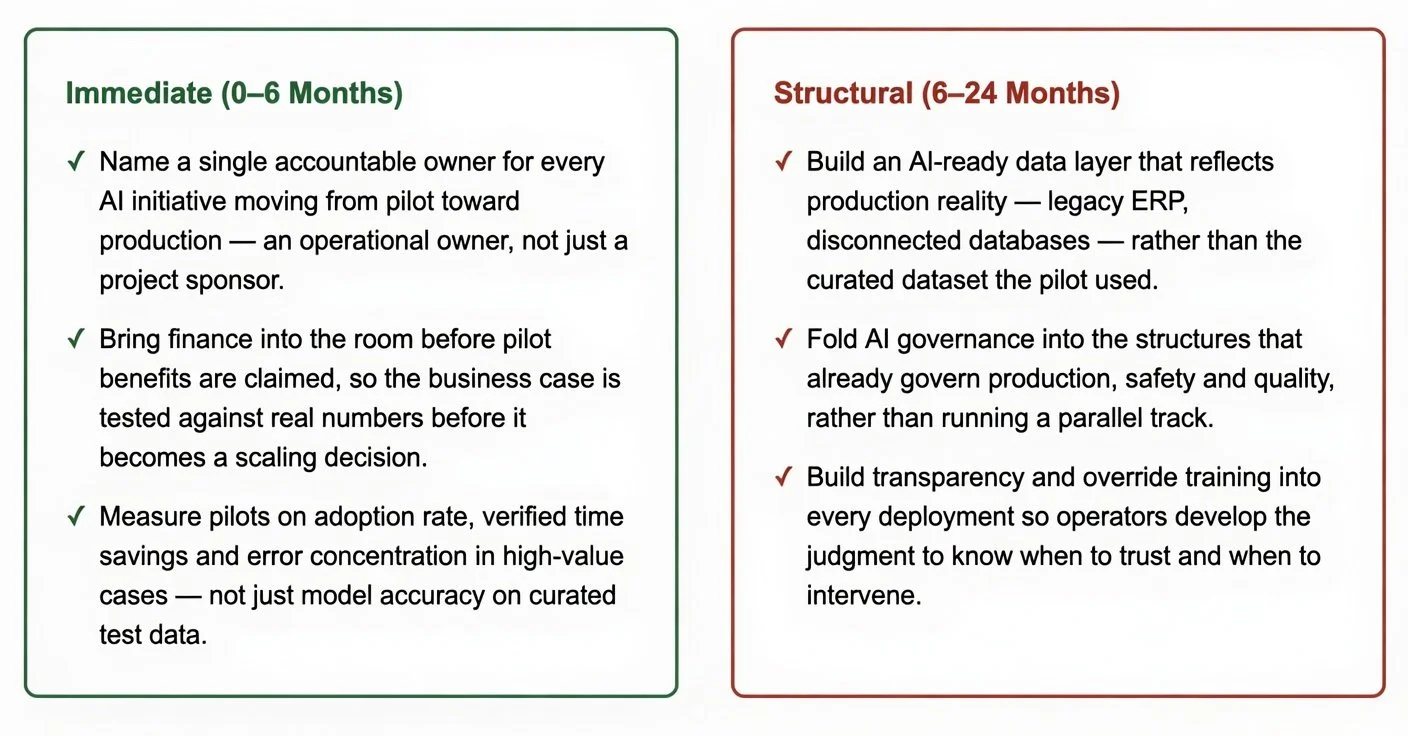
Checklist
Final Thought
Trust gets a pilot to production. Part II of this Week 32 pair asks what happens on the other side of that line — once an autonomous system is making real decisions, and something goes wrong at a level the board, not the plant, has to answer for.
Efficiency Before Fuel means the organization that scales isn't the one with the best model. It's the one whose people, finance function and governance structures already trusted the answer before the incident made trust mandatory.
Systems don't fail. Decisions do.
Take the Next Step
Subscribe to the Weekly Punch for weekly strategic clarity, direct to your inbox.
References
AI Assembly Lines (2026) Why AI Pilots Fail to Scale: 7 Root Causes Enterprise Leaders Miss. [Online article, citing RAND Corporation, 2025 and Gartner, 2026].
Digital Divide Data (2026) Why AI Pilots Fail To Reach Production. [Online article].
Ema (2026) Why AI Pilots Fail in Production (And What Actually Works). [Online article].
Manufacturing Today (2026) AI After the Pilot Phase. [Online article].
Disclaimer: This article synthesizes publicly available industry research and reporting current as of publication. No detailed section brief was supplied for this week; body sections, framing and evidence selection were originated by the writer from the two given titles. The RAND Corporation and Gartner figures are cited as reported by the secondary source referenced above; readers relying on these figures for board or investment decisions should verify them against the original RAND and Gartner publications. Verification Gate:flagged for pre-publication source check.
Ownership as Design.
Note: This article reflects my personalviews based on industry experience and publicly available information. It does not constitute professional, legal, or investment advice and does not represent the views of my employer. AI-generated visuals, concept and content by the author.
