The Human Advantage in an AI-Driven Factory
PHYSICAL AI | HUMAN ADVANTAGE | SEPTEMBER 2026 | Week 36 · Part I
Why Experience, Judgment and Exception Handling Become More Valuable, Not Less, When Agents and Robots Enter the Shop Floor
Week 35 closed by arguing that team quality determines whether AI becomes an asset or a source of friction. Week 36 opens with the operational version of that same argument: as Physical AI takes over speed, scale and pattern recognition, what's left for humans to do isn't less important. It's the part that was always the hardest to automate.
Efficiency Before Fuel has one implication that gets missed on the org chart: the machine was never the source of advantage. Two plants can buy the same robots. Only one of them will keep the people who know what the robots can't see.
Executive Summary
IN 60 SECONDS:
AI-driven factories do not make people optional. They change which human capabilities matter, machines are stronger at repetition, high-frequency sensing and bounded optimization; humans remain stronger at context, tacit plant knowledge, novelty and knowing when a statistically plausible recommendation is operationally wrong.
The scale is already visible in the data: more than 81% of task hours in manufacturing are expected to remain human-driven even as AI adoption grows, because AI can replicate codified knowledge but not tacit knowledge.
Organizations that treat people as the leftover after automation lose the advantage. Organizations that deliberately protect and develop the human edge, judgment, exception handling, process understanding, get more value from the same technology.
1. What Machines Take, and What They Cannot Replace
A robot can absorb the routine. It cannot absorb the plant.
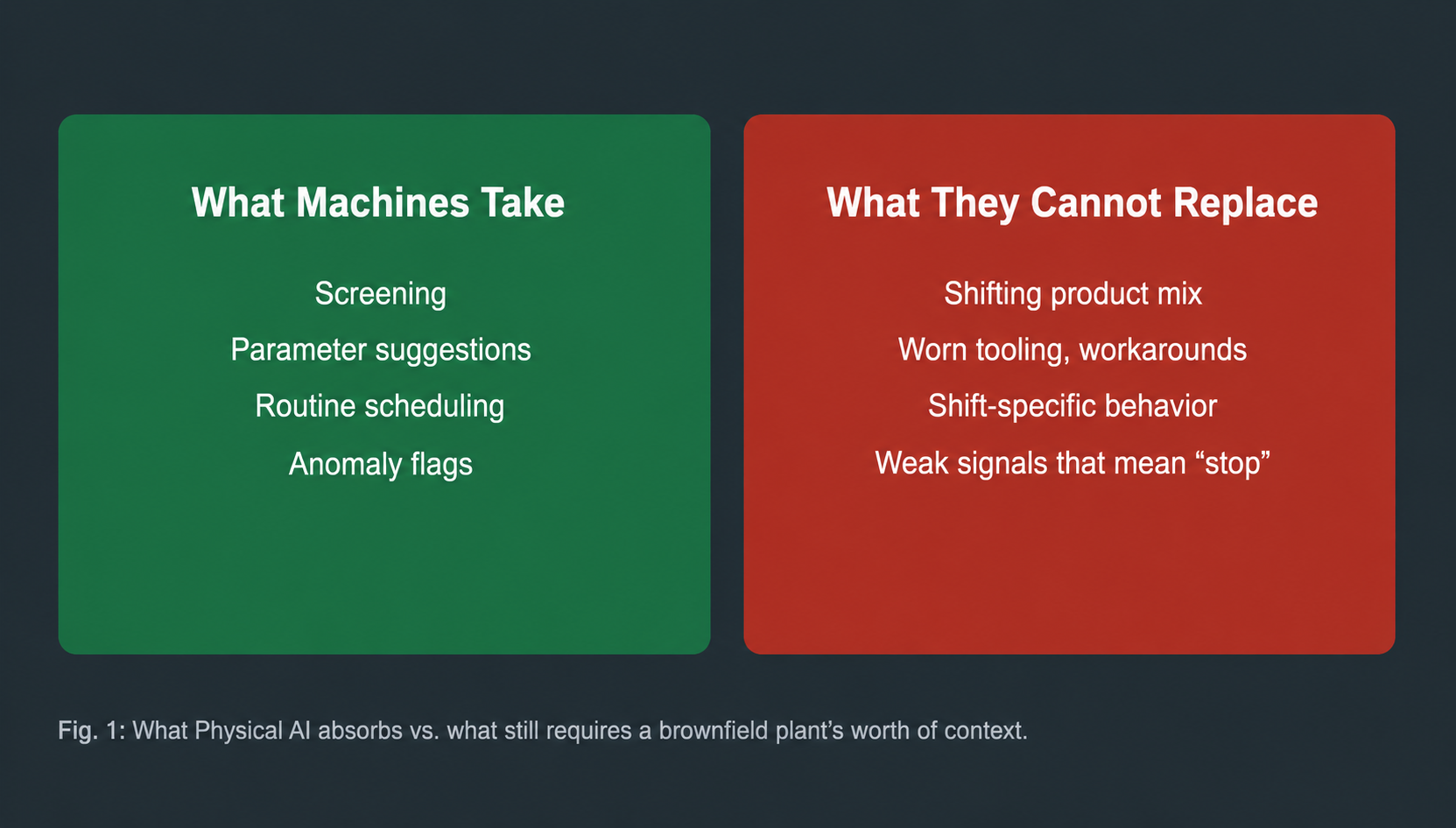
Physical AI and agents absorb work that is frequent, sensor-rich and rule-bounded: screening, parameter suggestions, routine scheduling, anomaly flags. They do not absorb the full reality of a brownfield plant: shifting product mix, worn tooling, undocumented workarounds, shift-specific behavior, and the moment when several weak signals together mean "stop."
The scale of what stays human is already showing up in the data, not just the argument. More than 81% of task hours in manufacturing are expected to remain human-driven even as AI adoption accelerates, reinforcing that the goal is augmentation, not replacement, and that the human role shifts from reactive diagnosis to proactive oversight (Solutions Review, 2026, citing Deloitte, 2026). That shift depends entirely on trust: workers need to understand how a recommendation was generated and how it connects to operational data they already use, or adoption slows regardless of how accurate the model is (Solutions Review, 2026).
👉 Key Insight
Automation removes routine. It concentrates value in the work that is not routine.
2. The Human Advantages That Compound with AI
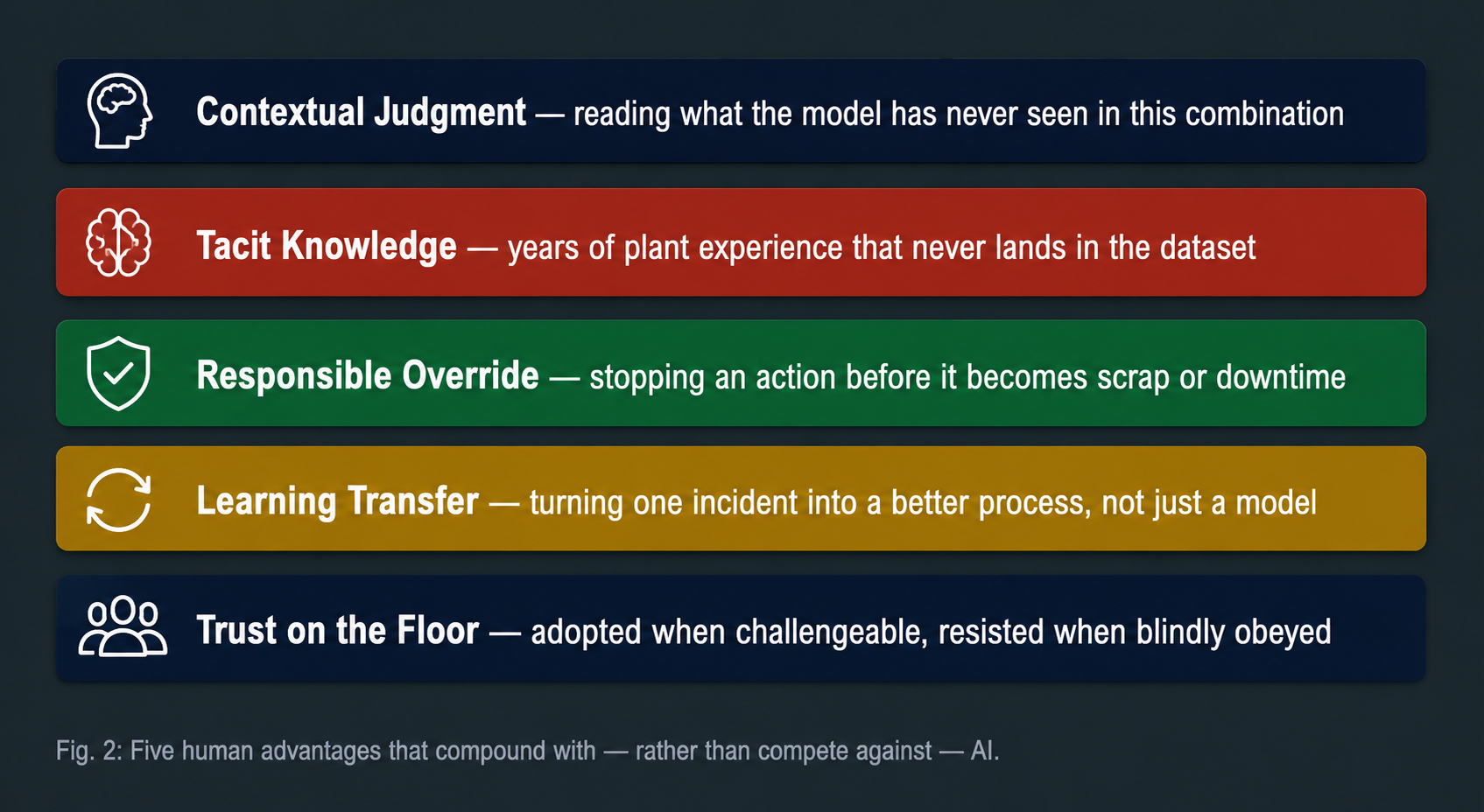
Five advantages don't show up on a capability matrix. They show up the moment someone decides whether to trust what the system just told them.
Contextual judgment: reading a situation the model has not seen in this combination. Tacit knowledge: years of plant-specific experience that never fully lands in the dataset. Responsible override: stopping or changing an agent action before it becomes scrap, downtime or a safety issue. Learning transfer: turning one incident into a better process, not only a better model. Trust on the floor: operators adopt systems they can challenge; they resist systems they must blindly follow.
Practical example: An agent recommends a speed increase after a quality metric improves. A supervisor recognizes that the improvement came from a temporary material batch, not from a stable process change. The override prevents a later quality collapse. The human advantage here is not "working faster than the machine." It is knowing what the machine cannot see.
Recent labor-market research gives the "tacit knowledge" advantage a sharper edge than intuition alone: analysis pointing to Dallas Fed data finds that AI disproportionately affects entry-level workers rather than experienced ones, precisely because AI can replicate codified knowledge but not tacit knowledge (Perspective on Risk, 2026, citing Dallas Fed research). The World Economic Forum frames the resulting shift plainly: as machines handle more of the execution, human roles move toward oversight, judgement and cross-system coordination (World Economic Forum, 2026).
👉 Key Insight
None of these five advantages show up in a capability matrix. They show up in the moment someone decides to trust, or not trust, what the system just told them.
3. Why This Advantage Is Strategic
Two plants can buy similar tools. They will not get similar results.
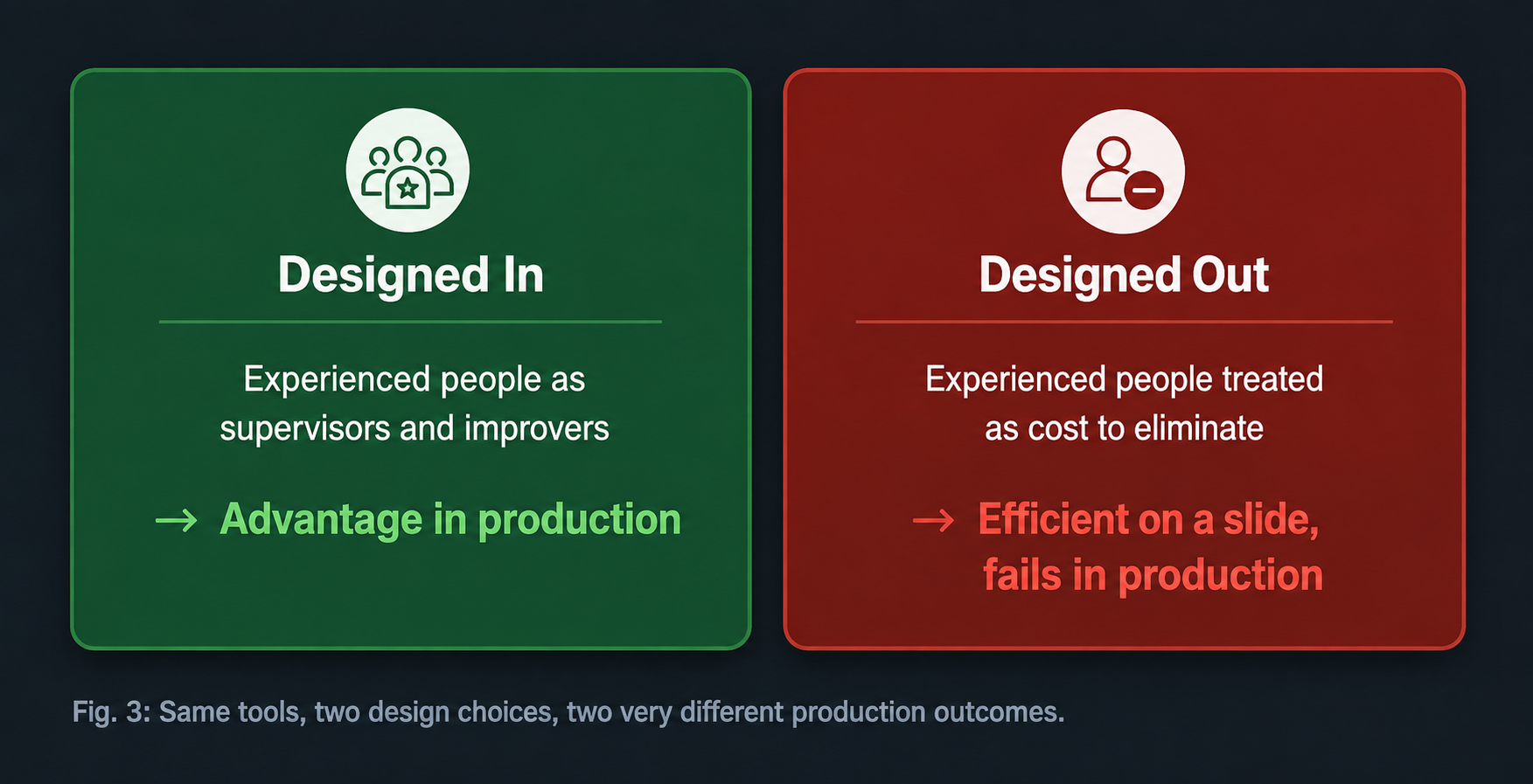
The difference is whether experienced people are designed into the loop as supervisors and improvers, or designed out as cost. The second path looks efficient on a slide and fails in production.
This is exactly why explainability and traceability keep showing up as leadership priorities rather than technical footnotes: AI outputs need to reflect the production logic, capacity limits and quality gates teams already use, because intelligence disconnected from plant reality slows adoption no matter how good the model is, and execution authority still has to flow through governed workflows that preserve human oversight and operational accountability (Solutions Review, 2026). That is the practical difference between "designed in" and "designed out."
👉 Key Insight
In an AI-driven factory the scarce asset is not another model. It is people who can use, challenge and improve the system under real conditions.
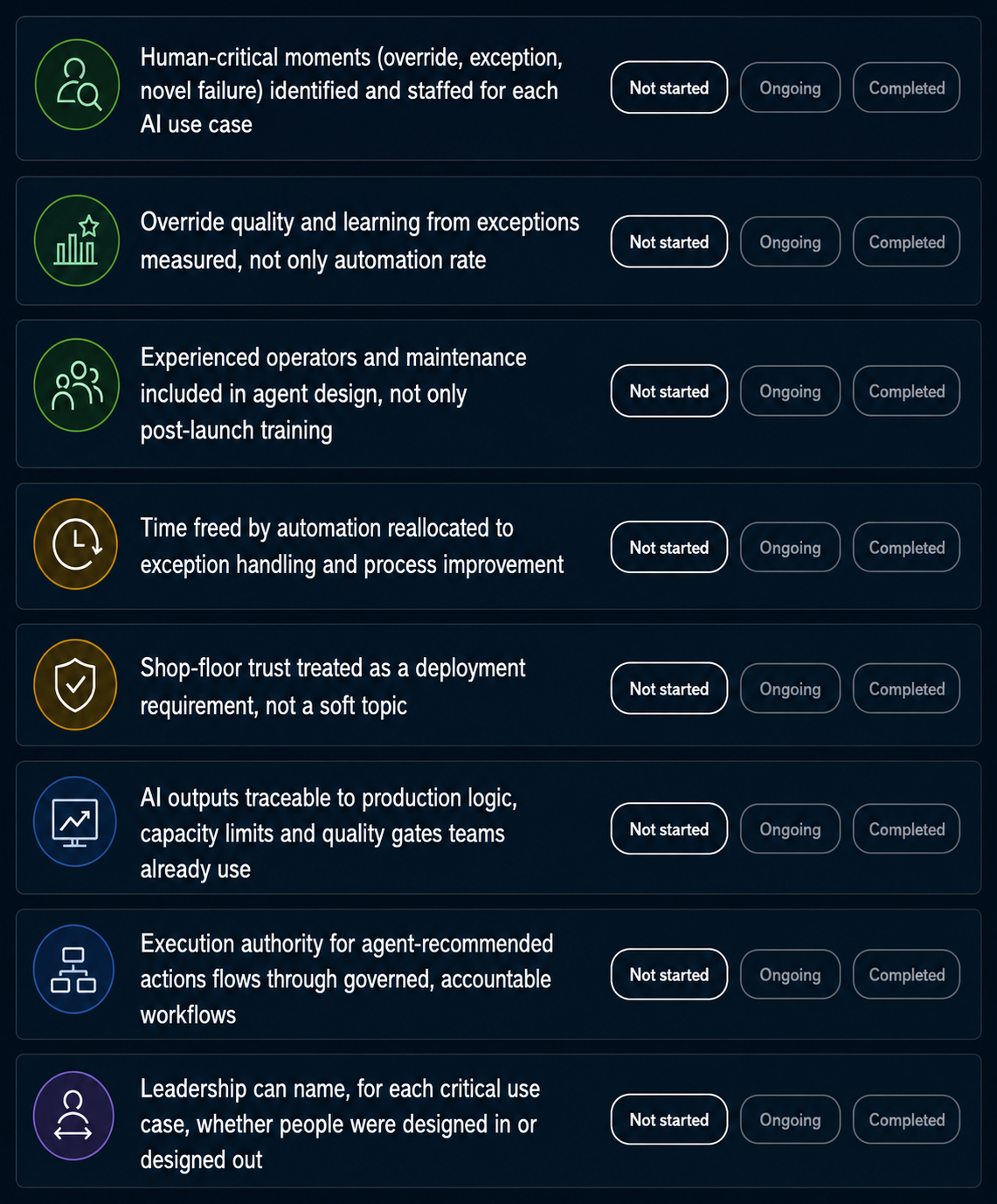
Action Plan for Decision Makers
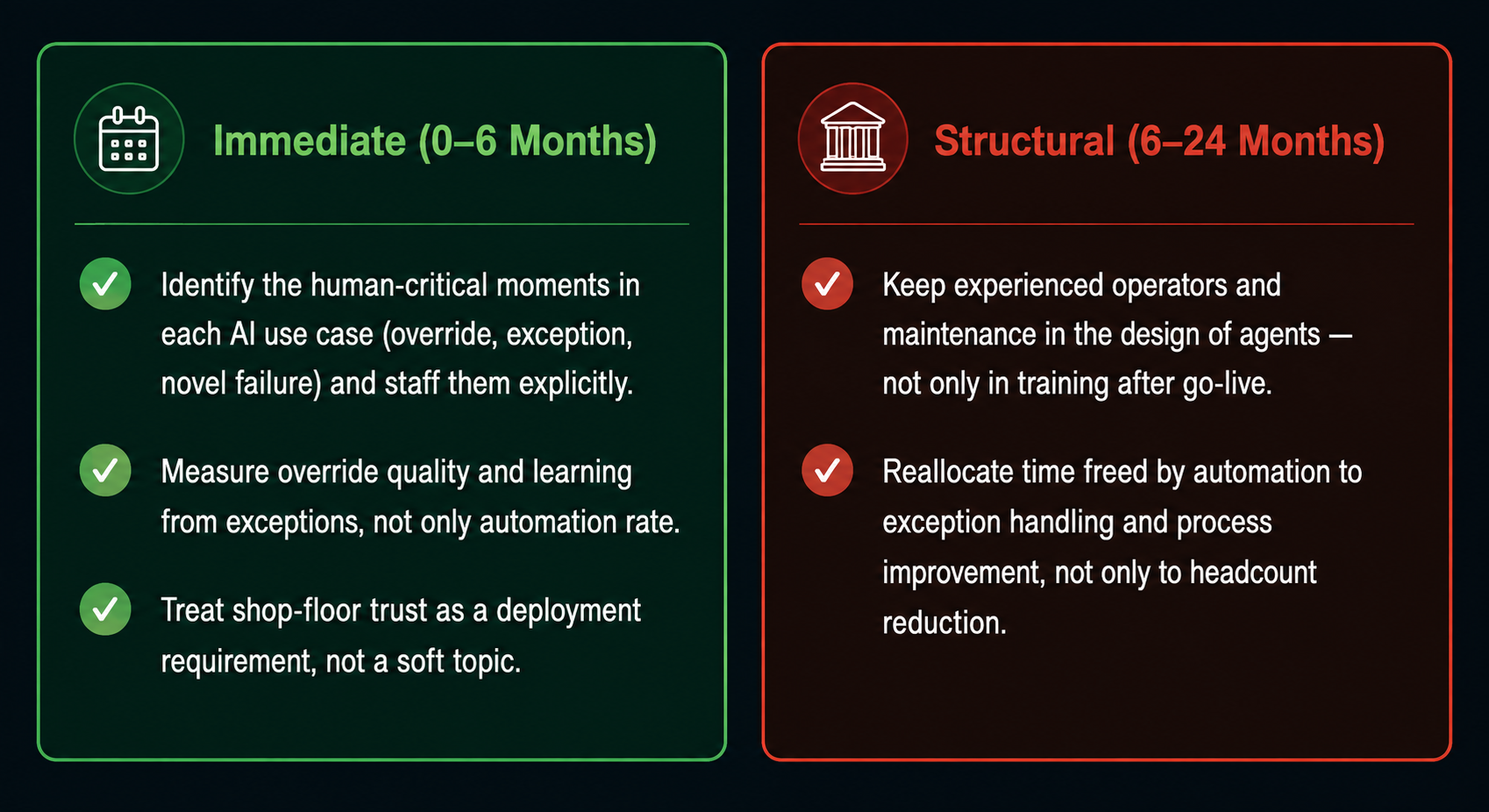
Checklist
Final Thought
The human advantage protects value on the shop floor. Part II of this Week 36 set turns to a constraint that decides how much shop floor there is to protect at all: energy.
Efficiency Before Fuel means the fuel was never the point, the judgment was. That's as true for the person standing next to the robot as it is for the leader deciding what the robot gets to do.
Systems don't fail. Decisions do.
Take the Next Step
Subscribe to the Weekly Punch for weekly strategic clarity, direct to your inbox.
References
Perspective on Risk (2026) Perspective on Risk, Apr. 18, 2026 (AI Part 2). [Online newsletter, citing Federal Reserve Bank of Dallas research].
Solutions Review (2026) How CIOs and COOs Are Applying AI on the Shop Floor Without Displacing the Workforce. [Online article, citing Deloitte, 2026].
World Economic Forum (2026) Intelligent Manufacturing: Visit a Future Factory Floor. [Online article].
Disclaimer: This article synthesizes publicly available research current as of publication. Readers should verify current figures against the original publications before relying on them for strategic decisions. Verification Gate: flagged for pre-publication source check.
Ownership as Design.
Note: This article reflects my personalviews based on industry experience and publicly available information. It does not constitute professional, legal, or investment advice and does not represent the views of my employer. AI-generated visuals, concept and content by the author.
