Why Information Is No Longer the Bottleneck, But Judgment Still Is

Leadership | Judgment | Decision Quality | Manufacturing | Week 33 · Part II
LEADERSHIP | JUDGMENT | AUGUST 2026
From Data Scarcity to Judgment Scarcity, How AI Has Inverted the Traditional Constraint in Leadership and What Organizations Must Do to Develop Superior Decision Quality
Part I of this pair named the new leadership skill: judgment under AI-induced uncertainty. Part II asks why that skill has become the scarcest resource in the organization, scarcer, now, than the information it's supposed to interpret.
Ownership as Design applies here too. An organization that hasn't deliberately designed how it builds judgment is quietly betting that good judgment will just show up when needed. It won't.
Executive Summary
IN 60 SECONDS:
AI has inverted the classic leadership bottleneck: the constraint used to be too little information. Deloitte's 2026 Global Human Capital Trends survey found 60% of executives now regularly use AI to support decisions, yet only a small fraction manage it well, the bottleneck has moved from data to judgment.
Judgment is not the same capability as analysis. Analysis processes information accurately and at scale, exactly what AI does well. Judgment integrates context, values, experience and accountability, and asks not just what the data says but what the right decision is and who owns it.
Organizations that treat judgment as a trainable capability, through structured decision reviews, simulation and deliberate practice, convert AI's abundance of information into an actual decision advantage, rather than more noise to manage.
1. The Inversion of the Bottleneck
For most of business history, the winning organization was the one that knew more. That era just ended.
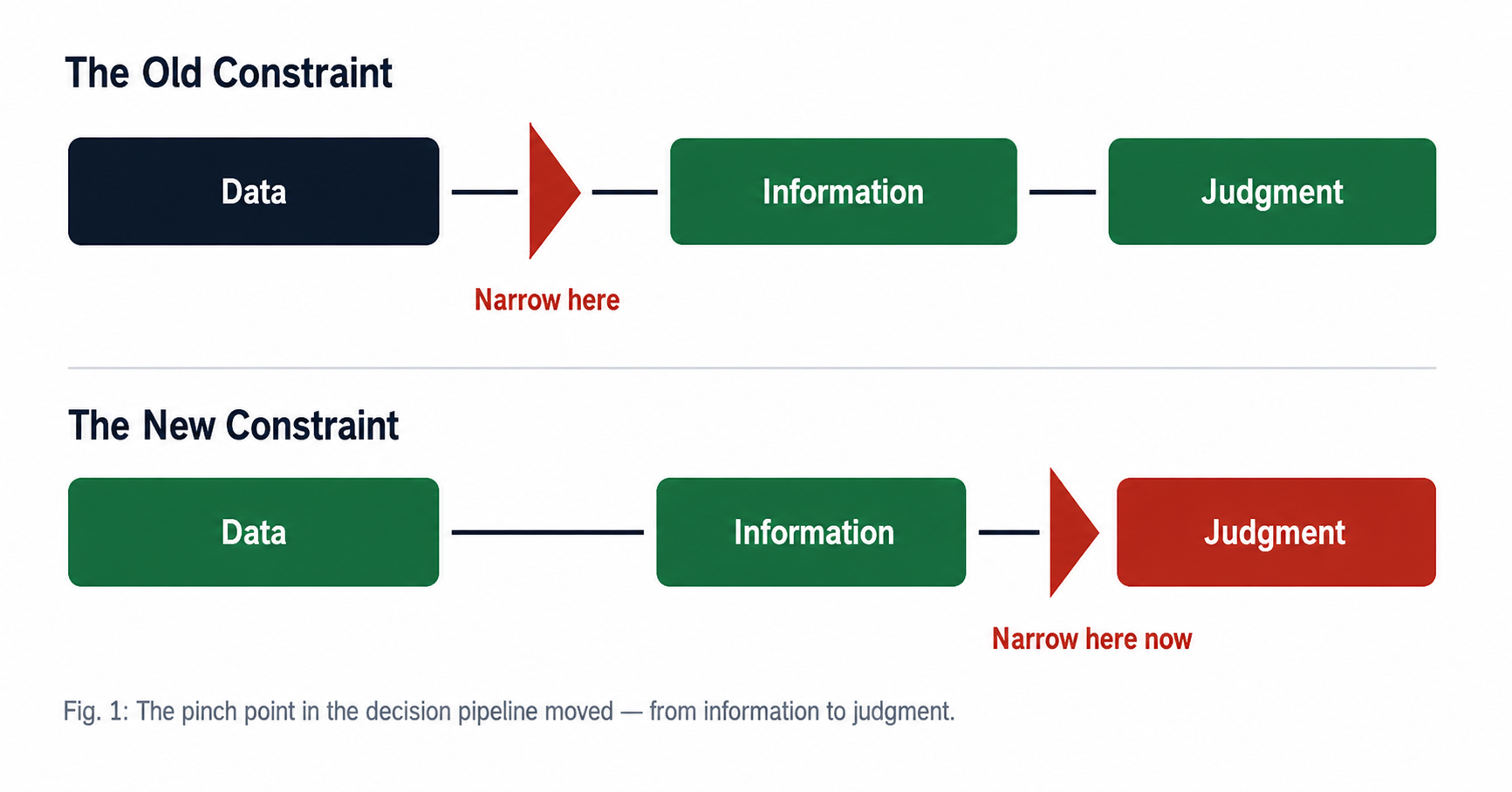
AI has inverted the classic constraint. Where leaders once struggled with incomplete data, they now struggle with excess signals, conflicting recommendations and the difficulty of distinguishing signal from noise. The limiting factor is no longer the volume of information but the quality of interpretation and decision-making applied to it.
The reframing is showing up across independent commentary, not just inside one firm's research. As one recent analysis put it plainly: as artificial intelligence makes raw analytical power abundant, the scarce and decisive executive asset becomes judgment (C-Suite Quarterly, 2026). A parallel argument, citing World Economic Forum projections on how automation is reshaping in-demand skills, frames the same shift in starker terms: intelligence is becoming a commodity, while the human capacity for discernment, the thing that can't be measured on a dashboard, remains scarce (Fortune, 2026, citing World Economic Forum).
👉 Key Insight
In an AI-saturated environment, the competitive edge shifts from "who has the best data" to "who makes the best decisions with the data available."
2. Why Judgment Remains Scarce and Difficult to Scale
You can copy a dataset in seconds. You cannot copy twenty years of a plant manager's instinct for when a number is lying.
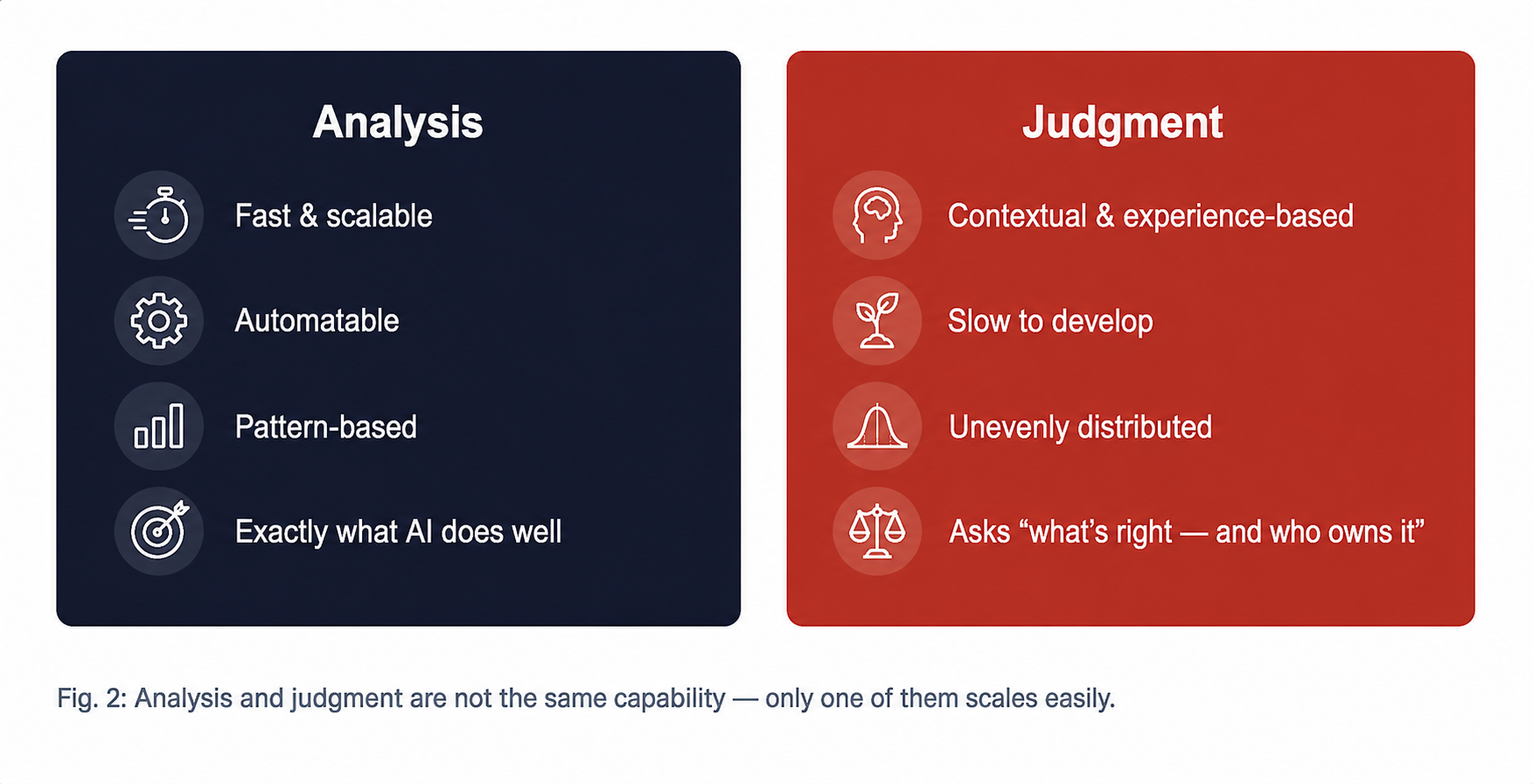
Judgment involves contextual understanding, experience, risk calibration, ethical considerations and the ability to integrate soft factors that models often miss. Unlike information, judgment is hard to automate, difficult to transfer and slow to develop. It is also unevenly distributed across organizations. AI can amplify good judgment but cannot replace the need for it, especially in complex, high-stakes industrial environments.
The distinction between analysis and judgment is doing a lot of work here, and it's worth stating precisely: analysis processes information accurately, efficiently, and at scale, exactly what AI does extraordinarily well. Judgment is something else entirely; it integrates information with context, values, relationships, history and consequence, asking not just what the data says but what the right thing to do is, and who is responsible for the outcome (PositivEnergy Consulting, 2026). Deloitte's own 2026 research puts a name on what happens when organizations blur that distinction: they accumulate "culture debt", the cost of scaling AI without maintaining the accountability structures, norms and trust frameworks that judgment depends on (Deloitte, 2026).
👉 Key Insight
Information scales easily. Judgment does not. This asymmetry is becoming one of the most important strategic realities for leadership teams.
3. Building Judgment as an Organizational Capability
Judgment isn't a personality trait some leaders have and others don't. It's a muscle, and most organizations have never designed a training program for it.
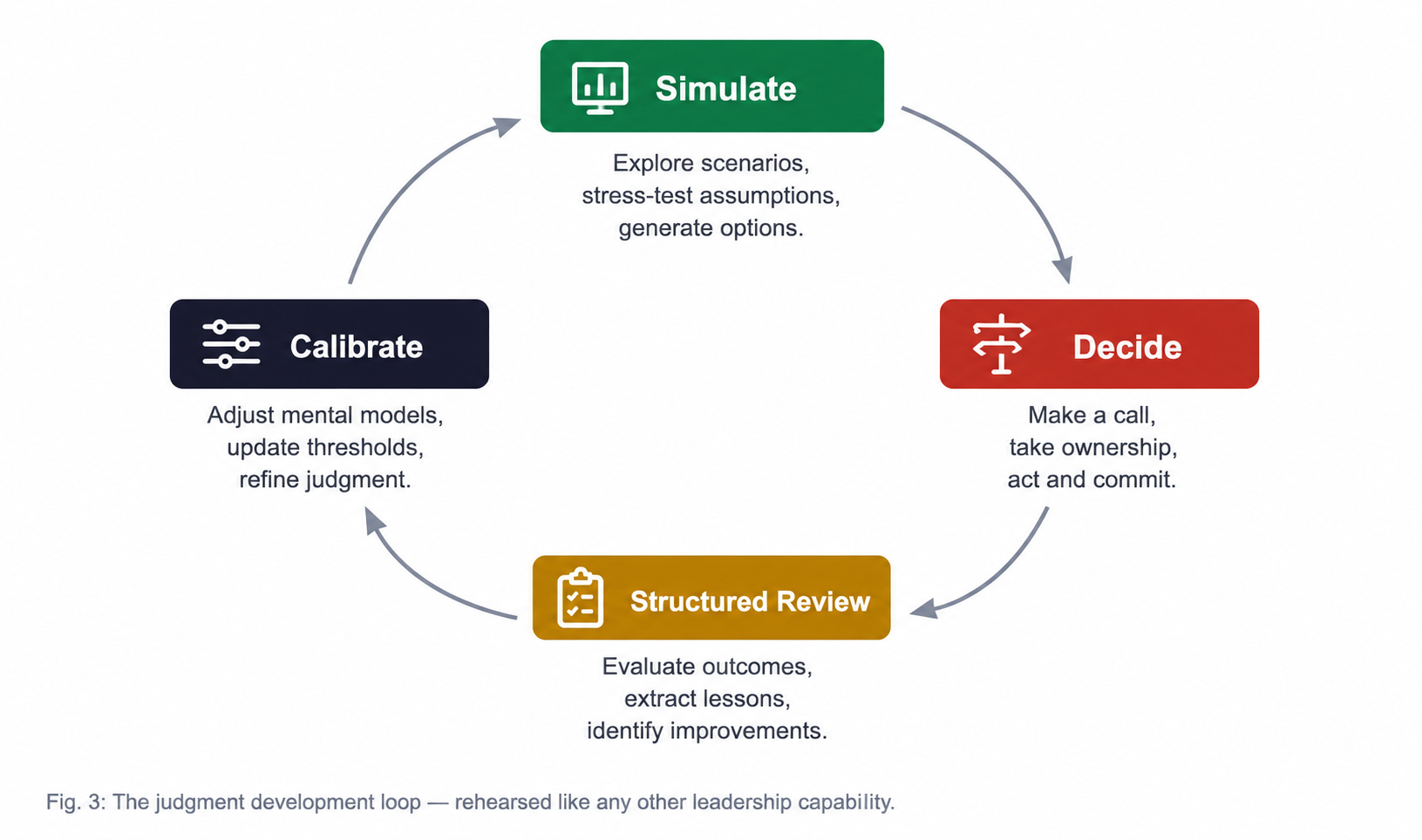
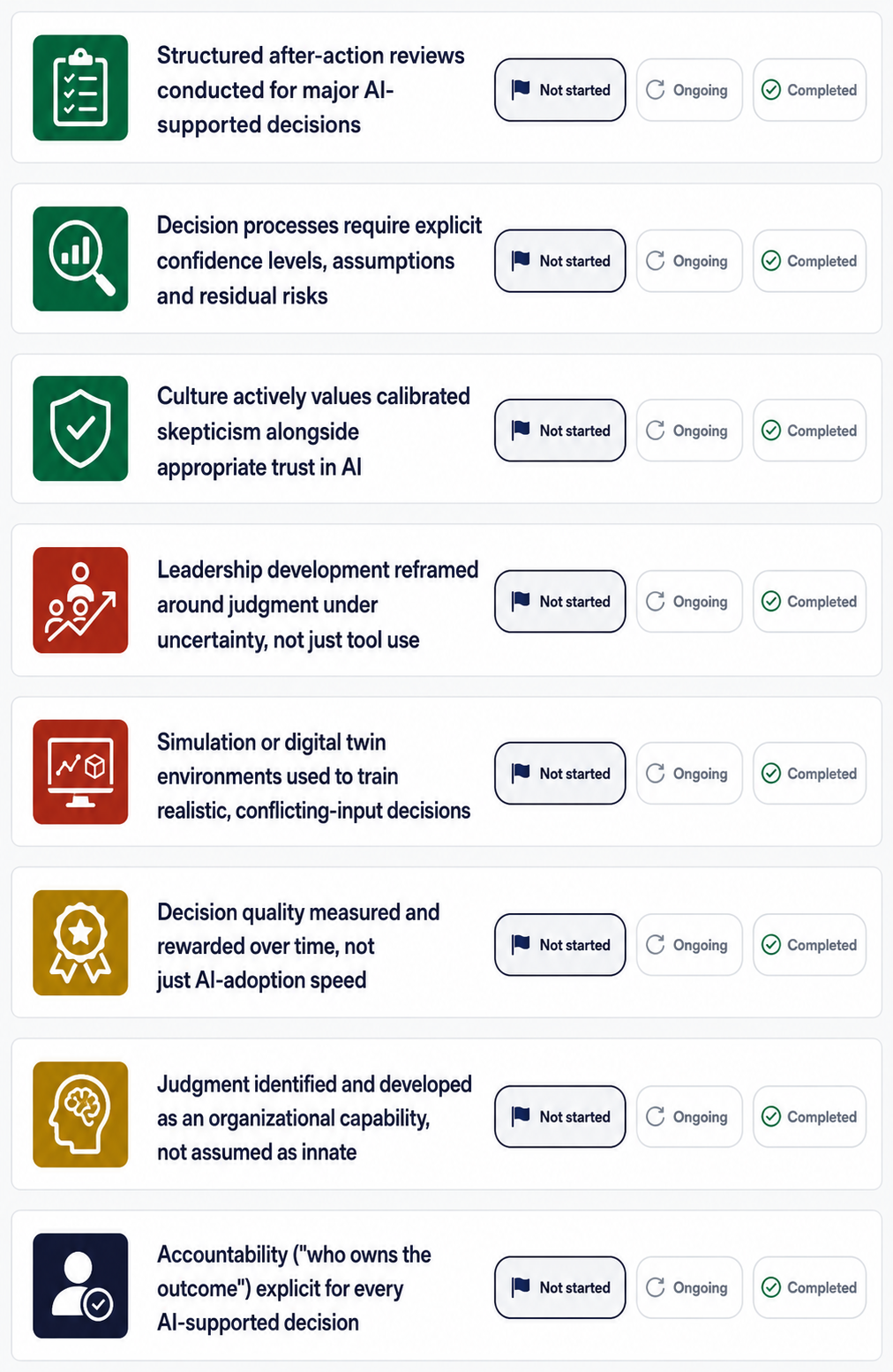
Leading organizations treat judgment as a developable capability rather than an innate trait. They create structured decision reviews, use simulation and digital twins to train judgment under realistic conditions, encourage deliberate practice in high-stakes scenarios, and design decision processes that force explicit weighing of AI recommendations against operational context and risk.
The gap this is meant to close is not small. Deloitte's 2026 research found that 60% of executives now use AI in decision-making, yet only 5% say they manage it well, the widest adoption-to-mastery gap the survey has recorded (Deloitte, 2026). Simulation infrastructure this series has already covered doesn't have to be built twice: the same digital-twin environments Siemens and NVIDIA use to let AI agents rehearse changes before touching a physical line (see Week 30) are equally suited to letting human leaders rehearse judgment calls before a real incident forces one.
👉 Key Insight
Organizations that systematically invest in judgment development will outperform those that assume AI will make better decisions on its own.
Action Plan for Decision Makers
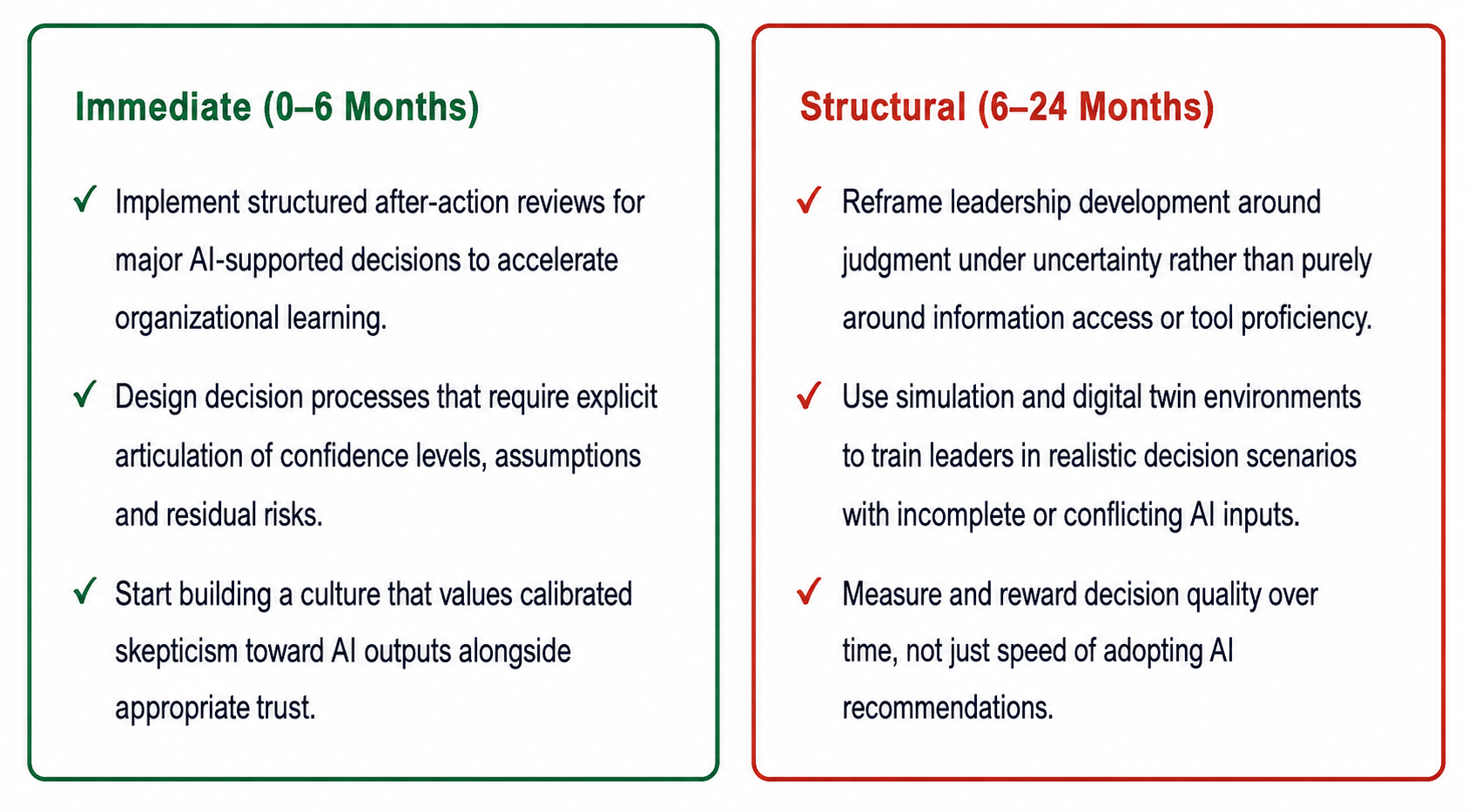
Checklist
Final Thought
Part I of this pair asked how leaders should decide under AI-induced uncertainty. Part II shows why so few of them currently can: the constraint that used to be information has quietly become judgment, and almost nobody has built a program to develop it on purpose.
Ownership as Design means treating judgment the way this series has treated every other capability across thirty-three weeks — as something built deliberately, not assumed. Efficiency Before Fuel means that a leadership team's judgment is worth more than any single model's confidence score.
Systems don't fail. Decisions do.
Take the Next Step
Subscribe to the Weekly Punch for weekly strategic clarity, direct to your inbox.
References
C-Suite Quarterly (2026) Why Judgment Will Matter More Than Intelligence in the AI Era. [Online article].
Deloitte (2026) Decision-Making with AI. Deloitte Insights, 2026 Global Human Capital Trends.
Fortune (2026) AI Is Making Productivity Obsolete. The Leaders Who Thrive Next Will Have Something Machines Can't Touch. [citing World Economic Forum].
HR Executive (2026) What Deloitte's 2026 Trends Report Says Leaders Want Tech to Fix. [Online article].
PositivEnergy Consulting (2026) The Judgment Imperative: Leadership in the AI Era. [Online article].
Disclaimer: This article synthesizes publicly available research current as of publication. Quantitative figures are attributed to their original sources; where a figure is reported by a secondary source citing a further original study (e.g. World Economic Forum), both are named. Readers should verify current figures against the original publications before relying on them for strategic decisions. Verification Gate: flagged for pre-publication source check.
Note: This article reflects my personalviews based on industry experience and publicly available information. It does not constitute professional, legal, or investment advice and does not represent the views of my employer. AI-generated visuals, concept and content by the author.
