Intuition When Sensors Lie: Leadership Lessons from Gary Klein's Sources of Power
LEADERSHIP | DECISION MAKING | OCTOBER 2026 | Week 41 · Part III
Recognition-Primed Judgment at the Line. Why Experts Must Still Decide When the Model Is Confident and Wrong
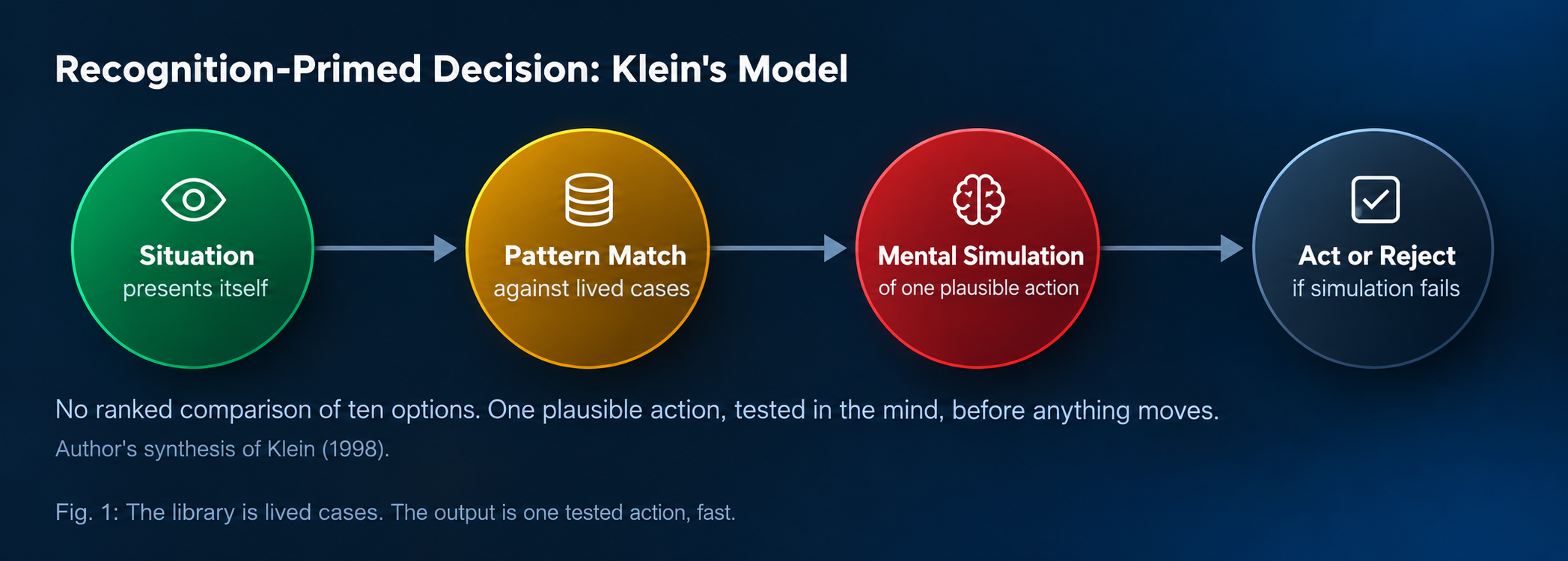
Gary Klein spent years studying how experienced people decide when there is no time for a full analysis: fire commanders reading a burning building, pilots reading a failing instrument, nurses reading a baby who looks "just slightly wrong." They do not compare ten options against a checklist. They recognize a pattern, mentally simulate one plausible action, and act, or reject that action if the simulation fails and reach for another. Klein called this recognition-primed decision, and it is the actual subject of his book Sources of Power.
Physical AI recreates the exact setting Klein studied, time pressure, incomplete information, a consequential call, and adds one new trap. Sensors and agents now offer a confident pattern of their own. Sometimes that pattern is the situation. Sometimes it is a lie: drifted calibration, a novel payload, a camera blinded by glare, a model trained on last year's product mix. The system keeps running regardless. This is where Klein's forty-year-old research becomes a leadership question for this week, not a historical curiosity.
Executive Summary
IN 60 SECONDS:
Klein studied how experienced people decide under time pressure without a full analysis, fire commanders, pilots, nurses. They recognize a pattern, mentally simulate one plausible action, and act, or reject it if the simulation fails. He called this recognition-primed decision.
Physical AI recreates that setting and adds a trap: sensors and agents now offer a confident pattern of their own. Sometimes the pattern is the situation. Sometimes it is a lie, drifted calibration, a novel payload, a blinded camera, stale training data, and the system keeps running regardless.
Klein's lesson for Decision Makers: intuition is not the opposite of data. It is the expert's ability to notice when the data do not match the world, and to have the authority to stop.
1. What Klein Actually Argued
Experts under pressure do not follow a textbook decision tree. They match the situation in front of them to cases they have personally lived.
Cues that do not fit trigger unease before they trigger a spreadsheet. The power behind this is not mysticism , Klein was explicit that it is a large library of real incidents, built from direct experience, used fast and largely below conscious awareness. A fire commander who orders everyone out of a building seconds before it collapses, in Klein's most cited example, cannot always say why. He can say what it reminded him of.
Organizations that strip that library out, by deskilling the shift, by rotating people off the process before they accumulate real cases, or by treating every agent output as the situation itself rather than one more input to judge, lose the only check that works on a timescale of seconds. A dashboard cannot recognize a case it has never seen described as a case. A person who has lived it can.
👉 Key Insight
Intuition here means recognition. It fails when people have no cases, and it fails when they are forbidden to contradict the screen.
2. When Sensors Lie – One Running Example
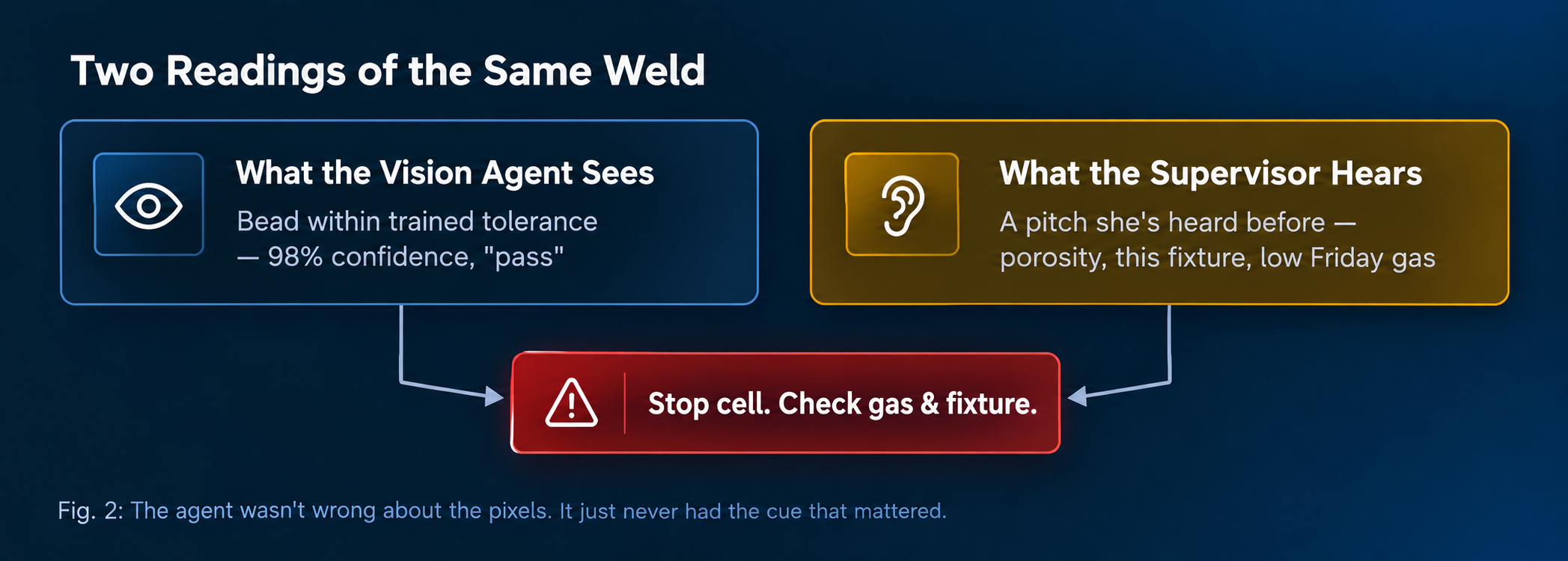
A vision agent clears a weld. The confidence score is high. A supervisor stops the cell anyway. Both of them are responding to real information, just not the same information.
The agent sees pixels: a weld bead within the trained tolerance band, scored against thousands of labeled examples, returning a high-confidence "pass." The supervisor hears a pitch in the torch, a sound she has heard before, tied to a specific porosity defect, on this fixture, on Friday shifts when gas pressure sags toward end of week. Klein's sequence plays out in under two seconds: she recognizes the mismatch between what she hears and what a good weld should sound like, mentally simulates "let it run" — scrap discovered downstream, or worse, a customer return, rejects that action, and stops the cell to check gas pressure and fixture alignment. The agent was not "stupid." It simply never had her cue; porosity from marginal gas flow does not reliably change what the camera sees before the weld fails later under load.
If policy says she may not stop the cell without first raising a ticket and waiting for a response, the system runs anyway. The scrap is discovered at the next constraint downstream, hours or shifts later, at a far higher cost than a two-second pause would have carried. The dashboard, meanwhile, still shows a good model, because nothing in its metrics ever asked whether the model's confidence matched the physical world.
👉 Key Insight
A dashboard showing green and a line that should have stopped are not in conflict. The dashboard simply isn't measuring the thing that mattered.
3. What Leaders Must Protect
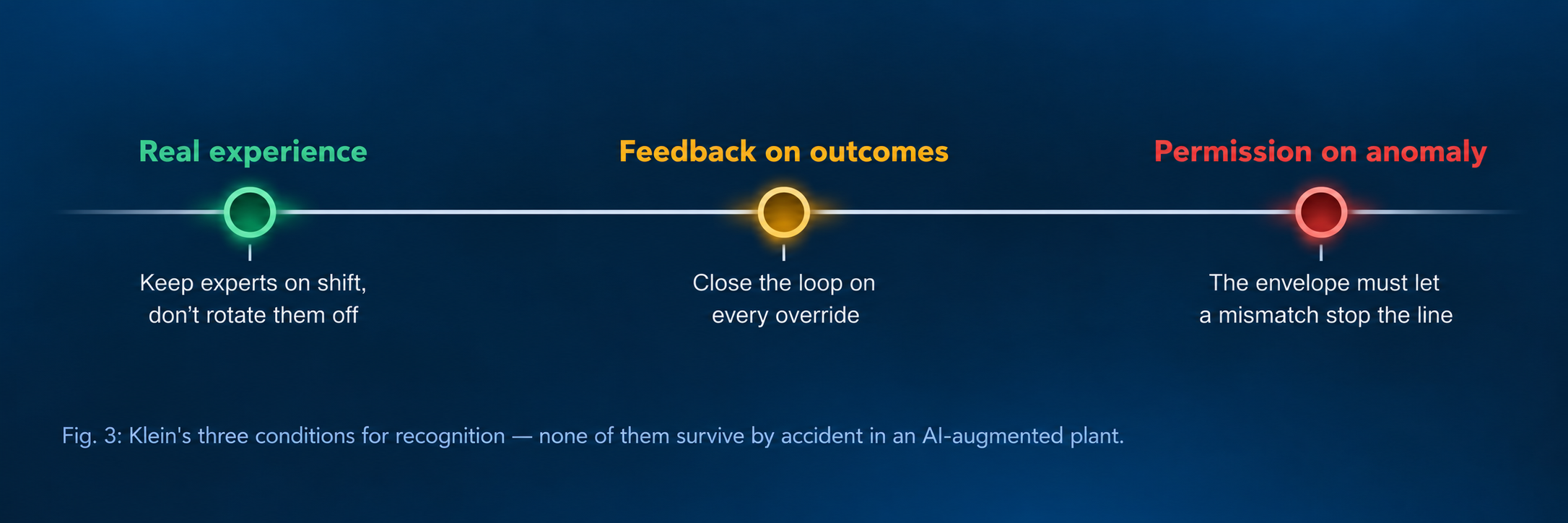
Klein's conditions for good recognition are specific, and all three have to be deliberately protected in an AI-supervised plant, they do not survive by accident.
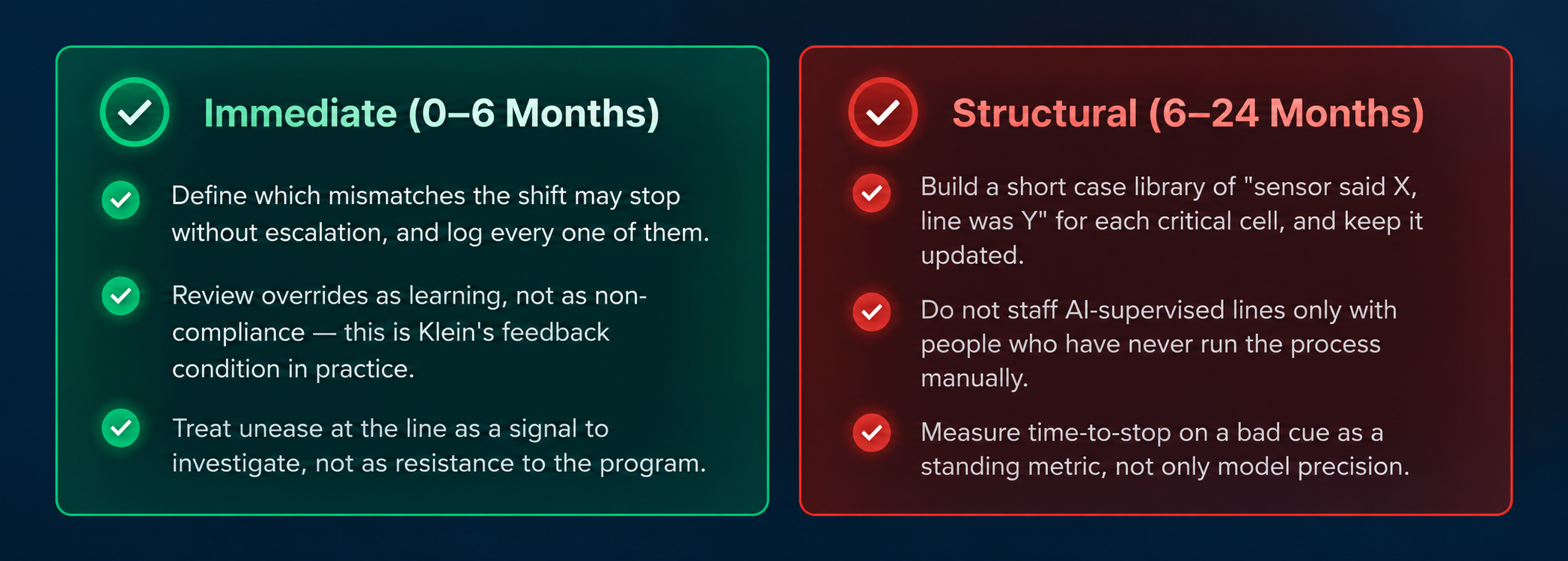
The first condition is real experience: people on the line need enough direct exposure to the process to build the case library in the first place, which means keeping experienced operators on the shift rather than rotating them off once a system is "automated." The second is feedback on outcomes: the loop has to close, so the person who overrides a model finds out afterward whether the override was right, without that feedback, recognition cannot improve and eventually degrades. The third is permission to act on anomaly: the envelope has to be written so a mismatch can actually stop the line, not just get logged for a review next week.
This also means training new supervisors on cases, not only on screens. The source of power, in Klein's own title, is the case library, and a library built only from watching dashboards is not the same library that caught the porosity defect by ear.
👉 Key Insight
A confident model plus a silenced expert is not automation. It is a single point of failure with a probability attached.
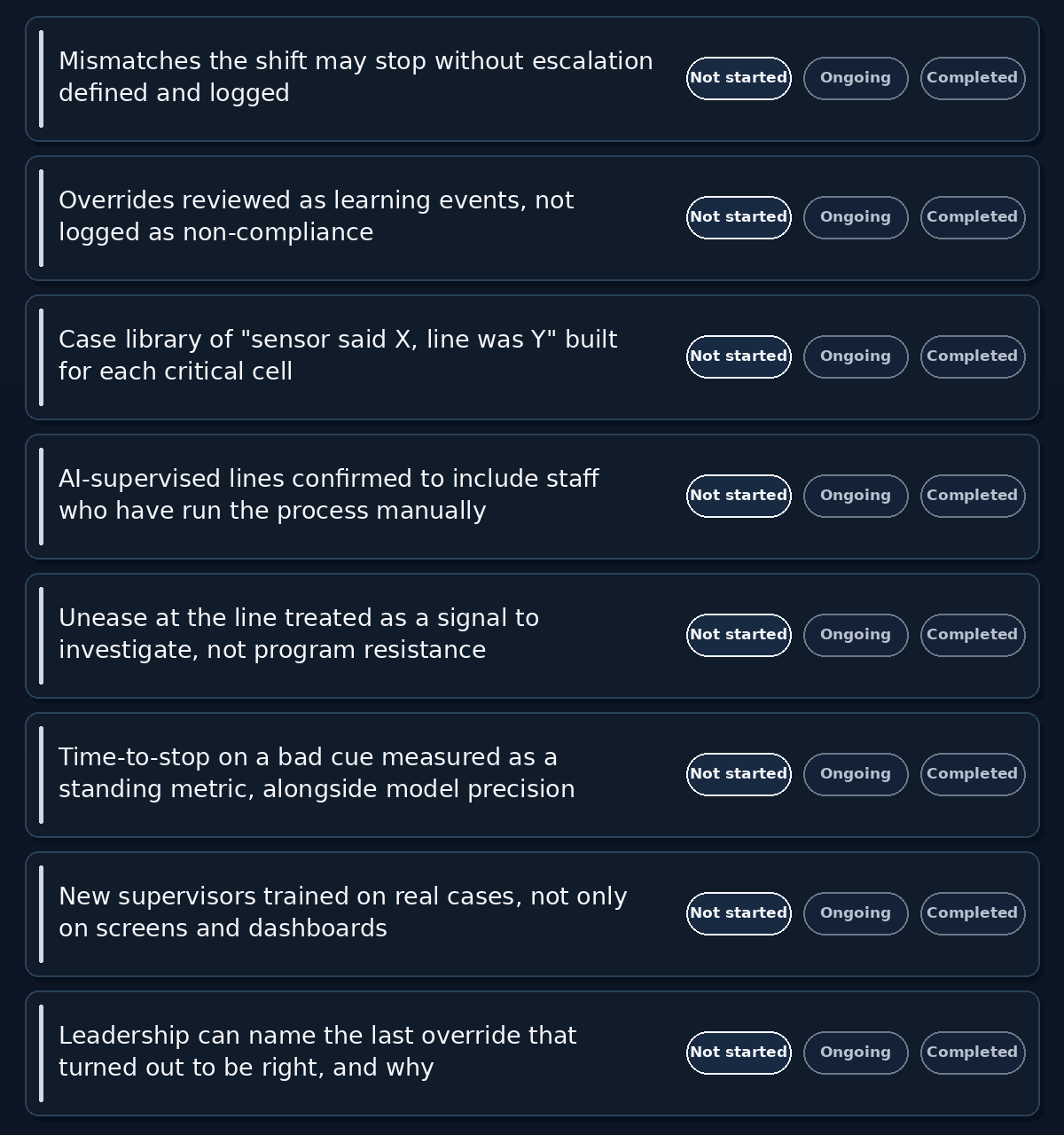
Action Plan for Decision Makers
Checklist
Final Thought
Klein's fire commanders didn't out-compute the fire. They recognized it faster than anyone could model it, and the organization around them had been built to let them act on that recognition in seconds, not after a ticket cleared. The plants running Physical AI well over the next decade will be the ones that still let their most experienced people do exactly that.
A confident sensor is a useful input. It was never meant to be the last word.
Systems don't fail. Decisions do.
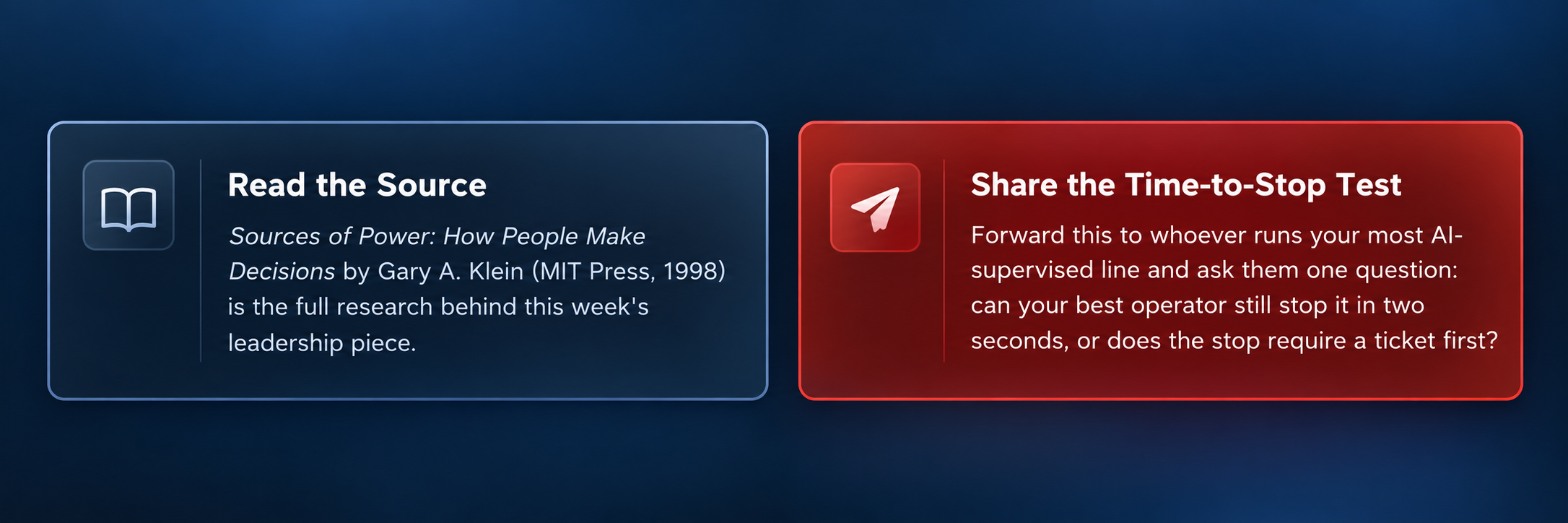
Take the Next Step
Subscribe to the Weekly Punch for weekly strategic clarity, direct to your inbox.
References
Klein, G.A. (1998) Sources of Power: How People Make Decisions. Cambridge, MA: MIT Press.
Disclaimer: This article draws on the publicly published research in Sources of Power and applies its recognition-primed decision framework to human supervision of industrial AI and sensor-driven cells. Readers should consult the original text for the full research base and methodology before citing specific findings. Verification Gate: flagged for pre-publication source check.
Ownership as Design.
Note: This article reflects my personalviews based on industry experience and publicly available information. It does not constitute professional, legal, or investment advice and does not represent the views of my employer. AI-generated visuals, concept and content by the author.
