Flexible AI Data Centers: When Compute Must Follow the Grid, Not the Other Way Around
DATA CENTERS | GRID FLEXIBILITY | OCTOBER 2026 | Week 42 · Part I
The Fastest Way to Connect a Data Center Is to Promise to Use Less of It When the Grid Is Stressed
Week 41 asked who inside a plant owns the power plan for a handful of robot cells. Week 42 asks the same question at a scale two orders of magnitude larger: the AI data-center campus, where the connection itself is now being rationed by one criterion above all others, whether the load can flex.
Rigid AI campuses wait in queues measured in years. Flexible ones are being written into the interconnection rules as the condition for getting power at all. This is the data-center connection argument: the fastest route to megawatts in 2026 is no longer a bigger substation. It is a credible promise to use less.
Executive Summary
IN 60 SECONDS:
Data centers have been designed as firm load. In 2026 that design collides with the queue: US interconnection waits stretch to years, and Europe's core hubs cite 7–10 years.
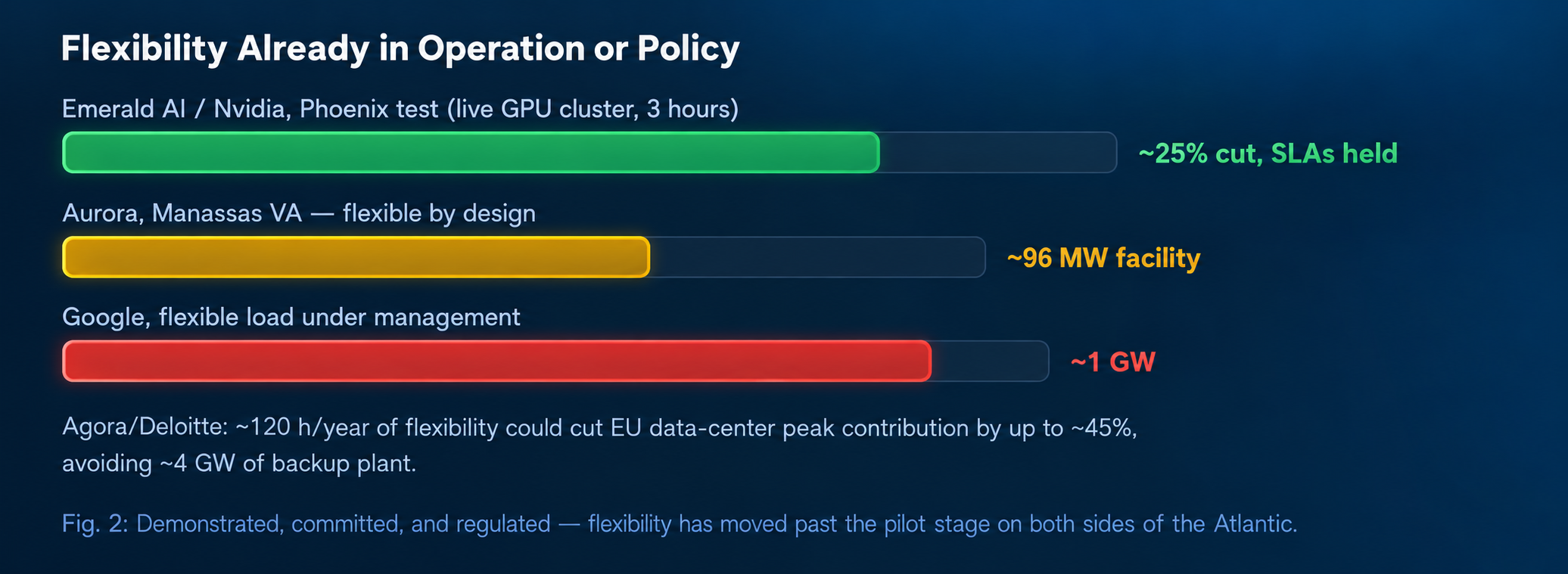
Flexibility is no longer theoretical. Emerald AI, with Nvidia and partners, cut a live GPU cluster by roughly 25% for hours without breaking SLAs, and is bringing a ~96 MW "power-flexible AI factory" online in Virginia. Google reports on the order of a gigawatt of flexible load under management. Agora/Deloitte find that ~120 hours of flexibility a year could cut European data-center peak contribution by up to ~45% and avoid ~4 GW of backup plant.
Decision Makers who still specify 100% firm AI campuses are specifying a product the grid no longer wants to underwrite on the old terms.
1. Why Data Centers Are the Test Case
A data center is a large, concentrated, and, unlike almost any other industrial load, genuinely controllable one. That combination makes it the grid's favorite test subject.
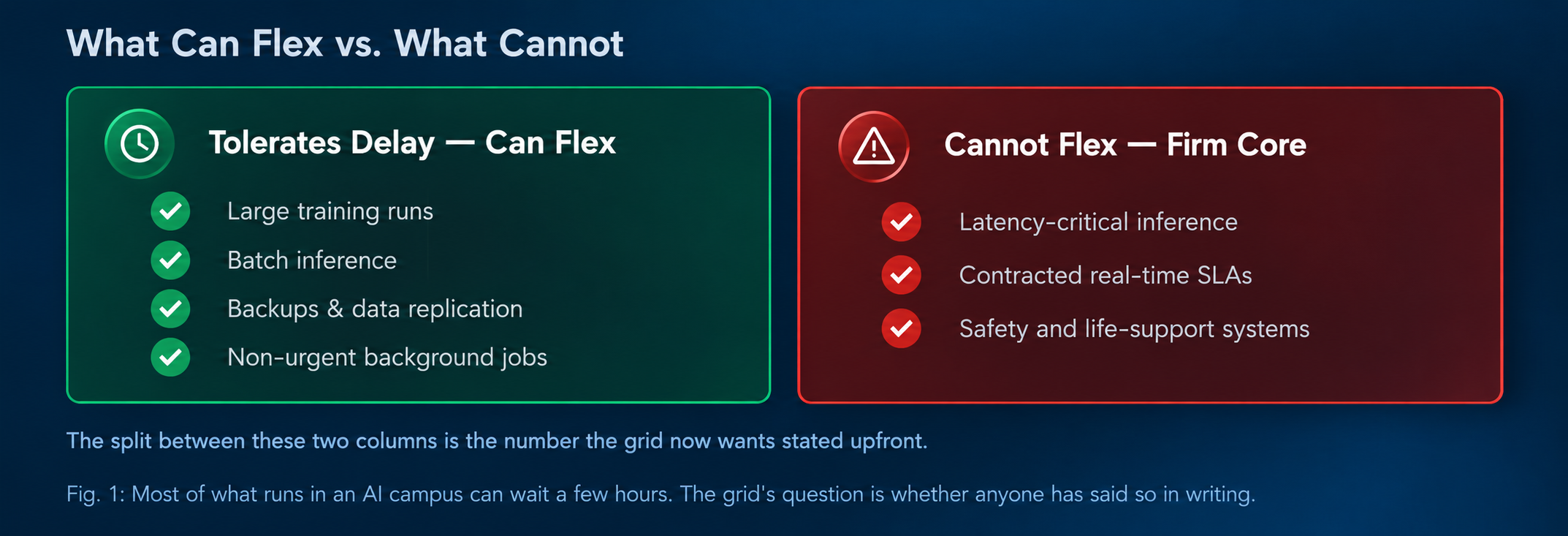
Unlike a chemical plant or a steel line, much of a data center's work can be queued, capped or moved without stopping anything that matters to a person: training runs, batch inference, backups, and non-urgent jobs all tolerate delay in a way a blast furnace does not. That makes the data center the clearest candidate for flexibility on the system, and simultaneously the largest new peak showing up on many grids at once.
Hyperscalers and utilities are therefore negotiating the trade explicitly, not implicitly: a faster or larger connection in exchange for a defined, contractual ability to drop or shift load when the grid asks. That negotiation is now the actual front door to new AI capacity, replacing the old assumption that a big enough check buys a big enough substation on any timeline the buyer wants.
👉 Key Insight
For data centers, flexibility is no longer a sustainability feature. It is an interconnection feature.
2. What Is Already Being Built and Ruled
This is not a pilot-stage idea sitting in a whitepaper. It is already running on live clusters, written into scale commitments, and showing up in regulatory text on two continents.
Demonstrated control: Emerald AI's Phoenix test cut a working Nvidia GPU cluster by roughly 25% for three hours while SLAs held throughout. Aurora, a ~96 MW facility in Manassas, Virginia built with Nvidia, Digital Realty and others, is designed to be flexible from day one rather than retrofitted later. Scale commitments follow the same pattern: Google reports on the order of 1 GW of flexible load under management, and OpenAI-style agreements now commit to cutting up to ~1 GW from a multi-gigawatt campus during grid stress events.
Regulation is catching up to the practice. In the US, FERC is pushing grid operators to consider faster connection paths for large loads that offer flexibility, while industry alliances including Google, Nvidia and Emerald AI press for formal controllable-load frameworks. In Europe, Agora/Deloitte modeling finds that roughly 120 hours of flexibility a year could cut data-center contribution to peak demand by up to ~45% and avoid ~4 GW of new thermal backup capacity, with Flexible Connection Agreements emerging as the practical alternative to a decade-long wait. Finland is proposing connection tiers from 2027 that demote large rigid data centers behind loads that flex or bring their own generation. Underneath all of this sits an uncomfortable number: European sites have been reported using well under their reserved capacity, figures around the mid-40% range in recent years, while the reservation itself still blocks everyone behind them in the queue.
👉 Key Insight
Every one of these numbers came from software and contracts, not from new power plants. The fastest gigawatts on the grid right now are the ones nobody has to generate.
3. What "Compute Follows the Grid" Means Inside a Campus
None of this requires a smaller AI campus. It requires a campus that can state, in writing, which part of itself is negotiable.
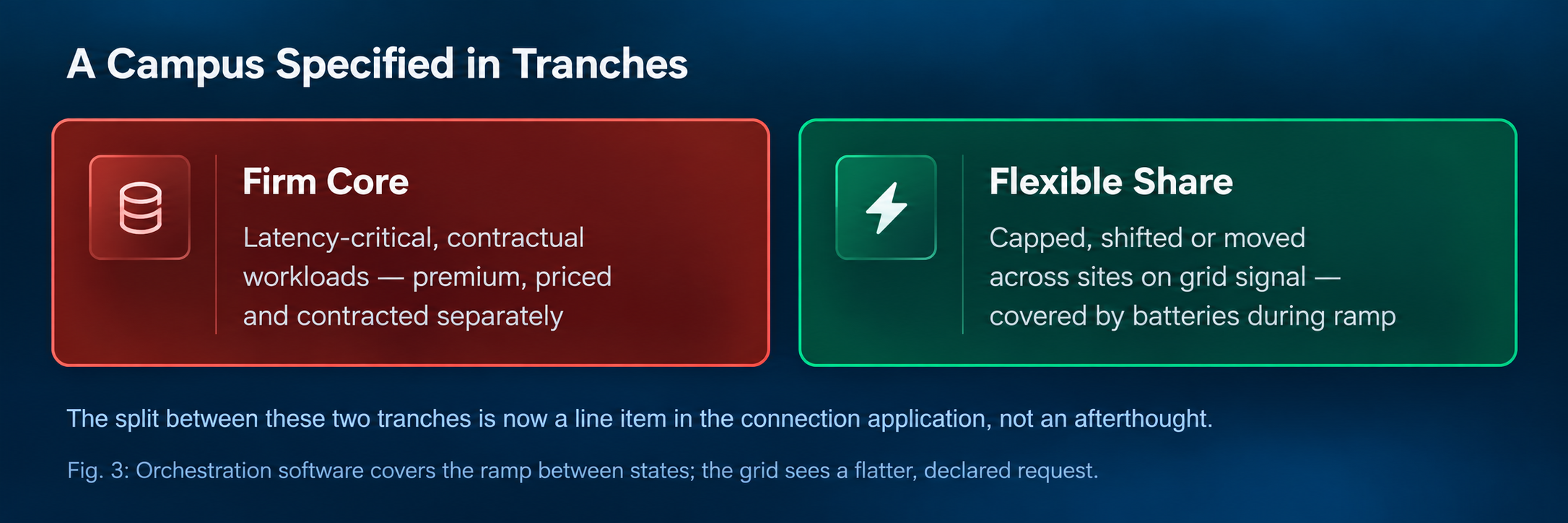
The practical design pattern is a campus specified in tranches: a firm core sized for latency-critical and contractual workloads, and a flexible share that the orchestration software can cap, shift in time, or move across sites when the grid signals stress. Batteries and limited on-site generation cover the ramp between states, so the transition reads as smooth rather than a visible cliff to the operator and to the grid.
The SLA itself gets rewritten as part of this. "Always full power" stops being the default promise attached to every job by default, it becomes a premium tier, priced and contracted separately from the flexible tier underneath it. Workload orchestration, in other words, stops being purely an IT concern and becomes a clause in the energy contract.
👉 Key Insight
A data center that cannot state its flexible megawatts will be planned as if it had none, and will wait accordingly.
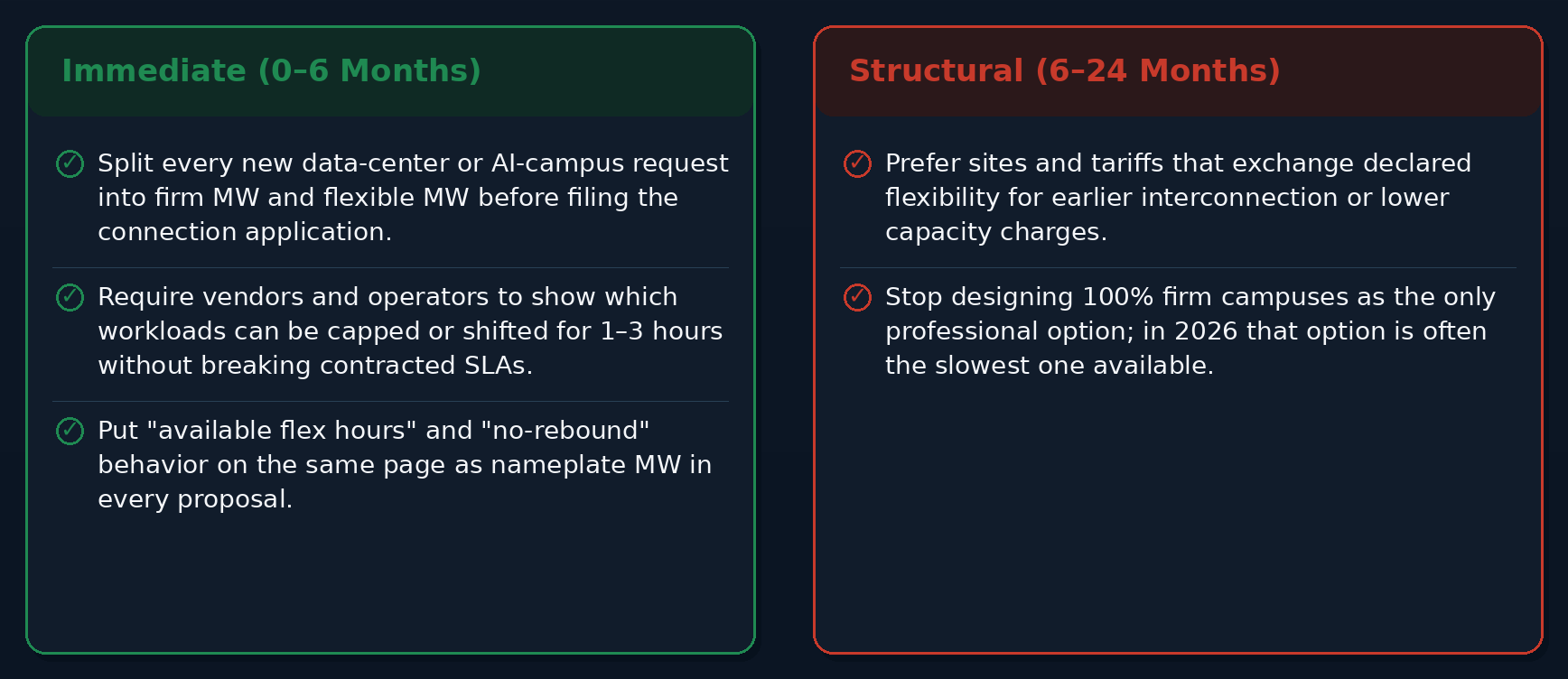
Action Plan for Decision Makers
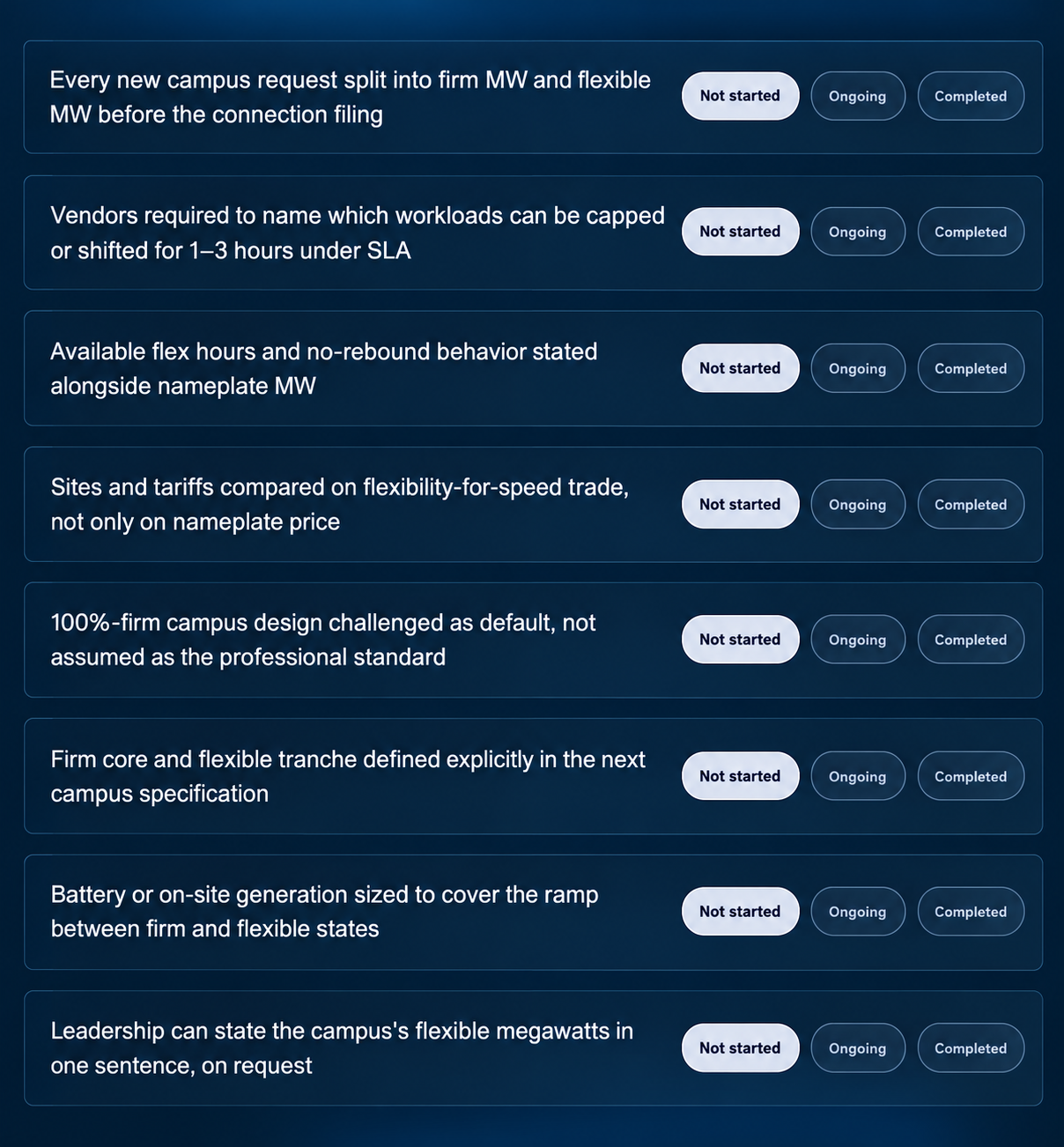
Checklist
Final Thought
Flexibility tells the grid operator what a campus can give up. It doesn't yet tell you which single number actually decides whether the campus connects at all. Part II of this Week 42 set names that number — and it isn't the one on the PUE slide.
Efficiency Before Energy means the fastest megawatt is the one you declared you could give back, not the one you quietly never planned to use.
Systems don't fail. Decisions do.
References
Reuters (2026) Data-Center Demand Response.
Duke University Nicholas Institute for Energy, Environment & Sustainability (2026) Flexibility Estimates for Data-Center Load.
Emerald AI / Nvidia (2026) Phoenix Test and the Aurora (~96 MW) Flexible AI Factory Project.
Google (2026) Flexible-Load Figures.
Agora Energiewende & Deloitte (2026) Value and Enablers of Data Centre Flexibility in Europe.
Finland Grid-Priority Proposals (2026).
Disclaimer: This article synthesizes publicly available industry and regulatory reporting current as of publication. Figures on flexibility, scale and timelines evolve as programs mature; readers should verify current figures against the original publications before relying on them for investment or connection decisions. Verification Gate: flagged for pre-publication source check.
Ownership as Design.
Take the Next Step
Subscribe to the Weekly Punch for weekly strategic clarity, direct to your inbox.
Note: This article reflects my personalviews based on industry experience and publicly available information. It does not constitute professional, legal, or investment advice and does not represent the views of my employer. AI-generated visuals, concept and content by the author.
