Who Owns Robot Power Planning — Operations, Energy, or IT?
GOVERNANCE | ENERGY | OCTOBER 2026 | Week 41 · Part II
The Cell Has Three Parents and No Owner. Power Planning Falls Between the Shift, the Utility Desk and the Digital Team
Part I of Week 41 traced embodied AI's energy problem into the actuator, motors, gearboxes and the heat between them. This is the ownership argument that follows directly from it: actuators create the load. Someone still has to plan it. In most plants, that someone does not exist.
Not because nobody cares. Because three different functions each own a piece of the answer, and none of them owns the whole question.
Executive Summary
IN 60 SECONDS:
Operations owns takt and uptime. Energy or facilities owns the feeder, the contract and the peak. IT or the digital team owns the agent, the twin and the edge box. Robot power sits in all three — and is planned by none.
The result is a cell that is electrically legal on paper and operationally coincident in reality: shift start, mass docking and simultaneous motion hit the same quarter-hour.
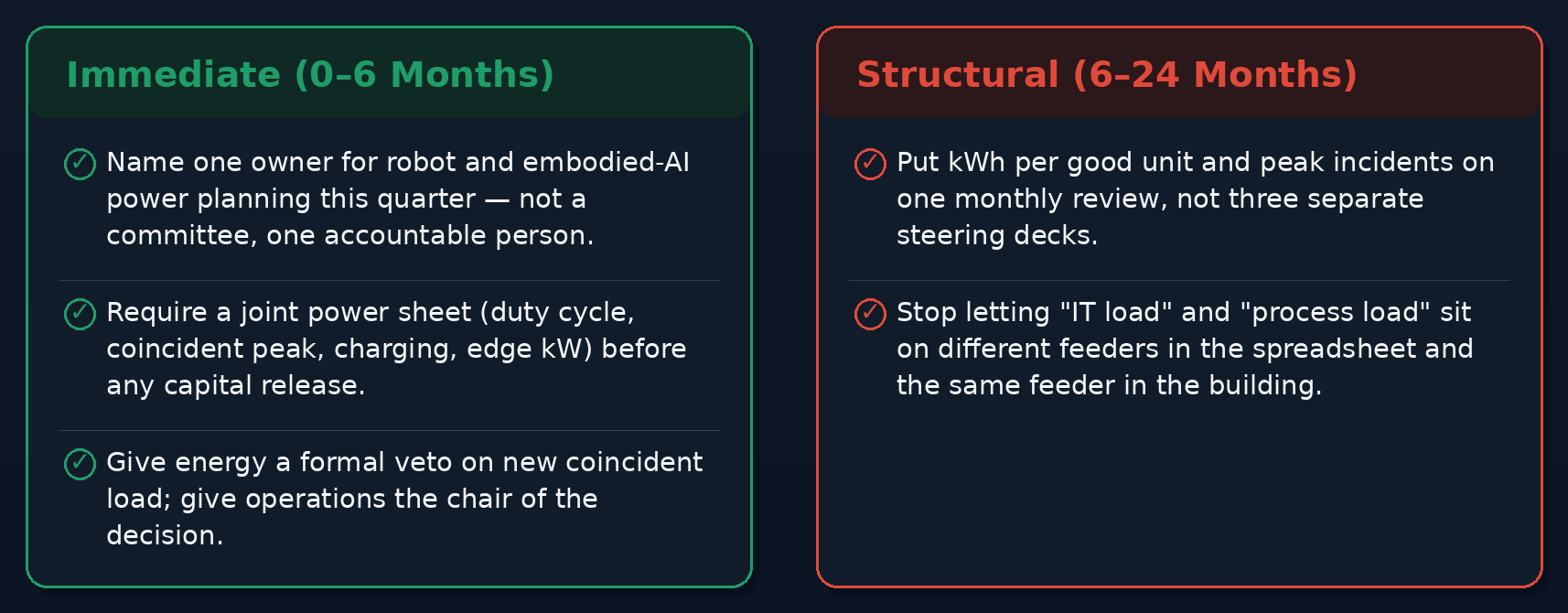
Decision Makers do not need a new department. They need a named owner for robot power planning, with the other two functions as mandatory inputs, not afterthoughts.
1. Three Logics, One Feeder
Each function is optimizing correctly for its own mandate. That is exactly why the gap between them is invisible until the meter spikes.
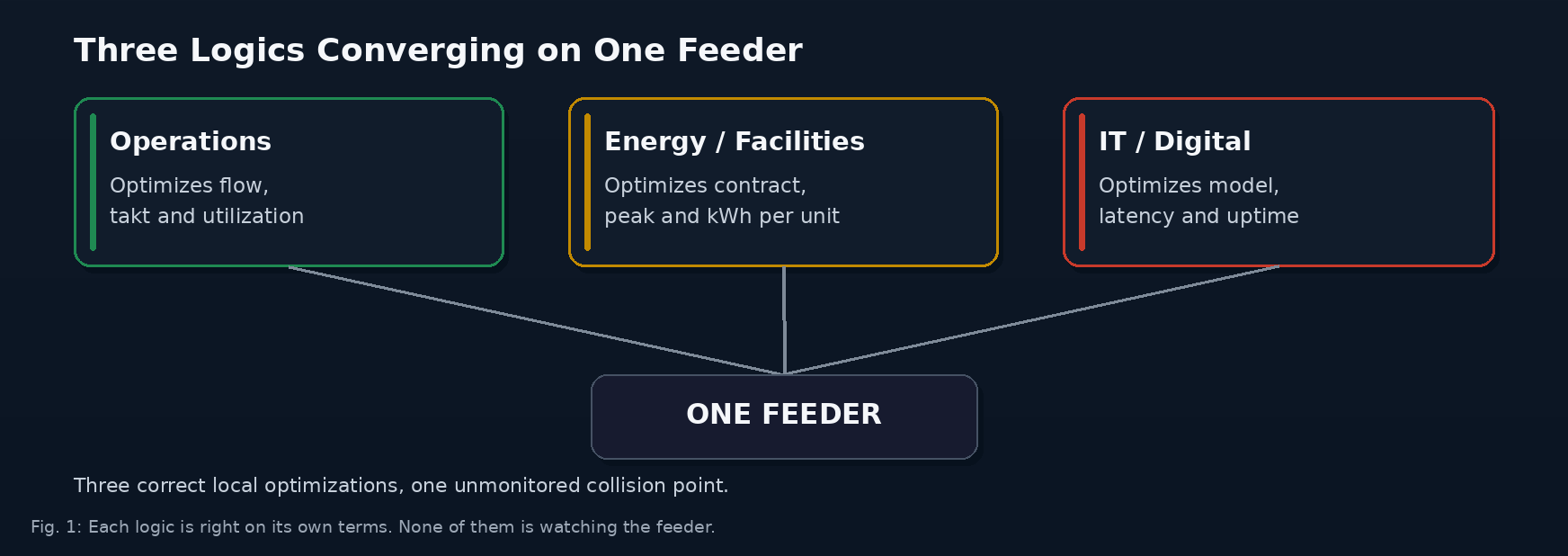
Operations optimizes flow and utilization, a busy cell is a good cell, until the production constraint and the charger queue disagree about which robot moves next. Energy optimizes contract, peak and kWh per unit, a robot rated "only 3 kW" is invisible on any single line item, until forty of them dock and charge together inside the same quarter-hour. IT or the digital team optimizes the model, its latency and the uptime of the compute, edge inference is treated as an IT load on an IT budget, not as part of the cell's actual electrical envelope.
None of these three logics is wrong on its own terms. Together, without a fourth party watching all three at once, they reliably produce two outcomes: surprise peaks that show up on the utility bill with no single accountable cause, and efficiency projects that get approved by one function and quietly orphaned by the other two.
👉 Key Insight
Shared responsibility for robot power is usually no responsibility.
2. What "Owning It" Actually Means
Naming an owner is not the same as creating a new job. It is the same as closing a gap that currently has nobody standing in it.
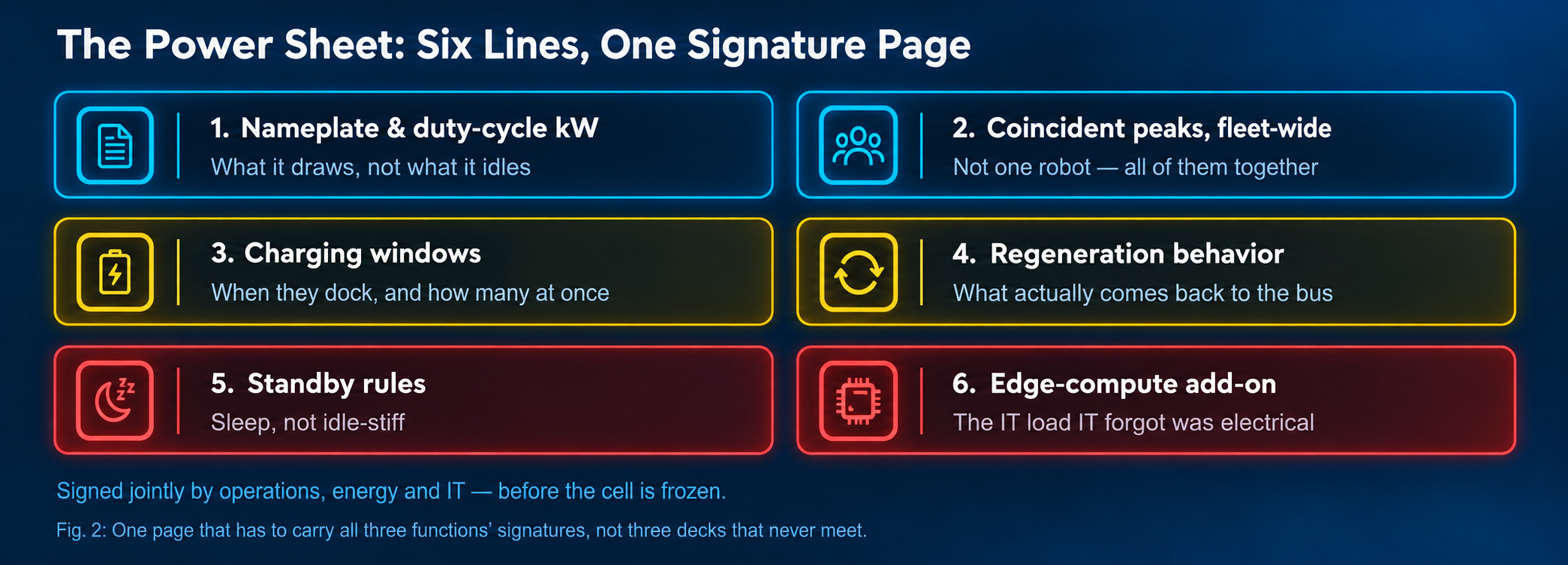
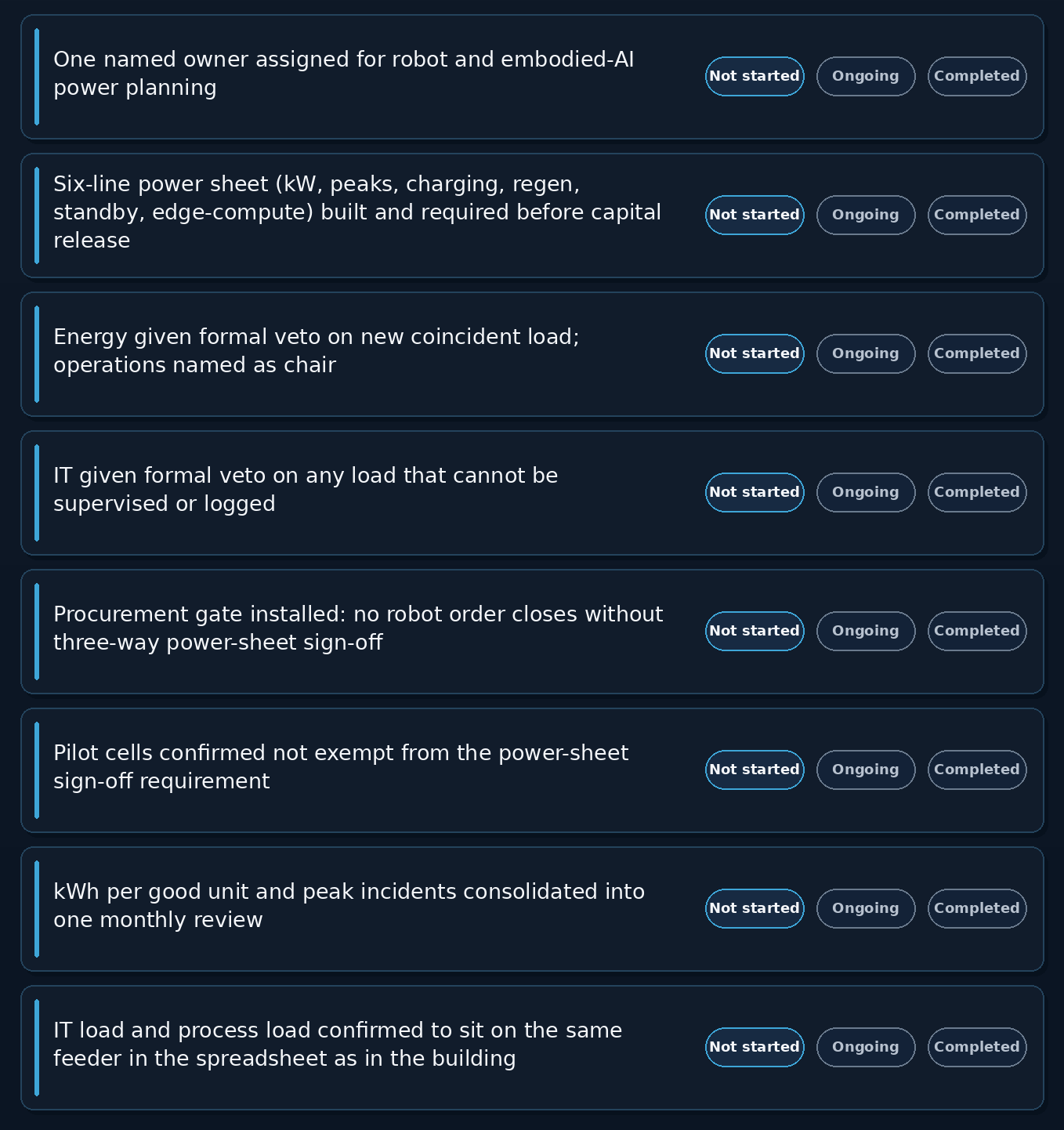
The owner does not have to run the robots or sign the energy contract. The owner has to hold one plan, and that plan has to include six things: nameplate and duty-cycle kW, coincident peaks across the fleet, charging windows, regeneration behavior, standby rules, and the edge-compute add-on that IT currently books separately. That plan gets signed by operations, energy and IT before the cell is frozen, not reviewed by each of them in a separate meeting, but signed jointly on the same page.
After go-live, the same owner reviews the same two numbers every month: kWh per good unit, and peak incidents. Not three separate slide decks that each function brings to its own steering committee, each telling a locally true story that never adds up to the actual feeder.
👉 Key Insight
Ownership is a decision right and a metric, not a job title on an org chart.
3. Practical Split That Works
A workable pattern has already emerged in brownfield plants running this for a year or more, and it does not require a reorganization to install.
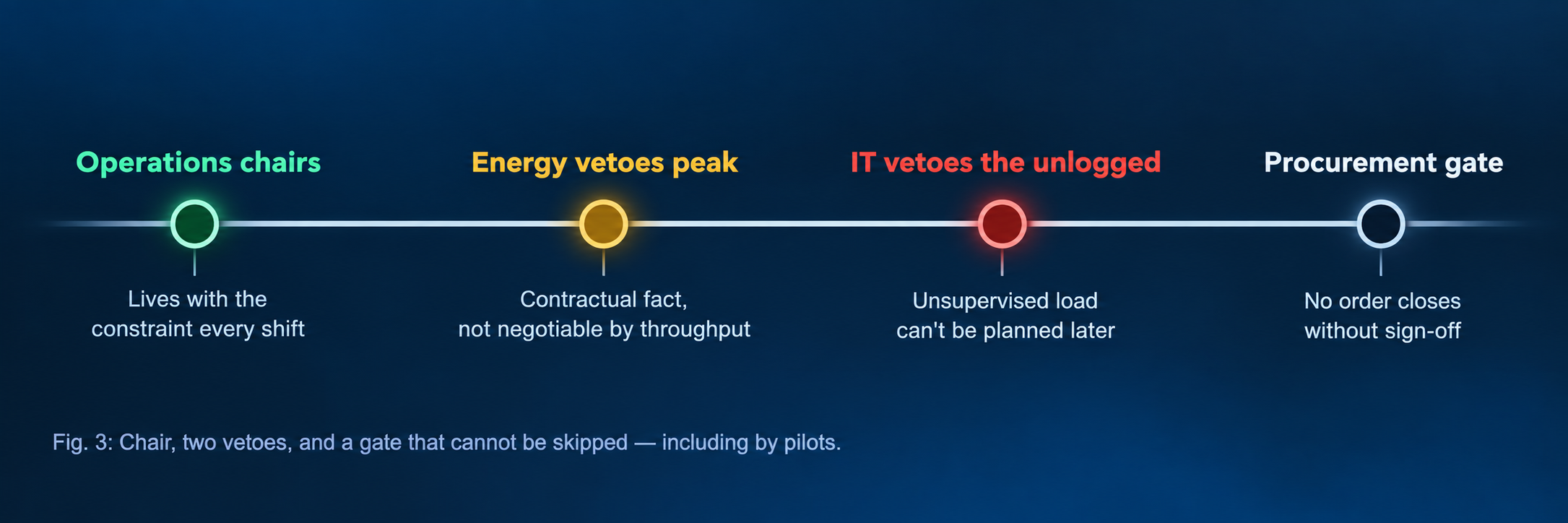
Operations chairs the decision, because operations lives with the constraint every shift and feels the cost of a bad call first. Energy holds a formal veto on peak and connection, not a vote, a veto, because a coincident peak is a contractual and physical fact that operations cannot override by wanting more throughput. IT holds a formal veto on anything that cannot be supervised or logged, because an edge-AI load nobody can see is a load nobody can plan around later.
The enforcement mechanism is procurement, not culture: procurement cannot close a robot order without the three-way sign-off on the power sheet. Pilot cells are not exempt, a pilot that skips the sign-off becomes next year's unplanned load precedent, the exact pattern this series has already named at the feeder and the fleet level.
👉 Key Insight
The cheapest governance is a one-page power sheet that cannot be skipped.
Action Plan for Decision Makers
Checklist
Final Thought
Who owns the power plan is a structure question, and structure questions have structural answers: a chair, two vetoes, a gate. Part III of this Week 41 set goes somewhere upstream of structure entirely — to the moment a sensor reports a confident number that is wrong, and the only thing standing between that number and a bad outcome is one experienced person's willingness to stop the line.
Efficiency Before Energy means the power plan is written before the feeder is surprised, not after.
Systems don't fail. Decisions do.
Take the Next Step
Subscribe to the Weekly Punch for weekly strategic clarity, direct to your inbox.
References
A3 / OEM Practice (2026) Plant-Level Patterns in Industrial Robot Energy Management.
Wood Mackenzie (2026) Distribution-Load Notes: Robot Charging as Unmodelled Demand.
Energy Dominance series (2026) Brownfield Feeders and Edge AI Power Load. Internal series analysis, Weeks 37–40.
Disclaimer: This article synthesizes publicly available industry patterns and the author's own series analysis current as of publication. Governance patterns vary by plant and jurisdiction; readers should verify current practice against their own energy contracts and internal policies before relying on them for governance decisions. Verification Gate: flagged for pre-publication source check.
Ownership as Design.
Note: This article reflects my personalviews based on industry experience and publicly available information. It does not constitute professional, legal, or investment advice and does not represent the views of my employer. AI-generated visuals, concept and content by the author.
