From Command to Networked Control: Leadership Lessons from McChrystal's Team of Teams

LEADERSHIP | ORGANIZATIONAL DESIGN | SEPTEMBER 2026 | Week 40 · Part III
An Efficient Organization Can Still Be Too Slow to Survive. The Fix Is Not More Control, It Is Shared Information and Decision Rights Pushed to Where the Problem Actually Is
In 2004, the Joint Special Operations Task Force General Stanley McChrystal commanded in Iraq was, by every conventional measure, one of the most capable military organizations in history, elite units, overwhelming technology, a textbook chain of command. It was losing. Not because it lacked skill or resources, but because the enemy it faced, al-Qaeda in Iraq, was organized as a fast, decentralized network, and JSOC was organized as a slow, efficient hierarchy. Efficient and slow turned out to be a losing combination against fast and improvised.
McChrystal's answer, documented in Team of Teams: New Rules of Engagement for a Complex World, was not to tighten command further. It was to rebuild the organization around two things a hierarchy is structurally bad at: shared information and pushed-down decision rights. That answer applies far beyond a war zone.
Executive Summary
IN 60 SECONDS:
Facing a decentralized, fast-adapting insurgent network in Iraq, JSOC found that its efficient, hierarchical command structure was too slow — decisions that a small team could see clearly still had to travel up and back down a long reporting chain.
McChrystal's fix, "team of teams," rested on two pillars: shared consciousness — radical transparency that gave everyone the same operating picture — and empowered execution— decision rights pushed down to whoever was closest to the information, once they had that picture.
The transferable leadership lesson has nothing to do with military structure specifically: the bottleneck in most organizations is rarely talent or technology. It is whether decision rights sit where the relevant information actually lands.
1. Why Efficient Command Failed Against a Networked Enemy
JSOC was not undisciplined, under-resourced, or poorly led in any conventional sense. It was, by design, extremely efficient. That was exactly the problem.
A classical hierarchy is built to be efficient in a predictable environment: information flows up through defined layers, decisions get made at the appropriate level of authority, and orders flow back down. Every step adds rigor and reduces error, as long as the environment holds still long enough for the loop to complete. Al-Qaeda in Iraq did not hold still. Its cells operated with near-total autonomy, bound together by shared ideology rather than a reporting chain, and could plan, adapt and strike on a cycle measured in hours. JSOC's structure meant a decision a captain on the ground could see clearly often still had to travel up multiple layers of command and back down before it was actioned, a cycle measured in days.
McChrystal's own diagnosis, laid out in the book, was blunt: the task force was optimized to be efficient, not to be fast, and in a networked fight those are not the same property. "It takes a network to defeat a network" became the organizing insight, not a metaphor, but a literal design requirement for how the task force itself had to be restructured (McChrystal et al., 2015).
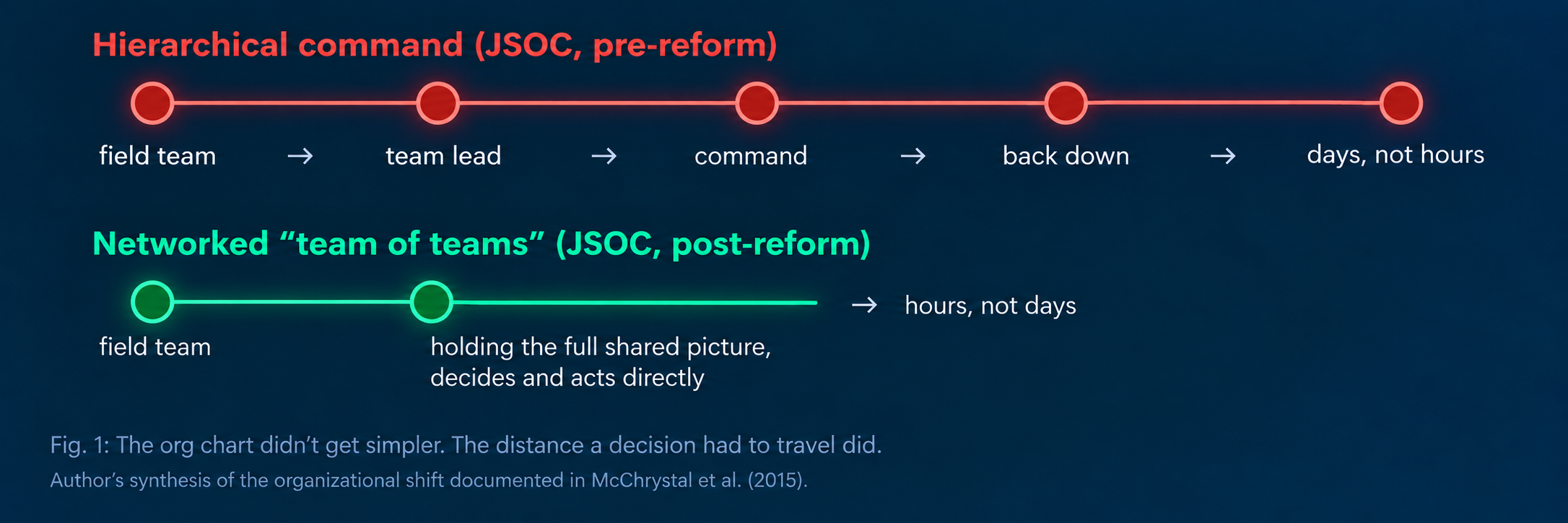
👉 Key Insight
An organization can be efficient and still be too slow. Efficiency measures effort well spent. Speed of adaptation measures whether the organization survives contact with a changing environment.
2. Building "Team of Teams": Shared Consciousness and Empowered Execution
McChrystal's fix was not a looser org chart. It was two specific, deliberately engineered habits, built in a fixed order, because the second one is dangerous without the first.
Shared consciousness came first: radical transparency that gave everyone in the task force the same operating picture regardless of rank or unit. The most visible mechanism was the daily Operations and Intelligence briefing, expanded from a small senior-staff meeting into a video-conference that eventually included thousands of participants across every partner agency and unit, sharing raw information in real time rather than pre-digested summaries. Liaison officers were embedded across the CIA, FBI, State Department and conventional military units specifically to dissolve the silo walls that had kept each organization's information from reaching the others.
Empowered execution came second, and only worked because the first pillar was already in place: decision rights were pushed down to the team members closest to the information, a raid decision, a targeting call, a resource request, without waiting for it to climb the hierarchy. That delegation was safe specifically because the people receiving that authority now had the same situational picture senior leadership did. Empowering people who don't yet share the full picture is not decentralization; it is just distributing risk.
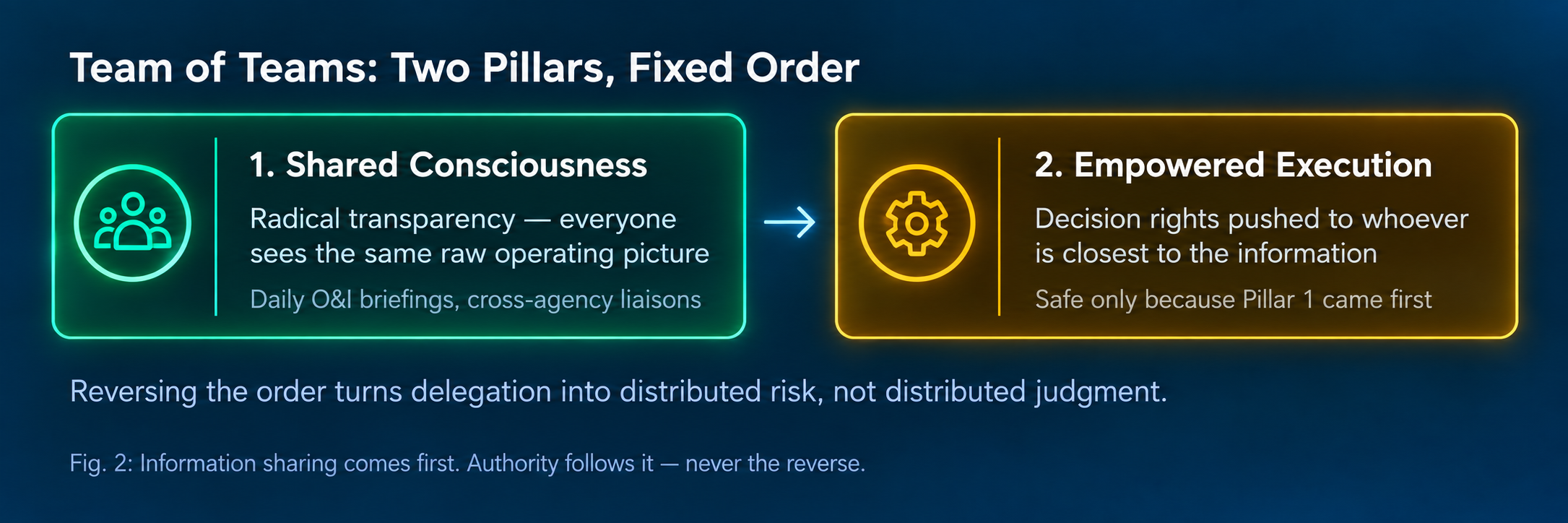
👉 Key Insight
Decentralizing authority without first decentralizing information doesn't decentralize decision-making. It just multiplies the number of places a bad decision can be made.
3. The Leadership Test: Where Do Decision Rights Actually Sit
Almost no civilian leadership team is fighting an insurgency. Nearly all of them are running organizations where the environment now changes faster than the reporting chain can update itself, which is precisely the condition McChrystal was diagnosing.
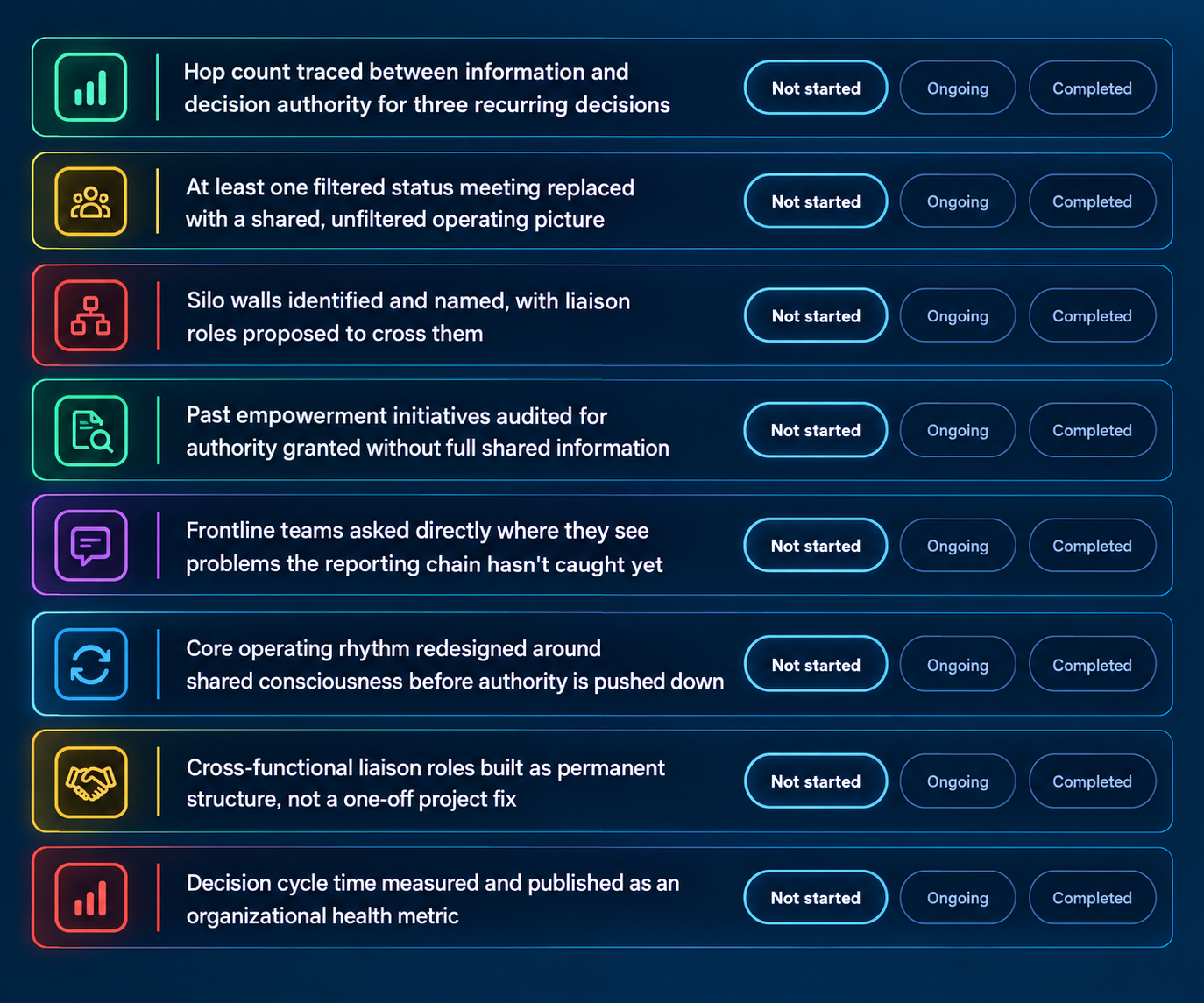
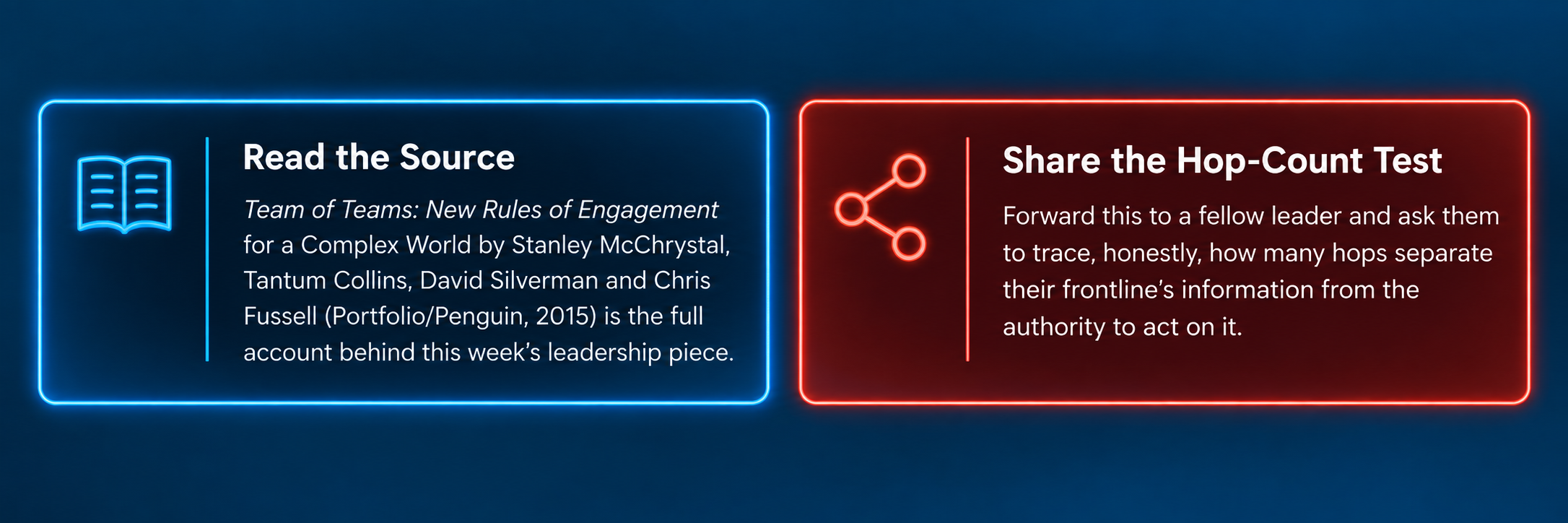
The practical test travels cleanly out of the book: pick any decision your organization makes regularly, and trace how far it has to travel between the person who has the information and the person with the authority to act on it. If that distance is more than one or two hops, the organization is paying a hierarchy tax, measured not in headcount, but in how long it takes to notice and correct a problem the frontline already saw coming.
The fix is the same two-pillar sequence, translated out of uniform. Build shared consciousness first, a common operating picture that reaches the people actually closest to sensors, customers or the factory floor, not a summarized version filtered through several layers of management. Only then push execution authority down to match it. Skipping straight to "empower the frontline" without first giving them the full picture recreates the exact failure mode McChrystal was trying to fix, it just moves the point of failure from headquarters to the field.
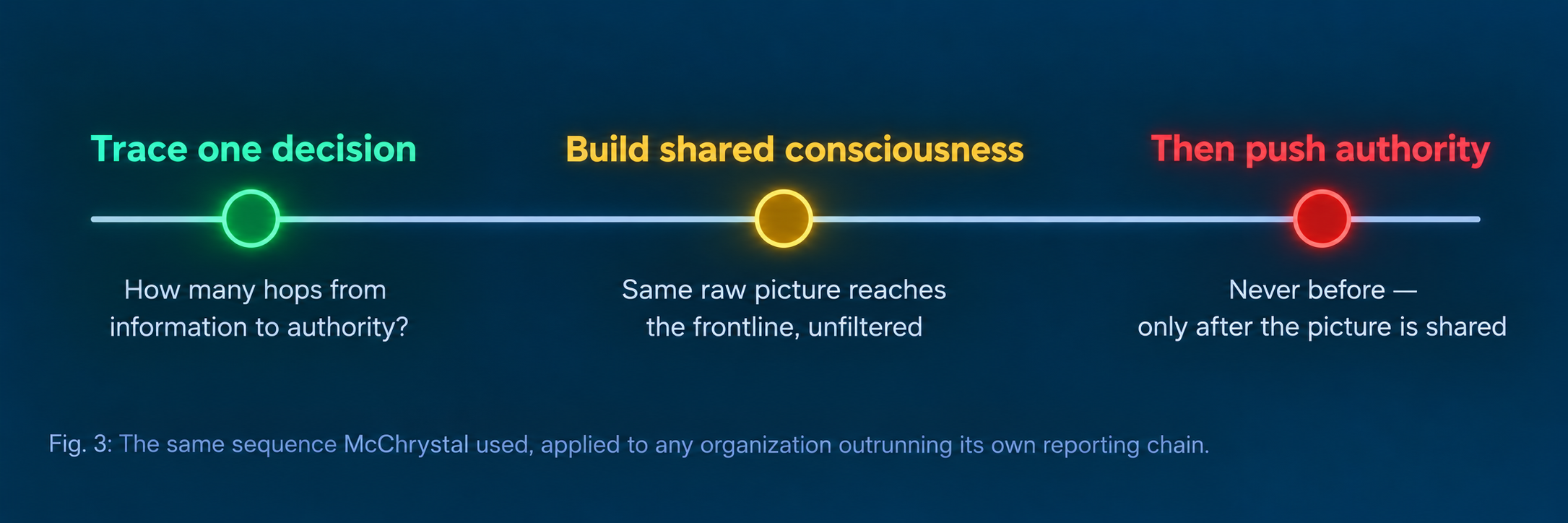
👉 Key Insight
The org chart tells you who reports to whom. It doesn't tell you whether the person closest to the problem is allowed to solve it. That gap is where systems fail.
Action Plan for Decision Makers
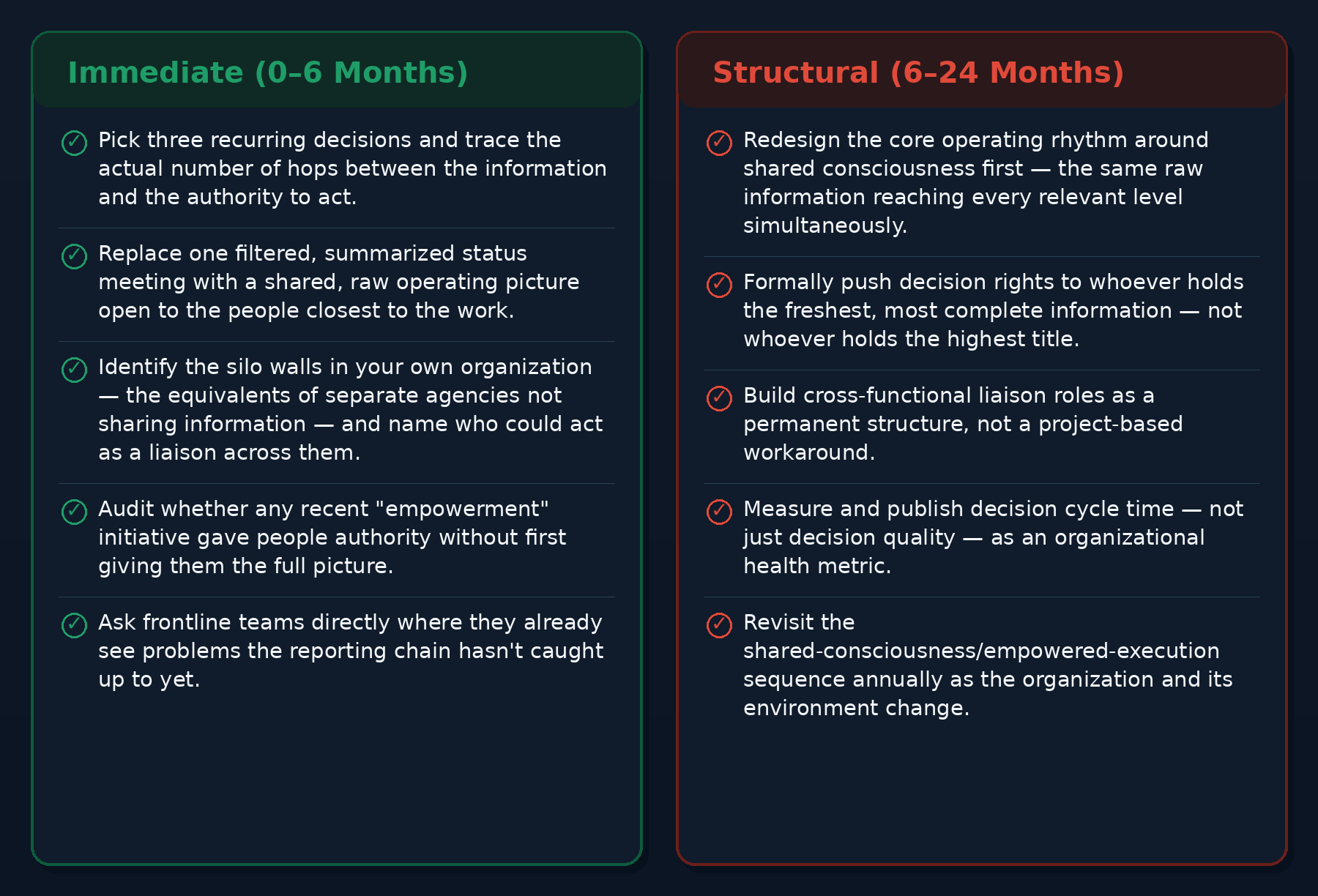
Checklist
Final Thought
JSOC did not win by becoming a bigger hierarchy or a looser one. It won by making sure the people who could see the problem were the same people allowed to solve it. That is not a military insight. It is an organizational one, and it applies whether the network you're up against is an insurgency, a competitor, or simply how fast your own environment now changes.
Ownership as Design means building the organization so that ownership and information sit in the same place — deliberately, not by accident of who happened to be in the room.
Systems don't fail. Decisions do.
Take the Next Step
Subscribe to the Weekly Punch for weekly strategic clarity, direct to your inbox.
References
McChrystal, S., Collins, T., Silverman, D. and Fussell, C. (2015) Team of Teams: New Rules of Engagement for a Complex World. New York: Portfolio/Penguin.
Disclaimer: This article draws on the publicly published account in Team of Teams and applies its organizational lessons to a civilian leadership context. Readers should consult the original text for the full military history and context before citing specific operational details. Verification Gate: flagged for pre-publication source check.
Ownership as Design.
Note: This article reflects my personalviews based on industry experience and publicly available information. It does not constitute professional, legal, or investment advice and does not represent the views of my employer. AI-generated visuals, concept and content by the author.
