AI Will Not Replace Leaders. It Will Expose Bad Ones.

Leadership | Accountability | Judgment | Manufacturing | Week 34 · Part I
LEADERSHIP | AI ACCOUNTABILITY | AUGUST 2026
Why Slow Information Used to Cover for Weak Leadership, and What Happens Now That the Cover Is Gone
Week 33 argued that judgment, not information, is now the scarce resource in every organization. Week 34 asks the question that follows naturally: what happens to the leaders who never had much judgment to begin with, now that AI has taken away the excuse that used to cover for them?
Efficiency Before Fuel has one uncomfortable implication for leadership itself: the fuel was never the real constraint. Neither was the data. It was always the decision — and now everyone can see whose decisions were good.
Executive Summary
IN 60 SECONDS:
AI doesn't create leadership weakness, it removes the cover that used to hide it. When analysis that once took days now takes minutes, leaders can no longer point to slow information as the reason for a slow decision.
The traits that built pre-AI leadership pipelines, confidence, visibility, decisiveness, aren't disqualifying on their own, but confidence without humility is quickly becoming a liability: it shows up as a failure to question AI outputs or catch fluency masquerading as accuracy.
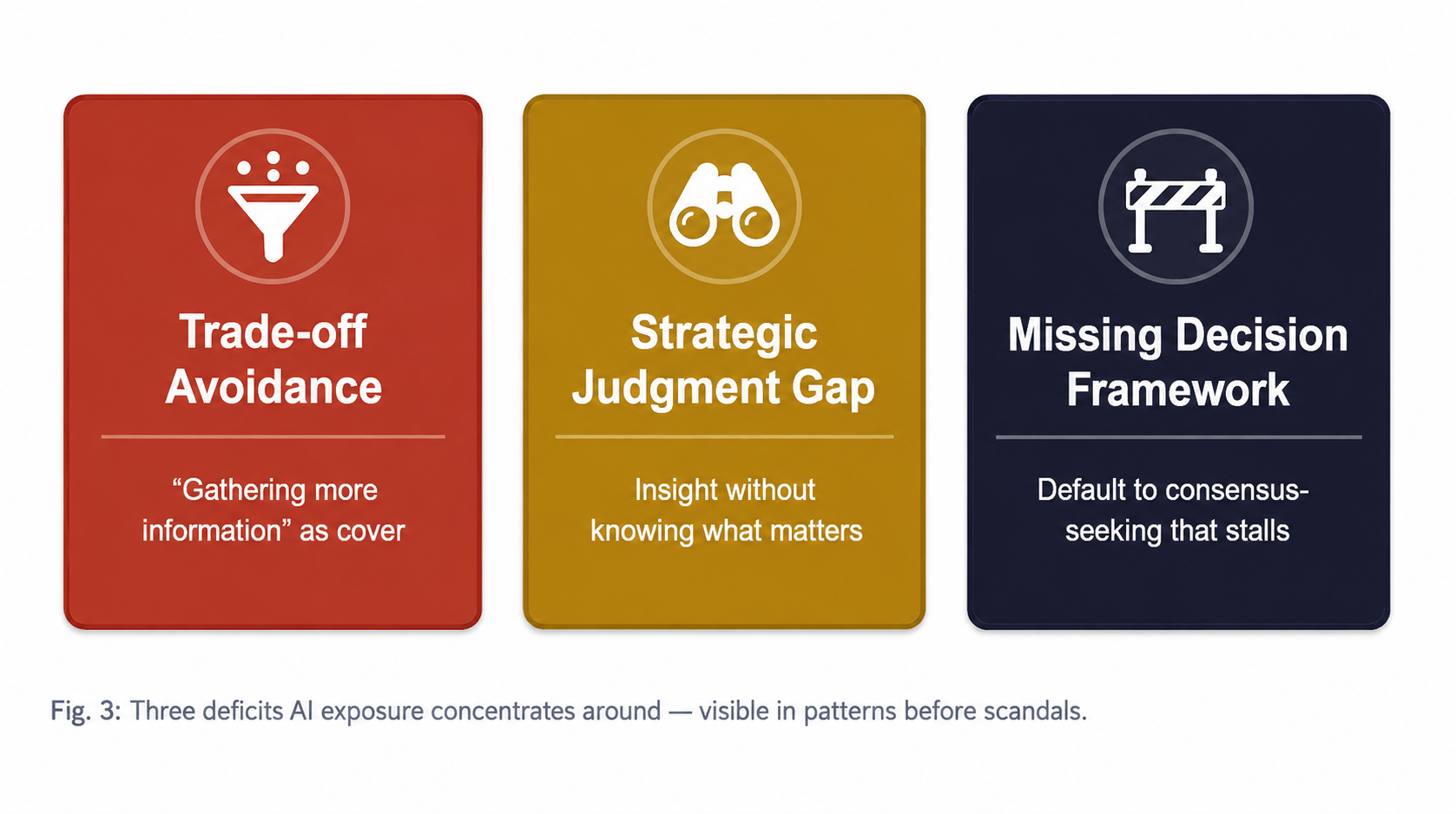
The exposure shows up in patterns, not scandals: trade-off avoidance disguised as "more information," missing decision frameworks, and teams that quietly start routing around leaders who can't keep pace.
1. Why AI Removes the Places Weak Leadership Used to Hide
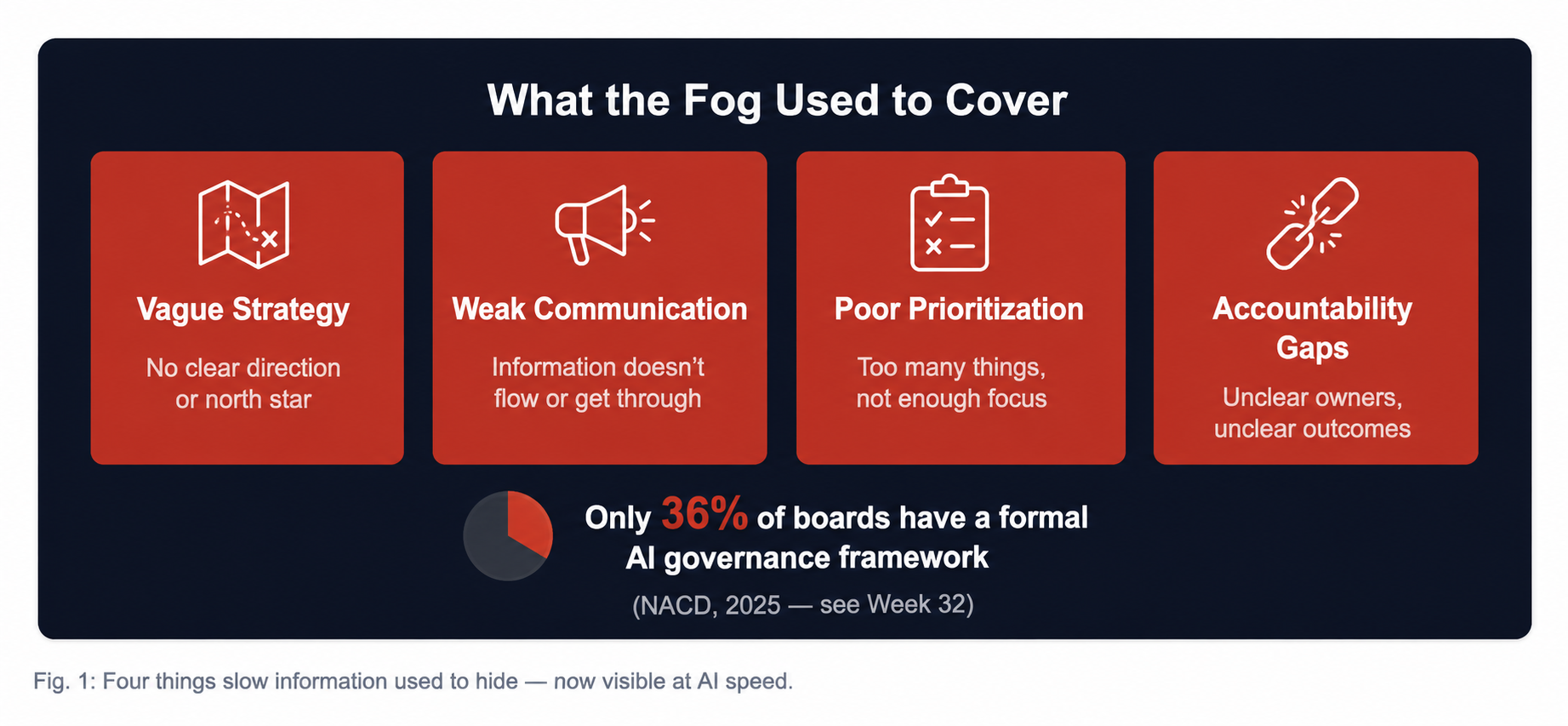
For years, slow information flow gave average leaders cover. That excuse just expired.
When analysis that once took days can be completed in minutes, leaders can no longer rely on slow information flows as an excuse. The bottleneck moves from access to data to the quality of judgment, and AI is functioning, in practice, as an X-ray machine for leadership competence, revealing the decision-making vacuums, accountability gaps and cultural dysfunctions that existed all along but stayed hidden behind bureaucratic complexity and information asymmetry.
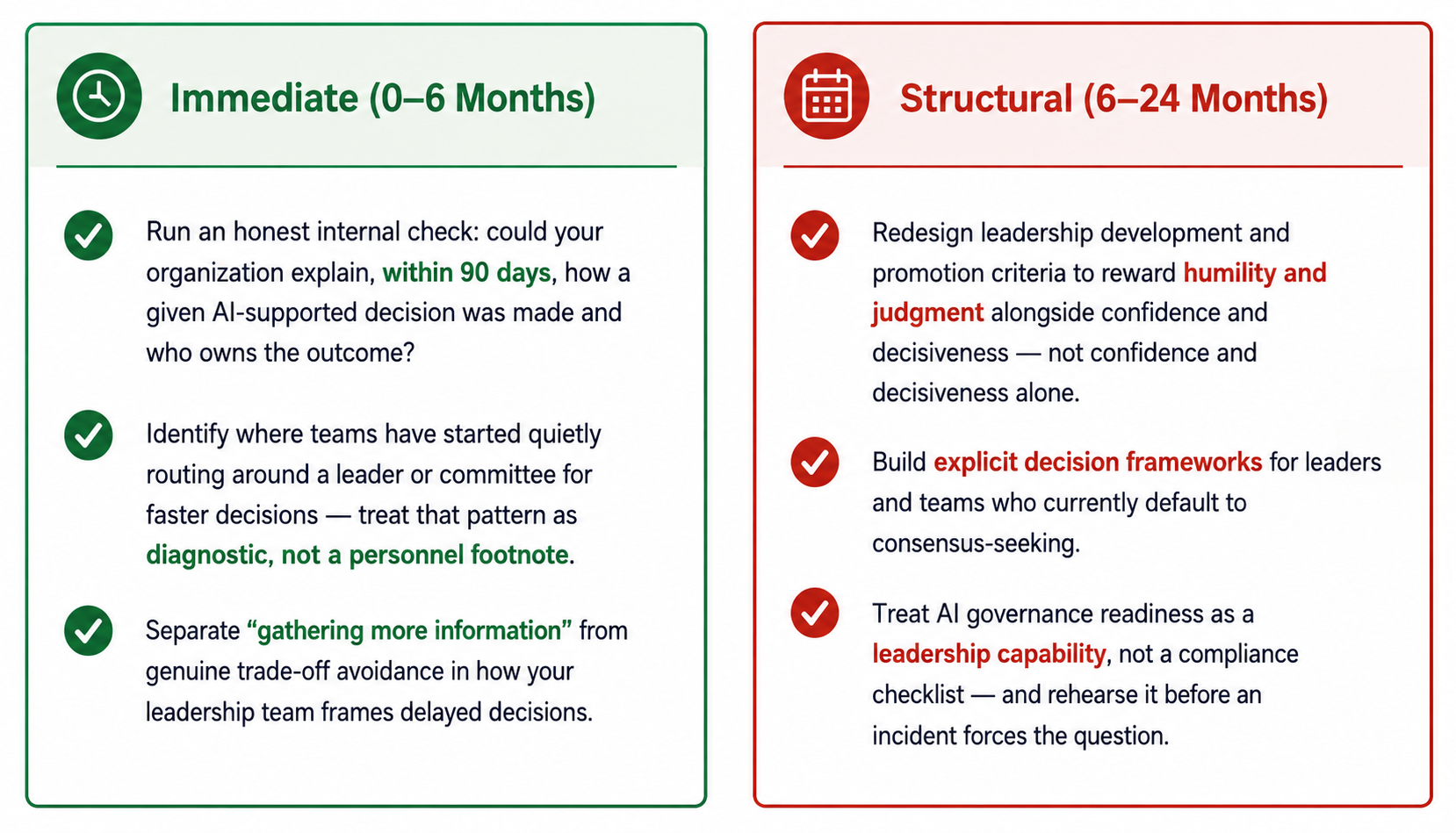
The uncomfortable finding sits right at the governance layer: Grant Thornton's 2026 AI Impact Survey found that many executives lack strong confidence their organizations could pass an independent AI governance audit within 90 days (Entrepreneur / Alaaldin, 2026, citing Grant Thornton, 2026). That is not a technical gap, it is an accountability gap. If no one can explain how an AI-supported decision was made, who owns the outcome, or where human judgment enters the process, the organization does not have an AI strategy. It has an AI exposure. This series flagged the same pattern in Week 32: only 36% of boards currently have a formal AI governance framework, the number behind the excuse that just ran out.
👉 Key Insight
AI doesn't lower the bar for leadership. It removes the fog that let some leaders operate below it without anyone noticing.
2. The Leadership Traits That Used to Work, and Now Work Against You
Confidence, visibility and decisiveness used to be the whole leadership playbook. In an AI-rich organization, two of those three can actively work against you.
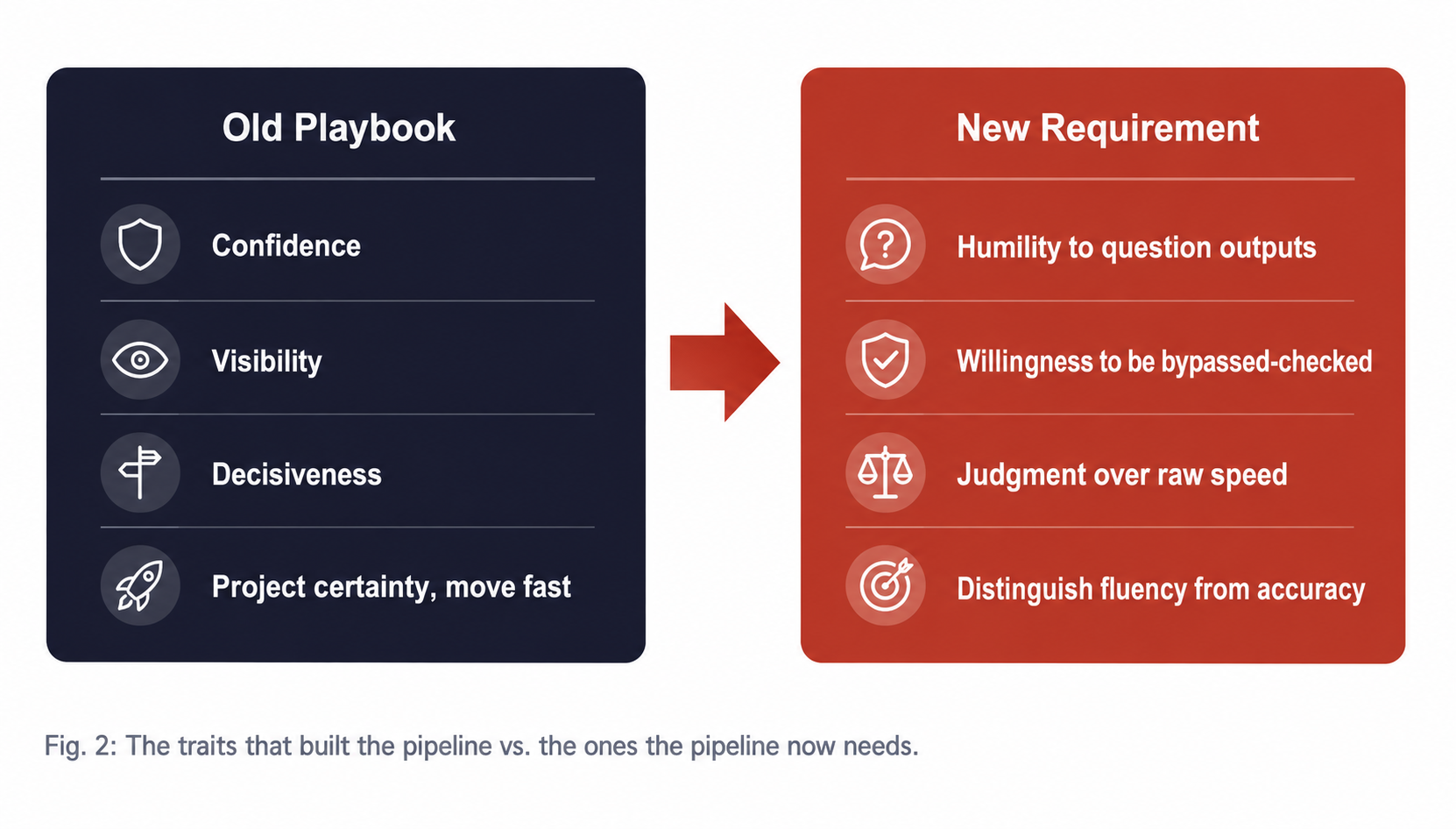
Pre-AI leadership pipelines rewarded confidence, visibility and decisiveness, traits optimized for environments where leaders were expected to project certainty, move fast, command attention and personally drive execution. Those same traits can now block the kind of human agency AI transformation depends on: confidence without humility becomes a failure to question AI outputs or distinguish fluency from accuracy.
The split shows up as a force multiplier in one direction and an accelerant in the other. Where leadership is strong, AI becomes a force multiplier; where leadership is weak, it accelerates confusion and amplifies risk (Forbes Councils / Lardi, 2026). Organizations deploying AI assistants across management layers report a consistent pattern: high-performing leaders accelerate because they already possess strong judgment frameworks, while struggling executives become more visible obstacles as their own teams learn to bypass them for faster decisions (Noomii / Markland, 2026).
👉 Key Insight
The traits that built a leadership pipeline for a pre-AI world aren't automatically disqualifying now, but confidence without humility is no longer an asset. It's a blind spot with a title.
3. Practical Signs: How Exposure Shows Up Inside Real Organizations
You don't need an AI audit to see this pattern. You just need to watch which meetings still happen, and which ones quietly stopped.
The exposure tends to concentrate in three deficits: an inability to make trade-off decisions, where leaders delay under the guise of "gathering more information" rather than actually choosing between competing priorities; a lack of strategic judgment, since access to insight is not the same as knowing what matters; and an absence of decision frameworks, where leaders default to consensus-seeking that stalls execution because no proprietary process exists for evaluation.
The underlying psychology reinforces the pattern rather than correcting it. Research from Stanford's Graduate School of Business finds that expressing uncertainty damages perceptions of leader effectiveness, so instead of transparent uncertainty, weak leaders often broadcast confusion through indecisiveness, contradictory communication and delayed action (Noomii / Markland, 2026, citing Stanford GSB research). None of this shows up on an engagement survey first. It shows up as a quiet reallocation of trust: the team's hard calls stop landing on that leader's desk, long before anyone writes it down.
👉 Key Insight
The diagnostic isn't a survey question. It's whether your best people still bring you the hard calls, or have quietly learned to solve around you.
Action Plan for Decision Makers
Checklist
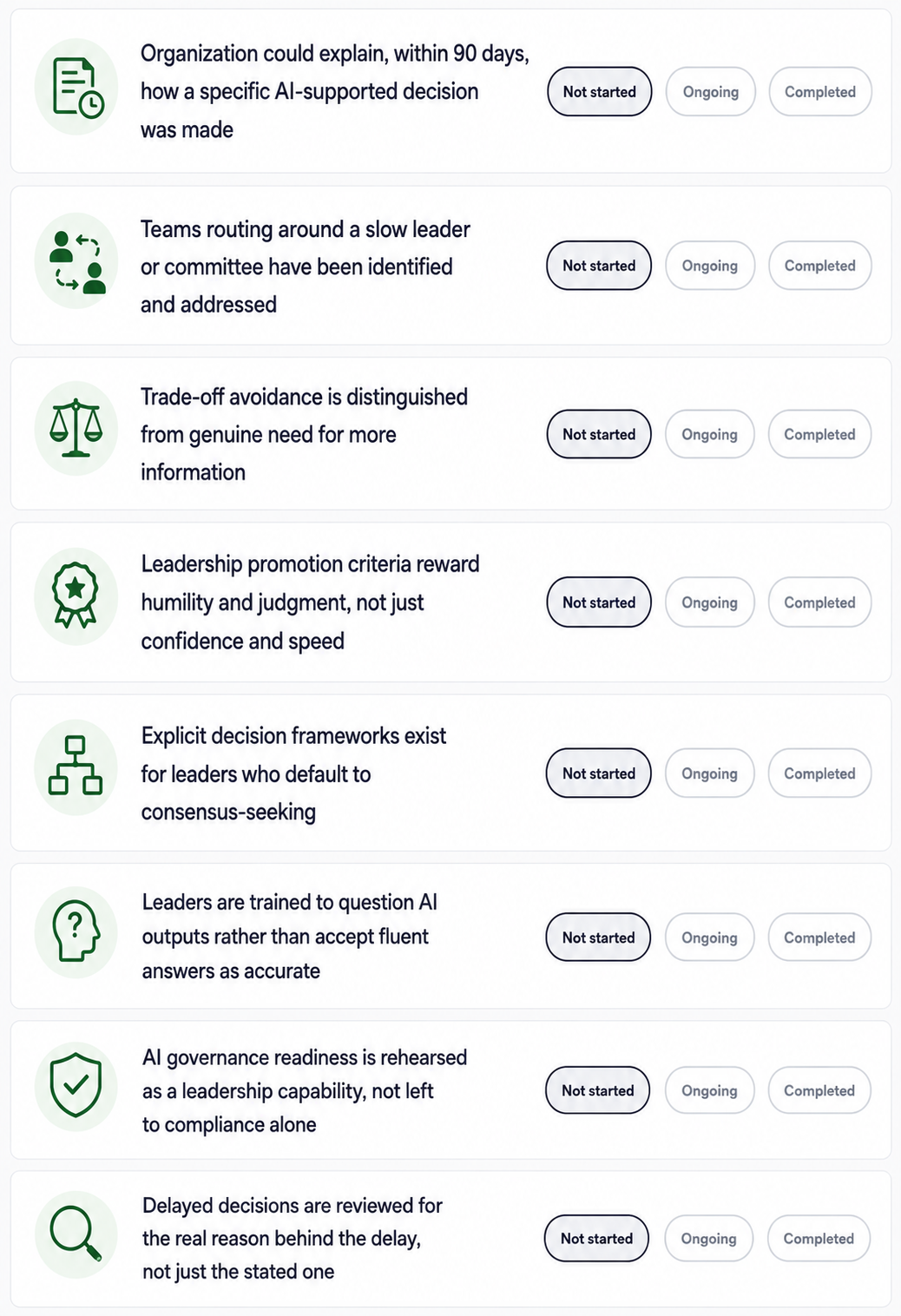
Final Thought
Not every exposed weakness shows up as a bad decision. Some of it shows up as no decision at all — a choice endlessly deferred under the cover of due diligence. Part II of this Week 34 pair puts a number on what that costs.
Efficiency Before Fuel means the decision was always the expensive part. Now it's just easier to see whose decisions were slow.
Systems don't fail. Decisions do.
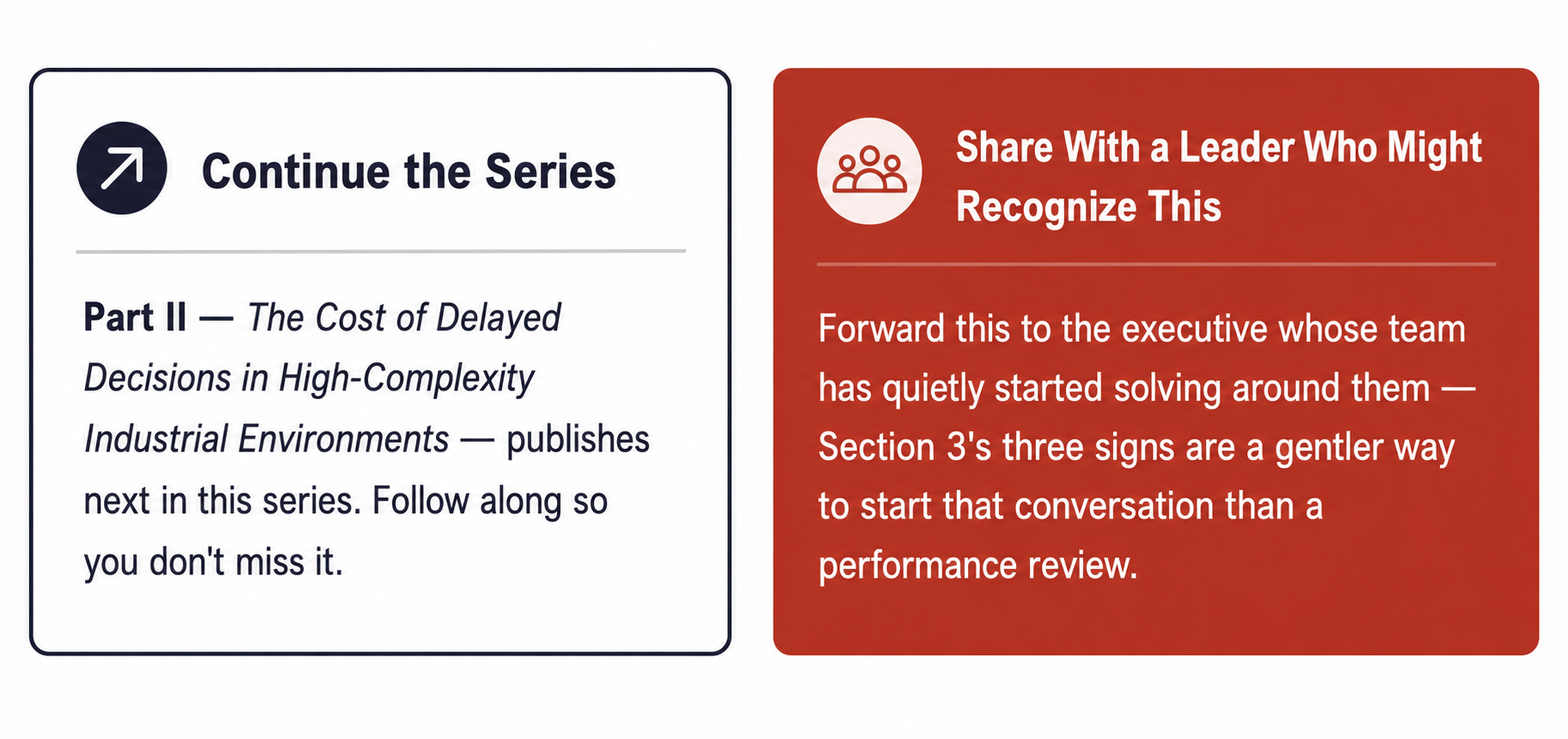
Take the Next Step
Subscribe to the Weekly Punch for weekly strategic clarity, direct to your inbox.
References
Alaaldin, R. (2026) AI Won't Replace Leaders, But It Will Expose Weak Ones. Here's How. Entrepreneur [citing Grant Thornton, 2026 AI Impact Survey].
Cohen, N. (2026) AI Is Exposing Why Organizations Promote the Wrong Leaders. [Originally published in Forbes, 25 May 2026].
Lardi, K. (2026) AI Won't Fix Leadership, It Will Expose It. Forbes Councils.
Markland, D. (2026) AI Is Exposing Weak Leaders: What It Reveals in 2026. Noomii Leadership Coaching [citing Stanford Graduate School of Business research].
Disclaimer: This article synthesizes publicly available research and commentary current as of publication. No detailed section brief was supplied for this week; body sections, framing and evidence selection were originated by the writer from the two given titles. Readers should verify current figures against the original publications before relying on them for strategic decisions. Verification Gate: flagged for pre-publication source check.
Ownership as Design.
Note: This article reflects my personalviews based on industry experience and publicly available information. It does not constitute professional, legal, or investment advice and does not represent the views of my employer. AI-generated visuals, concept and content by the author.
