From Ships to Servers: The Same Energy Problem in Data Centers
ENERGY DOMINANCE · WEEK 22 · PART I
Why Data Center Operators Are Repeating the Exact Same System-Level Energy Waste That Shipping Solved, And How to Leapfrog It
The physics don't negotiate. When a ship's auxiliary pumps ran at fixed speed against variable demand, the waste was predictable, measurable, and ultimately indefensible. The shipping industry spent a decade learning that lesson in hard capital. Today, data center operators are sitting inside the same thermodynamic trap, running cooling pumps and air handlers at fixed capacity against fluctuating AI workloads, and calling it operations. It isn't. It's deferred loss. The only question is whether your organisation recognises the pattern before the board does.
EXECUTIVE SUMMARY — IN 60 SECONDS
Data centers lose up to 40 % of total facility energy in auxiliary systems, cooling pumps, fans, power distribution, an exact structural mirror of the 30–50 % auxiliary waste shipping operated with before system-level reform.
The IEA's April 2026 report confirms the pattern: without integrated system optimisation, data centers will replicate shipping's decade of siloed, procurement-first energy waste at far greater scale and cost.
Decision makers who apply the proven maritime Efficiency Before Fuel playbook, board mandate, full TCO accounting, integrated retrofit windows, convert energy from an infrastructure constraint into a decisive AI deployment advantage.
The Striking Parallel Between Ships and Data Centers
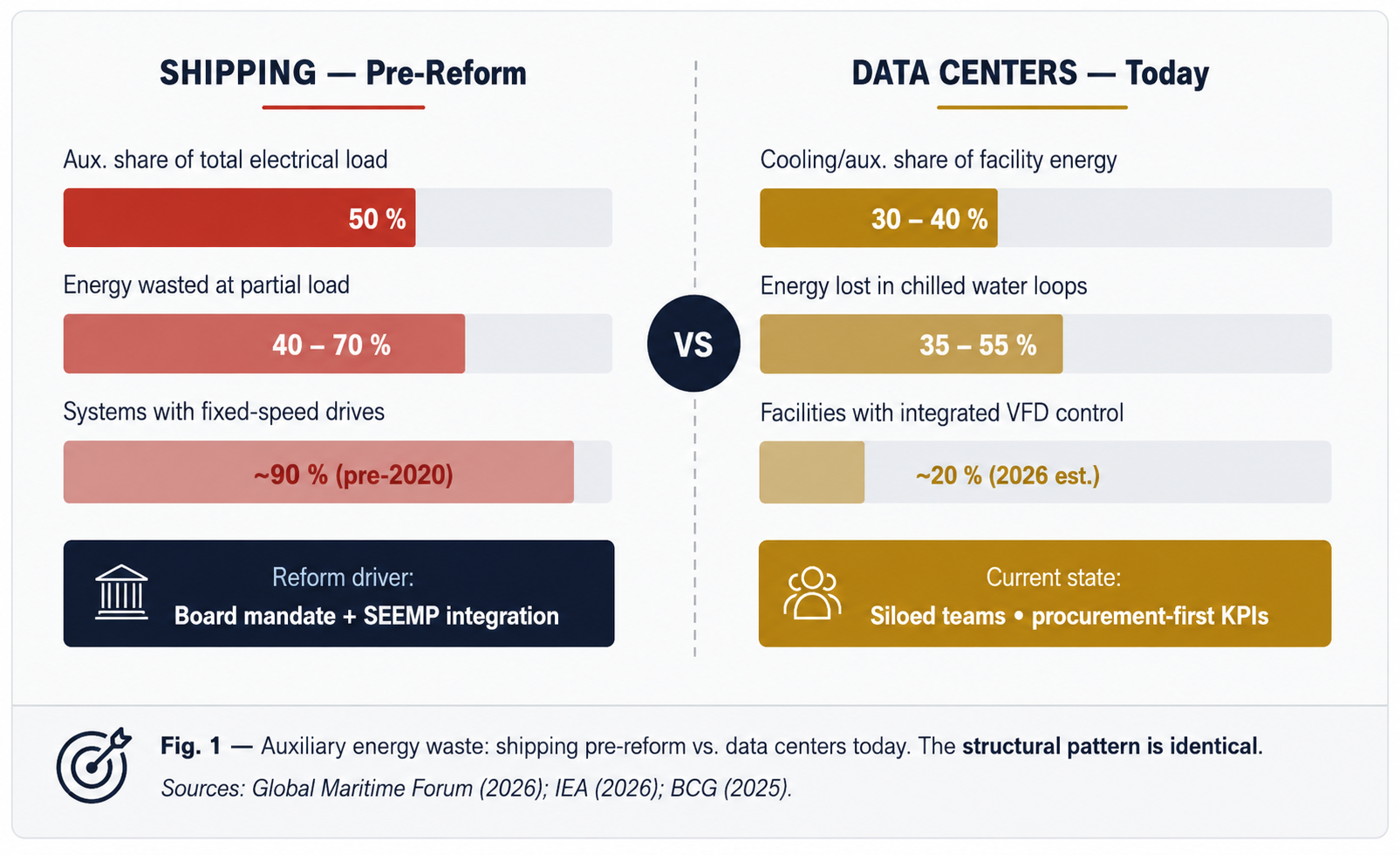
Two industries. Two decades apart. One identical engineering failure. Shipping's auxiliary systems, pumps, fans, compressors, consumed up to 50 % of total vessel electrical load, with 40–70 % of that energy dissipated as waste at partial operating conditions due to throttling and fixed-speed drive operation. This was not an anomaly; it was the designed default.
The physics of centrifugal machinery are unambiguous: affinity laws dictate that a pump running at 80 % of design flow consumes approximately 51 % of full-load power, but only when fitted with variable-frequency drive control. Without VFDs, fixed-speed pumps dissipate the energy difference as heat, vibration, and wear. Shipping operated this way for decades. Data centers are operating this way today. Cooling pumps and fans account for 30–40 % of total facility energy consumption, with chilled water loops and air handlers exhibiting near-identical dissipation profiles to marine auxiliary systems under partial IT load.
The IEA's April 2026 report on energy and AI notes that data center electricity consumption continues to accelerate without proportional efficiency gains in auxiliary infrastructure. The BCG 2025 analysis confirms that cooling and power distribution inefficiency, not compute density, is the primary driver of PUE degradation in hyperscale facilities. The Global Maritime Forum's 2026 operational efficiency review documents that marine auxiliary retrofits (VFDs, heat recovery, integrated controls) delivered 20–35 % electrical load reduction per vessel, directly translating to the data center context.
👉 Key Insight: Data centers are not facing a new problem, they are facing the same system-level energy problem that shipping solved through integrated retrofits and leadership-level mandate. The physics, the organisational failure mode, and the remedy are structurally identical.
Why Data Centers Are Repeating Shipping's Old Mistakes
Shipping's pre-reform era was not defined by ignorance of the waste, engineers measured it. It was defined by organisational architecture that made acting on the data structurally irrational for any single department. Data centers have rebuilt that architecture with remarkable precision.
Three failure modes are operating in parallel. First, siloed team structures: IT optimises compute performance, facilities manages thermal infrastructure, and energy procurement manages the grid connection, with no integrated P&L accountability shared across all three. This is the exact split incentive that blocked marine efficiency until fleet-level SEEMP mandates forced cross-functional ownership. Second, procurement thinking dominates capital decisions: "buy more power capacity" remains the default response to thermal constraints, mirroring shipping's historical instinct to add generators rather than reduce auxiliary demand. Third, legacy KPIs reward Capex avoidance and raw megawatt availability, not efficiency per compute unit, precisely the metric set that delayed shipping's efficiency transition until regulatory and market pressure forced board-level intervention.
McKinsey's March 2026 analysis of the USD 7 trillion AI data center infrastructure race identifies organisational fragmentation as a primary bottleneck to energy efficiency at scale. BCG's 2025 report on breaking barriers to data center growth confirms that procurement-led decision frameworks systematically underinvest in demand-side efficiency. ABS and Wärtsilä retrofit documentation from 2026, developed for marine applications, directly maps the technical correction pathway to cooling and power distribution infrastructure in modern data centers.
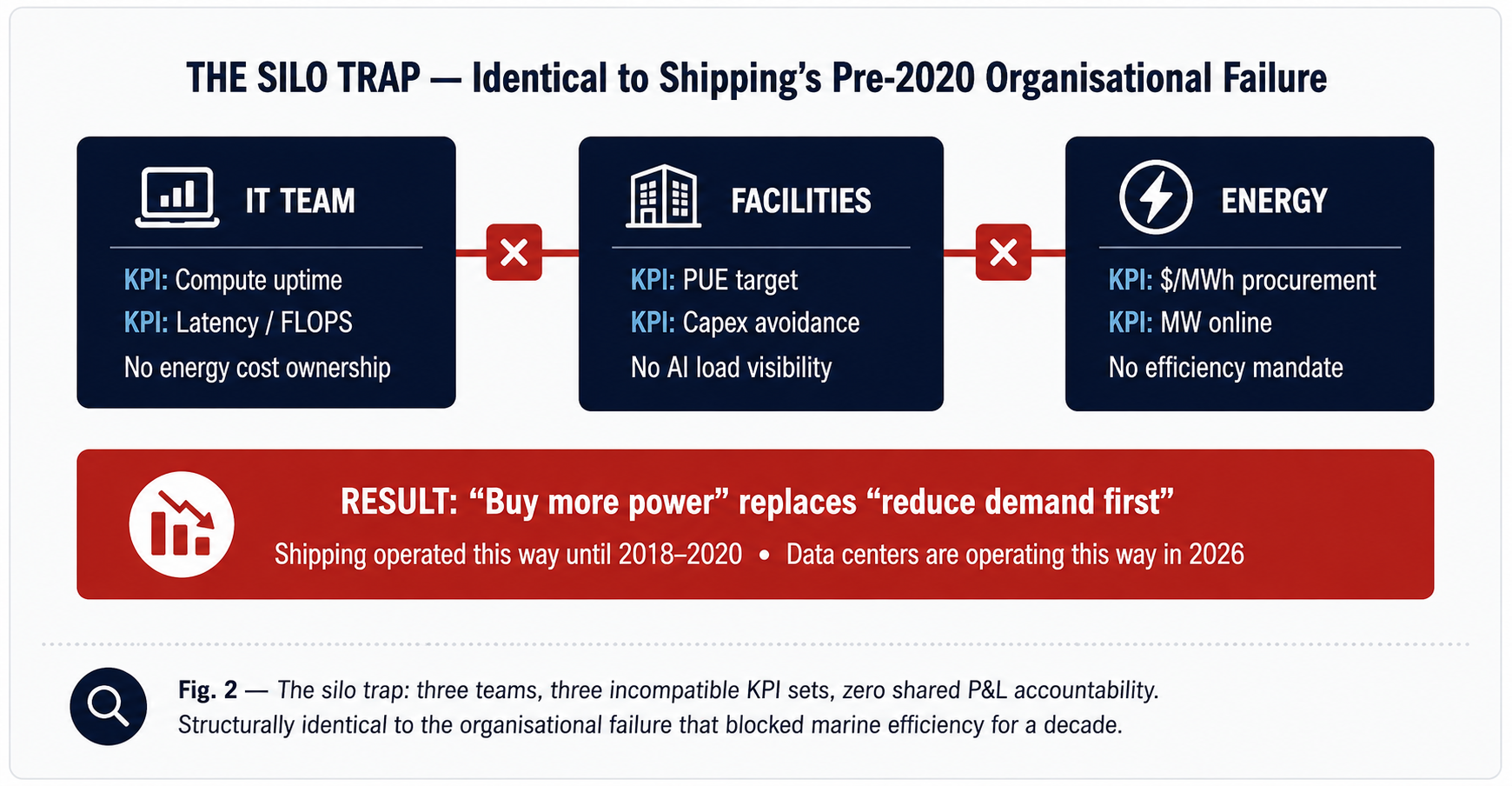
👉 Key Insight: The failure is not technical, it is structural. No single team inside a siloed data center organisation has the mandate or the incentive to optimise total energy consumption. Shipping broke this deadlock only through board-level intervention. Data centers will require the same.
Quantified Impact in Today's Data Centers
The efficiency gap is not abstract. It has a number, and that number has a direct line to AI deployment speed, grid permitting, and total cost of ownership. Three scenarios define the decision space for operators in 2026.
Status quo operations ,fixed-speed auxiliary systems, siloed management, procurement-first decisions, sustain auxiliary losses of 40 % or more of total facility energy. This directly inflates PUE, increases the MW footprint required per GPU cluster, and extends grid interconnection timelines. A moderate intervention (VFD retrofit across cooling pumps and air handlers, basic demand-response controls) delivers 15–25 % energy reduction with 12–24 month payback at current power prices. Full system-level dominance, integrated liquid cooling, coordinated power distribution, VFD packages, and cross-functional energy governance, delivers 30–50 % reduction in auxiliary energy: the same performance leap that generated USD 2–5 million EBITDA uplift per vessel in the maritime context.
IEA's 2025 data centre electricity use report quantifies the cost trajectory of unmitigated PUE degradation. ABS retrofit case documentation from 2026, applied to data center cooling equivalents, supports the 30–50 % reduction range for integrated interventions. McKinsey's AI infrastructure analysis confirms that operators achieving sub-1.3 PUE through system-level integration gain measurable advantages in grid permitting speed and hyperscaler contract eligibility.
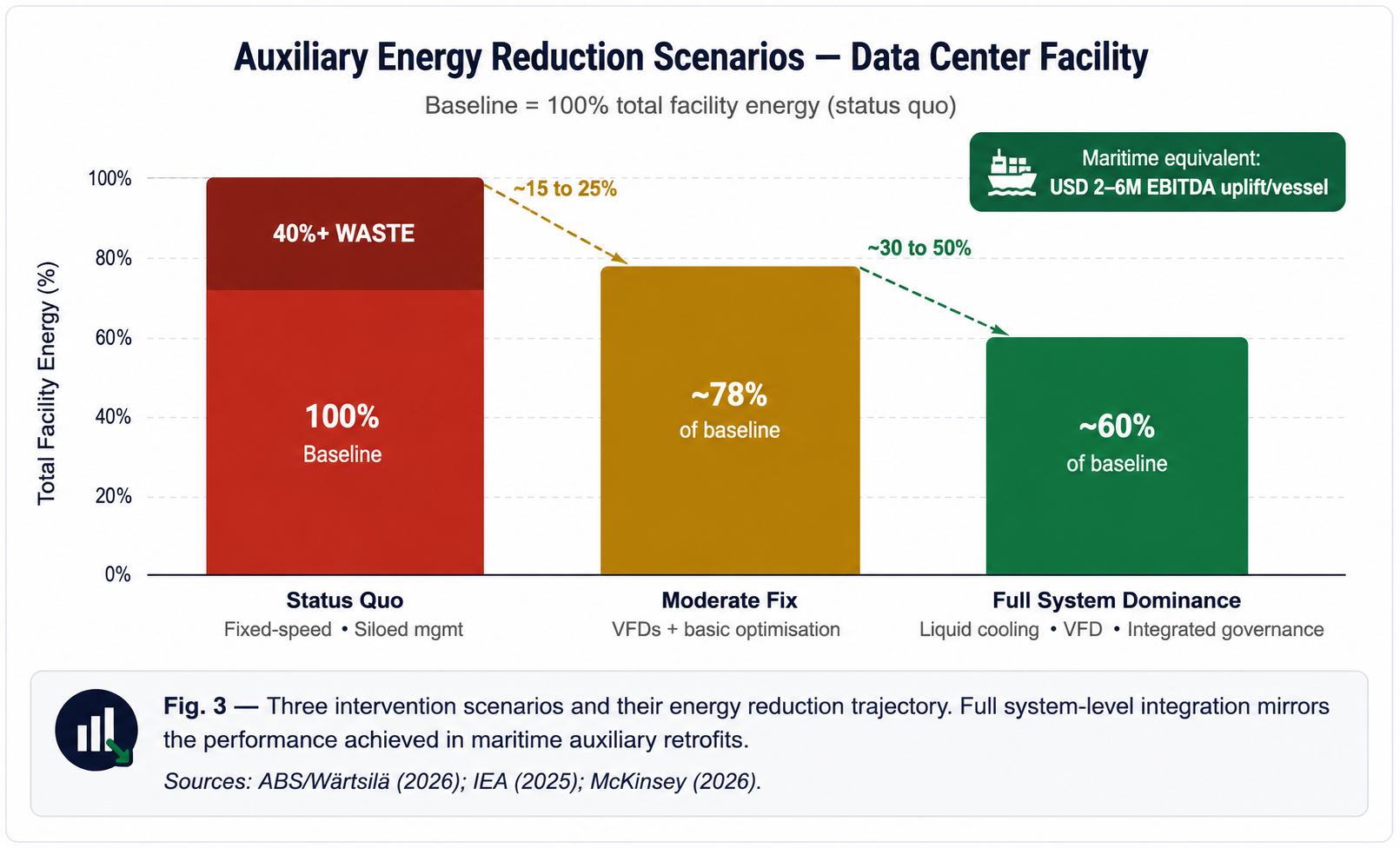
👉 Key Insight: The gap between status quo and full system dominance is not incremental, it is structural. A 30–50 % reduction in auxiliary energy does not require new physics; it requires the same integrated decision architecture that shipping eventually adopted. The operators who act first compound the advantage.
Apply the Shipping Playbook to Data Centers
Shipping did not reform through incremental operational improvement. It reformed because boards stopped treating energy as an engineering variable and started treating it as a strategic P&L line. The instruments that made the shift irreversible were SEEMP integration, cross-functional TCO mandates, and planned retrofit windows that bundled efficiency gains into scheduled downtime. Data centers have direct equivalents for each.
The playbook transfers in four movements. First: board mandate. Energy governance must sit at the enterprise level, not in facilities, not in IT. Until energy performance is a board KPI, procurement thinking will dominate. Second: full system TCO. Every new build and retrofit decision must account for the total cost of power plus cooling plus auxiliary distribution, not Capex per megawatt alone. Third: integrate efficiency metrics into AI deployment reviews. Leading shipping companies linked SEEMP performance to fleet P&L quarterly. Data center operators should link PUE and auxiliary efficiency to AI deployment timelines in the same review cadence. Fourth: drydock-style retrofit windows. Planned downtime events, upgrades, capacity expansions, scheduled maintenance, are the correct moment to bundle VFD packages, liquid cooling integration, and power distribution optimisation. Shipping learned this sequence. Data centers do not need to re-learn it.
Wärtsilä's 2026 retrofit programme documentation demonstrates that bundled intervention during planned maintenance windows reduces retrofit cost by 30–40 % versus standalone deployments. McKinsey confirms that hyperscalers achieving integrated energy governance report 20–30 % faster grid permitting, a direct competitive advantage in AI infrastructure buildout timelines. The Global Maritime Forum's 2026 review documents the SEEMP-to-P&L linkage as the single most effective governance change in shipping's efficiency transition.
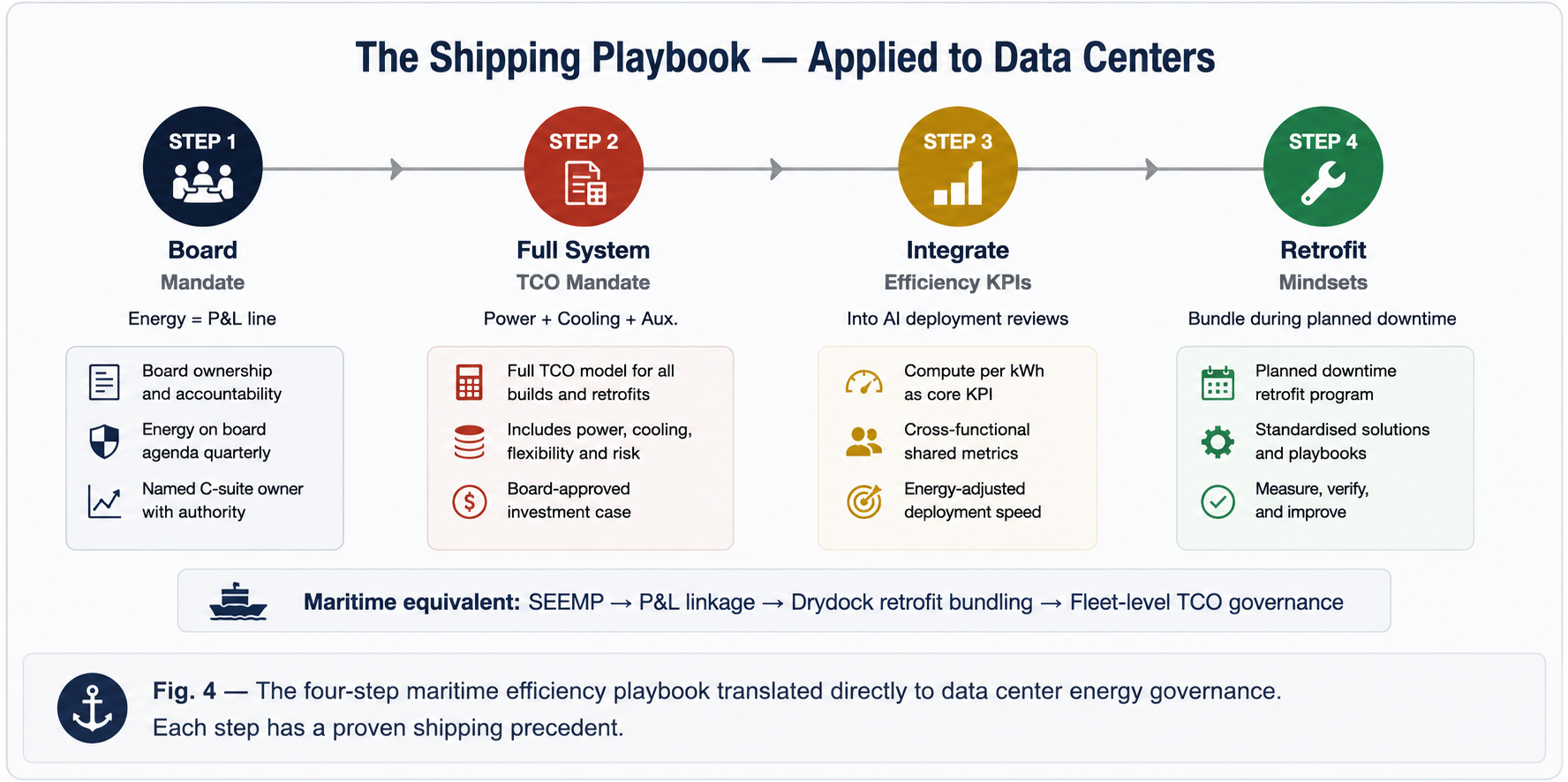
👉 Key Insight: The data center sector does not need to discover what shipping learned through a decade of costly failure. The playbook exists. The only remaining decision is whether leadership applies it now, or waits until the grid, the board, or the hyperscaler contract forces the issue.
Actions for Decision Makers
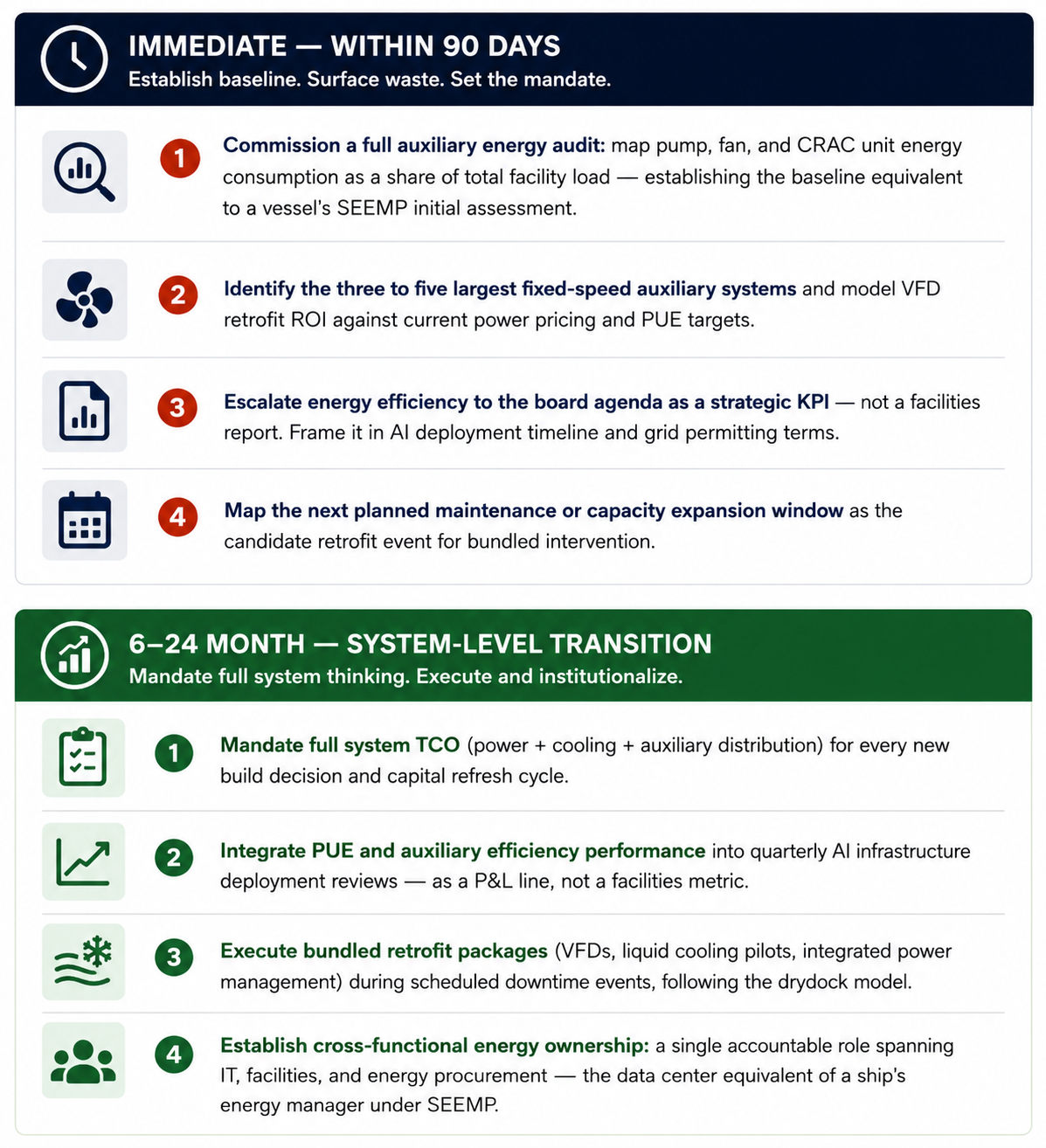
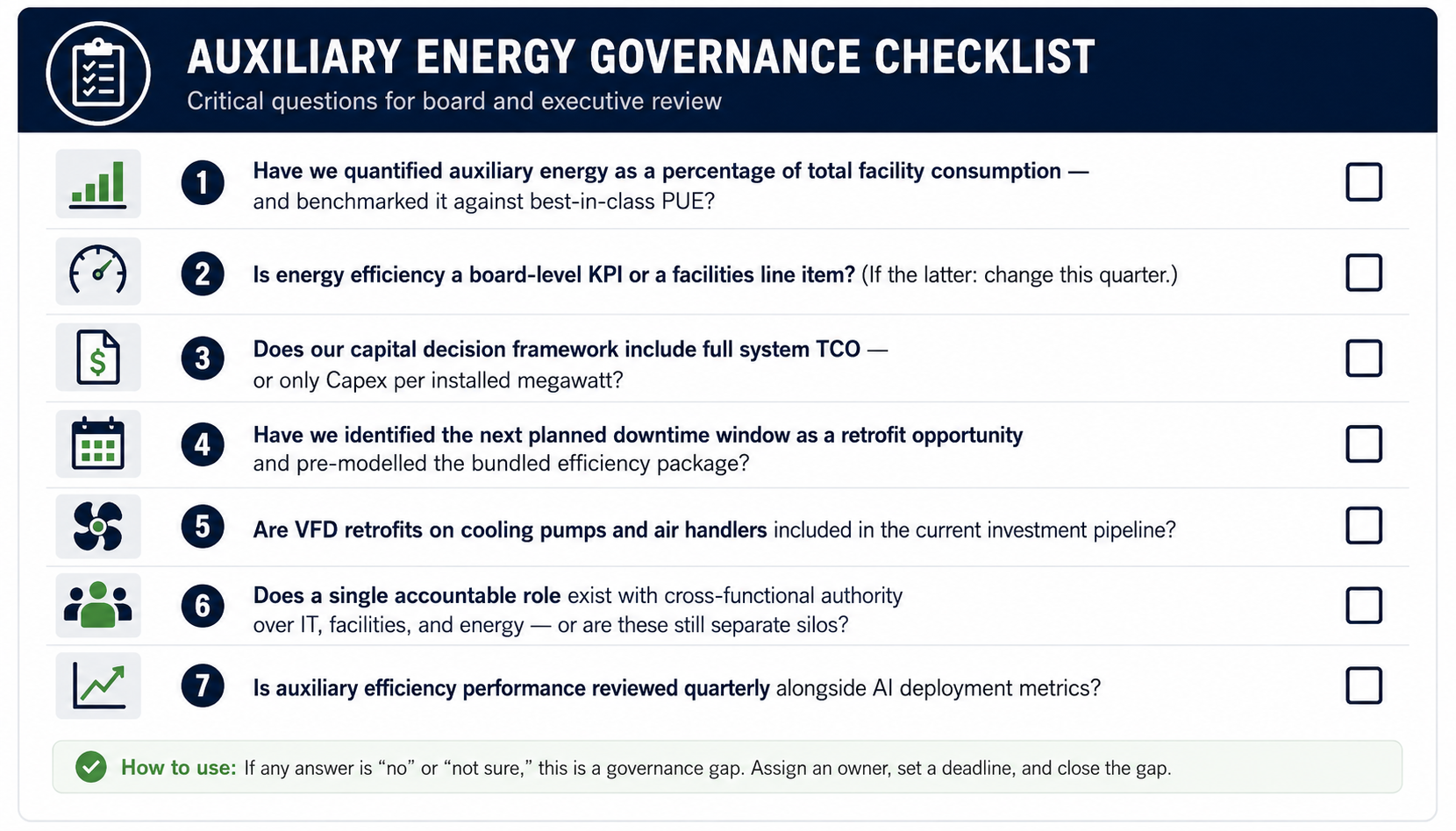
Leadership Checklist
The physics didn't negotiate with shipping. They won't negotiate with data centers.
Every auxiliary pump running at fixed speed against a variable AI workload is not a facilities problem, it is a compounding liability on your AI infrastructure cost structure, your grid permitting timeline, and your competitive position against operators who have already read the maritime lesson. Systems don't fail. Decisions do. The decision available to you today is exactly the decision shipping's board-level leaders took when they stopped buying capacity and started owning efficiency. The playbook was written at sea. The window to apply it on land is open, and it will not stay open indefinitely.
WHAT'S YOUR NEXT MOVE?
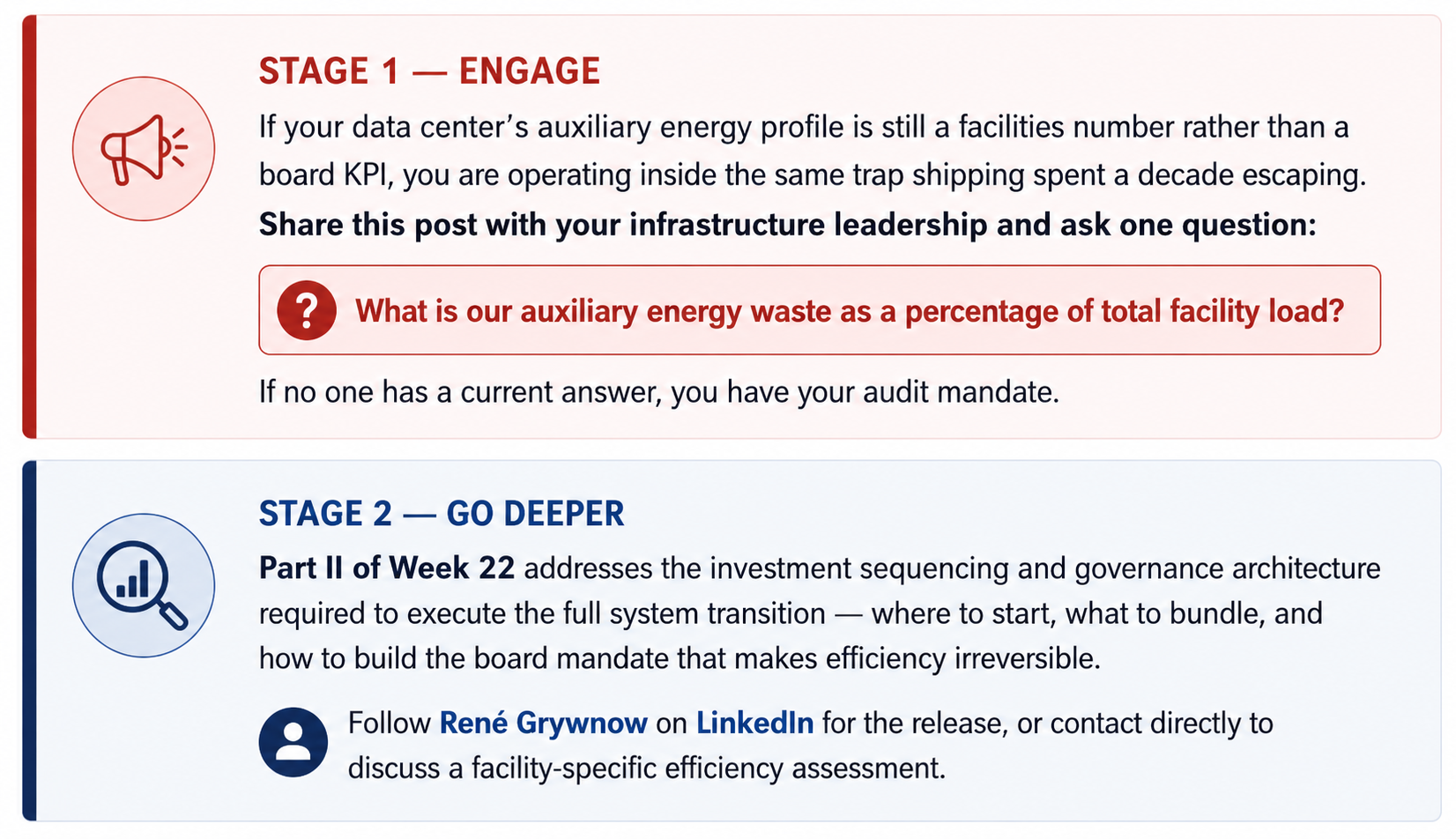
Take the Next Step
Subscribe to the Weekly Punch for weekly strategic clarity, direct to your inbox.
References
International Energy Agency (2026). Key Questions on Energy and AI. IEA, Paris. April 2026.
International Energy Agency (2025). Data Centres and Data Transmission Networks — Electricity Consumption. IEA, Paris.
BCG (2025). Breaking Barriers to Data Center Growth. Boston Consulting Group.
McKinsey & Company (2026). The $7 Trillion Race for AI Data Center Infrastructure. McKinsey Global Institute, March 2026.
Global Maritime Forum (2026). Maritime Operational Efficiency Review. Global Maritime Forum, January 2026.
ABS & Wärtsilä (2026). Vessel Auxiliary System Retrofit Performance Documentation. Applied framework: data center cooling and power distribution equivalents.
Note: This article reflects my personalviews based on industry experience and publicly available information. It does not constitute professional, legal, or investment advice and does not represent the views of my employer.
