Actuators, Motors, Gearboxes: The Hidden Energy Bill of Embodied AI
EMBODIED AI | ENERGY | OCTOBER 2026 | Week 41 · Part I
The Model Is Not the Meter. Joint Drives, Reducers and Heat Decide Whether a Robot Is an Asset or a Load
Week 39 found 23% sitting in a bad trajectory. Week 40 found a continent's worth of grid and installed-base load nobody had planned for. Week 41 goes one layer deeper than either: into the actuator itself, where most of embodied AI's electricity is spent before the algorithm ever "thinks." Inference runs on a chip. Motion runs on copper, iron and a gearbox — and that is where the joules actually die.
This is the component argument after path waste and grid load. A robot brochure sells payload and repeatability. The energy bill is written somewhere the brochure never mentions: the drive train.
Executive Summary
IN 60 SECONDS:
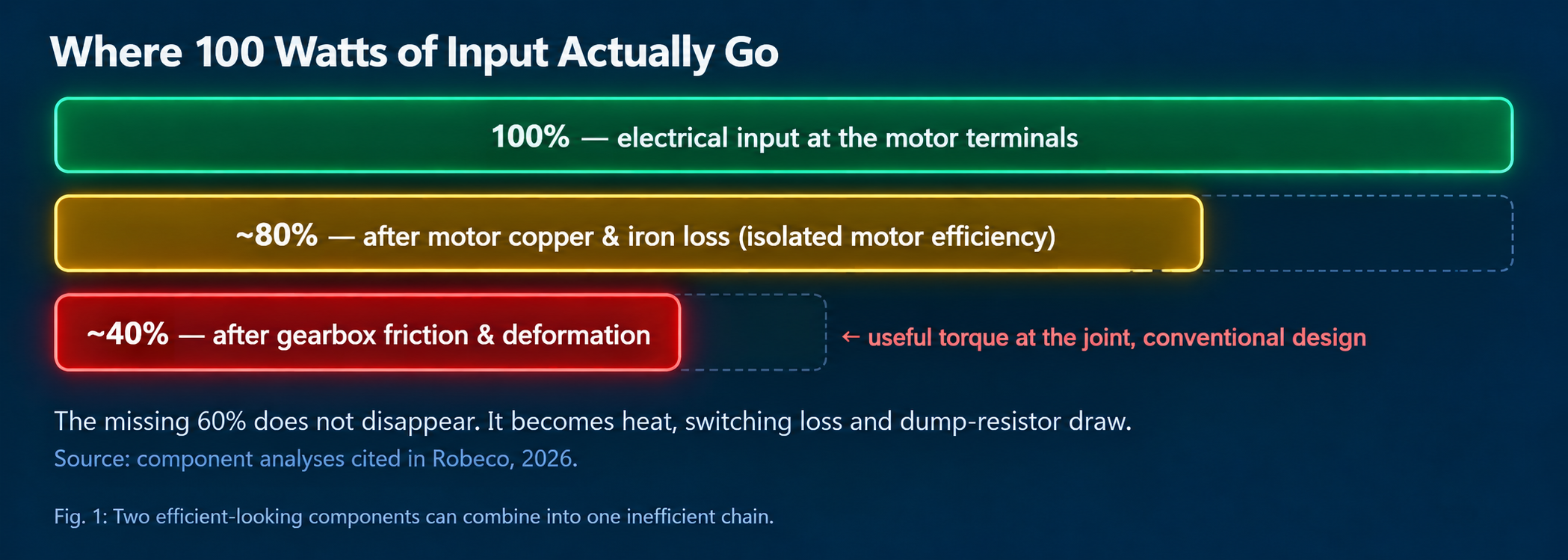
Servo motors can be efficient in isolation — industry analyses put isolated motor efficiency near 80%. Once a high-ratio gearbox sits between motor and joint, system efficiency falls sharply, nearer 40% in conventional industrial designs.
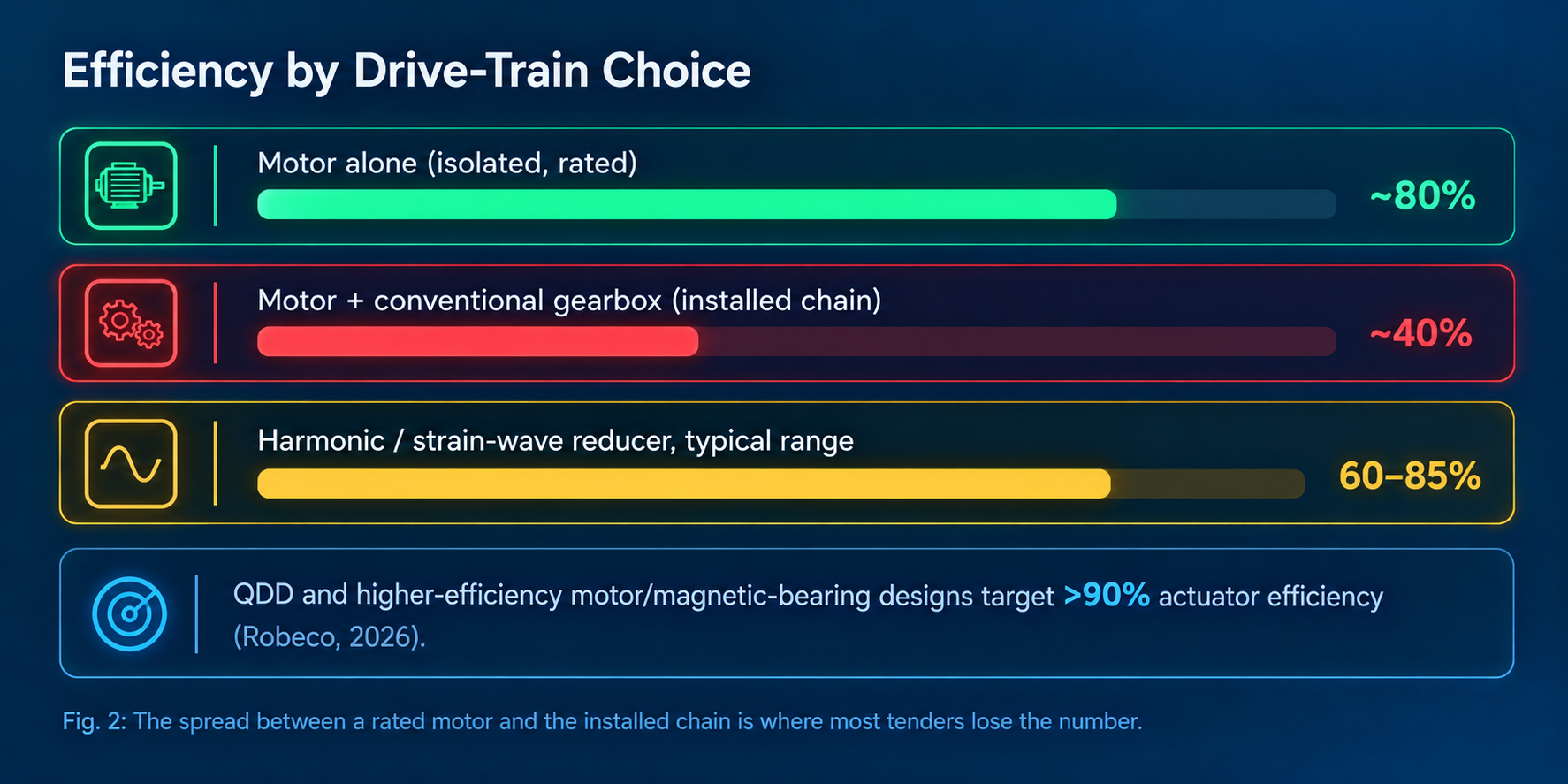
Harmonic drives, still the precision default in many robot and humanoid joints, typically sit in a 60–85% efficiency band and turn the rest into heat — on top of copper loss, iron loss, mesh friction, brake resistors and inverter switching.
Decision Makers who buy "AI robots" without an actuator energy spec are funding a hidden load they cannot see on the dashboard.
1. Where the Joule Actually Dies
Motion power is the dominant share of an industrial robot's consumption. The controller and fans matter. They are not the main story.
Electrical energy becomes torque in the motor, then passes a reducer. Every stage takes a cut: copper and iron losses in the motor, friction and deformation in the gearbox, switching loss in the drive, dump resistors firing when the arm decelerates and regeneration is incomplete. Aggressive acceleration and high continuous torque turn that cut into heat. Heat shortens duty cycle and forces cooling, another parasitic watt that never shows up on a spec sheet.
None of this is visible from outside the joint. A motor can be rated efficient, a gearbox can be rated precise, and the combination can still be quietly burning more than half of every watt that enters it before a single newton-metre reaches the payload.
👉 Key Insight
Embodied AI's energy problem is mechanical before it is computational. Inference watts are visible. Gearbox watts are structural.
2. The Numbers That Change the Spec
Drive systems dominate robot energy. Component choice, motor, gearbox, power electronics, sets the floor, not the AI model running on top of them.
The reported chain is consistent across sources: roughly 80% motor efficiency falling toward roughly 40% once gearbox and transmission are included in conventional industrial designs (Robeco, 2026, citing component analyses). Harmonic, or strain-wave, reducers are the precision default in many joints precisely because they are compact and low-backlash, but their efficiency is often cited in the 60–85% range, and the gap is heat. The next hardware response is already visible: quasi-direct-drive (QDD) actuators, with higher torque-to-weight and fewer reduction stages, plus higher-efficiency motors and magnetic gearing, aiming above 90% actuator efficiency.
OEM generations already show the lever working. Selected newer industrial models are reported around 60% below older-generation energy for the same class; controller improvements are landing on the order of 20%; standby modes can cut idle draw by up to roughly 95% when the cell actually sleeps instead of idling stiff. Humanoids make the same physics harsher: dozens of joints share a 1–3 kWh pack, and a 40% chain means most of that battery never becomes useful work.
👉 Key Insight
A 40-point efficiency gap between "motor efficiency" on the datasheet and the actual installed chain is not a rounding error. It is the difference between a robot that pays for its power bill and one that quietly doesn't.
3. Why Procurement Misses It
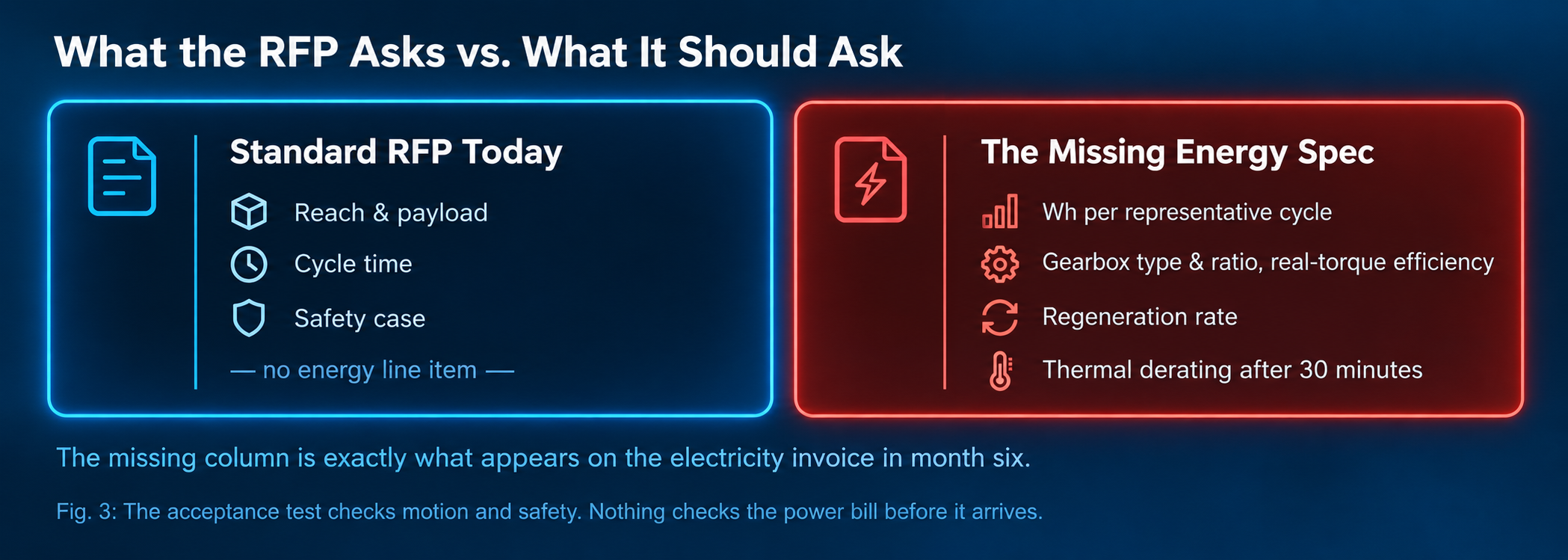
RFPs ask for reach, payload, cycle time and safety. They rarely ask the one question that determines the feeder bill.
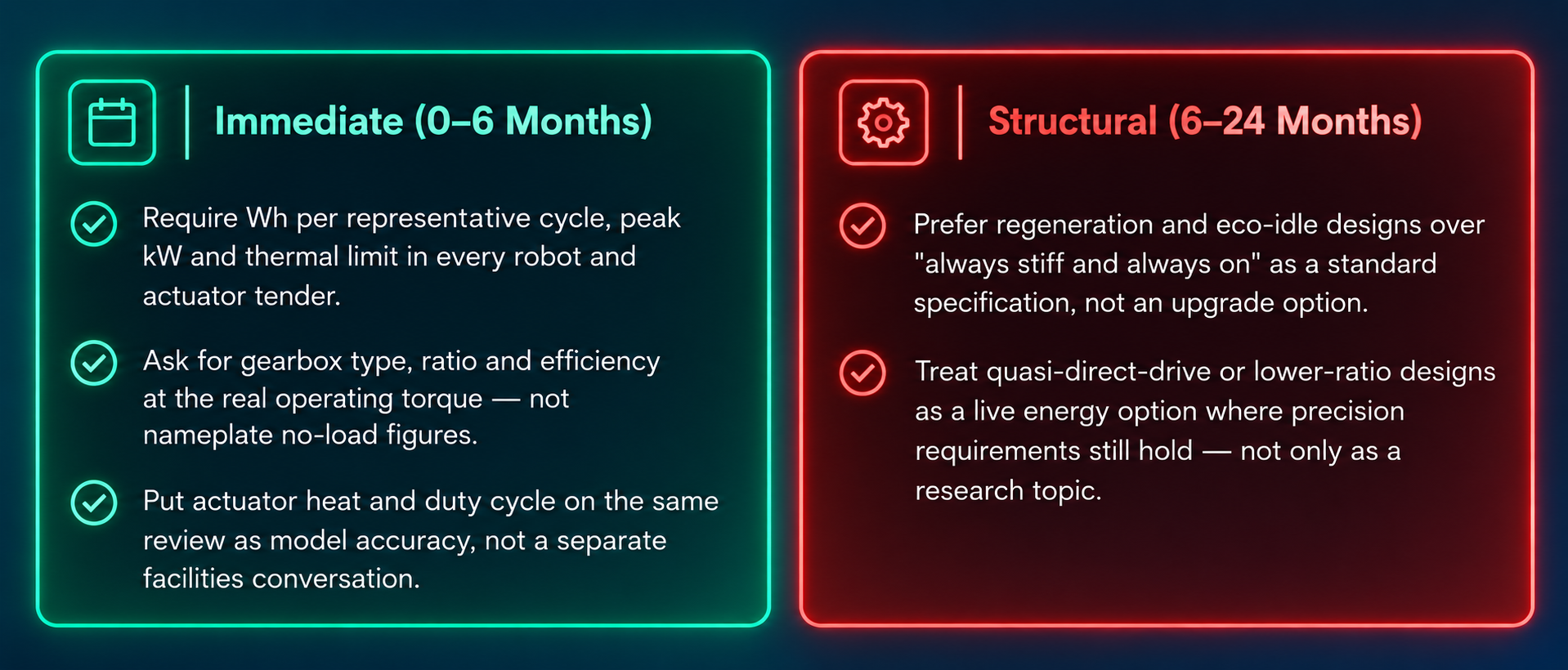
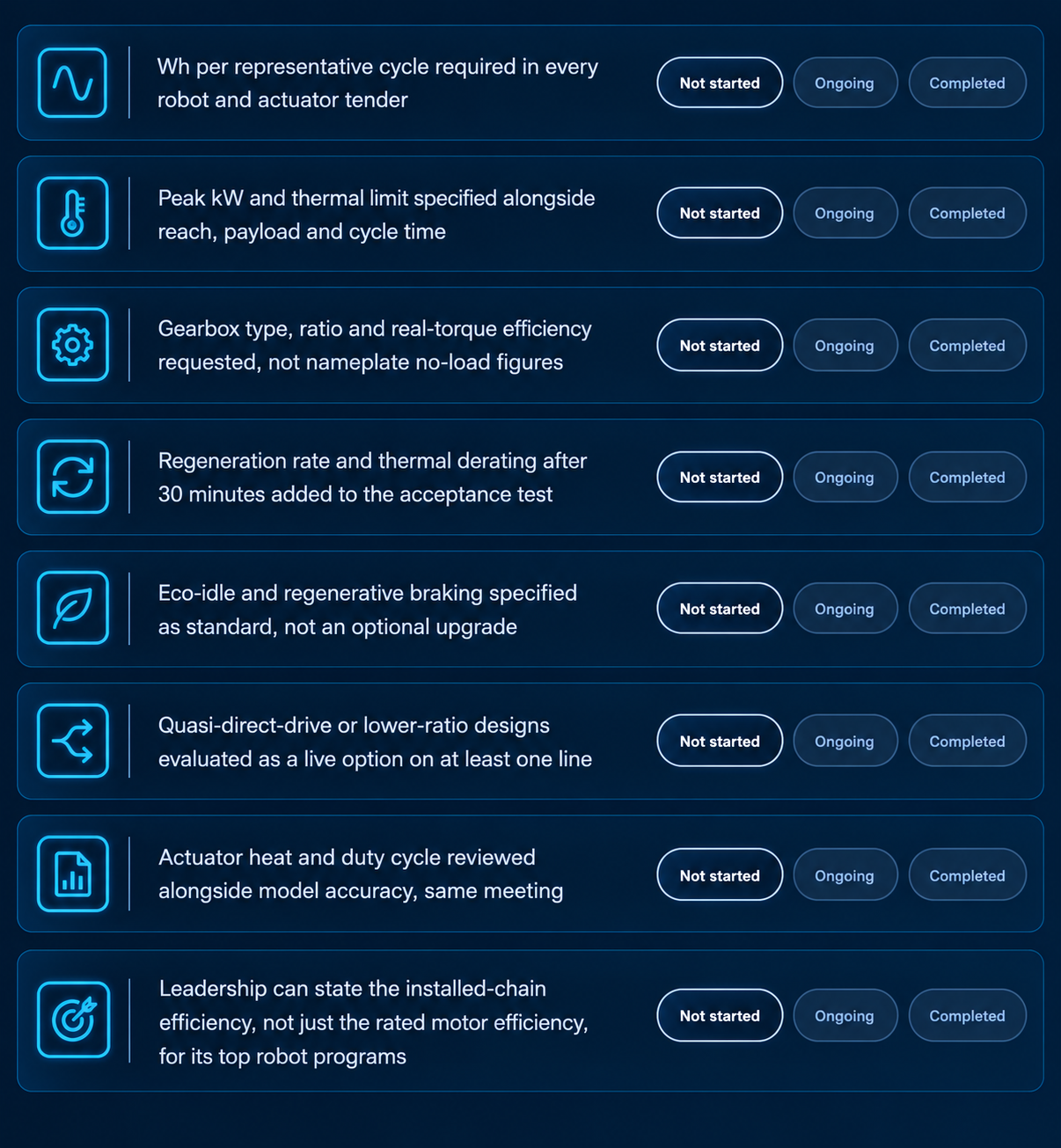
A typical industrial-robot or actuator tender specifies what the arm must do and how fast, and a safety case for how it must fail. It almost never specifies Wh per cycle at stated payload, gearbox type and ratio, regeneration rate, or thermal derating after 30 minutes of continuous duty. The result is a cell that meets takt on day one, passes commissioning, and then a feeder that surprises facilities in month six, once the thermal and duty-cycle reality of sustained operation shows up on the electricity invoice instead of the acceptance test.
None of the missing questions are exotic. They are standard drive-train engineering questions that simply never made it onto the procurement checklist, because the checklist was written for motion and safety, not for energy.
👉 Key Insight
If energy is not a line in the actuator spec, it will appear as a line on the electricity invoice.
Action Plan for Decision Makers
Checklist
Final Thought
The gearbox tells you where the energy goes. It doesn't tell you who is accountable for planning the load it creates. Part II of this Week 41 set asks who actually owns robot power planning — and finds that the honest answer, in most plants, is nobody.
Efficiency Before Energy means the cheapest watt is the one that never had to cross a 40%-efficient gearbox in the first place.
Systems don't fail. Decisions do.
Take the Next Step
Subscribe to the Weekly Punch for weekly strategic clarity, direct to your inbox.
References
MDPI Machines (2025) A Scoping Review of Energy Consumption in Industrial Robotics. Machines, 13(7), 542.
Robeco (2026) Physical AI and the New Energy Calculus in Manufacturing. Rotterdam: Robeco.
KUKA / A3 (2026) Industry Notes on Component and Controller Efficiency in Industrial Robotics.
Various authors (2026) Harmonic-Drive Efficiency Ranges in Humanoid Actuator Design — Industry Reviews.
Robotics and Computer-Integrated Manufacturing (2025) Energy-Flow Models of Servo, Friction and Inverter Loss in Industrial Robots.
Disclaimer: This article synthesizes publicly available component and industry analyses current as of publication. Efficiency figures vary by actuator model, duty cycle and vendor; readers should verify current figures against original datasheets and publications before relying on them for procurement decisions. Verification Gate: flagged for pre-publication source check.
Ownership as Design.
Note: This article reflects my personalviews based on industry experience and publicly available information. It does not constitute professional, legal, or investment advice and does not represent the views of my employer. AI-generated visuals, concept and content by the author.
