CO₂ Reduction vs Economics in Data Centers: What Leaders Ignore
ENERGY DOMINANCE · WEEK 23 · PART I
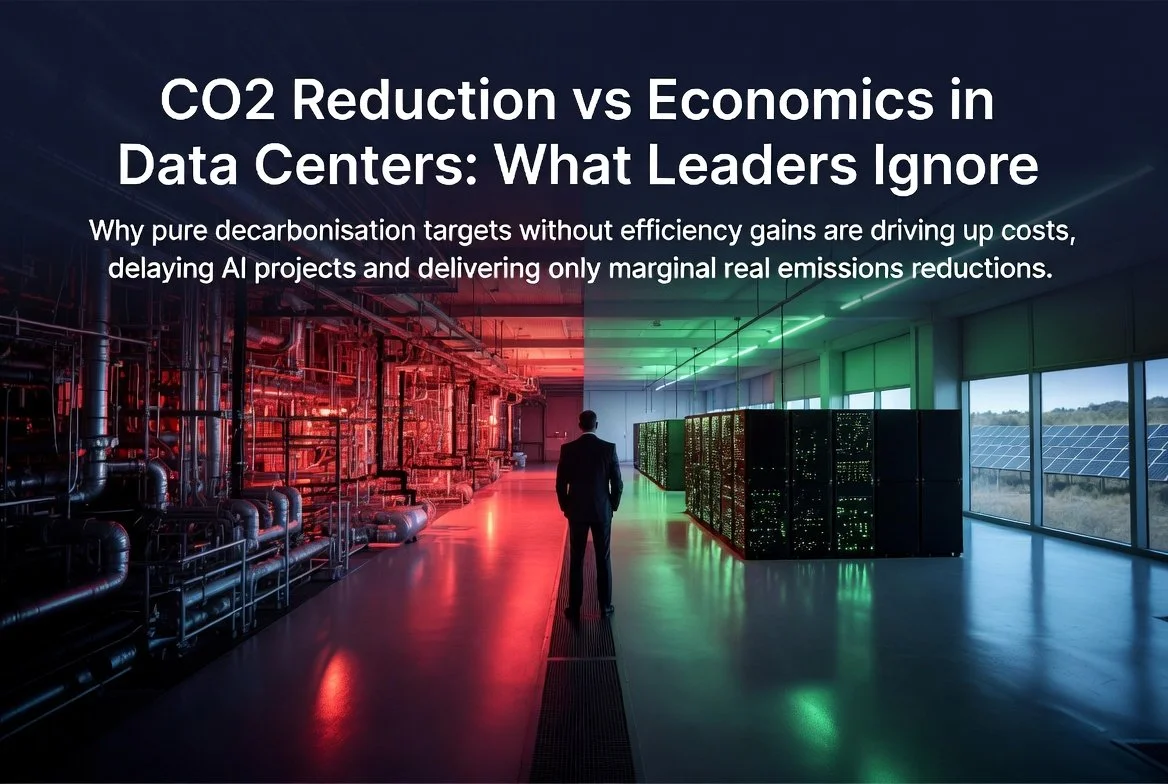
Why pure decarbonisation targets without efficiency gains are driving up costs, delaying AI projects and delivering only marginal real emissions reductions.
DATA CENTERS | CO₂ REDUCTION VS ECONOMICS | JUNE 2026
Most boards have quietly redefined climate leadership as a purchasing decision: sign enough renewable PPAs, buy enough certificates, book enough offsets, and the carbon problem is "managed." It is a comfortable story, and it is wrong. In AI infrastructure, a decarbonisation strategy that never touches the energy intensity of the asset itself does two things at once: it raises the total cost of ownership, and it leaves absolute emissions climbing. The decision-makers who treat CO₂ as procurement rather than physics are not buying a greener data centre. They are buying a more expensive one that still emits more next year than this one.
This is Part I of Week 23: the strategic conflict itself, why the "green versus profitable" trade-off is a false choice, why capable leaders keep making it anyway, and what it costs through 2030.
EXECUTIVE SUMMARY
1. The False Choice Between CO₂ Targets and Economic Reality
The trade-off is usually framed as "spend on green, or protect the budget." That framing is the error.
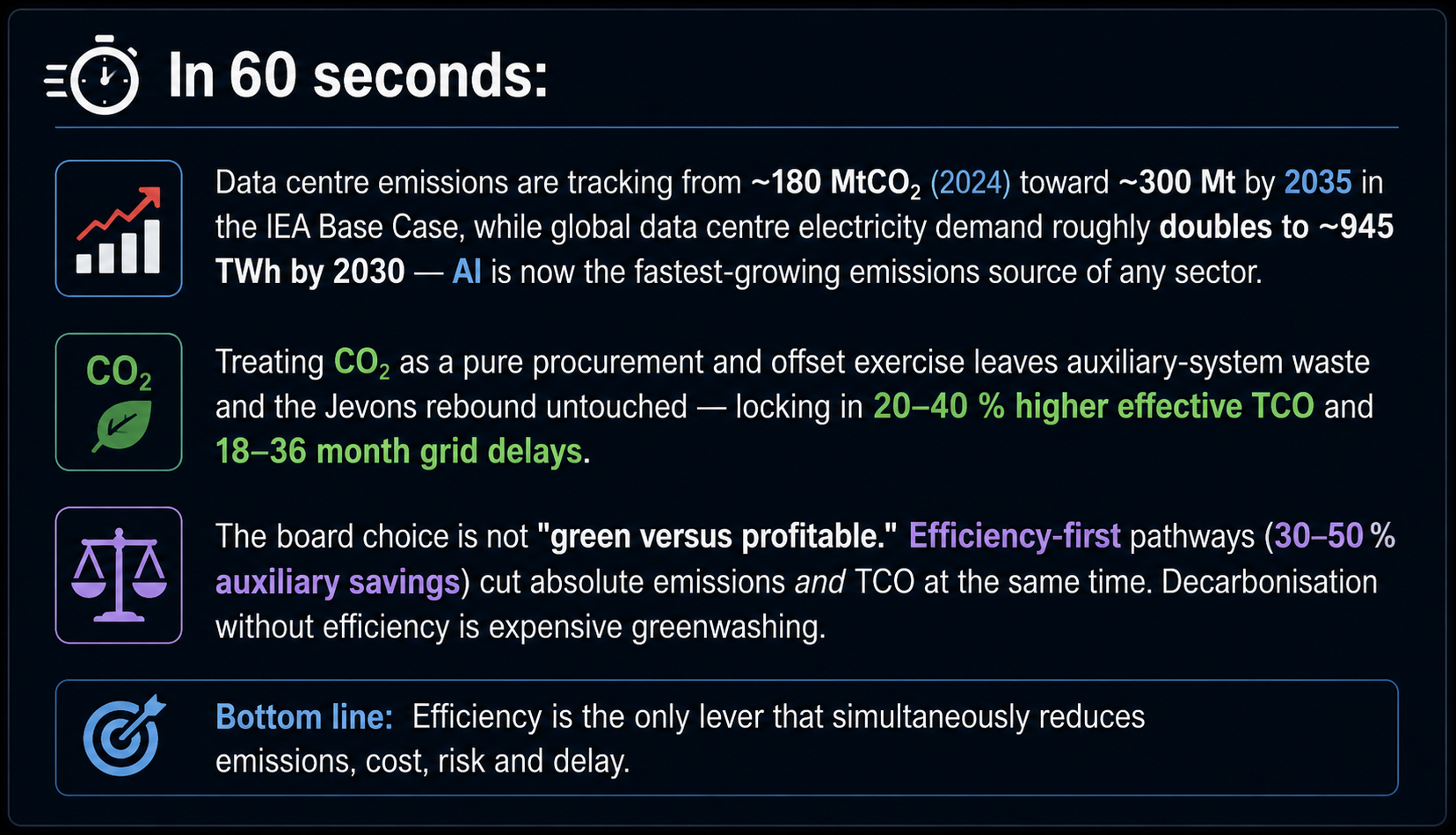
A pure CO₂-focus, 100 % renewable PPAs, offsets, internal carbon pricing, ignores the physics of auxiliary-system waste and the Jevons Paradox in AI workloads: cheaper, cleaner compute invites more compute. Every additional TWh of demand still requires new generation capacity, often gas or coal backup, while efficiency measures are deprioritised as "nice-to-have green projects."
2025 deployment data shows absolute demand growth outpacing renewable supply additions; auxiliary loads (cooling, power conversion, distribution) remain the largest controllable inefficiency in most facilities, and the one most often left out of the carbon conversation entirely.
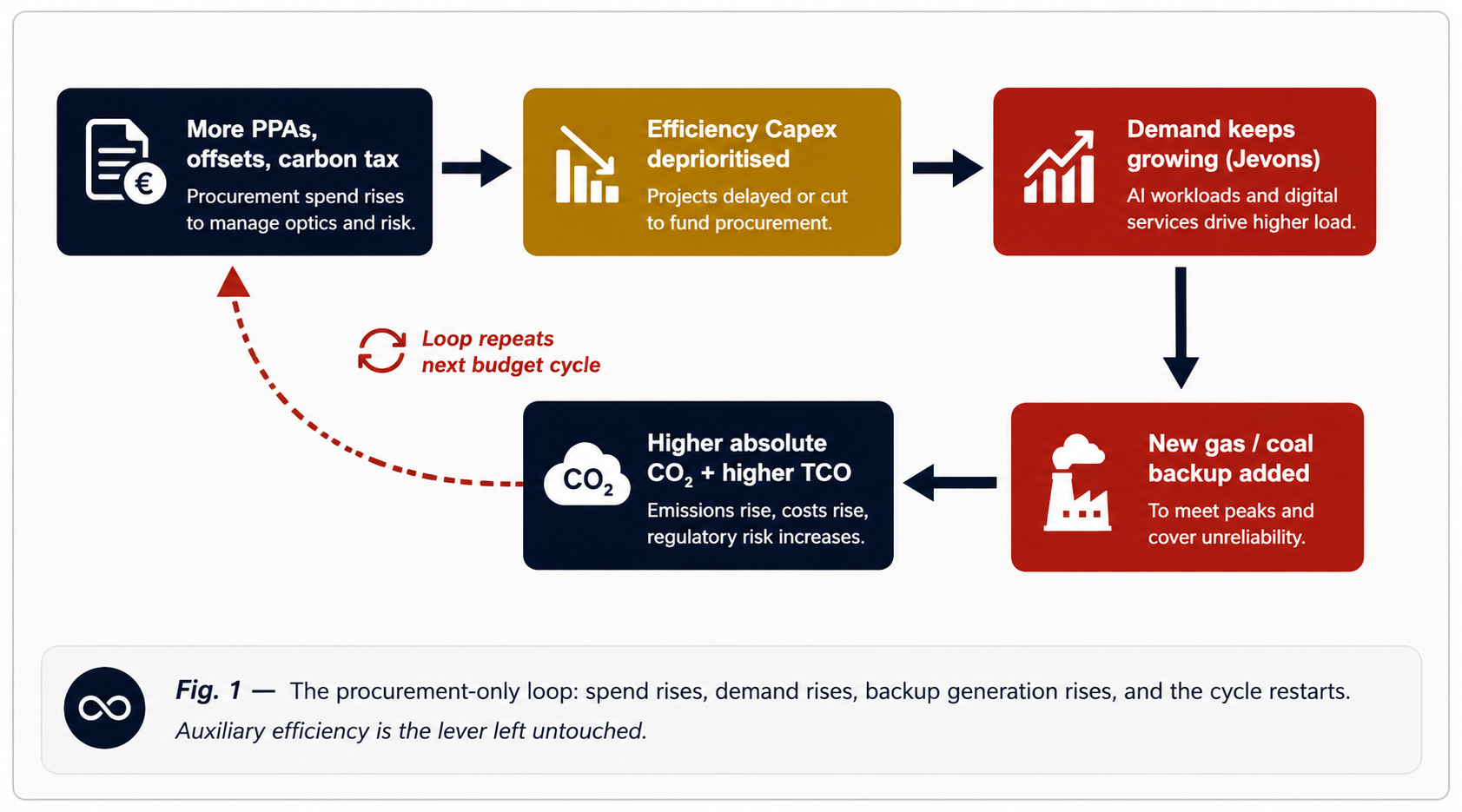
👉 Key Insight: CO₂ reduction without energy efficiency is not climate leadership, it is expensive greenwashing that increases both costs and absolute emissions.
2. Why Most Decision Makers Still Ignore the Trade-Off
If the logic is this clear, why do capable, well-resourced organisations keep choosing the costlier path?
The failure is organisational, not technical. Incentives, reporting structures and risk perception all push toward the visible procurement number and away from the harder demand-reduction work.
Four recurring patterns explain most of it:
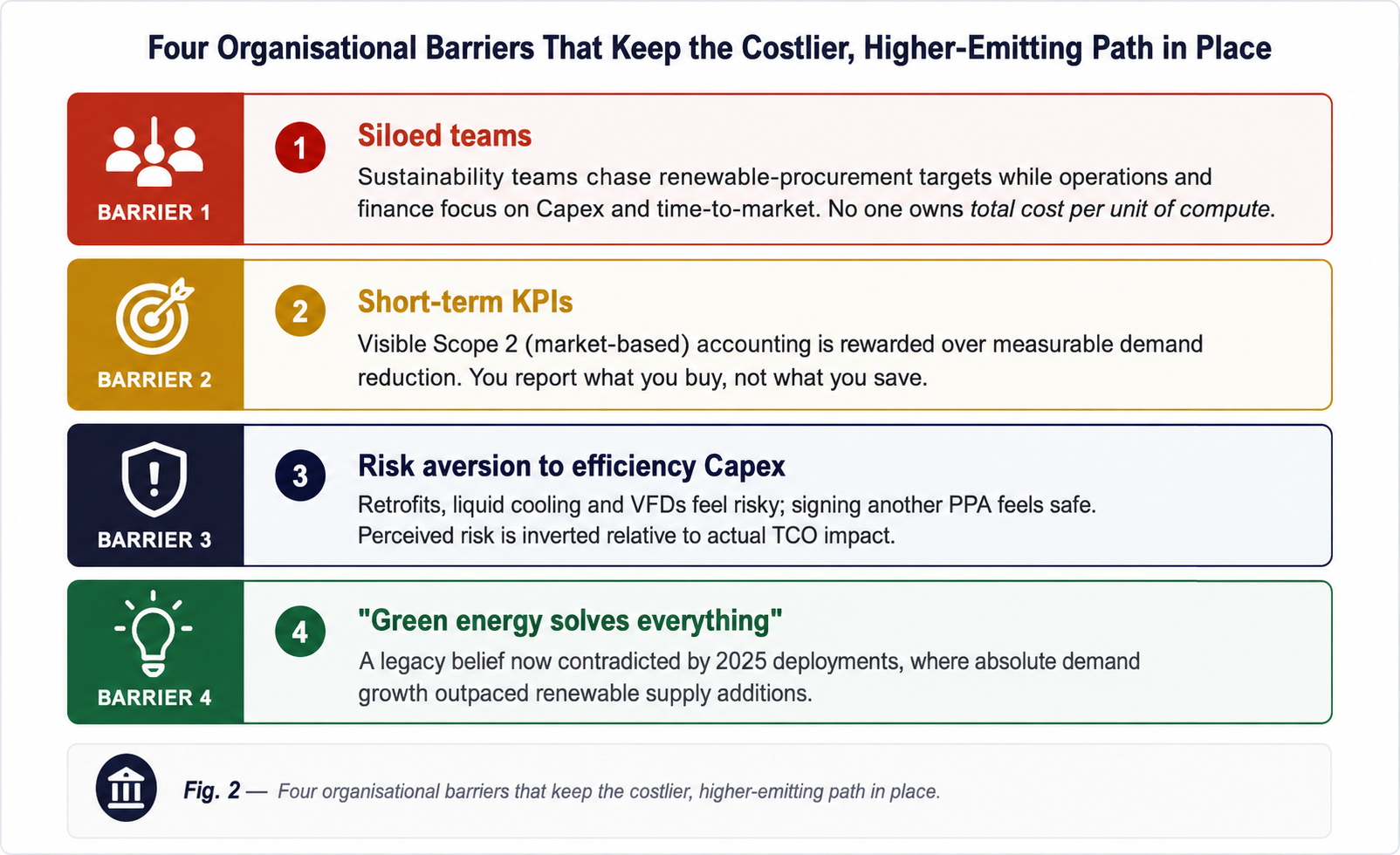
👉 Key Insight: The trade-off is ignored because the organisation is structured to ignore it. Fix the incentive map before the energy map.
3. Quantified Scenarios: What Actually Happens in 2026–2030
Three strategies, three very different balance sheets and emissions curves.
The variable that separates them is not how much clean energy is bought, but how much energy demand is removed at the asset level.
Modelled across the cited IEA, BCG and McKinsey ranges:
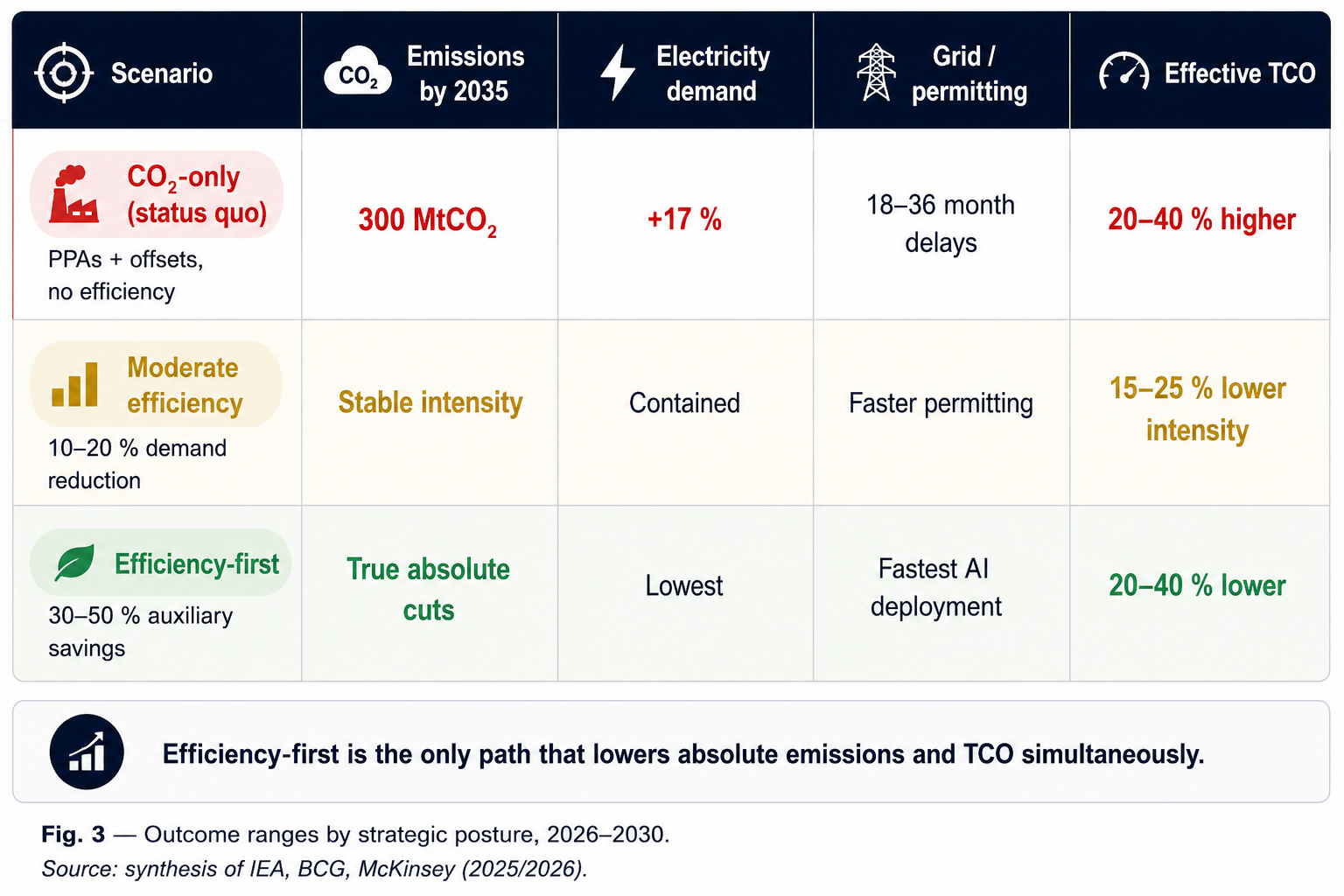
👉 Key Insight: Only the efficiency-first posture bends both curves at once. Every TWh removed is a TWh you never have to procure, permit, cool, or carbon-account for.
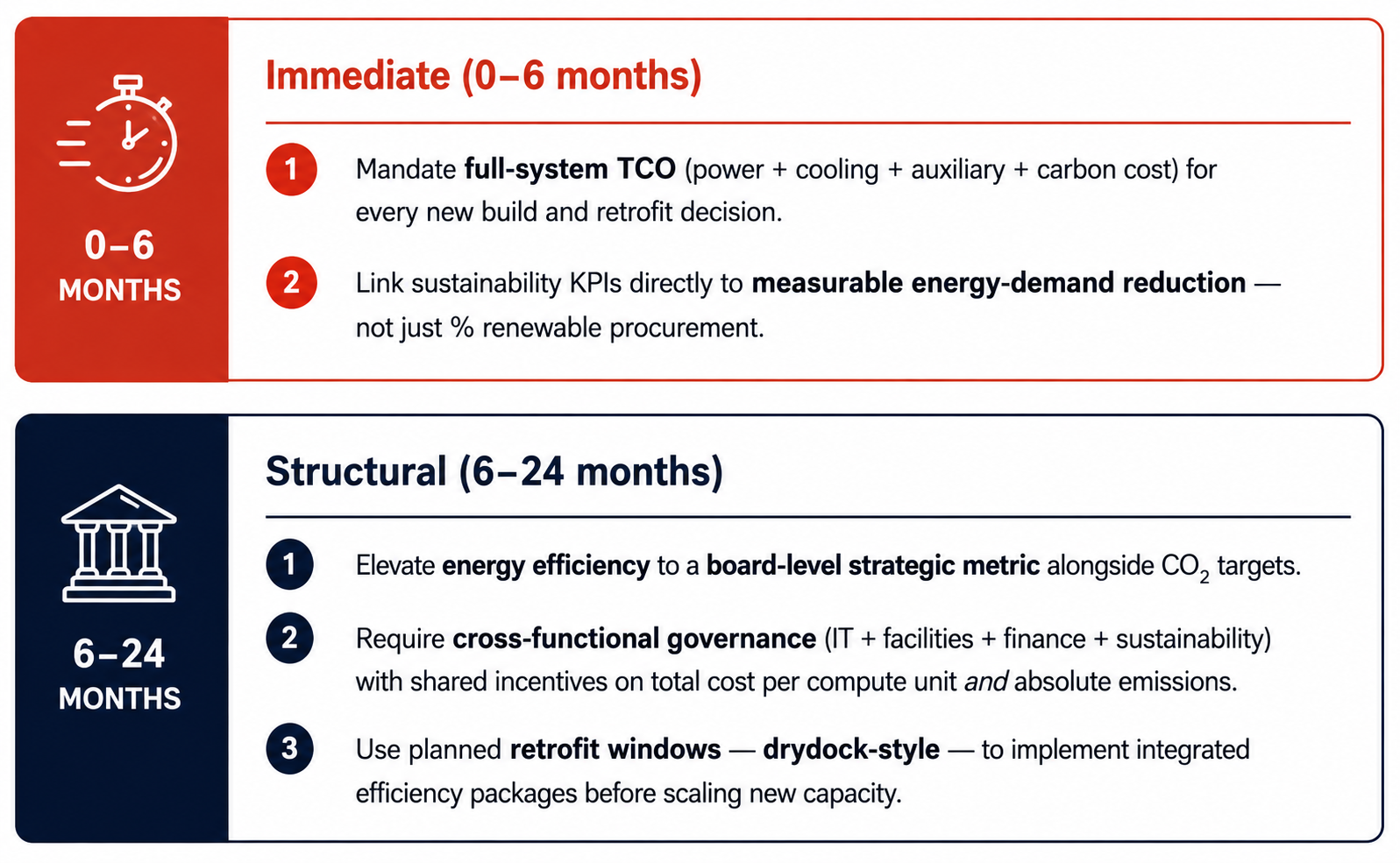
ACTIONS
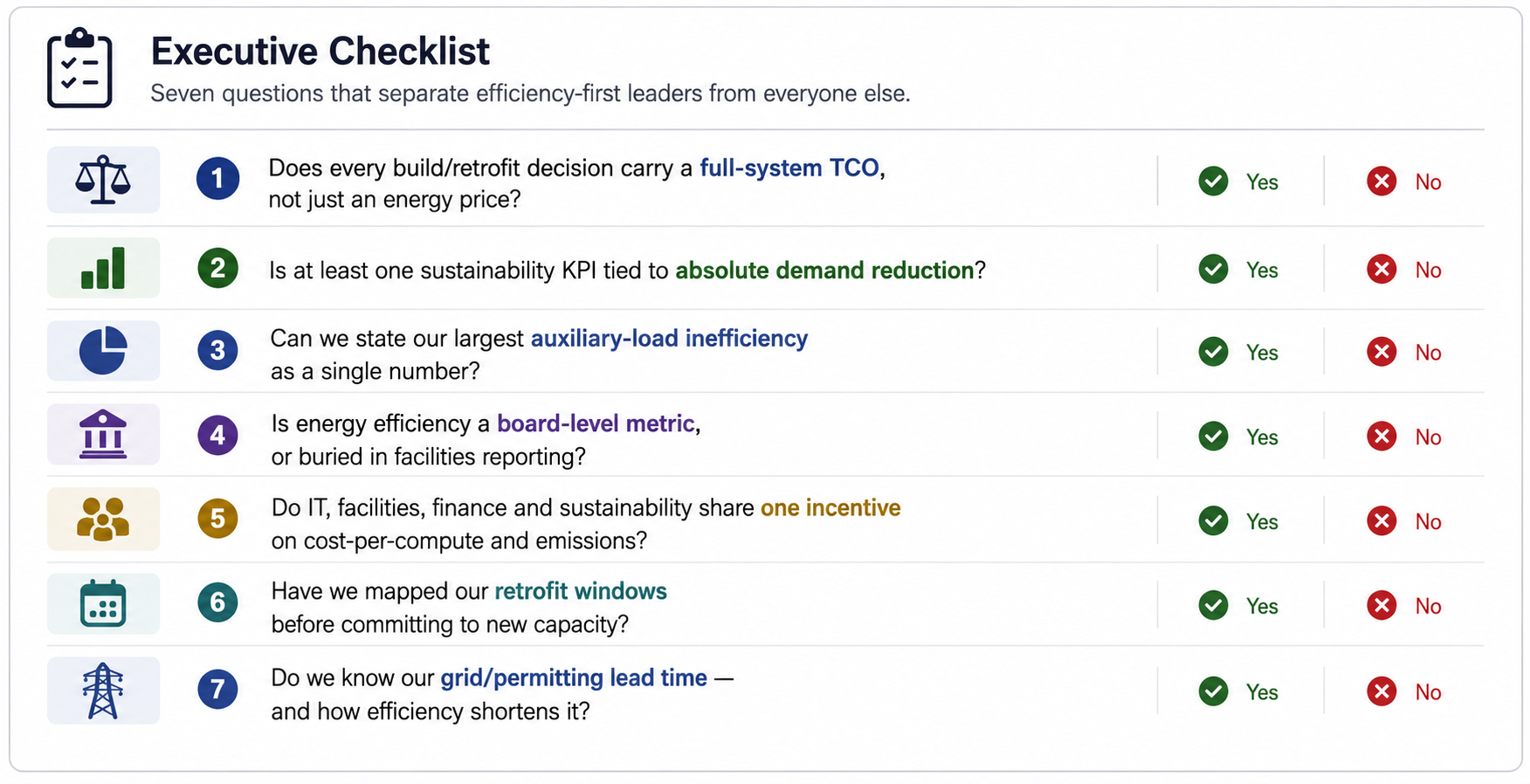
BOARD CHECKLIST
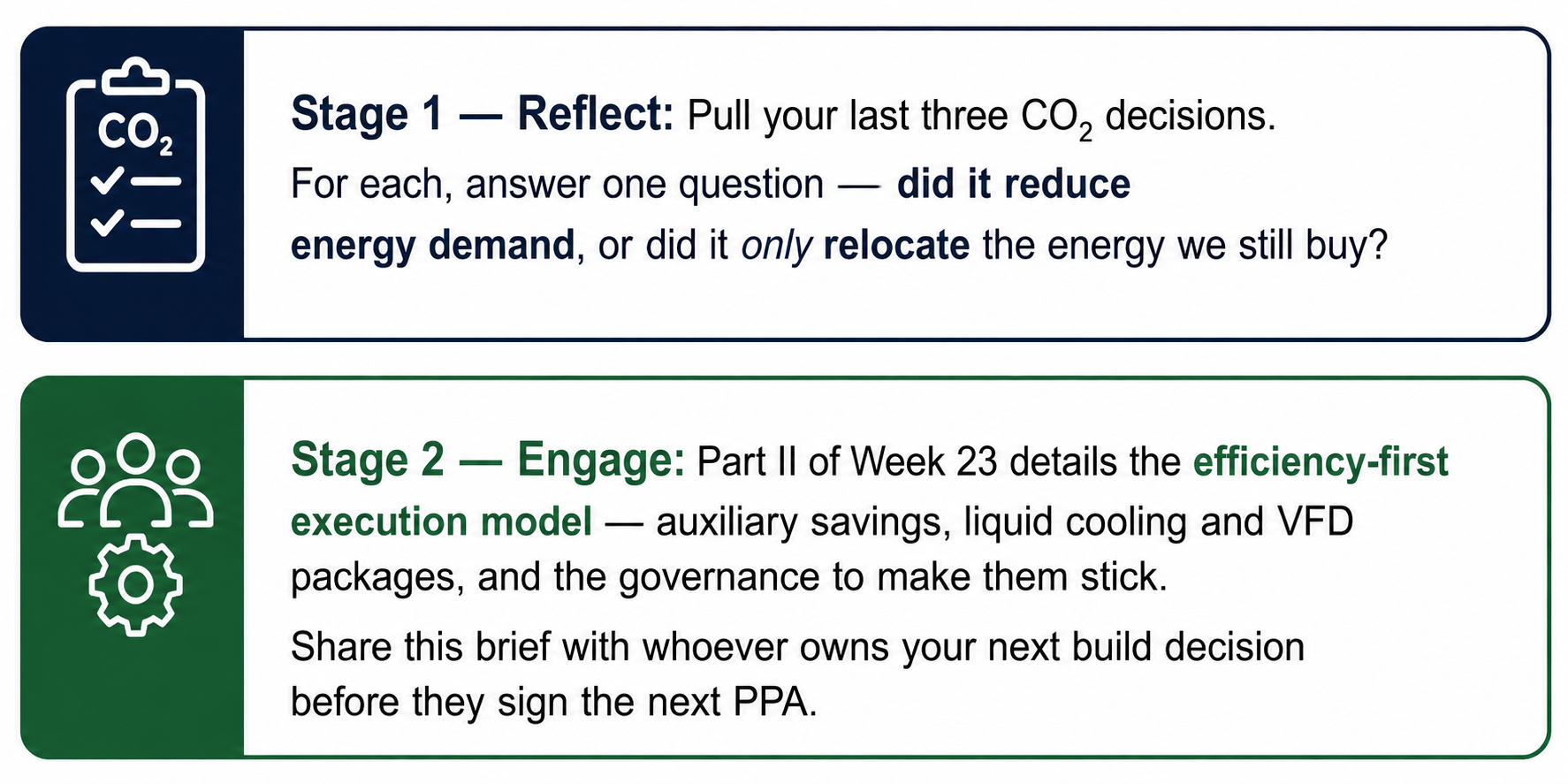
FINAL THOUGHT
Climate leadership was never a purchasing decision. The board that reframes decarbonisation as physics, energy demand removed at the asset, not certificates bought against it, discovers that the "green versus profitable" trade-off was never real. Lower emissions and lower cost are the same decision, made well. Systems don't fail. Decisions do. Part II turns from the conflict to the execution: the efficiency-first playbook that delivers both curves at once.
CALL TO ACTION
Take the Next Step
Subscribe to the Weekly Punch for weekly strategic clarity, direct to your inbox.
REFERENCES
International Energy Agency (2025) Energy and AI — Executive Summary. Paris: IEA.
International Energy Agency (2026) Electricity 2026. Paris: IEA.
Boston Consulting Group (2025) Breaking Barriers to Data Center Growth. Boston: BCG, January 2025.
McKinsey & Company (2025) The Cost of Compute: A $7 Trillion Race to Scale Data Centers. New York: McKinsey & Company.
Frontiers in Sustainability (2025) ‘Forecasting US data center CO₂ emissions using AI models', Frontiers in Sustainability.
IEA 4E Technology Collaboration Programme (2025) Data Centre Energy Use: Critical Review of Models and Results. Paris: IEA 4E TCP, March 2025.
Note: This article reflects my personalviews based on industry experience and publicly available information. It does not constitute professional, legal, or investment advice and does not represent the views of my employer.
