AI Regulation vs. Innovation, The European Tightrope

EU AI Act | Regulation | Innovation Policy | Manufacturing | Week 31 · Part II
EU AI ACT | REGULATION VS. INNOVATION | JULY 2026
Inside the EU's Digital Omnibus and the Real Trade-Offs Manufacturers Need to Plan Around
Part I of this week's pair asked how you prove a learning system is safe. Part II asks a harder question still: what happens when the rules for proving it change eight times in eighteen months?
That is not a hypothetical. Since the EU AI Act entered into force, its implementation calendar has been rewritten by trilogue, delayed by political disagreement, and rewritten again, most recently with the Council's final green light on 29 June 2026. Efficiency Before Fuel doesn't stop at the factory gate. In Europe today, it extends to the decision of how much regulatory uncertainty a manufacturer is willing to build a five-year investment case around.
Executive Summary
IN 60 SECONDS:
The EU's Digital Omnibus, formally adopted by the Council on 29 June 2026, pushes back the AI Act's high-risk obligations, Annex III systems to 2 December 2027, Annex I product-embedded systems to 2 August 2028, without removing a single substantive requirement.
Reactions split sharply: industry voices and some regulators call the extra runway reasonable and necessary for European competitiveness; critics warn of legal uncertainty and a false dichotomy between regulation and innovation that risks entrenching dominant foreign players.
Whichever camp proves right, the practical move for manufacturers is the same, build governance to the stricter, pre-Omnibus reading of the Act, and treat the extra time as runway, not relief.
1. Why Europe Is Walking an AI Tightrope
Ask a Brussels policymaker whether Europe over-regulates AI, and you'll get a passionate answer either way, which is exactly the problem.
The EU AI Act, in force since August 2024, was built to be the world's first comprehensive legal framework for artificial intelligence. It is also, by any measure, enormous: with well over a thousand recitals, articles and annexes, further elaborated through guidelines, codes of practice and technical standards, it is the most extensive regulatory framework in the EU's digital ecosystem, an ambition its own critics describe as risking "overregulation" that undermines the legal certainty it was meant to provide (The Regulatory Review, 2026).
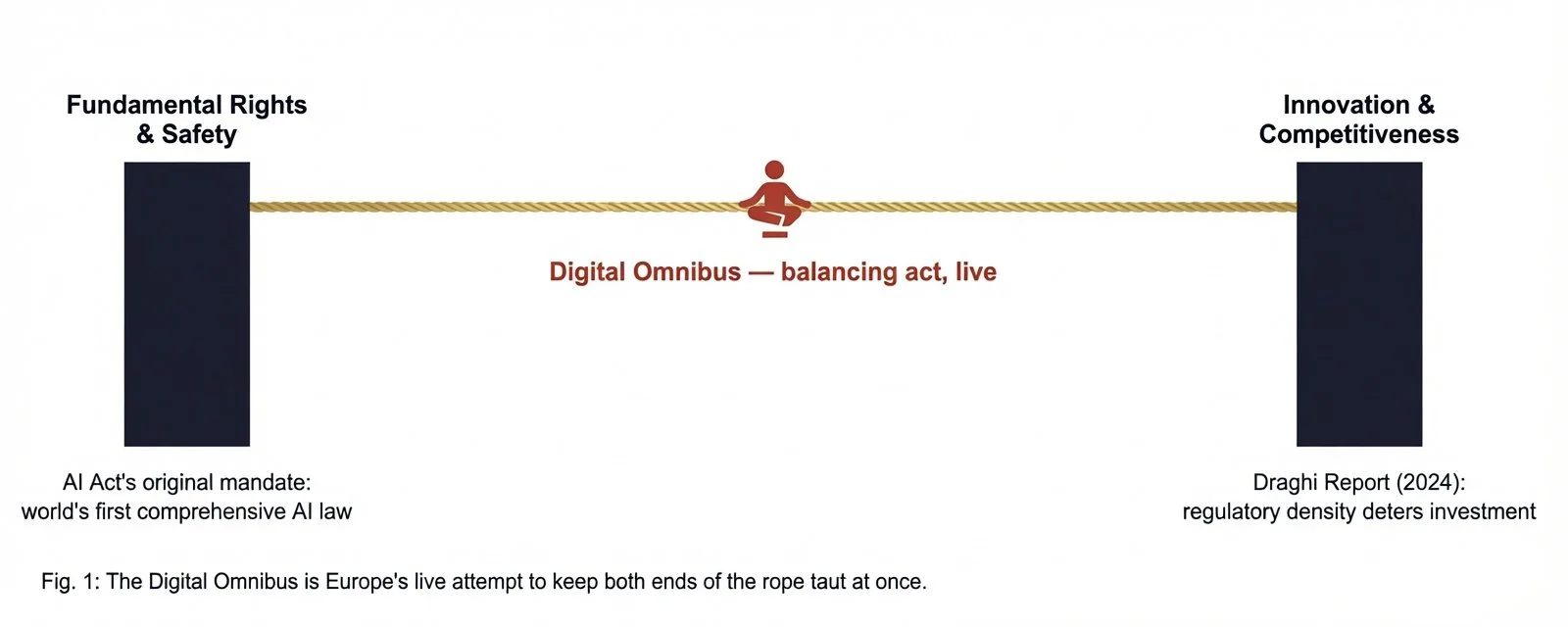
That scale collided with a competitiveness anxiety that predates the Act's own enforcement. The 2024 Draghi report on the future of European competitiveness warned that excessive regulatory density could deter investment and innovation, a concern policymakers now openly cite as they weigh AI rules against the risk of falling behind the US and China (The Regulatory Review, 2026). In response to mounting criticism, the European Commission proposed a Digital Omnibus on AI in November 2025, explicitly framed as a simplification exercise to support innovation and reduce compliance costs (The Regulatory Review, 2026). Whether that framing holds up is exactly what the rest of 2026 has been arguing about.
👉 Key Insight
Europe isn't choosing between regulation and innovation, it's trying to prove both can be true at once, and the Digital Omnibus is the first real test of whether that's possible.
2. Inside the Digital Omnibus: What Actually Changed
Strip away the politics, and the Digital Omnibus makes essentially one big change: it moves the clock, not the destination.
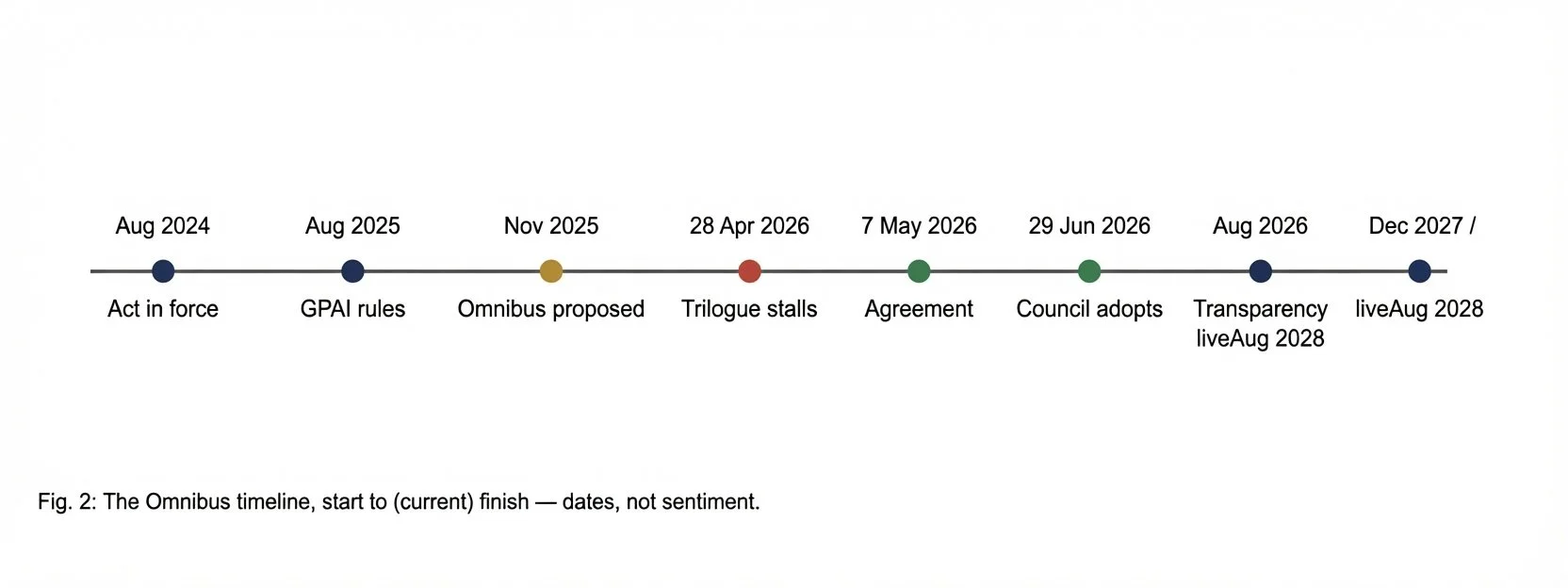
The headline shift defers the AI Act's high-risk obligations under Annex III (use-based systems, covering areas like employment decisions, credit scoring and biometric categorisation) from 2 August 2026 to 2 December 2027, a sixteen-month postponement. High-risk AI embedded as a safety component of regulated products under Annex I (including much industrial machinery) moves instead toward the EU Machinery Regulation, with obligations now expected from 2 August 2028. National regulatory sandbox deadlines shift from August 2026 to August 2027, alongside a new EU-level sandbox that will prioritize startup testing (Pandectes, 2026). Transparency and watermarking duties under Article 50(2) were postponed too, but only to 2 December 2026, a shorter delay than first proposed, while the package simultaneously adds new prohibitions on AI-generated non-consensual intimate imagery and CSAM, effective the same date.
None of this arrived smoothly. A second political trilogue on 28 April 2026 broke down after roughly twelve hours, not over the headline postponement but over the conformity-assessment architecture for Annex I products (Bird & Bird, 2026). Agreement followed on 7 May 2026, and the Council of the EU gave its final green light on 29 June 2026, following the European Parliament's endorsement on 16 June 2026, clearing the way for publication in the Official Journal (Council of the European Union, 2026).
👉 Key Insight
The Omnibus didn't remove a single substantive obligation for high-risk AI, it rescheduled almost all of them, while quietly tightening the rules on the most harmful content.
3. Two Readings of the Same Reform, and What They Mean for You
Read five reactions to the Digital Omnibus and you could conclude the EU either just saved European competitiveness or just started unwinding its own rulebook. Both readings are being argued by serious people.
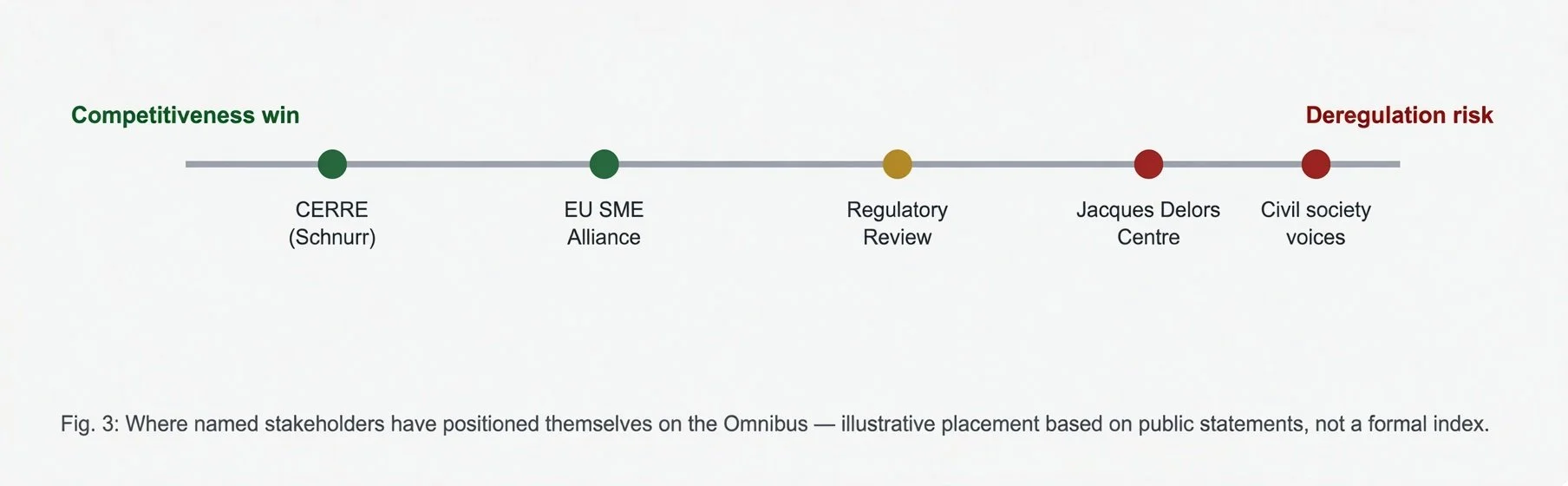
The competitiveness camp is not fringe. CERRE's Daniel Schnurr has called the extension of the high-risk timeline reasonable, while still questioning whether the Commission has an overarching digital strategy behind it, and the European Digital SME Alliance has welcomed the Omnibus as "a step forward", with the caveat that simplification alone will not reduce Europe's dependence on foreign technology providers (European Parliament, 2026).
The rights-and-safety camp is equally serious. The Jacques Delors Centre has warned that several amendments could increase legal uncertainty and create loopholes rather than reduce complexity, and cautioned that in markets already dominated by foreign tech companies, looser rules risk entrenching those same players rather than helping European competitors catch up (Jacques Delors Centre, 2026). Others go further, framing the entire regulation-versus-innovation trade-off as a false dichotomy that primarily serves industry interests in a lighter-touch regime. Underneath both positions sits an uncomfortable structural point: because the AI Act was already so complex, a "simplification" package risks adding interpretive uncertainty even as it removes obligations on paper (The Regulatory Review, 2026).
👉 Key Insight
Whichever camp is right, the practical answer for a manufacturer is the same: build your safety case as if the strictest reading will eventually apply, and treat the extra time as runway, not relief.
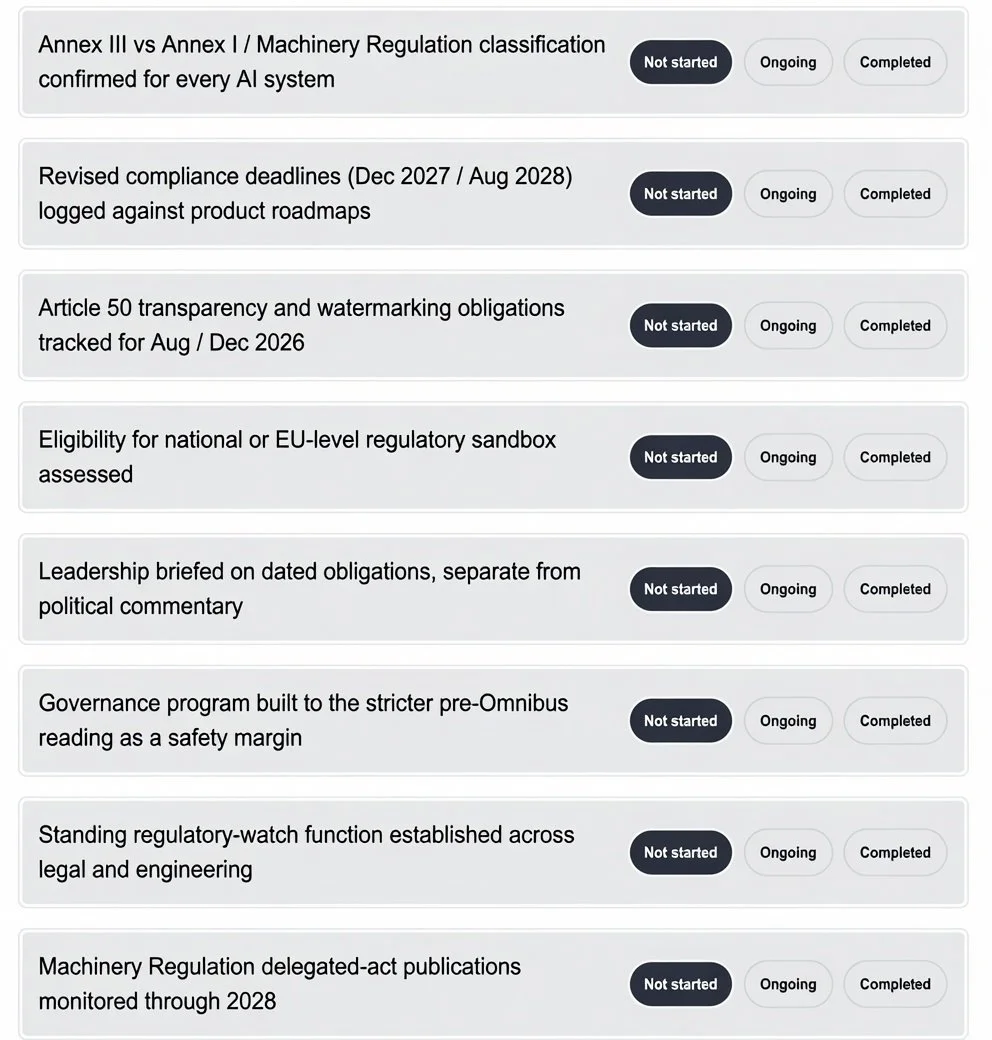
Action Plan for Decision Makers
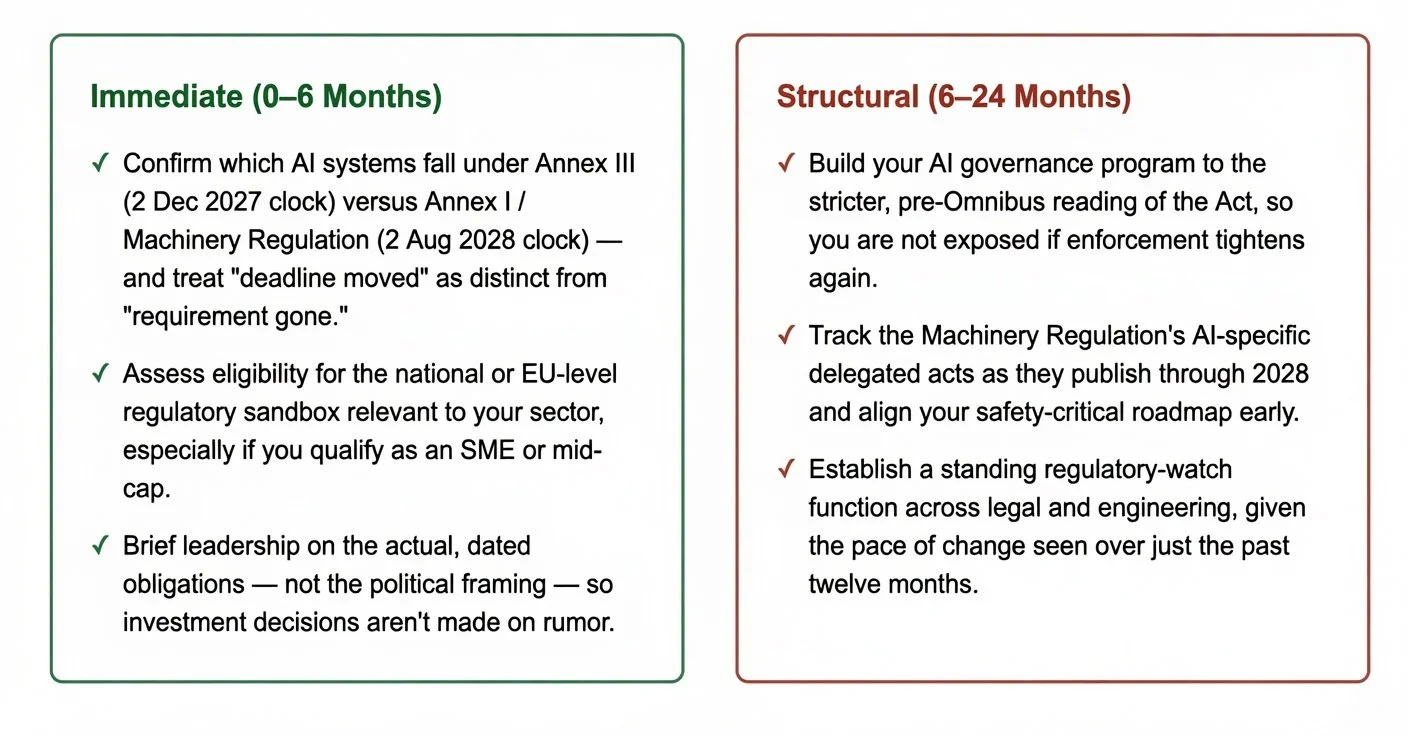
Checklist
Final Thought
Part I of this pair asked how you prove a safety-critical AI system is safe. Part II shows why that proof now has to be built on ground that keeps shifting, not because the underlying risk changed, but because the political weight given to that risk keeps being renegotiated.
Efficiency Before Fuel was never only about the factory floor. It is also the discipline of not letting a moving regulatory deadline become an excuse to move your own safety case.
Systems don't fail. Decisions do.
Take the Next Step
Subscribe to the Weekly Punch for weekly strategic clarity, direct to your inbox.
References
Bird & Bird (2026) Digital Omnibus on AI Trilogue Stalls Ahead of the AI Act Deadline. [Legal briefing].
Council of the European Union (2026) Artificial Intelligence: Council Gives Final Green Light to Simplify and Streamline Rules.Brussels: Consilium.
European Parliament (2026) Digital Omnibus on AI. Brussels: European Parliamentary Research Service.
Jacques Delors Centre (2026) The EU's Digital and AI Omnibus Is Heading in the Wrong Direction. Berlin: Hertie School.
The Regulatory Review (2026) The Paradoxes of the European Union's AI Regulation. [Online journal].
Disclaimer: This article synthesizes publicly available regulatory reporting and stakeholder commentary current as of publication. No detailed section brief was supplied for this week; body sections, framing and evidence selection were originated by the writer from the two given titles. The stakeholder positioning in Figure 3 is an illustrative summary of public statements, not a formal survey or index. Regulatory timelines remain subject to further change through implementing and delegated acts. Readers should verify current requirements against primary EU sources before relying on them for compliance or investment decisions. Verification Gate: flagged for pre-publication source check.
Ownership as Design.
Note: This article reflects my personalviews based on industry experience and publicly available information. It does not constitute professional, legal, or investment advice and does not represent the views of my employer. AI-generated visuals, concept and content by the author.
