AI Agents on the Shop Floor: Opportunities and Hidden Risks

INDUSTRIAL AI | AI AGENTS | JULY 2026
ENERGY DOMINANCE · WEEK 28 · PART I
From Promising Pilots to Production Reality: What Manufacturers Gain and What They Risk When Autonomous Agents Start Making Real-Time Decisions on the Factory Floor
This is Part I of Week 28: the focused look at Agentic AI on the shop floor after exploring the broader shift to autonomous operations: concrete opportunities paired with the less visible but critical risks that determine whether these systems scale successfully or create new liabilities.
An agent that only recommends is a colleague you can overrule. An agent that acts is a colleague with its hands on the machine. That shift, from advice to autonomous action, is where the real value of industrial AI lives, and also where its real danger hides. Most of the upside conversation in 2026 skips straight past the second half of that sentence.
The thread of this series, Efficiency Before Fuel, cuts both ways here. The scarce resource is not more model autonomy; it is disciplined scoping, clean integration, and clear governance. Pour raw autonomy onto a shop floor without that foundation and you do not accelerate value, you accelerate risk. The agents worth deploying are the ones built on the boring things first.
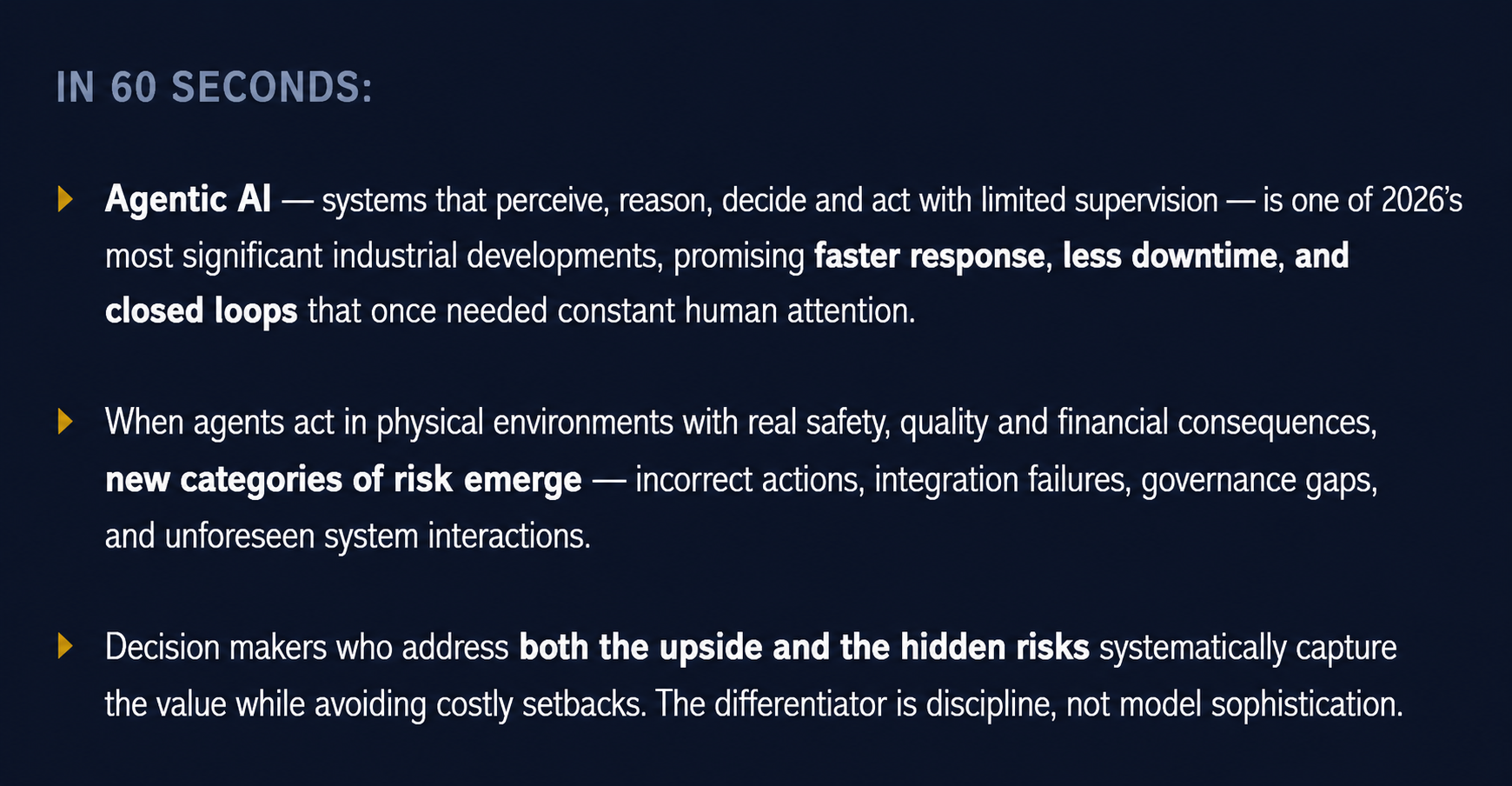
Executive Summary
1. The Opportunity: Closing the Decision-to-Action Gap on the Shop Floor
The hook: For decades, the bottleneck was never detecting the problem, sensors saw it. The bottleneck was the hours between detection and someone acting on it. Agents collapse that gap to seconds.
The mechanism: Traditional analytics and even most Generative AI applications stop at a recommendation. AI Agents can execute defined actions autonomously, adjusting process parameters within safe limits, triggering maintenance work orders, coordinating mobile robots, or initiating controlled stops when anomalies are detected. This dramatically shortens response times and enables 24/7 adaptive operations where constant human oversight is impractical or too expensive.
The evidence: Early deployments show particular strength in predictive-maintenance loops, real-time quality interventions, and exception handling in complex, high-mix production, precisely the settings where a human-in-the-loop delay is most costly.
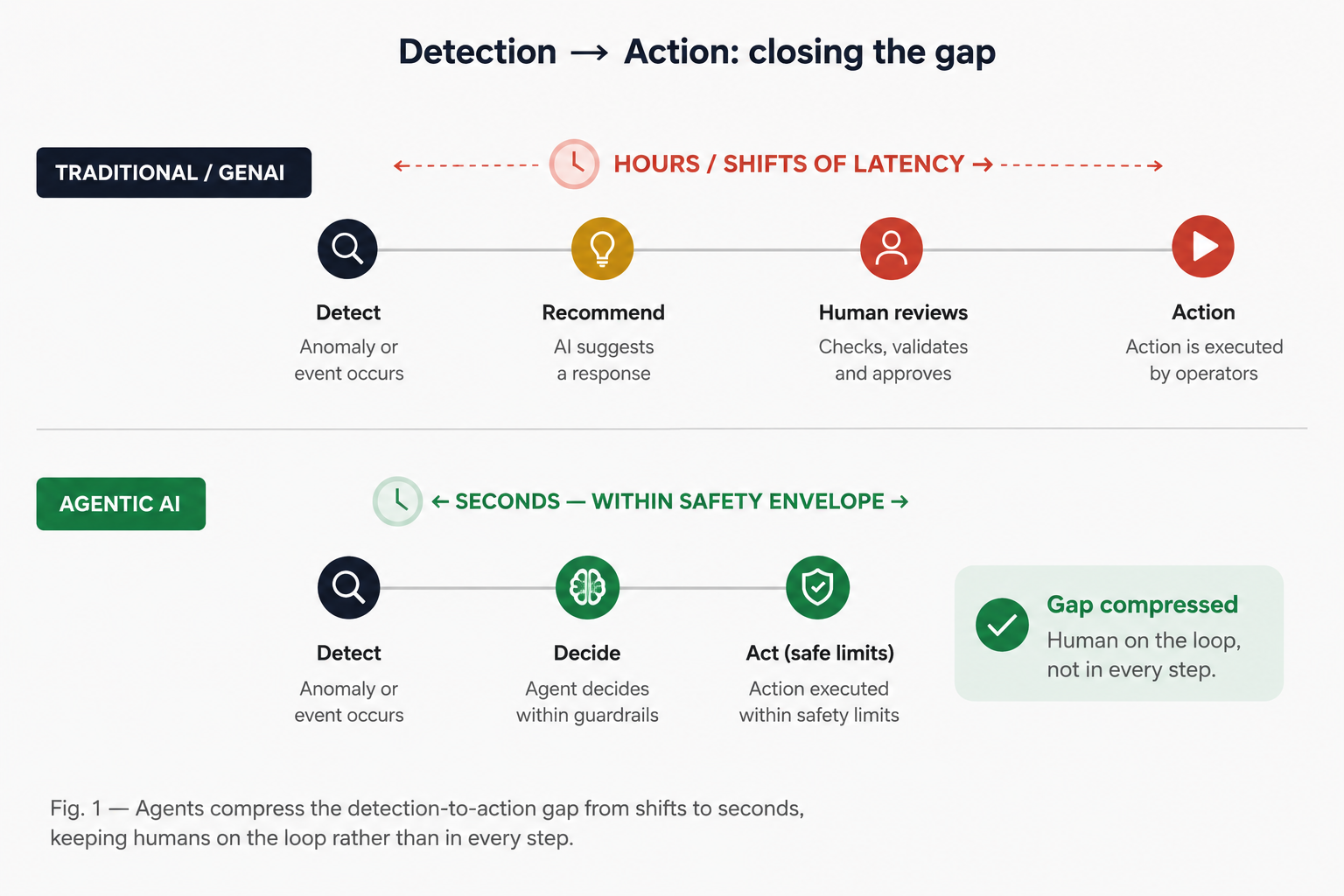
👉 Key Insight: The primary value of shop-floor AI Agents lies less in replacing humans and more in compressing the time between detection and corrective action while maintaining safety boundaries.
2. The Hidden Risks: When Agents Act in the Physical World
The hook: A wrong recommendation gets ignored. A wrong action gets executed. Once an agent can move a machine, every one of its blind spots acquires a physical price tag.
The mechanism: Six risk categories become critical the moment agents leave a purely digital environment:
Incorrect or unsafe physical actions: from sensor noise, incomplete context, model drift, or edge cases absent from training.
Integration & cascading failures: when agents interact with legacy OT, PLCs, or other agents in ways not fully anticipated.
Governance & accountability gaps: who is responsible when an agent's decision causes downtime, scrap, or a safety incident?
Data & cybersecurity vulnerabilities: agents that can act are attractive targets; poisoned data or a compromised agent has direct physical consequences.
Over-reliance & skill erosion: teams lose situational awareness and the ability to intervene if agents handle most routine decisions.
Regulatory & certification challenges: functional-safety standards were not written with adaptive, learning agents in mind.
The evidence: Across 2026 risk analyses, the failures that hurt most are not exotic model errors, they are mundane interaction failures at the seams between agent, OT, and human team.
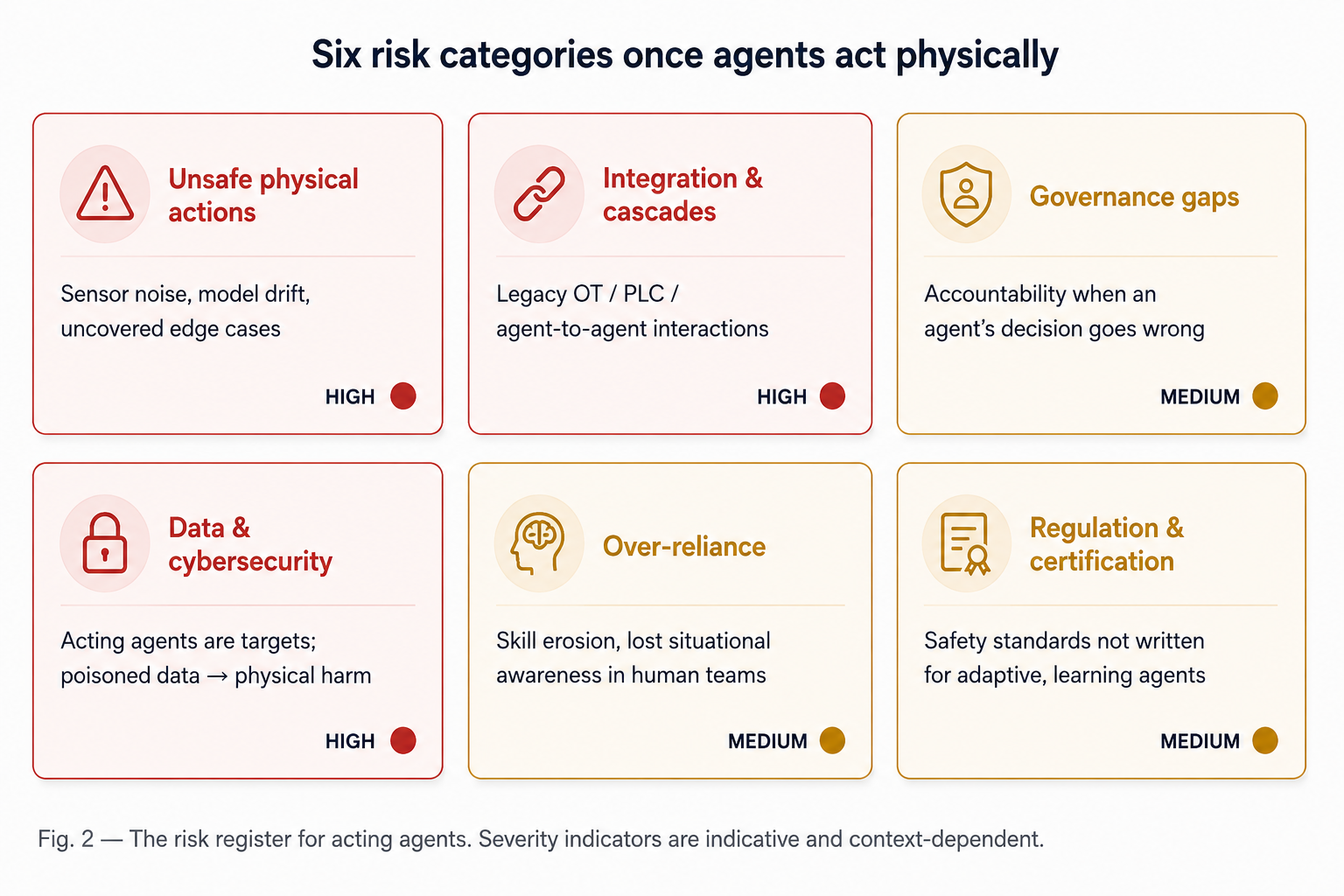
👉 Key Insight: The biggest risks are rarely the agents themselves in isolation, they arise from the interaction between agents, existing OT landscapes, human teams, and unclear governance.
3. What Successful Organizations Are Doing Differently in 2026
The hook: The manufacturers winning with agents in 2026 look almost cautious from the outside. That caution is the strategy — not a lack of ambition.
The mechanism: Leading manufacturers are not rushing into broad autonomy. Instead they:
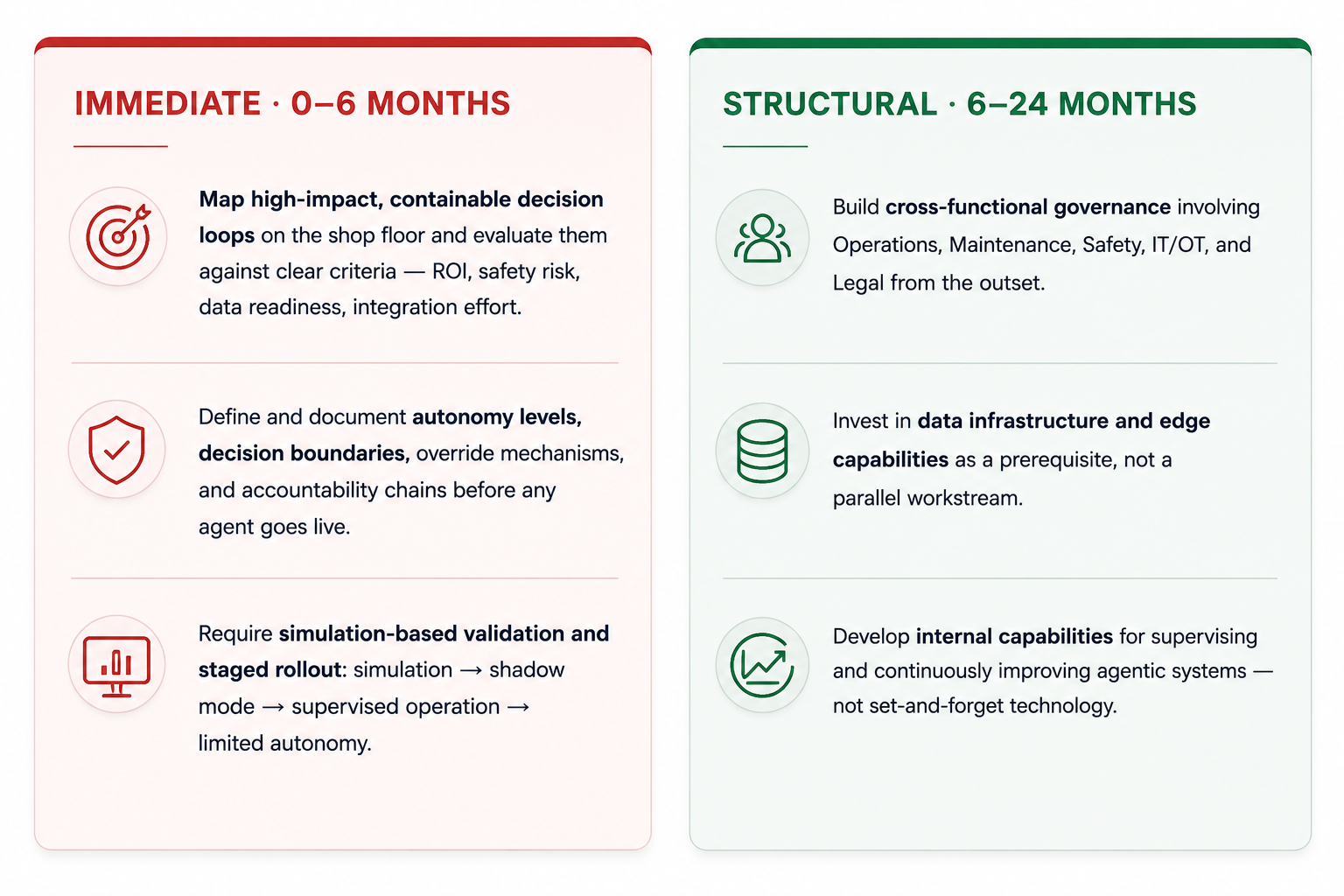
Start narrow: high-value decision loops with clear safety envelopes and measurable ROI.
Validate in simulation: strong digital-twin validation before any physical deployment.
Define autonomy levels: explicit levels with matching human oversight and escalation paths.
Invest in the foundation early: data quality, unified namespaces, robust integration layers.
Treat governance as design: auditability and explainability as core requirements, not afterthoughts.
Gate the rollout: controlled pilots with clear stage-gate criteria before scaling.
The evidence: The pattern is consistent across automotive and machinery case studies presented in 2026, sustainable scaling correlates with scoping discipline and integration quality, not with the raw capability of the model behind the agent.
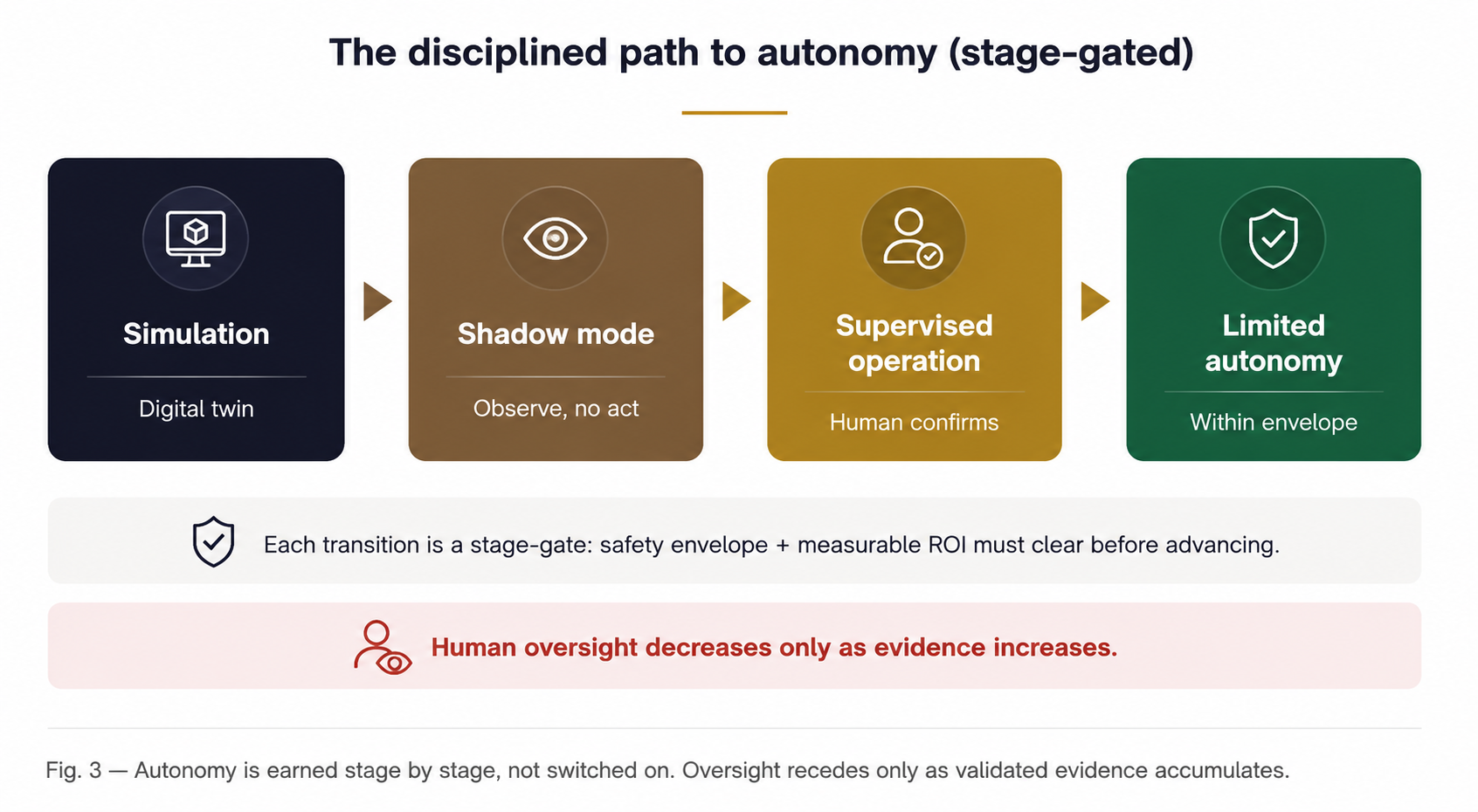
👉 Key Insight: Sustainable scaling of shop-floor AI Agents depends more on disciplined scoping, integration quality, and governance than on the sophistication of the underlying models.
Action Plan for Decision Makers
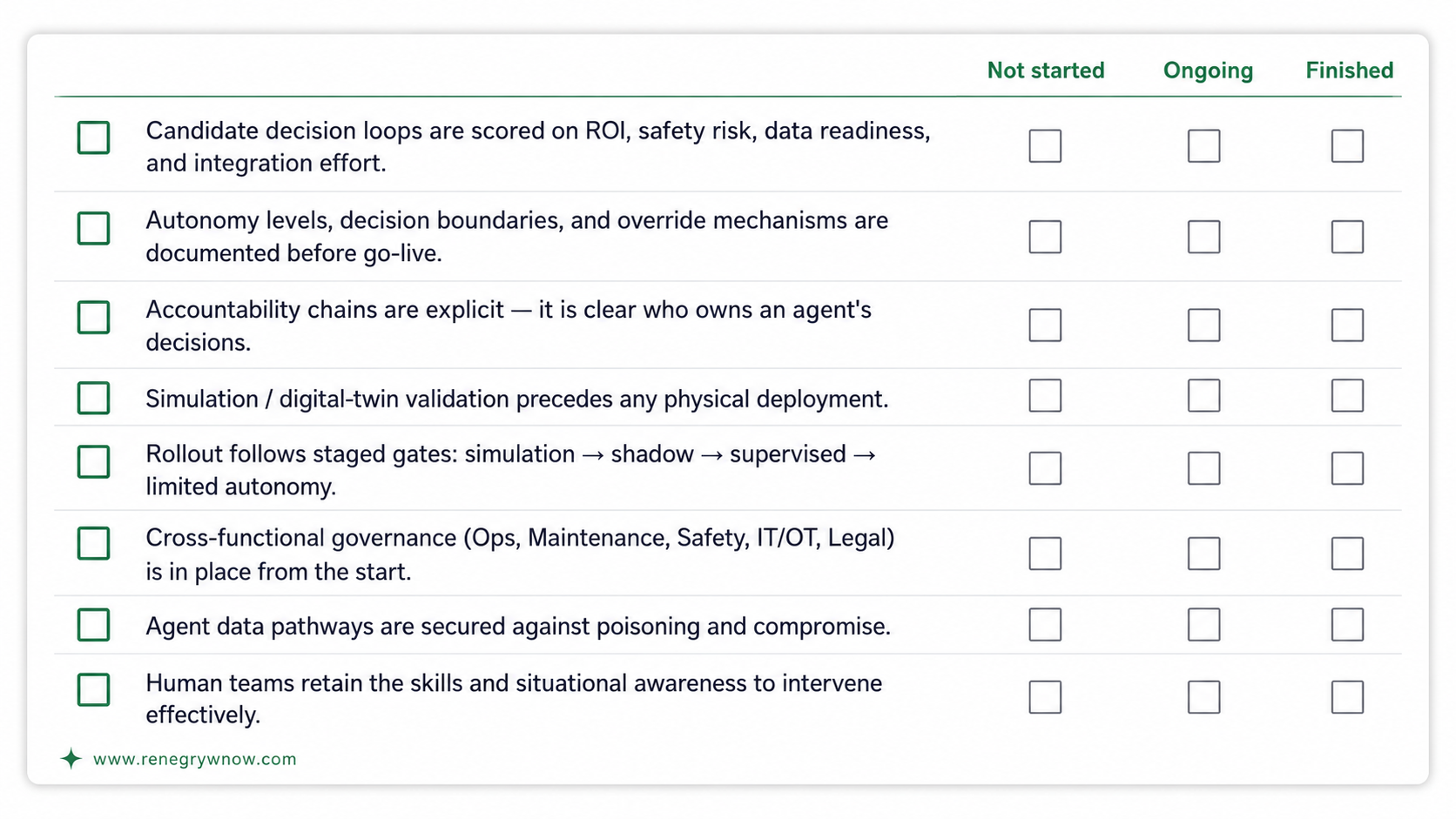
Readiness Checklist
Final Thought
Autonomy on the shop floor is not a capability you buy; it is a level of trust you earn, loop by loop, gate by gate. The manufacturers pulling ahead in 2026 understand that an agent's intelligence is the easy part. The hard part is the scaffolding around it: the scoping, the integration, the governance that turns a promising pilot into a system you can stand behind when it acts on its own.
The temptation is to measure agents by how much they can do unsupervised. The better measure is how confidently you can let them, and that confidence is built, not bought. Efficiency before fuel: the discipline comes first, and the autonomy follows safely.
Systems don't fail. Decisions do.
Which decision loop would you trust an agent to close?
First: Pick one candidate loop and run it through the Readiness Checklist. If you cannot yet name the safety envelope, the override, and the accountable owner, that is your work before any agent goes live.
Then: Part II of Week 28 continues the agentic thread. Share this with the colleague who is excited about what agents can do, and hasn't yet mapped what happens when one gets it wrong.
Take the Next Step
Subscribe to the Weekly Punch for weekly strategic clarity, direct to your inbox.
References
IIoT World (2026) Agentic AI reality in manufacturing, industry discussions.
Capgemini Research Institute (2026) Physical AI Report. Capgemini.
Siemens & NVIDIA (2026) Industrial AI platforms and agentic capabilities, announcements.
Hannover Messe (2026) Automotive and machinery agentic-AI case studies, conference proceedings.
Gartner (2026) Manufacturing AI risks and scaling challenges. Gartner Research.
Deloitte (2026) Scaling challenges and risk in manufacturing AI. Deloitte Insights.
Disclaimer: All performance ranges, comparisons and indices are indicative and based on published third-party analyses; they do not constitute investment, financial or management advice. Readers are encouraged to conduct their own verification before making governance, operational or capital-allocation decisions. The author maintains no commercial relationship with the organisations named.
© 2026 René Grywnow · Energy Dominance Series · Week 28 · Part I | Ownership as Design.
Note: This article reflects my personalviews based on industry experience and publicly available information. It does not constitute professional, legal, or investment advice and does not represent the views of my employer. AI-generated visuals, concept and content by the author.
