Leadership in the Age of Embodied AI: What Changes When Robots Decide

PHYSICAL AILEADERSHIP & GOVERNANCE JULY 2026
ENERGY DOMINANCE · WEEK 28 · PART II
From Command-and-Control to System Orchestration,How Embodied and Agentic AI Are Redefining Leadership Roles, Accountability and Decision-Making in Manufacturing Organizations
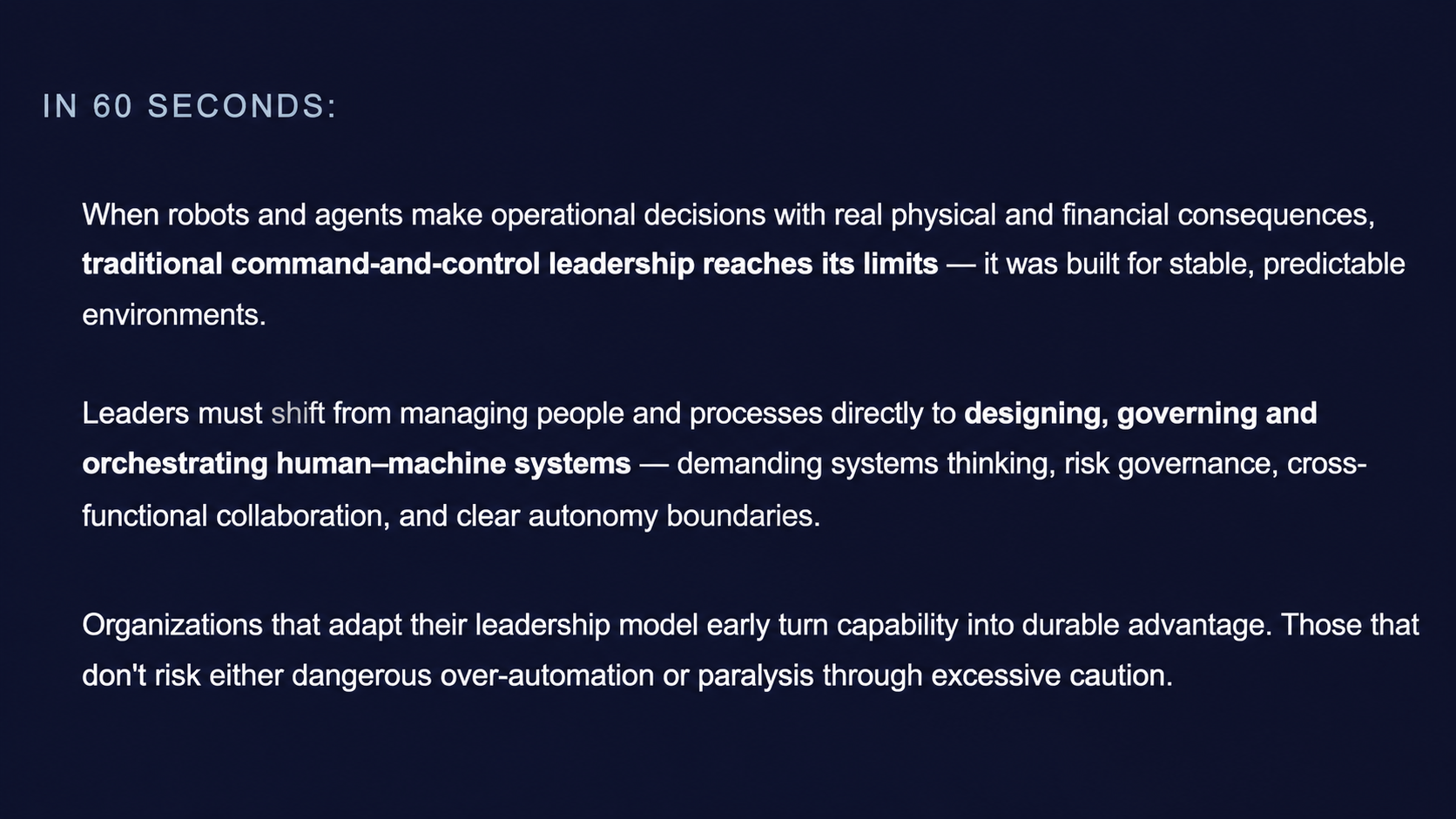
This is Part II of Week 28: the leadership and organizational dimension that becomes critical once AI Agents and embodied systems move from supporting tools to active decision-makers on the shop floor.
Part I ended on an uncomfortable truth: the hardest part of shop-floor agents is not the model, it is the scoping, integration and governance around it. Those are not engineering problems. They are leadership problems. The moment a robot decides, the question "who is accountable?" stops being a footnote and becomes the organizing question of the entire operation.
The thread of this series, “Efficiency Before Fuel” has a leadership form too. The scarce resource is not more autonomy or more compute; it is a leadership model capable of governing it. Install advanced systems under a command-and-control structure built for stable, predictable work, and you get one of two failures: dangerous over-automation, or paralysis through excessive caution. The organizational design comes first.
Executive Summary
1. The Fundamental Shift: From Direct Control to System Orchestration
The hook: For a century, a good manufacturing leader made the right calls. In an environment where systems now decide faster and on more data than any human, that job description quietly becomes obsolete.
The mechanism: Traditional leadership focuses on setting targets, allocating resources, monitoring performance, and intervening on deviations. Embodied and Agentic AI change the equation: many operational decisions are now made by systems operating faster, and with more data, than any human or hierarchy can match. Leadership increasingly becomes defining the rules of the game, which decisions agents may make, under what conditions, with which safeguards, and how humans and agents collaborate.
The evidence: The organizations moving fastest in 2026 describe the leader's role not as the top of a decision pyramid, but as the architect of the decision environment those agents operate inside.
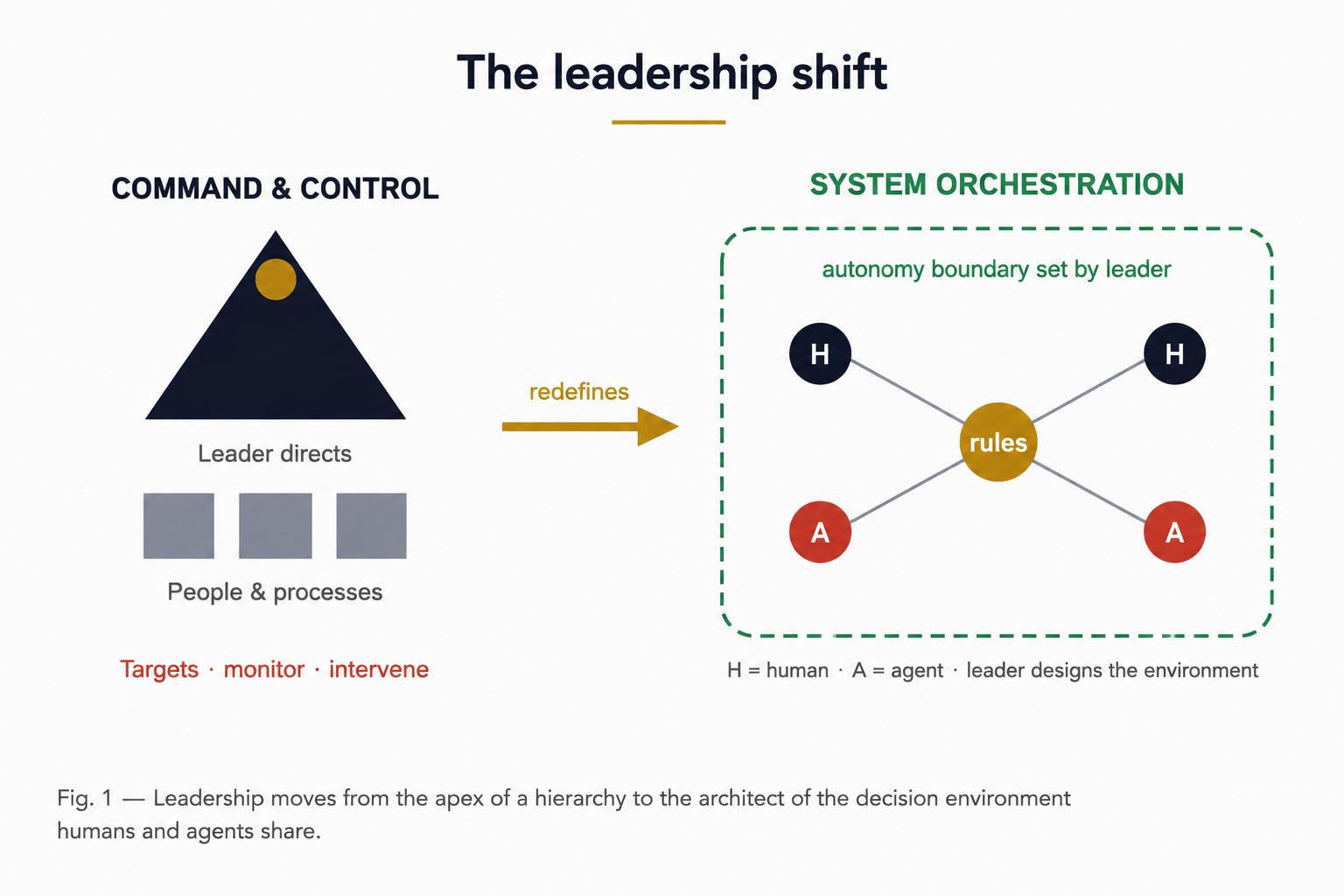
👉 Key Insight: The leader's job moves from "making the right decisions" to "designing decision-making systems that reliably produce good outcomes under uncertainty."
2. New Leadership Challenges and Required Capabilities
The hook: Knowing how the AI works is table stakes. The scarce, decisive skill is knowing how to govern a system where people and intelligent machines decide together.
The mechanism: Six capabilities separate leaders who can run these environments from those who cannot:
Governance of autonomy: clear boundaries, escalation rules, override mechanisms across technical, safety and ethical dimensions.
Accountability in hybrid systems: establishing who is responsible when an agent's decision leads to a negative outcome.
Cross-functional integration: breaking silos between OT, IT, Data Science, Operations, Safety and HR.
Change leadership & capability building: moving operators and supervisors into roles supervising intelligent systems.
Risk & resilience thinking: anticipating emergent behaviours in multi-agent and human–machine systems.
Strategic foresight: judging which decisions stay human and which can, or should, be delegated over time.
The evidence: Across 2026 leadership roundtables, the recurring lesson is that technical fluency alone predicts almost nothing, the differentiator is socio-technical design capability.
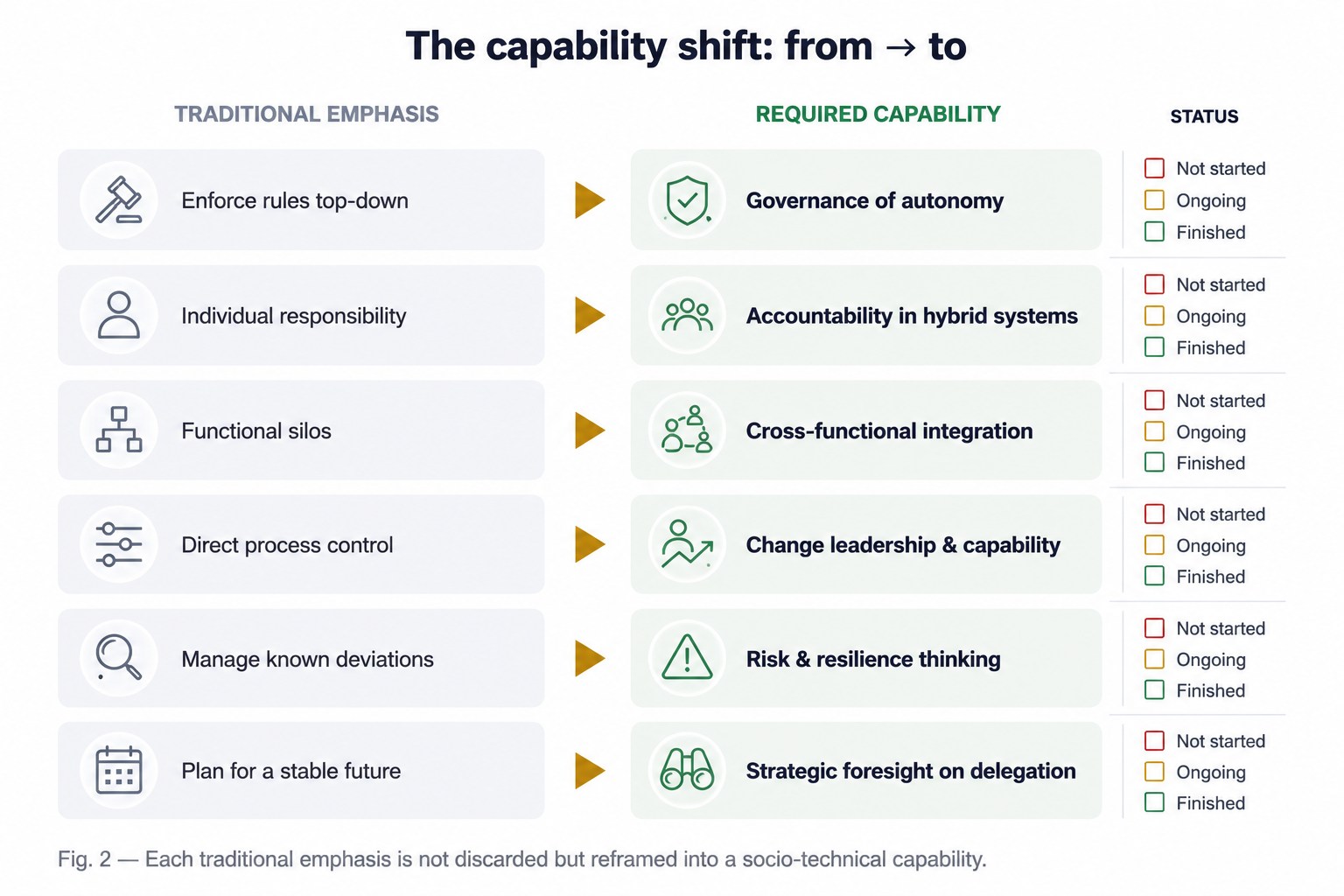
👉 Key Insight: Technical understanding of AI is necessary but not sufficient. The decisive leadership skill is designing and governing socio-technical systems in which humans and intelligent machines collaborate effectively.
3. What Leading Organizations Are Doing in Practice
The hook: The leaders getting this right are not waiting for the org chart to catch up to the technology. They are redrawing it on purpose.
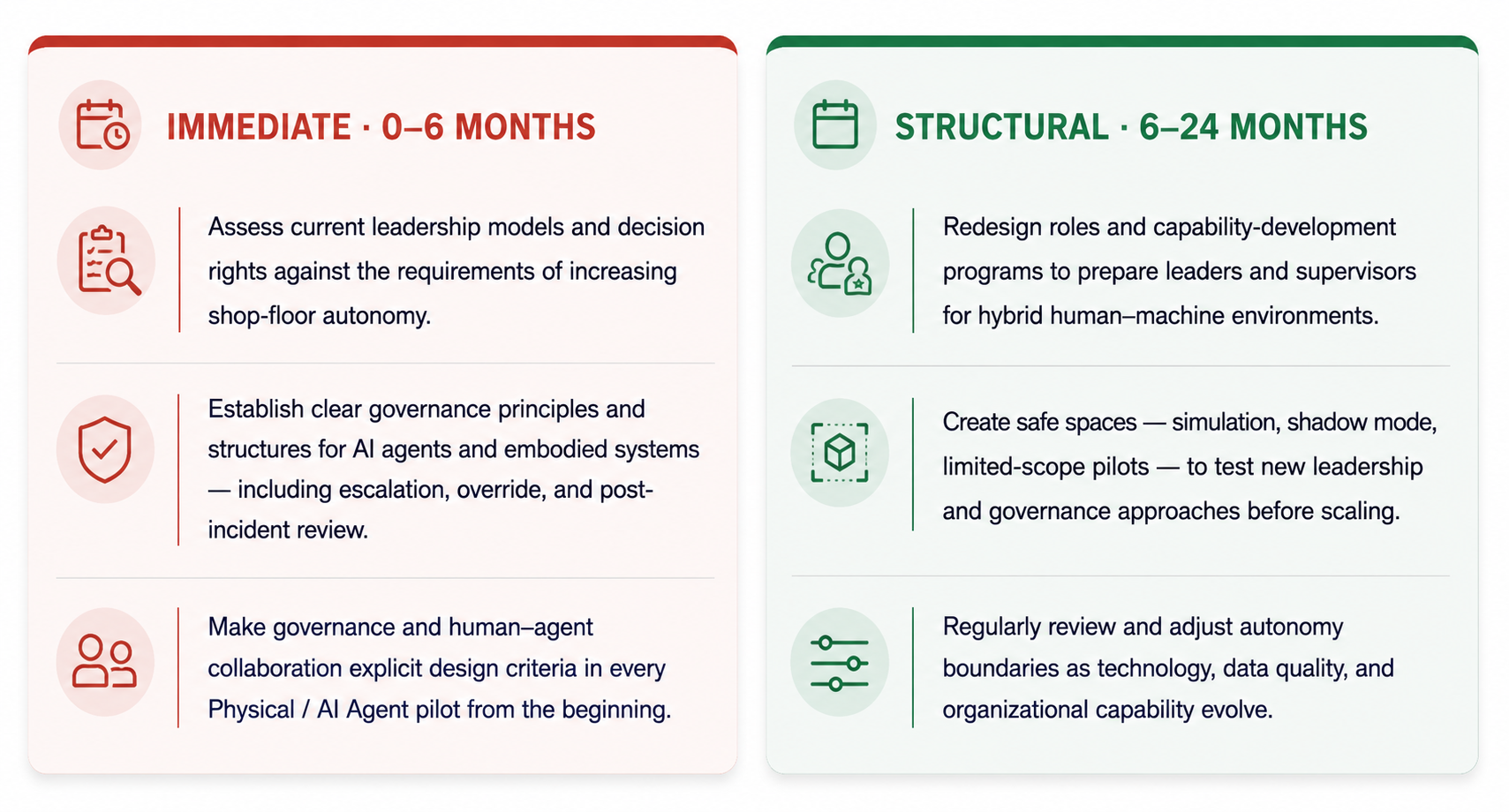
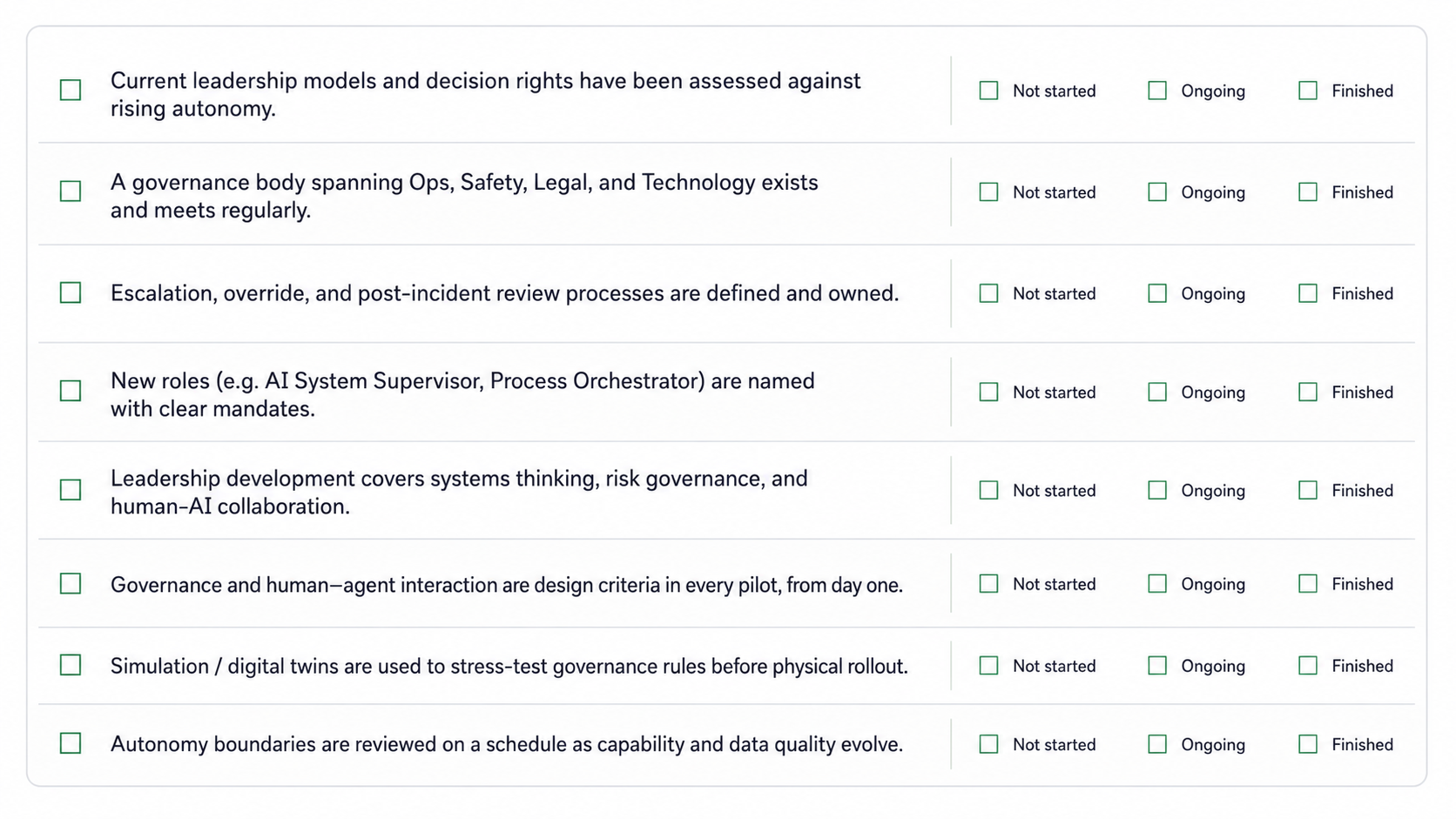
The mechanism: Forward-thinking manufacturers are creating explicit AI governance boards spanning operations, safety, legal and technology; redefining roles and career paths ("AI System Supervisor", "Process Orchestrator", "Digital Twin Engineer"); running structured pilots that test governance models and human, agent interaction, not just technology; investing in leadership development around systems thinking and risk governance; and using digital twins to stress-test governance rules before physical deployment.
The evidence: The common denominator across 2026 case studies is intent: leadership-model adaptation is run as a deliberate workstream with owners and milestones, not left to emerge on its own once the hardware arrives.
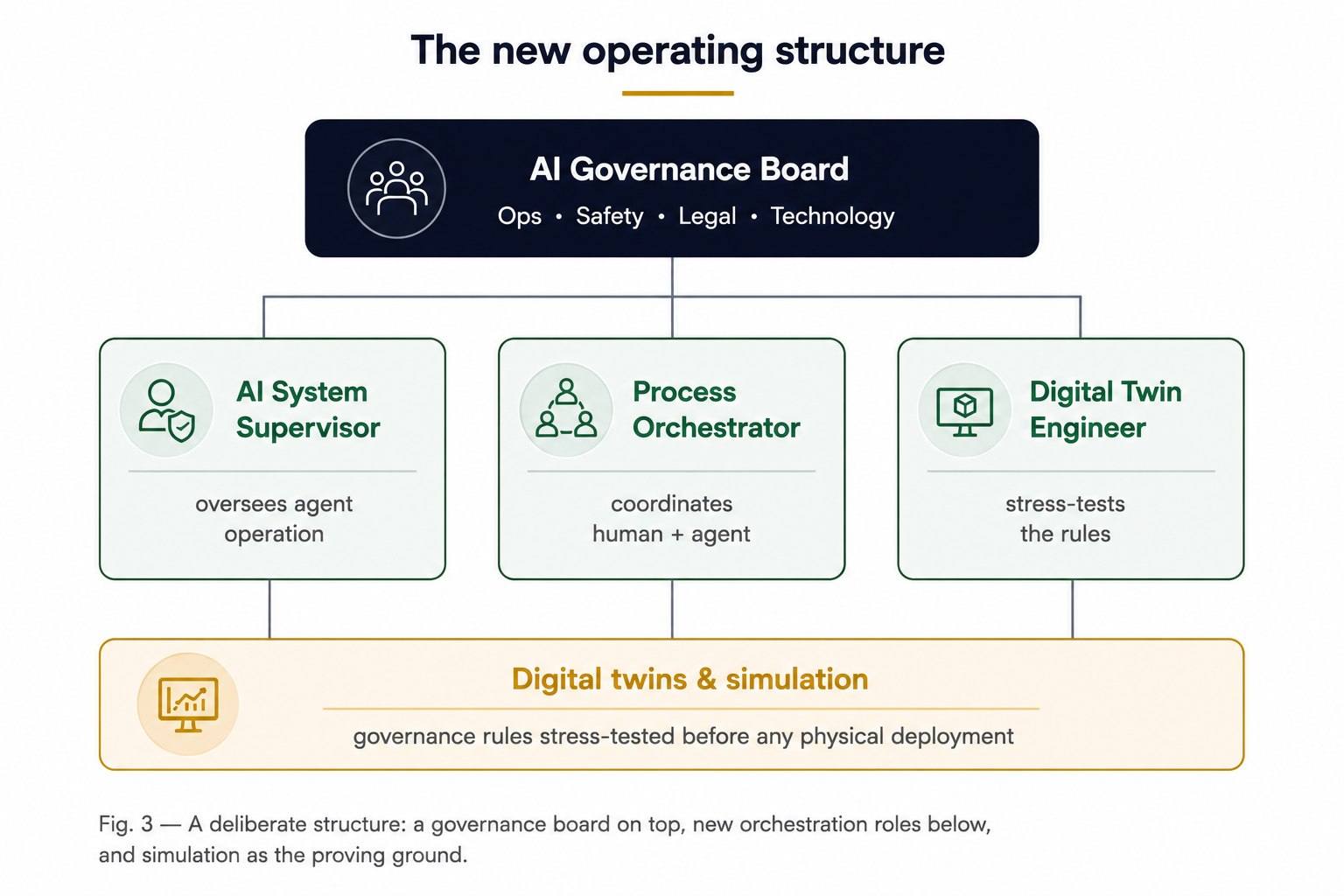
👉 Key Insight: The organizations pulling ahead treat leadership-model adaptation as a deliberate workstream, not something that happens automatically once the technology is installed.
Action Plan for Decision Makers
Readiness Checklist
Final Thought
Week 28 began with a machine that can act. It ends with the person accountable for letting it. Those are two ends of the same responsibility, and the organizations that thrive will be the ones that never let them drift apart. When robots decide, leadership does not disappear; it relocates, from making the call to designing the system that makes calls well, and owning the outcome either way.
The reflex is to treat the leadership question as something to sort out after the technology is installed. But autonomy without a leadership model to govern it is not progress, it is unowned risk. Efficiency before fuel: the organizational design comes first, and the technology delivers on it.
Systems don't fail. Decisions do.
If an agent made a costly decision tomorrow, who owns it?
First: Ask your team that question about one live or planned use case. If the answer is a pause, that pause is your leadership gap, and your starting point.
Then: Put leadership-model adaptation on the roadmap as its own workstream, with an owner and milestones, not as a box to tick after go-live. Share this with the executive still assuming the org chart will sort itself out once the robots arrive.
Take the Next Step
Subscribe to the Weekly Punch for weekly strategic clarity, direct to your inbox.
References
Capgemini Research Institute (2026) Physical AI Report. Capgemini.
Siemens (2026) Industry discussions on leadership implications of Industrial AI.
Manufacturing leadership roundtables and case studies (2026).
Gartner (2026) Organizational readiness for autonomous systems. Gartner Research.
Deloitte (2026) Organizational readiness and governance for autonomous systems. Deloitte Insights.
World Economic Forum & academic work (2025–2026) Human–AI collaboration in industrial settings.
Disclaimer: All performance ranges, comparisons and indices are indicative and based on published third-party analyses; they do not constitute investment, financial or management advice. Readers are encouraged to conduct their own verification before making governance, operational or capital-allocation decisions. The author maintains no commercial relationship with the organisations named.
© 2026 René Grywnow · Energy Dominance Series · Week 28 · Part II | Ownership as Design.
Note: This article reflects my personalviews based on industry experience and publicly available information. It does not constitute professional, legal, or investment advice and does not represent the views of my employer. AI-generated visuals, concept and content by the author.
