WORLD MODELS | MANUFACTURING | OCTOBER 2026 | Week 44 · Part I
A Language Model Describes the Cell. A World Model Predicts What Happens When the Gripper Closes, and Fails When the Physics Does Not Match
Last week's set asked what an agent may write into the operational record. Week 44 asks the question that comes before it: what does the agent actually understand about the cell it is about to act on?
Language models excel at describing. Manufacturing decisions require predicting, if the robot moves here, with this payload, on this surface, what happens next? Shop-floor AI that only understands language and pixels will not plan contact, mass or friction. In manufacturing, that is the difference between a demo and a cell.
Executive Summary
IN 60 SECONDS:
Language models excel at describing. Manufacturing decisions require predicting. World models are trained to answer that: if the robot moves here, with this payload, on this surface, what happens next?
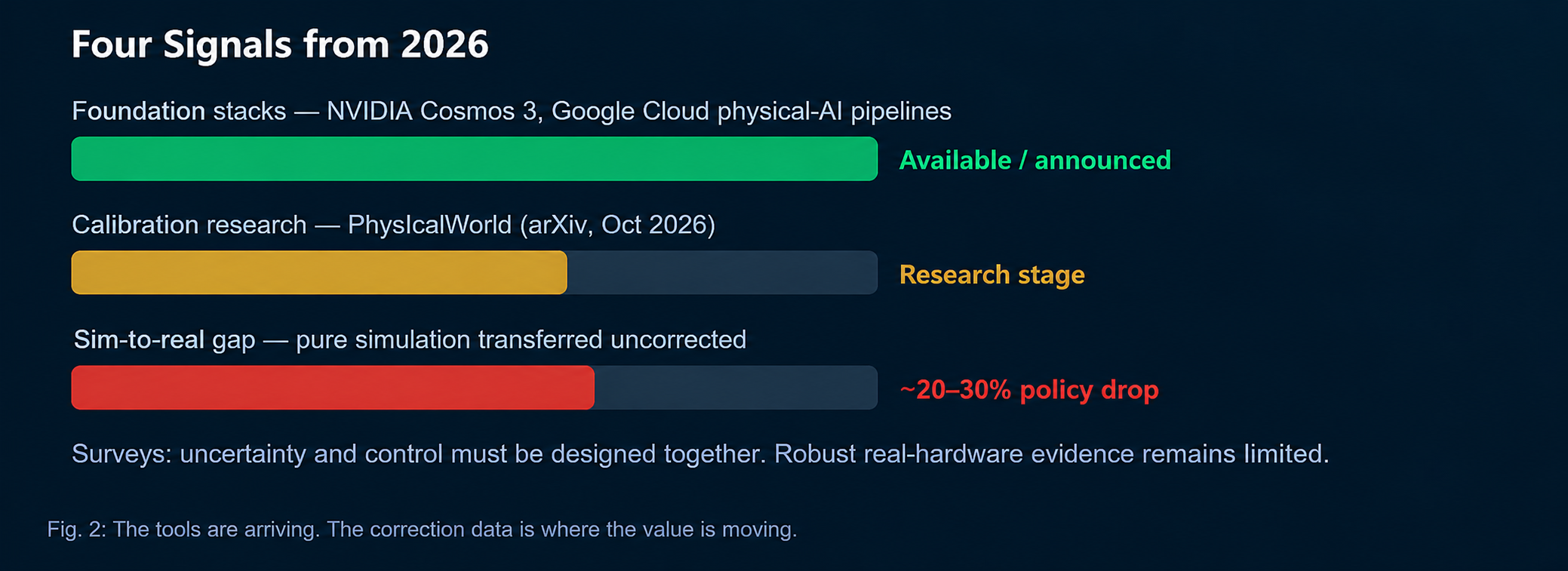
NVIDIA Cosmos 3 (launched May 2026, with an edge variant announced),* Google Cloud's physical-AI pipelines combining Isaac Sim and MuJoCo,* and research such as PhysiCalWorld (arXiv, Oct 2026)* treat dynamics — mass, damping, friction — as first-class. Surveys conclude that prediction accuracy alone is not enough: uncertainty and control must be designed together, and robust real-hardware evidence remains limited.*
Decision Makers who buy "AI that understands the plant" should ask whether it understands physics or only the manual.
1. Language vs. Physics
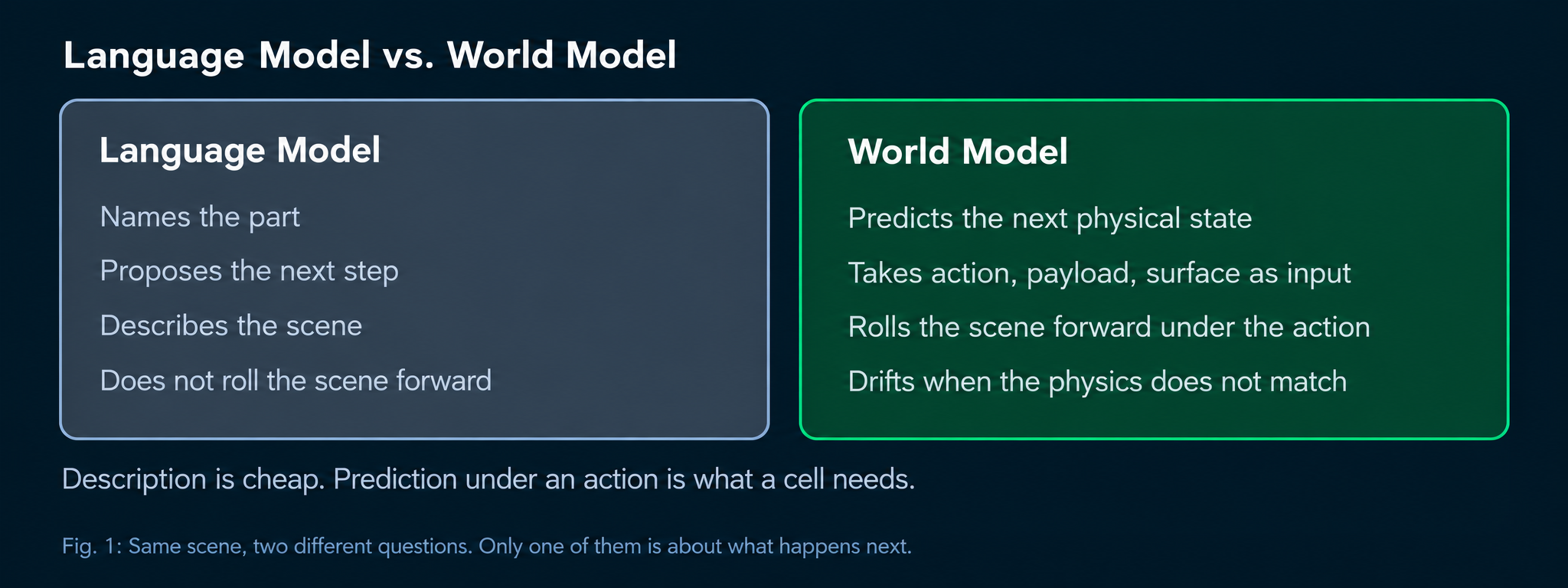
A vision-language model can name a part and propose a step. It does not inherently know what happens when that step meets the real world.
It does not inherently know that a wet floor changes friction, that a full bin changes mass, or that contact will jam. A world model aims to do something different: roll the scene forward under an action and predict the next physical state. The question it answers is not "what is this?" but "what happens if I do this?"
When the physics inside the model is wrong, the rollout drifts, and the plan fails on the real cell. The failure is quiet until contact. The plan reads correctly, the explanation sounds right, and the gripper closes on something that moves differently than the model assumed.
👉 Key Insight
Manufacturing AI fails at contact and dynamics, not at vocabulary.
2. What Is Moving in 2026
The 2026 stack is real and moving fast. The honest reading of it matters as much as the headline.
Foundation stacks: NVIDIA launched Cosmos 3, an open world foundation model for physical AI, in May 2026, with an Edge variant announced.* Google Cloud publishes physical-AI pipelines that combine Isaac Sim, MuJoCo and training for VLA and world-model architectures.* Calibration research: PhysiCalWorld encodes an exploratory interaction clip from the test scene into a compact physics descriptor, so predictions match the actual scene without fine-tuning or full analytical modeling.*
Deployment reality is more sober. Analyses note that the value is shifting toward the data that corrects the model, and that sim-to-real gaps remain material, policy performance drops on the order of 20–30% when pure simulation transfers uncorrected.* The survey consensus is consistent: learned world models can support safer decisions only when uncertainty is represented and the model is coupled to control, not when it merely generates plausible video.*
👉 Key Insight
The model is the starting point. The data that corrects it on your parts is where the value is moving.
3. What a Plant Should Demand
A world model for manufacturing is a procurement object. It should be tested like one.
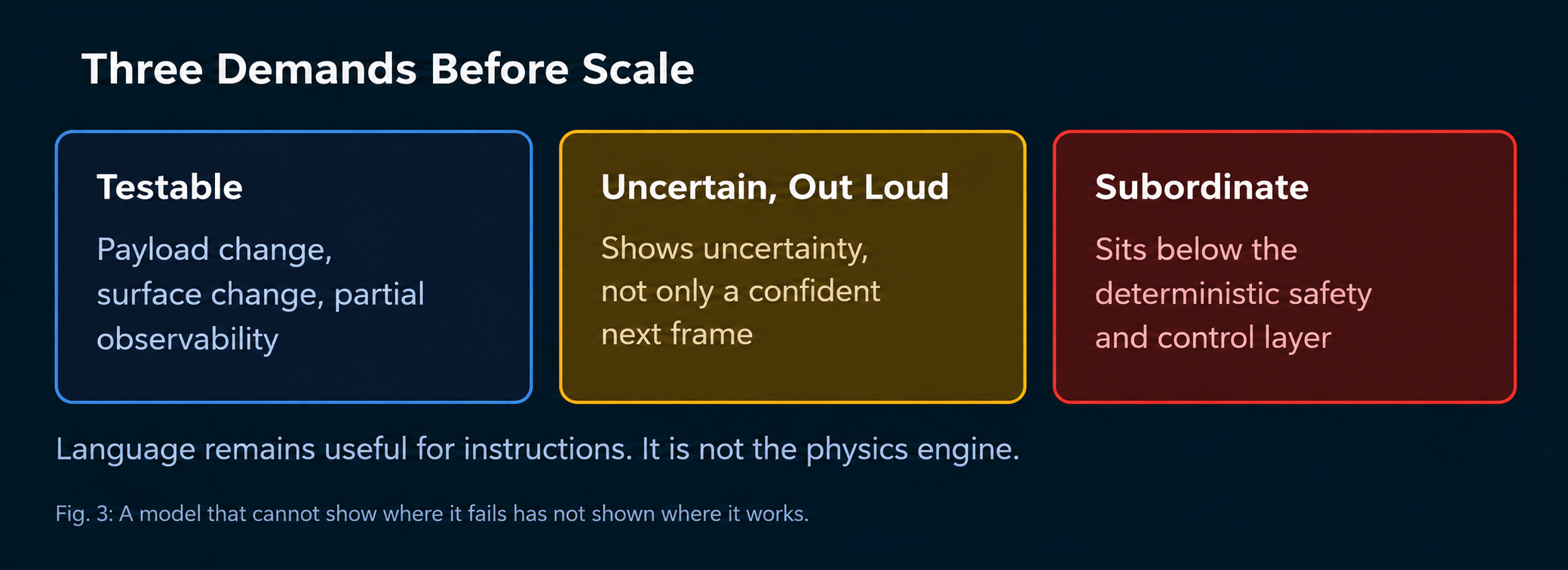
It must be testable against real dynamics: a payload change, a surface change, partial observability. It must expose uncertainty, not only a confident next frame. And it must be subordinate to the safety and control layer. Language remains useful for instructions. It is not the physics engine.
The test is cheap relative to the failure. Run the model against your heaviest payload, your slickest surface, and the part you can only partly see. A vendor whose model has never been allowed to fail in front of you has not shown you where it works.
👉 Key Insight
If the model cannot fail a physics test on your parts, it is not ready for your cell.
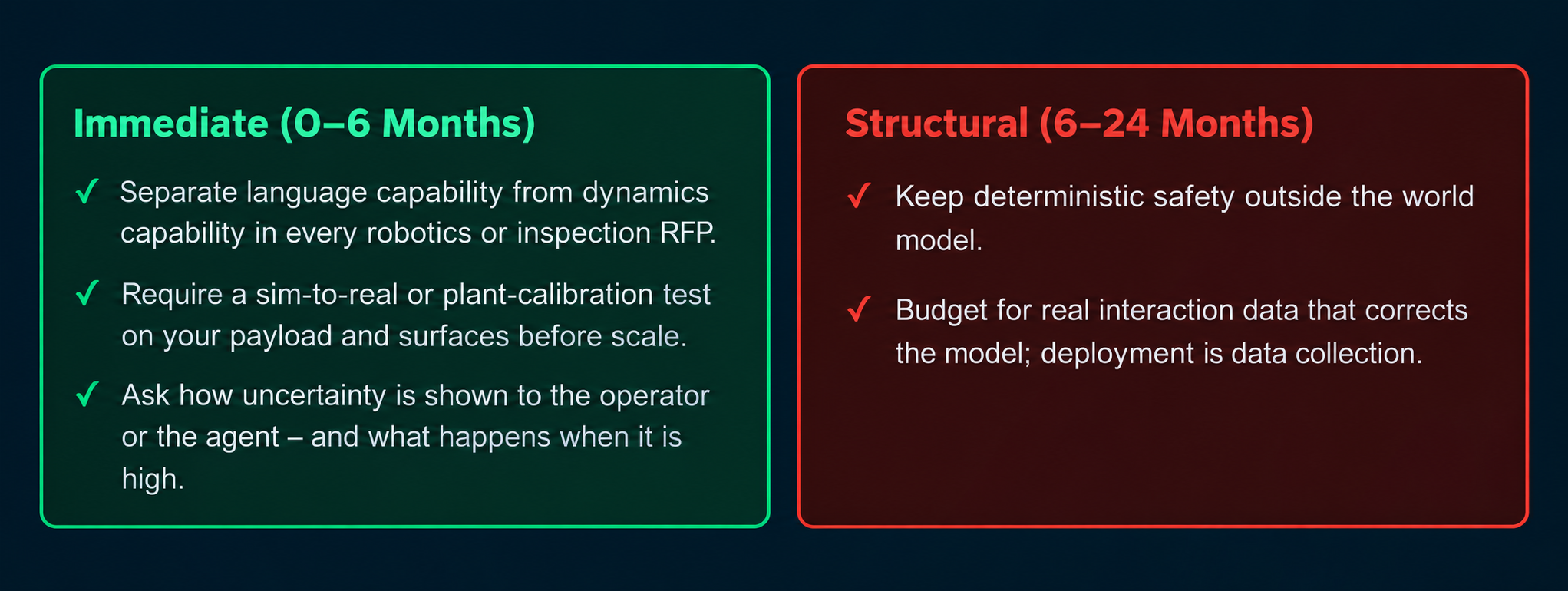
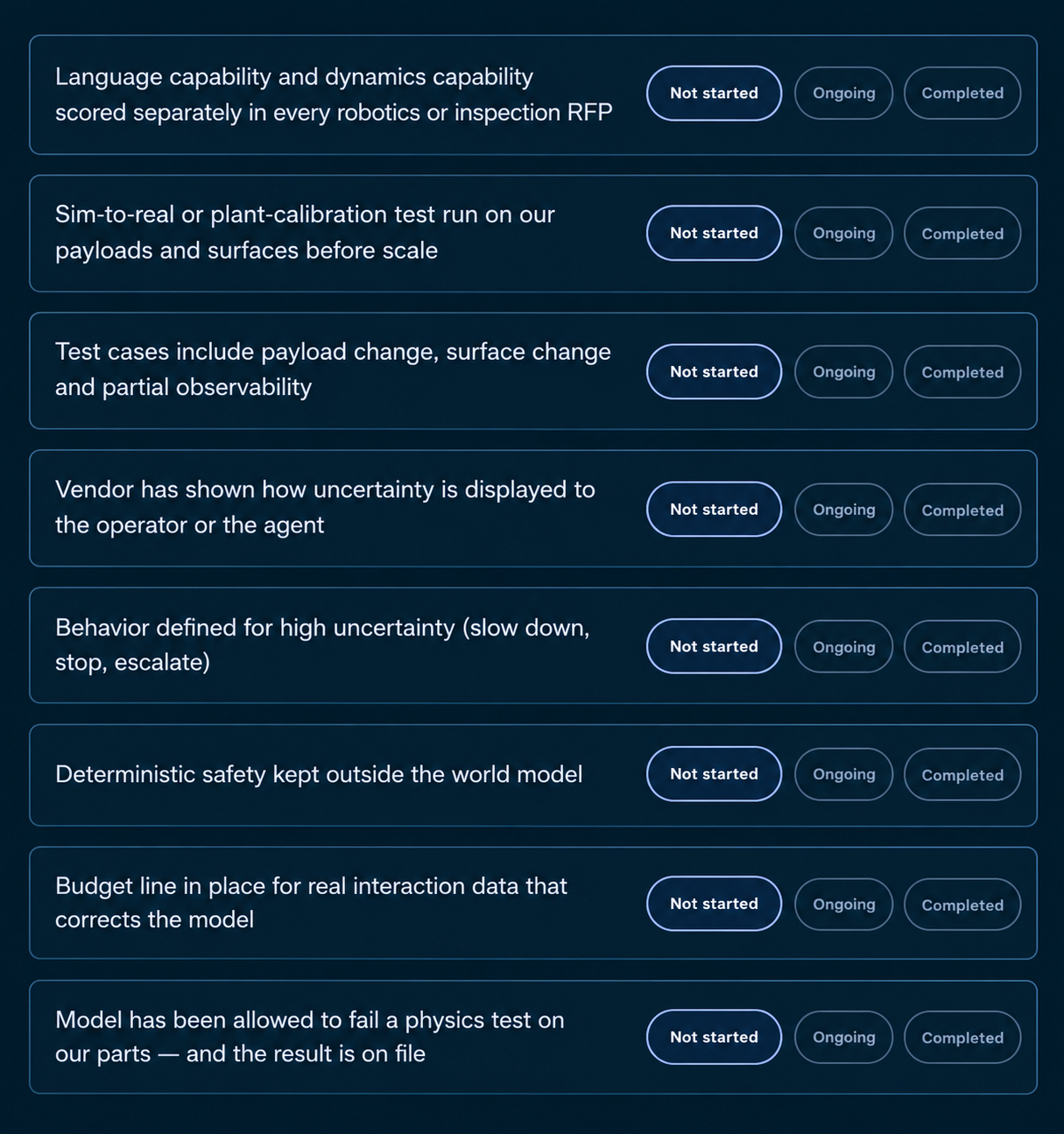
Action Plan for Decision Makers
Checklist
Final Thought
A world model is only as good as the data that corrects it. Part II of this Week 44 set asks the question this one leaves open: which data do you trust to train the model, and which data decides whether it may run at all?
Efficiency Before Energy means a plan that respects friction, mass and contact the first time costs less than a clever plan that discovers them on the real cell.
Systems don't fail. Decisions do.
Take the Next Step
Subscribe to the Weekly Punch for weekly strategic clarity, direct to your inbox.
References
Luo, Y., He, W., Dai, Y., Nam, H., Fu, H., Chai, J., Fazeli, N. and Park, J.J. (2026) PhysiCalWorld: In-Context Physics Calibration for World Models. arXiv:2610.30125, 21 October 2026.
NVIDIA (2026) NVIDIA Launches Cosmos 3, the Open Frontier Foundation Model for Physical AI. NVIDIA Newsroom, 31 May 2026.
Google Cloud (2026) Build Safe, Adaptive Physical Agents (physical-AI solutions; Isaac Sim, MuJoCo and VLA / world-model pipelines).
Surveys of World Models for Physical AI with Uncertainty and Control (2026).
Analyses of Sim-to-Real Performance Gaps (2025–2026).
Disclaimer: This article synthesizes publicly available vendor, research and survey reporting current as of publication. Figures on sim-to-real gaps and model capabilities evolve quickly; readers should verify current figures against the original publications before relying on them for investment or deployment decisions. Verification Gate: flagged for pre-publication source check.
Ownership as Design.
Note: This article reflects my personalviews based on industry experience and publicly available information. It does not constitute professional, legal, or investment advice and does not represent the views of my employer. AI-generated visuals, concept and content by the author.
