OT vs. IT: The Integration Debt That Stops Industrial Agents
OT/IT | INTEGRATION | OCTOBER 2026 | Week 43 · Part II
The Agent Is Ready. The 20-Year ERP, the Unnamed Tag and the Two Definitions of "Good" Are Not
Part I of this Week 43 set argued that the agent's envelope, what it may change, what it must escalate, how fast it can be reversed, is a leadership decision. Part II asks what happens when leadership signs off on an envelope the surrounding systems cannot actually support.
Agents fail less on models than on the systems and definitions they are asked to act through. An industrial agent needs a trusted operational record and a way to write back into it. Most plants do not have either in clean form, and the debt that blocks them was accumulated over decades, not months.
Executive Summary
IN 60 SECONDS:
An industrial agent needs a trusted operational record and a way to write back. Most plants do not have either in clean form. OT technical debt — local calculations, drifting state definitions, tags without context — stays invisible until data must serve enterprise KPIs or an agent.
IT debt is the other half: legacy ERPs with no usable API, screens as the only interface, disconnected systems. Surveys put legacy integration among the top barriers to manufacturing AI.* Agents that drive UIs break on the next patch; agents that cannot see OT context recommend actions that are unsafe or impossible.
The integration debt is the reason most "AI on the floor" stays a pilot.
1. Two Debts, One Blocked Loop
OT debt and IT debt look like separate problems from inside each function. An agent experiences them as the same wall.
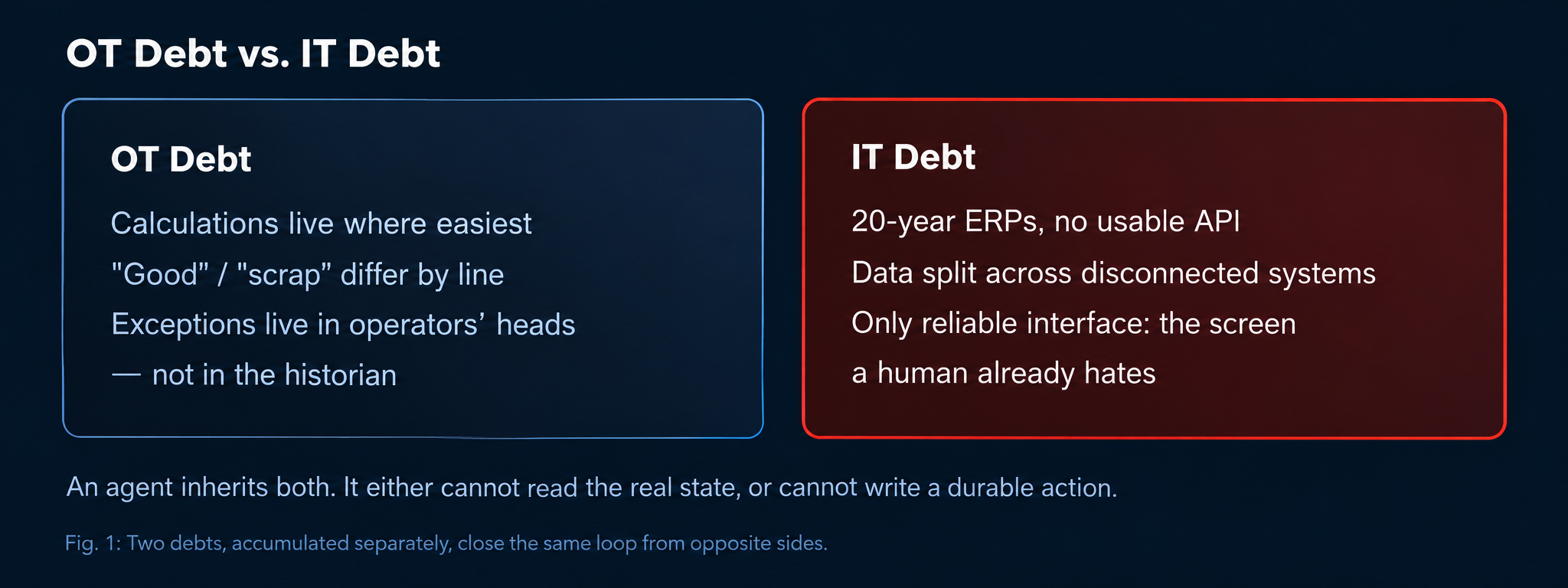
OT debt: calculations live wherever they were easiest to implement at the time, not wherever a system of record would want them; "running," "good" and "scrap" mean different things line to line, sometimes shift to shift; the exceptions that actually keep the plant moving live in operators' heads, not in the historian. IT debt: twenty-year-old ERPs with a read-only interface or no API at all; data scattered across disconnected systems that were never meant to talk to each other; the only reliable interface left is the screen a human operator already resents using.
An agent inherits both debts at once, and the failure mode is symmetric: it either cannot read the real state of the plant, or it can read it but has no durable way to write an action back in.
👉 Key Insight
Integration debt is not a backlog item. It is the reason the agent cannot close the loop.
2. How It Shows Up
None of these failure modes announce themselves as integration debt. They show up as something else first, and the agent is usually the first thing to expose them.
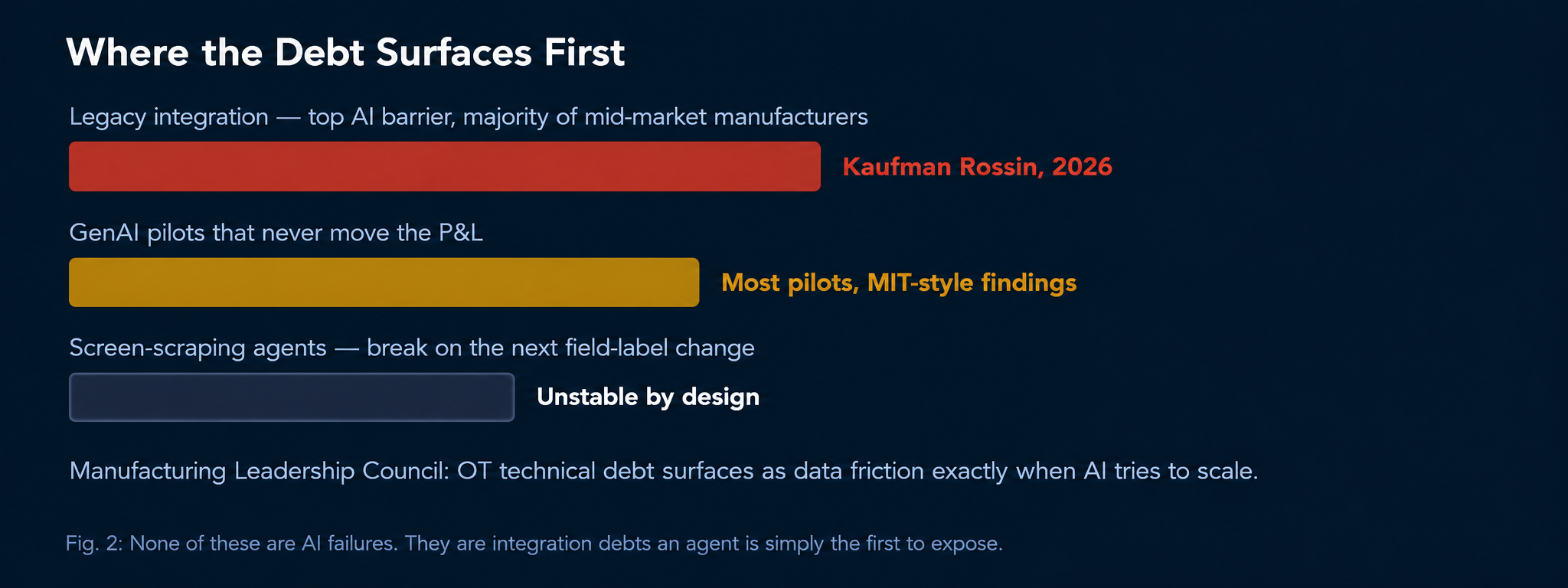
KPI disputes and spreadsheet validation happen before anyone trusts a number enough to let an agent act on it. Agents that "integrate" by clicking through ERP screens work, right up until a field label changes on the next patch, and then they stop working without warning. Pilots that run beautifully on a clean, hand-prepared data extract die on contact with the live tag set, where the real drift and the real gaps live. Mid-market surveys, Kaufman Rossin's 2026 research among them, name legacy integration as the top AI barrier for a majority of manufacturers,* and MIT-style findings show most GenAI pilots never move the P&L at all.* The Manufacturing Leadership Council frames it precisely: OT technical debt surfaces as data friction exactly when analytics and AI try to scale.*
Every one of these is a known, named failure mode before AI ever enters the picture. The agent doesn't create the debt. It is simply the first user with no patience for it.
👉 Key Insight
None of these failures are AI failures. They are integration debts that were invisible until an agent tried to act on them.
3. What Must Be Paid Before the Agent
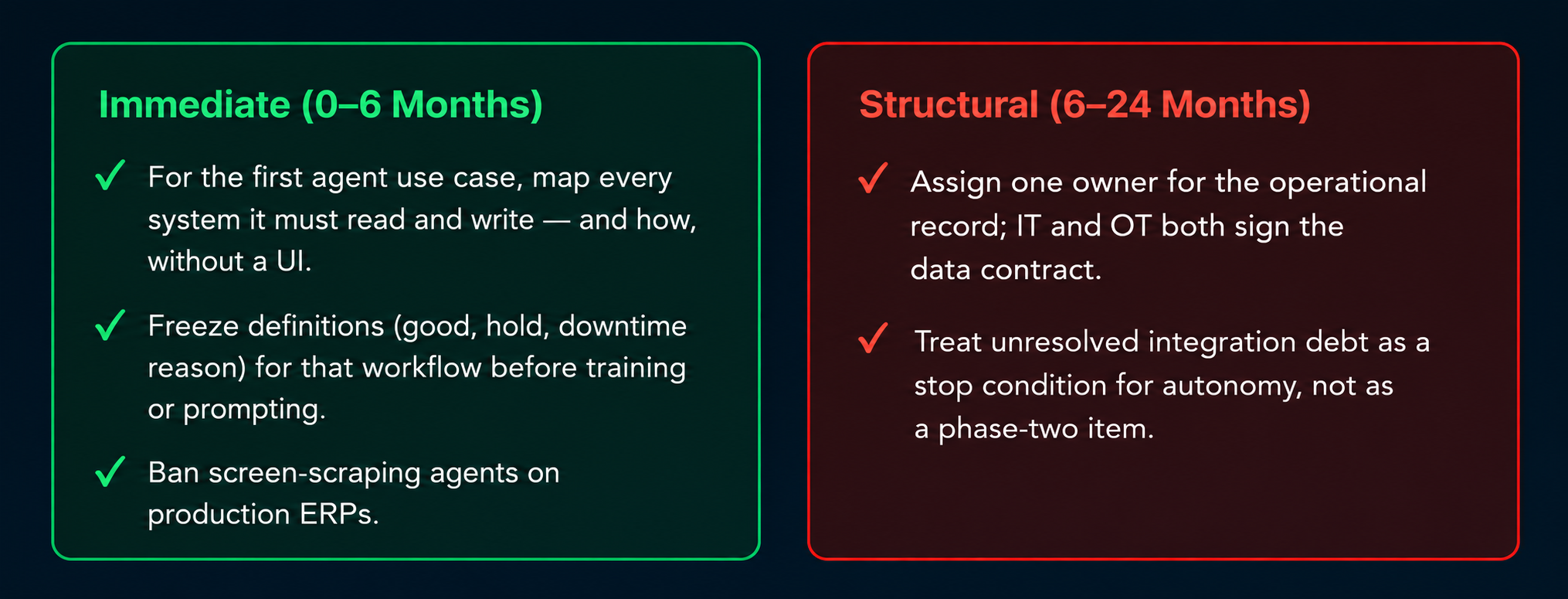
None of this requires a plant-wide data platform. It requires paying down four specific debts on the one workflow the agent will actually touch.
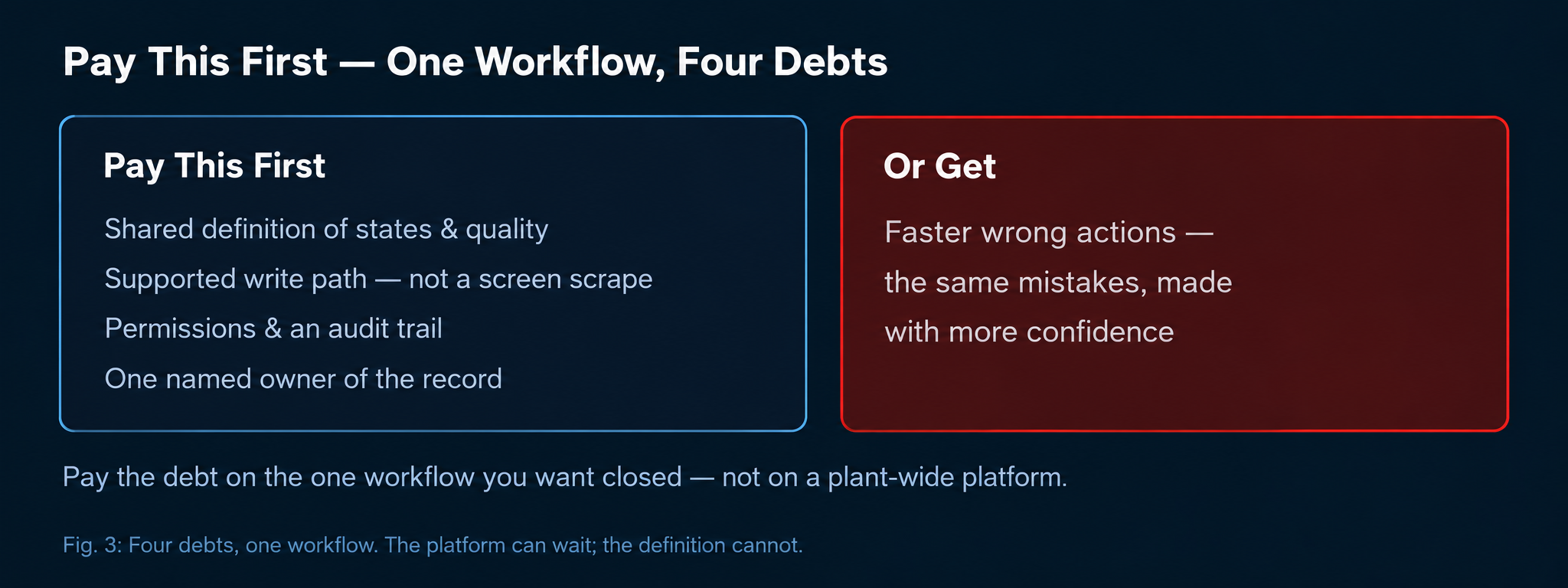
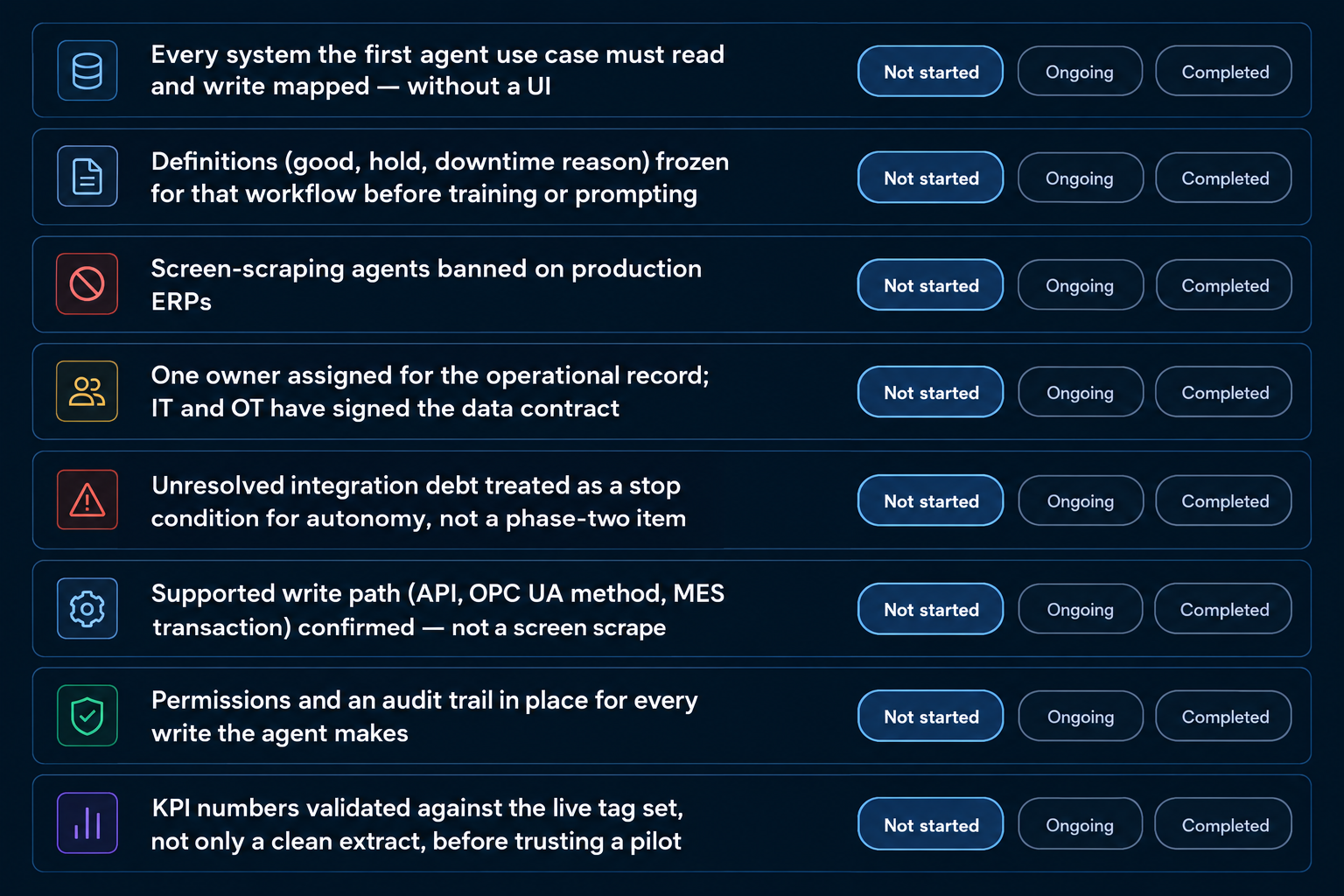
A minimal shared definition of states and quality, "good," "hold," "downtime reason", agreed once, in writing, for that workflow. A supported write path: an API, an OPC UA method, an MES transaction, never a screen scrape dressed up as an integration. Permissions and an audit trail on every write the agent is allowed to make. And one named owner for the operational record the agent will use, so "who approved this definition" has an answer six months from now.
Without these four, more model capability does not produce a safer agent. It produces faster wrong actions, the same mistakes, made with more confidence and at higher speed.
👉 Key Insight
Pay the integration debt on the one workflow you want closed. Do not wait for a plant-wide data platform.
Action Plan for Decision Makers
Checklist
Final Thought
Part I showed what a closed loop requires technically: an envelope. Part II shows what usually stops a plant from building one at all, debt nobody budgeted for, because it stayed invisible until an agent tried to act on it. Paying it down doesn't close the loop by itself; it only makes the loop possible to manage. Part III of this Week 43 set turns to that management discipline directly: what a plant run by humans and agents together still has to get right about meetings, indicators, and who gets to stop what.
Efficiency Before Energy means paying down the integration debt on one workflow beats announcing a plant-wide AI platform that cannot write anywhere yet.
Systems don't fail. Decisions do.
Take the Next Step
Subscribe to the Weekly Punch for weekly strategic clarity, direct to your inbox.
References
Manufacturing Leadership Council (2026) OT Technical Debt and Trusted Operational Information.
Industrial Sage (2026) Agents in Legacy ERPs.
Kaufman Rossin (2026) Mid-Market Manufacturing AI Survey — Legacy Integration as the Top Barrier.
Infosys / Manufacturing Dive (2026) The IT/OT Seam.
Tulip & Siemens (2026) Connectors and Agentic Orchestration Requiring Governed Write-Back.
Disclaimer: This article synthesizes publicly available industry research and vendor reporting current as of publication. Survey figures and barrier rankings evolve as methodologies and samples change; readers should verify current figures against the original publications before relying on them for investment or deployment decisions. Verification Gate: flagged for pre-publication source check.
Ownership as Design.
Note: This article reflects my personalviews based on industry experience and publicly available information. It does not constitute professional, legal, or investment advice and does not represent the views of my employer. AI-generated visuals, concept and content by the author.
