Why Peak Demand, Not Average kWh, Will Kill Data Center Projects
DATA CENTERS | PEAK DEMAND | OCTOBER 2026 | Week 42 · Part II
The PUE Slide Shows Energy Efficiency. The Queue, the Transformer and the Capacity Charge Are Written in Megawatts
Part I of this Week 42 set argued that the fastest route to a data-center connection is a credible promise to use less. Part II asks the harder question underneath that promise: less of what, measured how? The grid, the transformer and the capacity charge all agree on an answer, and it is not the number on the sustainability slide.
A campus can average 40% of its reserved load and still be unconnectable, because every document that decides whether it exists, the interconnection study, the transformer order, the capacity tariff, is written in peak megawatts, not annual kilowatt-hours. PUE never appears in the connection study. Peak MW does.
Executive Summary
IN 60 SECONDS:
A data-center business case can look excellent on average energy and still be unconnectable. Grids, transformers, switchgear and capacity products are all sized for the highest coincident demand the site is allowed to draw — not for its annual kWh or its PUE.*
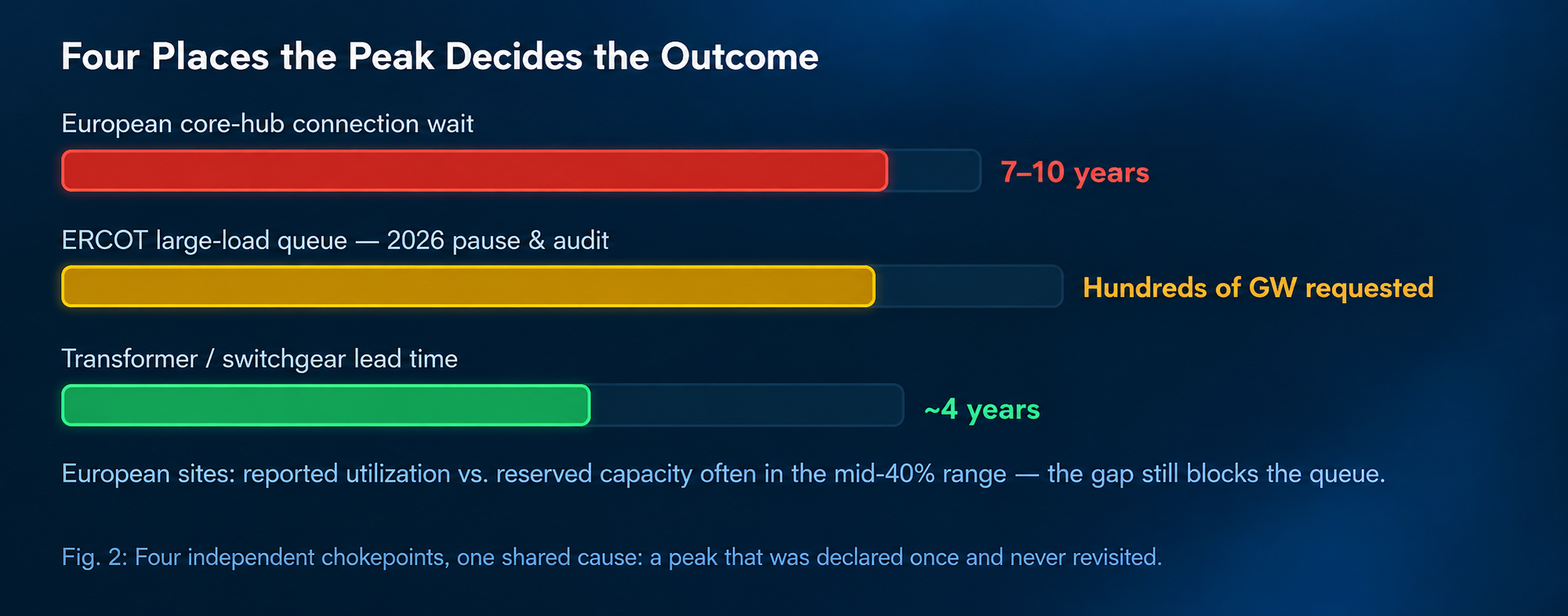
European core hubs cite 7–10 year connection waits.* In Texas, the ERCOT large-load queue — running into the hundreds of gigawatts of requests, the large majority from data centers — triggered a 2026 connection pause and statewide audit ordered by the Governor's office.* Transformer and medium-voltage switchgear lead times have stretched toward four years.*
Connected European data centers have been reported using well under the power they reserved* — yet the reservation itself still blocks everyone behind them in the queue. Projects die on the peak they claim, not the energy they consume.
1. Two Numbers, Only One Decides the Gate
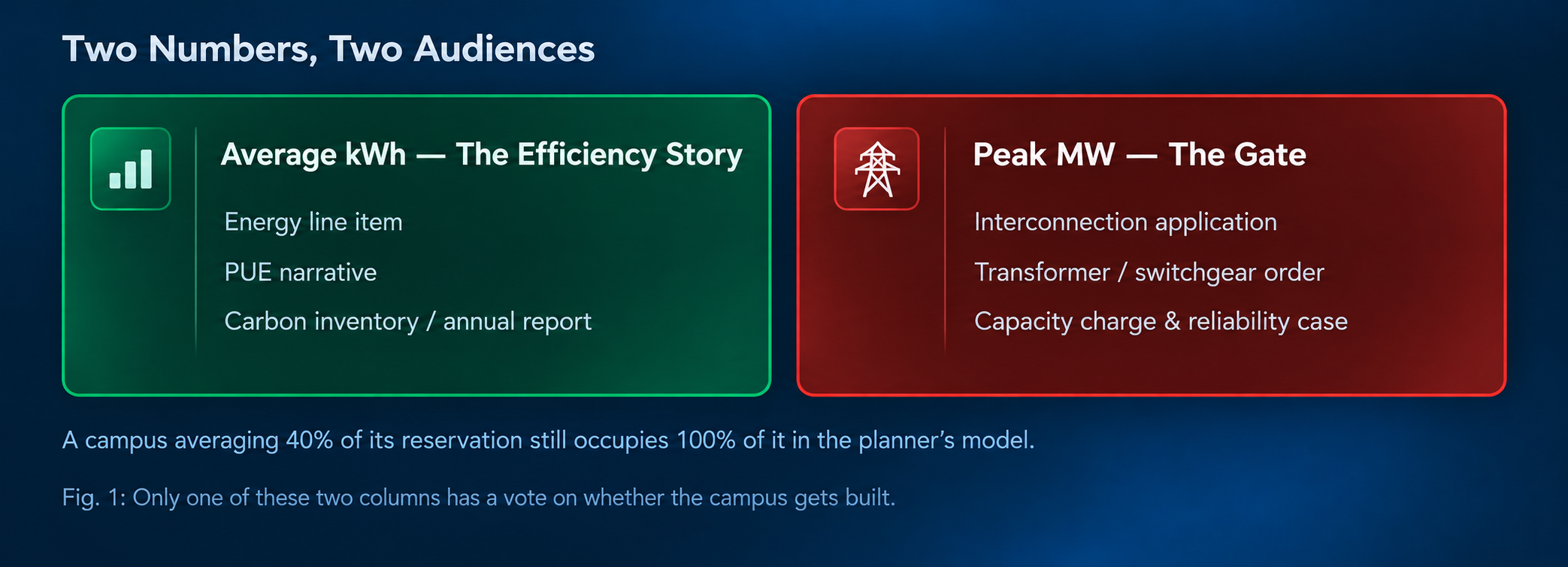
Average kWh drives the story everyone wants to tell. Peak MW drives the decision everyone else has to make.
Average kWh feeds the energy line item, the PUE narrative, and the carbon inventory, the numbers that go on the sustainability slide and into the annual report. Peak MW feeds something else entirely: the interconnection application, the transformer order, the capacity charge, and the neighbor's reliability case. These two numbers are not competing versions of the same fact. They answer different questions for different audiences, and only one of those audiences controls whether the campus gets to exist.
A campus that averages 40% of its reserved load still occupies 100% of that reservation in the planner's model. Efficiency on the first number does nothing to unlock the second, a more efficient campus can still request the same peak, wait in the same queue, and sterilize the same capacity for the project behind it.
👉 Key Insight
PUE optimizes the invoice. Peak MW decides whether the campus is allowed to exist.
2. Where Peaks Kill Data-Center Projects
None of the places a data-center project actually dies have anything to do with annual consumption. All of them have to do with the one interval the system cannot avoid seeing.
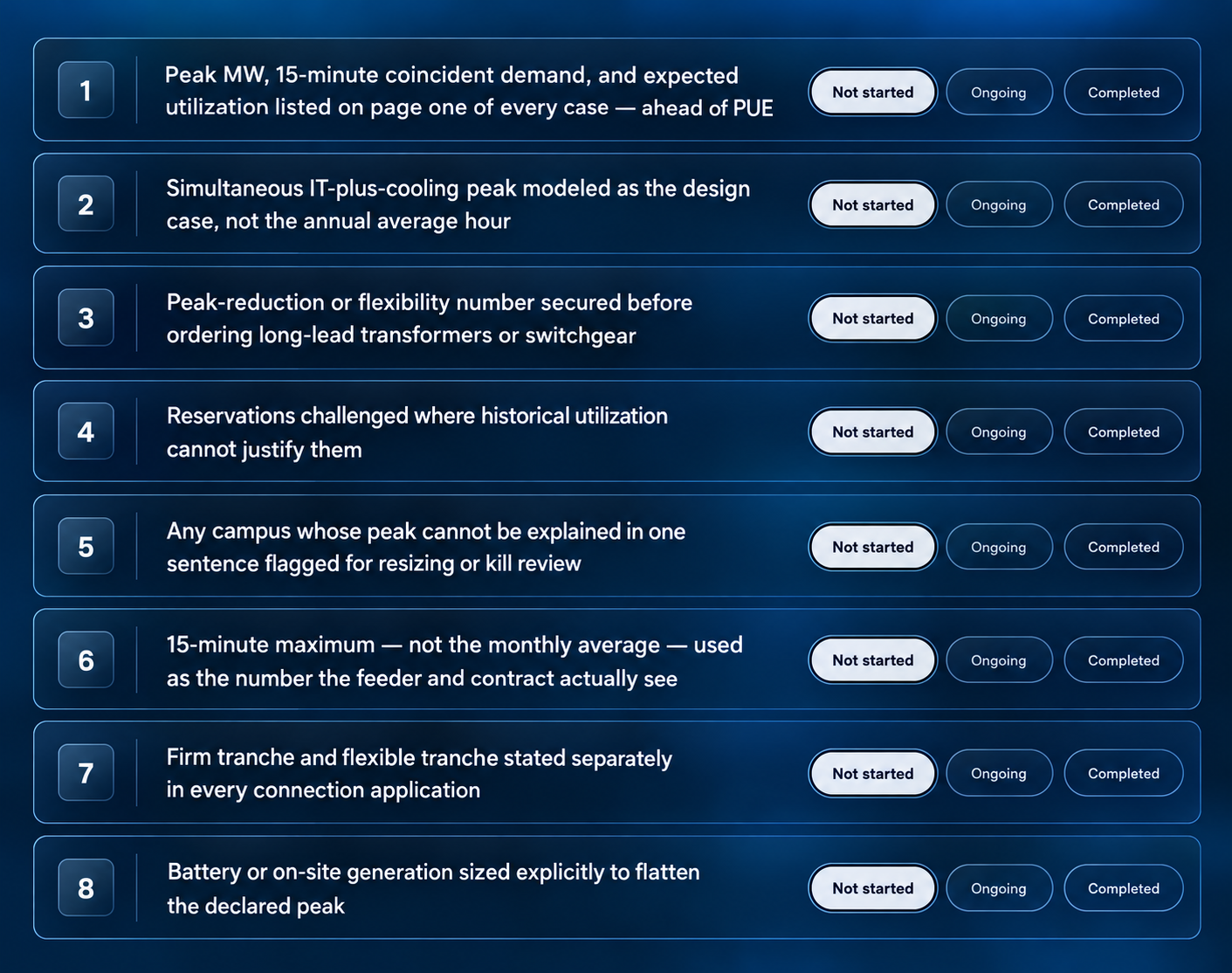
Connection queues are MW queues: the 7–10 year waits cited by several European hubs, and the hundreds-of-gigawatts large-load queue that triggered Texas's 2026 ERCOT connection pause and statewide audit, are both triggered by requested peak, not by expected annual kWh. Equipment is ordered to match that same peak, large power transformers and medium-voltage switchgear now carry lead times stretching toward four years, specified to the highest simultaneous draw across IT and cooling, not the average hour. Sites that reserve far more than they use still sterilize capacity for every project behind them in the queue; reported utilization well below reservation is common enough on European sites to be a planning problem, not an anecdote. All of it lands in the same 15-minute interval, IT load, cooling, and any on-site charging or edge clusters coincide, and it is that interval, not the monthly average, that the feeder and the contract actually see. Even after connection, capacity charges and emergency curtailment actions key off exactly this behavior: a site that cannot drop is planned as firm, and firm is precisely what the queue is short of.
👉 Key Insight
A campus that reserves more than it uses isn't being cautious. It is sterilizing capacity that someone else's project needed to clear the same queue.
3. What Changes the Peak Without Killing the SLA
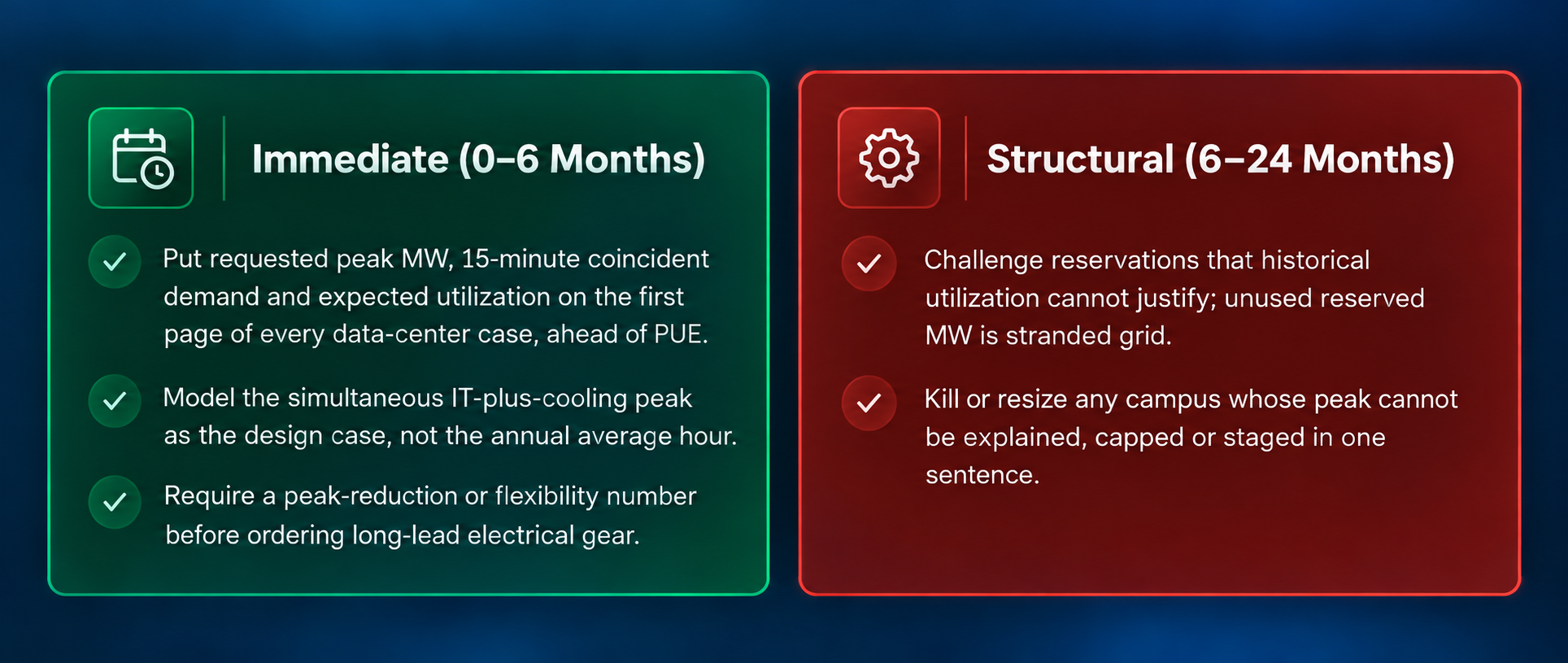
None of this requires promising less compute. It requires declaring, in advance, which 15 minutes you are actually planning for.
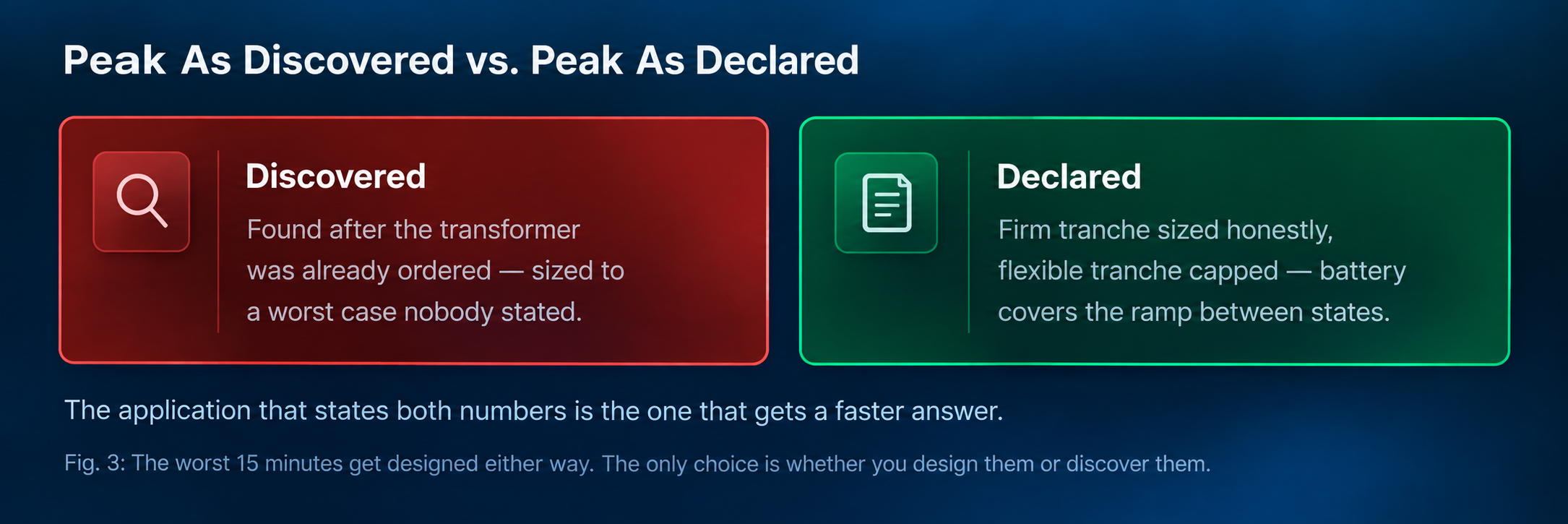
Workload orchestration that caps or shifts non-urgent jobs removes load from exactly the interval that matters, not from the annual total. Cooling strategies that do not ramp in lockstep with IT prevent the two biggest draws on site from stacking into one coincident spike. A declared firm tranche sized honestly, paired with a flexible tranche the orchestration layer can actually move, gives planners something to size equipment against that isn't "assume the worst, always." Batteries cover the ramp between states so the grid sees a flatter request rather than a cliff.
The connection application itself changes shape: instead of a single nameplate number, it states both the absolute peak and the peak the operator can actually hold under a flexibility clause. That second number is the one that gets a faster answer.
👉 Key Insight
The data center that gets power is the one whose worst 15 minutes were designed and declared – not discovered after the transformer was ordered.
Action Plan for Decision Makers
Checklist
Final Thought
Part I showed that flexibility is now the price of a faster connection. Part II shows the number flexibility is actually bidding against: peak MW, not average kWh, decides whether the campus is allowed to exist at all. Both numbers, the flexible megawatts promised and the peak megawatts declared, are forecasts of how a campus will behave under stress it hasn't faced yet. Part III of this Week 42 set turns to the discipline for making exactly that kind of forecast without fooling yourself.
Efficiency Before Energy means the connection that gets approved is the one whose worst fifteen minutes were designed on purpose, not the one whose average looked good enough that nobody asked.
Systems don't fail. Decisions do.
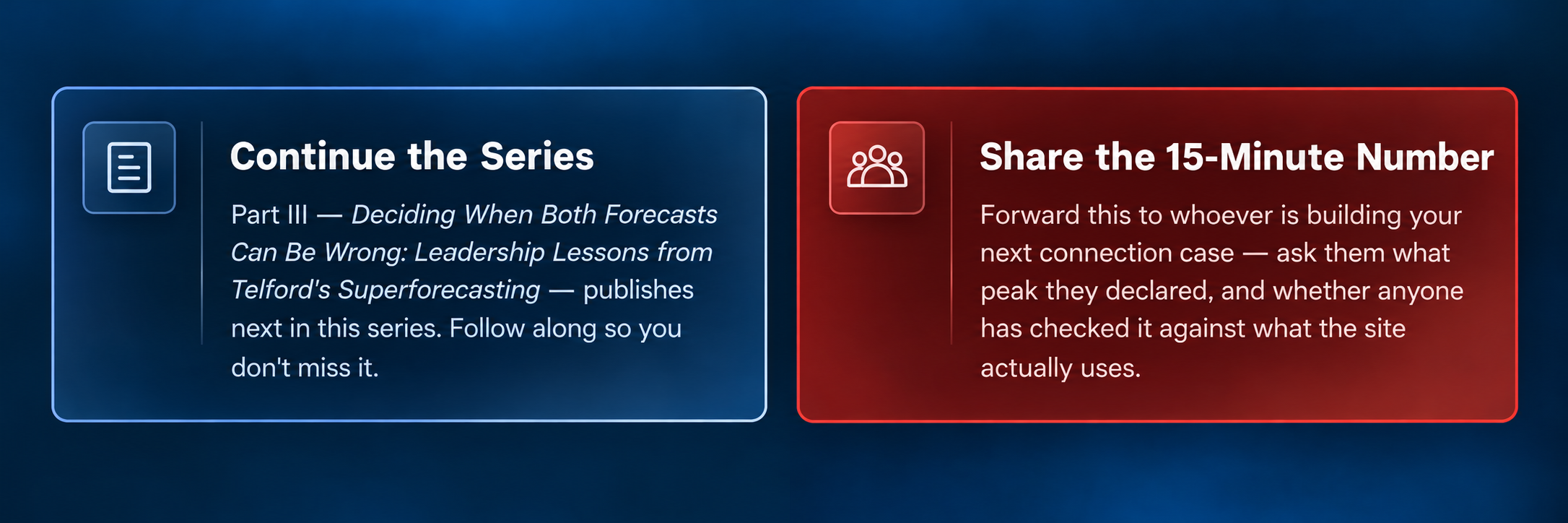
Take the Next Step
Subscribe to the Weekly Punch for weekly strategic clarity, direct to your inbox.
References
Agora Energiewende & Deloitte (2026) Value and Enablers of Data Centre Flexibility in Europe.
Office of the Governor of Texas / ERCOT (2026) Data-Center Interconnection Pause and Statewide Audit.
pv magazine USA (2026) U.S. Transformer Market Faces Severe Supply Constraints as Lead Times Extend to Four Years.
European Data-Center Utilization-versus-Reservation Reporting (2026).
Reuters (2026) Peak-Driven Interconnection Constraints.
Disclaimer: This article synthesizes publicly available industry and regulatory reporting current as of publication. Figures on queues, lead times and utilization evolve as programs and dockets move; readers should verify current figures against the original publications before relying on them for investment or connection decisions. Verification Gate: flagged for pre-publication source check.
Ownership as Design.
Note: This article reflects my personalviews based on industry experience and publicly available information. It does not constitute professional, legal, or investment advice and does not represent the views of my employer. AI-generated visuals, concept and content by the author.
