Why Most Data Center Strategies Fail (and What Leaders Miss)
AI INFRASTRUCTURE | STRATEGY FAILURE | WEEK 20 PART II
The Painful Blind Spots Turning Billion-Dollar AI Bets into Expensive, Avoidable Failures
René Grywnow | May 2026 | Strategic Intelligence Brief
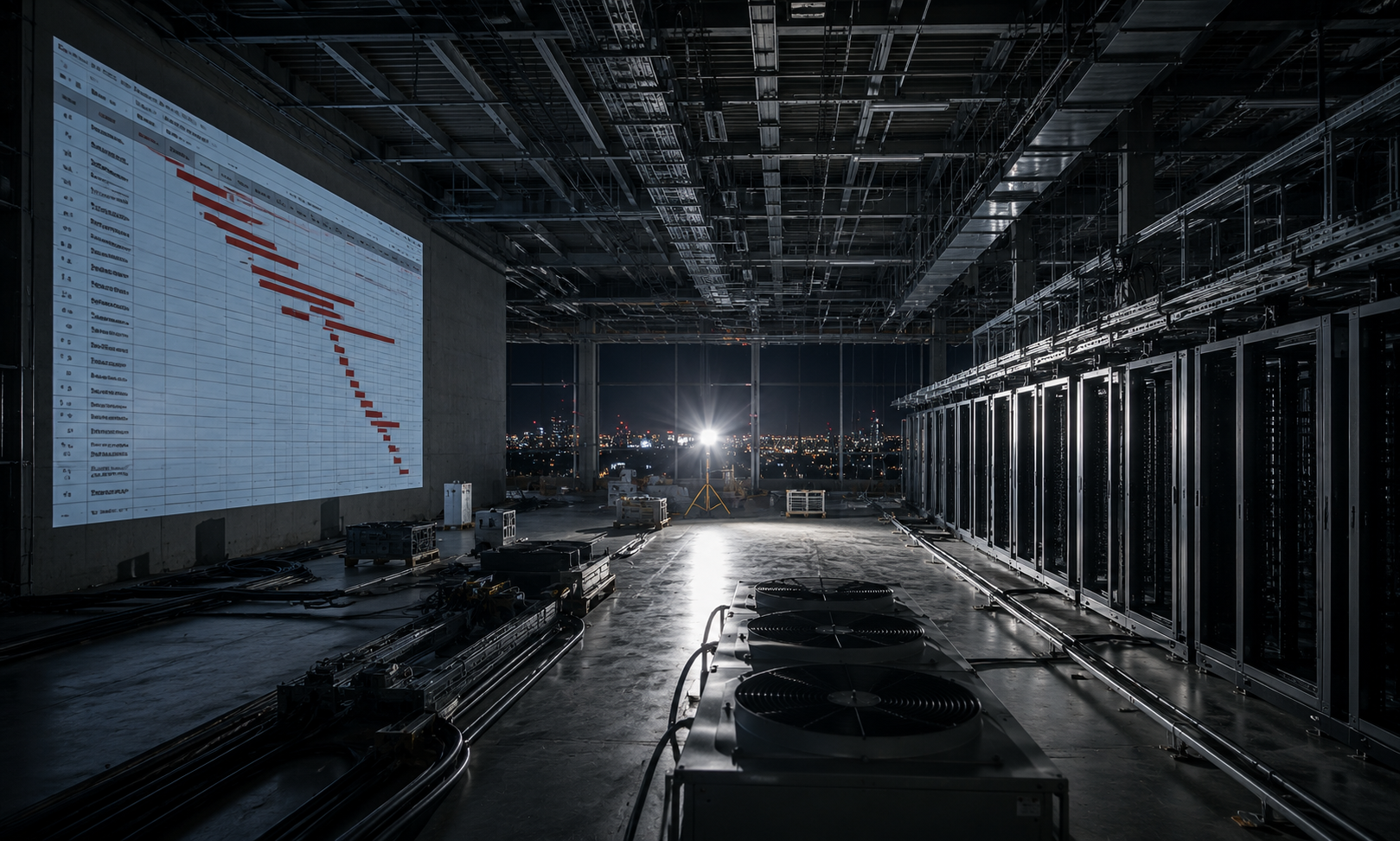
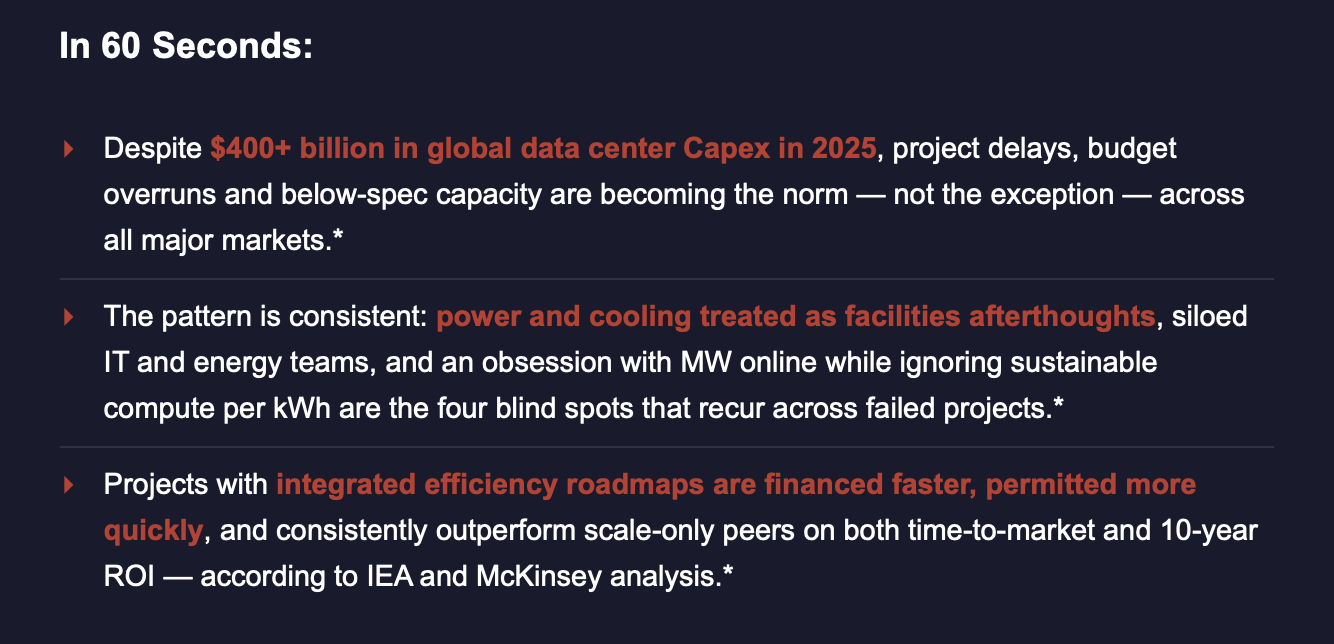
More than $400 billion was committed to data center Capex in 2025 alone, and the number is rising in 2026. Yet a striking and growing proportion of these projects are stalling, running over budget, or delivering AI capacity that underperforms against initial projections by a significant margin. The technology is not failing. The strategy is. And the failure point is almost always the same: leaders who treated power and cooling as facilities management while the real constraint was quietly becoming an existential infrastructure problem.
EXECUTIVE SUMMARY
* All figures cited from referenced sources. Verify against originals before publication.
1. The $400 Billion Problem Nobody Is Talking About Loudly Enough
There is an uncomfortable truth at the centre of the global AI infrastructure build-out: the majority of organisations committing nine and ten-figure Capex to data centers in 2025 and 2026 are doing so without a credible, integrated energy strategy. They have GPU roadmaps. They have rack density targets. They have land secured and permits in process. What they do not have is a coherent answer to the question: how will you reliably deliver power and remove heat at the density your AI workloads actually require, within the grid and timeline constraints that actually exist?
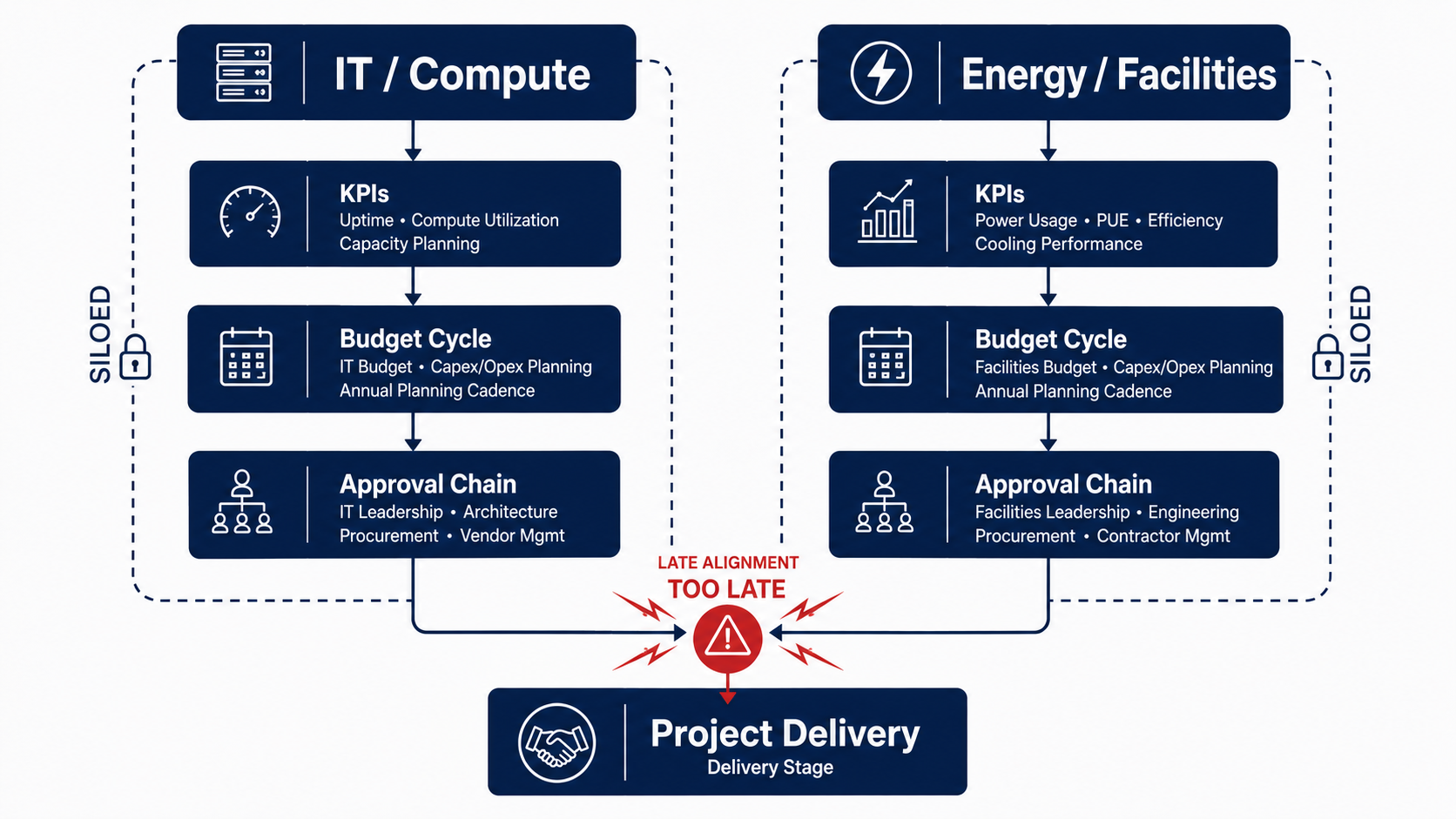
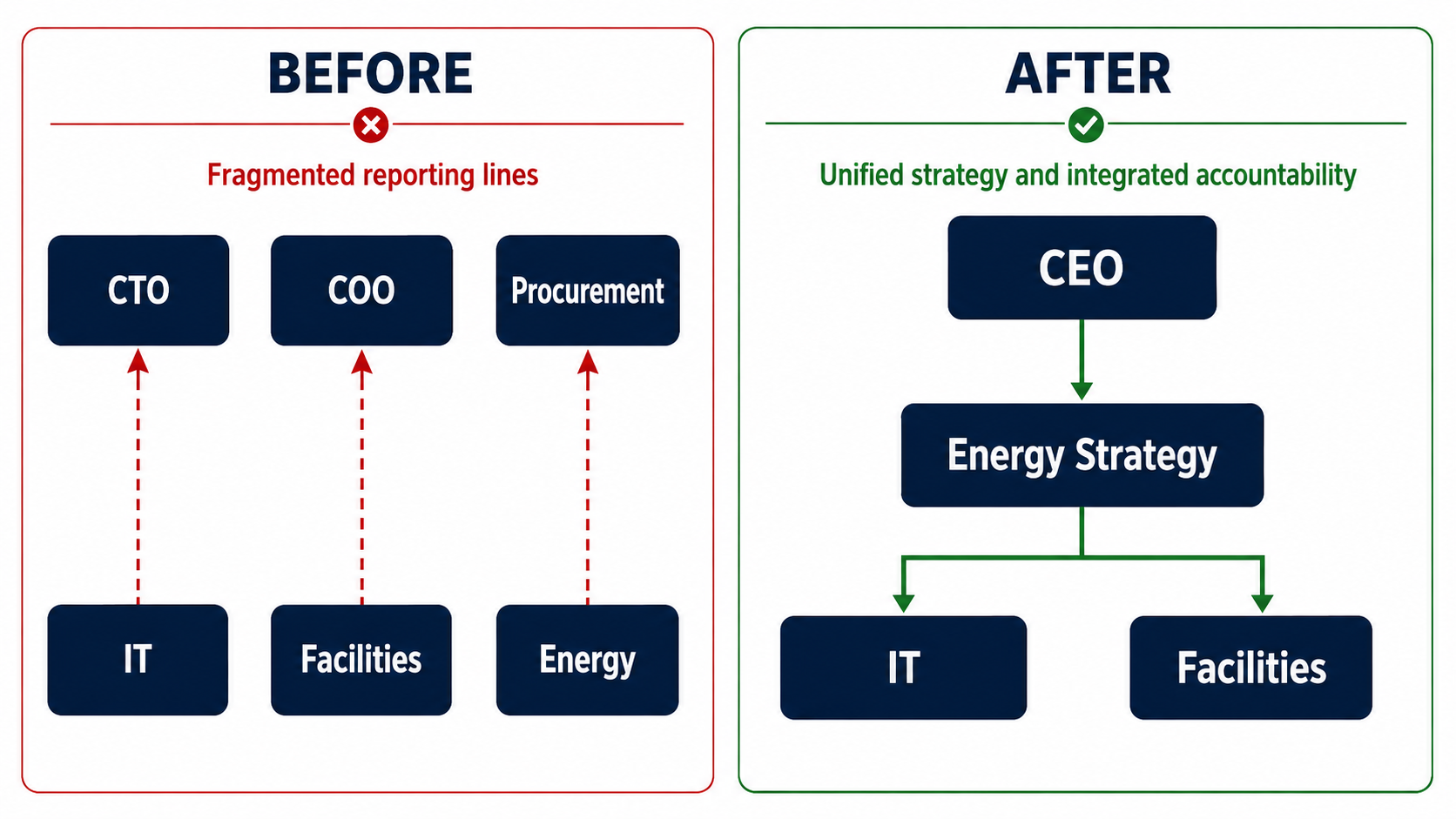
The failure mechanism is structural, not incidental. It begins with the organisational decision, almost universal in legacy infrastructure planning, to separate IT strategy from energy and facilities strategy. When those two functions operate with different reporting lines, different KPIs, and different budget cycles, the result is predictable: IT teams specify compute requirements without regard for power density limits; facilities teams plan cooling without input from workload profiles; and energy procurement makes MW commitments without visibility into utilisation efficiency. Each silo optimises for its own metric. The system as a whole deteriorates.
Wood Mackenzie's project delay analysis from 2025–2026 documents the downstream consequences: interconnection queue backlogs, cooling retrofits mid-construction, and permitting holdups attributable to energy demand projections that regulators no longer accept at face value.*
McKinsey's 2026 data center infrastructure analysis identifies organisational fragmentation between IT and energy strategy as a primary driver of project underperformance, ahead of supply chain disruption, permitting delays, and chip availability as root causes of schedule and budget overruns.*
👉 KEY INSIGHT
The $400 billion Capex commitment does not buy you AI capacity. It buys you the opportunity to deploy AI capacity, an opportunity that the majority of projects are squandering through structural decisions made at the organisational level, before a single server is racked.
2. The Four Blind Spots: Named, Mapped, and Costed
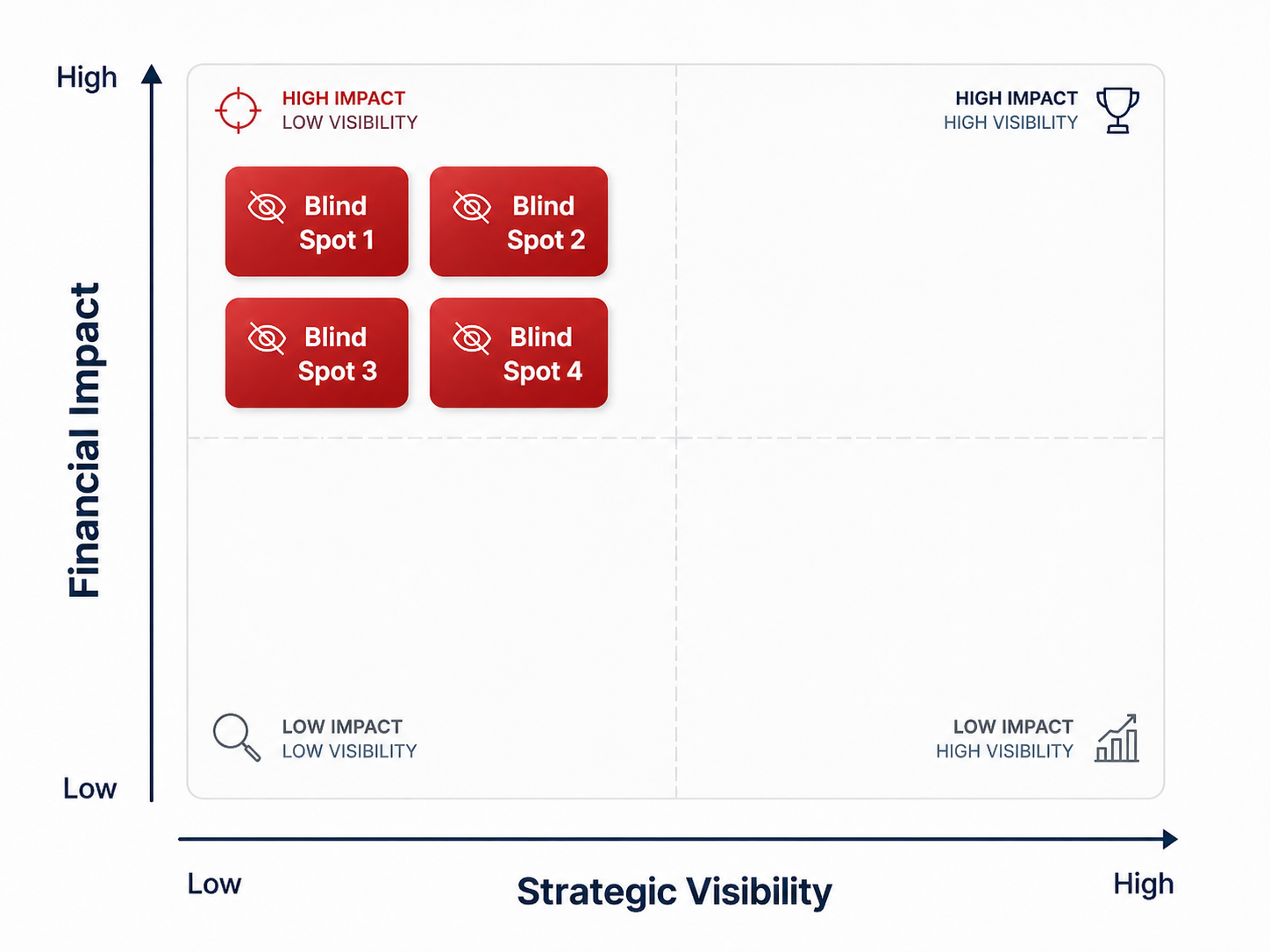
Blind spots are not random. Across the project failures and underperformances that the industry data now documents clearly, four strategic errors appear with remarkable consistency. They are not technically complex. They are organisationally predictable,and that makes them both avoidable and inexcusable.
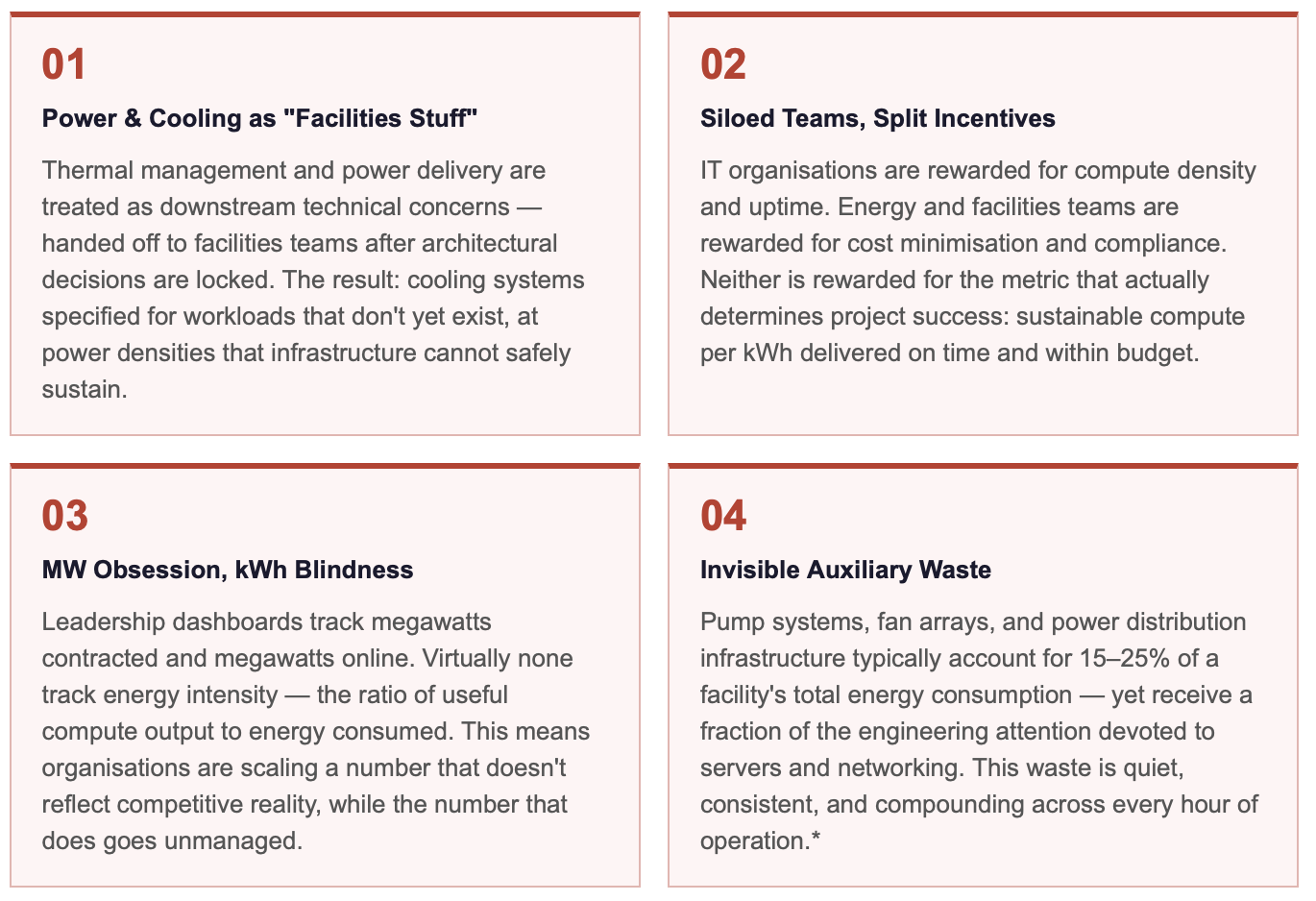
BCG's 2025 data center growth analysis identifies auxiliary system inefficiency, specifically cooling distribution and power conversion losses, as a consistent and systematically underestimated contributor to above-projected operational costs in large-scale AI facilities.*
👉 KEY INSIGHT
None of these blind spots are technical mysteries. They are governance failures, the predictable result of KPI structures, reporting lines, and budget cycles that were designed for a world where energy was cheap, abundant, and strategically irrelevant.
3. The Compounding Cost of Getting This Wrong
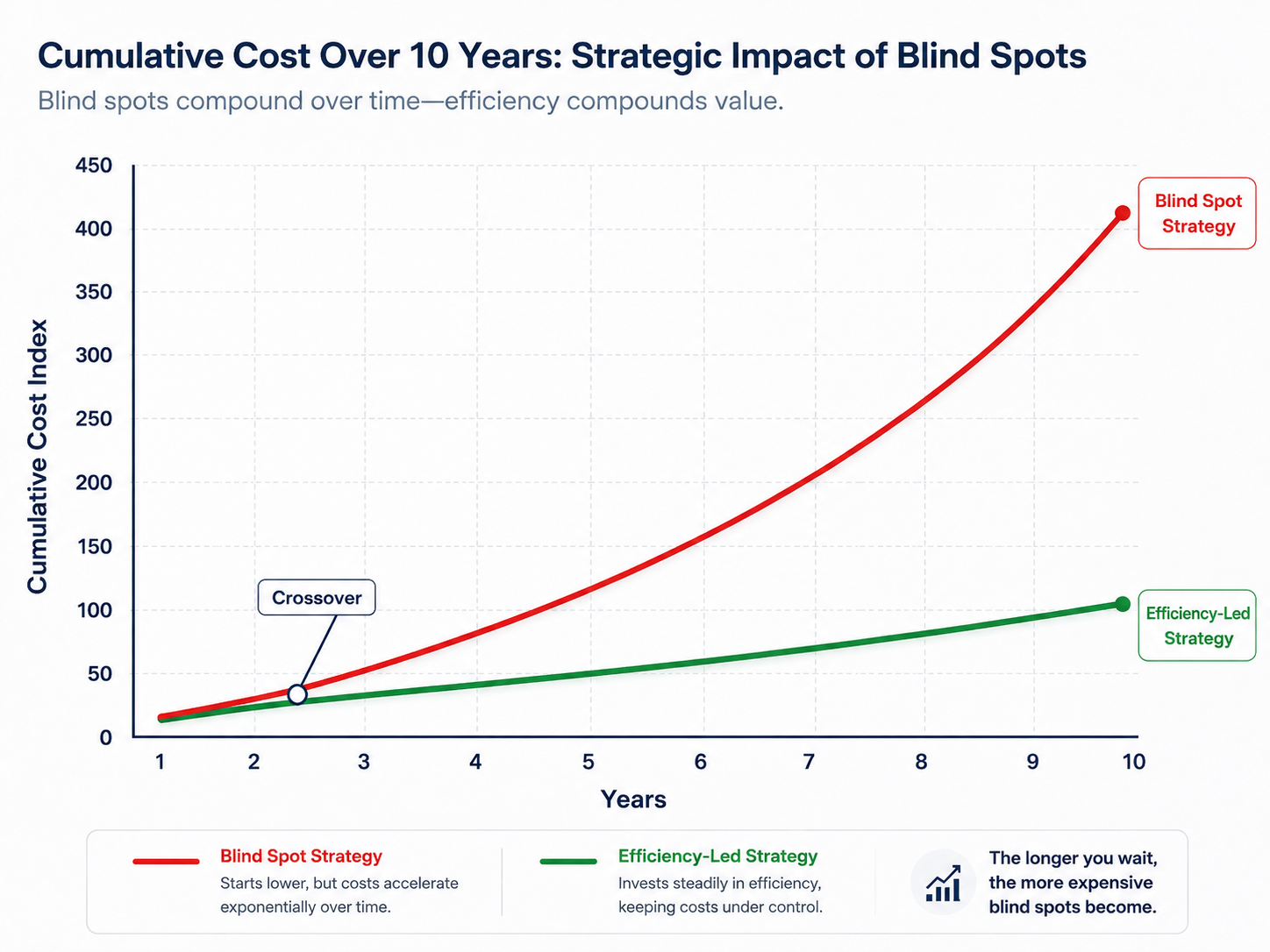
The financial cost of these blind spots does not announce itself in a single quarterly write-down. It compounds, through energy bills that run 20–30% above projection, through cooling retrofit costs that arrive mid-construction, through permitting delays that push go-live dates six to eighteen months, and through stranded Capex in facilities that were designed at power density assumptions the grid cannot support. By the time it is visible on a balance sheet, the competitive window has already closed.
The cost trajectory follows a predictable compounding pattern. A facility that launches with a PUE of 1.6 instead of a target of 1.3 does not just consume more energy, it generates more heat per rack, which strains cooling capacity, which accelerates hardware degradation, which increases replacement cycles, which compounds the original inefficiency across every year of asset life. A single architectural decision, made wrong at the design stage, replicates its consequences every hour for ten years.
Against this, the cost of getting it right is front-loaded and one-time: integrated energy architecture, unified IT and facilities planning, and TCO-based Capex gating. The investments are defined and finite. The savings are continuous.
IEA's April 2026 analysis documents a clear bifurcation between data center projects with formal efficiency roadmaps integrated into Capex approval and those without: the former cohort shows measurably faster permitting timelines, lower financing costs, and higher operational efficiency across comparable asset classes.*
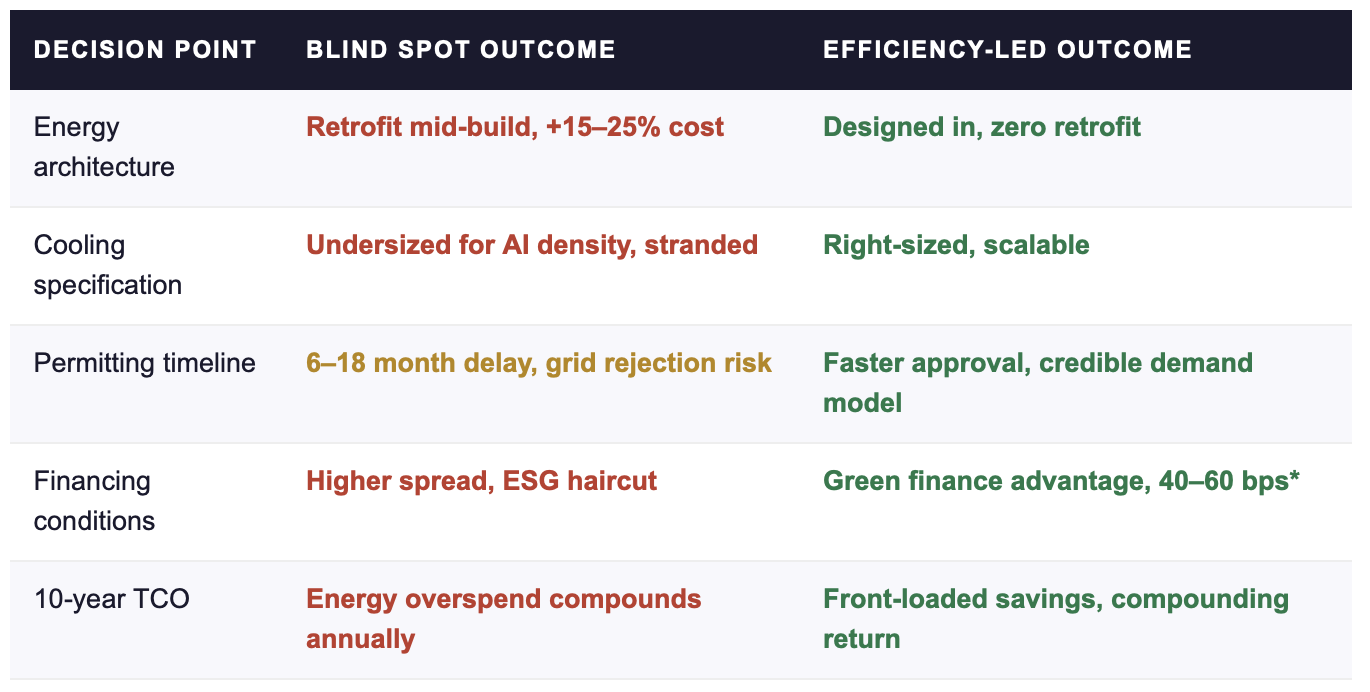
* Verify green finance spread figures against current lender benchmarks before publication.
👉 KEY INSIGHT
The cost of these blind spots is not a one-time budget line. It is a compounding operational tax, paid every hour, on every rack, across every year of the asset's life. The leaders who correct the architecture at the design stage are not just saving money. They are buying time.
4. The Leadership Decision That Changes the Failure Pattern
None of the four blind spots require a technology breakthrough to resolve. They require a governance decision. Specifically: the decision to treat energy architecture as a board-level strategic function rather than a facilities management responsibility. That one shift, moving energy strategy from the third floor to the boardroom, changes every downstream decision in the project chain.
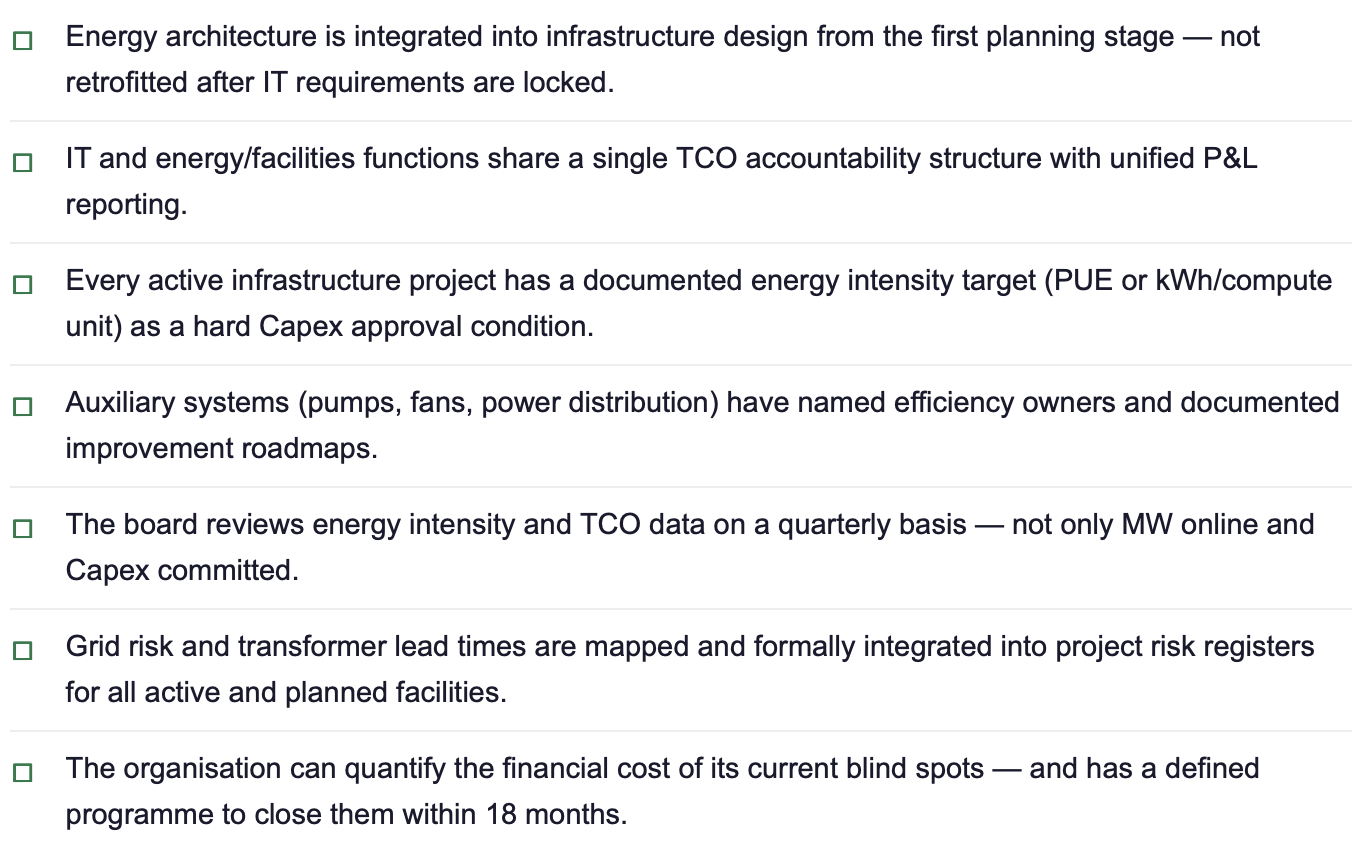
When energy strategy is a board-level mandate, three structural changes follow automatically. First, IT and energy teams are unified under a single P&L accountability, ending the split incentive problem at source. Second, Capex approval requires demonstrated TCO over a defined horizon, not just MW committed, replacing the metric that drives blind spot behaviour with one that rewards integrated thinking. Third, efficiency performance becomes a quarterly governance KPI alongside financial and operational metrics, ensuring that the invisible waste of auxiliary systems gets the same visibility as server utilisation. Governance does not fix engineering. But it creates the conditions under which engineering can fix itself.
McKinsey's 2026 infrastructure analysis identifies board-level energy governance as one of the distinguishing characteristics of the top-quartile performers in data center deployment speed and cost efficiency, not technical differentiation, but organisational design.*
👉 KEY INSIGHT
The organisations getting AI infrastructure right are not smarter than their peers. They are better organised. They decided, at board level, that energy is a strategic function, not a service line. That decision costs nothing to make and changes everything that follows.
Action Recommendations
IMMEDIATE ACTIONS: THIS WEEK
Map your current organisational structure: who owns energy strategy, and at what reporting level? If the answer is "Procurement" or "Facilities," that is the first problem to solve.
Pull the PUE and energy intensity data for your three largest active or planned facilities. If you cannot access that data within 24 hours, your visibility problem is already costing you money.
Identify which active projects have separate IT and energy budget owners. Those are your highest blind spot risk exposures, assess them now, before construction locks decisions in.
Add energy intensity (kWh per unit of compute delivered) as a standing agenda item on your next infrastructure review.
STRATEGIC COMMITMENTS: 6–24 MONTHS
Establish a unified infrastructure mandate, one executive accountable for both IT performance and energy architecture, with a single TCO-based P&L.
Redesign Capex approval gates to require integrated energy architecture review as a condition of proceeding, not as a parallel track that joins the project later.
Commission a full auxiliary system audit across your top facilities: pump systems, fan arrays, and power distribution infrastructure should each have a named efficiency owner and a documented improvement roadmap.
Build a 10-year TCO model for every major facility and present it at board level, not as a finance exercise, but as a strategic risk document.
Benchmark your energy intensity position against sector peers annually, and make the result visible to investors and lenders as part of your infrastructure narrative.
Infrastructure Blind Spot Diagnostic: Board-Level Readiness Check
FINAL THOUGHT
There is no shortage of capital committed to AI infrastructure. There is a shortage of leaders willing to treat energy as a first-order strategic variable rather than a cost to be managed after the real decisions are made. The organisations that will define the AI infrastructure landscape in 2029 are making organisational design decisions right now, not technology bets. The blind spots described here are not unknown. They are simply unaddressed. That gap is a choice.
Take the Next Step
Subscribe to the Weekly Punch for weekly strategic clarity, direct to your inbox.
References
BCG (2025) Breaking Barriers to Data Center Growth. Boston Consulting Group. [Verify full citation and publication date before publication.]
IEA (2026) Key Questions on Energy and AI. International Energy Agency, April. [Verify full URL and page references before publication.]
McKinsey & Company (2026) The $7 Trillion Race for AI Data Center Infrastructure. McKinsey Global Institute, March. [Verify full citation and access date before publication.]
Wood Mackenzie (2025–2026) Data Center Project Delay Analysis. [Verify full report title, date, and access details before publication.]
