Efficiency vs Scale: The Next Battle in AI Infrastructure
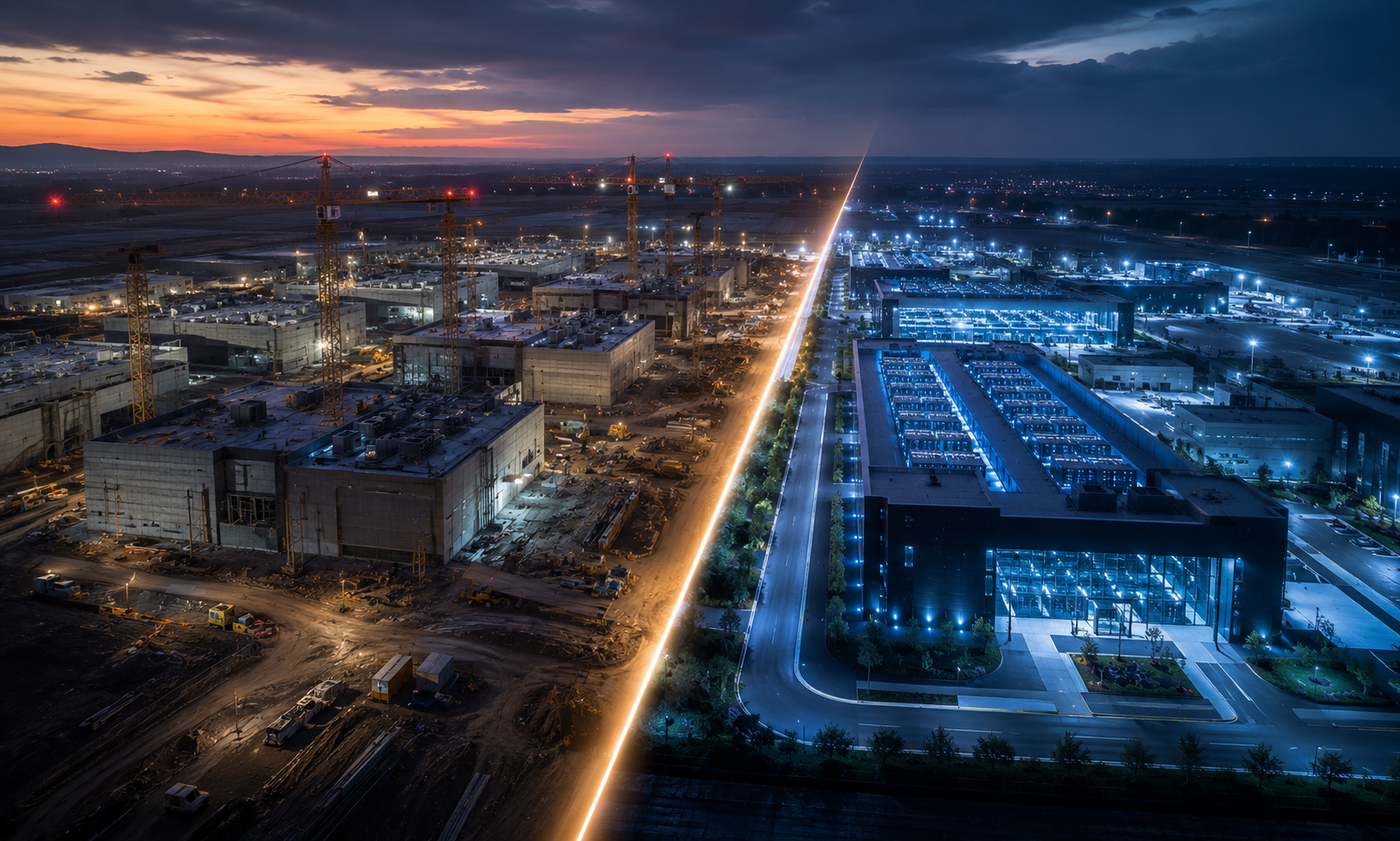
AI INFRASTRUCTURE | EFFICIENCY VS SCALE | WEEK 20 PART I
Why Raw Expansion Alone Will Lose the AI Race in 2026
René Grywnow | May 2026 | Strategic Intelligence Brief
The most dangerous strategy in AI infrastructure right now is not building too little, it is building without thinking. Every major hyperscaler is racing to announce gigawatt-scale campuses, yet a growing share of those projects are stalled, cancelled, or stranded, not because chips are missing, but because the grid isn't there. In 2026, the leaders who win the AI infrastructure race will not be the ones who spent the most. They will be the ones who extracted the most from what they had.
EXECUTIVE SUMMARY
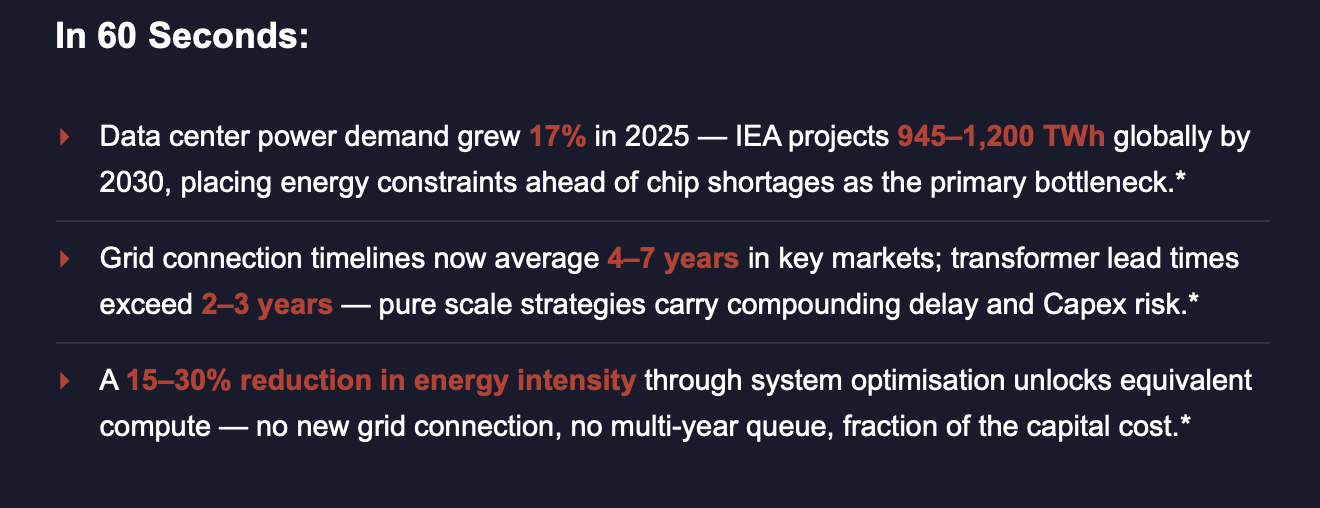
* All figures cited from referenced sources. Verify against originals before publication.
1. The Scale Trap: When More Means Less
Hyperscalers are committing hundreds of billions to Capex. And yet, announced GW-scale campuses are being delayed, redesigned, or quietly shelved, not because ambition faltered, but because the grid did. Raw power is no longer a freely available input. It is a scarce, rationed resource with queues measured in years, not months.
The larger a planned facility, the earlier it must secure grid access, and the longer it waits in a connection queue already congested by competing industrial and energy transition demands. Transformer shortages compound this further, with lead times beyond 2–3 years in major markets. More money does not buy a faster grid.
The IEA's April 2026 report projects global data center electricity demand reaching 945–1,200 TWh by 2030. McKinsey's March 2026 analysis explicitly identifies grid constraints and transformer shortages as the critical path bottleneck, not chip availability.*
👉 KEY INSIGHT
Scale strategies are not failing because of financial limits, they are failing because of physical ones. Every watt unlocked through efficiency requires no grid connection, no transformer, and no five-year queue.
2. Efficiency as Force Multiplier
"Efficiency" is routinely misunderstood in infrastructure discussions, treated as a cost-reduction metric, something the finance department cares about after the strategic decisions are made. In the current AI infrastructure landscape, efficiency is not an operational afterthought. It is a deployment accelerator, a risk hedge, and a competitive moat in one.
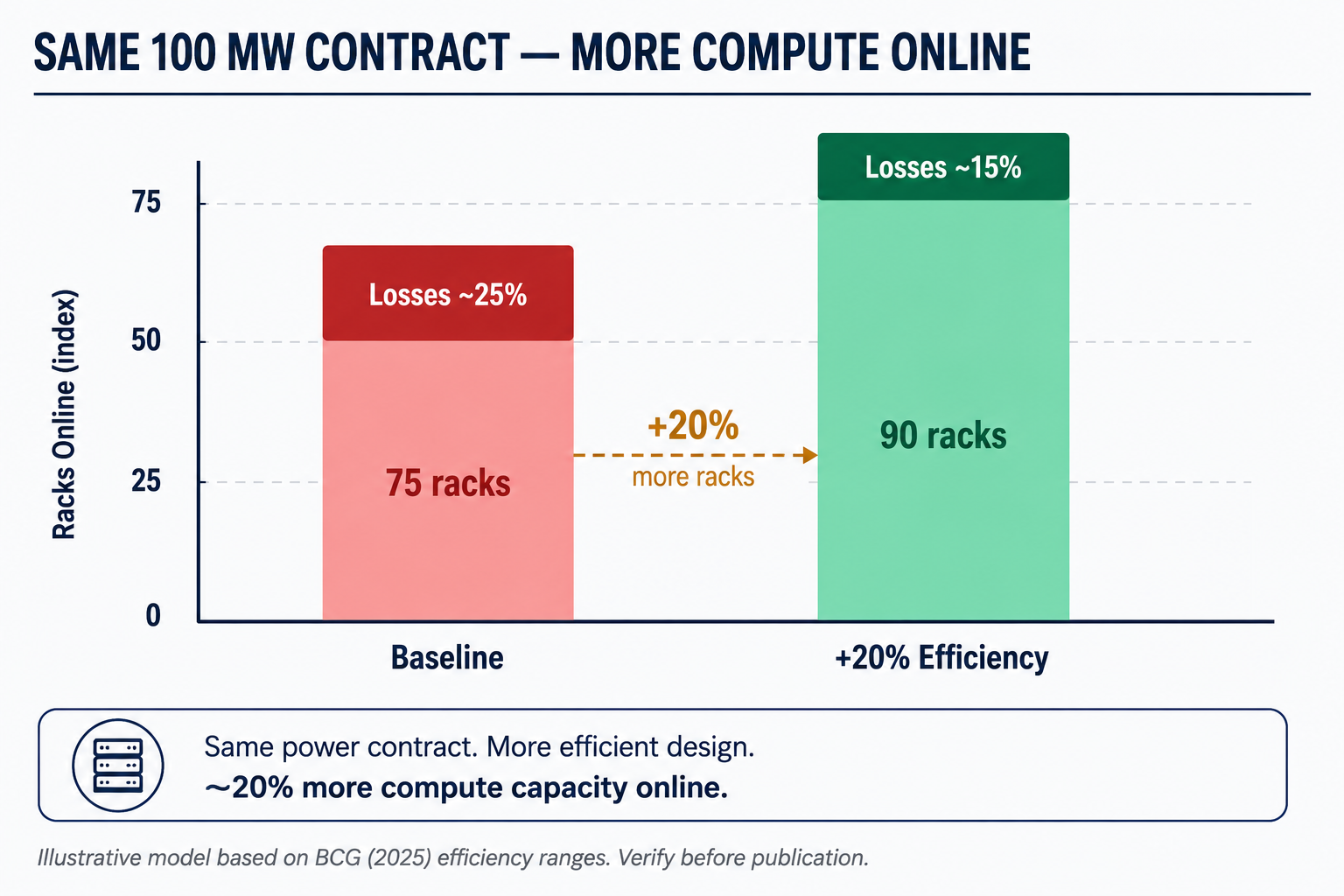
System-level optimisation, cooling architecture, server utilisation rates, power delivery losses, workload scheduling, can reduce energy intensity per unit of compute by 15–30%.* A 20% improvement means 20% more racks online per MW of contracted power, today, without waiting for new infrastructure, without renegotiating grid access.
BCG's 2025 analysis "Breaking Barriers to Data Center Growth" identifies system-level thermal and power management as the highest-leverage intervention available under grid-constrained conditions.*
👉 KEY INSIGHT
Efficiency investment does not reduce scale. It multiplies it, extracting more usable compute from every MW of contracted power, without touching the grid queue, the transformer lead time, or Capex for new land.
3. Two Paths in 2026:One Leads to Stranded Assets
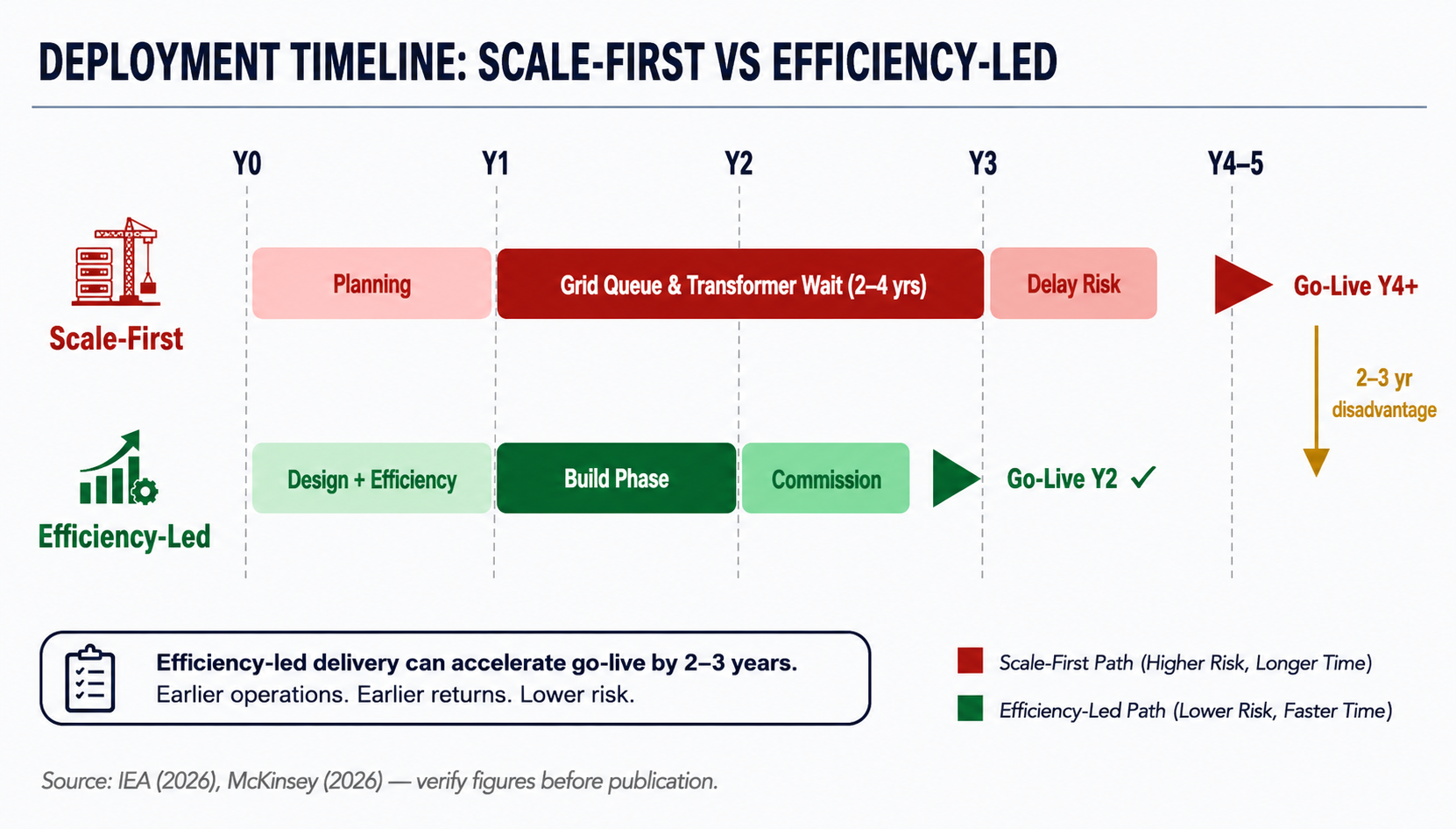
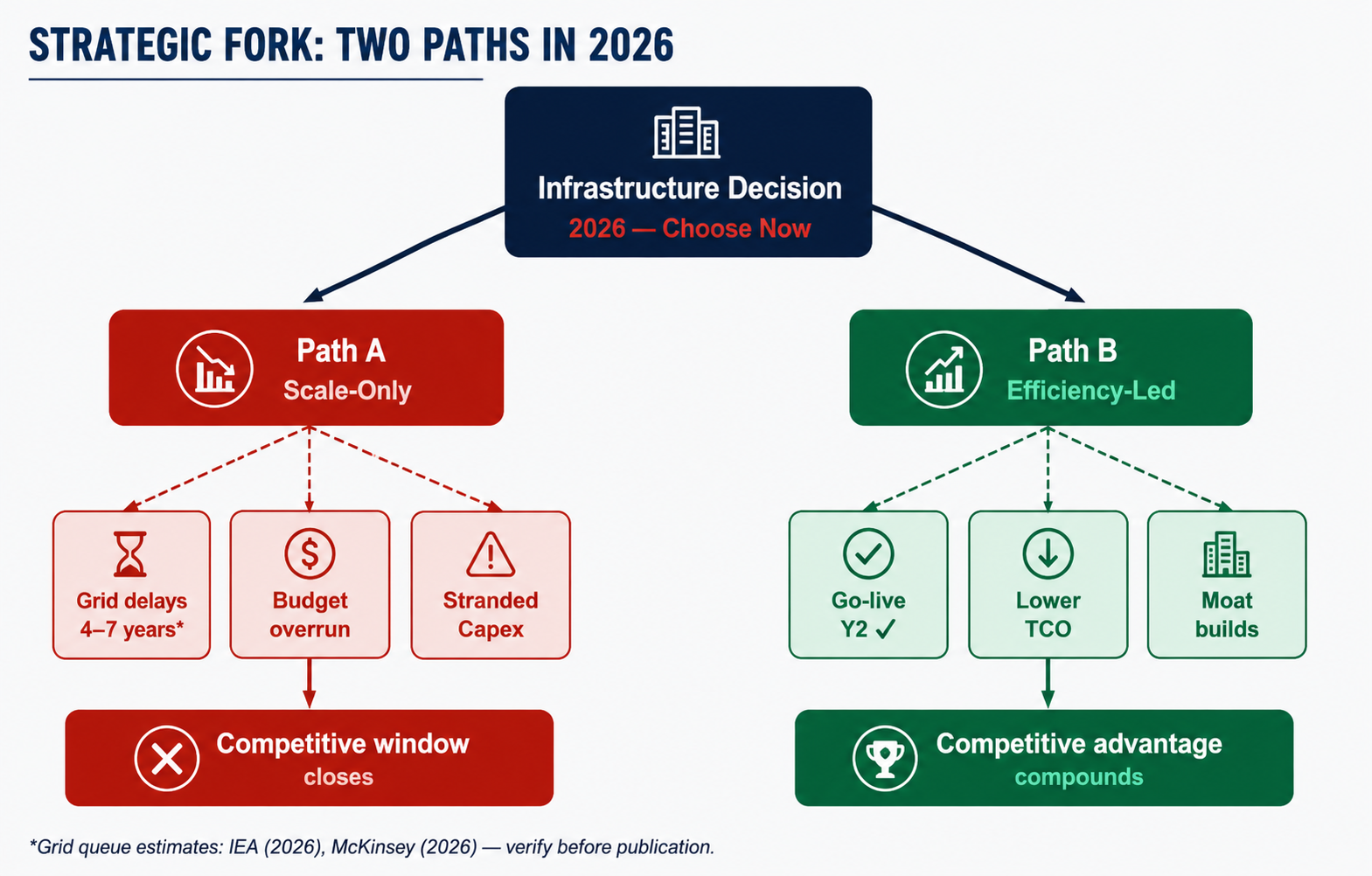
Every infrastructure decision made today is a bet on one of two futures. The distinction is not between "build big" and "build small." It is between leaders who treat energy as a scarce strategic input and those who still treat it as a utility cost to be managed by procurement.
Path A: Scale-Only: High Capex commitments, facilities designed for peak power assumptions no grid can reliably deliver, long lead times in the critical path, growing stranded asset risk as regulatory environments tighten.
Path B: Efficiency-Led Dominance: Infrastructure optimised from day one for energy intensity per unit of compute. Faster deployment. Lower grid constraint exposure. Superior operating margins. And a structural advantage that compounds.
McKinsey's 2026 infrastructure analysis documents divergence between facilities with mature energy efficiency programmes and scale-first operations, with the efficiency cohort achieving materially faster deployment and lower all-in cost per unit of compute capacity.*
👉 KEY INSIGHT
Stranded assets are not a failure of ambition. They are a failure of assumption, that energy supply constraints are temporary inconveniences rather than structural features of the 2026 infrastructure landscape.
4. The CEO Decision That Defines the Next Three Years
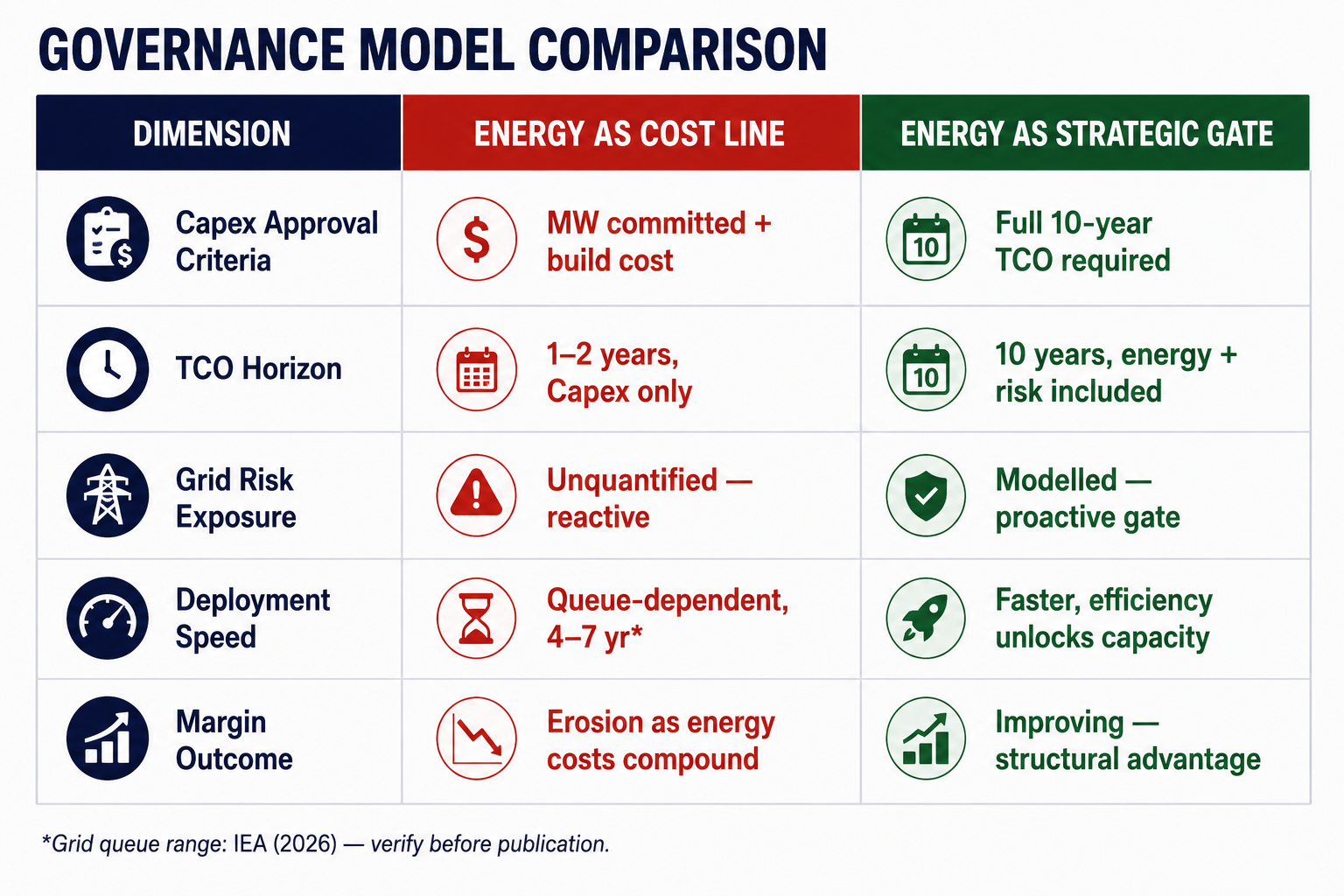
This is not an engineering question. It is a governance question. The decision to treat energy efficiency as a Capex gate, rather than a post-deployment optimisation target, is a CEO-level choice. Organisations that have not made it are accumulating risk with every new project approval.
When energy efficiency is a Capex gate, every new infrastructure investment must demonstrate, before approval, what its total cost of ownership looks like over a 10-year horizon, including energy costs, grid risk exposure, and the cost of capacity delays attributable to power constraints. TCO replaces MW as the primary unit of infrastructure evaluation.
The IEA's April 2026 analysis underscores that organisations with established governance frameworks for energy-aware infrastructure decision-making are systematically better positioned to navigate grid constraint environments.*
👉 KEY INSIGHT
If energy efficiency is not a condition of Capex approval, it will never be a genuine strategic priority. The gate has to move upstream, or the problem stays downstream forever.
Action Recommendations
IMMEDIATE ACTIONS: THIS WEEK
Audit every active infrastructure project: does the approval documentation include a full 10-year TCO with energy costs and grid risk exposure quantified?
Identify your three highest-power-draw facilities and commission a rapid energy intensity benchmark against comparable operations.
Brief your CFO: grid constraint delay risk is a financial exposure that belongs in capital planning, not just in the engineering backlog.
Define a single, non-negotiable efficiency metric (e.g. PUE target, energy intensity per rack) as a go/no-go Capex gate from this month forward.
STRATEGIC COMMITMENTS: 6–24 MONTHS
Redesign infrastructure procurement to require full system-level energy optimisation as a contract condition, not a vendor option.
Build energy grid risk into your strategic scenario planning, model the impact of 2–3 year grid delays on competitive position and revenue timeline.
Invest in cooling and power delivery architecture review across all planned facilities before permits are submitted.
Establish an internal Efficiency Council at C-suite level with mandate over Capex energy criteria and lifecycle performance accountability.
Develop a competitive moat narrative around your efficiency position, procurement differentiator, capital markets story, and talent argument simultaneously.
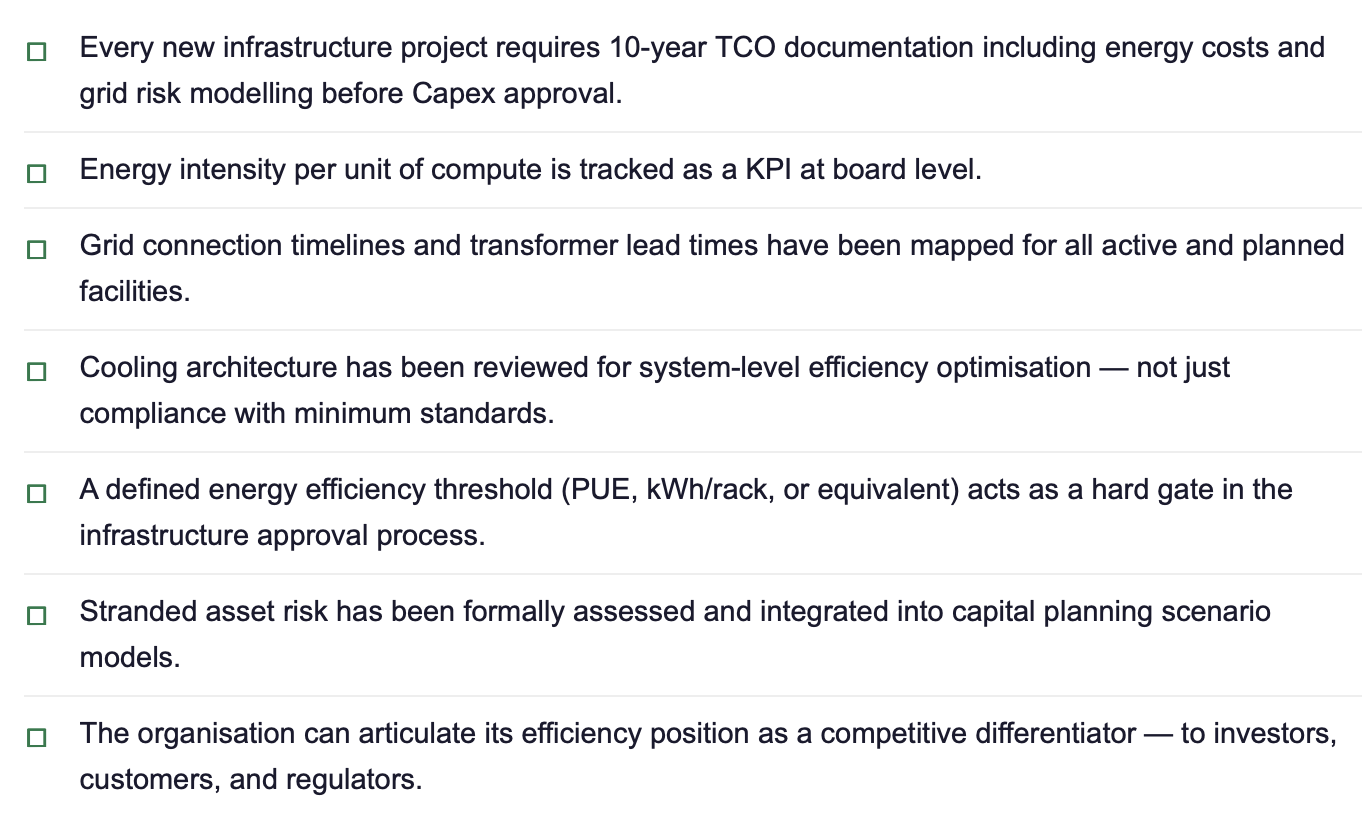
CEO Infrastructure Readiness Checklist: Efficiency-Led AI Deployment
FINAL THOUGHT
The grid does not care about your Capex budget. It does not respond to urgency. It does not accelerate for competitive timelines. Every organisation that treats efficiency as an afterthought is outsourcing its competitive fate to an infrastructure bottleneck it cannot control. The leaders who win the AI infrastructure race in 2026 will not be the ones who built the most, they will be the ones who built the smartest. That decision is made now, at the Capex gate, before the concrete is poured.
Take the Next Step
Subscribe to the Weekly Punch for weekly strategic clarity, direct to your inbox.
References
BCG (2025) Breaking Barriers to Data Center Growth. Boston Consulting Group. [Verify full citation and publication date before publication.]
IEA (2026) Key Questions on Energy and AI. International Energy Agency, April. [Verify full URL and page references before publication.]
McKinsey & Company (2026) The $7 Trillion Race for AI Data Center Infrastructure. McKinsey Global Institute, March. [Verify full citation before publication.]
