PRODUCT LIABILITY | AUTONOMOUS EQUIPMENT | NOVEMBER 2026 | Week 47 · Part I
From 9 December 2026, Software and AI Are Products. Strict Liability, Disclosure Orders and Presumptions Shift the Burden, and the Board Is Still Treating It as a Legal Memo
In December, the software inside autonomous equipment becomes a product in EU law. Most boards have filed that under "legal."
The revised Product Liability Directive does not ask whether the AI was careful. It asks whether the product was defective, and who can prove otherwise. That is not a contract question. It is a question about evidence, updates and ownership, and it is the one boards still avoid.
Executive Summary
IN 60 SECONDS:
Member States must transpose the revised Product Liability Directive (EU) 2024/2853 by 9 December 2026; it applies to products placed on the market or put into service after that date. Software and AI systems are products – embedded, cloud-based or SaaS – and manufacturers face strict, no-fault liability for death, personal injury, damage to private property and destruction of private data, without a cap.*
Courts can order disclosure of internal evidence, and defectiveness and causation can be presumed – for example where evidence is withheld, or where technical complexity, particularly relevant for AI, makes proof excessively difficult for the claimant. Cybersecurity failures, post-sale learning and failure to supply necessary updates all enter the defect analysis.*
Products placed on the market before the date stay under the old regime. Boards that treat autonomous-equipment liability as "the lawyers will handle the contract" are avoiding a question the Directive has already answered: the learning system is the product, and the manufacturer is on the hook.
1. What Changed on 9 December 2026
The Directive moves liability from fault to defect, and the burden from the claimant's proof to the manufacturer's evidence.
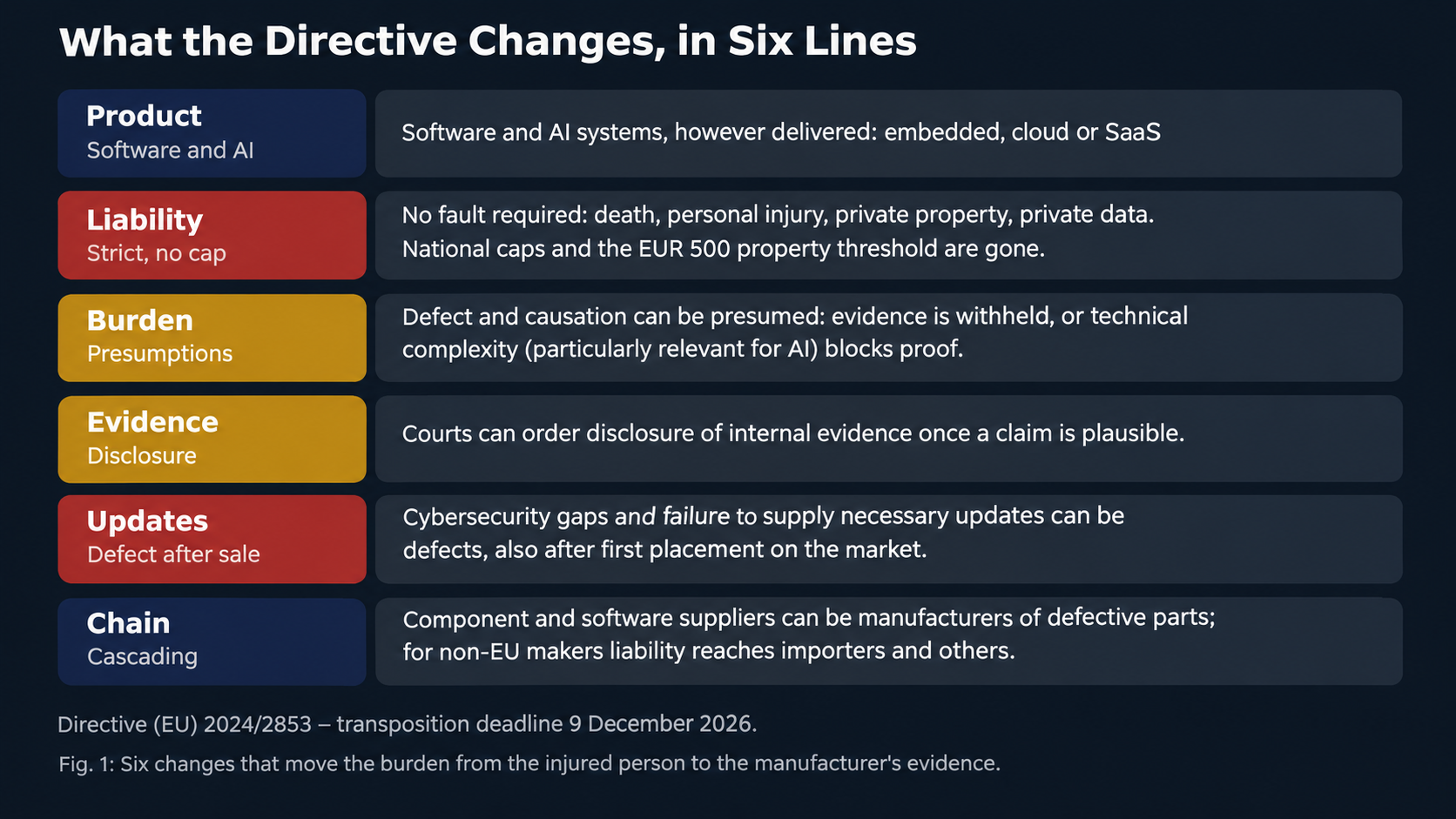
The product definition covers software and AI systems however delivered. Liability is strict, no fault is required, for death and personal injury (including medically recognised psychological harm), damage to private property and destruction or corruption of private data, and it is no longer capped.* Cybersecurity vulnerabilities and a failure to supply necessary updates can themselves constitute defects, including after first placement on the market.
The procedural shift matters as much. Courts can order disclosure of relevant evidence once a claim is plausible, and presumptions ease the claimant's burden on technically complex products.* Liability also cascades: component and software suppliers can be manufacturers of defective parts, and for non-EU manufacturers it reaches importers, authorised representatives and others. Products already on the market before the date stay under the old regime, unless a substantial modification or update after it brings them into scope.
👉 Key Insight
The Directive does not ask whether the AI was careful. It asks whether the product was defective when it caused the harm.
2. Where Autonomous Equipment Is Exposed
Exposure sits where the product keeps changing after the sale.
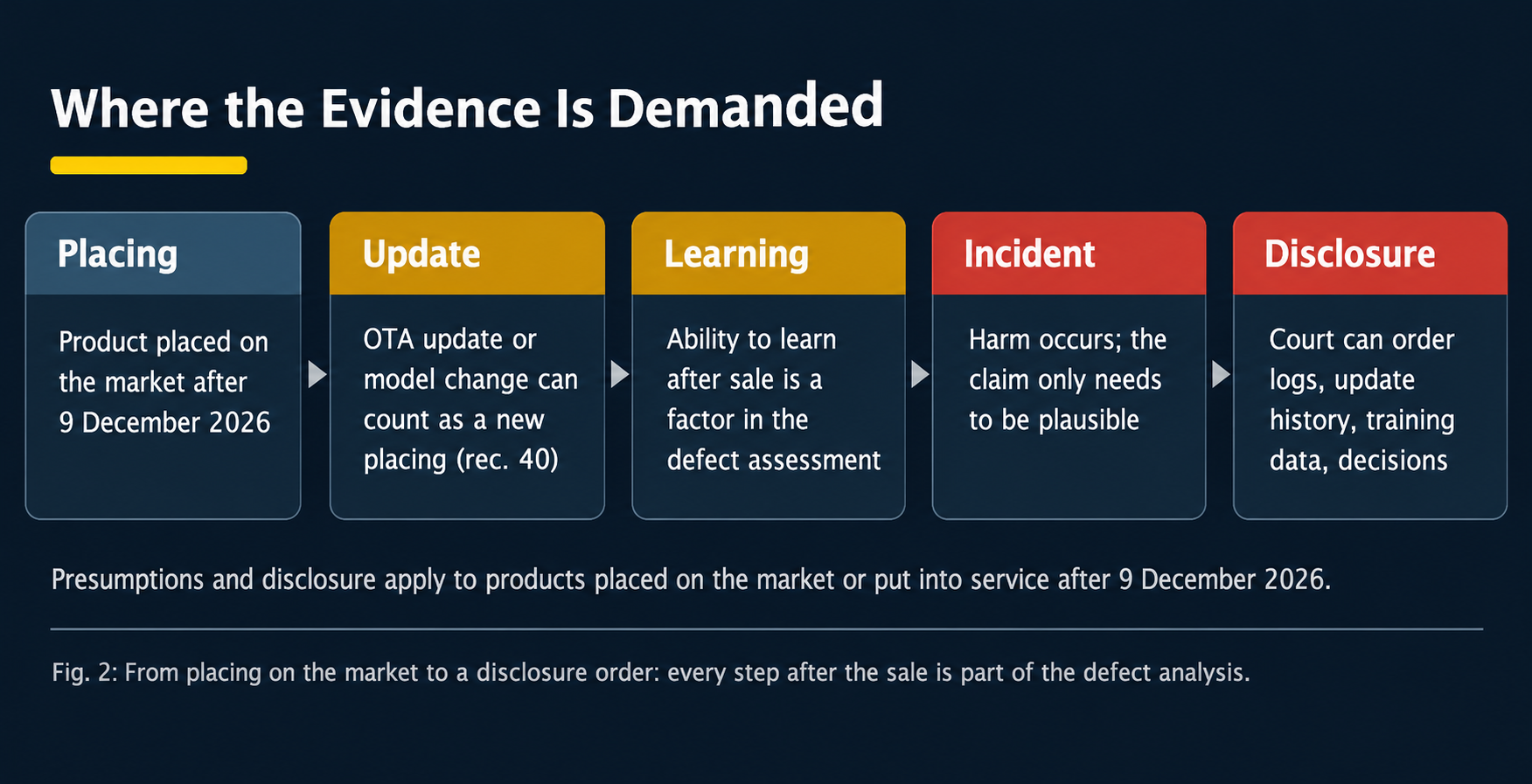
Physical AI and robotics – collaborative robots, mobile systems, service robots – behave adaptively after sale. Over-the-air updates can introduce or fail to fix defects, and missing security patches can be defects of their own. The Directive lists a product's ability to continue to learn after placement on the market among the factors for assessing defectiveness, and a substantial modification through a software update or continuous learning is treated as a new placing on the market (recital 40).*
An integrator who substantially modifies the product or changes its intended purpose can become the manufacturer. The AI Omnibus realignment, which made the Machinery Regulation the primary compliance path for industrial machinery, does not remove this liability layer: the product-safety path and the liability regime run side by side.
👉 Key Insight
A policy PDF and a conformity file do not answer a disclosure order for the training data, the update log or the decision record.
3. The Question Boards Avoid
Three questions decide who pays. Most boards have assigned none of them.
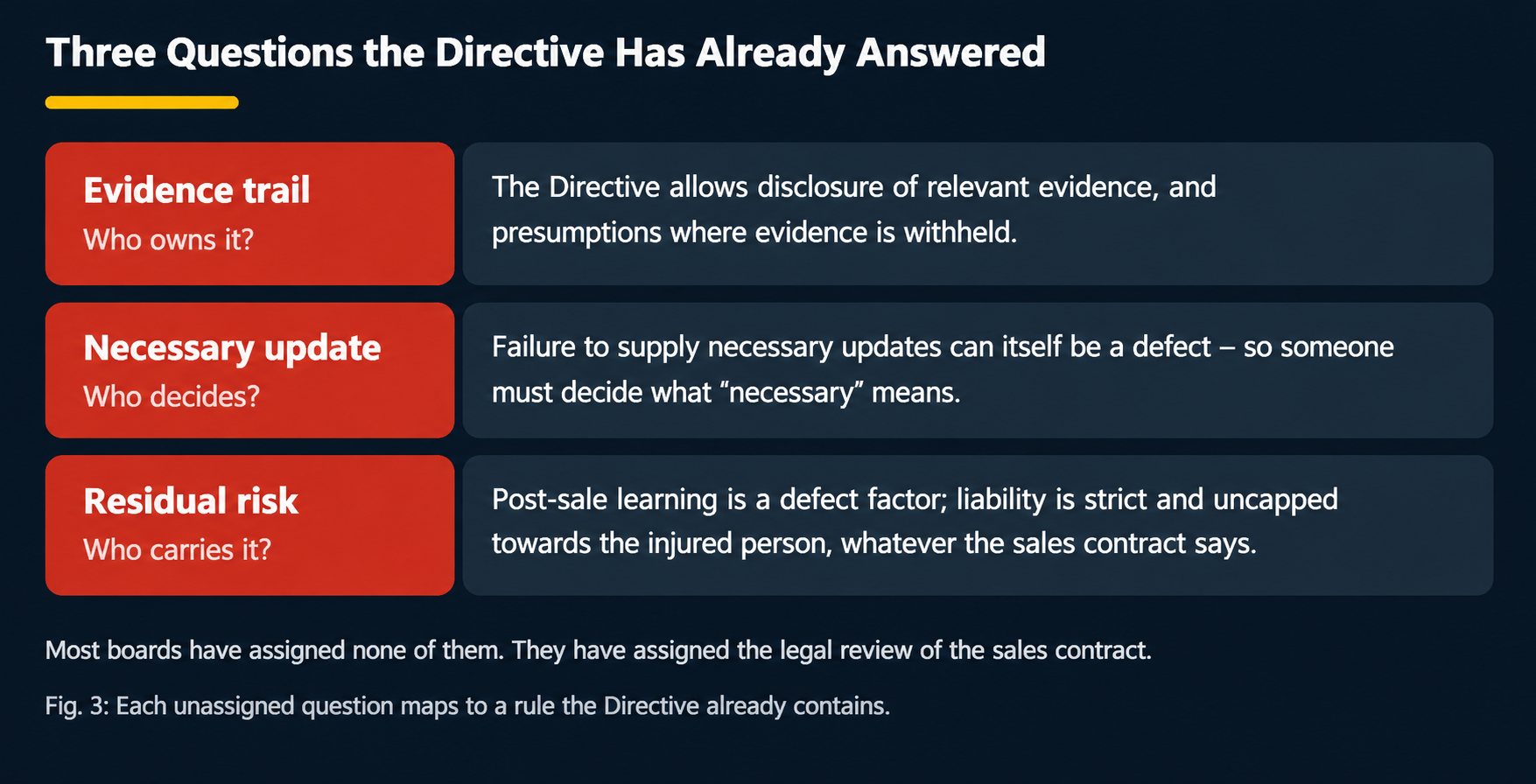
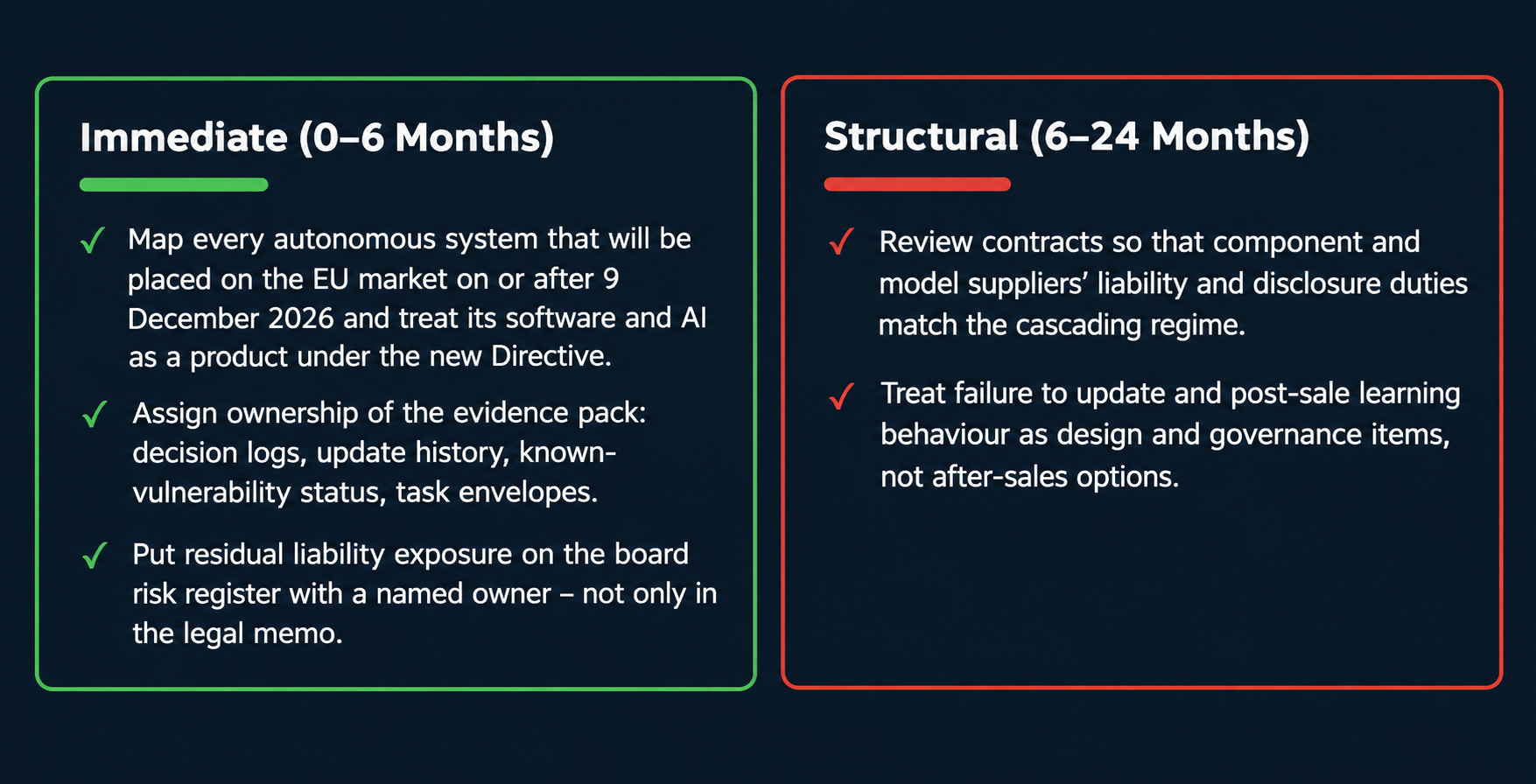
Who owns the evidence trail that will be demanded after an incident? Who decides whether an update is "necessary" under the defect definition? Who carries the residual risk when the model continues to learn after sale?
Most boards have not assigned these. They have assigned the legal review of the sales contract. A contract allocates cost between two commercial parties. The injured person is not one of them.
👉 Key Insight
If no one on the board owns the evidence trail, the first owner will be a court order.
Action Plan for Decision Makers
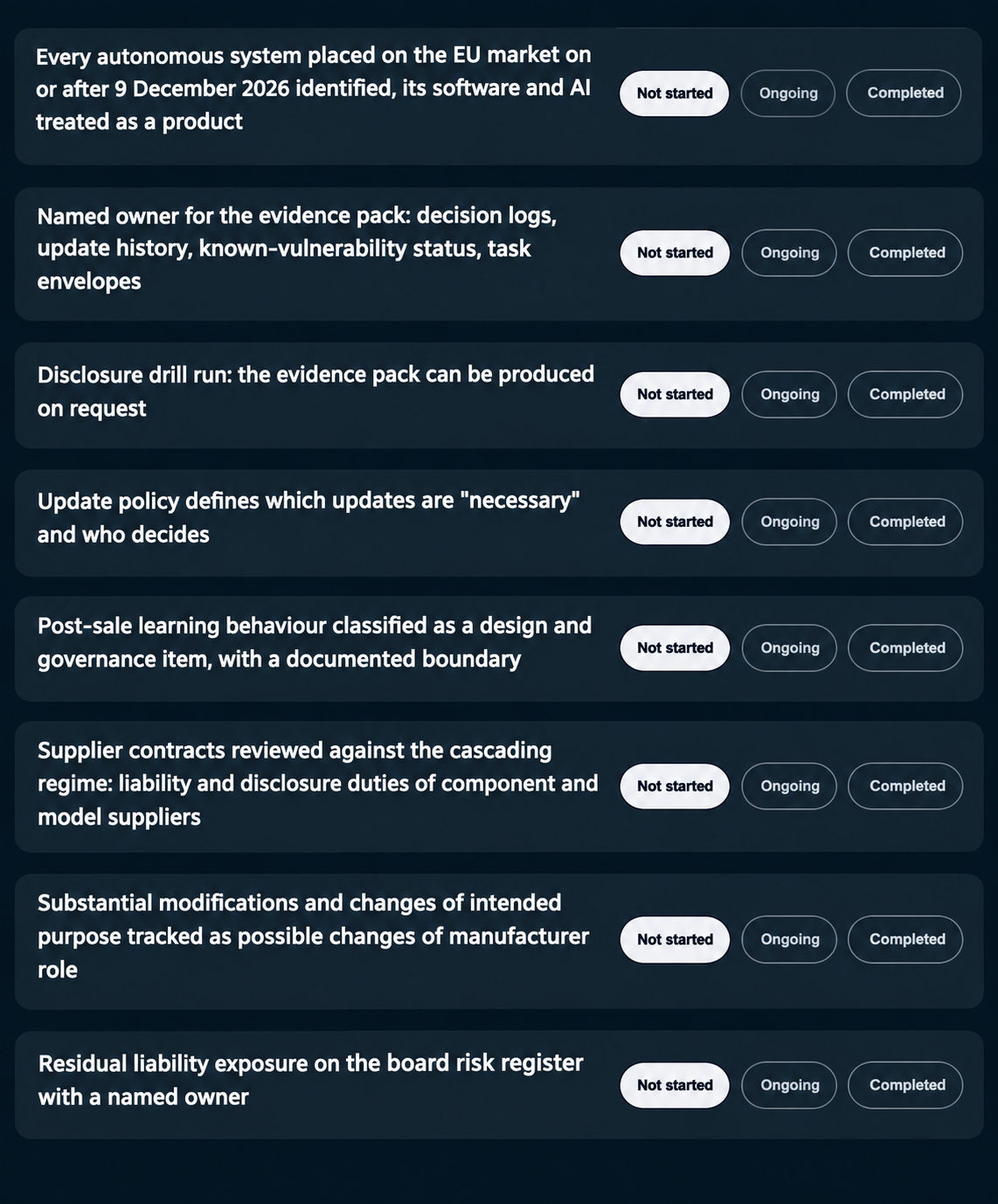
Checklist
Final Thought
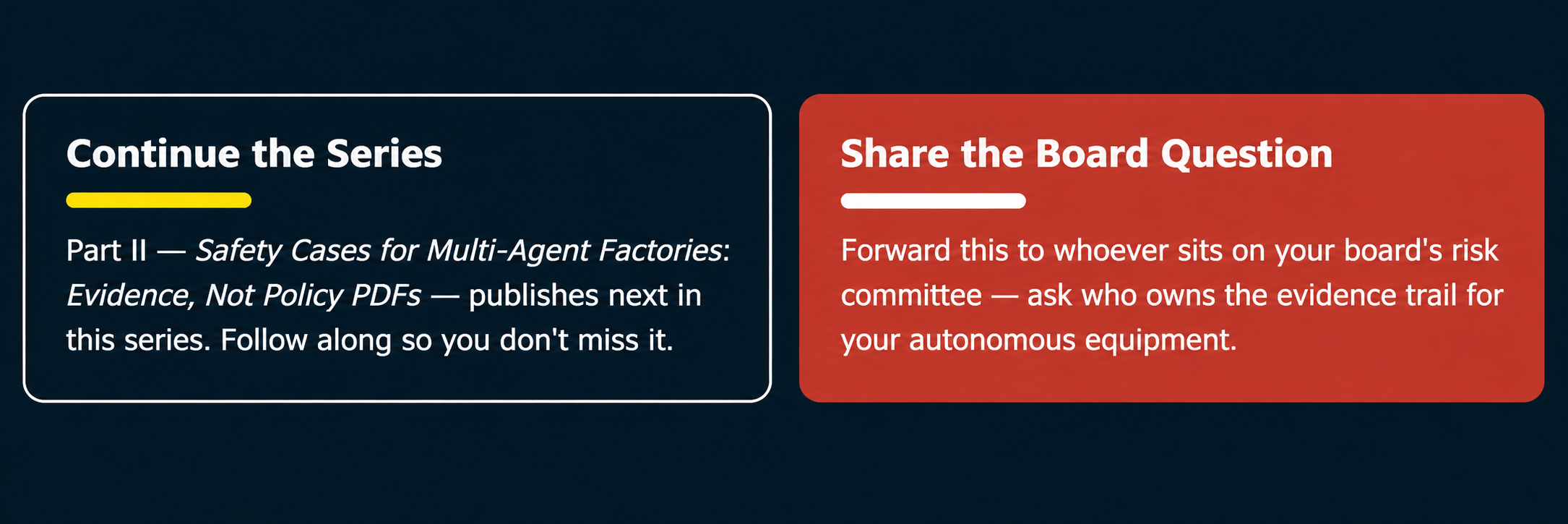
In December, the software becomes a product. The question boards avoid is the one the Directive has already answered. Part II of this week turns from liability to evidence: what a safety case must contain when several agents can act on the same machine.
Efficiency Before Energy means the cheapest liability is the one a complete evidence trail removes.
Systems don't fail. Decisions do.
Take the Next Step
Subscribe to the Weekly Punch for weekly strategic clarity, direct to your inbox.
References
European Parliament and Council of the European Union (2024) Directive (EU) 2024/2853 of 23 October 2024 on liability for defective products and repealing Council Directive 85/374/EEC. Official Journal of the European Union, L, 18 November 2024. Transposition deadline and application: 9 December 2026. [Recital references (13, 40) and article-level content cited via secondary summaries; the application wording "after 9 December 2026" should be confirmed against EUR-Lex.]
European Parliament and Council of the European Union (2026) Regulation (EU) 2026/1744 of 8 July 2026 (Digital Omnibus on AI). Official Journal of the European Union, L series, 24 July 2026; in force 27 July 2026. [Cited for context only.]
European Parliament and Council of the European Union (2023) Regulation (EU) 2023/1230 on machinery and repealing Directive 2006/42/EC and Council Directive 73/361/EEC. Official Journal of the European Union, L 165, 29 June 2023. Applies from 20 January 2027. [Cited for context only.]
Disclaimer: This article summarizes an EU directive and is not legal advice. Liability rules are transposed into national law and may differ between Member States. Dates, recital and article references should be checked against the Official Journal before readers rely on them for compliance, insurance or investment decisions. Verification Gate: flagged for pre-publication source check.
Ownership as Design.
Note: This article reflects my personalviews based on industry experience and publicly available information. It does not constitute professional, legal, or investment advice and does not represent the views of my employer. AI-generated visuals, concept and content by the author.
