MACHINERY REGULATION | PHYSICAL AI | NOVEMBER 2026 | Week 46 · Part II
Self-Learning Safety Functions, Recorded Decisions and One Conformity Path Mean the Safety Case Is Written in the Architecture: Not Added by the Lawyer Afterwards
Part I set the calendar. This part asks what the calendar does to the drawing board.
A safety case written after the design freeze is a document about a decision that has already been made. Once AI sits inside the safety architecture of a machine, compliance requirements stop being a stage at the end and become constraints on sensors, logs, task envelopes and update processes from the first review.
Executive Summary
IN 60 SECONDS:
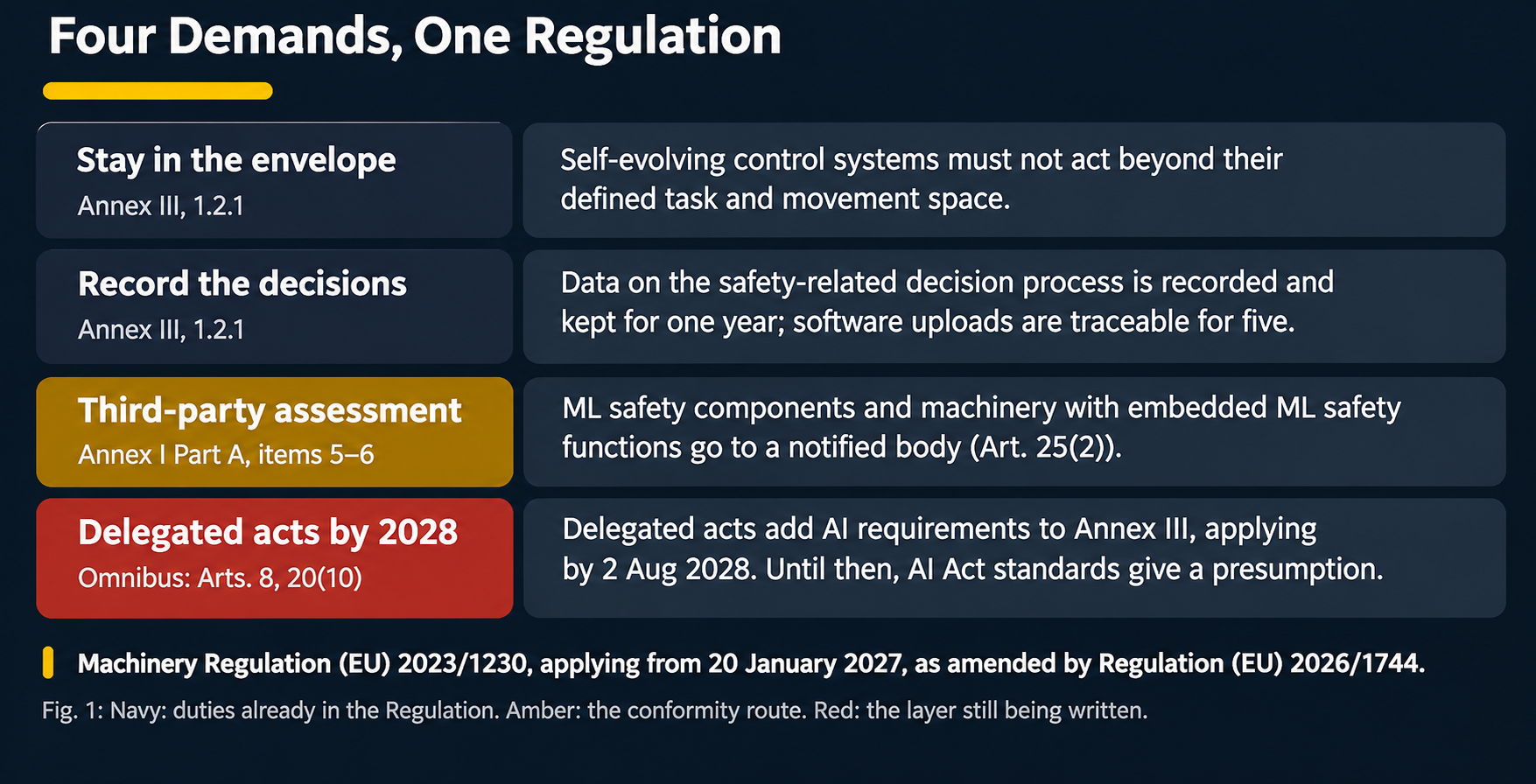
The Machinery Regulation (EU) 2023/1230 applies from 20 January 2027 and already addresses self-evolving, machine-learning-based safety functions: such machines must stay within their defined task and movement space, and data on their safety-related decisions must be recorded.* Safety components with such behaviour, and machinery with embedded systems of that kind, are listed in Annex I Part A and need third-party conformity assessment.*
After the AI Omnibus, the detailed AI health-and-safety requirements for machinery will be specified by delegated acts under that Regulation, which must apply by 2 August 2028; until then, compliance with AI Act standards can create a presumption of conformity.* One conformity path replaces two parallel regimes.
Roles matter. An integrator who substantially modifies the machinery or changes its intended purpose can become the manufacturer.* Compliance is no longer a documentation exercise at the end. It is a product-design constraint on what the physical AI is allowed to learn, log and do.
1. What the Machinery Regulation Now Demands of Physical AI
The Regulation does not ask whether the robot is intelligent. It asks whether the intelligence stays inside a boundary someone can inspect.
Self-learning systems must remain within their defined tasks. Safety-related decisions must be recorded: under Annex III, section 1.2.1, the data on the safety-related decision process is retained for one year after collection, and a tracing log of interventions and uploaded safety software versions is kept for five years.* AI functionality that ensures safety functions triggers specific conformity paths, including third-party assessment in defined cases.
The Omnibus routes the detailed AI health-and-safety requirements into this Regulation through delegated acts rather than a parallel AI Act high-risk track for machinery. Until those acts land, the presumption of conformity can rest on harmonised standards or common specifications under the AI Act – although no harmonised AI standards under the Machinery Regulation exist yet, and the essential requirements apply in full.*
👉 Key Insight
The safety case for a learning robot is an architectural property – task envelope, logging, update control – not a PDF.
2. Why This Is Product Design
Ask what the agent is allowed to change about a safety behaviour. The answer is an architecture, not a policy.
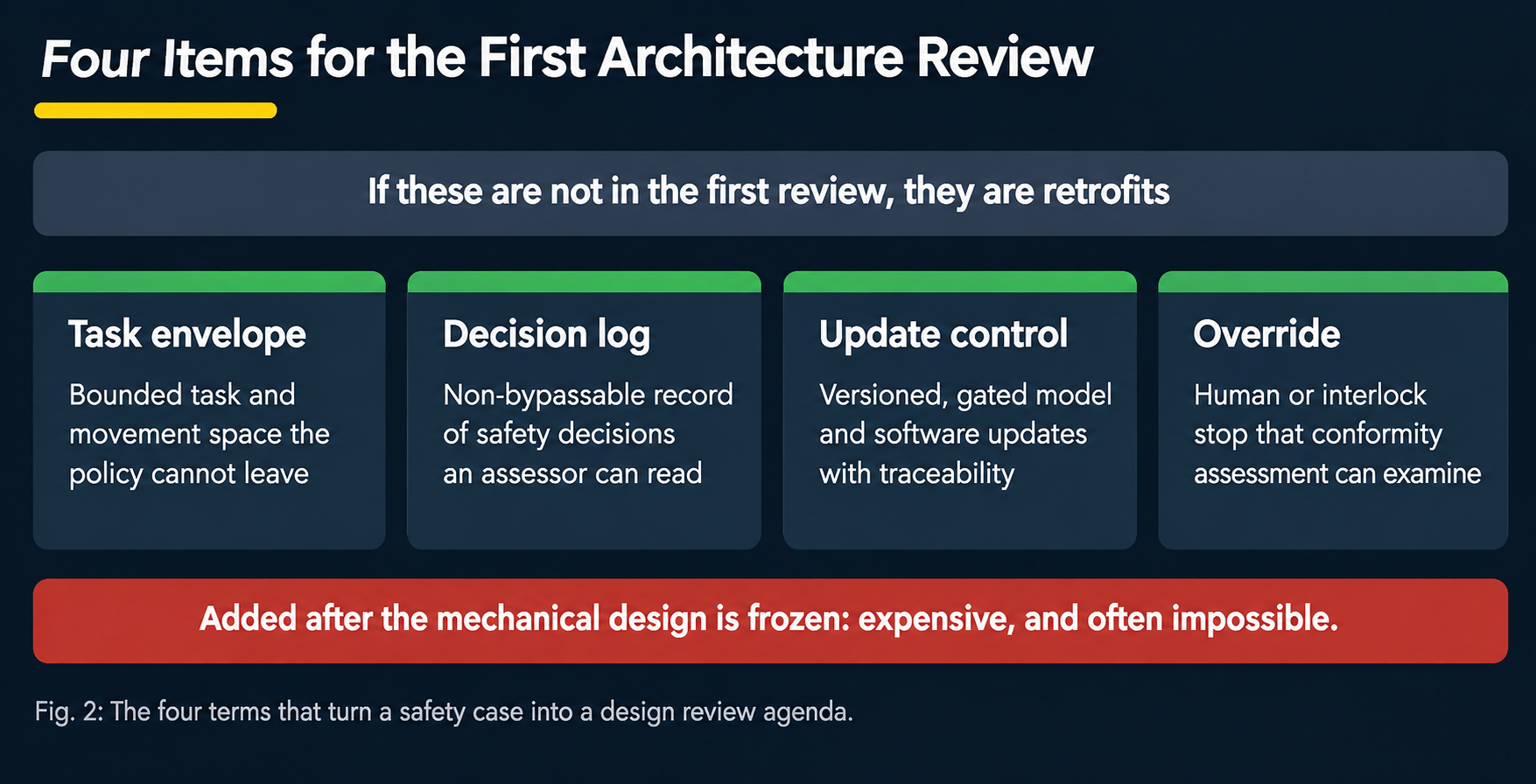
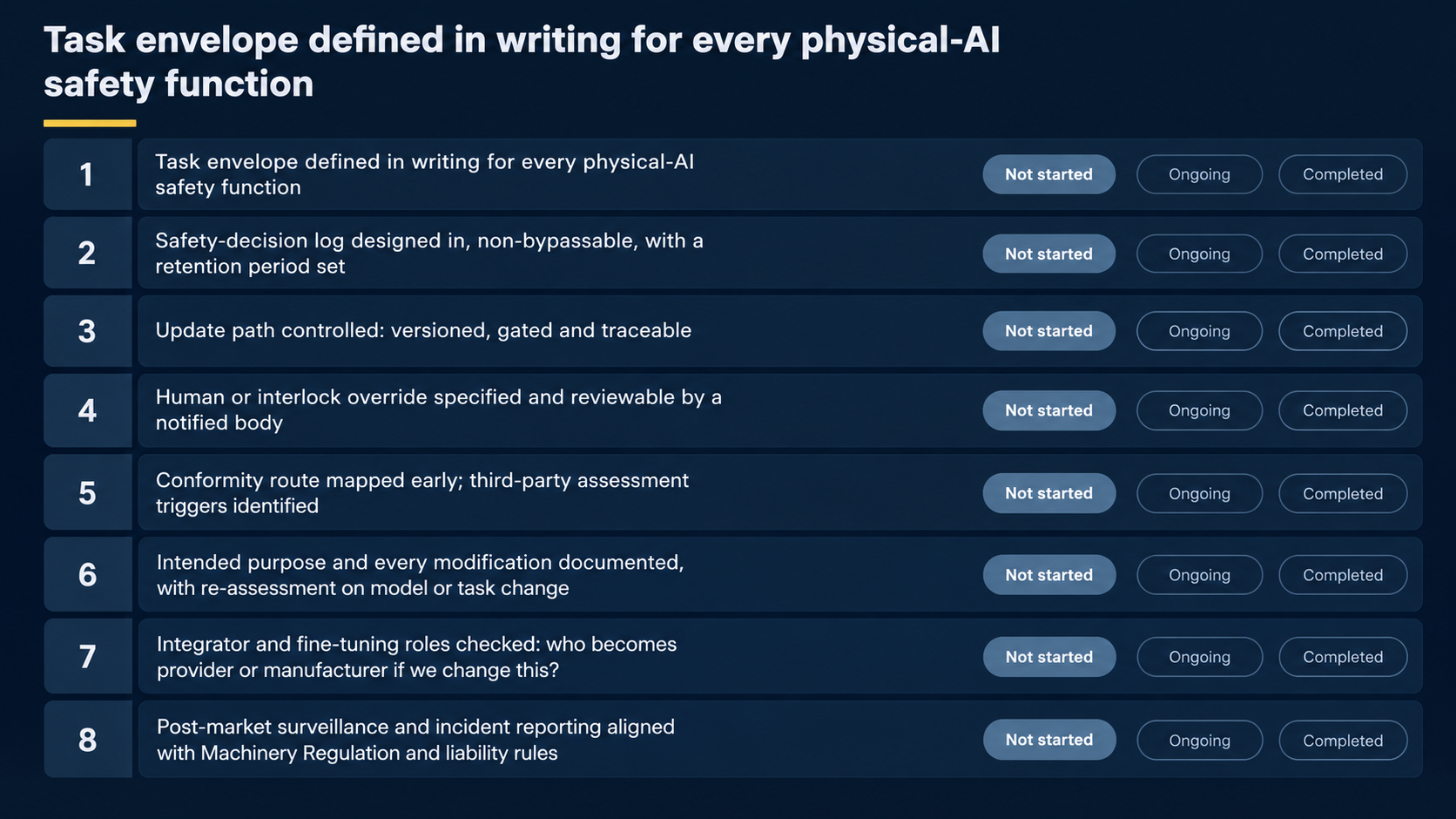
An agent or policy that can alter a safety-related behaviour needs four things: a bounded task definition, a non-bypassable log of safety decisions, a controlled update path, and a human or interlock override that the conformity assessment can examine. Adding them after the mechanical design is frozen is expensive and often impossible.
The surrounding law points the same way. The Cyber Resilience Act and the revised Product Liability Directive, which treats software, including AI, as a product, reinforce the same point: the learning system is part of the product.
👉 Key Insight
If the safety log and the task envelope are not in the first architecture review, they will not be in the CE file.
3. Integrator and Modification Risk
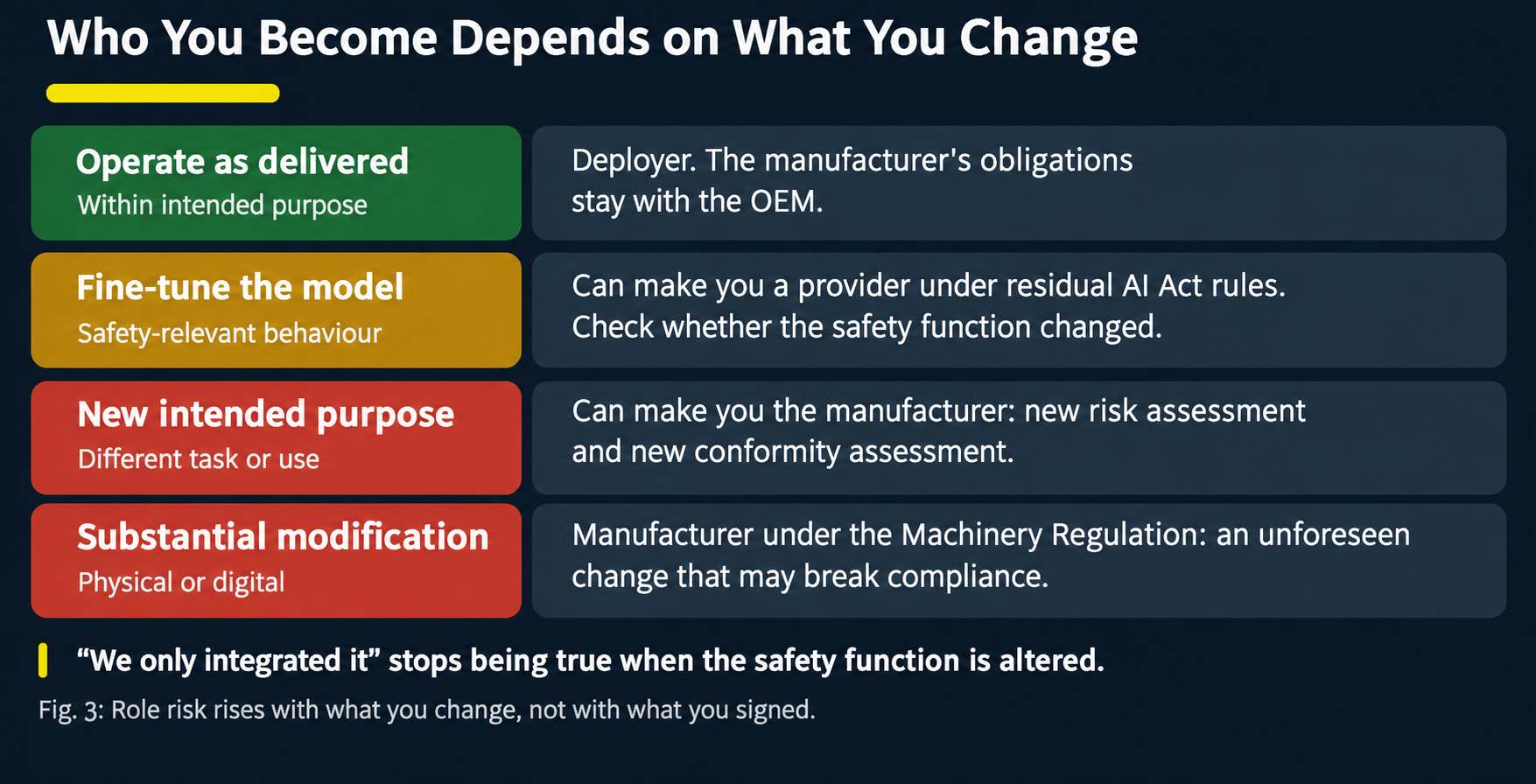
"We only integrated it" stops being true at the moment the safety function is altered.
Deployers who fine-tune the model, change the intended purpose or substantially modify a robot can become providers under residual AI Act rules and manufacturers under the Machinery Regulation. The Regulation treats a substantial modification as a physical or digital change the manufacturer did not foresee and that may leave the machinery non-compliant with the essential requirements; whoever makes it must carry out a new conformity assessment and becomes the manufacturer.*
One robot can still touch several regimes, Machinery, Cyber Resilience, Product Liability and the residual AI Act, but the Omnibus made the machinery path the primary design driver for industrial systems.
👉 Key Insight
The role you hold is decided by what you changed, not by what you signed.
Action Plan for Decision Makers
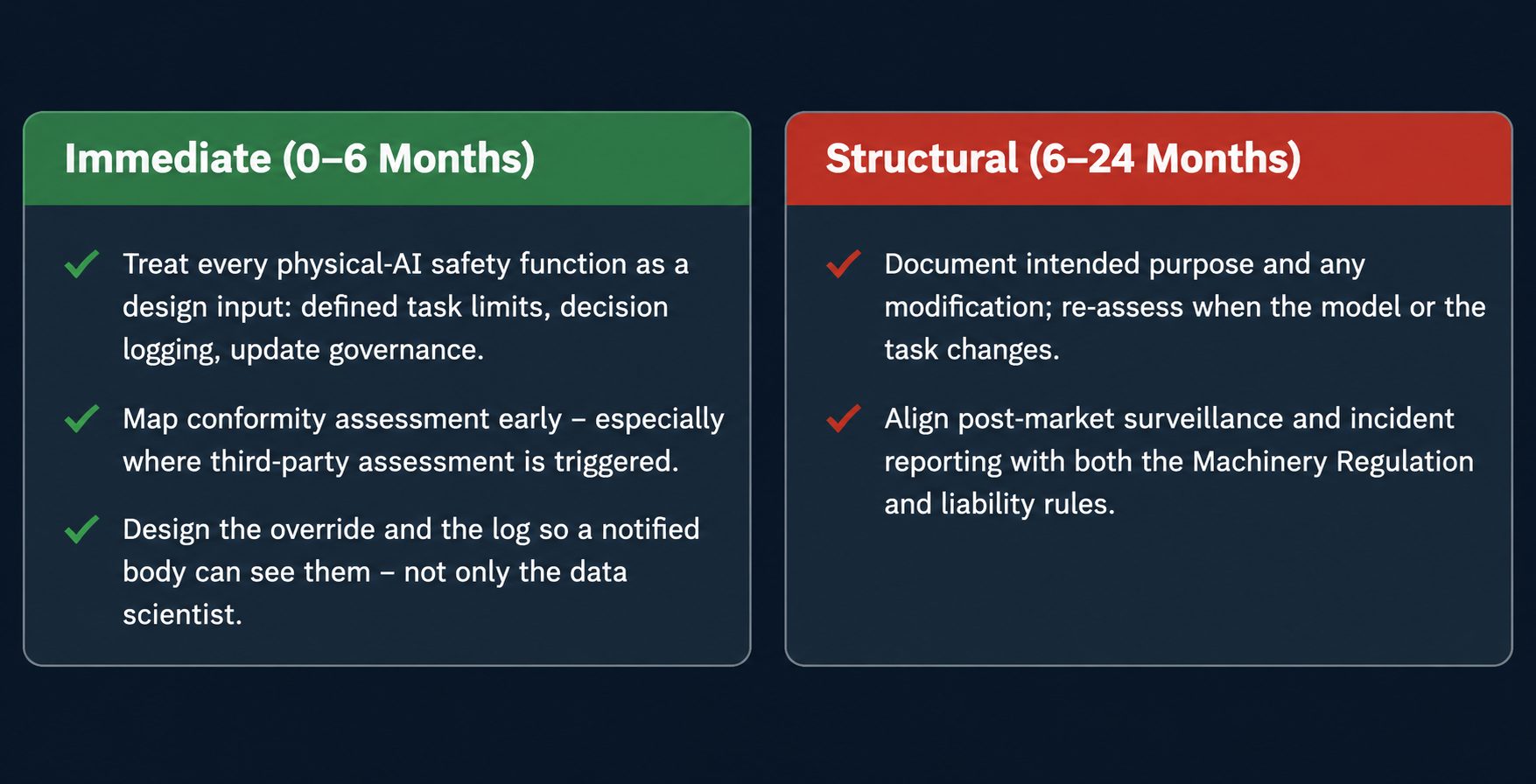
Checklist
Final Thought
A safety case written afterwards is a document about a decision already made. Part III of this week steps back from the machine to the organization: what kind of governance keeps these logs, envelopes and conformity assumptions true after the first assessment.
Efficiency Before Energy means the cheapest safety feature is the one in the first architecture review.
Systems don't fail. Decisions do.
Take the Next Step
Subscribe to the Weekly Punch for weekly strategic clarity, direct to your inbox.
References
European Parliament and Council of the European Union (2023) Regulation (EU) 2023/1230 on machinery and repealing Directive 2006/42/EC and Council Directive 73/361/EEC. Official Journal of the European Union, L 165, 29 June 2023. Applies from 20 January 2027. [Annex I Part A items 5–6, Annex III section 1.2.1 and Article 25(2) cited via secondary summaries; confirm wording against EUR-Lex before publication.]
European Parliament and Council of the European Union (2026) Regulation (EU) 2026/1744 of 8 July 2026 (Digital Omnibus on AI), amending, among others, Regulation (EU) 2024/1689 and Regulation (EU) 2023/1230. Official Journal of the European Union, L series, 24 July 2026; in force 27 July 2026. [Article-level wording (new Article 8 and Article 20(10) of the Machinery Regulation) checked against a reproduction of the Official Journal text; confirm against EUR-Lex.]
European Parliament and Council of the European Union (2024) Regulation (EU) 2024/1689 laying down harmonised rules on artificial intelligence (Artificial Intelligence Act), Articles 40 and 41. Official Journal of the European Union, L, 12 July 2024.
European Parliament and Council of the European Union (2024) Directive (EU) 2024/2853 on liability for defective products and repealing Council Directive 85/374/EEC. Official Journal of the European Union, L, 18 November 2024. Transposition deadline: 9 December 2026.
European Parliament and Council of the European Union (2024) Regulation (EU) 2024/2847 on horizontal cybersecurity requirements for products with digital elements (Cyber Resilience Act). Official Journal of the European Union, L, 20 November 2024.
Disclaimer: This article summarizes EU legislation as amended by Regulation (EU) 2026/1744 and is not legal advice. Annex and article references, retention periods and the conformity routes described should be checked against the Official Journal before readers rely on them for compliance, investment or product decisions; the content of the delegated acts is not yet adopted. Verification Gate:flagged for pre-publication source check.
Ownership as Design.
Note: This article reflects my personalviews based on industry experience and publicly available information. It does not constitute professional, legal, or investment advice and does not represent the views of my employer. AI-generated visuals, concept and content by the author.
