Agentic AI on the Shop Floor: From Copilot to Closed-Loop Control
AGENTIC AI | SHOP FLOOR | OCTOBER 2026 | Week 43 · Part I
A Chatbot Suggests. An Agent Writes the Hold, the Work Order or the Schedule Change – Inside Bounds the Shift Can Still Override
Industrial AI is leaving the advisory screen and entering the systems that move material. That is a small-sounding sentence for a large change: a chatbot that suggests costs nothing if it is wrong. An agent that writes a hold, a work order or a schedule change has just changed what happens on the floor, and the only question that matters is whether a human can still reverse it in time.
Copilots sit beside the operator. Agents act. The practical versions running in 2026 are still narrow, they read live plant data, reason over a scoped problem, and write one bounded action into MES, CMMS or the schedule, with permissions, an audit trail and a human stop. The decision makers who keep AI in a chat window will not get the cycle-time or quality effect. The ones who close the loop without bounds will get incidents.
Executive Summary
IN 60 SECONDS:
Copilots sit beside the operator. Agents act. In 2026 the practical versions on the floor read live plant data, reason over quality, maintenance and order context, and write a scoped action into MES, CMMS or the schedule with permissions, audit and a human stop.
Vendors such as Tulip are shipping composable agents and MCP connectors so an agent can call systems under platform controls.* Industry forums including A3 are moving the conversation from pilot to production,* and research prototypes now pair LLM agents with OPC UA skills and real-time state.
The shift that matters is not "more intelligence." It is closed-loop: perceive → decide → write → log → allow override. Decision Makers who keep AI in a chat window will not get the cycle-time or quality effect; those who close the loop without bounds will get incidents.
1. Copilot vs. Closed Loop
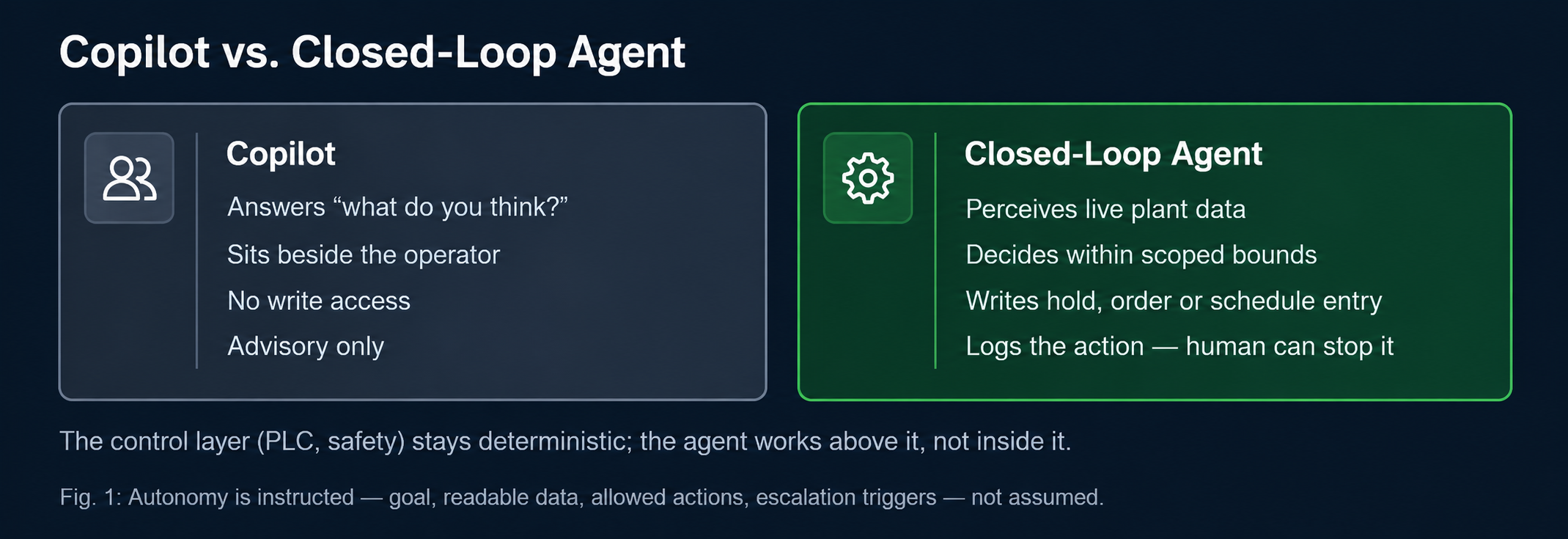
A copilot answers "what do you think?" An agent is allowed to place a quality hold, open a work order or adjust a non-critical schedule entry when defined conditions are met.
The distinction is not depth of intelligence. It is write access. A copilot's output is a suggestion a human has to act on, which means every mistake is caught at the point of translation into action. An agent's output is the action itself, it has already been translated, logged, and is already changing what the floor does next.
The control layer, PLC, safety, stays deterministic no matter how capable the agent becomes. The agent works above it, in the systems the PLC does not reach: MES, CMMS, the schedule. Its autonomy is instructed, not assumed: a stated goal, readable data, a defined set of allowed actions, and explicit escalation triggers for everything outside that set.
👉 Key Insight
Closed-loop is not full autonomy. It is a permitted write into the operational record, with a log and a stop.
2. What Is Already on the Floor
None of the examples running today are science fiction, and none of them are unsupervised process control.
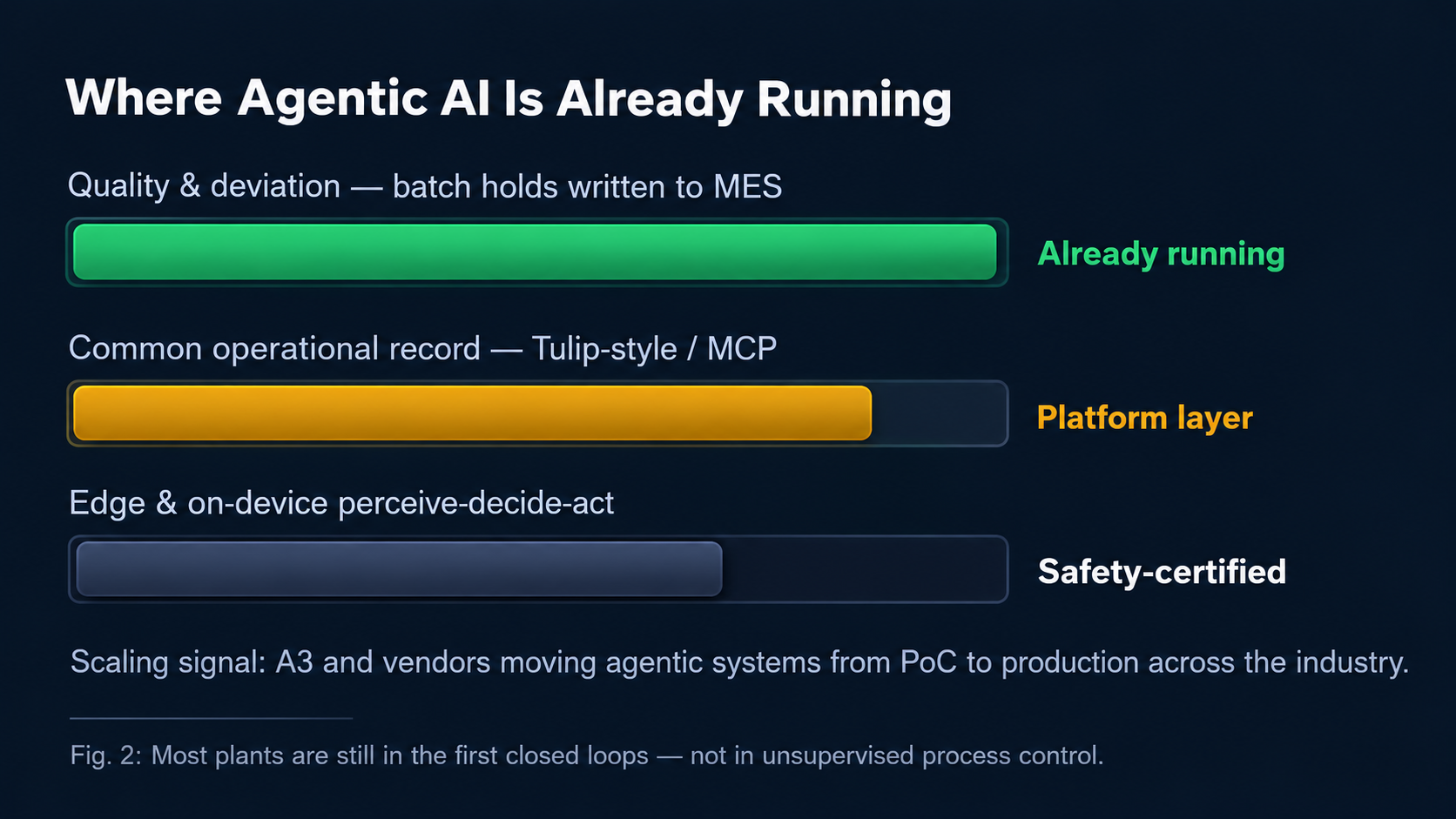
Quality and deviation: agents that link a surface mark to a speed change after changeover, place a batch hold in MES, tell the operator what adjustment they made, and write the reasoning back into the record. Common operational record: machine data, work instructions, orders, video and enterprise systems unified in one place so the agent is not guessing across silos, Tulip-style connectivity and MCP connectors now ship this as a platform feature.* Edge and on-device: agentic perception-decide-act loops running inside power and latency budgets, on safety-certified stacks built for industrial use. Scaling signal: A3 and vendor work is actively moving agentic systems from proof-of-concept to production,* alongside research on multi-agent coordination across factory modules sharing real-time state.
Most plants are still in the first closed loops, quality holds, maintenance triggers, schedule nudges, not in unsupervised process control. That is not a sign the technology is behind. It is the correct order of operations.
👉 Key Insight
The agents already running on real floors are not the ones with the most autonomy. They are the ones with the narrowest, best-defined write.
3. The Leadership Condition
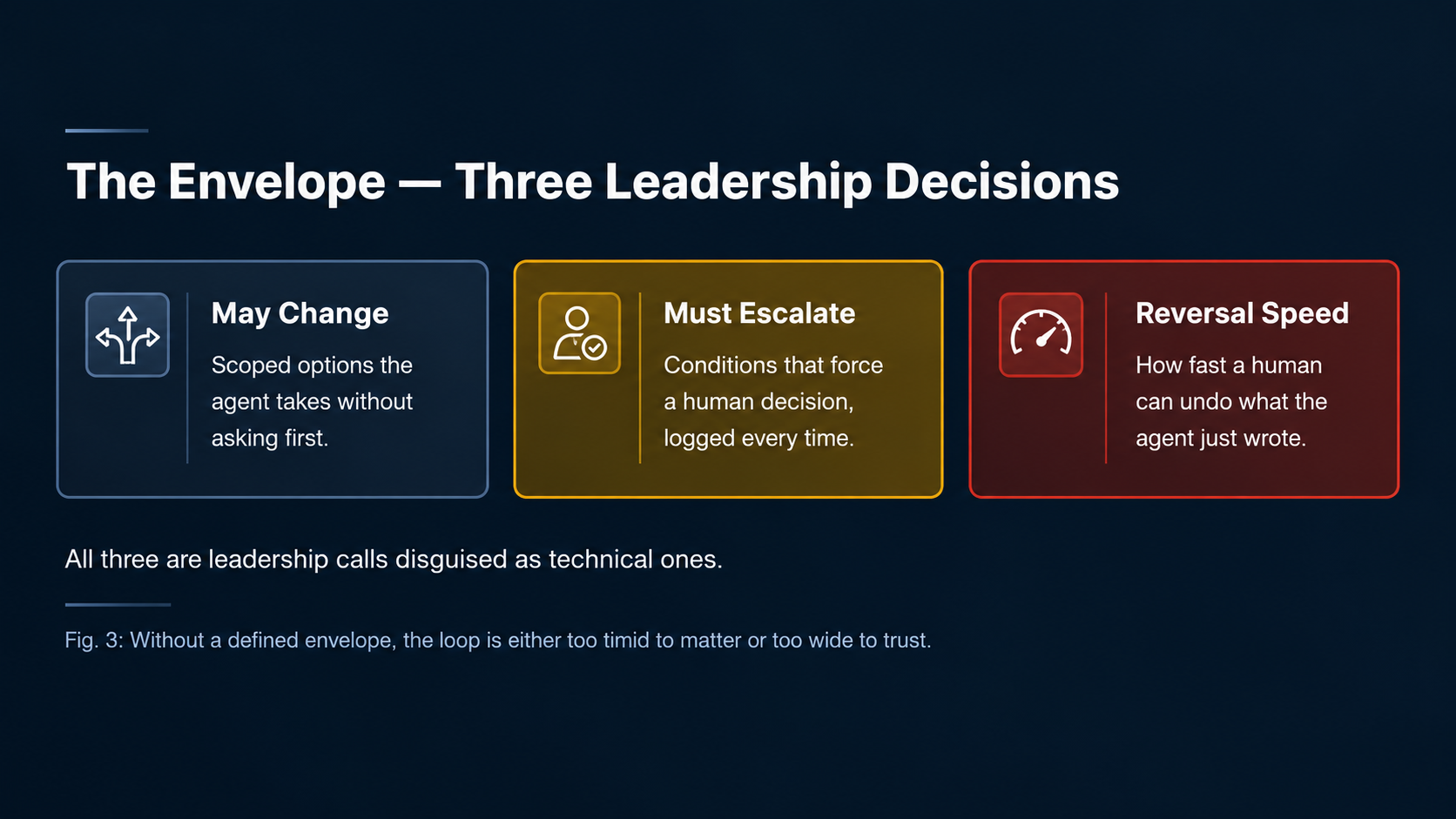
An agent that can write must have an envelope. Without one, the loop is either too timid to matter or too wide to trust.
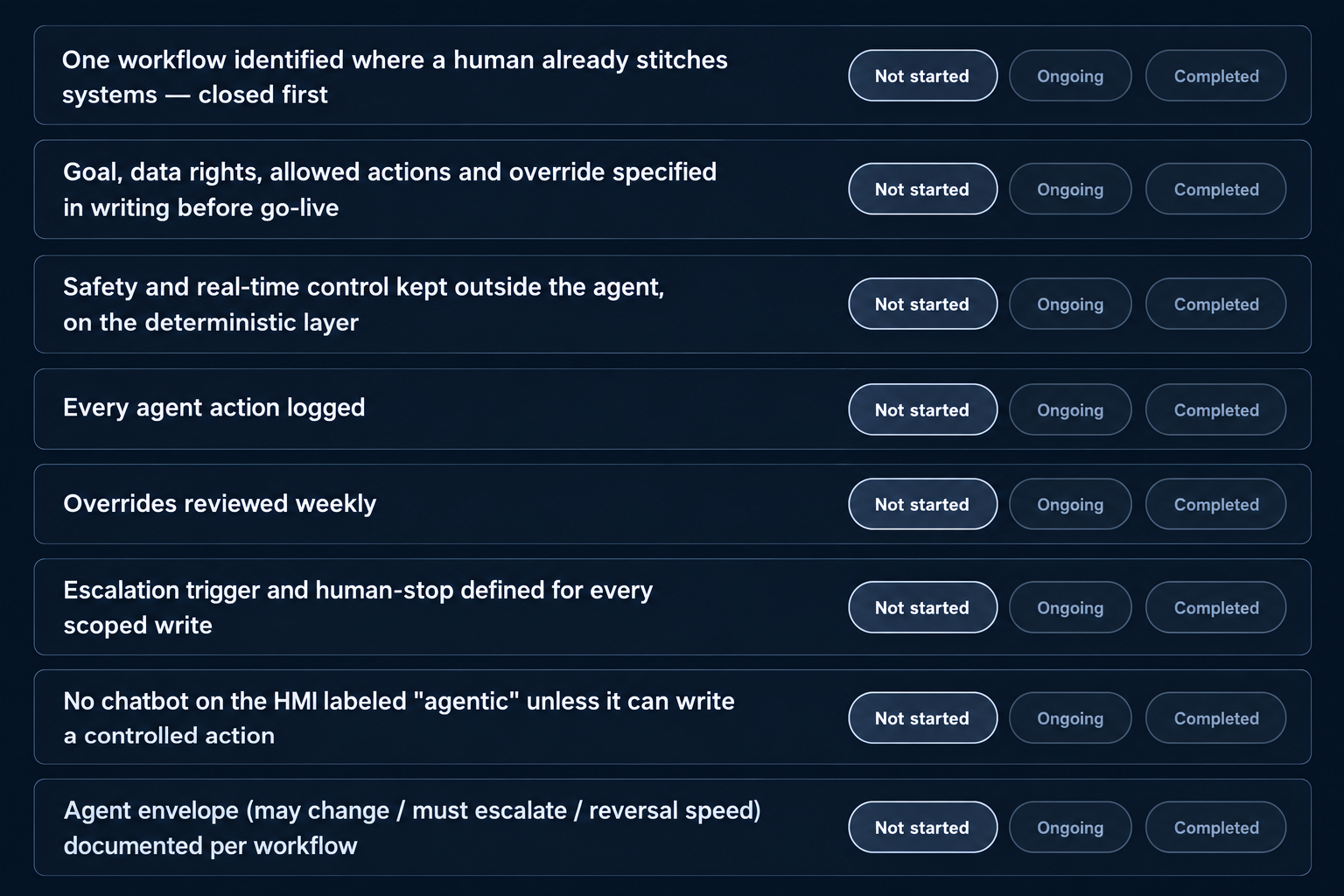
The envelope has three parts, and leadership, not engineering alone, has to sign off on all three: what the agent may change without asking, what it must escalate to a human instead of acting on, and how fast a human can actually reverse what it did. Each of these is a leadership decision disguised as a technical one. "What may it change" is a risk-appetite statement. "What must it escalate" is a judgment about which failures are tolerable. "How fast can it be reversed" is a statement about how much trust the organization is willing to extend before it has earned it.
Get the envelope too narrow, and the agent never accumulates enough write authority to move the metrics that justified the project. Get it too wide, and the first bad decision becomes a production incident instead of a logged, reversible mistake.
👉 Key Insight
The value is in the write. The risk is in an unbounded write.
Action Plan for Decision Makers
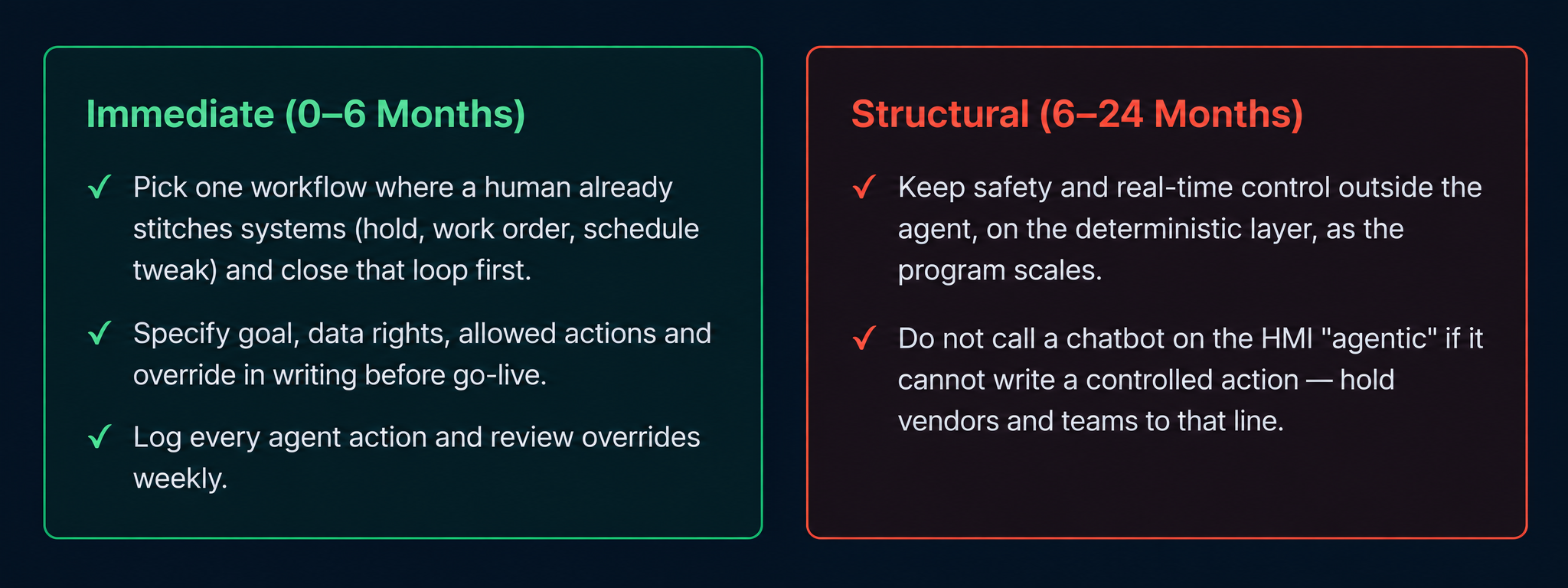
Checklist
Final Thought
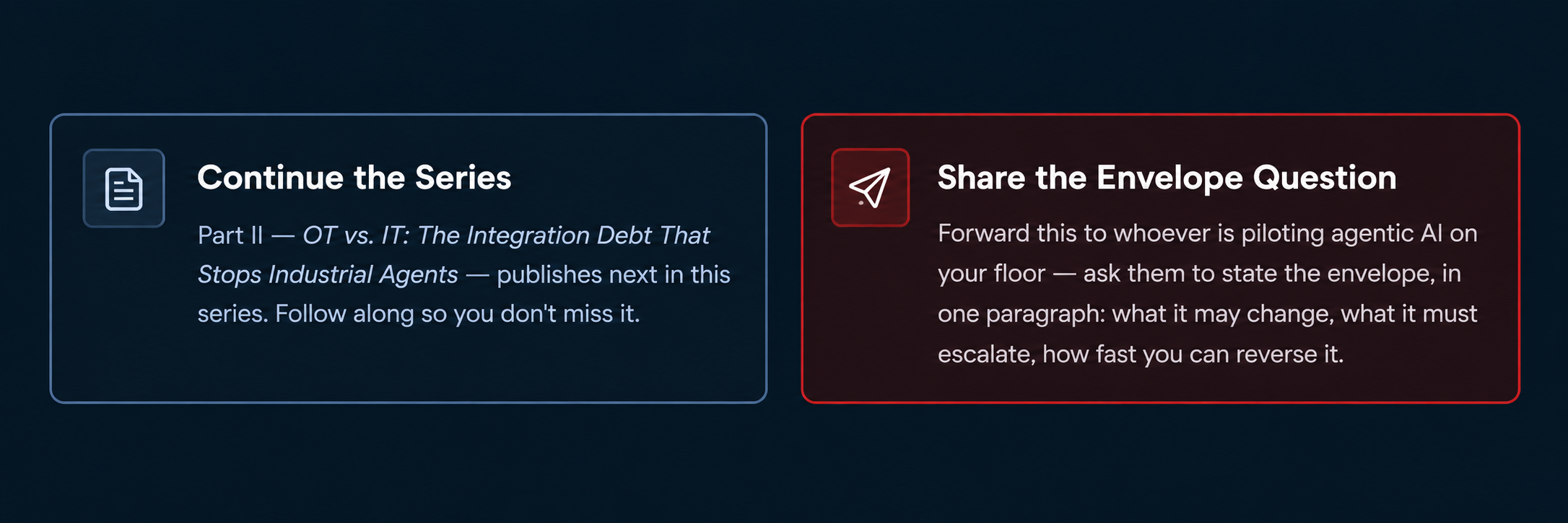
Closed-loop sounds like a model problem. It is actually an integration problem, the agent can only write what the systems around it will accept, in a form they can actually use. Part II of this Week 43 set names exactly where that debt lives, and why it stops most "AI on the floor" at the pilot stage.
Efficiency Before Energy means the first write an agent makes should be the smallest one that actually matters — not the widest one that looks impressive in a demo.
Systems don't fail. Decisions do.
Take the Next Step
Subscribe to the Weekly Punch for weekly strategic clarity, direct to your inbox.
References
ARC Advisory Group / Tulip (2026) Operational Intelligence and Composable AI Agents / MCP Connectors.
Manufacturing Dive & Control Engineering (2026) Agentic and Closed-Loop Shop-Floor AI.
Sigma (2026) Agents Writing Holds and Work Orders.
A3 / Automate.org (2026) Scaling Agentic Systems from Proof-of-Concept to Production.
arXiv (2026) Multi-Agent Manufacturing Control.
Disclaimer: This article synthesizes publicly available vendor, industry-forum and research reporting current as of publication. Figures and deployment claims evolve as platforms and pilots mature; readers should verify current figures against the original publications before relying on them for investment or deployment decisions. Verification Gate: flagged for pre-publication source check.
Ownership as Design.
Note: This article reflects my personalviews based on industry experience and publicly available information. It does not constitute professional, legal, or investment advice and does not represent the views of my employer. AI-generated visuals, concept and content by the author.
