
AI OMNIBUS | ROBOTICS | NOVEMBER 2026 | Week 46 · Part I
Two Dates Now Govern the Sector – 2 December 2027 and 2 August 2028. Everything Else Is Residual or Already in Force
Most European robot roadmaps were built on a regulatory calendar that no longer exists.
Since 27 July 2026, Regulation (EU) 2026/1744, the AI Omnibus, has replaced it with two dates and one structural shift. For industrial robotics the question is no longer which year the AI Act bites. It is which two dates are design gates, and which regulation now owns the compliance file.
Executive Summary
IN 60 SECONDS:
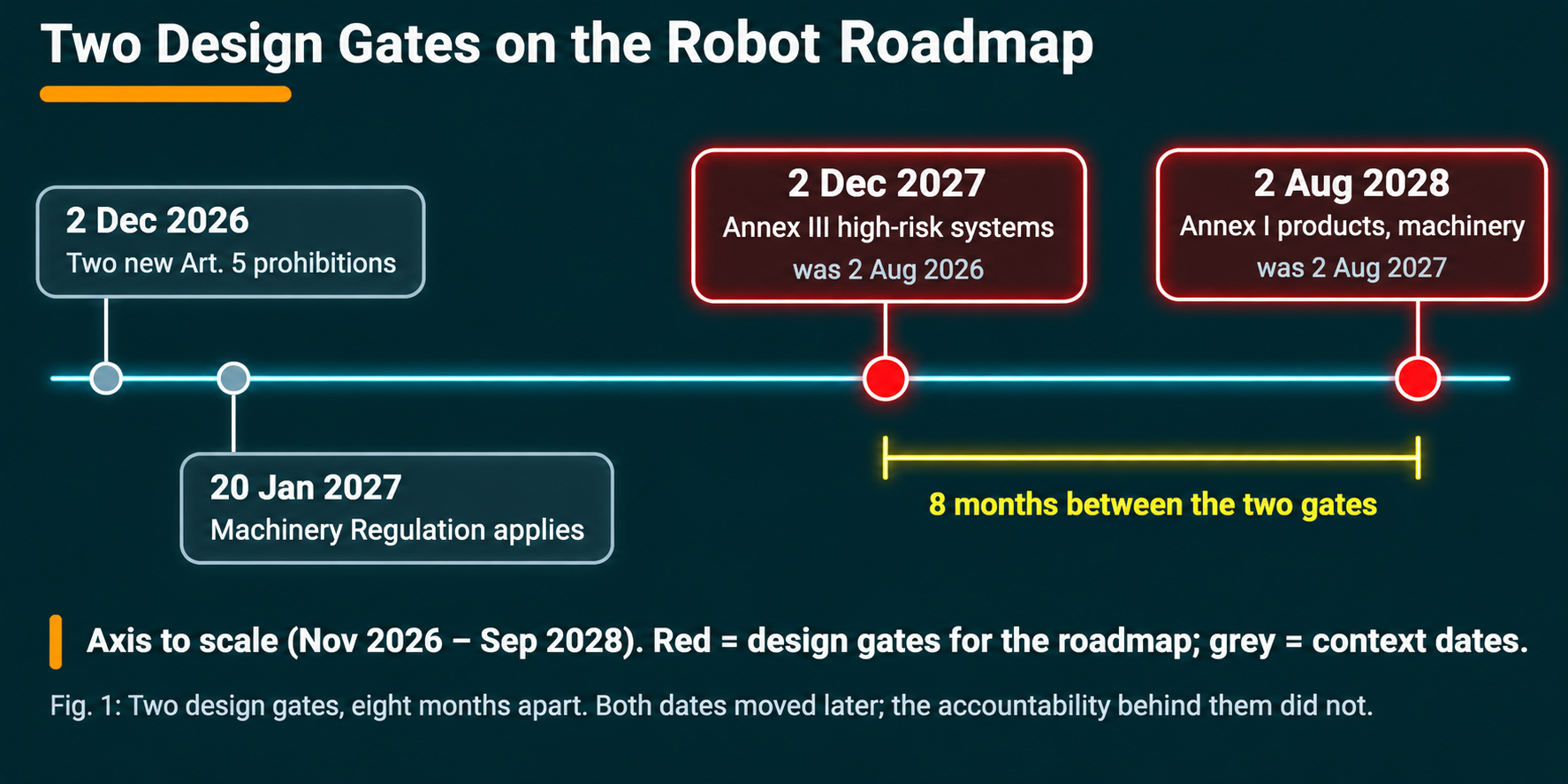
Two dates now govern industrial robotics. High-risk obligations for stand-alone (Annex III) systems apply from 2 December 2027, moved from 2 August 2026. For AI in Annex I products, machinery included, they apply from 2 August 2028, moved from 2 August 2027.*
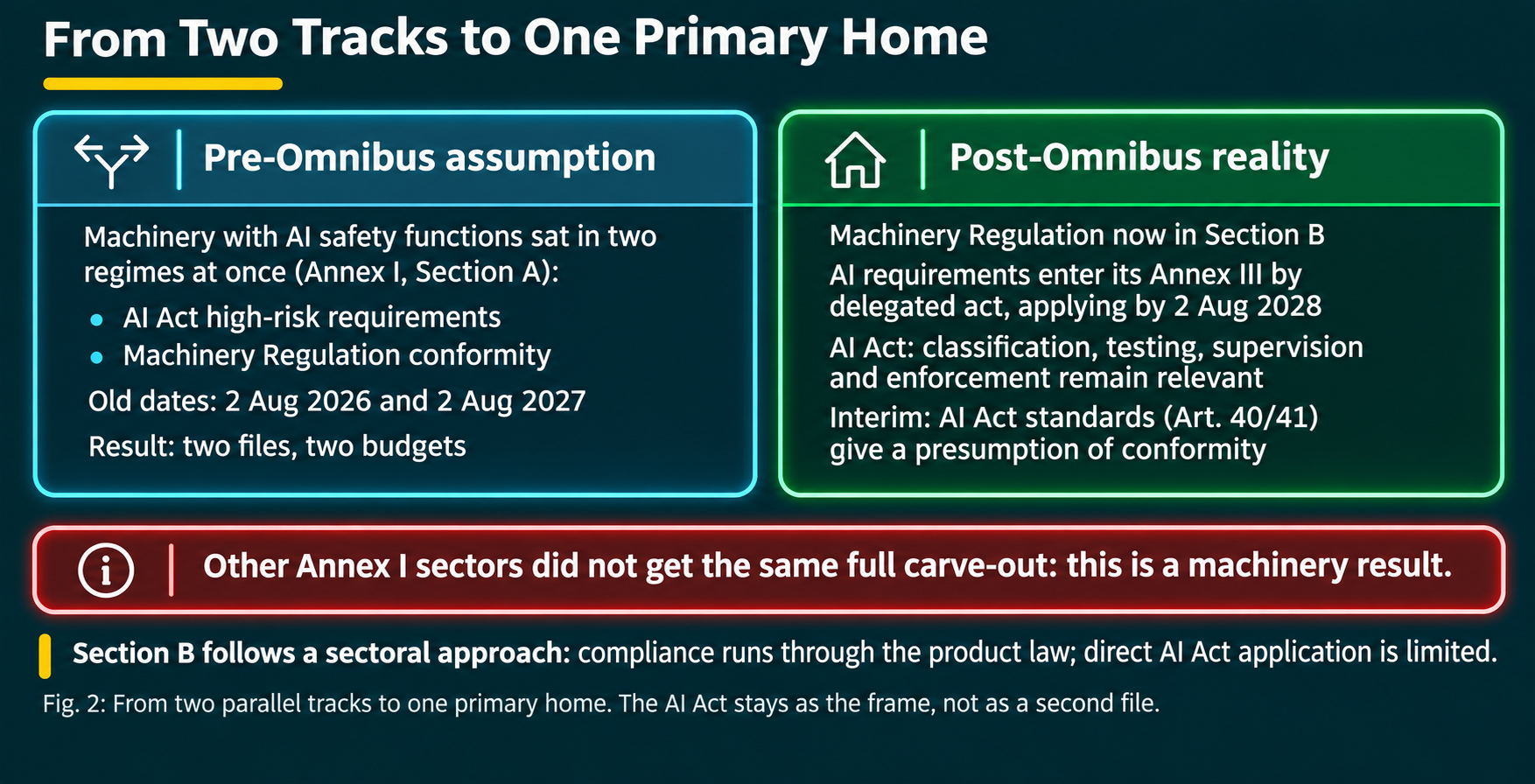
The structural shift matters more than the delay. The Machinery Regulation moved from Section A to Section B of Annex I of the AI Act, and the detailed AI health-and-safety requirements will enter the Machinery Regulation through delegated acts that must apply by 2 August 2028 – one conformity regime instead of two parallel tracks.*
Prohibitions, AI literacy and general-purpose AI obligations are already in force, and systems placed on the market before the new dates are generally caught only after a significant design change.* Decision Makers who still plan against the old 2026/2027 dual-track dates are planning against a calendar the Omnibus replaced.
1. The Two Dates That Matter
For a robotics programme, the Omnibus reduces to two design gates.
2 December 2027: high-risk obligations for Annex III systems apply. 2 August 2028: the rules for high-risk AI embedded in Annex I products apply – for machinery, through the Machinery Regulation, whose Annex III is to be amended by Commission delegated acts that must apply by that date.*
The 2028 date is only as firm as its delegated acts. They enter into force only if neither Parliament nor the Council objects within two months of notification (extendable by two), so in practice the text has to be adopted well before 2 August 2028. Until then, a presumption of conformity for the AI-related essential requirements can rest on harmonised standards or common specifications under Articles 40 and 41 of the AI Act (Article 20(10) of the Machinery Regulation).* Sandboxes, SME and small-mid-cap simplifications and database changes are secondary to these two horizons.
👉 Key Insight
If your robot roadmap does not have 2 December 2027 and 2 August 2028 as design gates, it is still on the pre-Omnibus calendar.
2. What Changed for the Compliance Home
The Omnibus realigned the regime. It did not merely delay it.
By moving the Machinery Regulation from Section A to Section B of Annex I of the AI Act, the Omnibus ended the automatic dual regulation of industrial machinery. The AI-related safety requirements move into the Machinery Regulation; the AI Act remains relevant mainly for classification, testing, supervision and enforcement.* One conformity path remains, with the AI-specific requirements added on top through the sectoral route.
Two cautions. The Machinery Regulation itself applies from 20 January 2027, and the AI layer on top of it is still being written; the content of the delegated acts decides how much changes in practice. And other Annex I sectors did not receive the same full carve-out – this is a machinery result, not a general one.
👉 Key Insight
For industrial robots the primary design driver is now the Machinery Regulation plus the forthcoming delegated acts, not a full parallel AI Act high-risk file.
3. What Is Already Live and What Still Binds
The new dates relieve one obligation. They leave the rest of the stack in place.
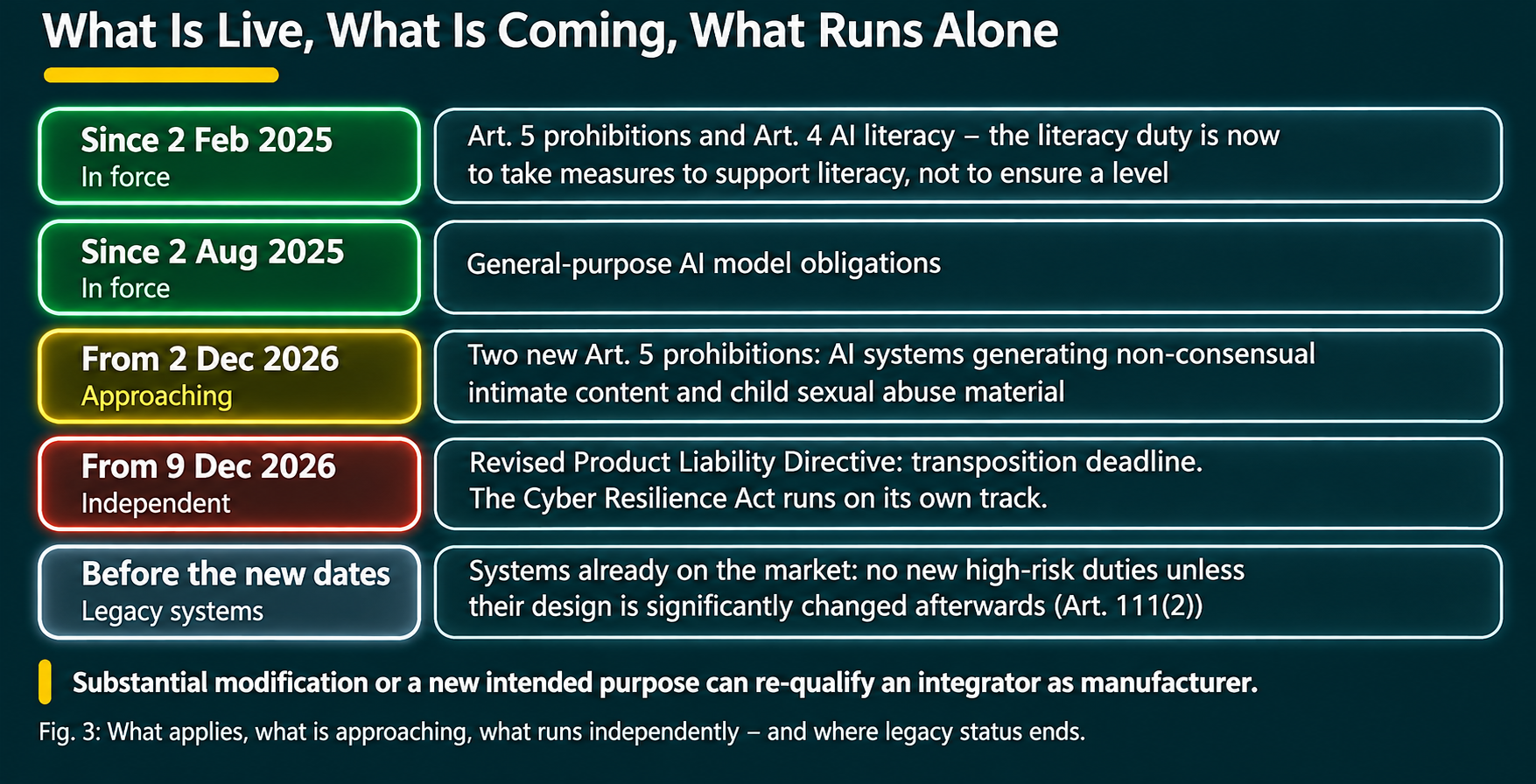
Prohibited practices (Art. 5) and AI literacy (Art. 4) have applied since 2 February 2025, and general-purpose AI model obligations since 2 August 2025. The Omnibus softened the literacy duty from ensuring a sufficient level to taking measures to support it.* Two new prohibitions, on AI systems that generate non-consensual intimate content and child sexual abuse material, apply from 2 December 2026.*
Systems placed on the market before the new dates are generally caught only if their design is significantly changed afterwards. That protection lasts only as long as the design stays unchanged: the revised Product Liability Directive (transposition deadline 9 December 2026) and the Cyber Resilience Act run independently of the Omnibus, and a substantial modification or a new intended purpose can still make an integrator the manufacturer or provider.
👉 Key Insight
Grandfathering lasts exactly as long as the design stays unchanged. Every model update is a decision about which calendar you are on.
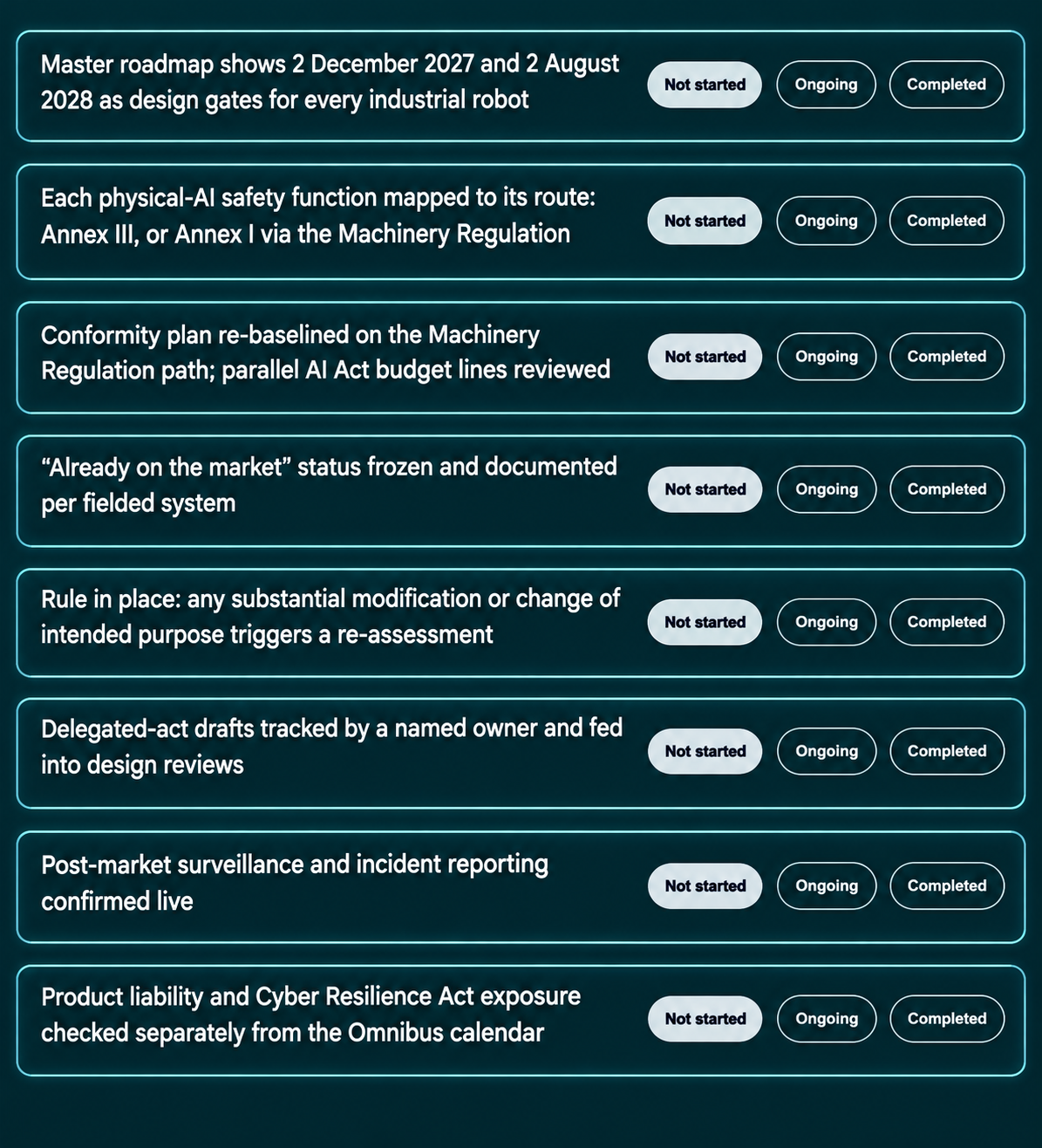
Action Plan for Decision Makers
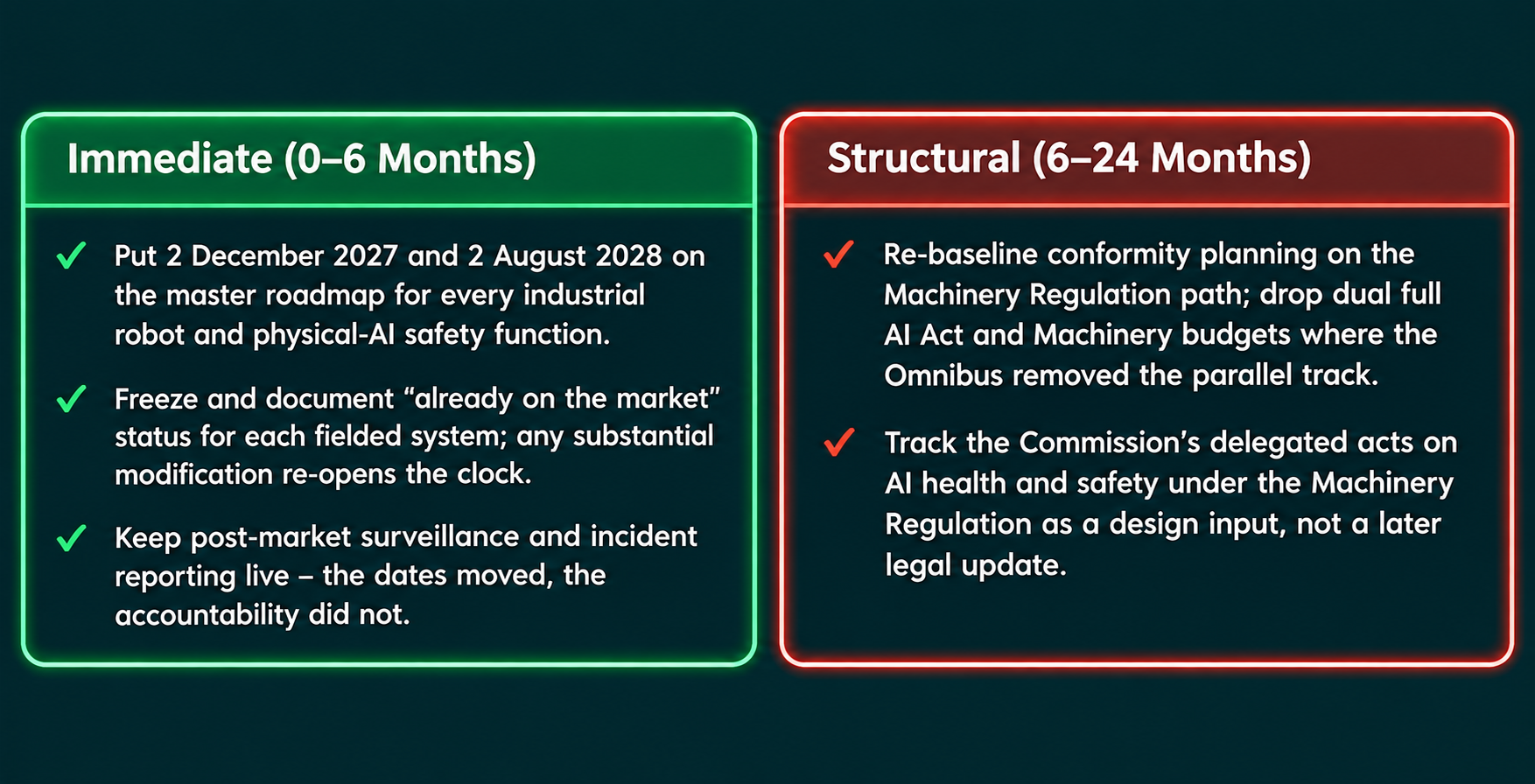
Checklist
Final Thought
The calendar you inherited was written for a regime that no longer exists. Part II of this week turns from the calendar to the drawing board: once AI sits inside the safety architecture, compliance shapes sensors, logs and update processes from the first review.
Efficiency Before Energy means not paying twice for a compliance track the Omnibus removed.
Systems don't fail. Decisions do.
Take the Next Step
Subscribe to the Weekly Punch for weekly strategic clarity, direct to your inbox.
References
European Parliament and Council of the European Union (2026) Regulation (EU) 2026/1744 of 8 July 2026 (Digital Omnibus on AI), amending, among others, Regulation (EU) 2024/1689 and Regulation (EU) 2023/1230. Official Journal of the European Union, L series, 24 July 2026; in force 27 July 2026. [Article-level wording checked against a reproduction of the Official Journal text; confirm against EUR-Lex before publication.]
European Parliament and Council of the European Union (2024) Regulation (EU) 2024/1689 laying down harmonised rules on artificial intelligence (Artificial Intelligence Act). Official Journal of the European Union, L, 12 July 2024.
European Parliament and Council of the European Union (2023) Regulation (EU) 2023/1230 on machinery and repealing Directive 2006/42/EC and Council Directive 73/361/EEC. Official Journal of the European Union, L 165, 29 June 2023. Applies from 20 January 2027.
European Parliament and Council of the European Union (2024) Directive (EU) 2024/2853 on liability for defective products and repealing Council Directive 85/374/EEC. Official Journal of the European Union, L, 18 November 2024. Transposition deadline: 9 December 2026.
European Parliament and Council of the European Union (2024) Regulation (EU) 2024/2847 on horizontal cybersecurity requirements for products with digital elements (Cyber Resilience Act). Official Journal of the European Union, L, 20 November 2024.
Disclaimer: This article summarizes EU legislation as amended by Regulation (EU) 2026/1744 and is not legal advice. Dates and article references should be checked against the Official Journal before readers rely on them for compliance, investment or product decisions; the content of the delegated acts is not yet adopted. Verification Gate: flagged for pre-publication source check.
Ownership as Design.
Note: This article reflects my personalviews based on industry experience and publicly available information. It does not constitute professional, legal, or investment advice and does not represent the views of my employer. AI-generated visuals, concept and content by the author.
