AI Governance: The Missing Layer in Industrial Digital Transformation
INDUSTRIAL | AI | GOVERNANCE | JULY 2026
ENERGY DOMINANCE · WEEK 29 · PART I
Why Technology Alone Is Not Enough.
The Critical Governance Layer That Separates Successful Industrial AI Deployments from Costly Failures and Regulatory Risk
This is Part I of Week 29, shifting from the technical possibilities of Physical and Agentic AI to the often overlooked but decisive governance layer required for safe, scalable and compliant industrial deployment.
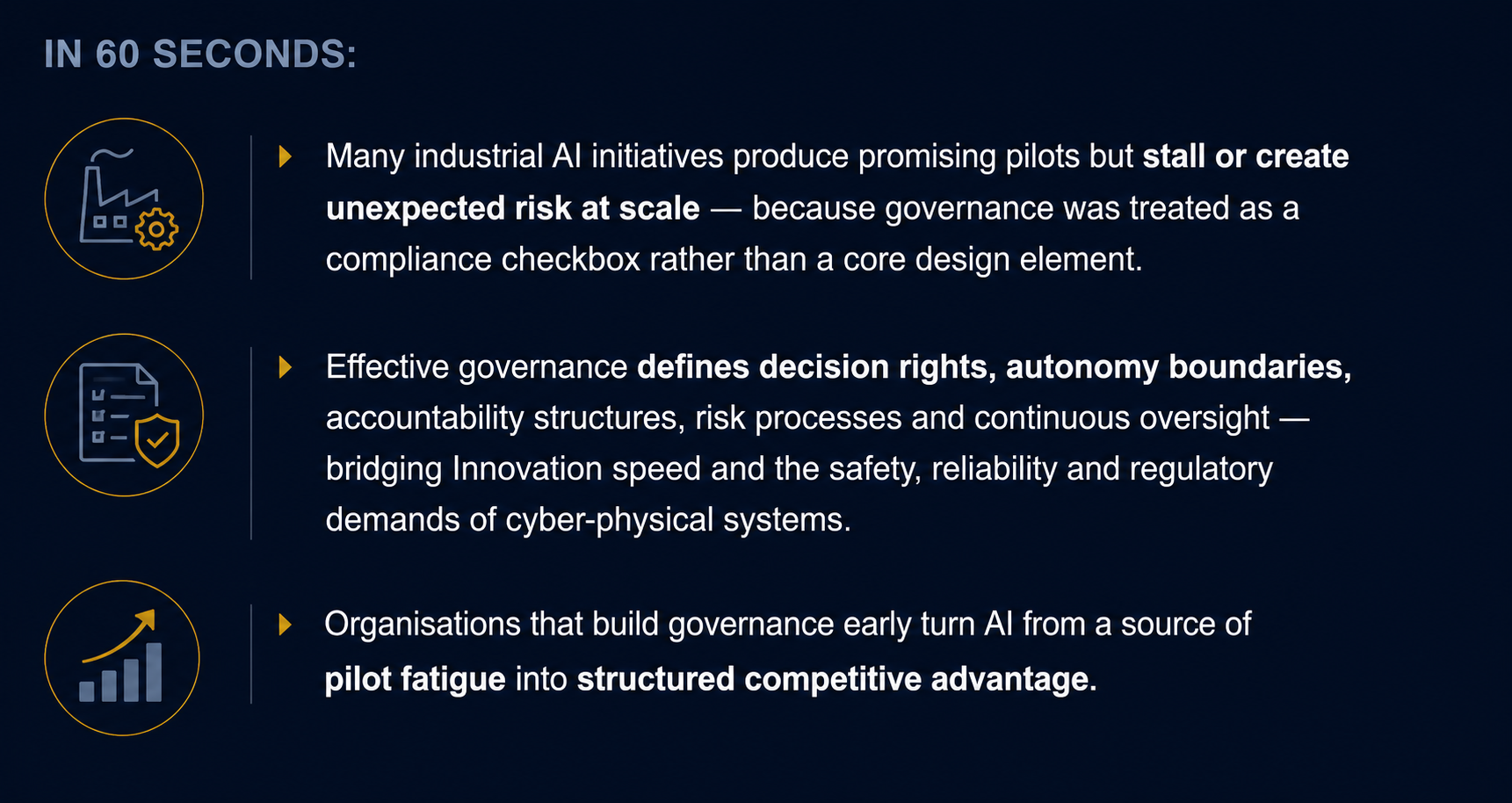
Almost every manufacturer can point to a successful AI pilot. Far fewer can point to an AI system running at scale in production. The gap between those two sentences is rarely technical. It is the layer nobody put on the architecture diagram: who decides what, within which limits, and who answers when it goes wrong.
The thread of this series, “Efficiency Before Fuel” has rarely applied more directly. The instinct is to add capability: better models, more agents, more autonomy. But capability without a governance layer does not scale, it accumulates unowned risk until something forces a halt. The structure comes first. Build it, and the same technology that stalled at pilot stage starts compounding.
Executive Summary
1. Why Governance Is the Missing Layer in Most Industrial AI Transformations
The hook: Governance is the only part of the stack that gets written after the system is already running, which is precisely the wrong order.
The mechanism: Technical capability for Physical and Agentic AI has advanced quickly. Governance has not. Most organisations still treat it as an afterthought, policies written post-deployment, or scoped narrowly to data privacy and IT security. In industrial environments that creates dangerous blind spots: unclear responsibility when an agent decides wrongly, missing escalation paths, inadequate auditability, and weak alignment between AI behaviour and operational safety standards.
The evidence: The result splits into two failure modes, and both are expensive. Excessive caution that prevents scaling at all ,or uncontrolled deployment that exposes the company to operational, financial and regulatory risk.
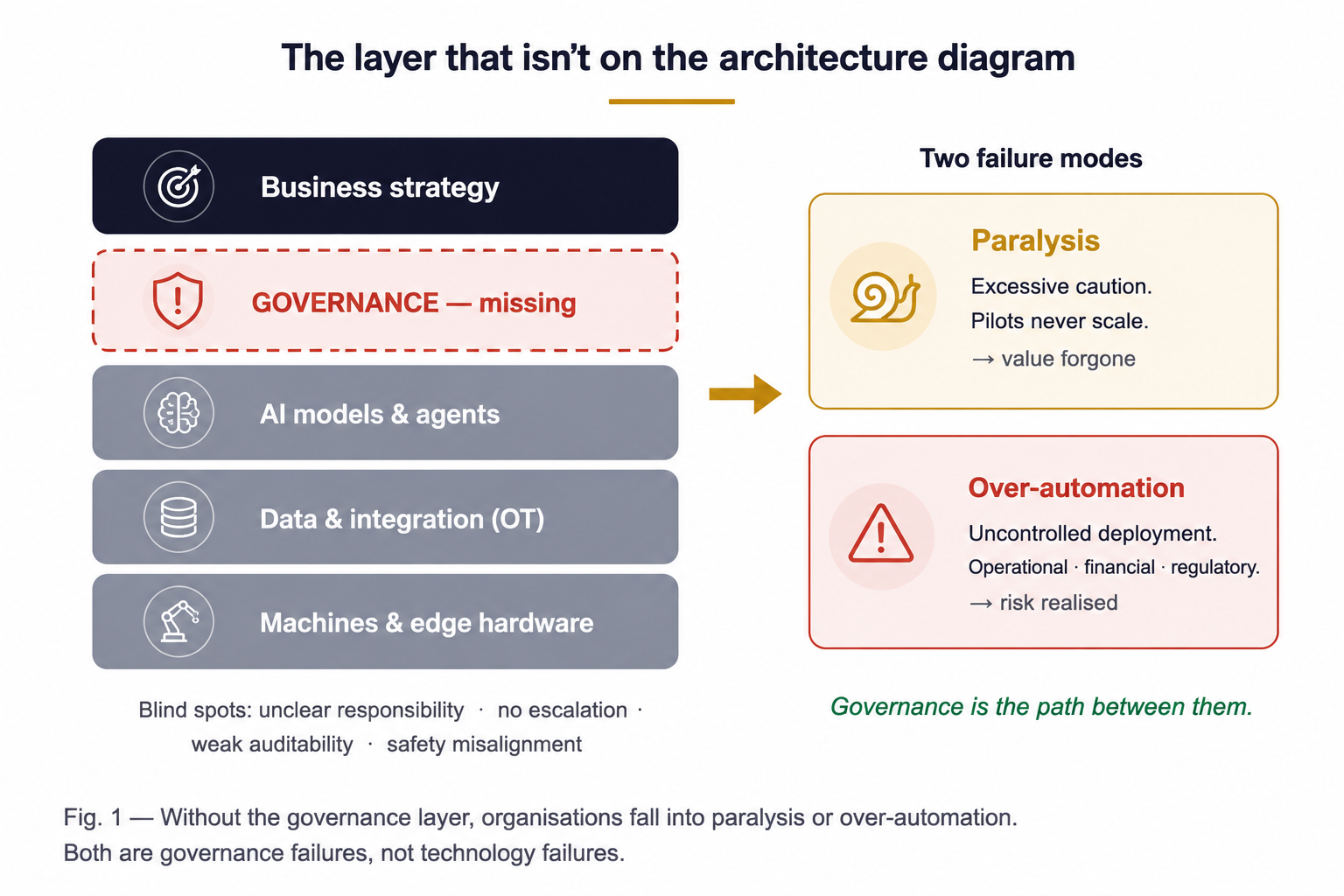
👉 Key Insight: Governance is not a brake on innovation — it is the accelerator that allows safe, responsible scaling of industrial AI.
2. What Effective Industrial AI Governance Actually Looks Like
The hook: Real governance is not a document. It is a set of decisions made before deployment — and a structure that keeps making them afterwards.
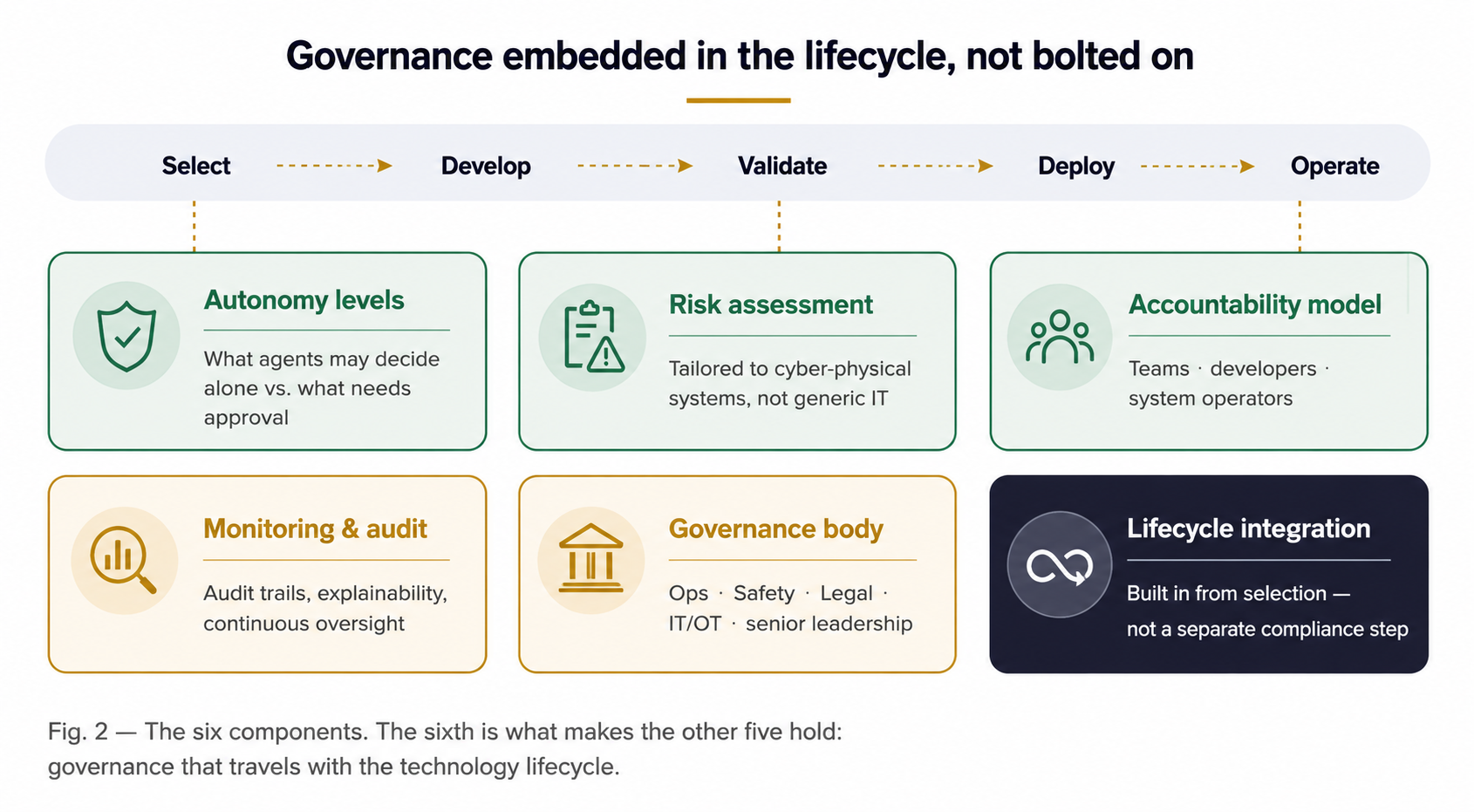
The mechanism: Strong frameworks in manufacturing typically include six components:
Autonomy levels & decision domains: what agents may decide autonomously, what requires human approval.
Risk assessment & mitigation: structured processes tailored specifically to cyber-physical systems.
Accountability models: responsibility assigned across human teams, AI developers and system operators.
Monitoring, audit trails & explainability: continuous, not periodic; a requirement, not a feature request.
Cross-functional governance bodies: Operations, Safety, Legal, IT/OT and senior leadership at the same table.
Lifecycle integration: governance built into development and deployment, not bolted on as a separate compliance step.
The evidence: The distinguishing feature of the frameworks that hold under pressure is that last point. Governance treated as a parallel compliance track always lags the technology; governance embedded in the lifecycle moves with it.
👉 Key Insight: Good governance makes AI systems more predictable, auditable and trustworthy, qualities that are non-negotiable in safety-critical industrial settings.
3. Quantified and Practical Impact
The hook: Governance is usually filed under cost. On the evidence, it behaves far more like leverage.
The mechanism: Organisations with mature AI governance report higher success rates moving pilots into production, lower incident rates, and better regulatory preparedness. Projects without structured governance frequently face delays, rework, or outright cancellation once unexpected behaviours surface in production, precisely when the cost of change is highest.
The evidence: European manufacturers hold a specific advantage here. Integrating AI governance with existing functional-safety and compliance frameworks turns a regulatory obligation into a differentiator, the discipline already exists; it needs extending, not inventing.
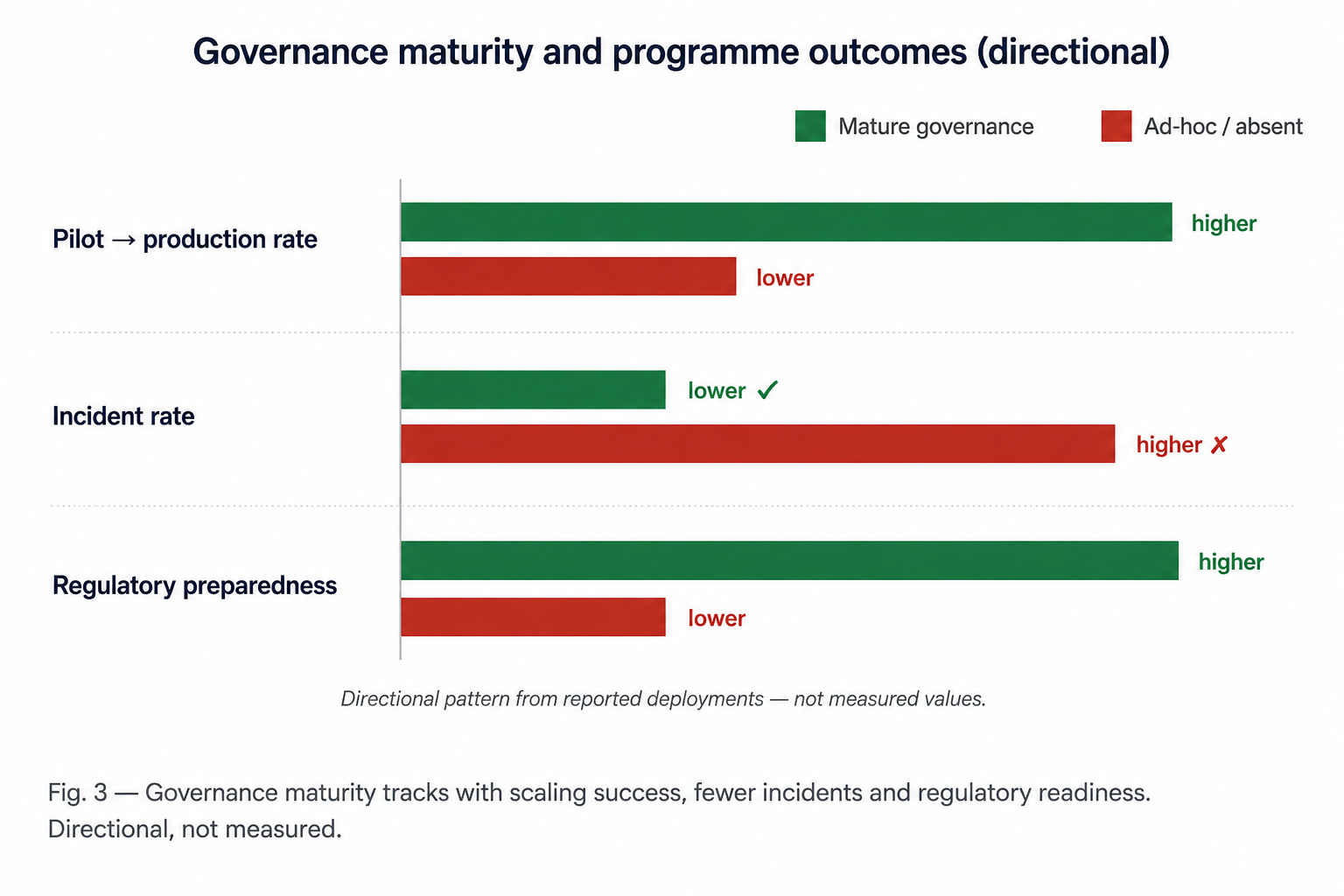
👉 Key Insight: Governance is one of the highest-leverage investments in any industrial AI program — it directly influences speed of scaling, risk exposure and long-term value capture.
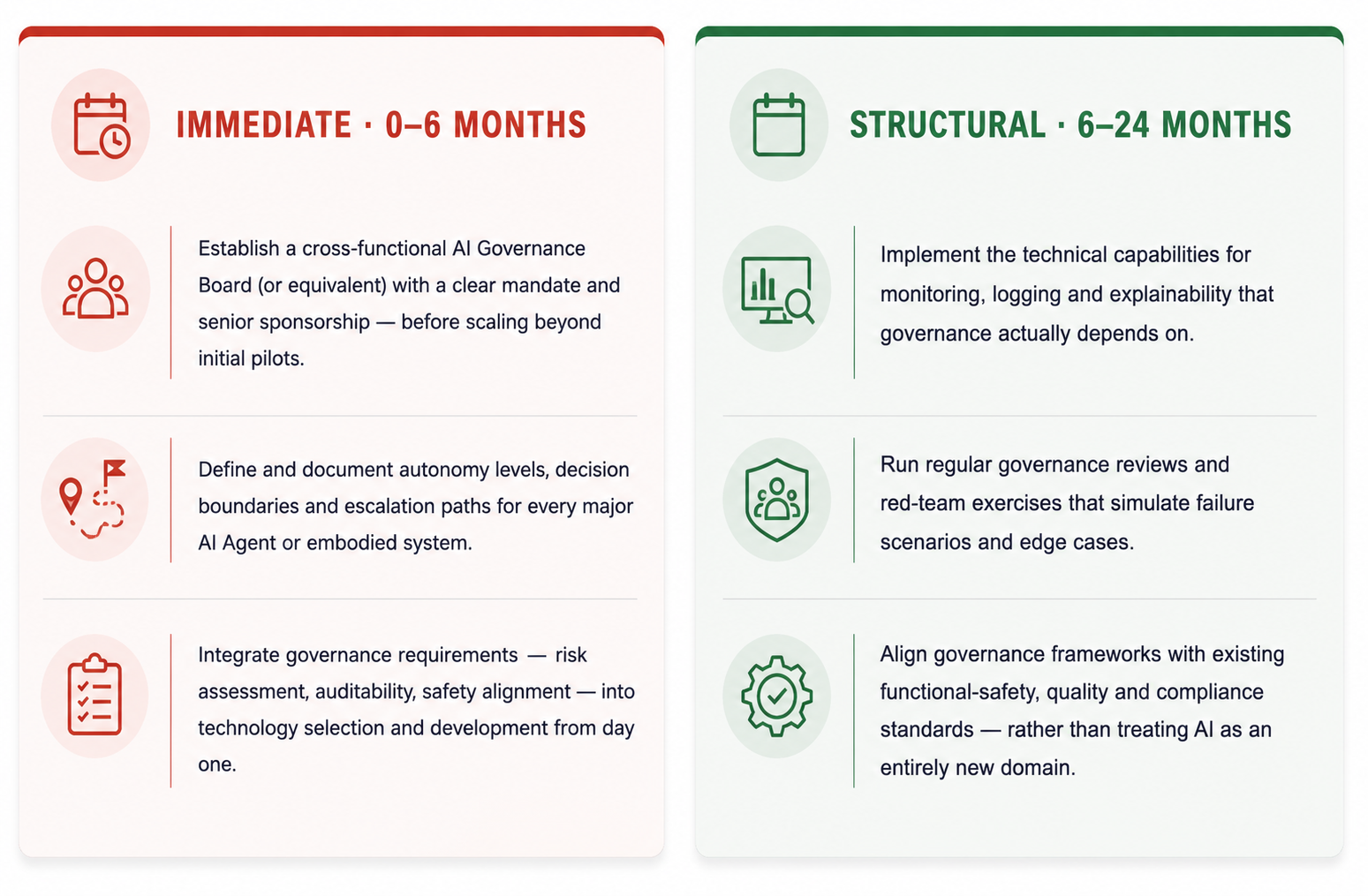
Action Plan for Decision Makers
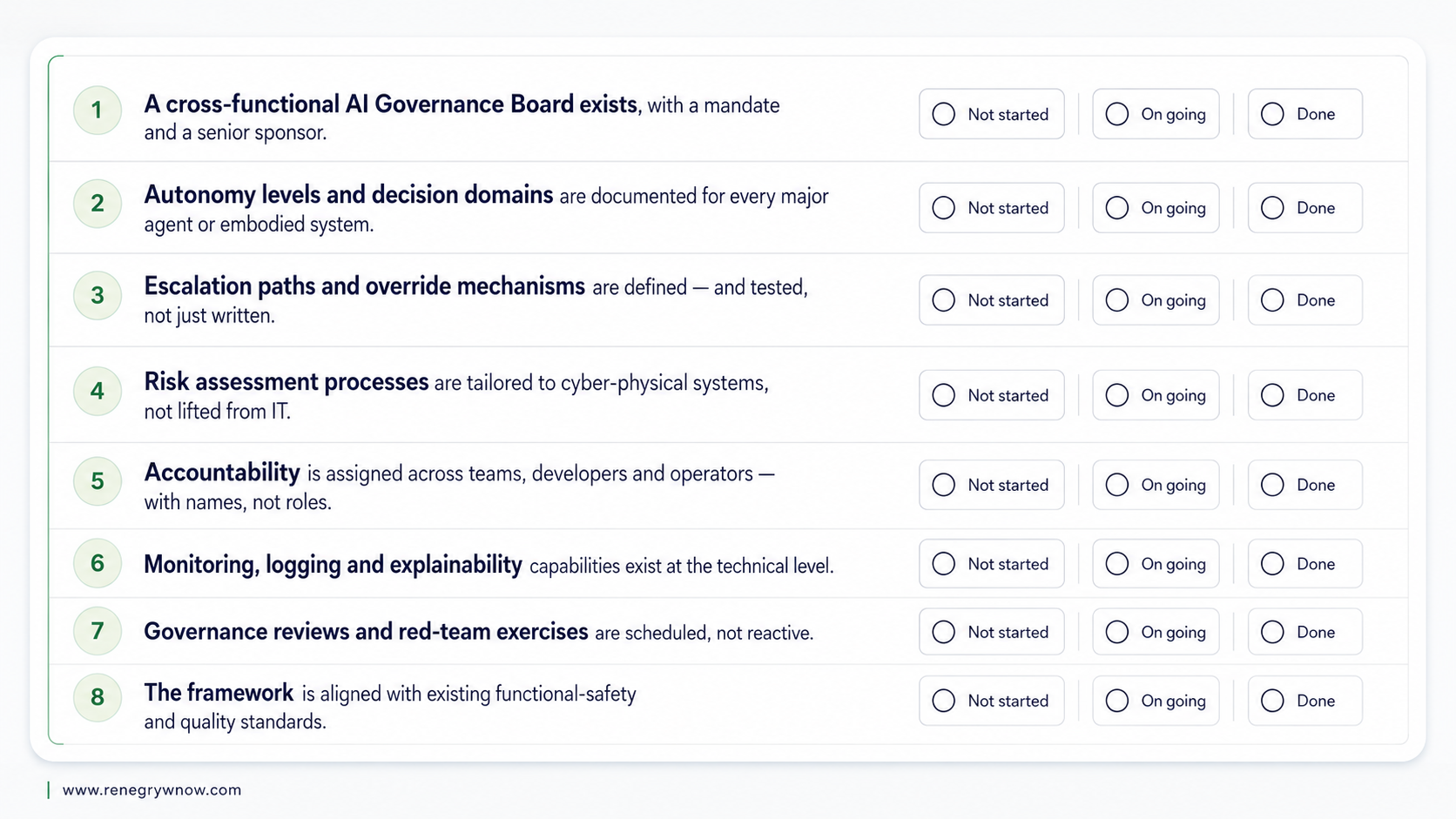
Readiness Checklist
Final Thought
Every manufacturer that has run an AI pilot already owns the technology. What separates the ones scaling from the ones stuck is invisible on any architecture diagram: the layer that decides who decides. Part II turns to the regulatory face of the same problem, why GDPR and today's rules, however necessary, are not sufficient once AI starts making decisions in the physical world.
The reflex is to see governance as the thing that slows you down. In industrial AI, it is the only thing that lets you go fast without eventually being stopped. Efficiency before fuel: the structure first, and the capability compounds on top of it.
Systems don't fail. Decisions do.
Is your governance layer real, or is it a document?
First: Take one AI system already running in your plant and try to answer three questions in under a minute: what may it decide alone, who approves the rest, and who is accountable if it errs. If you can't, your governance layer is missing.
Then: Read Part II of Week 29, where we examine why data-protection rules like GDPR, necessary as they are, fall short the moment AI acts physically. Share this with the colleague who thinks governance is what Legal does after go-live.
Take the Next Step
Subscribe to the Weekly Punch for weekly strategic clarity, direct to your inbox.
References
Capgemini Research Institute (2026) Physical AI Report. Capgemini.
Siemens (2026) Industry governance discussions around the Industrial AI Operating System.
Gartner (2026) AI governance in manufacturing. Gartner Research.
Deloitte (2026) AI governance in manufacturing. Deloitte Insights.
Case studies and lessons from scaled industrial AI deployments (2026).
Disclaimer: All performance ranges, comparisons and indices are indicative and based on published third-party analyses; they do not constitute investment, financial, legal or management advice. Readers are encouraged to conduct their own verification before making governance, operational or capital-allocation decisions. The author maintains no commercial relationship with the organisations named.
© 2026 René Grywnow · Energy Dominance Series · Week 29 · Part I | Ownership as Design.
Note: This article reflects my personalviews based on industry experience and publicly available information. It does not constitute professional, legal, or investment advice and does not represent the views of my employer. AI-generated visuals, concept and content by the author.
